Questions from Presentations and New Jim Crow for Midterm
 Call Kai
 Learn
Learn Practice Test
 Spaced Repetition
 Match
Match Flashcards
 Knowt Play
1/28

There's no tags or description
Looks like no tags are added yet.
Name | Mastery | Learn | Test | Matching | Spaced | Call with Kai |
|---|
No analytics yet
Send a link to your students to track their progress
29 Terms
What are specialized Miller hearings used for?
✅ Mandatory legal proceeding to determine if a juvenile can receive life in prison (LWOP).
Options:
A) To determine if a juvenile can be tried as an adult ❌
✅ B) Mandatory legal proceeding to determine if a juvenile can receive life in prison ✅
C) How courts determine if someone can use an insanity plea ❌
D) They do not exist ❌
Why: After Miller v. Alabama (2012), mandatory juvenile LWOP is unconstitutional, so courts must hold a hearing to consider youth-specific factors before imposing LWOP.
Specialized Miller hearings are conducted to assess whether a juvenile should receive life without parole (LWOP), taking into account youth-specific factors as mandated by Miller v. Alabama (2012).
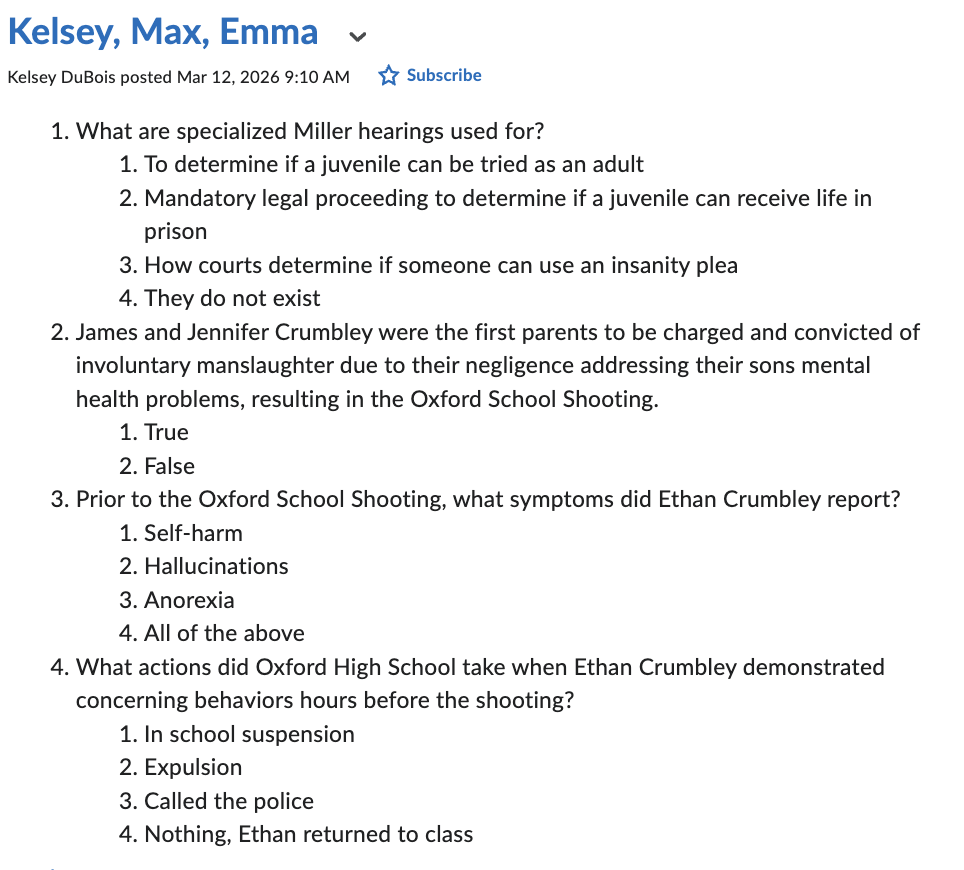
James and Jennifer Crumbley were the first parents to be charged and convicted of involuntary manslaughter due to negligence, resulting in the Oxford School Shooting. (True/False)
✅ True.
Options: True ✅ / False ❌
Why: They were widely reported as the first parents convicted in a U.S. mass school shooting context for involuntary manslaughter tied to negligence (gun access + ignoring warning signs).
The statement is accurate; they were charged and convicted as a consequence of their negligence in the school shooting incident.
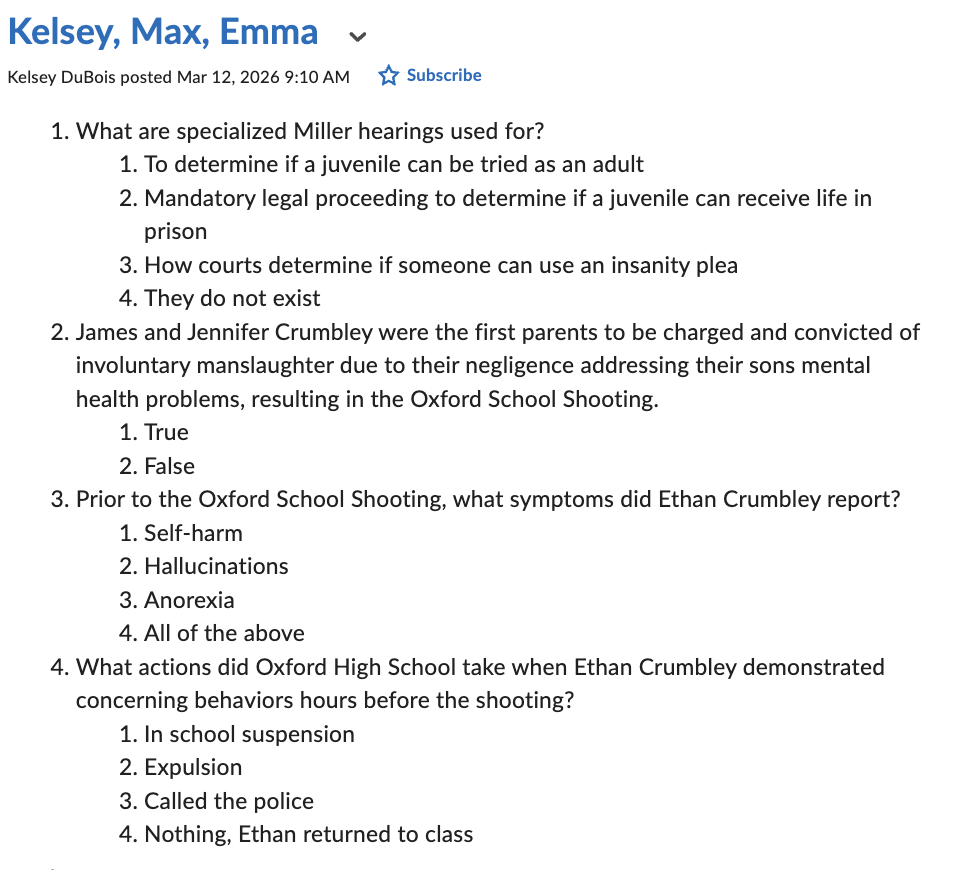
Prior to the Oxford School Shooting, what symptoms did Ethan Crumbley report?
✅ Hallucinations.
Options:
A) Self-harm ❓ (not clearly supported in the provided options set)
✅ B) Hallucinations ✅
C) Anorexia ❌
D) All of the above ❌
Why: Evidence from the case includes reports/texts about seeing “demons/ghosts” (hallucination-like experiences). The slide/options mention self-harm and anorexia, but the strongest documented item here is hallucinations.
✅ Hallucinations were reported symptoms by Ethan Crumbley before the shooting, including seeing 'demons/ghosts'.
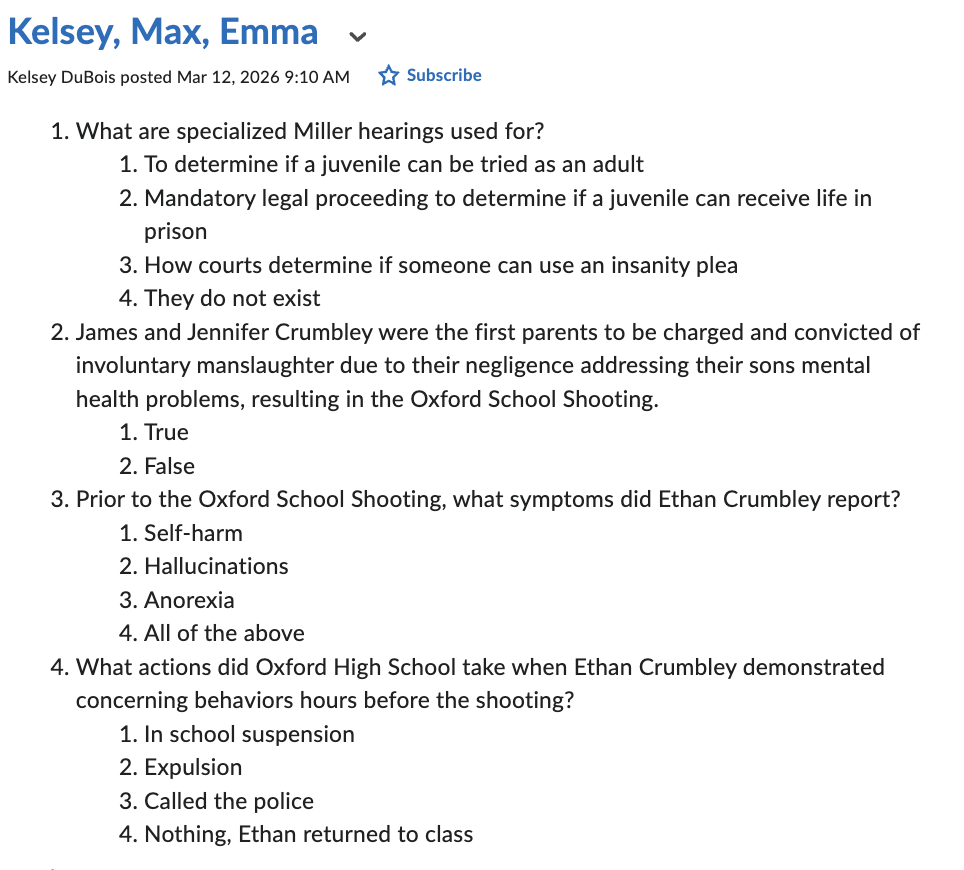
What actions did Oxford High School take when Ethan Crumbley demonstrated concerning behaviors hours before the shooting?
✅ Nothing, Ethan returned to class.
Options:
A) In-school suspension ❌
B) Expulsion ❌
C) Called the police ❌
✅ D) Nothing, Ethan returned to class ✅
Why: Reporting indicates he was allowed to return to class after meetings; concerns were not escalated to police as a disciplinary removal.
Oxford High School took no action, allowing him to return to class despite concerning behaviors.
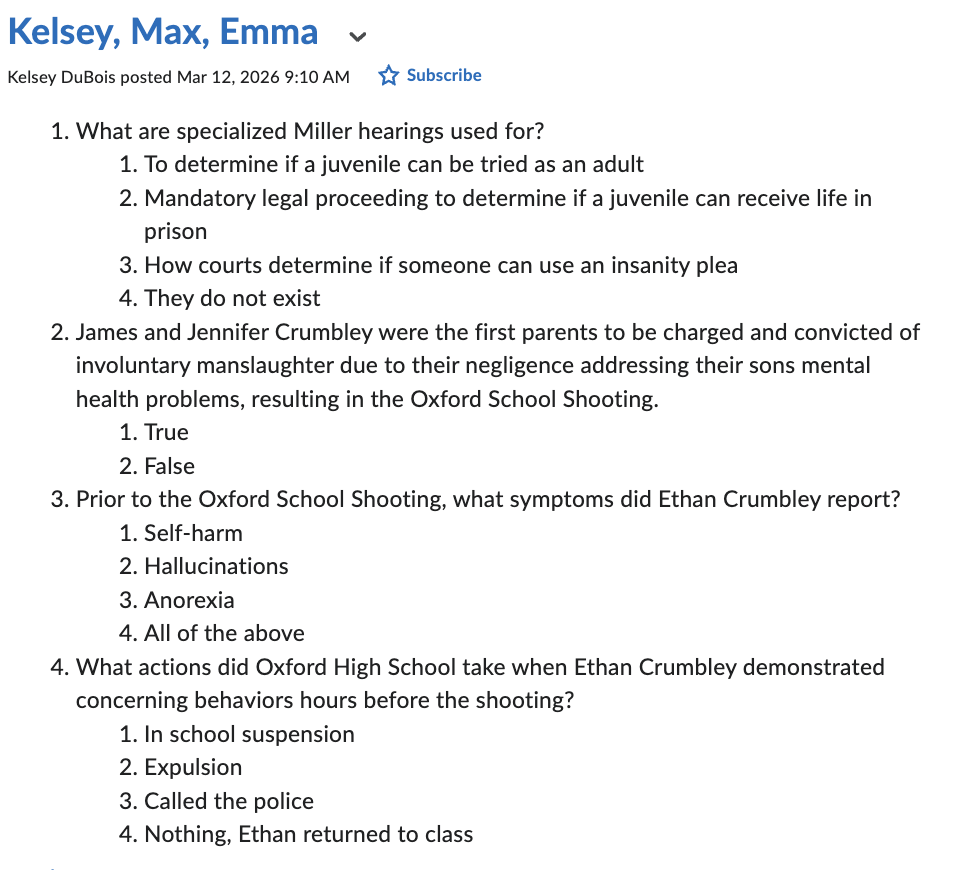
What is it called when a healthy person develops a psychotic disorder by being around a psychotic person?
✅ None of the above — it’s called Shared Psychotic Disorder (Folie à deux).
Options:
A) DSM V ❌
B) Multiple Personality Disorder ❌
C) Schizophrenia ❌
Why: The phenomenon is shared psychotic disorder (folie à deux)—a rare condition where delusions spread in a close relationship.
Shared Psychotic Disorder (Folie à deux) is a rare condition where a healthy individual develops a psychotic disorder due to being in close association with someone who has a psychotic disorder. This occurs when delusions or hallucinations are shared between the two individuals.
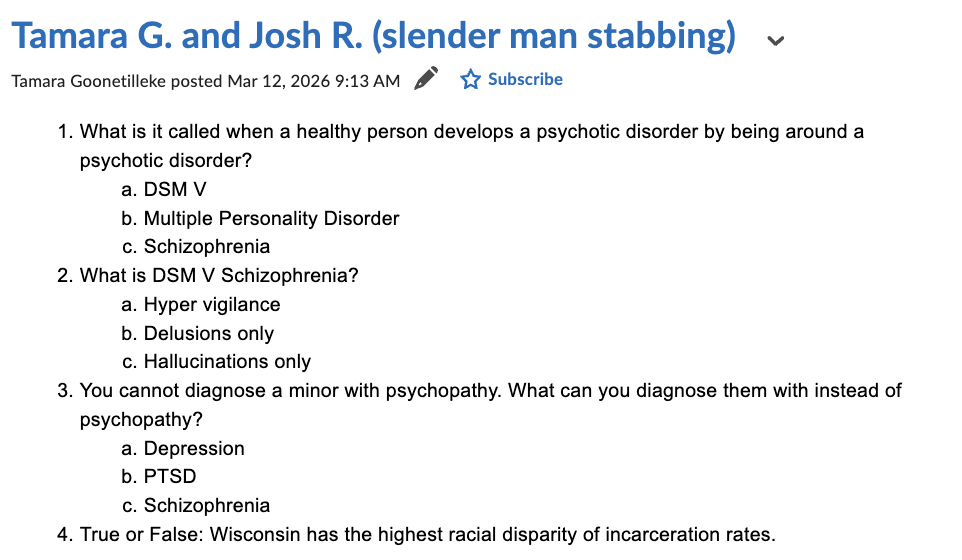
What is DSM V Schizophrenia?
✅ None of these options are correct.
Options:
A) Hypervigilance ❌
B) Delusions only ❌
C) Hallucinations only ❌
Why: Schizophrenia is not “delusions only” or “hallucinations only.” Diagnosis requires a broader symptom pattern (e.g., delusions, hallucinations, disorganized speech, etc.). (Your options don’t include a correct definition.)
Schizophrenia is a complex mental disorder characterized by a range of symptoms including delusions, hallucinations, disorganized thinking, and impaired functioning.
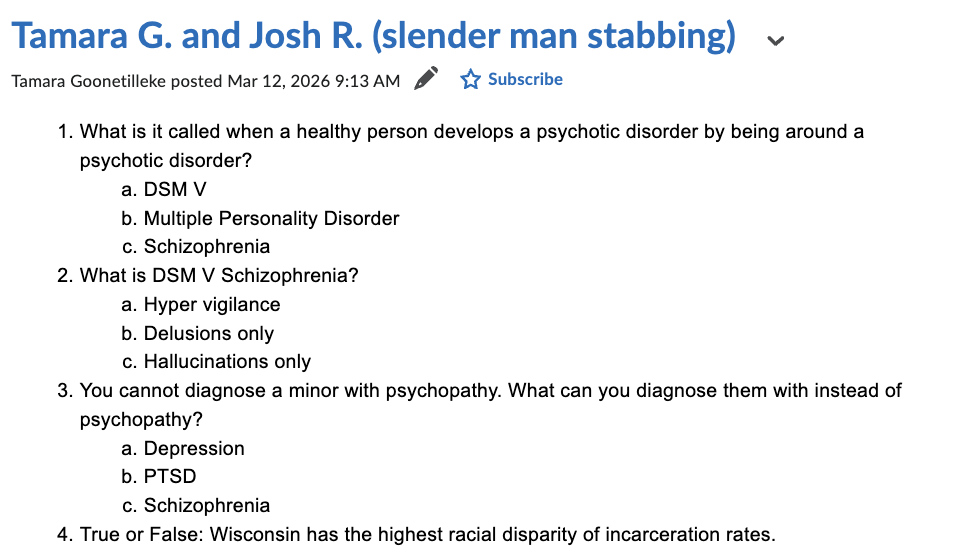
You cannot diagnose a minor with psychopathy. What can you diagnose them with instead of psychopathy?
✅ None of the above — Conduct Disorder (often with CU traits specifier).
Options:
A) Depression ❌
B) PTSD ❌
C) Schizophrenia ❌
Why: In juvenile-forensic contexts, the closest clinical diagnosis is Conduct Disorder, sometimes noting callous-unemotional traits (DSM-5 specifier). (Your options omit the correct one.)
Conduct Disorder with CU traits.
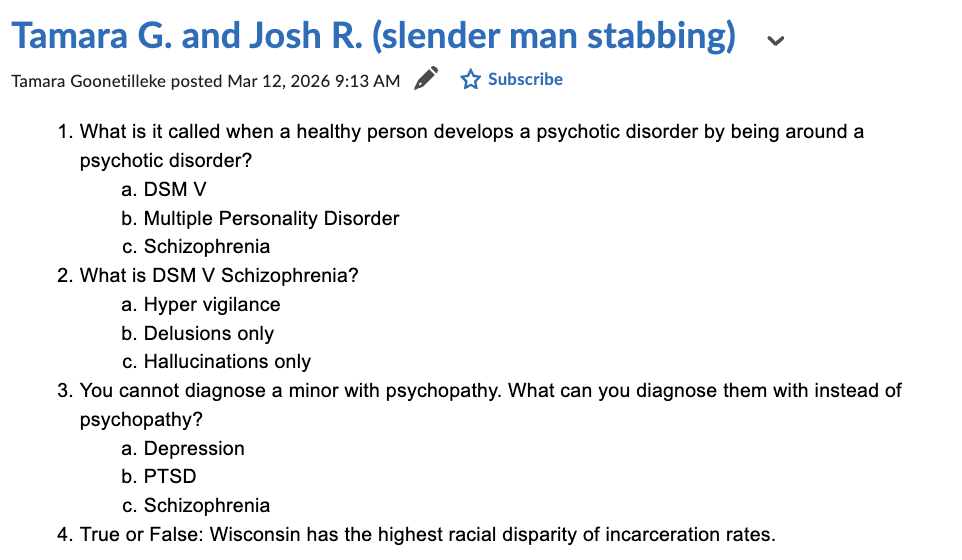
True or False: Wisconsin has the highest racial disparity of incarceration rates.
✅ True (commonly cited as among the highest; often #1 for Black incarceration rate/disparity).
Options: True ✅ / False ❌
Why: Reports have identified Wisconsin as having extremely high Black incarceration rates and major Black/White disparities.
True, often ranked highest in Black incarceration disparity.
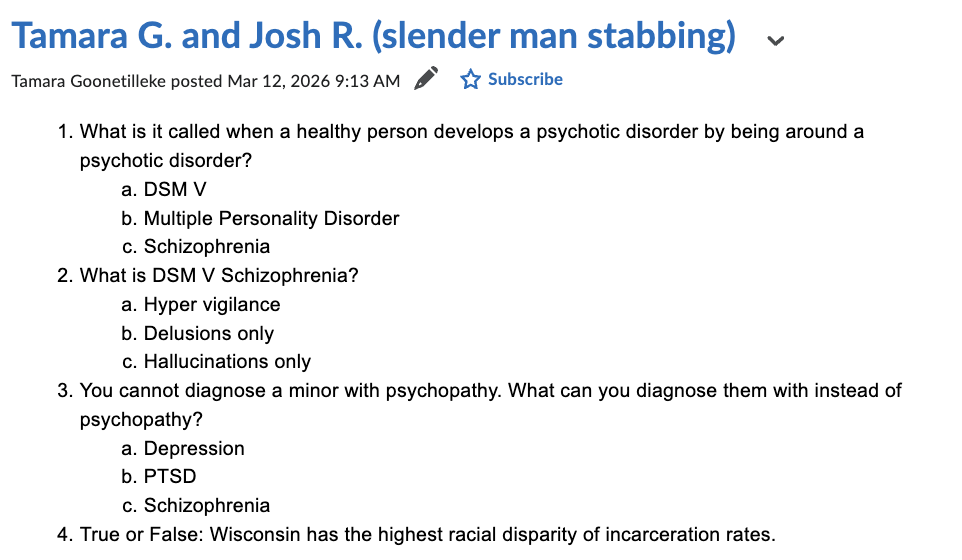
What is Kalief’s Law primarily designed to do?
✅ Limit the length of time prosecutors can delay before being ready for trial.
Options:
A) Require bail waivers for juvenile felony charges ❌
B) Prevent usage of prison camera footage in court ❌
✅ C) Limit how long prosecutors can delay readiness for trial ✅
D) Ensure proper prescribed medication is given ❌
Why: It targets a loophole in NY “speedy trial” practice that allowed long delays even when people were jailed pretrial.
Kalief's Law is primarily designed to limit the prolongation of pretrial detention by setting strict timeframes for prosecutors to declare readiness for trial, addressing delays that disproportionately affect those incarcerated before their trial.
Why did Kalief Browder lose the opportunity to post bail?
✅ His family could not afford bail.
Options:
A) Remanded due to probation and bail removed ❌
✅ B) His family could not afford bail ✅
C) Public defender waived bail ❌
D) Evidence he would skip court ❌
Why: Bail was set at $3,000 and his family couldn’t pay.
Kalief Browder was unable to post bail because his family did not have the financial means to pay the set amount of $3,000.
Kalief Browder’s case (backpack/assault charges) was dropped because of what reason?
✅ Closest option: “The witness fled / prosecution had no evidence.”
Options:
A) Case was not dropped ❌
✅ B) Witness unavailable / prosecution lacked evidence ✅ (closest match)
C) Let go after abuse by correctional officer ❌
D) Statute of limitations expired ❌
Why: The charges were dropped after years of delay due to lack of evidence / inability to proceed (often described as witness/complainant issues).
Kalief Browder's case was dropped due to the unavailability of a witness and the prosecution's inability to present sufficient evidence.
Before the incident that led to his detention at Rikers Island, Kalief Browder had previously been arrested. What was the accusation?
✅ Joyriding a bakery delivery truck and crashing it.
Options:
A) Vandalizing public property ❌
B) Shoplifting snacks ❌
✅ C) Joyriding a bakery delivery truck and crashing it ✅
D) Stealing electronics ❌
Why: Reported as an earlier incident involving a delivery truck.
The accusation against Kalief Browder was that he was arrested for joyriding in a bakery delivery truck and subsequently crashed it.
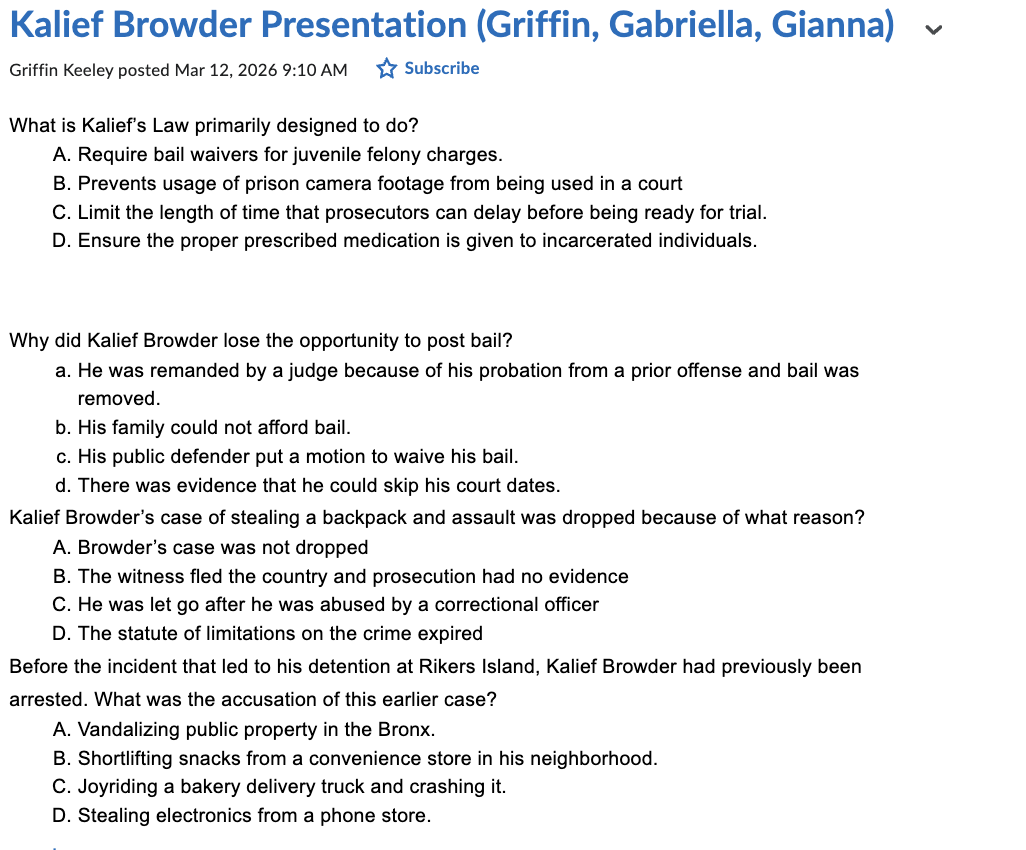
What is the name of the law that disproportionately disadvantages Black and Hispanic youth when it comes to punishing for drugs?
✅ Anti Drug Abuse Act.
Options:
A) 14th Amendment ❌
✅ B) Anti Drug Abuse Act ✅
C) Anti Substance Abuse Act ❌
D) Raise the Age Legislation ❌
Why: The 1986 Anti-Drug Abuse Act created harsh mandatory minimums and disparities (famously crack vs powder cocaine).
The law that imposes harsh penalties on drug offenders, disproportionately affecting Black and Hispanic youth.
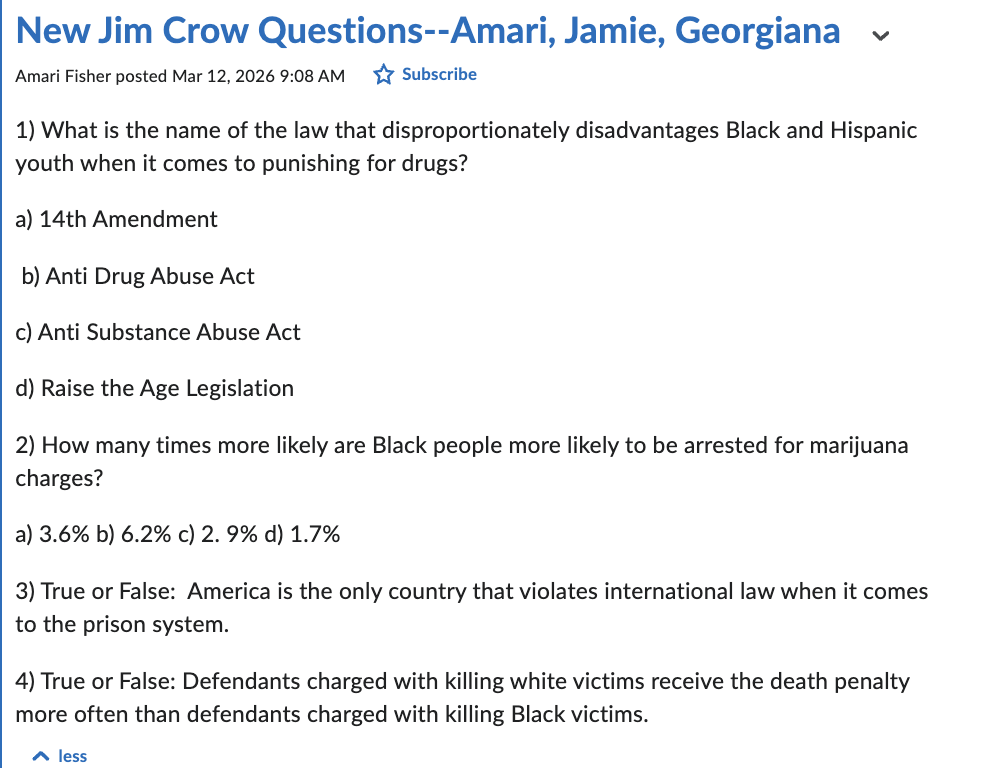
How many times more likely are Black people to be arrested for marijuana charges?
✅ 3.6 (closest to the research).
Options:
✅ A) 3.6 ✅
B) 6.2 ❌
C) 2.9 ❌
D) 1.7 ❌
Why: ACLU reports around 3.64–3.73x nationally; 3.6 is the best match here.
Black people are 3.6 times more likely than white people to be arrested for marijuana charges, according to research by the ACLU.
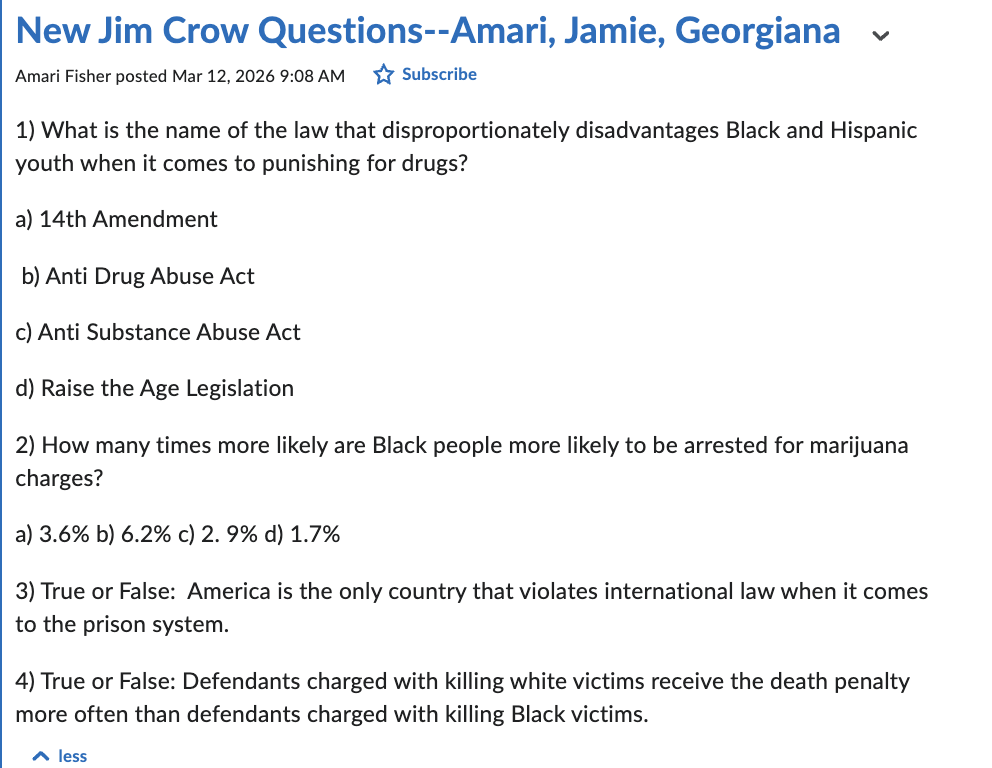
True or False: America is the only country that violates international law when it comes to the prison system.
✅ False.
Options: True ❌ / False ✅
Why: The U.S. is unusual in some sentencing practices (e.g., juvenile LWOP), but it is not accurate to say it’s the only country that violates international law regarding prisons. (Even on juvenile LWOP, the claim is “stands alone” on that practice—not “only violator of prison international law.”)
The statement is misleading; other countries also violate international law in their prison systems.
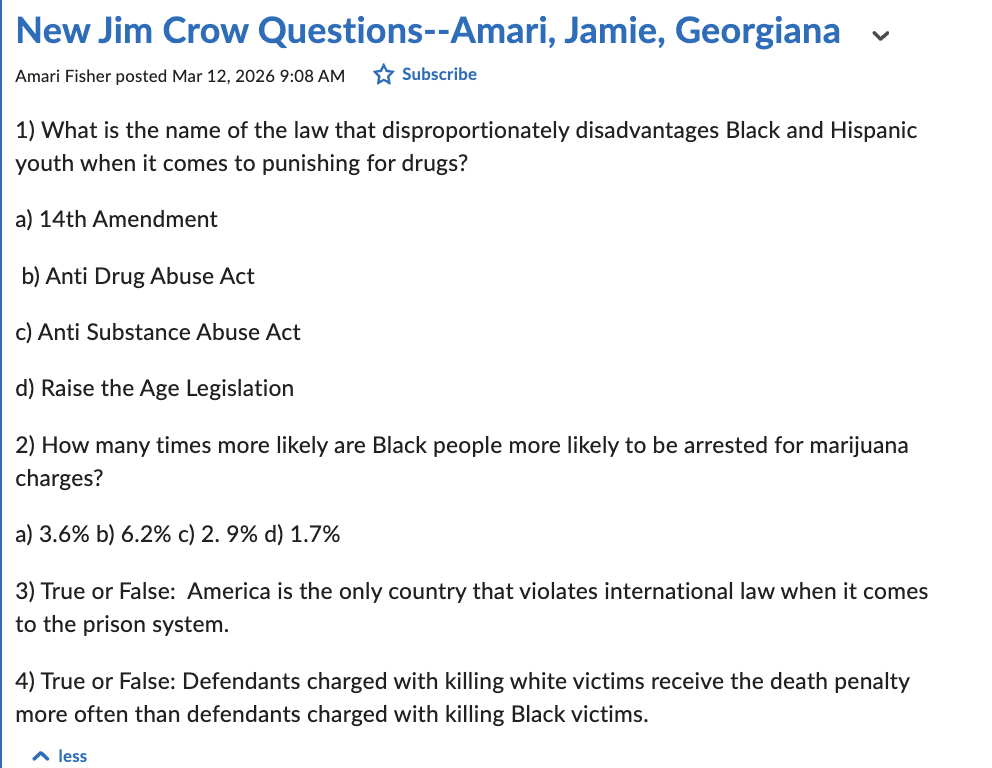
True or False: Defendants charged with killing white victims receive the death penalty more often than defendants charged with killing Black victims.
✅ True.
Options: True ✅ / False ❌
Why: Research shows a strong race-of-victim effect: cases with white victims are more likely to result in death sentences.
The statement is accurate; defendants who kill white victims tend to be sentenced to death more frequently than those who kill Black victims, indicating racial bias in sentencing.
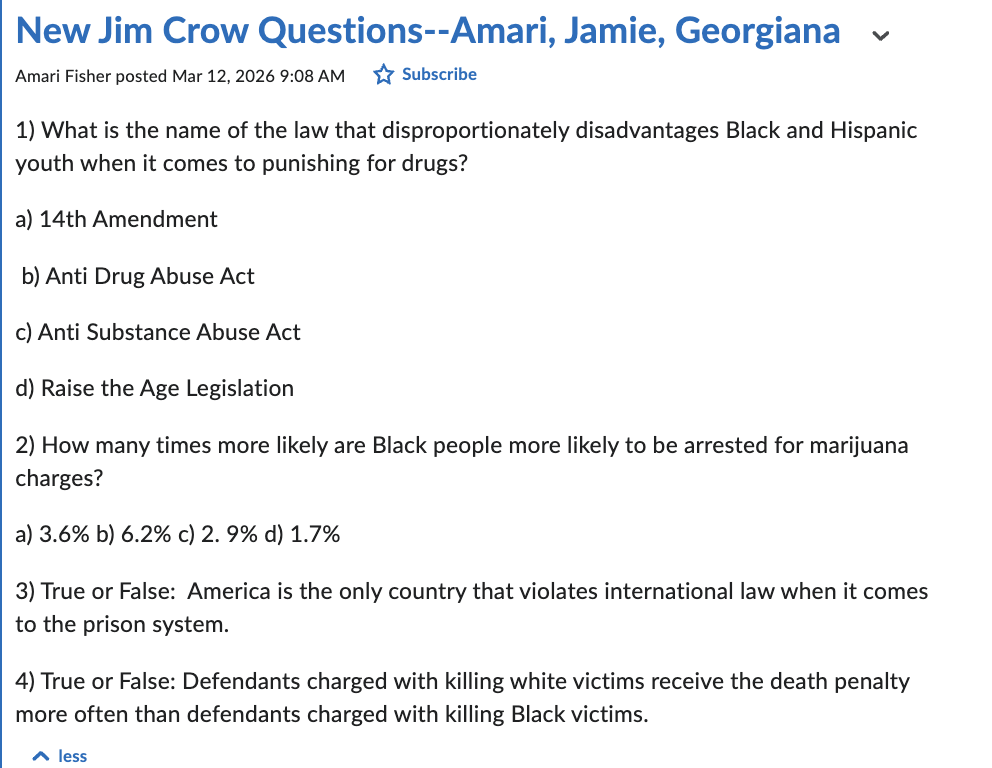
What rights can be denied if you have a felony conviction?
✅ All of the above.
Options:
A) Housing ✅
B) Employment ✅
C) Voting ✅
✅ D) All of the above ✅
Why: A felony record can legally trigger discrimination/exclusion across housing, jobs, and (in many places) voting.
A felony conviction can lead to the loss of various rights, including the right to vote, access to housing, and employment opportunities.
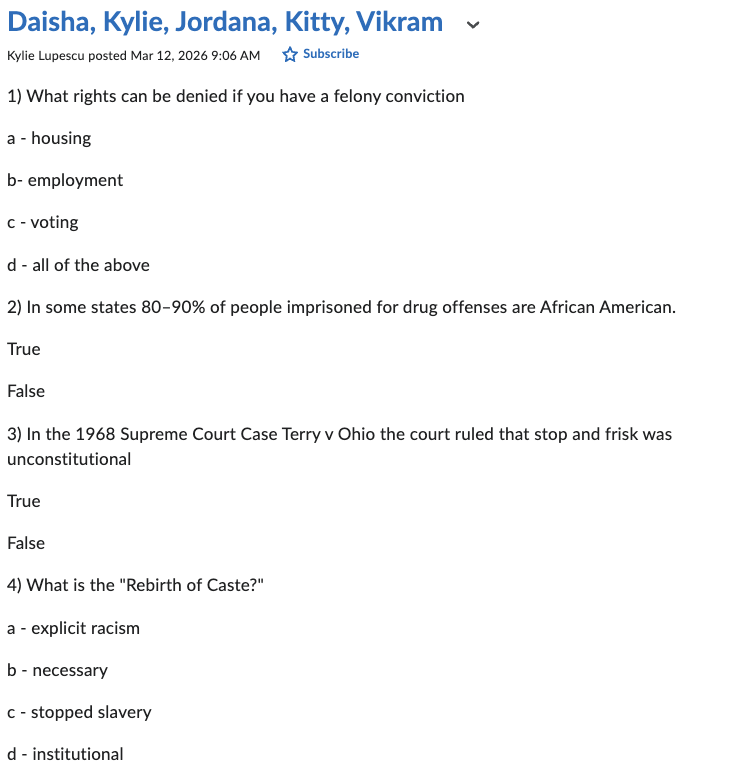
In some states 80–90% of people imprisoned for drug offenses are African American. (True/False)
✅ True (consistent with reports showing extremely high proportions in certain drug enforcement contexts).
Options: True ✅ / False ❌
Why: For example, crack sentencing historically had over 80% African American defendants, reflecting extreme racial disproportionality in drug enforcement/sentencing.
In certain states, a significant majority of those incarcerated for drug offenses are Black, highlighting systemic racial disparities in law enforcement and sentencing practices.
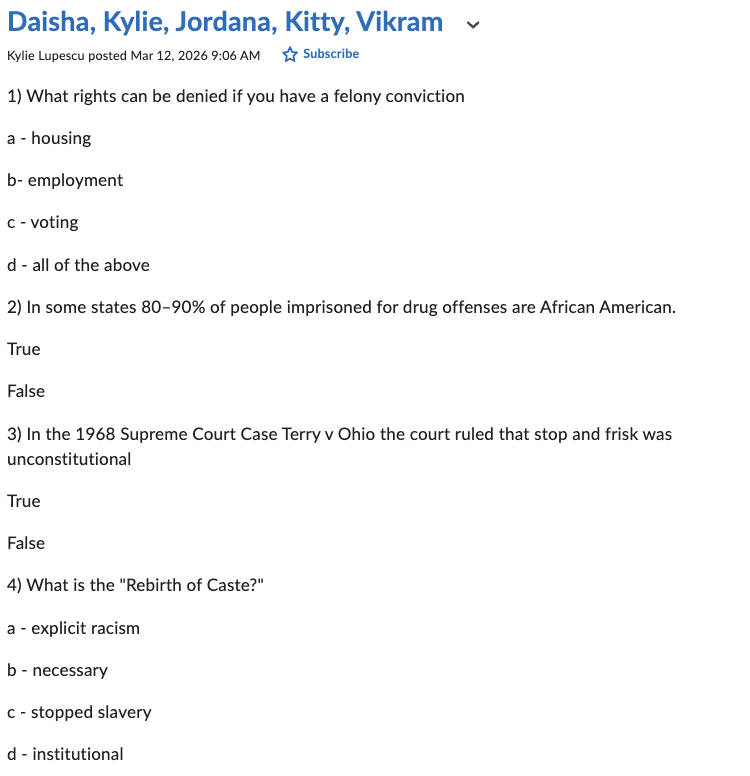
True or False: In Terry v Ohio (1968) the court ruled that stop and frisk was unconstitutional.
✅ False.
Options: True ❌ / False ✅
Why: Terry held stop-and-frisk can be constitutional with reasonable suspicion and belief the person is armed/dangerous.
The Supreme Court ruled that stop-and-frisk does not violate the Fourth Amendment if there is reasonable suspicion that a person is involved in criminal activity and may be armed.
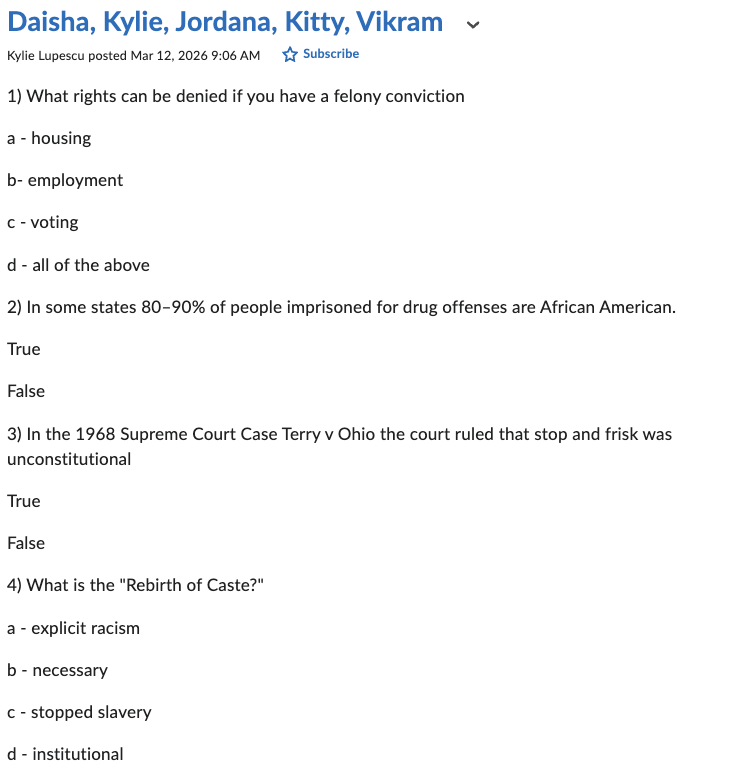
What is the "Rebirth of Caste?"
✅ Institutional.
Options:
A) Explicit racism ❌
B) Necessary ❌
C) Stopped slavery ❌
✅ D) Institutional ✅
Why: In The New Jim Crow, “rebirth of caste” refers to mass incarceration as an institutional racial caste system (structural/institutional social control).
The "Rebirth of Caste" is an institutional racial caste system that stems from mass incarceration and serves as a means of structural social control.
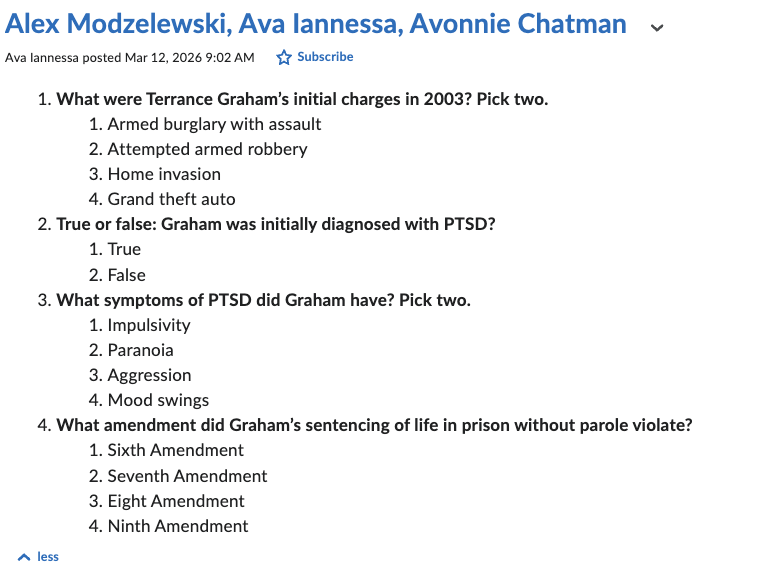
What were Terrance Graham’s initial charges in 2003? Pick two.
✅ Armed burglary with assault + ✅ Attempted armed robbery
Options:
✅ Armed burglary with assault ✅
✅ Attempted armed robbery ✅
Home invasion ❌
Grand theft auto ❌
Why: Those are the charges described in the case record.
The charges against Terrance Graham in 2003 were related to serious violent offenses that demonstrated a pattern of criminal behavior and options of attempted armed robbery and armed burglary with assault.
True or false: Graham was initially diagnosed with PTSD?
✅ False (not a core fact of the Graham case record; the case centers on sentencing).
Options: True ❌ / False ✅
Why: The major documented focus is his conviction/sentencing and the constitutional issue—not a PTSD diagnosis.
The claim that Graham was diagnosed with PTSD is inaccurate; his case revolves around matters of sentencing rather than mental health diagnoses.
What symptoms of PTSD did Graham have? Pick two.
✅ Aggression + ✅ Paranoia (best match to PTSD-related irritability/hypervigilance among your options)
Options:
Impulsivity ❌ (can occur, but less “core PTSD” than hypervigilance/irritability)
✅ Paranoia ✅ (closest to hypervigilance)
✅ Aggression ✅ (fits irritability/anger outbursts)
Mood swings ❌ (possible but less direct)
Why: PTSD commonly includes hypervigilance and irritability; with these choices, paranoia/aggression align best.
The symptoms of PTSD Graham exhibited included ✅ aggression and ✅ paranoia, which are closely related to hypervigilance and irritability, common in PTSD.
(NOT TOO SURE)
What amendment did Graham’s sentencing of life in prison without parole violate?
✅ Eighth Amendment.
Options:
Sixth ❌
Seventh ❌
✅ Eighth ✅
Ninth ❌
Why: Graham v. Florida held juvenile LWOP for nonhomicide violates the Eighth Amendment (cruel and unusual punishment).
The Eighth Amendment prohibits cruel and unusual punishment, which was a central issue in Graham's case.
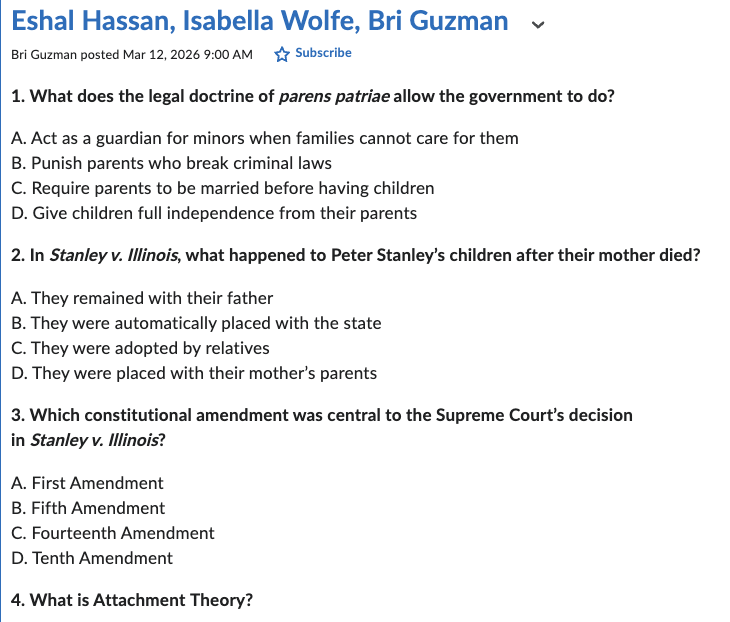
What does the legal doctrine of parens patriae allow the government to do?
✅ Act as a guardian for minors when families cannot care for them.
Options:
✅ A) Act as a guardian for minors when families cannot care for them ✅
B) Punish parents who break criminal laws ❌
C) Require parents to be married before having children ❌
D) Give children full independence from parents ❌
Why: Parens patriae = the state as “parent of the nation,” stepping in for child welfare.
The legal doctrine of parens patriae allows the government to intervene in the care of minors by acting as their guardian when families are unable or unwilling to provide proper care. It prioritizes the welfare of children in such circumstances.
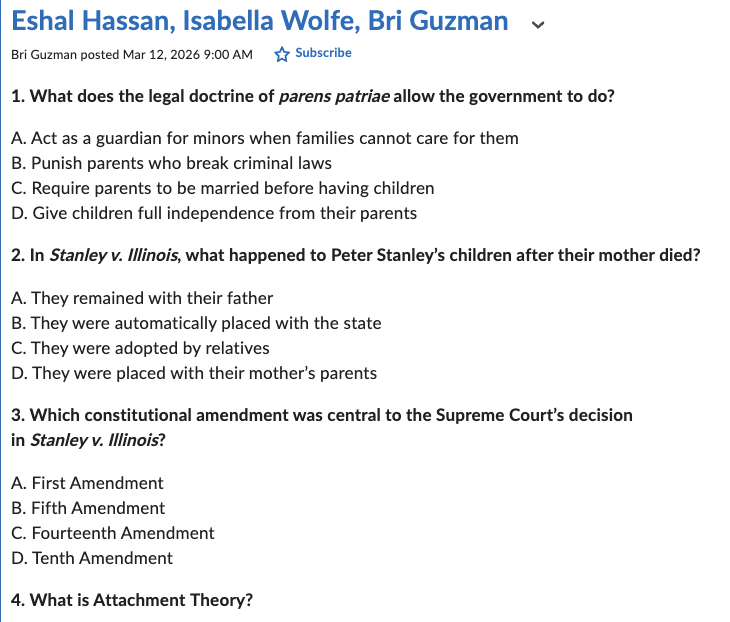
In Stanley v. Illinois, what happened to Peter Stanley’s children after their mother died?
✅ They were automatically placed with the state.
Options:
A) Remained with father ❌
✅ B) Automatically placed with the state ✅
C) Adopted by relatives ❌
D) Placed with mother’s parents ❌
Why: Under Illinois law, children of unwed fathers became wards of the state upon the mother’s death.
The court ruled that Peter Stanley's children were automatically placed into the custody of the state following their mother's death, as Illinois law dictated that offspring of an unwed father would become wards of the state.
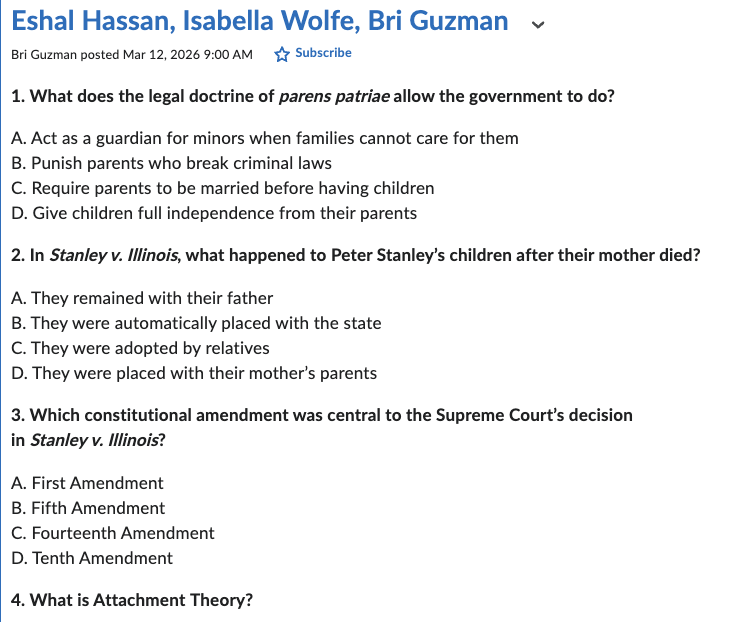
Which constitutional amendment was central to the Supreme Court’s decision in Stanley v. Illinois?
✅ Fourteenth Amendment.
Options:
First ❌
Fifth ❌
✅ Fourteenth ✅
Tenth ❌
Why: The case is grounded in due process/equal protection principles under the Fourteenth Amendment.
The Supreme Court’s decision in Stanley v. Illinois was based on the principles of due process and equal protection as guaranteed by the Fourteenth Amendment.
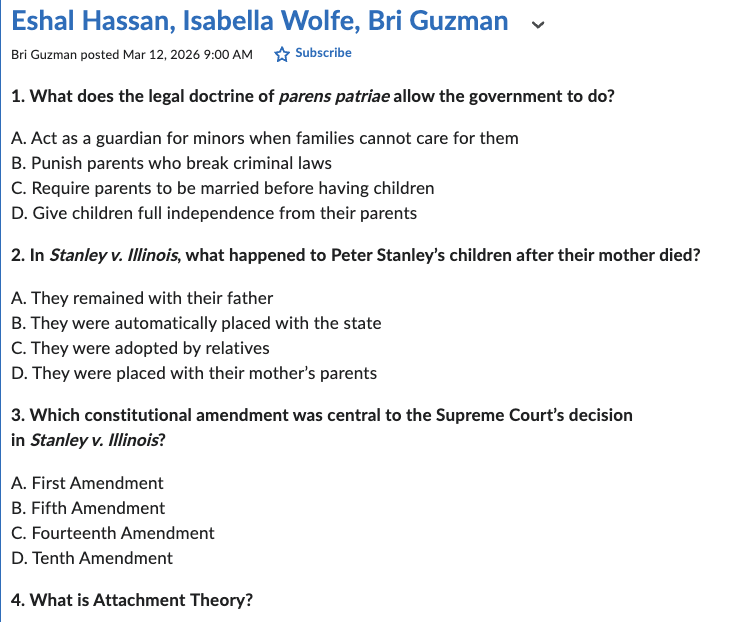
What is Attachment Theory?
✅ Attachment theory explains how early emotional bonds form between a child and caregiver, shaping security, emotion regulation, and later relationships.
Why: It’s a framework about the caregiver-child bond as foundational for development.
Attachment theory is a psychological framework that describes how early emotional bonds between a child and their caregiver influence the child's sense of security, emotional regulation, and the nature of their future relationships. It emphasizes the caretaker's role in fostering a secure attachment vital for healthy psychological development.