Chapter 1: Overview of Market Participants and Market Structure
 Call Kai
 Learn
Learn Practice Test
 Spaced Repetition
 Match
Match Flashcards
 Knowt Play
1/64

There's no tags or description
Looks like no tags are added yet.
Name | Mastery | Learn | Test | Matching | Spaced | Call with Kai |
|---|
No analytics yet
Send a link to your students to track their progress
65 Terms
Market Participants
One of the primary purposes of the securities industry is to match investors who have money with issuers that need money
The securities marketplaces and its participants provide the bridge between those with capital and those that need capital
Issuer
Definition: a legal entity that sells securities in order to finance its operations
Examples:
US Treasury and other US government agencies
Foreign governments
State and local governments
Corporations
Banks
***Financial Reserve Board is not an issuer
Two primary methods that issuers use to raise capital:
Debt securities (bonds)
Equity securities (stocks)
Debt Securities
Corporations and various government borrowers raise funds through the issuance of publicly traded loans
These loans are often referred to as bonds, notes, or debt instruments
Bonds
Definition: a security that represents the amount of principal that the issuer owes to the investor
Investors who purchase bonds are considered creditors of the issuer and lend their funds to the issuer until maturity
The issuer is required to repay the principal balance of the bond at a future date and will typically make interest payments over the life of the loan.
Default
Definition: when an interest or principal payment is missed
Equity Securities
Traditionally, corporations raise capital through the issuance of stock
If an investor purchases a stock they have ownership interest in the underlying business
Stocks
Definition: a security that signifies ownership in a corporation and represents a claim on part of the corporation's assets and earnings.
If that company is profitable, the investor may be entitled to a portion of the profits (dividends)
Ownership interest typically doesn't have a maturity date and the payment of any dividend is voluntary for the issuer
Broker-Dealer & Investment Advisers
Financial firms are the bridges that connect issuers and investors
Two categories:
Broker-dealer
Investment advisers
Broker-Dealer
Definition: the two capacities in which a firm may operate
Broker
Definition: any person that engages in the business of effecting agency transactions in securities for the account of others
Match up buyers and sellers and earn a commission for their efforts
Dealer
Definition: any person that engages in the business of buying and selling securities for its own account
Engage in principal transactions in which they buy securities directly from their clients and hold them in inventory, or they sell security to clients from their inventory
Broker-Dealer Departments (5)
Many brokerage firms are divided into several distinct departments:
Investment Banking
Research
Sales
Trading
Operations
Investment Banking Department (IB)
Definition: the area that works directly with the issuers to arrange and structure their securities offerings
Often advise an issuer that intends to raise funds through an issuance of stocks, bonds, or a combination of both
Often referred to as the underwriters of securities
Often assist companies with mergers and acquisitions (M&A) or those that need to restructure due to bankruptcy
Research Department (Analyst)
Definition: The area that study both the markets and individual issuers in order to issue recommendations
The typical recommendations are to buy, sell, or hold
Sales Department
Definition: the area that typically markets individual stocks or bonds, but also packaged products (mutual funds) to both retail investors and institutions
Historically referred to as: stock brokers or bond brokers
SIE Exam referred to as:
Registered Representative (RRs)
Investments Adviser Representatives (IARs)
Trading Department
Definition: the area that handles the execution of trades for both the firm's clients and the firm's own (proprietary) account
Trades occur in electronic marketplaces (NASDAQ) or hybrid marketplaces (NYSE)
Operations Department
Definition: the area that ensures that all of the paperwork, funds, and securities transfers that are associated with a trade (or processing) are handled efficiently and according to specific industry standards
Generating customers statements, confirmations, and tax records, as well as assisting in the transfer of securities and/or funds
Responsible for ensuring that all firm and client assets are organized properly and safeguarded
Market Maker
When a broker-dealer chooses to display quotes into a trading system to indicate its readiness to buy and/or sell securities at specific prices, the firm is referred to as a __________.
Required to make regular bids and offers and meet specific capital requirements
Quote is two sided:
Buy a security (bid)
Sell a security (ask/offer)
Generally, if no size is indicated, a __________ must be prepared to buy or sell a minimum unit of trading (100 shares) at the quoted prices

The firm is willing to buy 1,000 shares (10 round lots of 100 shares) at 17.05 and/or sell 2,000 shares (20 round lots of 100 shares) at 17.08
Trader
Firms and individuals that choose to trade securities for the firm’s benefit (proprietary trading) or for the benefit of the firm’s clients (without the interest in making markets) are referred to as __________.
These __________ are not obligated to enter quotes into a marketplace; instead, they execute trades against the quotes of the market making firms
Proprietary Trading
Definition: buying and selling securities for the bank’s own account rather than for clients
Investment Adviser (IA)
Many financial firms act as __________, rather than functioning as broker-dealers
__________ come in all shapes and sizes with some managing hundreds of millions of dollars for mutual funds, while others have small practices and work exclusively with individual investors
Regulators with whom the __________ must register with is often determined by its AUM:
<$100 million - register with the state(s) in which it conducts business
$100-$110 million - register with the SEC or the state(s)
>$110 million - register with the SEC
Broker-Dealer vs. Investment Adviser
Broker-dealers earn compensation (commissions) for executing transactions
IAs charge fees for providing advice to their clients
Fees are often based on a percentage of asset under management (AUM)
Charged regardless of whether any trades occurred in their client’s accounts
Municipal Advisors
Definition: a special type of advisor that provides advice either to or on behalf of a municipal entity, such as state, county, or city
An advisor’s client is typically the issuer, not the investor
Provide advice related to the structure, timing, and terms of a municipal finance offering
The term itself is broad and includes financial advisors, third-party marketers, placement agents, solicitors, finders, and swap advisors that engage in municipal advisory activities
Types of Investors (3)
Retail Investors
Accredited Investors
Institutional Investors
Asset Allocation
Definition: the process of spreading your assets among several different types of investments to reduce risk
Retail Investors
Definition: investors who directly buy stocks or bonds from broker dealers are retail investors
AKA: “regular individuals” with limited assets and income
Investors may hold assets in a single or joint account
Other forms of accounts include, but are not limited to various retirement accounts, such as IRAs, or custodial accounts established for children
Many professionals define a retail investor as a person who doesn't meet the definition of an institutional investor
Accredited Investors
Definition: investors who are viewed as more sophisticated and/or able to assume greater risk
The Securities and Exchange Commission (the primary regulator for the securities industry) categorizes certain investors by the nature of their income or assets
These investors are referred to as __________ and include the following:
Financial institutions, large tax-exempt pensions plans, and private business development companies
Directors, executive officers, or general partners of the issuer
Individuals who have attained a certain professional certification (CFP, Series 7, Series 65, or Series 82 registration that’s in good standing)
Individuals whole meet either one of the following criteria
Net worth ≥$1,000,000 (excluding primary residence)
Gross annual income of ≥$200,000 (or ≥$300,000 combined with a spouse) for each of the past two years, with the anticipation that this level of income will continue
Institutional Investors
Definition: typically large entities that pool their money to purchase securities
Examples: banks, insurance companies, pensions plans, endowments, and hedge funds
FINRA’s definition: an account of an individual or other entity with total assets of ≥$50 million
The SEC refers to certain institutions as qualified institutional buyers (QIBs), buyers must satisfy the following three-part test:
Certain types of investors are eligible:
Insurance companies
Registered investment companies
Registered investment advisers
Small business development companies
Private and public pension plans
Certain bank trust funds
Corporations, partnerships, business trust, and certain non-profit organizations
The buyer must be purchasing for its own account or for the account of another QIB
The buyer must own and invest ≥$100 million of securities of issuers that are not affiliated with the buyer
Qualified Institutional Buyer (QIB)
Under no circumstances is an individual considered to be a QIB
Even if they meet the standard of being an accredited individual investor
QIBs are not humans they’re entities (firms)
Market Structure (2)
Definition: involves the issuance of the securities in one market and the trading of the securities in another market
Primary
Secondary
Primary Market
Definition: where new securities are created and sold for the first time (issuer)
Regulated by the SEC under the Securities Act of 1933
Initial Public Offerings (IPOs) and new bond issuance
Example:
A company is unaware of the nuances of raising capital, it works with the investment banking department of a brokerage firm. The investment banker will assume the role of the underwriter by agreeing (for a fee) to market the shares to the ultimate investors. These investors could include insurance companies, investment companies, pension funds, as well as individuals throughout the country. As the securities are sold to investors, most or all of the proceeds received will go to the issuer. Since this issuance marks the beginning of the shares' existence, this is referred to as the __________.
Secondary Market
Definition: where existing securities are bought and sold between investors
Stock exchanges and bond markets
Example: After the primary distribution of the issuer's shares, the investors that purchased the shares from the issuer will inevitably want to sell them. The market that brings together these buyers and sellers is referred to as the __________. In the __________, the funds are no longer directed to the issuer; instead, the securities and the funds pass between investors.
Traditionally, stock markets were broken down into two categories:
Physical trading venues (NYSE)
Over-the-counter (OTC) marketplaces
Exchange Market
Definition: a centralized trading venue that functions as an open outcry auction market
Over time, exchanges began to shift to hybrid trading methods
Designated Market Maker (DMM)
Definition: the auctioneer who controls trading in a given stock
Listed Securities
Definition: any equity security that meets the standards for trading on a national exchange
NASDAQ
Expanded: The National Association of Securities Dealers Automated Quotation System
Primary Market vs. Secondary Market
Primary
IPO
Regulated by Securities Act of 1933
Investment Bankers to issue these securities
Secondary
After security is issued, it trades in the secondary market
Regulated by the Securities Exchange Act of 1934
Security can be listed on the NYSE, NASQAQ, or OTC/OCTBB/PINK
Dealer-to-Dealer Market
Definition: A part of the financial system where dealers trade securities directly with other dealers, rather than with regular investors
When stocks don’t qualify for listing on either a physical or electronic exchange, they’re considered to be trading OTC and are referred to as OTC equities or unlisted securities
Most corporate, municipal, and US government bonds don't have organized exchanges like equity securities
Most bonds are traded in the OTC market through dealer-to-dealer networks
Unlisted Exchange Markets (3)
Over-The-Counter Market (OTC)
Over-The-Counter Bulletin Board (OCTBB)
OTC Pink Markets
Over-The-Counter Market (OTC)
Definition: a network of dealers who buy and sell the stocks of corporations that are not listed on a securities exchange
Over-The-Counter Bulletin Board (OTCBB)
Definition: quotation service operated by FINRA for unlisted securities
Corporations too small to be listed on OTCBB may sell securities in the Pink Market
OTC Pink Market
Definition: a part of the OTC market where thinly traded, volatile stocks change hands
AKA: non-NASDAQ OTC
Not required to meet listing requirements or file with the SEC
Securities Act of 1933
The first major federal law regulating the securities industry. It requires firms issuing new stock in a public offering to file a registration statement with the SEC.
Securities Exchange Act of 1934
A federal law dealing with securities regulation that established the Securities and Exchange Commission to regulate and oversee the securities industry.
Other Execution Methods and Venues
In recent years, market participants have created alternatives to the NYSE and Nasdaq for trading listed securities.
Many broker-dealers have abandoned their market making operations on the traditional exchanges and directed orders to high frequency trading firms.
Alternatives Include:
The Third Market
The Fourth Market
Electronic Communication Networks (ECNs)
Dark Pools
The Third Market
Definition: refers to exchange-listed securities being traded over-the-counter or away from traditional exchanges, directly between large investors and dealers
Brings together investors and also accommodates after-hours trading.
Transactions between dealer-brokers and large institutions
The Fourth Market
Definition: refers to direct institution-to-institution trading and doesn't involve the public markets or exchanges.
While some of this trading involves different portfolio managers contacting one another by phone, most true __________ trades are internal crosses set up by broker-dealers that execute trades for institutional accounts.
These proprietary trading systems (PTSs) are established to facilitate the institution-to-institution trading are often considered a part of the __________.
Transactions between large institutions
Electronic Communication Networks (ECNs)
Definition: market centers (exchanges) that allow for both the quoting and trading of exchange listed securities
Objective: to provide an electronic system for bringing buyers and sellers together (matching)
Allow subscribers to disseminate information about orders, execute transactions both during the trading day and after-hours, and buy and sell anonymously
Charge subscribers a fee for using their systems and act in only an agency (broker) capacity.
Dark Pools
Definition: a system that provides liquidity for large institutional investors and high frequency traders, but it doesn’t disseminate quotes
Objective: to allow investors to trade with the least amount of market impact and with low transactions costs
The name is derived from the fact that the details of the quotes are concealed from the public
The system may be operated by broker-dealers or exchanges, and it allows these specific investors to buy and sell large blocks of stock anonymously
Some dark pools provide order-matching systems and may also allow participants to negotiate prices
Clearing and Settlement - An Overview (What happens after a trade occurs?)
The buyer and seller must agree on the terms of the transaction
The buyer is expected to pay for the security, and the seller is expected to deliver the security
Settlement
Definition: the simultaneous payment and delivery process between two parties
The Depository Trust & Clearing Corporation (DTCC)
Definition: a securities depository and a national clearinghouse for the settlement of transactions in equities, corporate, municipal, and US government bonds, mortgage-backed securities, money-market instruments, and OTC derivatives
Has also expanded its ability to process transactions in mutual funds and insurance products.
Most major financial institutions in the U.S. are members of the DTCC system.
DTCC is a non-profit, industry owned corporation
Function: to automate and centralize the clearing and settlement of trades among its (owners) members.
Objective: eliminate physical securities in order to increase the speed and reduce the cost of clearing and settling trades
Depository Trust & Clearing Corporation Subsidiaries (2)
National Securities Clearing Corporation (NSCC)
Fixed Income Clearing Corporation (FICC)
National Securities Clearing Corporation (NSCC)
Definition: clears equity trades for both US and foreign issuers
Fixed Income Clearing Corporation (FICC)
Definition: clears bond trades
Processing the Trade - Clearing and Introducing Firms
Due to the cost and complexity of creating and maintaining a fully functional trade processing area, many smaller broker-dealers (introducing firms) choose to hand off all or part of their trade processing and clearing functions to larger broker-dealers (clearing or carrying firms)
The costs of clearing include a significant investment in hardware, software, and personnel
Clearing Firms
Definition: perform order execution, clearing, and settlement functions
__________ interface with the DTCC directly for both their own transactions as well as those of any other broker-dealers that choose to clear through them.
A step below the DTCC on the trade processing hierarchy
AKA: full-service firms
Introducing Firms
Definition: contract with clearing firms to perform trade processing services
While customers of an __________ consider that firm to be their broker-dealer, customer funds and securities are actually physically held at the clearing firm, from which they generally also receive statements and confirmations
Client Trade > Introducing Firm > (Contracted) Clearing Firm
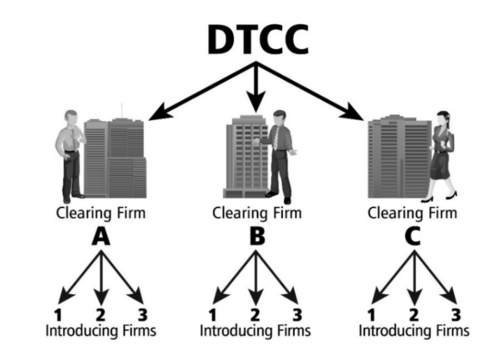
Overview of clearing process involving both introducing and clearing firms
DTCC > Clearing Firms > Introducing Firms
Introducing Firms - Fully Disclosed vs. Omnibus Accounts
A clearing broker may provide introducing firms with back office and related record keeping functions on either a fully disclosed or omnibus basis
The differences between these two arrangements involve the level of detail the clearing firm will have regarding the customer as well as which entity will be responsible for providing trade details to the customer
Accounts Include:
Full Disclosed Accounts
Omnibus Accounts
Introducing Firms - Fully Disclosed Accounts
Definition: clearing firm knows each individual customer and maintains separate accounts for each one
Operate through a clearing firm on a fully disclosed basis
This means that information about each of the individual customers of the introducing firm will be transmitted to the clearing firm and the clients' assets are held at the clearing firm
The clearing firm establishes separate accounts for each client and is responsible for all of the paperwork associated with the accounts, such as the delivery of confirmations and statements
The paperwork will be identified as coming from the clearing firm, but it will contain additional identifying information so that the client can determine to which introducing firm the paperwork is related.
Example: a client's statement may list ABC Clearing at the top of the document, but will also contain the name and contact information for XYZ Brokers, the introducing firm.
Information about each individual customer of the introducing firm will be transmitted to the clearing firm
Client's assets are held at the clear
Summary: a fully disclosed arrangement, the clearing firm knows each customer, holds their assets, and handles the paperwork, while the introducing firm focuses on the client relationship.
Introducing Firms - Omnibus Accounts
Definition: a single account that combines (aggregates) many customers into one account at the clearing firm
Not all of the relationships between introducing and clearing firms are fully disclosed.
Example: ABC Bond Brokers, Inc. is a fixed-income broker-dealer that has a complete back-office operation for clearing its bond trades and holding customer positions. However, the firm will occasionally accept an order from a customer for common stock. Since the firm doesn't want to set up clearing operations to handle these infrequent accommodation transactions, it has arranged for DEF Clearing to execute and clear its customers' stock trades. ABC doesn't provide DEF Clearing with details regarding the individual clients. Instead, ABC uses a single omnibus account that's specifically designated by the clearing firm for customers of ABC Bond Brokers. In this type of arrangement, since the clearing firm doesn't have information on each individual customer, the record keeping responsibilities belong primarily to the ABC Bond Brokers, the introducing firm.
Handles infrequent accommodation transactions

