I&O Psych Exam 2
 Call Kai
 Learn
Learn Practice Test
 Spaced Repetition
 Match
Match Flashcards
 Knowt Play
1/148

There's no tags or description
Looks like no tags are added yet.
Name | Mastery | Learn | Test | Matching | Spaced | Call with Kai |
|---|
No analytics yet
Send a link to your students to track their progress
149 Terms
What is a Performance Measurement?
Evaluating them on job related score
Reps job perf (construct) -> performance measure (variable)
Use scores to eval job perf
What are the Three Types of Performance Measurement?
Objective
Personnel
Judgmental
What is Objective (Hard Criteria) Performance Measurement? Adv/Disadv?
quantitative counts of the results of work (sales volume, number of complaint letters)
ex: Number of sales, tips made etc
Advantages
Exact, not subjective
Disadvantages
Narrow in scope (one number rarely captures full picture of someone's perf)
Can be affected by external factors (similar to effectiveness)
May still entail many judgmental contents and not necessarily more reliable
What is Personnel Performance Measurement?
HR records (absences, disciplinary actions)
What is Judgmental (Soft Criteria) Performance Measurement? Adv/Disadv?
subjective evaluations of work behavior (supervisory ratings, self ratings, peer)
Subjective
Soft Criteria
Advantages:
Can capture more aspects of performance, less influenced by external factors
Disadvantages
Subjectivity of the rater
Correlation with objective perf: about .20 around .39
Special Cases: Electronic Performance Monitoring...
Monitoring work processes with electronic devices
Cost effective, detailed and accurate work logs
Privacy and fairness issues (can lead to bad work attitudes, self esteem, and communication)
Also positively associated with performance at work (under some circumstances)
Highly skilled students/workers were monitored
The student/worker was able to delay or prevent monitoring at particular times
Lower-skilled were not monitored (performed better without EPM)
When will EPMs be welcomed and effective? When people
Job relevance (its actually relevant to their job)
Participation (able to be involved in the process)
Control (more control (delay/prevent)
Advance warnings (when and how monitoring will occur)
What is Performance Management?
Does not equal performance appraisal/evaluation (is broader than performance appraisal)
System that emphasizes the link between individual behavior and organizational strategies, goals, and feedback
1. By defining performance in the context of these goals (Goal customer service = clients solving problems)
What are the 3 Components of Performance Management?
Define performance (task job analysis and strategic analysis)
Measurement of performance
Communication between supervisor and subordinate (feedback)
Goals of Performance Management?
1. Evaluate proficiency of employees
Make ratings
Evaluate efficiency
2. Provide feedback
Set goals
Develop to improve performance
Purpose of Performance Management?
Administration purposes
Promotions, rewards, transfer, layoffs, fires
Development and feedback
See where and how employees can improve
Criterion Data
How well does something predict performance
In this case you need a measure of performance
What are Overall Performance Ratings?
High-level and simple; Usually for administrative purposes
No "real" or conceptual meaning
Affected by (Rotundo & Sackett, 2002)
Task performance (+)
OCB (+)
CWB (-)
Campbell (1999) suggests looking inside the "boxcar" of overall job performance
What are the Specific Performance Ratings?
Trait ratings
Task Based ratings
Critical Incidents
What are Trait Ratings (Specific Peformance)?
(don't use these)
Persistence, concentration, personality
Based on traits and not actions or behaviors
Unfair
What are Task Based Ratings (Specific Performance rating)
(defensible in court and accepted by incumbents)
Extensions of job analysis
Effectiveness on groups of similar and critical tasks (often called duties)
What are Critical Incidents (Specific Performance Rating)?
Effective vs ineffective versions of important aspects of performance
What are the 3 Fundamental Characteristics of Ratings?
Behavioral Definitions
Response Categories Defined
Response Unambiguous
What are Behavioral Definitions?
Is it clear what behavior you are measuring
Customer service quality rate from 1 to 5
Vs
Customers service quality (prompt response, clear communication, timely follow up) rate from 1 to 5
What is Response Categories Defined?
what does a certain response option (satisfactory or 4) mean?
Customer service quality, rate from 1 (receives neg customer feedback weekly) to 5 (receives pos customer feedback weekly)
These benchmarks defining the scale points are called anchors (explain what beh are expected for each response category)
What is Response Unambiguous?
can we interpret as the rater intended
If the rater intended to rate 4 on the scale,can we identify that based on their rating
5 4 3 2 1 VS. 5—------1
[] [] [] [] []
First one has response unambiguous
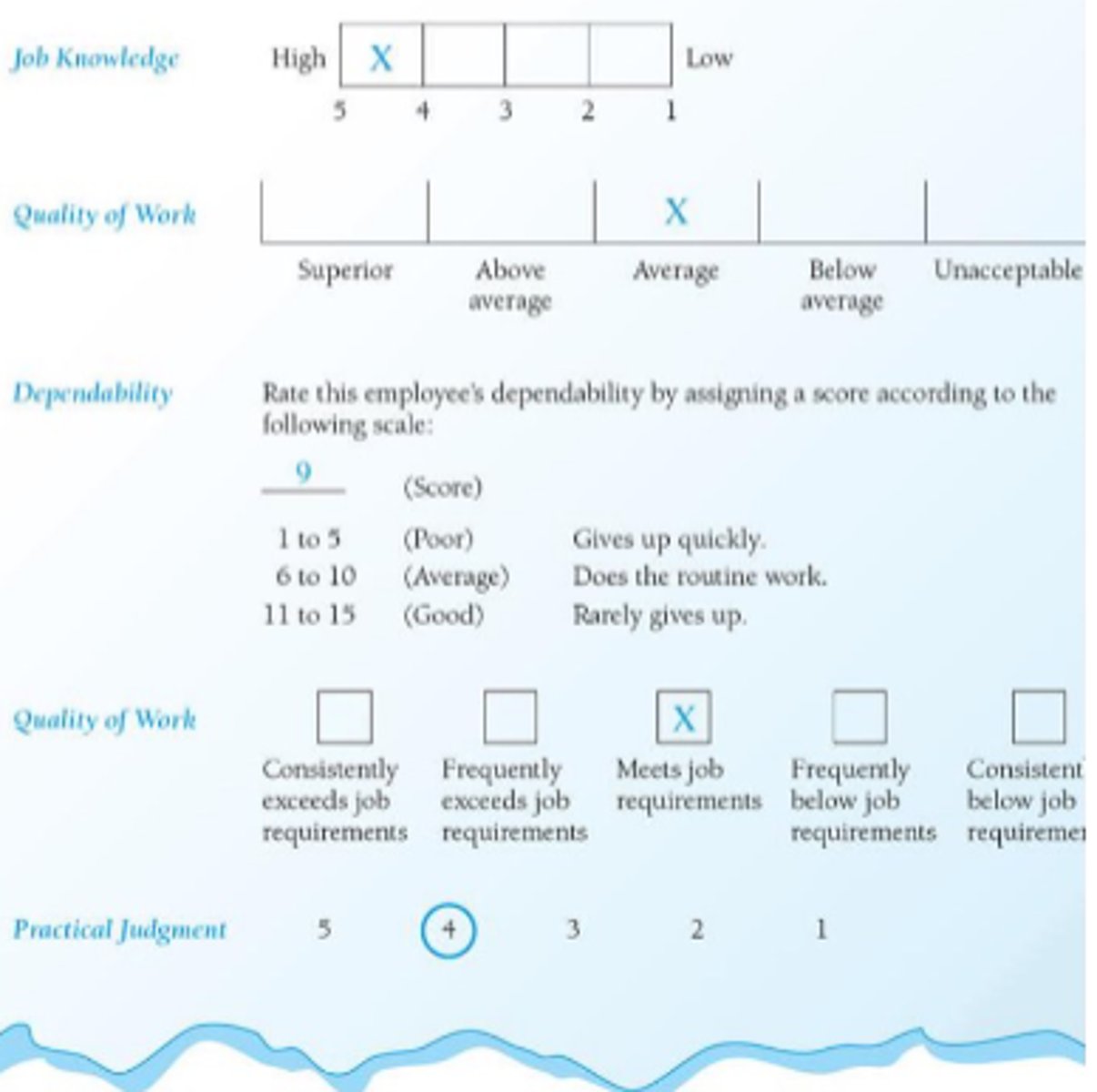
What is a Graphic Rating Scale?
scores running from high on one end and low on the other end
Most widely used judgmental measure
First types of scales used for performance evaluation
Can be very effective if well designed
What are Checklists?
Lists of behaviors presented to a rater, who needs to select items best (least) describe the ratee
May be weighted by SMEs
Variation: forced choice checklist
Rater need to check only one behavior that describes the ratee the best
Not particular conductive to providing feedback
Evaluation not day to day perf management
Assessment > Management
Avoiding bias, halo effect (bias)
Examples of Checklists
The instructor created a classroom environment that encouraged questions and discussion (1.2).
The instructor presented material clearly (4.2).
Lectures were adequately organized (3.7).
The instructor was enthusiastic and friendly (2.7).
The instructor used examples from his/her experience or research
^ example of a weighted checklist (includes items that have value or weights assigned to them, derived from expert judgments of incumbents)
Example 2 Forced Choice
Choose one of the following options that best describes the employee:
Takes up challenges eagerly
Always comes up with a new idea
Leads and shows proper direction to each of its team member
Understand the problem and provides valuable alternative solutions to it
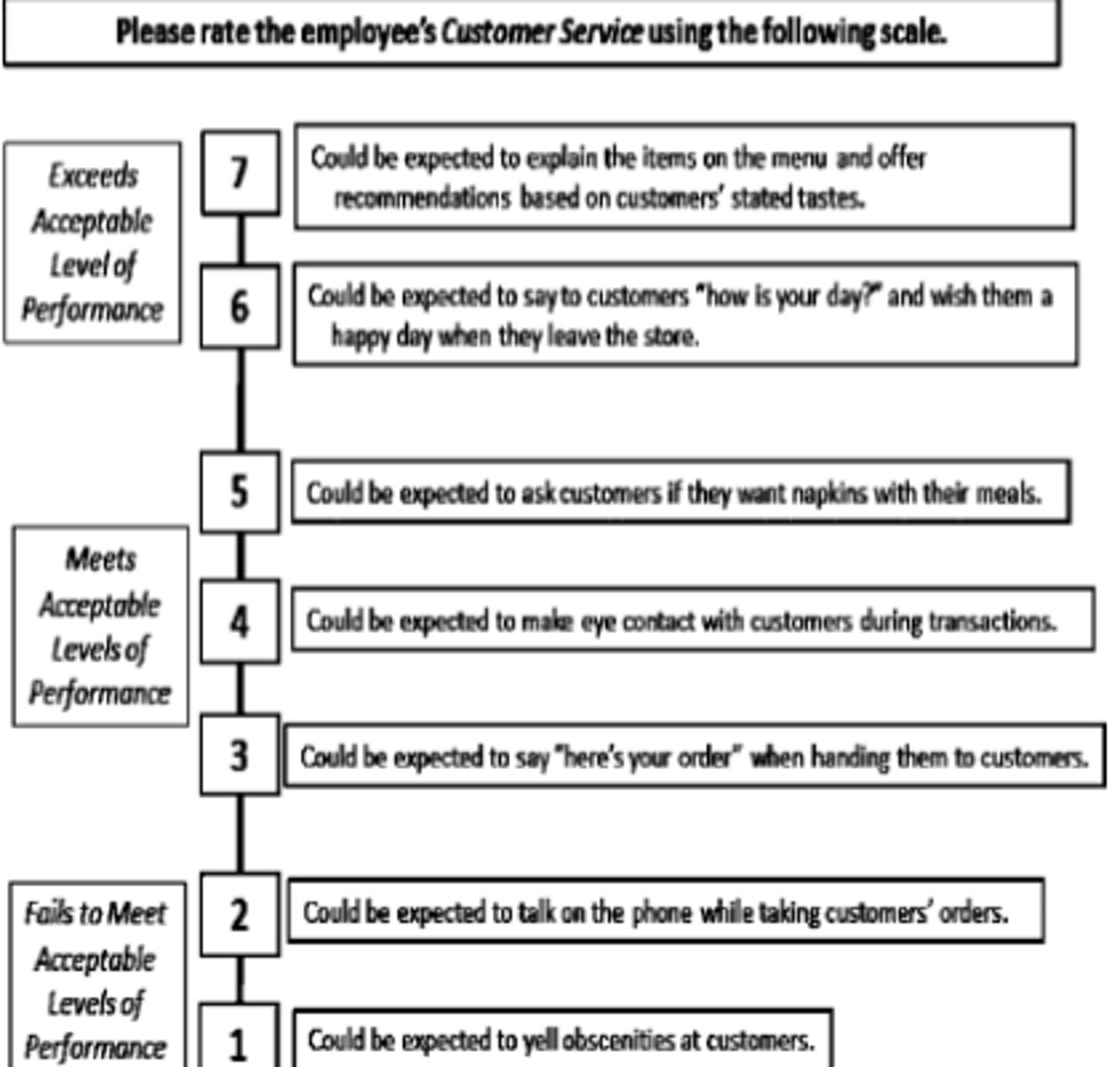
What are Behaviorally Anchored Rating Scales (BARS)?
Scales included behavioral anchors describing work behaviors
Choose the beh that matched the number the best
Rater choose what a target employee has done or might do
High inter rater reliability
Great way to make shit more objective and behavioral focused
exceeds/expected behavior
Pros and Cons of BARS?
Pros
Clearly defined anchors
Measures behaviors, not stereotypes
High involvement with employees and supervisors (extensives SME interaction)
Cons
Time consuming and costly to develop
Job and task dependent
Not all critical incidents or tasks may be listed or observed
Beh didnt beh, would imagine beh, then provide ratings based on imagined beh
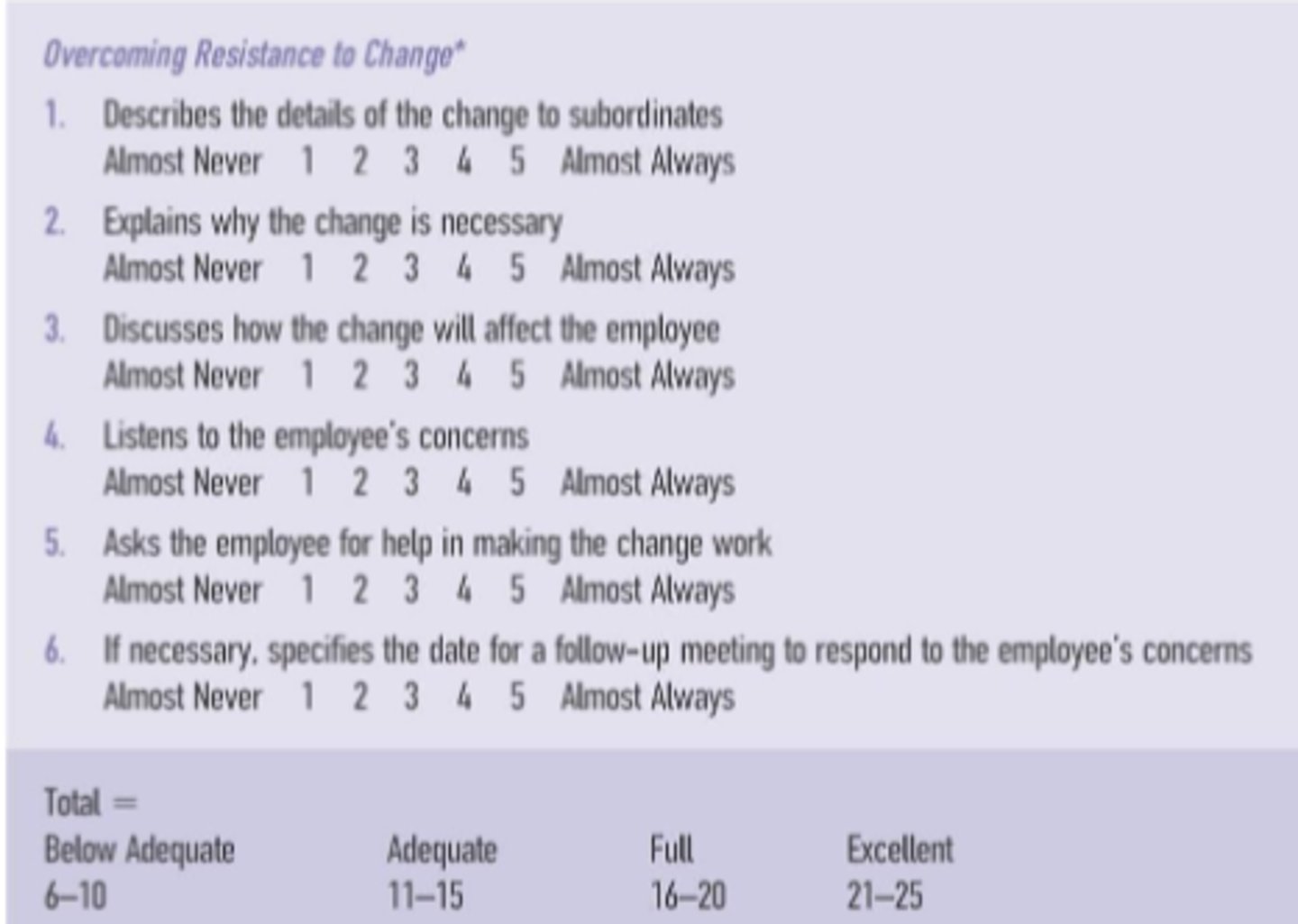
What are Behavioral Observation Scales (BOS)
Scales asking raters to consider the frequency of an employee acting in a particular way
Gets around BARS issue of using anchors that may not be observed
Easier to develop because more closely tied to job analysis
Beh dont show up = no imagination, will just be a zero
What are Computer Adaptive Rating Scales?
Uses forced choice format
Uses computer adaptive testing (CAT) format
Raters response to an item
Next item is chosen so that it matches the current estimate of performance
Until certain criteria is reached
Increases efficiency and accuracy of ratings
What are Employee Comparison Methods?
Performance rating = compare employee behavior with given standards (anchors)
Compare between employees..
Rank order
Paired comparison
forced distribution
What is Rank Order?
Rank all employees on some dimensions from low to high (worst to best)
For mult dimensions can also use average ranks of each dimensions PRO
Hard with large number of employees (100 vs 10 employees) CON
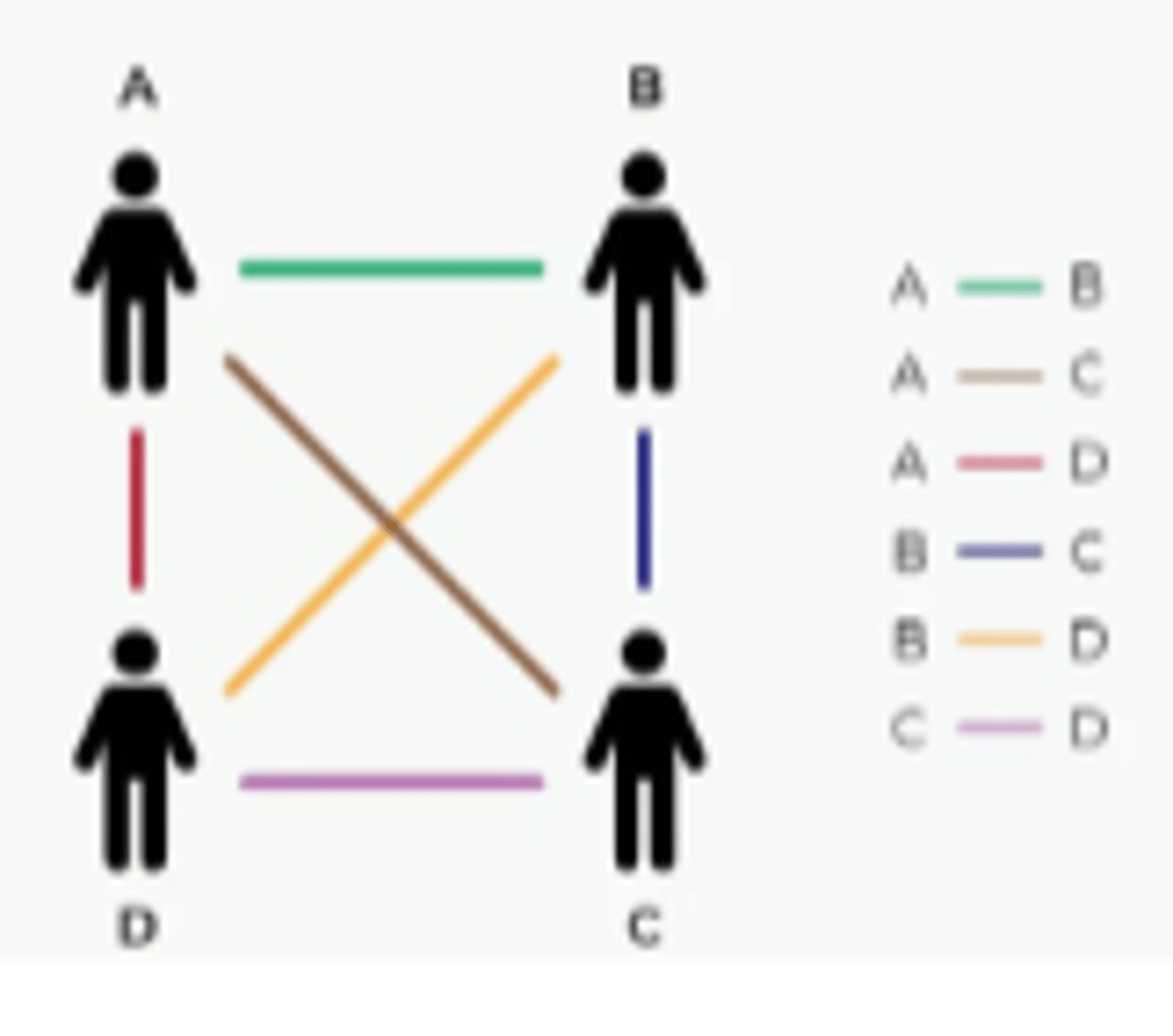
What is Paired Comparison?
employees compared against each other
Individuals score = number of times chosen over others
Total number to compare: N(N-1)/2
Forcing raters to make direct judgment of employees
Clear decision of who performs better
Good for layoff decisions, but time consuming
But what about 1000..
What is Forced Distribution?
force raters to distribute employees in some distributions
Normal distribution, Top 20% = A performers
Sometimes arbitrary, forces arbitrary distribution
Can prevent rating inflation sometimes BUT arbitrary and may not be fair
Forces to put employees to be put in a distribution (fairness issue)
Not legally defensible either
Types of Rating Sources?
Supervisor
Peers
Subordinates’
Clients/customers
Yourself
All rating sources for judgmental
What are Supervisor Ratings?
Typically see results of your performance
Good for measuring maximum performance
What are Peer Ratings?
May know more about typical performance and more likely to observe OCB
But better for developmental purpose rather than administrative (giving feedback, coaching needs, team growth rather than promotion of firing)
Conflicts of interest
Friendships
What are Subordinate Ratings?
Best for evaluating leadership behaviors and their effect on subordinates
Needs to be kept anonymous to prevent supervisor retaliation
Better for developmental purposes than administrative
What are Client/Customer Ratings?
Good choice when supervisors have limited observation
Can be biased by:
External factors (angry customer, products quality = might provide low rating despite not actually reflecting employee)
Feeling towards the company
Limited to customer oriented behaviors
What are Self Ratings?
Potential for leniency bias (perform better than others, provide higher ratings for self)
Perceive self to perform better than others]
When discussing with supervisors, can be minimized
Better for developmental purpose rather than administrative purpose
Why used Self Ratings?
Important role in performance management
Better understands performance
Reflect on behs in the past
Helps employees themselves
CWB: self ratings report more CWB than supervisor/peer ratings
OCB: difference between self and supervisor/peer ratings is small
What is 360 Degree Feedback?
Collective ratings and feedback from many sources
Best fro developmental purposes
Are Humans Good at Ratings? Intentional/Systematic Distortions of this
Not always, there can be errors, or intentional/systematic distortions
Central tendency: raters pick middle point to be safe (avoiding extreme response options)
Avoid extra justification for extreme choices
Leniency/Severity Bias: Raters are unusually easy/harsh in the ratings
Due to being demanding, avoid friction
Can be reduced by providing well-defined behavioral anchors
Halo: raters give all high ratings, based on one positive aspect of the employee
Examples of Rating Training (for minimizing distortions)?
Administrative Training
Psychometric Training
Frame of Reference
What is Administrative Training?
Discussion for meaning of behaviors and anchors (particularly for BARS and BOS)
But always more direct to design better scales
What is Psychometric Training?
Train raters aware of distortions
Does really workL at the cost of harming accuracy
What is Frame od Reference (FOR) Training?
Give rater a context for ratings
Facets of performance
Meaning of anchors
Make practice ratings
Provide immediate feedback on practice
Effective in reducing rating errors
Reliability in Performance Ratings...
Should inter-rater reliability be high
Different sources = differences perspective
In this case, don't expect high IRR. Otherwise info is redundant (not really capturing diff persp of ones performance)
Typically .5 - .6 (overlap moderately, should be)
Same source = expect high IRR (same aspect of performance)
Validity in Performance Ratings?
How can rating scales be valid
Based on job analysis
Represents more aspects of performance
Rater training
Embrace three fundamental characteristics of rating
What Makes Feedback Effective?
Backed by data (numbers, critical incidents)
Specific and informative: what's wrong and how to it can be fixed
Not simply a documentation of poor performance
Focus on behavior not outcomes
Avoid praise criticism praise sandwich
Start with praise, then give criticism, then praise again
Then praise signals bad news coming
Confusing to do this
Negative feedback must always be constructive
Destructive feedback: Cruel, sarcastic, and offensive; Usually general than specific; Directed towards personal characteristics than job-relevant behaviors
Legal Contexts..
Courts care more about fairness than theory or validity
Care about fairness
For example, forced distribution has lota of legal issues
Forced distributions (10-80-10) rating system for seniors managers
Many lawsuits based on discrimination
How can it be legally sound
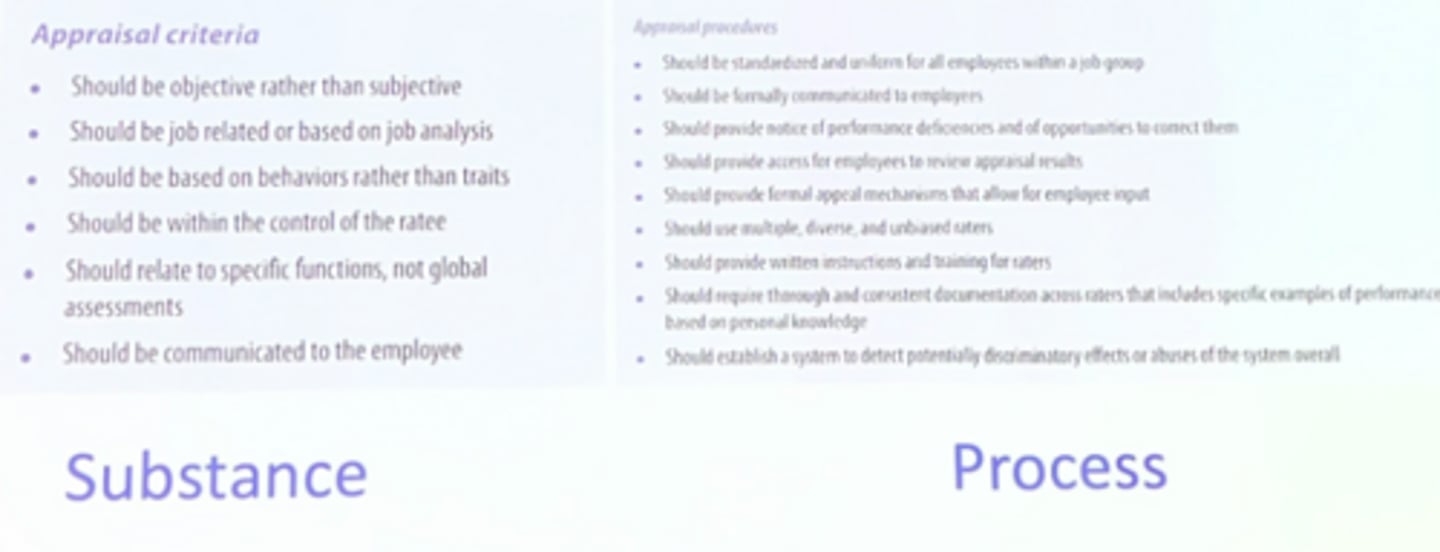
Substance
Behavior based not trait based
Process
System
Procedure of perf measurement
What are Staffing Decisions? Purpose?
associated with recruiting, selecting, promoting, and separating (layoff or termination) employees
Purpose: hire and keep people who will be successful
Why do we Care about Staffing Decisions?
Staffing practices do have a positive association with firm performance when they follow high performance work practices
Use of job analysis (help guide staffing decisions, carefully define task required for job)
Select from existing employees for key positions (internal selection)
Adjustment timeline typically shorter (current employees alr know the culture, less time for them to adjust)
Motivates current employees as well
Merit-based promotions
Amount of training
Use of formal assessment devices for selection decisions
Decreases turnover, increases sales and overall profits
What is Recruitment in Staffing Process?
Build right applicant pool
1st step in staffing
To attract people with right qualifications to apply (not yet selecting)
Based on job analysis
Internal vs external (within or outside members of organization)
What is Internal Recruitment? Pros? Cons?
recruiting from within organization
(Pros):
know company culture, adjustment time is shorter, company already knows how they work (past performance), can see opportunity for promotion = higher motivation for the future
Cons:
Got a smaller pool, homogeneous applicants (hard to bring new ideas/policies), comp between employees (politics)
What is external recruitment?
recruiting outside members of the organization
Pros:
new ideas/perspectives, larger applicant pool (more diverse)
Cons:
more expensive (higher costs), riskier (more uncertainty)
Common methods: job posting, referrals, school recruiters
What is Selection of the Staffing Process? Types?
Needs to answer these questions
What KSAOs (job analysis)
How to measure KSAOs
How to score measures and combine info
How to make a decision
How to evaluate outcomes
Compare with recruitment
Types:
Compensatory
Non-Compensatory
What is the Compensatory Selection System?
candidates can make up for weaknesses in one area by strength si another area
Ex: candidate for assistant prof does not have much exp in instruction, but has many publications
What is the Non-Compensatory Selection System?
candidates wont be hired if they lack certain KSAO
Ex: legally blind individual cannot become a bus driver
Nurses, truck drivers, specific requirements (lawyers/attorneys)
Promotion and Termination/Deselection...
Both based on performance measurement
Two types of deselection
Layoffs: lose job due to downsizing
Termination for cause: lose job due to underperformance
Decisions to make at these stages:
How to make decisions
How to evaluate decisions
How do you combine information from different methods to make decisions
Methods in an assessment center
Clinical vs statistical decisions
Clinical (intuitive): combine info based on human judgment (unreliable based)
Statistical (actuarial): use a math formula to combine info (reliable, fair)
Compensatory Methods for Combining Info?
Total Mean Score (ranking/cut score)
Multiple Regression (Weighted Score)
Score Banding
What is Total Mean Score? Ranking? Cut Score?
Based on cut score; ranking
total/mean score approach (Take average of all their score)
Ranking
Rank total score or mean and rank them in order and take however many we want going down the line highest to lowest
Cut score
Higher score than 23 can be selected
What is Multiple Regression (Weighred Score)?
Determine diff task have diff weight
Weighted score = 0.5g + 0.2C + 0.3 Intervie
What is Score Banding?
Close scores as ties/band
Same band = essentially equal
A = total > 23
B = total > 21
Reason:
Sometimes not care about actual score differences
Tests not perfectly reliable
What is the Hurdle System (NON-Compensatory)?
Cut score for each assessment
Applicants must pass one stage to move onto the next
Effective in narrowing down large applicant pool
More costly overall (mult assessments)
usually mult hurdle systems in non compensatory
What is Subgroup Norming?
develop separate lists of individuals in different demographic groups, then rank within groups
White employees vs black employees; women vs men then ranking them within the groups
Can actually lead to more bias despite intention to reduce subgroup differences
For example, may introduce reverse discrimination (not using same standard to all applicants) people who actually score higher overall can be passed over just bc they are in a certain group
Illegal under the Civil Rights Act of 1991
What Does Good Decision Mean?
Identify good performers - validity
Cost efficient - utility
Is it cost effective
Save or earn more on the whole process
Unbiased across various groups - fairness
Is our decision fair
Applying the same process/rules to everyone?
What is Validity in Good Decisions?
Translate the question does the selection system work
Actually end up being a good performer..?
Criterion related validity: correlation between selection measure scores and job performance scores
r= 0, useless
0 < r < 1, typical
R = 1, perfect (impossible)
What is Selection Ratio (SR)
Proportion of applicants we hire
Proportion of applicants that are selected into positions
10 positions, 100 applicants -> SR = 10%
validity
What is Base rate (BR)
How common something is in the overall population
Proportion of applicants that would be successful performers
If you hire all 100 applicants, 40 will have good performance -> BR = 40%
Don't know BR at the time of hire
Estimate BR from historical performance data
Can use last year BR to estimate
What is a Cut Score?
Cutoff for hiring employees
Higher cut score = low selection ratio
E.g., 0-100 scale, 100 applicants:
Cut score 70 → 40 people pass → SR= 40%
Cut score 85 → 15 people pass → SR = 15%
BR and SR....
N = 30
1. Identify performance standard
Its 4 = considered good performers, below = bad performers
Now have a base rate
BR = # above the line/N
2. Set a Cut Score
People who score higher than cut score = hired (right = hired, left = reject)
SR = # right to the line/N
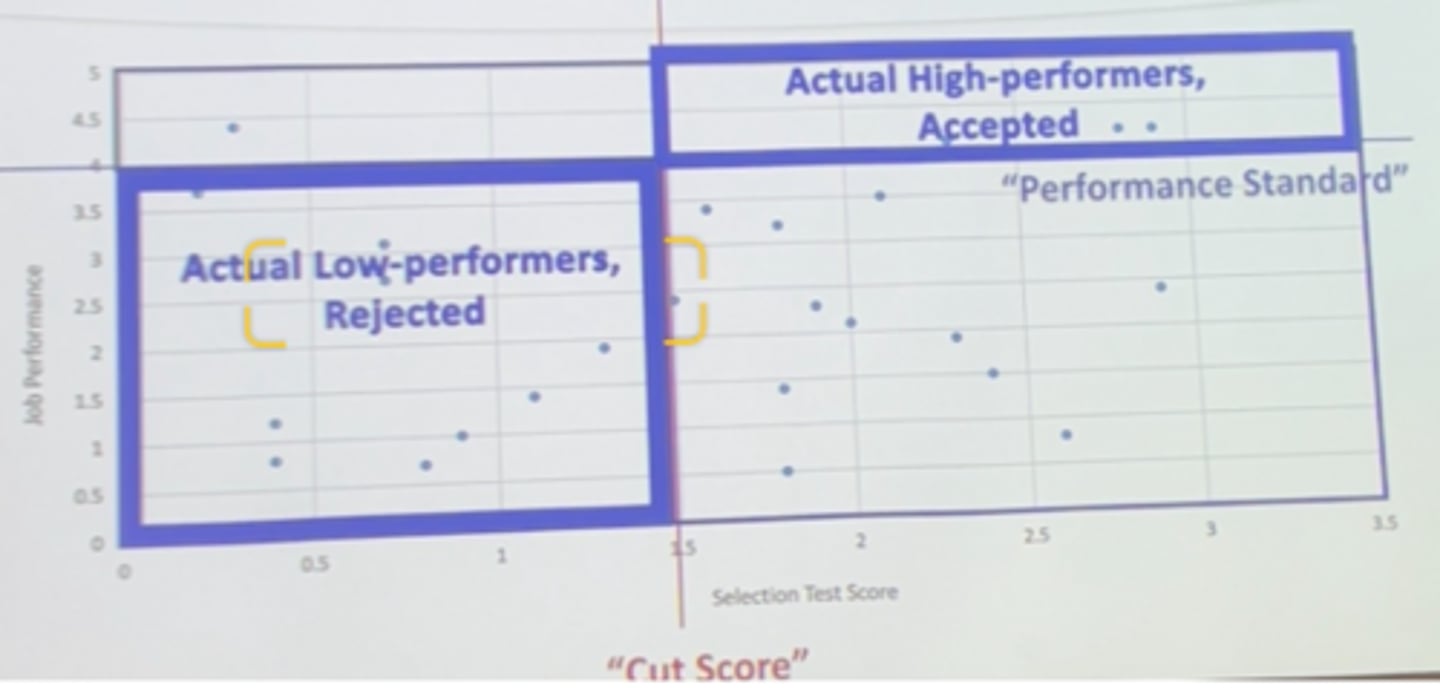
Example of Incorrect (False) Decisions
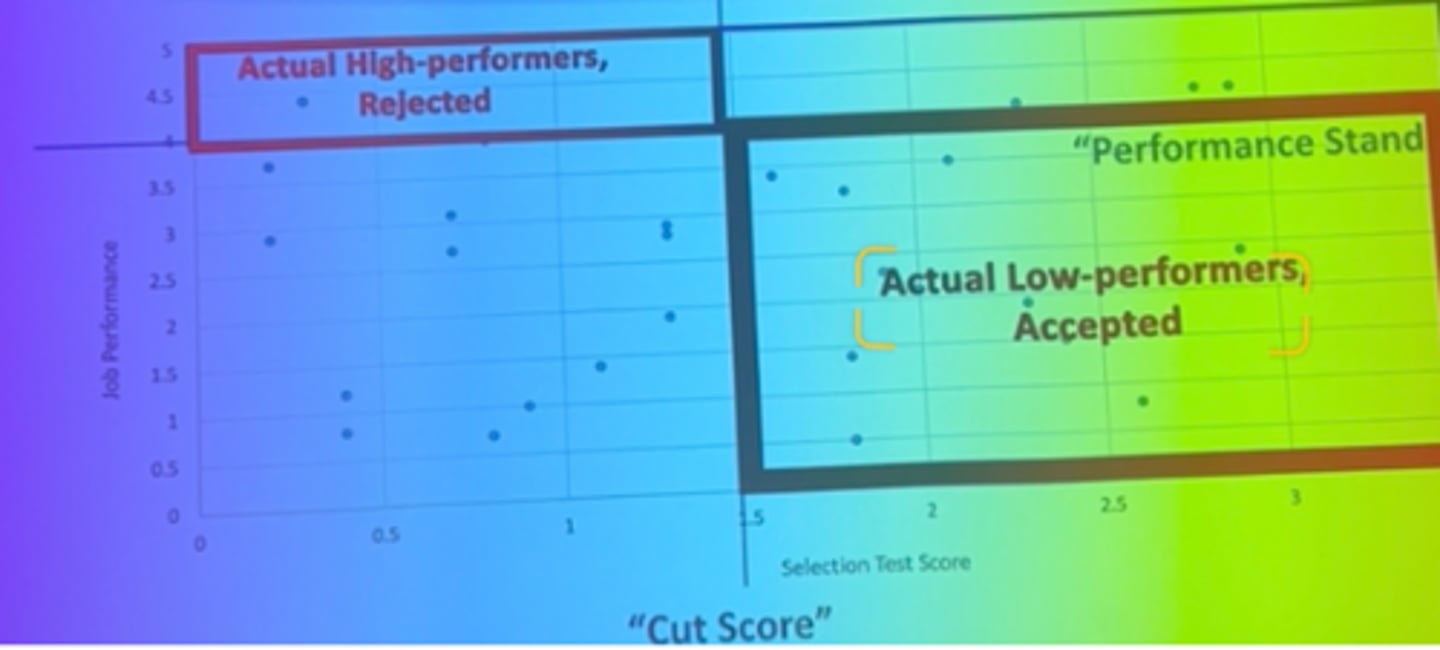
What are Positive Decisions?
You decide to hire this candidate
If indeed a good performer then its a correct (true) decision -> true positive
instead a bad performer, then it's an incorrect (False) decision → False Positive
What are Negative Decisions?
You decide not to hire this candidate
If indeed a bad performer then its a correct (true Decision) -> true negative
If instead a good performer, then it's an incorrect (False) decision → False Negative
goal = less false positive and false negatives
Decrease the Performance Standard..
More successful performers in the pool, BR increases
Less false positives, more false negatives
More true positives
Less true negatives
Increase the Cutoff and Decrease the Selection Ratio...
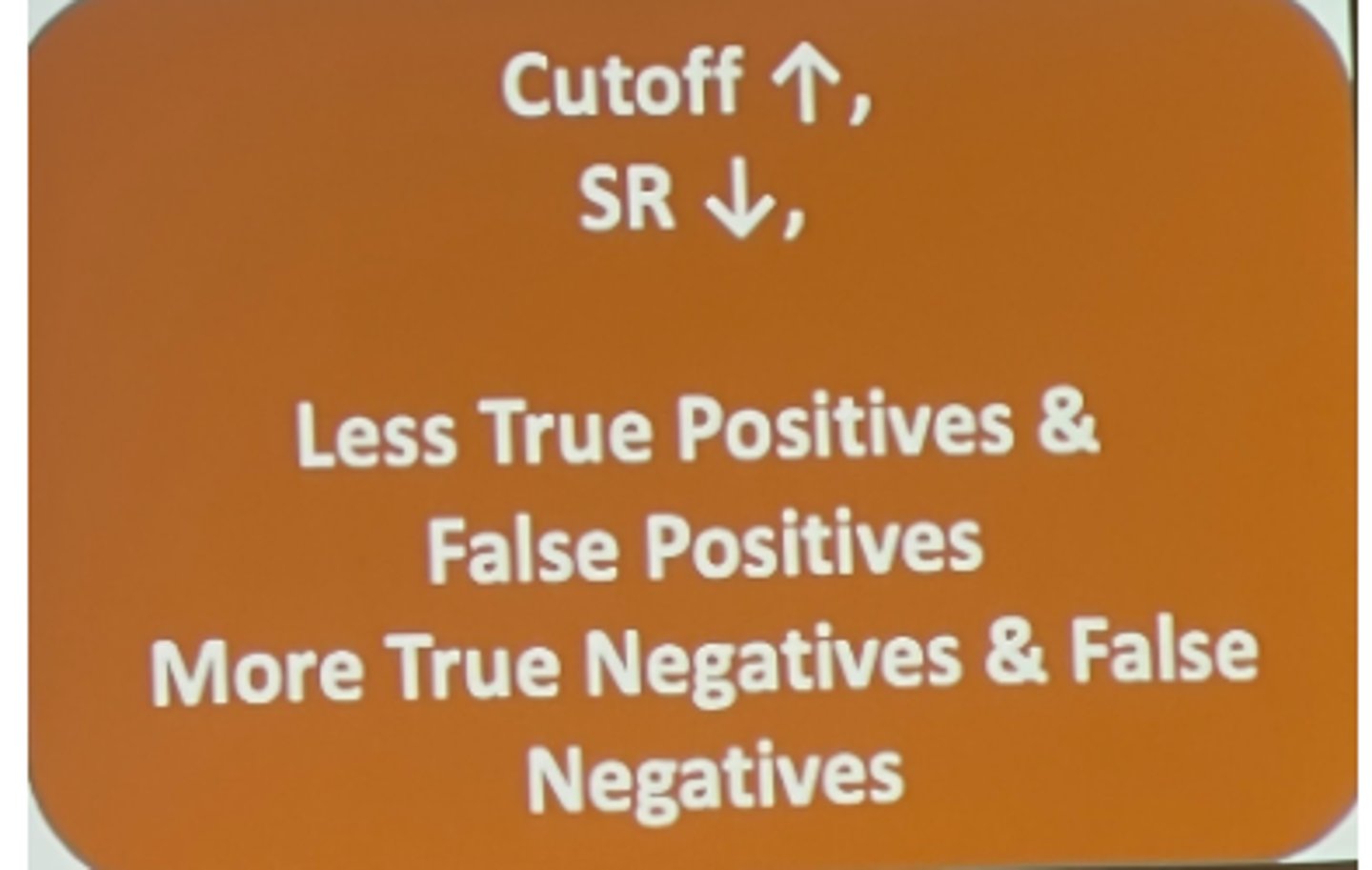
Choosing the Best SR...
Lower SR is better
Higher cut score, lower selection ration
Reduce cost of false positives
SR = # hired/ # applicants
Hire less = decrease SR
Get more applicants = decrease SR
What is Utility? ROI?
assessment of return on investment (ROI)
In the case of staffing
ROI
Benefit of hiring good performers/cost of staffing strategy
Utility Analysis Considers?
Costs of hiring and FALSE POSITIVES (hiring bad performers)
Base rate (proportion of good performers among applicant pool)
High BR = utility of good assessment would be low
Low BR = need a really good assessment to identity good performers (utility high)
Decrease false positives
What is Fairness? If unfair...
Is our decision fair
Applying the same process/rules to everyone?
If staffing are unfair, employees may
Engage in CWB
File formal complaint
Sue the company
What is Adverse Treatment?
employer knowingly and willfully treats minority applicants differently (than majority) intentional
Ex: diff cut score for diff groups, diff groups diff questions
Avoid hiring older workers
What is Adverse Impact?
employer incidentally treats minority applicants differently unintentional
The company requires to complete a 5 mile team building run during the hiring process
Adverse Impact Ratio
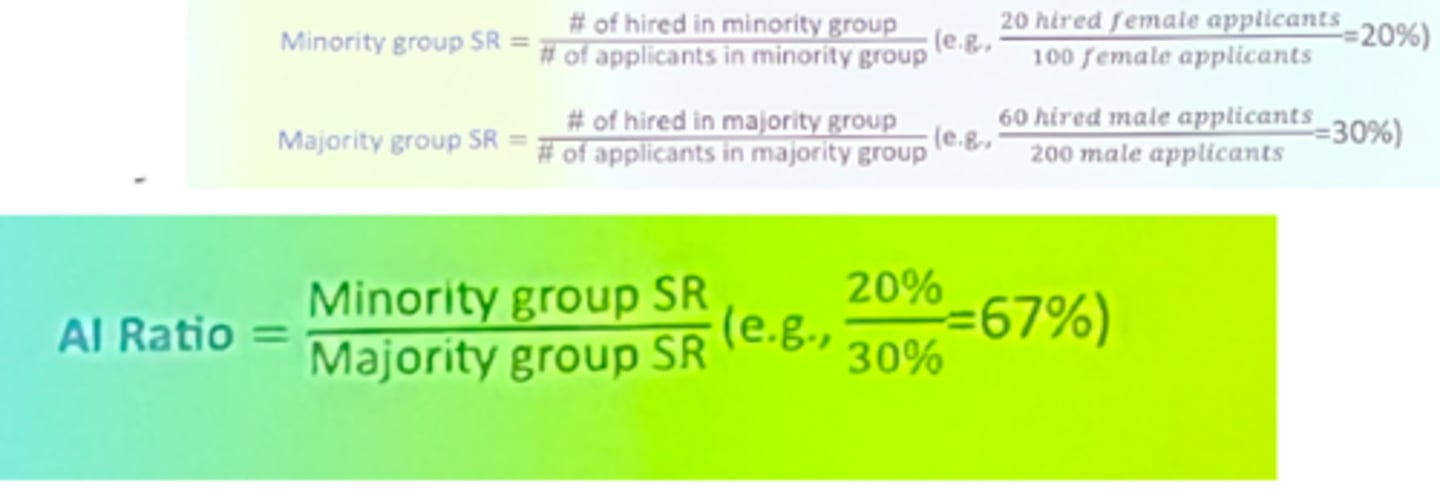
What is the 4/5th rule?
potential adverse impact when: minority group received less than 80% (4/5th) of desirable outcomes received by majority group
Not necessarily adverse treatment or adverse impact. Why
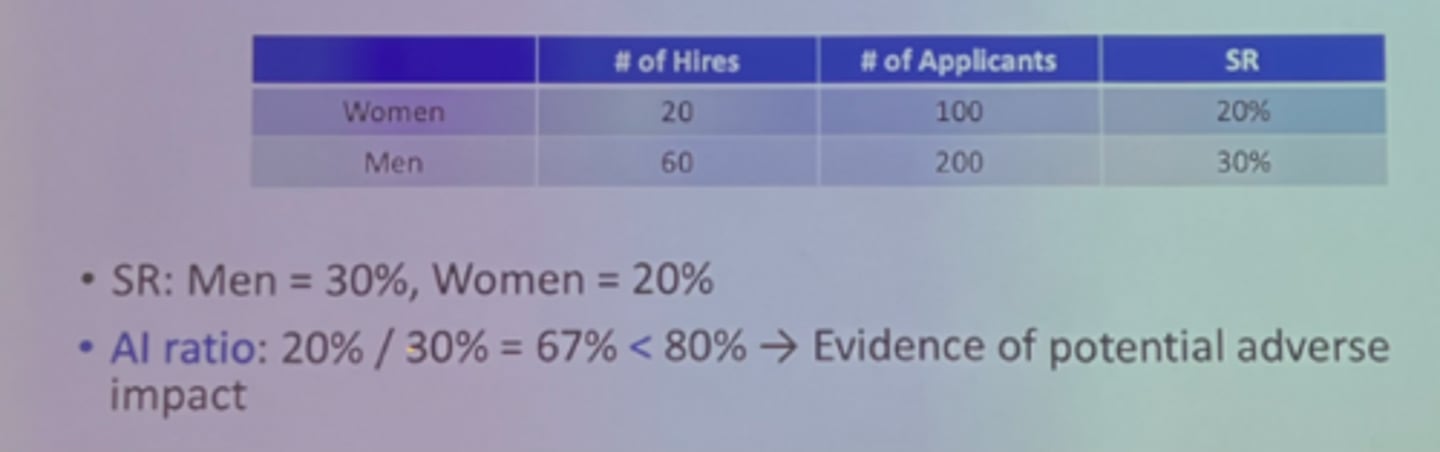
Determining Adverse Impact?
4/5th rule is only a guideline
Final judgment made in court
In response to evidence of AI, employers must demonstrate that this practice is job related (therefore valid)
I/O psychologists as expert witnesses
Discrimination cases typically violate
Title VII rights act of 1964
Americans with disabilities Act
Age discrimination in employment act
Very expensive for organization and hurts public opinion
What Is Training?
Training = systematic acquisition of
Concepts (K)
Skills (S)
Attitudes (O)
Not ability (A)- because ability is more resistance to change and music less malleable
Foundation for Training Progrmas..
learning
Learning outcomes
Cognitive (e.g., declarative knowledge (facts, procedural)
Skill based (motor and technical)
Affective (attitudes and beliefs)
Training does NOT...
Does not guarantee learning
Planned or informal experience intended to lead to learning
How much is learned is influenced by many factors
What is Learning?
Relatively permanent change in behavior and capabilities
Cannot be observed:
Assumed to be taken place when observing performance
Infer learning from performance
What is Performance?
Actions or behaviors relevant to organization goals
Can be directly observed
Learning often leads to better performance in training and job tasks
Why do we care about training?
Big cost: 102.8 billion spent on training in 2025
Assessment of return of investment (ROI) is good if training is useful
Attract and refrain good employees
Combined with selection to build strong workforce
Select on certain KSOs
Enforce and Enhance these KSOs in training
Some Conceptual Issues of Training?
Individual differences assumes KSAOs are relatively stable, but training and development assumes K and S can be changed and enhanced
Rank order stability (Individual Differences KSAOs)
The extent to which individuals maintain their relative positions (rankings) on a trait compared to others over time
Mean level stability (change in training and development)
The extent to which the average score of a group remains the same over time
The average motivation score on increases from 80 to 90 after training
If K and S can be improved, then what's the role of personnel selection
Schmidt and Hunter 1992
Training Needs Analysis...
necessary step before actually designing a training system
Training needs analysis
Three-step process to identify where, what, and who of training
Where is training needed? (ORG)
What needs to be trained? (What)
Who will be trained? (Who)
What is Organizational Analysis (Where)?
Where is training needed
Identifies the training needs of different departments/units (or company-wide goal and problems)
Determine through examined organizational goals, available resources and the organizational environment
Helps to build appropriate support for training
What is Task Analysis (What)?
What needs to be trained
Identifies: what does the employee need to do in order to perform properly
Examines the actual content of training can be consisting of
Developing task statements
Identifying KSAOS required for the job
Based on Job analysis
Can also assess competencies
What is Person Analysis (Who)?
Who needs training and what instructions
Identifies which individuals in the organization should be trained and what instruction they need to improve
Can be identified by performance appraisal critical incidents and 360 degree feedback
What is Trainee Readiness?
whether employees have the personal characteristics necessary to (1) acquire KSOs from training and (2) apply those to the job
"g"- predictive performance, r=.56, according to schmit and hunter (1998) can be used for grouping employees in training)
Goal orientation: performance vs Mastery oriented
What is Performance and Mastery (Goal Orientation of Trainee Readiness)?
Performance: cares more about doing well in training and to be evaluated positively
Mastery: concerned with increasing competence for task at hand
More flexible and adaptable in learning situations (care about process not end results)
Experience (Trainee Readiness)?
More experienced: shorter, less structured training programs
Less experience: longer, more structured training programs
What is Trainee Motivation?
interest in attending training, learning from training, and KSO transferring
Trainee motivation and learning goal orientation contribute most to positive outcomes
What affects trainee motivation
Expectancy: Belief of the association between effort and performance
Learning Style: preferred method of learning (auditory, visual, kinesthetic)
What is Transfer of Training?
degree to which trainees apply KSOs gained in training their jobs
Affected by TOT climate: workplace characteristics that inhibit or facilitate TOT
Examples: emphasis on training importance, the supervisor and peer support
Climate also affects reactions to training and motivation to learn
Activities before/after training (supervisor involvement, supervisor support) strongly related to TOT than activities during training (rewards, feedback)

