Lecture 7 Developmental Genetics
 Studied by 0 people
 Call Kai
 Learn
Learn Practice Test
 Spaced Repetition
 Match
Match Flashcards
 Knowt Play
1/83

There's no tags or description
Looks like no tags are added yet.
Name | Mastery | Learn | Test | Matching | Spaced | Call with Kai |
|---|
No analytics yet
Send a link to your students to track their progress
84 Terms
4. Post-translational Control
c. attachment of small residue
Provide the Type/s and/or Subtype/s of Point of Control of Eukaryotic Gene Expression
e.g. sialic acid residues attach to alkaline phosphatase. The sialic acid generates a variety of electrophoretically distinct molecular forms of the enzyme, each form fulfilling a different role in cell metabolism. The sialic acid may be removed from the enzyme, and all the forms of the enzyme are converted into a single form.
4. Post-translational Control
b. change in the state of oxidation and reduction
Provide the Type/s and/or Subtype/s of Point of Control of Eukaryotic Gene Expression
e.g. malate dehydrogenase, which oxidizes malate into oxaloacetate or reduces oxaloacetate into malate.

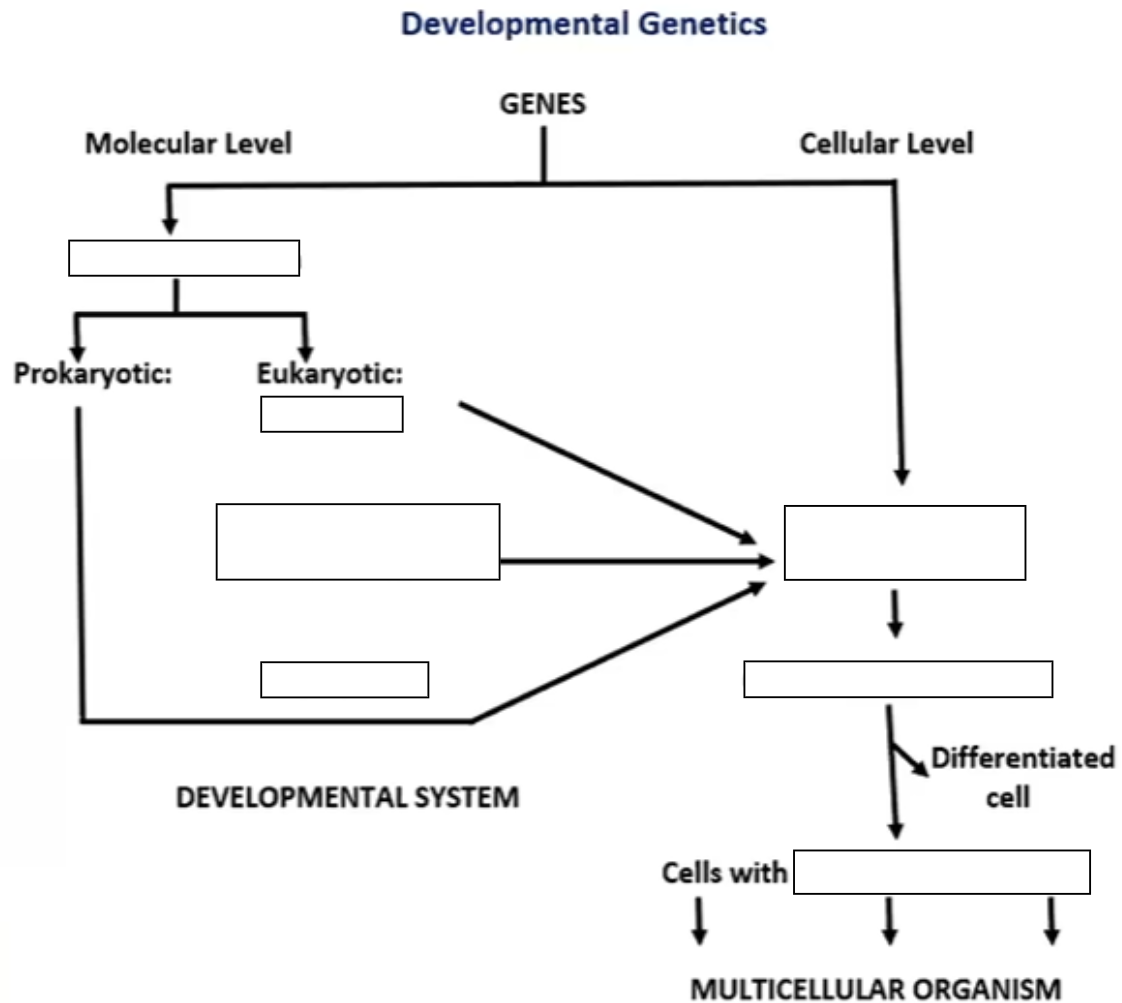
Developmental Genetics
It is the study of the relationships between gene regulation and cell differentiation during development
Development
A process of regulated growth that results from the interaction of the genome with the cytoplasm and the environment
Developmental Genetics
it is not only looking at the DNA of the nucleus or the nucleosome, but also the signal present in the cytoplasm or in the environment that will trigger the processes that leads to development.
Development involves:
1. A programmed sequence of phenotypic events that is typically irreversible.
Once the first set of events occurs, they trigger the next set of events, which are typically irreversible.
2. Differentiation
- formation of different cell types, tissues, and organs
- through specific regulation of gene expression
Single cell zygote with just a single genotype then divides into cells that have the same genome which will eventually lead to differentiated cells which is caused by the regulated gene action
Development involves:
1. __________________________
2. __________________________
Development
It involves a programmed sequence of phenotypic events that is typically irreversible.
Once the first set of events occurs, they trigger the next set of events, which are typically irreversible.
Differentiation
It is the formation of different cell types, tissues, and organs through specific regulation of gene expression.

Explain the basic process of development starting from a single-celled zygote to a complex multi-cellular organism.
Determination
At a particular step or point, when the cell reaches that point, it makes an irreversible commitment to follow a certain developmental path.
Determination
For example, we have the eyes, the lens of the eyes, which is composed of cells. During development, we have cells that are differentiating, but once those cells start to make the proteins that are incorporated into the lens, they become committed to following that path.
Determinants
What do you call cytoplasmic effector substances?
Determinants, specifically cytoplasmic effector substances
These are molecules that are present in the cytoplasm, which cause the cells to become irreversibly committed to perform a specialized function
Determinants
Recall that in the fusion of the sperm and egg, the egg has a larger cytoplasm, so there's a maternal contribution not only of genetic material but also the molecules, proteins, and organelles, some of which are __________.
Differentiation
It is the expression of cells' specialized role
Specialized cells
These are cells producing specialized proteins derived from luxury genes
Luxury genes
Genes that code for gene products which are not needed for survival
Luxury genes
They are tissue-specific or organ-specific genes, which means they are not expressed in all cells.
e.g.,
Once the immature RBCs start to make hemoglobin, they become committed to following that path of being RBCs
Once beta cells in the pancreas produce insulin, they become committed to doing so.
Luxury genes
Genes that are expressed occasionally or sometimes are called _________ genes or non-constitutive genes. The expression of these genes is regulated or controlled by metabolic, physiological and environmental conditions.
They are not constantly expressed, only when their function is needed.
housekeeping; luxury
There are some genes whose products are necessary for survival, such as ___________ genes, for example, those encoding respiratory enzymes. If they become defective, the organism will die. However, for example, cells for the lens of the eye, if they do not produce the protein, even if the organism cannot see, the organism can still survive; that can be considered a _________ gene.

Initial cytoplasmic environment
We have the molecules and proteins present in the cytoplasm of the cell, which are set by the maternal genome, originally coming from the expression of the maternal genes
The sperm contributes almost only nuclear DNA (the chromosomes from the father), while the egg contributes nuclear DNA plus all of the cytoplasm.
That means things found in the cytoplasm — like mitochondria, ribosomes, mRNAs, proteins, and organelles — all come from the mother’s egg cell.
Initial cytoplasmic environment
We have the molecules and proteins present in the cytoplasm of the cell, which are set by the __________ genome, originally coming from the expression of the ___________ genes
Why are they from that genome or genes?
molecules and proteins present in the cytoplasm set by the maternal genome
It triggers the switching "on and off" of genes in the Initial cytoplasmic environment
The gene products synthesized from the maternal genome will occupy a specific position in the egg
when the cell divides, the cytoplasmic environment of each cell will be different from each other

The gene products synthesized from the maternal genome will occupy a specific position in the egg, this implies that?
can be accounted for initially due to the unequal distribution of the cytoplasmic environment, which triggers differential gene action

What causes the formation of different cellular phenotypes
Positioning of the cell during division is important as it can determine the amount of cytoplasm it receives.
Why is the positioning of the cell during division important?
Differential gene function is an intrinsic and fundamental aspect of cell differentiation.
Cell phenotype is a consequence of differential gene action or selective expression of its genes.
Certain cells will have certain genes on or off due to the number of determinants influenced by the cytoplasm inherited, which will lead to different phenotypes.
________________ is an intrinsic and fundamental aspect of cell differentiation.
Cell phenotype is a consequence of ________________ or the ________________ of its genes.
Certain cells will have certain genes on or off due to the number of determinants influenced by the cytoplasm inherited, which will lead to different phenotypes.
a. Selective DNA replication
b. Condensation and decondensation of chromatin
Provide the Type/s and/or Subtype/s of Point of Control of Eukaryotic Gene Expression
What are the pre-transcriptional points?
1. Pre-transcriptional
a. Selective DNA replication
Provide the Type/s and/or Subtype/s of Point of Control of Eukaryotic Gene Expression
also called gene amplification if its restricted to particular gene
1. Pre-transcriptional
a. Selective DNA replication
Provide the Type/s and/or Subtype/s of Point of Control of Eukaryotic Gene Expression
amphibian oocyte rDNA, when you have a developing oocyte it needs to produce proteins which needs ribosomes, in the formation of the organelles there needs to be rRNA, the rDNA is increased to produce more rRNA, it is amplified to direct the formation of more ribosomes. So, even before transcription, certain genes are amplified.
amphibian oocyte rDNA, when you have a developing oocyte it needs to produce proteins which needs ribosomes, in the formation of the organelles there needs to be rRNA, the rDNA is increased to produce more rRNA, it is amplified to direct the formation of more ribosomes. So, even before transcription, certain genes are amplified.
oocyte needs more proteins - needs more ribosomes - needs more rRNA - genes coding for rDNA synthesis amplified - more rDNA is synthesized
Explain
1. Pre-transcriptional
a. Selective DNA replication
in terms of the amphibian oocyte rDNA
1. Pre-transcriptional
b. Condensation and decondensation of chromatin
Provide the Type/s and/or Subtype/s of Point of Control of Eukaryotic Gene Expression
The chromatin can be tightly coiled into higher orders of coiling, but this leads to difficulty in transcribing and expressing genes because it is inaccessible. So some chromatin types can be tightly or loosely packed to control gene expression.
euchromatin (active)
Loosely packed chromatin which means there is active transcription of genes, loose form
heterochromatin (inactive)
Inactive gene expression, as it is tightly packed/coiling chromatin, does not allow the entry of enzymes like RNA polymerase.
DNA methylation
The cytosine base can be added with a methyl group, which leads to the compact folding of DNA and silences the genes. This is also synonymous with gene silencing.
a. Differential RNA synthesis


Provide the Type/s and/or Subtype/s of Point of Control of Eukaryotic Gene Expression
What are the Transcriptional Control points?
2. Transcriptional Control
a. Differential RNA synthesis
Provide the Type/s and/or Subtype/s of Point of Control of Eukaryotic Gene Expression
Amphibian Xenopus laevis
- high rRNA synthesis in immature oocytes
There is a need for a lot of ribosomes.
- 0 rRNA synthesis during meiosis or after fertilization,
then resumption of rRNA synthesis during gastrulation
2. Transcriptional Control
a. Differential RNA synthesis
Provide the Type/s and/or Subtype/s of Point of Control of Eukaryotic Gene Expression
It's when different genes coding for rRNA synthesis are turned on or off in different cells or at different times during development. As is in the example of Xenopus laevis
2. Transcriptional Control
Provide the Type/s and/or Subtype/s of Point of Control of Eukaryotic Gene Expression
Two TATA boxes so the cell has the choice of using the box nearer or farther from the gene.
If you have the TATA box father from the gene being transcribed, then you have a shorter mRNA
If you have the TATA box near the gene being transcribed, then you have a shorter mRNA
Two TATA boxes so the cell has the choice of using the box nearer or farther from the gene.
If you have the TATA box father from the gene being transcribed, then you have a shorter mRNA
If you have the TATA box near the gene being transcribed, then you have a shorter mRNA
Explain
2. Transcriptional Control
Provide the Type/s and/or Subtype/s of Point of Control of Eukaryotic Gene Expression
There can be more than one polyadenylation site. If the first Poly A site used is nearer to the gene (which in the picture is the coding sequence between the PolyA tail and TATA box) then you have a shorter mRNA.
If the one farther then you have a longer mRNA.
These two will code for different proteins. Which one to transcribe is a choice the cell makes depending on the given signal.
There can be more than one polyadenylation site. If the first Poly A site used is nearer to the gene (which in the picture is the coding sequence between the PolyA tail and TATA box) then you have a shorter mRNA.
If the one farther then you have a longer mRNA.
These two will code for different proteins. Which one to transcribe is a choice the cell makes depending on the given signal.
Explain
2. Transcriptional Control
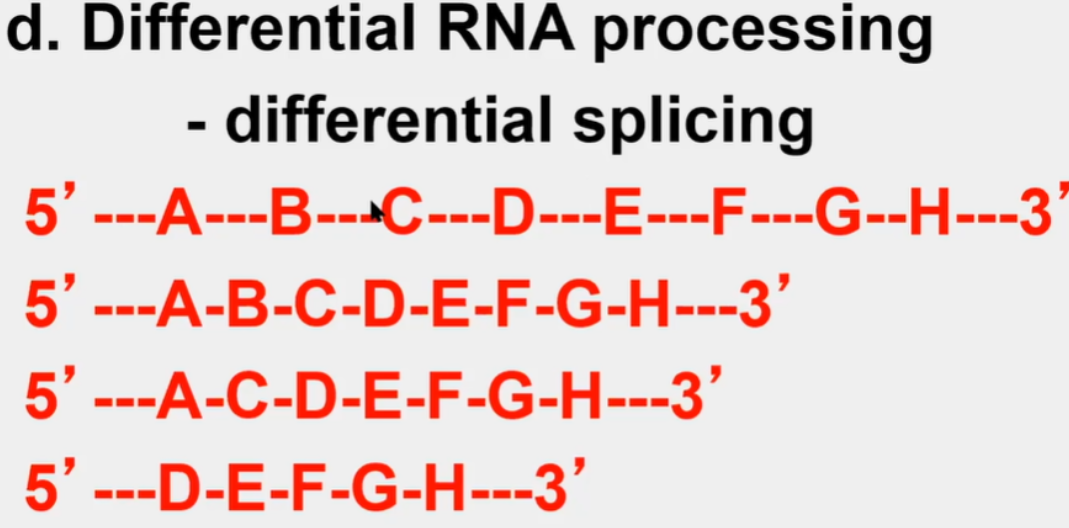
Provide the Type/s and/or Subtype/s of Point of Control of Eukaryotic Gene Expression
You have different transcripts before the mRNA is processed and matured.
After splicing and removal of the intron, you could have all the available exons A to H or removal of one exon, wherein its only A to H except B.
From one primary transcript, the cell has a choice, depending on the signals, of which exons to keep or remove and assemble.
2. Transcriptional Control
e. Selective pre-mRNA degradation
Provide the Type/s and/or Subtype/s of Point of Control of Eukaryotic Gene Expression
You have the pre-mRNA in the nucleus but then there is no need for it by the cell then it will be degraded. Lets say you have pre-mRNA 1, 2, 3, 4, 5 but the cell only needs 1, 2, 3 so the cell degrades the 4 and 5.
You have the pre-mRNA in the nucleus but then there is no need for it by the cell then it will be degraded. Lets say you have pre-mRNA 1, 2, 3, 4, 5 but the cell only needs 1, 2, 3 so the cell degrades the 4 and 5.
Explain
2. Transcriptional Control
e. Selective pre-mRNA degradation
3. Translational Control
a. Selective translation
b. Stability of mRNA
Provide the Type/s and/or Subtype/s of Point of Control of Eukaryotic Gene Expression
What are the Translational Control points?
3. Translational Control
a. Selective translation
Provide the Type/s and/or Subtype/s of Point of Control of Eukaryotic Gene Expression
Even if you have these mRNAs, only some will be used to synthesize proteins as needed.
3. Translational Control
a. Selective translation
Provide the Type/s and/or Subtype/s of Point of Control of Eukaryotic Gene Expression
At different events and time points in the organism's development, there will be different syntheses of proteins, with the level varying over time. It may be high at one point for a gene, then low at another, and then high again.
3. Translational Control
a. Selective translation
Provide the Type/s and/or Subtype/s of Point of Control of Eukaryotic Gene Expression
e.g. in sea urchin
0 translation at/or before fertilization
high protein synthesis after fertilization
low protein synthesis during gastrulation
At different events and time points in the organism's development, there will be selective translation of proteins, with the level varying over time for a given gene. It could be high at one time, then low at another time, then high again.
e.g. in sea urchin
0 translation at/or before fertilization
high protein synthesis after fertilization
low protein synthesis during gastrulation
Explain
3. Translational Control
a. Selective translation
3. Translational Control
b. Stability of mRNA
Provide the Type/s and/or Subtype/s of Point of Control of Eukaryotic Gene Expression
The mRNA, once it is in the cytoplasm, has its lifetime already determined. For a certain amount of time, it will stay in the cytoplasm, available for translation.
3. Translational Control
b. Stability of mRNA
Provide the Type/s and/or Subtype/s of Point of Control of Eukaryotic Gene Expression
The half-life of mRNA is dependent on the length of the poly A tail; the longer the poly A tail, the more stable the mRNA, the longer it can stay in the cytoplasm.
length; poly A tail; longer; poly A tail
The half-life of mRNA is dependent on the ______ of the ___________; the ________ the ________, the more stable the mRNA, the longer it can stay in the cytoplasm.
3. Translational Control
b. Stability of mRNA
Provide the Type/s and/or Subtype/s of Point of Control of Eukaryotic Gene Expression
auto-regulation of the mRNA
e.g. synthesis of histones
When there is no longer a need for histones, the histone itself can act as a signal to cause the degradation of the mRNA.
The mRNA, once it is in the cytoplasm, has its lifetime already determined. For a certain amount of time, it will stay in the cytoplasm, available for translation.
Either be through the length of the poly A tail or the auto-regulation of its degradation through signals.
Explain
3. Translational Control
b. Stability of mRNA

This shows how ribosomes can be anchored onto the RER to have their growing p.p. Chain removed and inserted into the RER to be processed.
This shows how ribosomes can be anchored onto the RER to have their growing p.p. Chain removed and inserted into the RER to be processed.
4. Post-translational Control
Provide the Type/s and/or Subtype/s of Point of Control of Eukaryotic Gene Expression
modification of proteins that needs to happen before they become functional
Its not enough to produce the p.p. chain certain changes must happen for them to become functional proteins.
a. deletion of a part of a polypeptide
b. change in the state of oxidation and reduction
c. attachment of small residue
d. Polymerization
Provide the Type/s and/or Subtype/s of Point of Control of Eukaryotic Gene Expression
What are the processes under the Post-translational Control point?
4. Post-translational Control
d. Polymerization
Provide the Type/s and/or Subtype/s of Point of Control of Eukaryotic Gene Expression
Due to complex interaction, more than one polypeptide will be associated, producing several isozyme forms with unique metabolic activities.
1. Molecular exchanges between the nucleus and the cytoplasm
2. Control of macromolecular synthesis in the nucleus by the cytoplasm
What are the Nucleo-cytoplasmic Interactions?

A nucleus was taken from another cell and radioactively labeled, then transplanted into an amoeba cell that also has its own nucleus, now there tare wo nuclei. One from the host cell and another transplanted, which was radioactively labeled.
They found that the radioactivity was distributed into the cytoplasm and the host nucleus. The probable explanation was that molecules from inside the nucleus, like proteins and RNA, went out into the cytoplasm and went back into the nucleus of the host cell through the nuclear pores.
There is communication and exchange of molecules between the nucleus and cytoplasm.
Explain the experiment done in Amoeba to prove the molecular exchanges between the nucleus and the cytoplasm
2. Control of macromolecular synthesis in the nucleus by the cytoplasm
Nucleo-cytoplasmic Interactions, which process?
DNA synthesis inside the nucleus is an example that can be directed or governed by something in the cytoplasm

So in an adult frog brain tissue, for example, the cells no longer divide; they took the nucleus from one of those cells and transplanted it into an oocyte, which is still a dividing cell.
They noticed that when the germinal vesicles were intact, there would be no DNA synthesis inside the nucleus, while in broken germinal vesicles, there was.
The germinal vesicles in the cytoplasm could be something that would trigger DNA synthesis, in this case, it's DNA polymerase or any other DNA replication proteins or enzymes. With a broken germinal vesicle, this allows the enzymes to enter the nucleus and start DNA synthesis.
Explain the experiment that was used to prove the process of
Nucleo-cytoplasmic Interactions wherein there is a control of macromolecular synthesis in the nucleus by the cytoplasm.
Hint: Nucleus from adult frog.
Morphogenesis
a stage in development where there is a formation of the particular morphology or form of the organism.
Gene Effects on the System of Embryonic Induction
Gene Effects on Endocrine System
Gene Effects on the Regulation of Growth and Metabolism
Gene Effects on Migrating Cells
What are the interactions between Genes and Morphogenesis?
Gene Effects on the System of Embryonic Induction
Genes and Morphogenesis
organizing tissue of one organ triggers the development of another organ.
One organ triggers the development of another organ.
Gene Effects on the System of Embryonic Induction
Genes and Morphogenesis
For example, ureter arises from the mesonephric bud while kidneys arise from the ureter, which is an organizer in kidney formation

Genes and Morphogenesis
In the example of the Sd allele, what is the effect on the development of the kidneys, ureter, and tail?
Whether it’s homozygous recessive, homozygous dominant, or heterozygous.
Effect of dominant Sd allele - no elongation of mesonephric bud - ureter does not reach kidney initial cell - no kidney organizer - no kidneys
Genes and Morphogenesis
What are the effects of the dominant Sd allele?

- absence of large cells in the anterior pituitary gland
no secretion of growth hormone
it occured in the homozygous recessive mice
Genes and Morphogenesis
Explain the gene effects on the endocrine system in terms of the mouse example.
Wherein normal and mutant mice had the same rate of growth initially, while mutant mice stopped growing and never reached maturity
Modification of a metabolic process that is of prime importance to the whole organism.
Which kills the organism.
A metabolic process is affected to some degree
affecting the characteristic of a particular region
Which causes a change in the growth of the region relative to the other parts
Genes and Morphogenesis
What are the types of Gene Effects on the Regulation of Growth and Metabolism?
The organism dies.
Genes and Morphogenesis
Gene Effects on the Regulation of Growth and Metabolism
What happens when a modification of a metabolic process that is of prime importance to the whole organism occurs?
affecting the characteristic of a particular region
Which causes a change in the growth of the region relative to the other parts

In letter c image, you can see the representation of the lethal genotype wherein the limbs are nonexistent.
Genes and Morphogenesis
What happens when a metabolic process is affected to some degree?
Cpcp — "creeper" trait
Genes and Morphogenesis
A mutation that causes the following in chickens:
- smaller eyes
- no eyelids
- misshapen head
- smaller body
- skeleton not ossified

Genes and Morphogenesis
Gene Effects on Migrating Cells
Migration
Genes and Morphogenesis
Genes affect the differentiation and __________ of cells to other regions
__________ is important for the embryo as they have to travel to different sites, which will govern the expression of a particular organ.
W
Genes and Morphogenesis
in mice, cell migration is due to ____ allele
- melanophore migration near embryonic nerve cord
- production of pigments in the skin and hair
- RBC migration to the blood-forming tissues
- migration of ancestors of germ cells to the prospective genital regions
Genes and Morphogenesis
Gene Effects on Migrating Cells
What are examples cell migration as mentioned in class?
Examples of gene regulation in humans
Development of the fetus
1st trimester
- head, fast developing
later part of 1st trimester and 2nd trimester
- limbs develop faster
- development of the trunk
Examples of gene regulation in humans
Development of the fetus
1st trimester
- _______________, fast developing
later part of 1st trimester and 2nd trimester
- _______________ develop faster
- development of the _______________
Examples of gene regulation in humans
Development of the nose
- at birth, infants have pug nose
- at early child's development
nose develops fastest
large nose in proportion to the other parts of the face
after adolescence:
- nose stops growing
- other parts of the face are growing
- 16 to 18 years old (proper proportion)
Examples of gene regulation in humans
Development of the nose
- at birth, infants have pug nose
- at early child's development
nose develops fastest
_______ nose in proportion to the other parts of the face
after adolescence:
- nose _______ growing
- other parts of the face are growing
- 16 to 18 years old (proper proportion)
Lemonick M.D. and A. Dorfman 2006. What makes us different? Time Magazine Dec. 2006. 39-45.
They mentioned in a magazine that 98 to 99% of the DNA of chimps and humans is identical.
Genes
_______ alone don't dictate the differences.
It depends on molecular switches that tell _______ when and where to turn on and off.
Only some _______ are on or off in humans while others maybe on or off in chimps. That's why we look so different even with such similar genes.
 Note
Note  Flashcards (70)