ling 313 - week 14
 Studied by 0 people
 Call Kai
 Learn
Learn Practice Test
 Spaced Repetition
 Match
Match Flashcards
 Knowt Play
1/23

There's no tags or description
Looks like no tags are added yet.
Name | Mastery | Learn | Test | Matching | Spaced | Call with Kai |
|---|
No analytics yet
Send a link to your students to track their progress
24 Terms
Nasal descriptions and the IPA
The closure portions used in stops are also used for nasal consonants.
Air is allowed to flow through the nasal passage by lowering the velum.
The oral cavity then forms a side cavity.
Pharyngeal and glottal closures are formed below the velopharyngeal port, so there can be no nasal consonants at these places.
Nasal consonants are most often - but not always - voiced. Voiceless nasals are marked with the voiceless diacritic.
There are lots of places of articulation represented in nasals across languages.
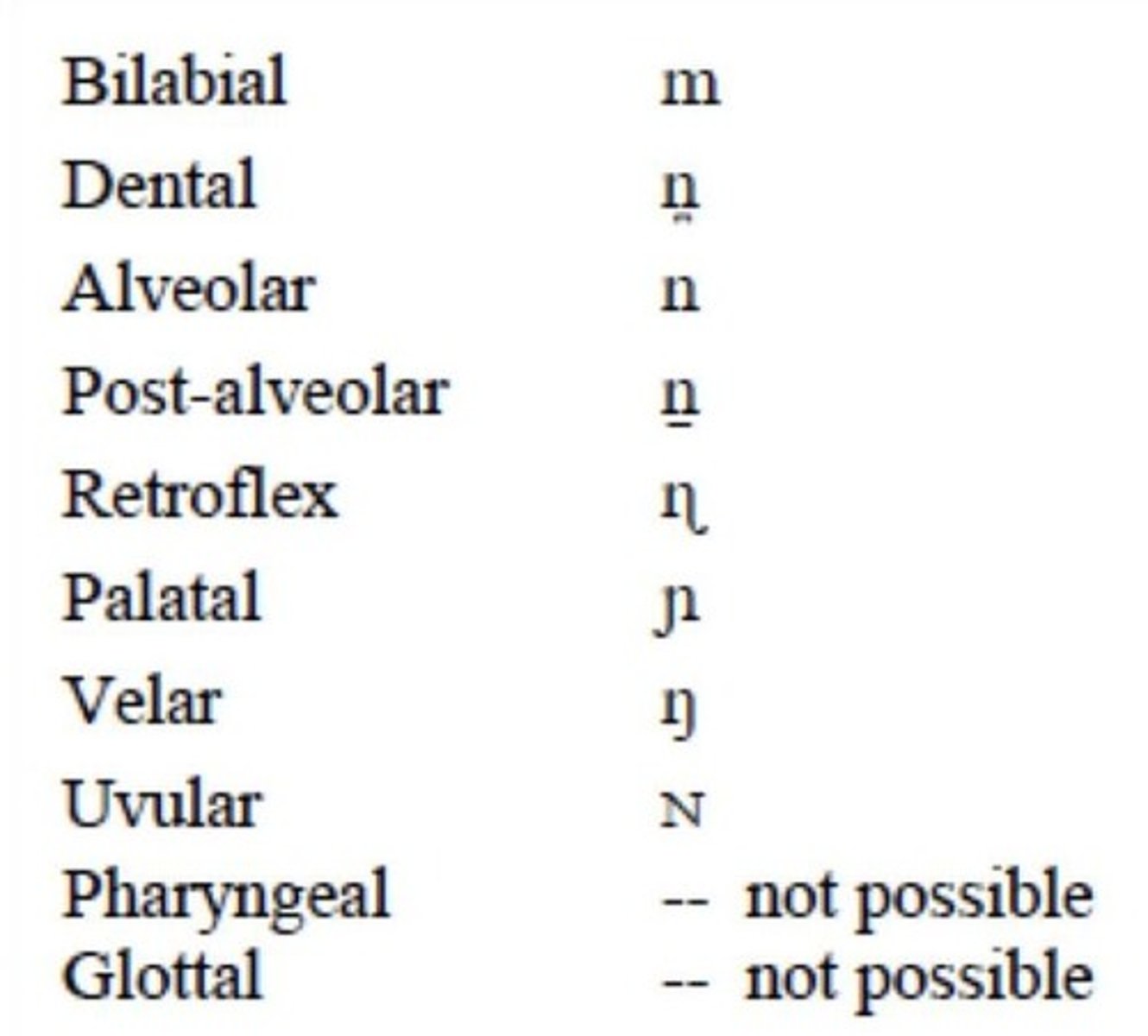
nasal acoustics
• Nasals (and laterals) break up the vocal tract in different ways than vowels and stops (in their shutting and opening phases).
• This decreases their amplitude relative to vowels.
• They also have increased bandwidth compared to vowels.
Damping and increased bandwidth
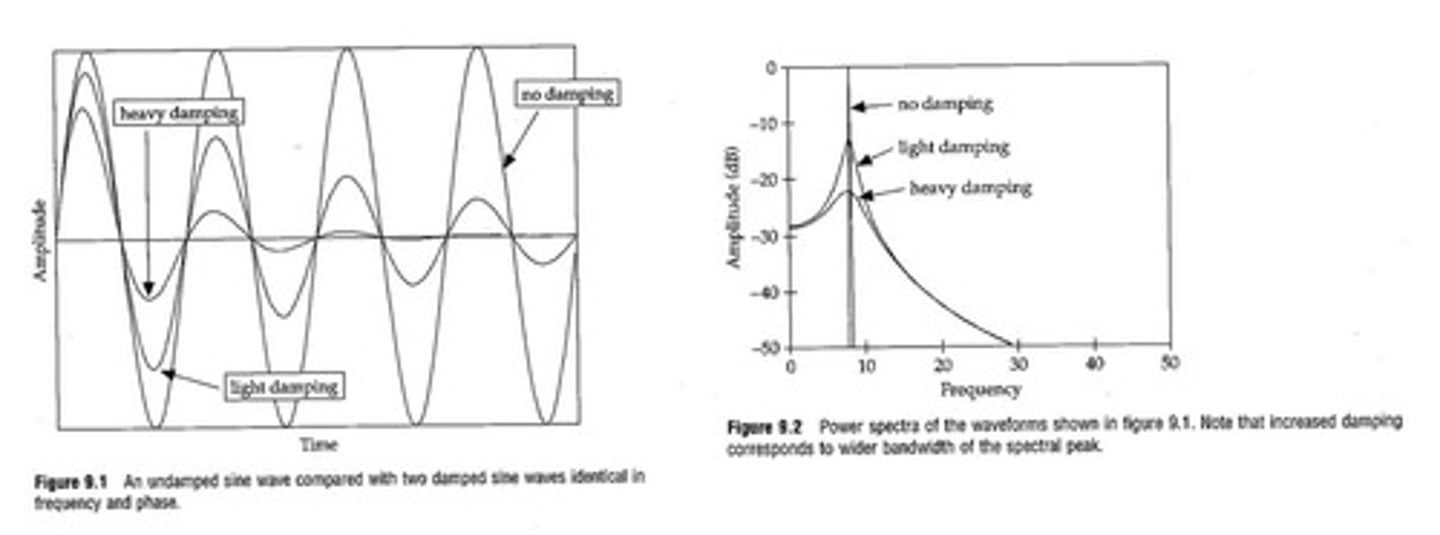
why?
Soft walls of the vocal tract absorb sound and dampen the resonant frequencies.
In nasals, the velo-pharnygeal port is open, which means there is more surface area for absorption.
Thus, nasals have larger bandwidths than oral sounds
tube model for nasals
The side branch is going to make things tricky.
What's going to be the easiest nasal to model acoustically?
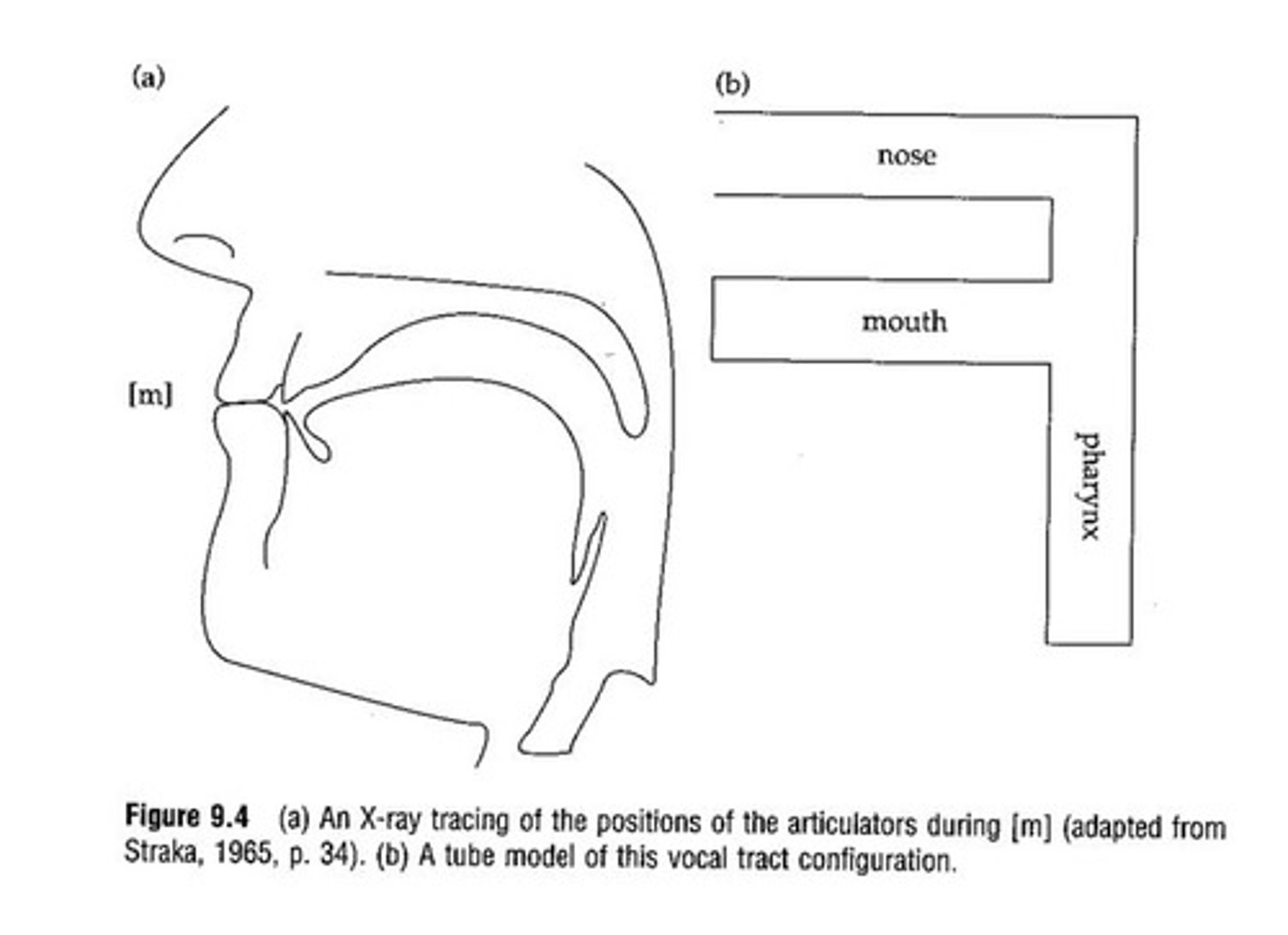
What's going to be the easiest nasal to model acoustically?
•Uvular nasal: /N/
• Uniform tube that is closed on one end and open on the other.
• The nostrils are always constricted.
• This means the formants will always be lower than what we calculate based on our tube model (because perturbation theory).
What about non-uvular nasals?
In these cases, you have what's called a side branch within a larger resonance tube.
• Frequency components that resonate in the side branch are cancelled from the spectrum, forming anti-resonances or anti-formants.
anti-formants
• Anti-formants are spectral valleys.
• Harmonics in the sound source near the resonant frequencies of the side cavity are trapped/absorbed by the side branch.
• Those frequency components are subtracted from the acoustic signal.
• This is not the same as a frequency region that is simply not amplified.
place of articulation
• The frequencies of the anti-formants depend on the length of the oral tube.
• So, the location of the anti-formants serves as a perceptual cue to place of articulation.
First pass at predicting nasal formants
• Estimate whole tube resonant frequencies • Glottis to nostrils
• Estimate the anti-formants by calculating resonant frequencies of side branch • Place of articulation of nasal to pharynx.
• Estimate whole tube resonant frequencies • Glottis to nostrils
• Estimate the anti-formants by calculating resonant frequencies of side branch • Place of articulation of nasal to pharynx.
nasality
• A nasal spectrum will have increased bandwidth in lower frequencies.
• A nasal spectrum will have weak energy in the higher formants.
• This will provide a strong cue to NASAL, but a relatively weak place of articulation cue.
weaker formants in nasals
• Nasals have weaker formants than vowels (particularly at the higher frequencies).
• Why?
• Presence of side cavities.
• Each contributing anti-formants
• Vocal tract is more constricted in nasal consonants than in vowels.
sinuses
• Your sinuses function as Helmholtz resonators and add their own anti-formants to the signal.
• Nasals are pretty complicated, so our predictions as to what their formant structure won't be all that accurate.
• Individual variation in sinus cavities is a contributing factor.
• No sex-based differences in nasal formant frequencies.
• Testament to individual variation
Nasal formants and adjacent oral formants at transitions provide place of information clues.
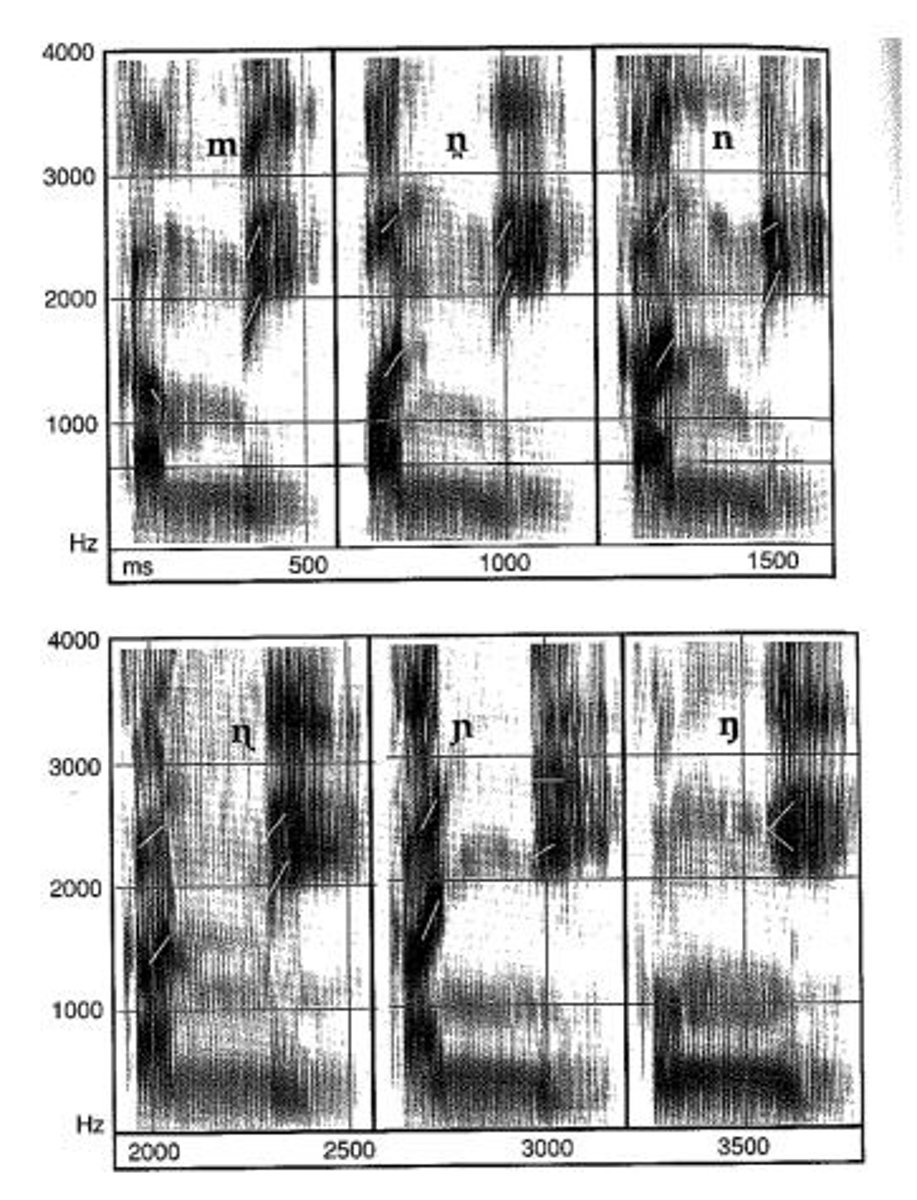
laterals
• The tongue divides the oral cavity into two, but there is not a complete closure.
• The configuration of the tongue is such that a small pocket of air sits on top of the tongue.
• This pocket functions as a side-branch.
Lateral side branch tube model
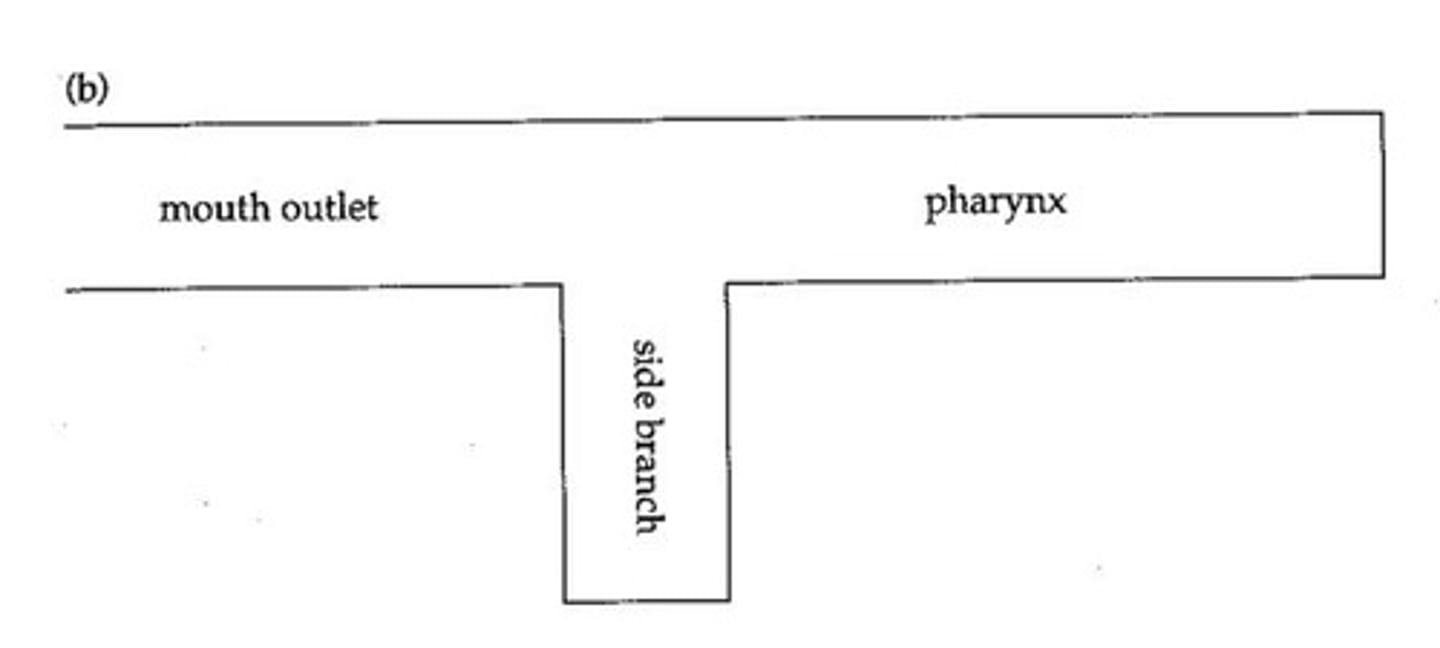
for /l/
F1 and F2 should be lower than expected
• Fant (1960) predicts that antiformant should be present around 2000 Hz, but this is going to depend on the kind of lateral produced
example /l/
Anti-formant between F2 and F3.
• Lower F1 than predicted because the tube diameter in front of the constriction is more narrow than the tube behind the constriction.
Formants in laterals and formant transitions at adjacent vowels produce place of articulation information for lateral consonants.
comparing nasals and laterals
Formant spacing is wider in laterals than in nasals because of overall differences in tube length
Tube physics: smaller tubes resonant at higher frequencies so their multiples will be spaced further apart.
vowel nasalization
During nasalization, both the oral and nasal cavities are open.
typically, the oral passage is more open than the nasal passage.
thus, the nasal passage produces the anti-formants.
Anti-formants in nasalized vowels are a function of the coupling between the nasal passage and the pharynx.
Degree of nasalization: the more open the velo-pharyngeal port, the higher the anti-formants.
cavities during nasalization
During nasalization, both the oral and nasal cavities are open.
Typically, the oral passage is more open than the nasal passage.
Thus, the nasal passage produces the anti-formants.
What I want you to know: the passage that is more open is the one that produces the formants, the one that is less open produces the anti-formants
rhotics
The main acoustic feature is the lowering of F3. • This can be a manner of degree.
walker, 2014 take home point
One's realization of / ɹ/ varies according to the social and pragmatic context in which it is produced.
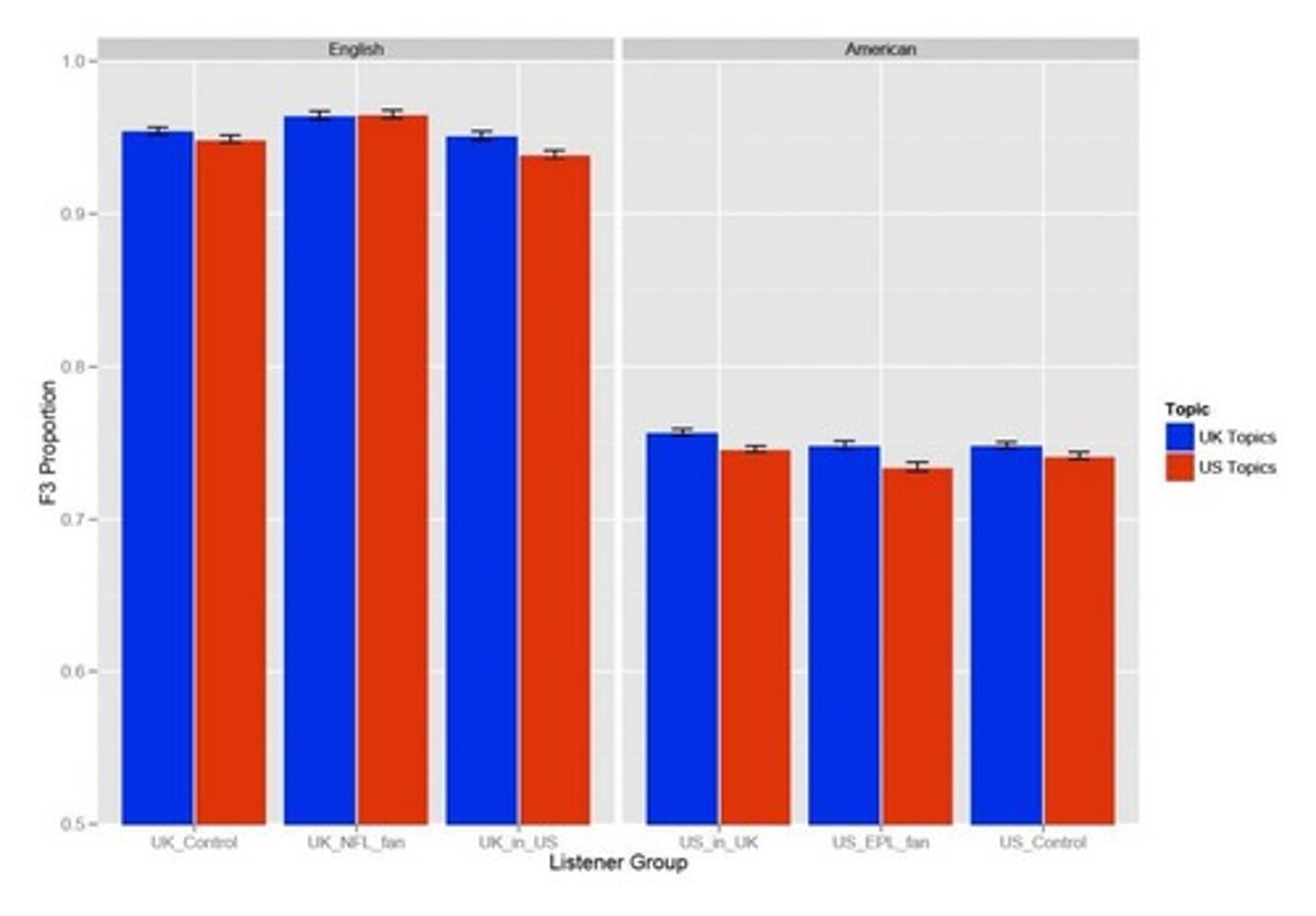
 Note
Note  Flashcards (69)