Patterns of Fetal Anomalies
 Call Kai
 Learn
Learn Practice Test
 Spaced Repetition
 Match
Match Flashcards
 Knowt Play
1/59

There's no tags or description
Looks like no tags are added yet.
Name | Mastery | Learn | Test | Matching | Spaced | Call with Kai |
|---|
No analytics yet
Send a link to your students to track their progress
60 Terms
Fetal anomaly incidence:
major anomly 3/100 births
10-15% = minor birth defect
Testing for genetic disorders prior to birth can prepare families for life with a special needs child or allow parents to choose to terminate the pregnancy
Aneuploidy
abnormal number of chromosomes
Karyotype
the chromosomal complement of an individual, including the number of chromosomes and any abnormality
Trisomy
the presence of three chromosomes of a given number, rather than two
Autosomal Recessive
a genetic condition that only appears in individuals that received two copies of an autosomal gene
One copy from each parent
The gene is an an autosome, a non-sex chromosome
Parents are carriers who have only on copy of the gene and do not exhibit the trait
What are the statistics if both parents are carriers of an autosomal recessive gene?
there is a 25% chance of a child inheriting both abnormal genes + developing the disease
There’s a 50% chance of a child inheriting only one abnormal gene and being a carrier
And 25% chance the child will inherit both normal genes
Autosomal Dominant
an affected individual has one copy of an abnormal gene on are pair of autosomal chromosomes
Individuals w/ autosomal dominant diseases have a 50/50 chance of passing the mutant gene + the disorder onto each of their children
X-Linked
X-linked diseases are single gene disorders that reflect the presence of defective genes on the X chromosome
Affected males do not transmit the disorder to their sons, but all of their daughters will be carriers
Mosaicism
the occurrence of a gene mutation or chromosomal abnormality in only a portion of an individual’s cells
This causes two different genotypes (karyotypes) in an individual
Normal Karyotype
normal Karyotype consists of 46 chromosomes
22 pairs of autosomes
1 pair of sex chromosomes
Females XX
Males XY
Trisomy 13 AKA:
Patau Syndrome
Trisomy 13
mean survival age is 2.5 days
cardiac defects (>80%)
IUGR
Cleft lip / plate
Ocular (eye) anomalies
Clenched hands
Patau Syndrome (T13) is associated with:
microcephaly, CNS abnormalities (ex: absent corpus callosum), abnormal posterior fossa, venticulomegaly
Cardiac defects (>80%)
IUGR
Cleft lip / palate (60-70%)
Ocular anomalies
Rocker bottom / club feet
Clenched hands w/ overlapping digits / polydactyly
Abnormal features seem w/ holoprosencephaly
T13 findings:
U/S is very sensitive for detecting Trisomy 13
sensitivity up to 90%
Survivors have:
severe intellectual disabilities
seizures
apnea
feeding difficulties
failure to thrive
Trisomy 18 AKA:
Edwards Syndrome
Trisomy 18
95% result on spontaneous Ab
Second most common autosomal trisomy
Common intrauterine demise
Edward’s Syndrome (T18) signature finds:
2VC
Cardiac anomalies (90%)
Strawberry shaped skull**
Cleft lip / palate
Rocker bottom feet
Umbilical cord cysts
Other T18 findings include:
FGR
Polyhydramnios
Dolichoceohaly
Microcephaly
Hydrocephalus
Agenesis of the corpus callosum
Cerebellar hypoplasia
Low set ears
Micrognathia
Clenched hands
Club feet
Omphalocele
VACTERAL (S)
Cystic hygroma
NTD
Trisomy 21 AKA:
Down Syndrome
Trisomy 21
most common autosomal trisomy
1/800 children
High level of mortality in the first year d/t heart defects + increased incidence of leukemia
Down Syndrome (T21) signature findings:
thick nuchal skin fold
small / absent nasal bone
hypoplasia midphalynx of the fifth digit
sandal (toe) gap
cardiac defects (A-V Canal, ASD, VSD,Tetralogy of Fallot)
Intecardiac echigenic focus
Duodenal atresia
Echogenic bowel
Other T21 findings include:
short stature
small flat nose
small ears
clinodactyly
simian crease
brachycephaly
flat occipital
epicanthal folds
protruding tongue
cystic hygroma
FGR
mild ventriculomegaly
Turner Syndome AKA’s:
monosomy
Monosomy X
Congenital Ovarian Hypoplasia Syndrome
Turner Syndrome
absence of one X chromosome
only occurs in females
cystic hygroma
webbed neck
poor hearing
Monosomy findings include:
cystic hygroma
cardiac anomalies
aortic coarctation
lymphedema
hydrops
renal anomalies
short stature
lack of sex organ development
webbed neck
poor hearing
Apert Syndrome
autosomal dominant
characterized by premature fusion of he skull bones
craniosynostosis
no specific maternal serum markers
may have elevated MSAFP in case of open spinal defect
craniosynostosis
main characteristic of Apert Syndrome
results in changes of head and face shape
Key characteristics of Apert Syndrome include:
craniosynostosis
increased cephalic index
sinking of the midface
maxillary underdevelopment
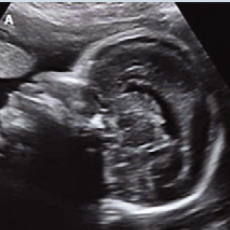
Other findings of Apert Syndrome include:
frontal bossing
premature skull fusion
hypertelorism
agenesis of the corpus callosum
ventriculomegaly
syndactyly / digit fusion
CHARGE Syndrome
colobomatous malformation
males
coloboma - hole in a structure of the eye
affects eyesight depending on location
eyes may be small, + possibly also the nasal passages
Signature findings of charge syndrome:
colobomatous malformation → hole in eye(s)
Heart defects**
cranial nerve anomalies (degree of hearing loss)
ear anomalies (anomalies of shape + size almost always occur)
Atresia Choanae
Other CHARGE syndrome findings may include:
Intellectual + growth deficiencies / disabilities
Genitalia hypoplasia
Cranial nerve anomalies
Swallowing difficulties, facial paralysis, diminished smell
Micrognathia
Cleft palate
Renal anomalies
Omphalocele
TE fistula
hemivertebrae
Hypertelorism
CHARGE syndrome cardiac anomalies:
most commonly recognized prenatal finding w/ CHARGE
Tetralogy of Fallot
Double-Outlet RV w/ an A-V canal
VSD / ASD
Right sided + interrupted Ao arch
Goldenhar Syndrome AKA:
Oculoauriculovertebral Syndrome
Goldenhar Syndrome
male
Incomplete development of the ear, nose, soft palate, lip, and mandible on only one side of the body
Usually unilateral
Associated w/:
Scoliosis, hemivertebrae, + cervical fusion
Key findings of Oculoauriculovertebral syndrome (Goldenhar syndrome):
facial asymmetry
Cleft lip / palate
Microphthalmia
Hemivertebrae
Scoliosis
Respiratory + feeding problems
Intellectual disabilities
Other findings of Goldenharr Syndrome:
Cardiac defects → VSD’s, tetralogy of Fallot, + Aortic Coarctation
Renal anomalies
UPJ obstruction, Multicystic dysplastic kidney
Meckel-Gruber Syndrome
rare
Autosomal recessive
Slightly more common in Finland
Renal dysplasia, limb anomalies, + encephalocele
Poor prognosis d/t kidney issues & oligohydramnios impacting lungs
Most common findings of Meckel-Gruber Syndrome:
Polycystic kidney disease (100%)
Polydactyly (55-75%)
Occipital encephalocele (60-80%)
Poor prognosis
Other findings of Meckel-Gruber Syndrome include:
oligohydramnios
Postaxial polydactyly
Limb bowing / shortening
Dandy-Walker Syndrome
Noonan Syndrome
cystic hygroma is a similar finding to Turner syndrome
Cardiac anomalies (60%)
Low set ears, depressed nasal bridge, & macrocephaly
VACTERAL(S) Association:
V - Vertebral anomalies
A - Anal Atresia
C - Cardiac anomalies
TE - Transesophageal Fistula
R - Renal Anomalies
L - Limb defect
S - Single Umbilicl Artery
** rare but has been associated w/ diabetic mothers
Chorionic Villus Sampling (CVS)
biopsy of placenta or chorionic villi
Chorionic villi are fetal in origin = ability to detect chromosome anomaly (Does not test for NTD’s!)
Biochemical, metabolic disorders, thalassemia, sickle-cell disease may also be diagnosed
Transceevical / Transabdominal CVS approach:
determine placental location relative to the cervix and path of sampling catheter
Determine fetal age, lie, + viability
Uterine mass or other obstacle?
Risk of loss = 0.5-1.0%
Inc risk of limb defects if performed before 8 weeks!
Transvaginal CVS approach:
careful OB/GYN hx taken
Active infection of vagina / genital tract, IUD’s, & cervical stenosis are all contraindications
Complete U/S eval
Confirm viability, GA, placenta location
Pt in lithotomy position
Speculum inserted
Transvaginal CVS approach:
thickest part of trophoblast (chorion frondosum) is the target area of obtaining samples
Specimen aspirated
Done under constant U/S visualization
Transvaginal CVS approach sampling process:
20-30 mg of tissue is obtained and put in tube w/ culture medium
Specimen is shaken and examined under light to make sure enough chorionic villi is present
May use microscope
Check fetal heartbeat
The difference in the transabdominal CVS approach:
pt is sound
Placental thickness measured
Abdomen site with cleansed
Needle inserted into placenta
Transabdominal vs Transvaginal CVS:
TA reduced risk of infection
Greater risk in obtaining specimen
Used with anterior placenta
TV expediences more complications such as fluid leakage and vaginal spotting
Higher association w/ pregnancy loss
CVS advantages:
performed early 10-12 weeks
Results within 1 week
Early results = options for parents
Amnio
performed after 14 weeks
Results take 7-14 days to grow chromosomes
Amniocentesis
relieve polyhydramnios, predict Rh isoimmunization, detect fetal lung maturity and chromosome analysis
Best for genetic analysis between 15-28 weeks can be done as early as 12 weeks
But may lead to complications
What are the indications for an amniocentesis?
abnormality on U/S
Screening d/t maternal disease
Risk factor
Amniocentesis screens for:
Gestational age
Defects
Placental location
Fetal lie
Always confirm post tap FHR!
Amniocentesis Protocol:
Operative site is draped with sterile towel
Use sterile precautions entire time
Reduce risk of infection
Cover trdx with sterile cover
Needle inserted under U/S guidance
20-30ml is withdrawn
Needle withdrawn
Check for heart rate and document
Maturity Amniocentesis
perform anytime to determine lung Maturity for delivery
Usually in 3rd trimester
L/S ratio (Lecithin / sphingomyelin)
Obtain results the same day
FISH
Fluorescence In Situ Hybridization
Fast form of an amnio
Results within 24 hours
Still need to do complete amniocentesis
Usually screens T13, 18 & 21
Cordocentesis AKA:
PUBS → Percutaneous Umbilical Blood Sampling
Cordocentesis (PUBS)
high risk for complications
Fetal blood sample is obtained thru needle aspiration of the umbilical cord
Can also transfuse blood or supple medication directly to the fetus via the cord
Embryoscopy
direct viewing of developing fetus via transcervical endoscope inserted into the extra-coelomic space in the 1st semester
Detect fetal anomalies
Take blood samples
In future potential for gene therapy?

