L5: Subset selection and shrinkage methods
 Call Kai
 Learn
Learn Practice Test
 Spaced Repetition
 Match
Match Flashcards
 Knowt Play
1/25

There's no tags or description
Looks like no tags are added yet.
Name | Mastery | Learn | Test | Matching | Spaced | Call with Kai | Chat |
|---|
No analytics yet
Send a link to your students to track their progress
26 Terms
Linear model
Linear model has advantages with interpretability and good predictive performance
Advantages:
Inference
Competitive to non-linear models
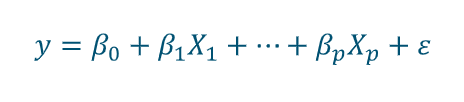
Prediction accuracy
True relationship linear, MLR low bias
Ratio p and n is important
n »p : low variance
n ~p: high variance, overtraining
n <p: no unique model (variance infinite)
Interpretability
Not all variables are associated with the response
By removing irrelevant features (set coefs to zero)
→ more easily interpreted, feature selection
Three alternatives to least squares
Subset selection
Shrinkage
Dimension reduction
Subset selection
Identify a subset of predictors that best predicts a response. Use least squares to fit the model
Shrinkage
Fit a model using least squares but shrink the coefficients to zero. This reduces variance and can perform variable selection
How to select subsets
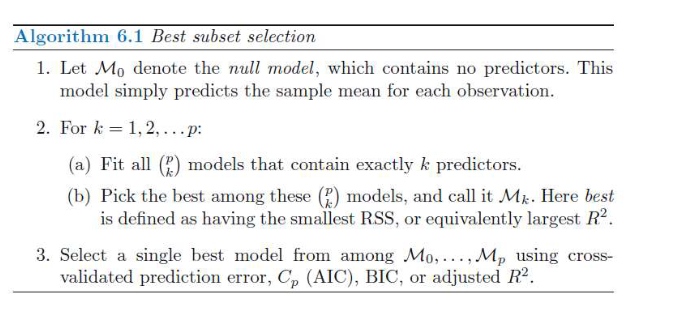
Best subset selection
Fit separate least squares regression model
For each possible combination of predictiors
model with 1,2, .. p predictorss
How to select single best model?
Select best model out of p+1 models
RSS decreases monotonically, R² increases monotonically
RSS/R² is a bad choice
will end with max variables in model
RSS/R² is about training error
Choose model with low test error
Cross validation or some other criterion
Cp, AIC, BIC and adjusted R²
Best subset selection is unfeasible for p > 40
same logic for best subset also extends to other models
logistic regression
Forward stepwise regressoin
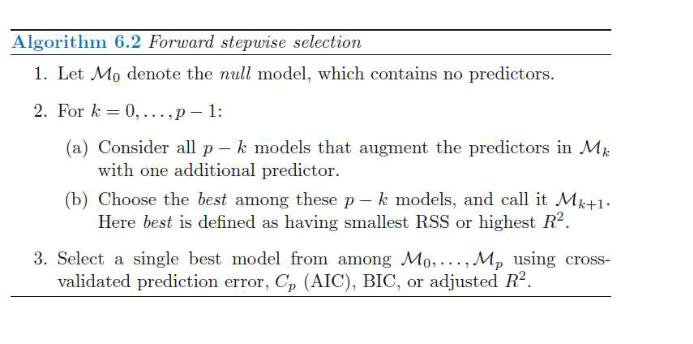
Computationally efficient alternative
start with an empty model
keeps on adding predictors one-at-a-time that gives best additoinal improvement
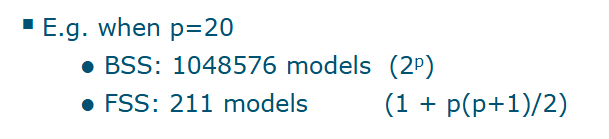
Cost - how many models
Best subset selction: 2^p models
Forward stepwise selection:
One null model
p=k models in the Kth iteration (k=0, …, p-1)
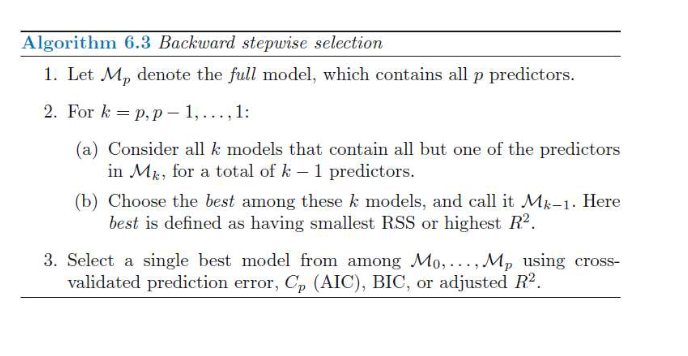
Backward stepwise selection
Starts with full least squares model containing all predictors
Iteratively removes least useful predictor one at a time
like forward, 1 + p(p+1)/2 models
n>p (must be)
Hybrid approaches
Combination of forward selection and backward elimination
Idea is to remove a variable added by forward when it no longer improves the model fit
Choosing the best model
Select the best model amongst models with different number of predictors
Training error estimates R², RSS are not suited
Best model: model with smallest test error
Two common approahces
make adjustment to training error
Cross validation
Cp, AIC, BIC and adjusted R²
Training error MSE is underestimate of test MSE
Adjust training error for model size
can be used to select between models with different numbers of variables
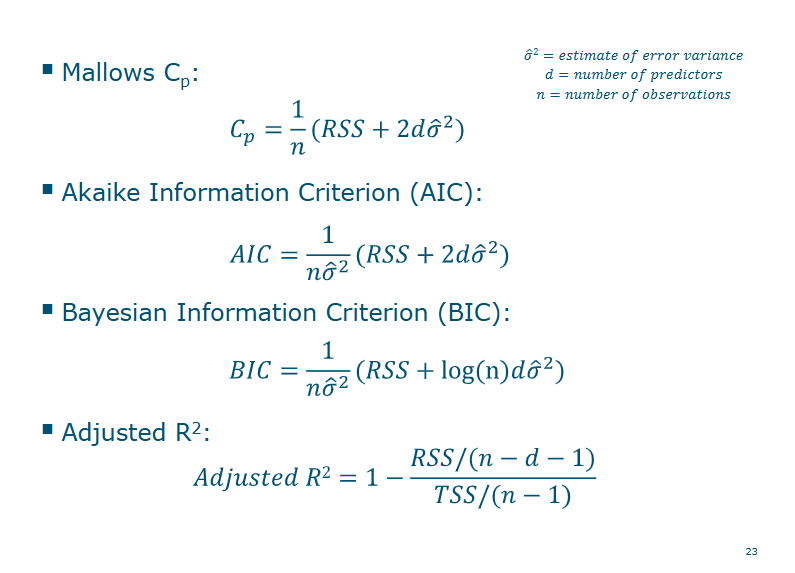
Four criteria
Mallow’s Cp, colin lingwood mallows
AIC, Aikake information criterion, hirotugu aikake
BIC (Bayesian information criterion)
Adjusted R²
Cross-validation
K-fold cross validation
Leave-one-out cross validation
Advantage over AIC, BIC, Cp and AdjR^@
Provides a direct estimate of test error
Fewer underlying assumptions
Useful in wider range of model, e.g. hard to estimate estimate of error varaince
One-standard-error-rule
Select smallest model for which test error is within one standard error of the lowest point
Shrinkage methods
Subset methods use least squares to fit a model using a subset of predictors
Alternatively, we can fit all predictors using a technique that constrains or regularizes the coefficient estimates
shirnks the estimates to zero
Shirnking coefficients reduces their variance
best known methods: ridge regression and lasso
q
Ridge regression
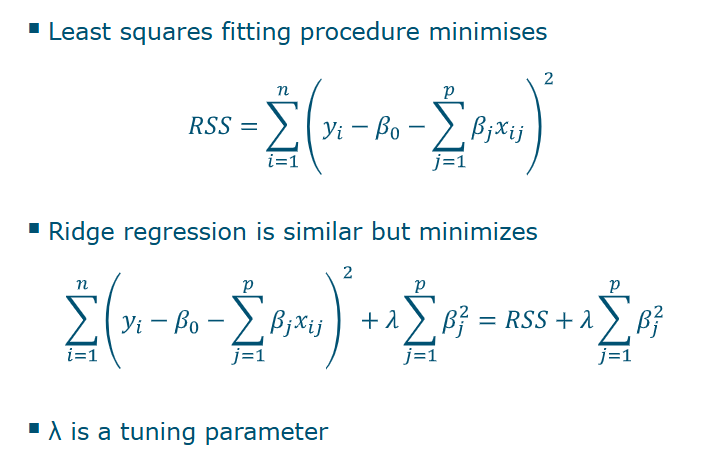
As with least squares, ridge regression seeks coefficient estimates that fit the data well, by making the RSS small
However, the second term (shrinkage penalty) is small when beta1, … beta p are close to zero and thus it has the effect of shrinking the estimates of Betaj towards zero
The tuning parameter lambda serves to control the relative impact of these two terms on the regression coefficient estimates
Lmabda
when lambda = 0, penalty has no effect, ridge produces least squares estimates
when lambda → infinity, impact of penalty grows and coeffiicient will aproach zero
Selecting a good vaue for lambda is critical
cross-validation is used for this
scaling of predictors
The standard least squares coefficient estiamtes are scale equivariant
multiplying Xj by a constant c simply leads to a scaling of the least squares coefficient estimates by a factor of 1/c
In contrast, the ridge regression coefficient estimates can change substantially when multiplying a given predictor by a constant, due to the sum of squared coefficients term in the penalty part of the ridge regression objective function
Therefore, it is best to apply ridge regression after standardizing the predictors
Why does ridge improve over least squares
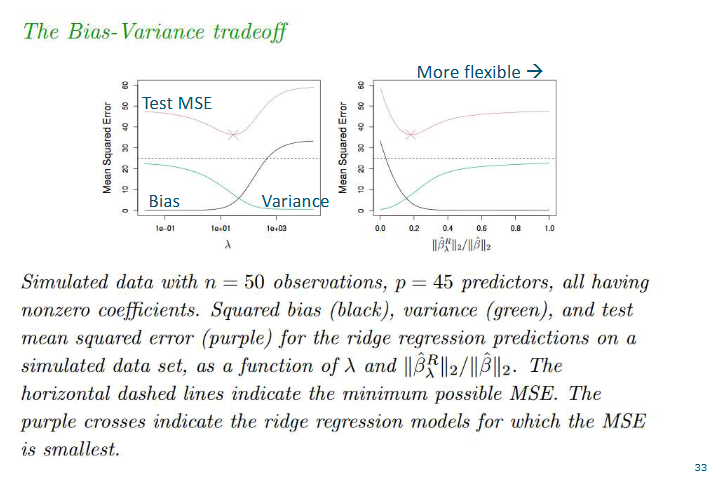
Ridge regression is an "improvement" because it accepts a tiny bit of bias (not fitting the training data perfectly) in exchange for a massive reduction in variance (making better predictions on new data). Variance is the error that comes form being too sensitive to small fluctuations in the training set
In data science, we almost always prefer a model that is "mostly right all the time" over a model that is "perfectly right once but wrong everywhere else."D
Drawback of ridge regression
It will include all p predictors, no selection
None of the regression coefficients will become exact zero
Not a problem for model accuracy
A problem for model interpretation
The Lasso
Lasso also shrinks coefficients to zero, but this time they can become zero
Models have fewer predictors, thus easier to interpret
Lasso performs variable selectionV
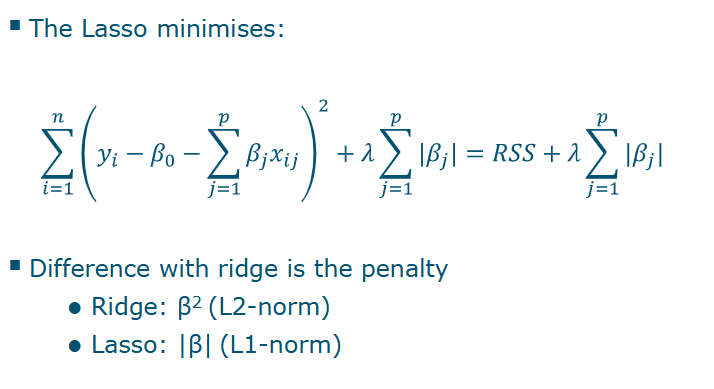
Variable selection properties of Lasso
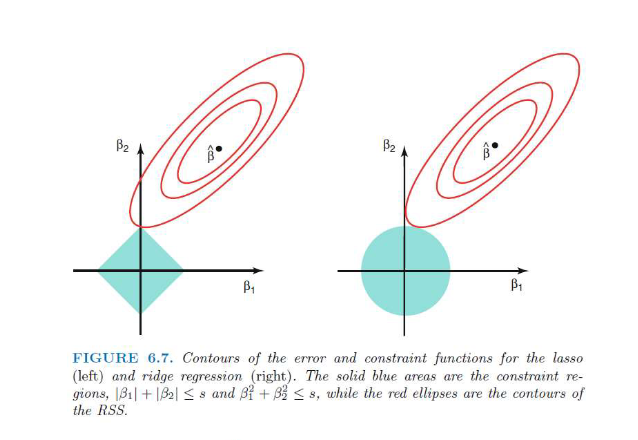
1. The Shapes: The "Constraint Regions"
The blue areas represent the "budget" or limit placed on the coefficients ($\beta_1$ and $\beta_2$). The penalty parameter $\lambda$ (or $s$ in this diagram) determines how small these shapes are.
Lasso (The Diamond): Because Lasso uses absolute values ($|\beta_1| + |\beta_2| \leq s$), the boundary is a diamond. In 2D space, absolute values create straight lines that meet at sharp corners on the axes.
Ridge (The Circle): Because Ridge uses squared values ($\beta_1^2 + \beta_2^2 \leq s$), the boundary is a circle. This is the standard equation for a circle centered at the origin.
2. The Red Ellipses: Residual Sum of Squares (RSS)
The red rings are like a "topographical map" for error.
The black dot ($\hat{\beta}$) in the center is the Least Squares estimate (the point of minimum error).
As you move away from that dot, the error (RSS) increases. Every point on a single red ring has the exact same error level.
wHat is better, ridge or lasso?
Depends on data characteristics
Lasso assumes some predictors are not related to the response
Ridge includes all predictors in the model
Selecting the tuning parameter
As for subset selection, for ridge regression and lasso we require a method to determine which of the models under consideration is bets
That is, we require a method selecting a value for the tuning parameter lambda, or equivalently, the value of the constraints
Cross-validation provides a simple way to tackly this problem. We choose a grid of lambda values, and compute the cross-validation error rate for each value of lambda.
We then select the tuning parameter value for which the cross-validation error is smallest
Finally, the model is re-fit using all of the available observations and the selected value of the tuning parameter