bio 108 topic 35: primates and humans
 Studied by 0 people
 Call Kai
 Learn
Learn Practice Test
 Spaced Repetition
 Match
Match Flashcards
 Knowt Play
1/20

There's no tags or description
Looks like no tags are added yet.
Name | Mastery | Learn | Test | Matching | Spaced | Call with Kai |
|---|
No analytics yet
Send a link to your students to track their progress
21 Terms
Primates what r they
include lemurs, monkeys apes
Humans part of apes evolved from mammalian ancestors that lived in trees
Shared derived traits of primates (4)
Grasping hands and feet
opposable thumbs
Precise grip
Digits w flat nails and sensitive tactile pads for better control and touch sensitivity
Flexible limbs and shoulder joints
arboreal and terrestrial movement
Wide range motion bc shoulder joints and mobile hips
(Climb walk leap)
Forward facing eyes
binocular vision for accurate distance judging
Rely on vision than smell
Large brain relative to body
big in learning memory problem solving areas
Complex social behaviour
Extended parental care (babies dev skills via observation and practice)
Anthropoids include
Monkeys and apes
Apes diverged from
Old anthropoids
Apes have
no tails
Large brains
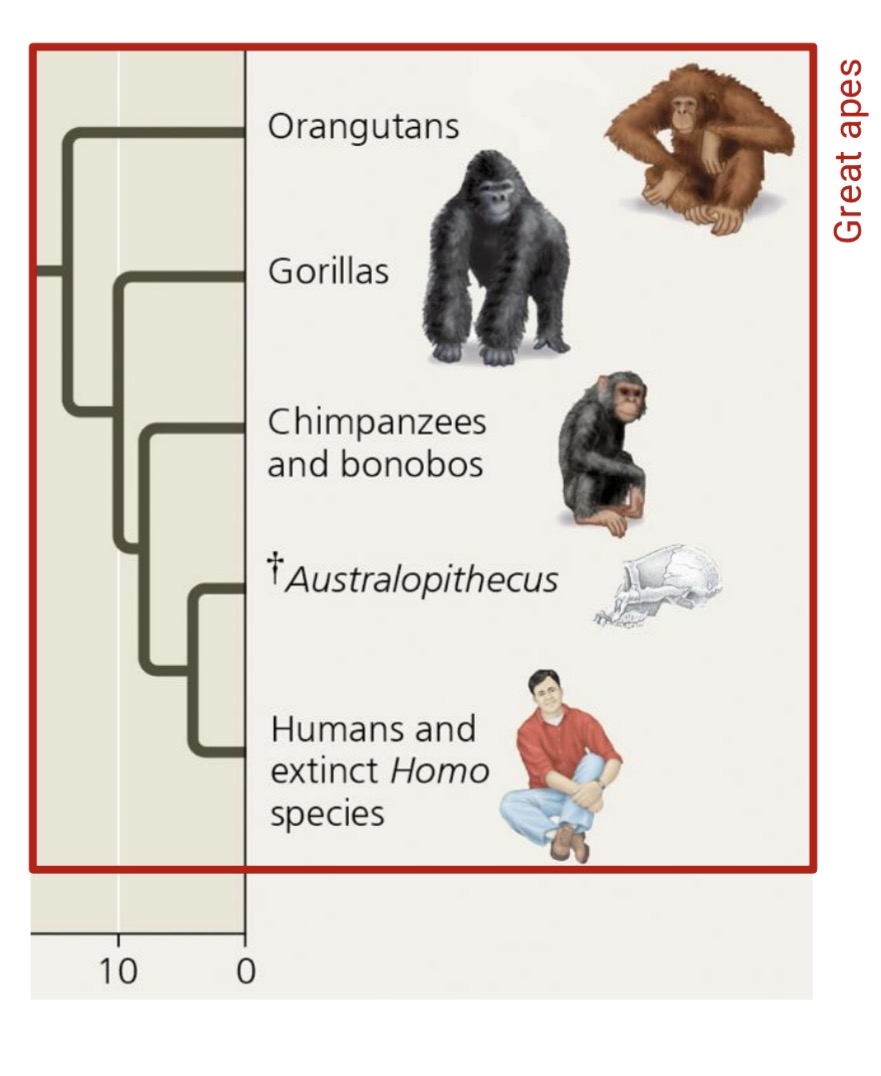
Great apes
orangutangs
Gorillas
Chimpanzee
Bonobos
Humans
Human and chimpanzee genomes are 99% similar meaning
Tehy shared a common ancestor
Not humans evolved from chimpanzees
Shared derived traits of humans (4)
Obligate bipedalism
only primates adapted for walking upright
Larger brains
complex language, thought, artistic
Reduced jaw and face structure
small teeth, not protruding jaw, flat face
Extended childhood and learning
results in and advanced learning and brain dev
Challenges that pushed for bipedalism
large mammal predators
Comp from terrestrial primates
Change in habitats (decline in arboreal env and more grasslands )
Pros of bipedalism
enhanced visibility of predators and prey
Energy efficient locomotion (good for long distance travl’
Better thermoregulation in open habitats (Max breeze and min body sees hot sun during midday)
Free hands to carry food tools and babies
Cons of bipedalism
vulnerable to foot injury
Strain in hips, back, knees and ankles
Hominin
Small brains
Increasing bipedalism Formerly called hominids
More closely related to humans than chimpanzees
Evolutionary history shows many branches coexist but only humans alive today
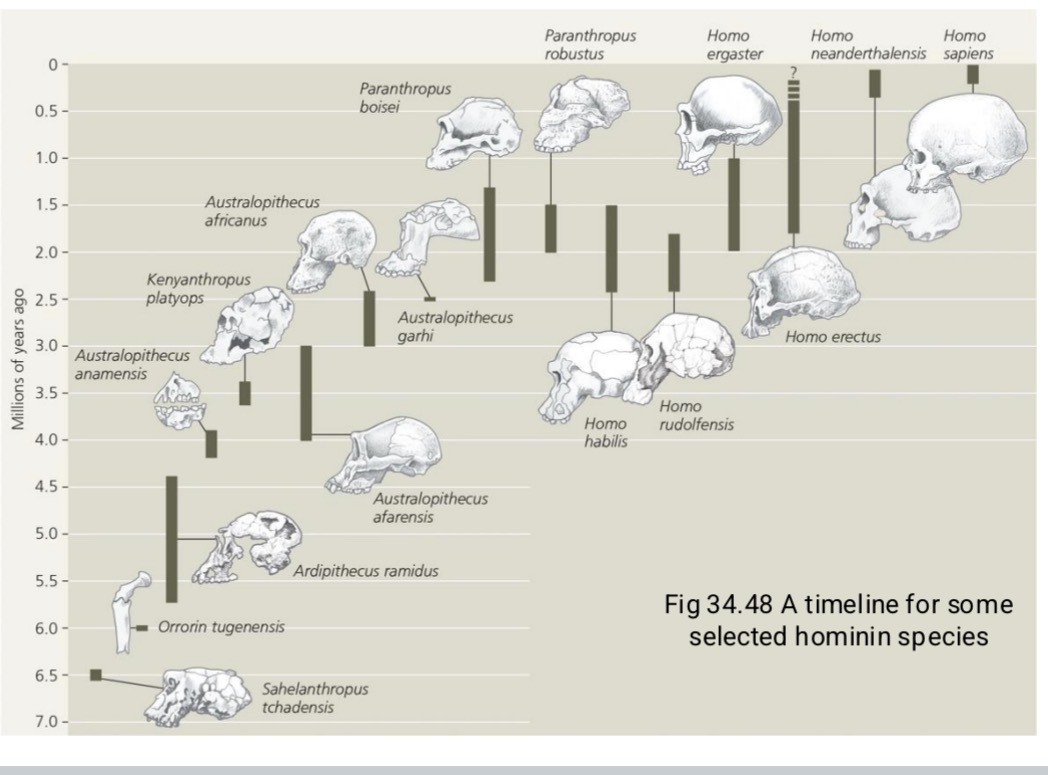
Australopiths
Paraphyletic assemblage of hominins living bw 4 and 2 million years ago
Evidence of tool usage
Two kinds of australopiths
Robust: sturdy skull powerful jaw
Gracile: slender and lighter jaw
Homo species
Fully bipedal and large brained
First we’re Homo ergaster and Homo erectus
What is reduced sexual dimorphism in Homo species
Increased pair bonding and reduced make-make competition
Who did Homo heidelbergenesis evolve from? And what’re they
Likely from Homo erectus that stayed in Africa
Large-animal hunter
• H. heidelbergensis was similar to H. sapiens in
Body proportions
Neanderthals and H. sapiens likely evolved from distinct
populations of
H. heidelbergensis
Neanderthal
Thick boned
cold adapted hominins
Large brain
Buried their dead
Made hunting tools
Lived in Europe 350 000 to 28 000 years ago
Humans
in Africa 195 000 years ago
Descend from Homo heidelbergensis
Large brains
Advanced tool use
Increased behaviour complexness
little genetic variation compared to other mammals
 Note
Note  Flashcards (31)