Ch 04 - Coping with Environmental Variation: Temperature and Water
 Call Kai
 Learn
Learn Practice Test
 Spaced Repetition
 Match
Match Flashcards
 Knowt Play
1/69

There's no tags or description
Looks like no tags are added yet.
Name | Mastery | Learn | Test | Matching | Spaced | Call with Kai |
|---|
No analytics yet
Send a link to your students to track their progress
70 Terms
Organisms have two options for coping with environmental variation: () and ()
Tolerance and Avoidance
What is an example of coping with environmental variation tolerance and avoidance?
Spruce trees in the boreal forest must be able to tolerate temperatures fro -50 C to 30 C
() -Study of interactions between organisms and their environment and how these interactions influence their survival and persistence
Physiological ecology
Each species has a range of () tolerances that determines its potential () distribution
Environmental
Geographic
The physical environment influences an organism’s () () (survival and reproduction) in two ways
ecological success
what are the two ways the physical environment influences an organism’s ecological success?
Availability of energy and resources - impacts growth and development
Extreme conditions can exceed tolerance limits and impact survival
() supply can influence an organism’s ability to tolerate environmental extremes
Energy
The actual geographic distribution of a species is also related to other factors such as () (), (), and ()
dispersal ability
disturbances
competition
Because plants do not move, they are () indicators of the () environment
good
physical
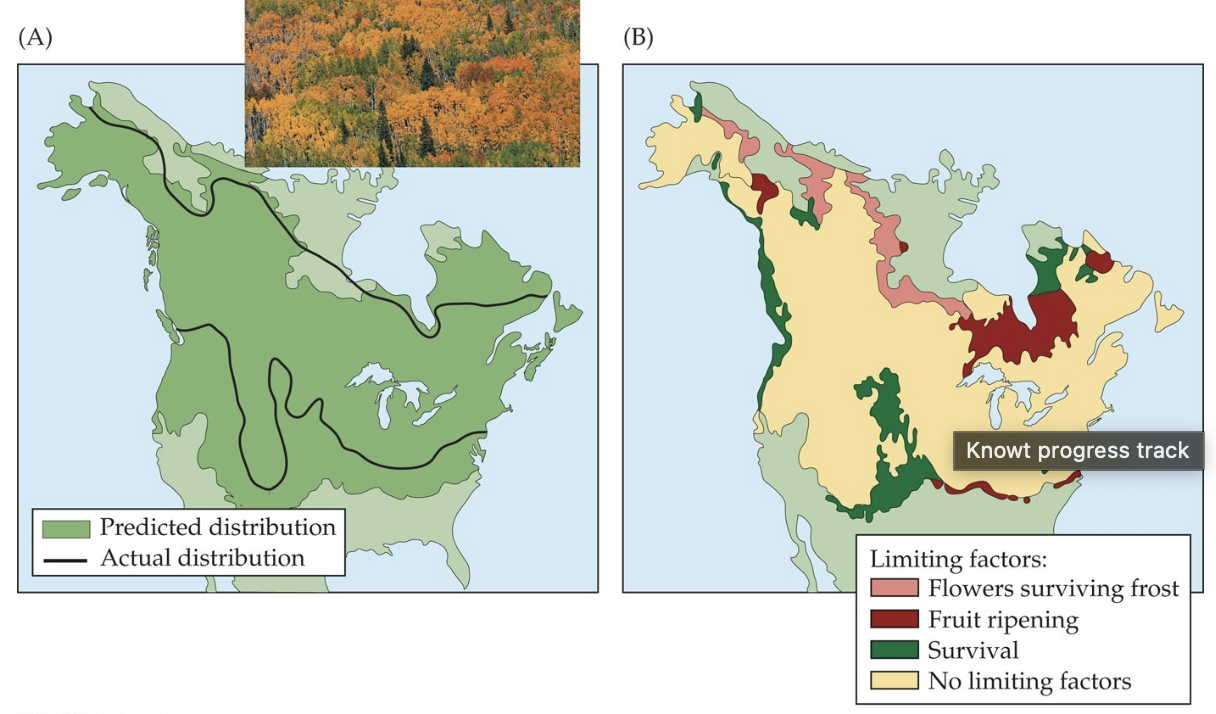
What is an example of a response to environmental variation?
Aspen distribution can be predicted based on climate
Limiting factors include low () and (), which affect reproduction and survival
Low temperatures
drought
A species’ () () is the range of conditions over which it occurs
Climate envelope
What is a climate envelope a useful tool for?
Predicting the species’ response to climate change
Stress
Environmental change results in decreased rates of physiological processes, lowering the potential for survival, growth, or reproduction
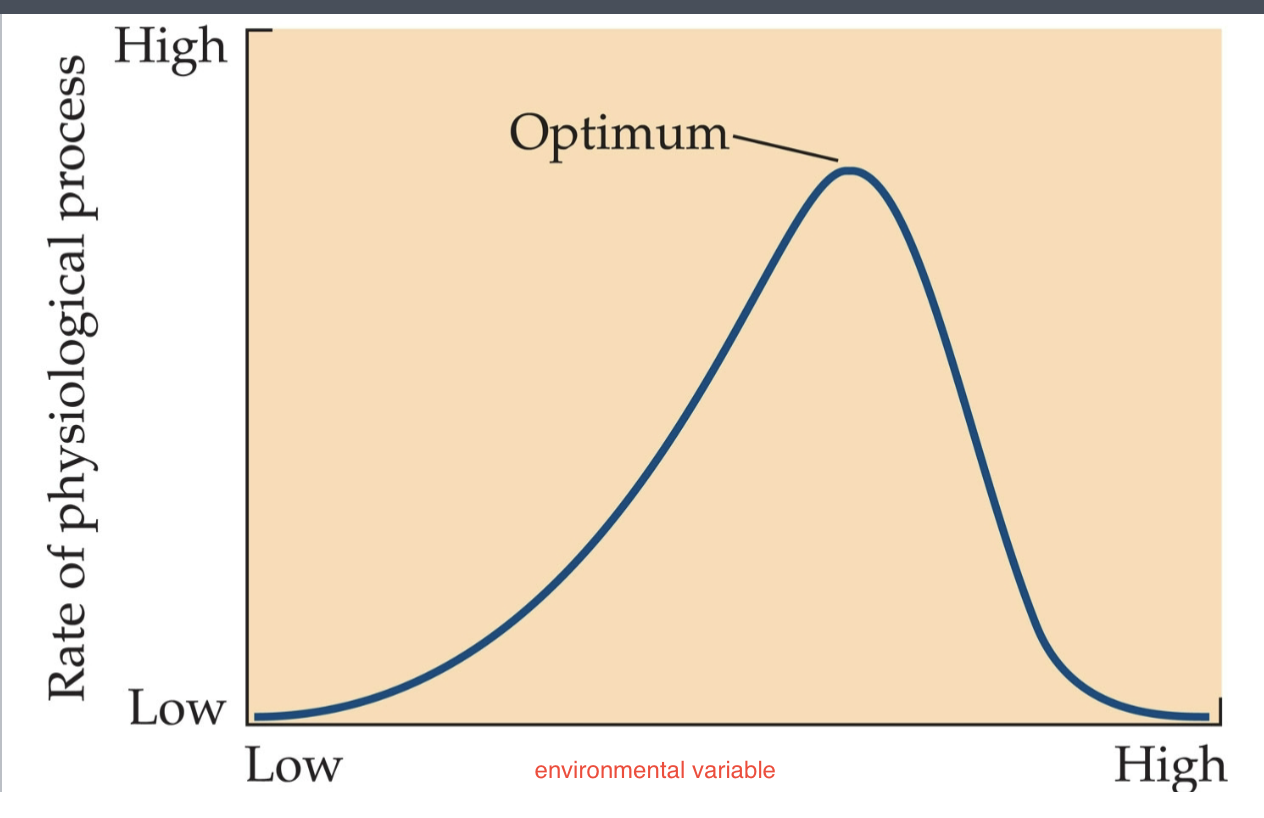
Deviations from the () reduce the rate of the process
Optimum (environmental factors: temp, nutrients, habitat)
Ex: at high altitudes, lower partial pressure of O2 in the atmosphere results in hypoxia - not enough oxygen is delivered to tissues
Hypoxia causes “altitude sickness,” which is physiological stress
Acclimatization
Adjusting to stress through behavior or physiology
it is a short term, reversible process
Acclimatization to () () involves higher breathing rates, greater production of red blood cells, and higher pulmonary blood pressure
higher elevations
Over time, natural selection can result in () of a population to environmental stress
adaptation
Individuals with traits that enable them to cope with stress are ()
favored
Over time, these () () become more () in the population
genetic traits
frequent
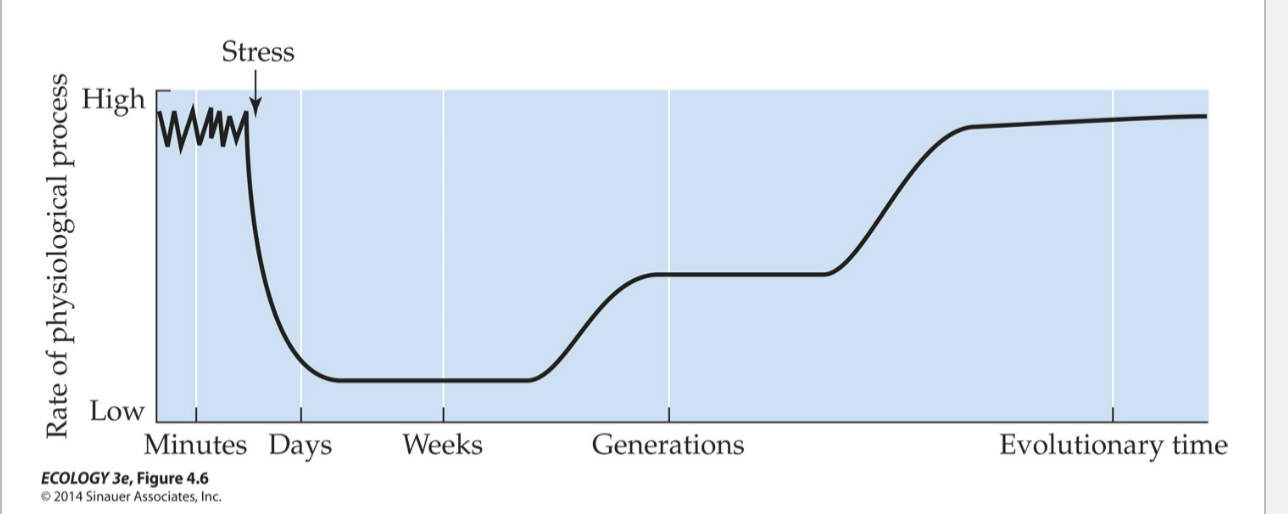
the effect of stress
ok
() - populations with adaptions to unique environments
Ecotypes
Ecotypes can eventually become () species as populations () and become reproductively ()
separate
diverge
isolated
EX: Humans have lived in the Andes Mountains for 10,000 years
When the Spanish first settled there, their birth rates were low for 2-3 generations due to poor oxygen supply to developing fetuses
The indigenous Andean populations were adapted to the low-oxygen conditions by having higher red blood cell production and greater lung capacity.
Example of adaptation
Indigenous Andean populations have high red blood cell concentrations and large lung capacity
Tibetans have faster breathing rates and higher blood flows
Adaptions can vary among populations
Acclimatization and adaptation require investments of () and () resources, representing possible ()-() with other functions that can also affect survival and reproduction
energy
resources
trade-offs
The () of an organism is determined by exchanges of () with the () ()
temperature
energy
external
environment
Environmental temperatures vary greatly throughout the ()
Biosphere
Some habitats experience little (), while other have () seasonal or daily variation
variation
large
Survival and function of organisms is strongly tied to ()
internal temperature
Some organisms can survive periods of extreme heat or cold by entering a state of (). in which little or no () () occurs
Dormancy
metabolic
activity
What is Dormancy?
Little or no metabolic activity occurs
An organism’s temperature is determined by the () of gains and () of energy to the external environment
Gains
Losses
Organisms must either () temperature change or () it by physiological, morphological, or behavioral means
tolerate
modify
() controls physiological activity
Temperature
Metabolic reactions are catalyzed by (), which have narrow () ranges for optimal function
enzymes
temperature
At () temperatures, enzymes become (), which () enzyme function
high
denatured
destroys
Bacteria in hot springs have enzymes that are stable up to ()
100C
Antarctic fish and crustaceans must have enzymes that function at ()
-2 C
some soil microbes are active at temperatures as low as
-5 C
Temperature also affects () ()
water
availability
The rate at which terrestrial organisms lose water is created to () ()
air
temperature
Some organisms use () to () exchange of () with the the environment
behavior
control
energy
what is an example of variation in temperature?
ex: elephants swim and spray water onto their backs with their trunks to cool their bodies
ex: moving into the shade reduces the amount of solar radiation received
what are the 3 energy exchanges with the environment?
conduction
convection
latent heat transfer
what is conduction?
transfer of energy from warmer to cooler molecules
what is convection?
heat energy is carried by moving water or air
what is heat transfer?
water absorbs heat as it changes from a liquid to as gas state
for terrestrial plants, energy inputs include () and () () from surrounding objects, as well as from () and () if the ground or air is warmer than the plant
sunglight
infrared
radiation
conduction
convection
losses of energy include () of () radiation, () and () convention, and ()
emission
infrared radiation
conduction
convection
evapotranspiration
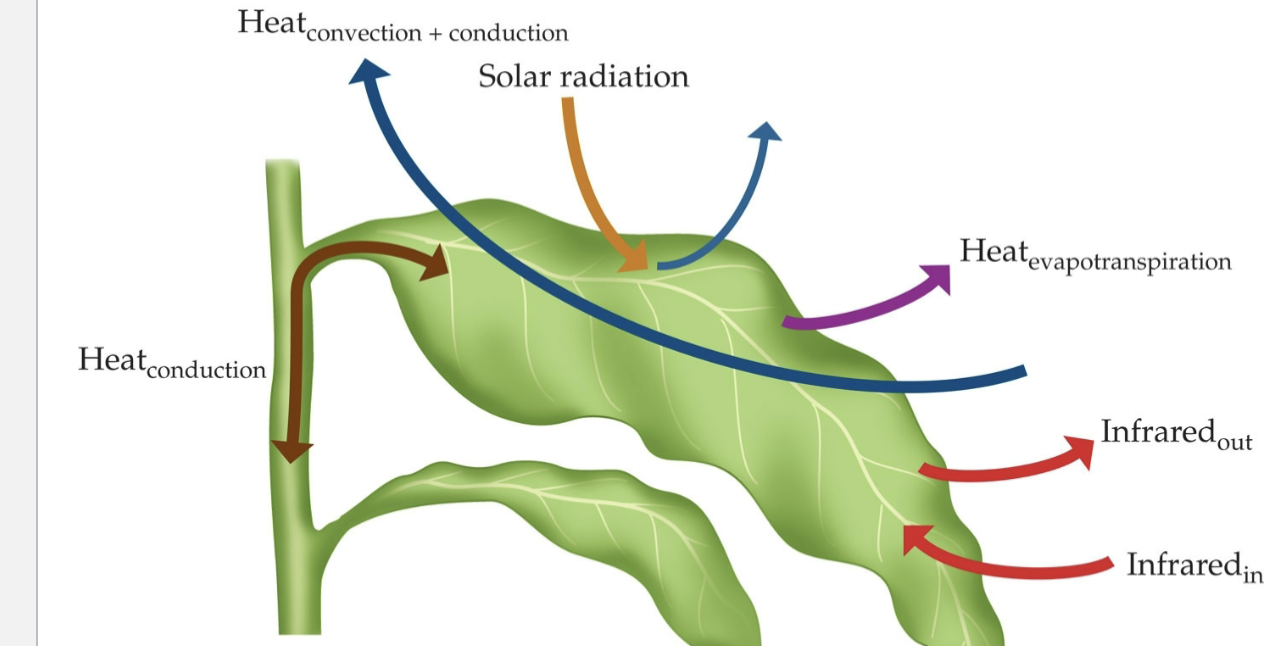
energy change in terrestrial plants
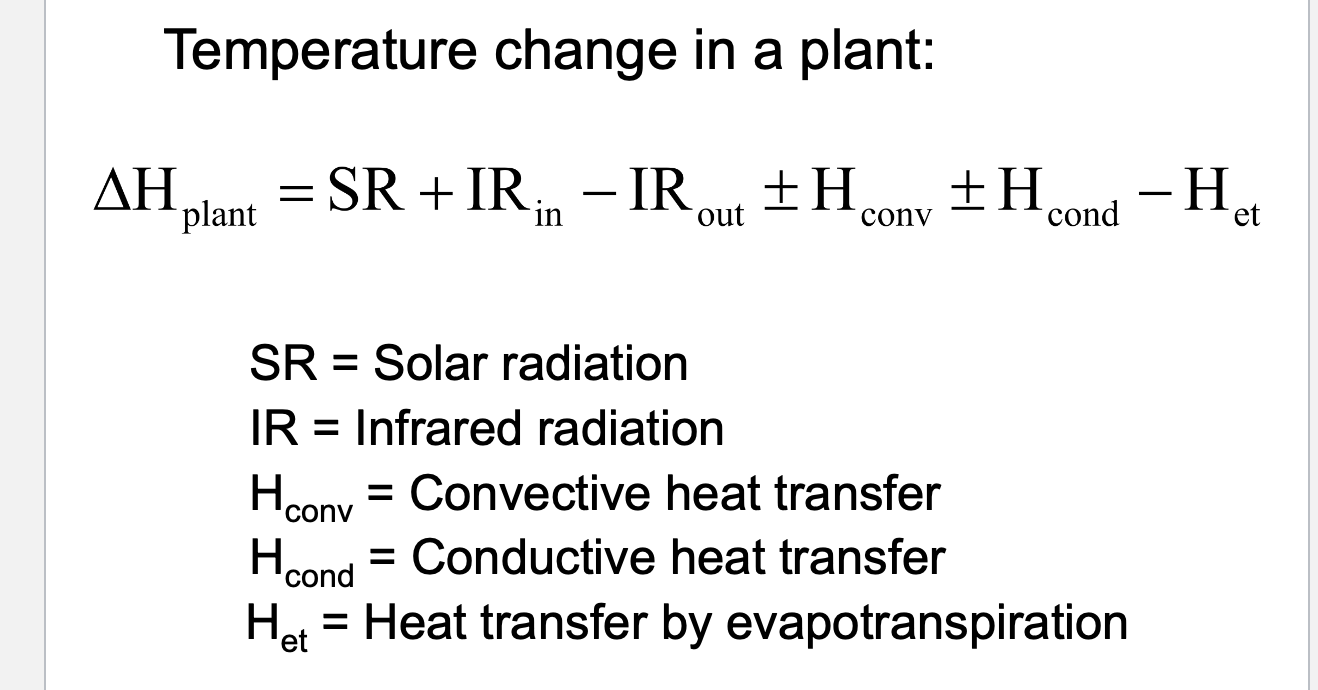
what is the equation for temperature change in a plant?
Plants can adjust energy () and ()
inputs
outputs
Transpiration rates can be controlled by () () cells surrounding leaf opening called ()
specialized
guard
stomates
Variation in degree of () and number of () controls the rate of () and thus leaf ()
opening
stomates
transpiration
temperature
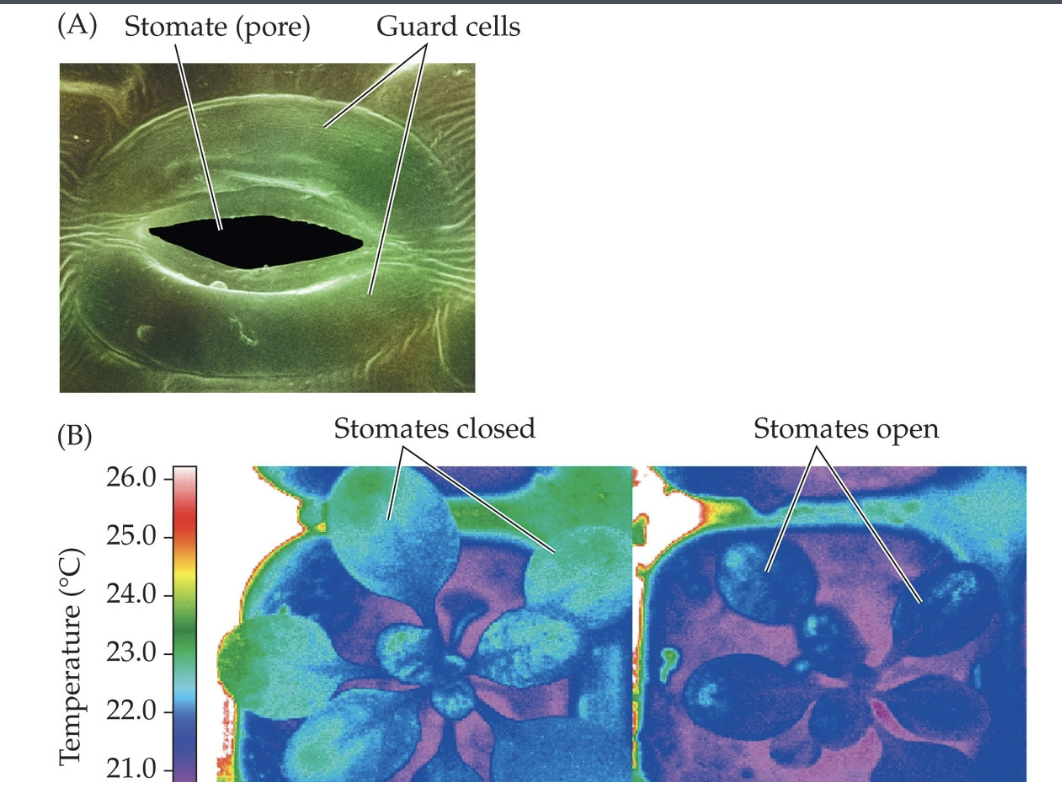
stomates control leaf temperature by controlling transpiration
if soil () is (), transpirational cooling is () a good mechanism
water
limited
not
() - hears on leaf surfaces that reflect solar energy. But hairs also reduce conductive heat loss
Pubescence
Pubescence was studied in three () species (plants in the daisy family)
Encelia
desert species with high pubescence were compared with non pubescent species from wetter, cooler habitats
plants of all three species were grown in both locations
in the cool, moist location, 3 species showed few differences in leaf temperature and stomatal opening.
in the desert, the species with no hairs maintained leaf temperature by transpiration or shedding leaves; the pubescent species’ leaves reflected about twice as much solar radiation
the study of 3 Encelia species
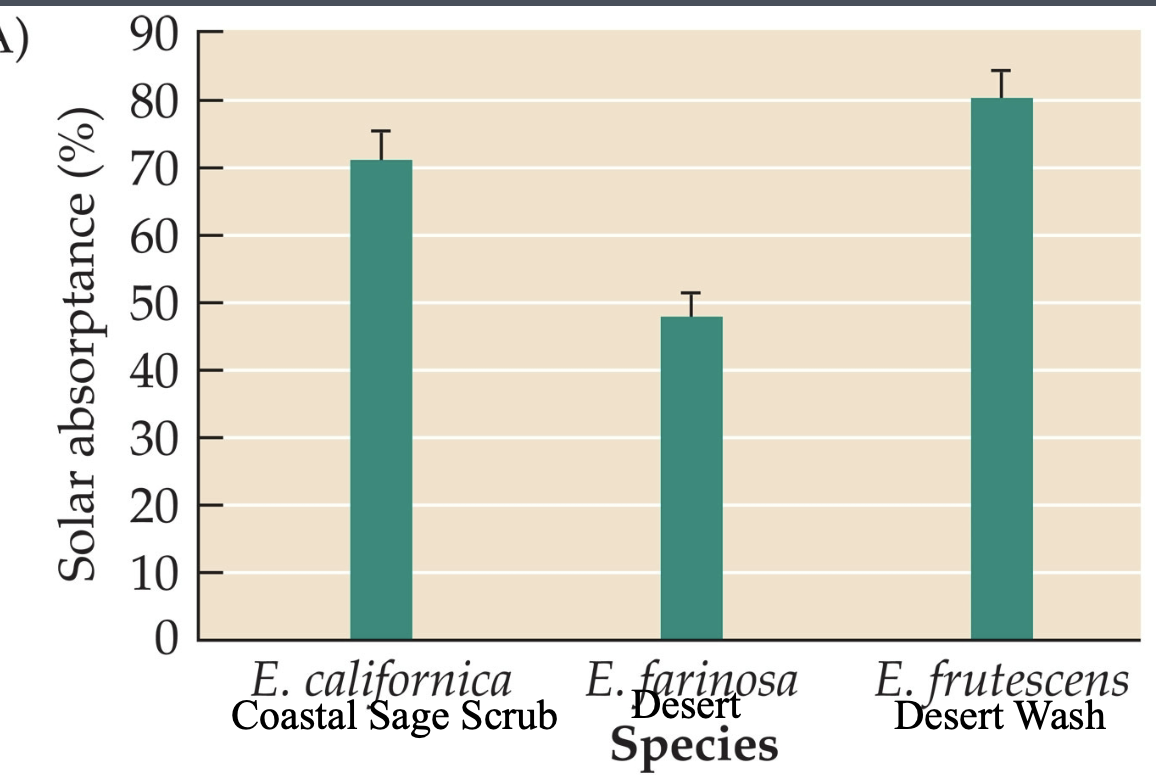
Natural selection has acted on ecotypes of E. farinosa
in the driver environments, plants have more pubescence and absorb less solar radiation than populations in moister environments
The desert species (E. farinosa) also has smaller, more pubescent leaves in summer than in winter, representing acclimatization to hot summer temperatures
Sunlight, seasonal changes, and leaf pubescence study of Encelia species
If air temperature is () than () temperature, heat can be lost by ()
lower
leaf
convection
() heat loss is related to the () of air moving across leaf ()
convective
surface
()- a zone of turbulent flow due to friction, next to the leaf surface
Boundary layer
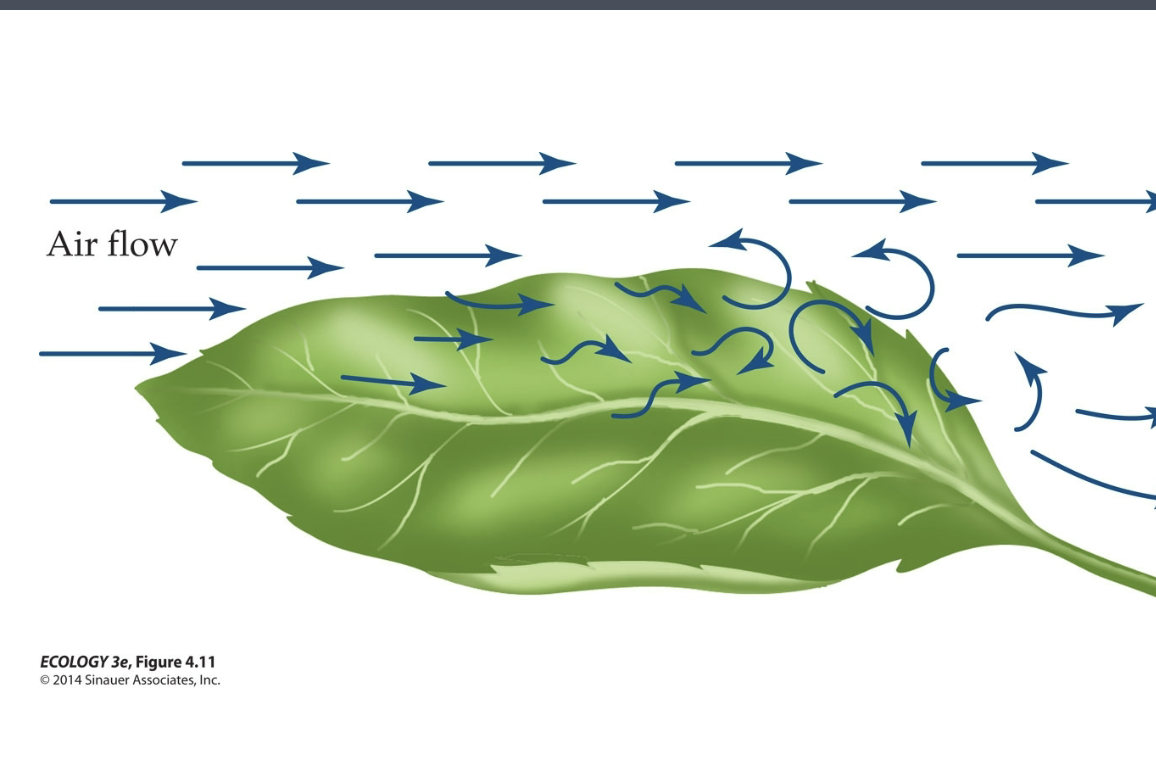
a leaf boundary layer
the boundary layer convective () ()
heat loss
Boundary layer () is related to () () and surface ()
layer
leaf size
roughness
(), smooth leave have () boundary layers and () more () than large or rough leaves
small
thin
lose
heat
in cold, windy environments, convective () loss is a problem for plants
most alpine plants () the ground surface to avoid high wind velocities
some have a layer of () hair to lower convective heat loss
heat
hug
insulating

