binocular balancing techniques
 Call Kai
 Learn
Learn Practice Test
 Spaced Repetition
 Match
Match Flashcards
 Knowt Play
1/10

There's no tags or description
Looks like no tags are added yet.
Name | Mastery | Learn | Test | Matching | Spaced | Call with Kai |
|---|
No analytics yet
Send a link to your students to track their progress
11 Terms
explain the purpose of binocular balancing (3)
ensure that both eyes receive an equal accommodative stimulus - helps align the accommodative response between the two eyes when they are used together
it promotes relaxation of accommodation - ideally, with both eyes open, accommodation should be evenly distributed and as relaxed as possible
helps equalise visual acuity between the eyes when determining the final prescription.
when would we not perform binocular balancing on a px/ when is it not necessary (2)
px who lack BV (eg have a tropia)
px who lack accommodation - such as those over approximately 60 years old / those with intraocular lens implants (most likely due to cataracts (pseudophakes) – these are unable to accommodate
state the different BBT we can use (4)
Humphriss fogging technique
Humphriss Immediate contrast technique
BB using polaroid filters
prism-dissociated BB
when is the Humphriss fogging technique performed
after monocular refraction (of both eyes)
explain the procedure of the Humphriss fogging technique (4)
Start by fogging the left eye (needs to be adequately fogged)—add enough plus power (usually +0.75 DS to +1.00 DS) to reduce its visual acuity by about three to four lines compared to the eye being tested.
Carry out the best vision sphere (BVS) in the right eye – remember to push the plus.
If the patient requires +0.50 DS or more, which may occur in cases of latent hyperopia, this can help relax accommodation in both eyes. To confirm the fogging lens is still effective, add more plus power to the left eye and ensure its acuity remains blurred by three to four lines.
Switch the fogging: remove the fogging lens from the left eye, then fog the right eye by the same amount (three to four lines reduction), and repeat BVS technique for the left eye.
explain the procedure of the Humphriss immediate contrast technique (8)
Fog the left eye—add enough plus power (typically +0.75 DS to +1.00 DS) to reduce its visual acuity by about three to four lines compared to the tested eye. For young patients with normal vision, this usually results in a VA of around 6/9 to 6/12
Ask the patient to focus on the smallest line they can read on the chart
Briefly place a +0.25 DS lens in front of the right eye for about one second (or longer if needed), then switch to a −0.25 DS lens for about half that time (roughly 0.5 seconds)
Ask the patient: “Are the letters clearer with lens 1... or lens 2?”
If they say lens 2 (minus one) – show them it again and clarify if its clearer or darker – if clearer can give them the minus, if they are hesitant or prefer lens 1 or they say its darker/or there is no difference – then give them the plus DO NOT GIVE MINUS
Since adding +0.25 DS to the right eye likely relaxes accommodation in both eyes, check the fogging lens on the left eye by adding +0.25 DS to ensure it still effectively blurs vision
Continue comparing +0.25 DS and −0.25 DS lenses until the patient clearly rejects the +0.25 DS lens
Repeat the entire procedure for the left eye, this time fogging the right eye
describe the principles of the BBT using polaroid filters (2)
Polaroid balance tests typically include several VA lines with one (or more, dependent on the programme) line seen by the right, left, and both eyes, respectively

These windows are aligned with the polarising filters so that the stimuli presented in the top window are seen by the right eye only; the stimuli in the middle window are seen binocularly and the stimuli in the bottom window are seen by the left eye only.
what is providing a fusional lock in this technique
the line that is seen by both eyes
explain the BBT using polaroid filters (8)
Place the polarised filters before both eyes.
Add +0.50 DS to both eyes.
Ask the patient if the letters are clearer on the line seen by the right eye or left eye or if they are both the same.
If one line is clearer, add +0.25 DS to that eye until the two monocularly seen lines are equally blurred.
If a balance cannot be achieved, use the lenses that provide the best vision to the dominant eye or the closest match.
Remove the polarised filters.
Remove the fog in binocular +0.25 DS steps until you obtain maximum VA.
If the patient can read the bottom line of your chart (and this is larger than 6/3, 2.0, or 20/10), you can allow extra minus or less plus that makes your bottom line of letters ‘clearer.’ Ensure that the bottom line of letters is ‘definitely clearer and not just smaller and blacker.’ — as their VA may exceed the smallest line available on the test chart
explain principle of prism-dissociated BB (2)
Used with phoropter
Splits the images via prisms
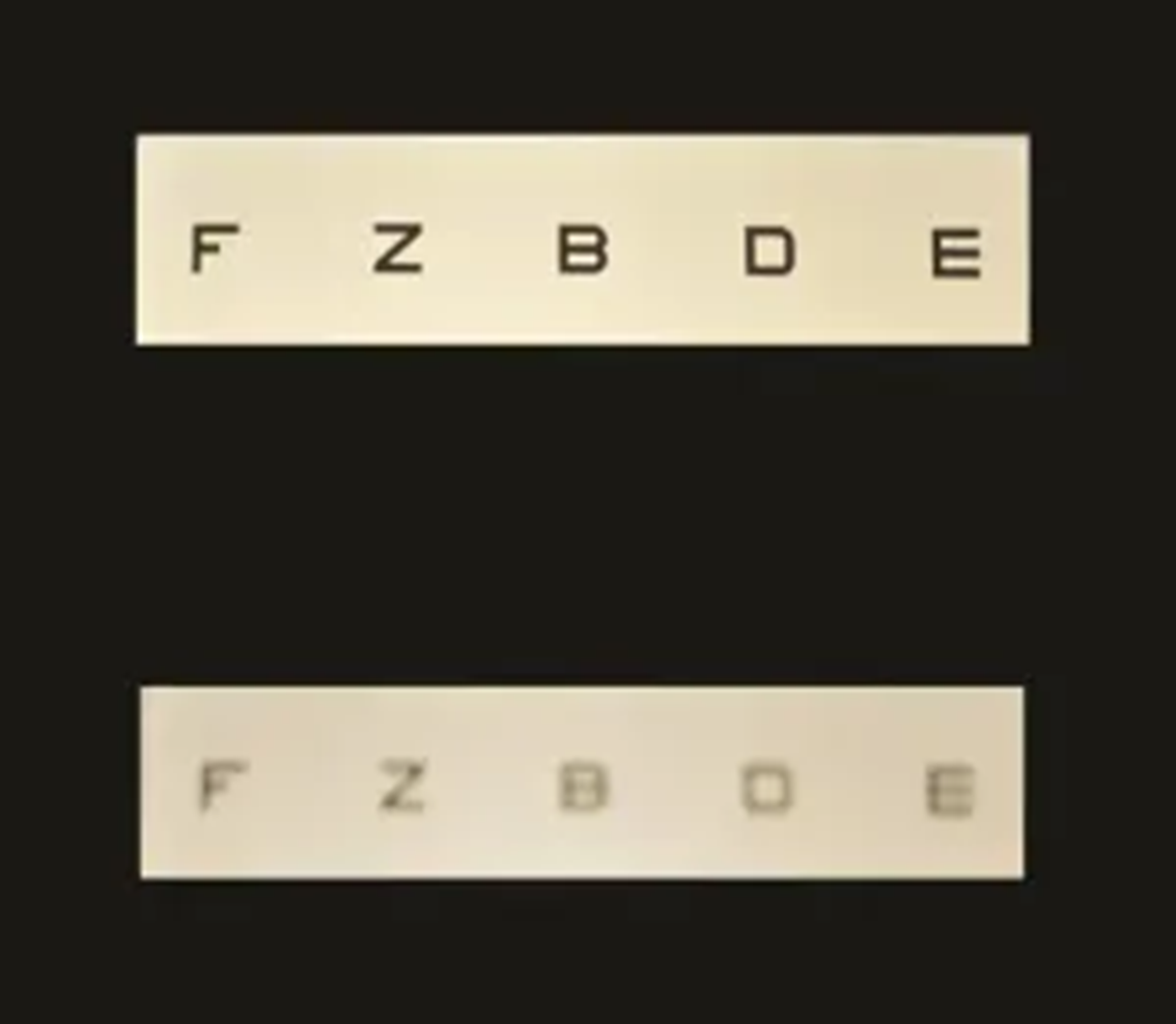
explain the procedure of prism-dissociated BB (11)
Make sure that neither eye is occluded and that both eyes can see the chart
Fog each eye by +0.75 D sphere relative to the endpoint of its respective monocular refraction
Measure the patient’s binocular VA and continues adding +0.25 sphere in front of both eyes until the binocular VA is 6/7.5 or worse
Isolate a line of letters one line above the VA found.
Ask the patient to close their eyes.
Place 3-4 base up over the right and 3-4 base down over the left eye using prism
Ask the patient to open their eyes. Inform the patient that they should see 2 lines of letters both of which should be blurry.
Have the patient look back and forth between the two lines of letters and let them tell you which line the upper or lower is clearer.
Add +0.25 to the clearer line ( make it blurrier ) keep repeating until the patient reports equal blurriness of the two lines.
Remove the prism
Remove the fogging lens.