Business Cycles: Key Concepts, Variables, and Historical US Data
 Call Kai
 Learn
Learn Practice Test
 Spaced Repetition
 Match
Match Flashcards
 Knowt Play
1/54

There's no tags or description
Looks like no tags are added yet.
Name | Mastery | Learn | Test | Matching | Spaced | Call with Kai |
|---|
No analytics yet
Send a link to your students to track their progress
55 Terms
What is a business cycle?
A fluctuation in aggregate economic activity characterized by expansions and recessions.
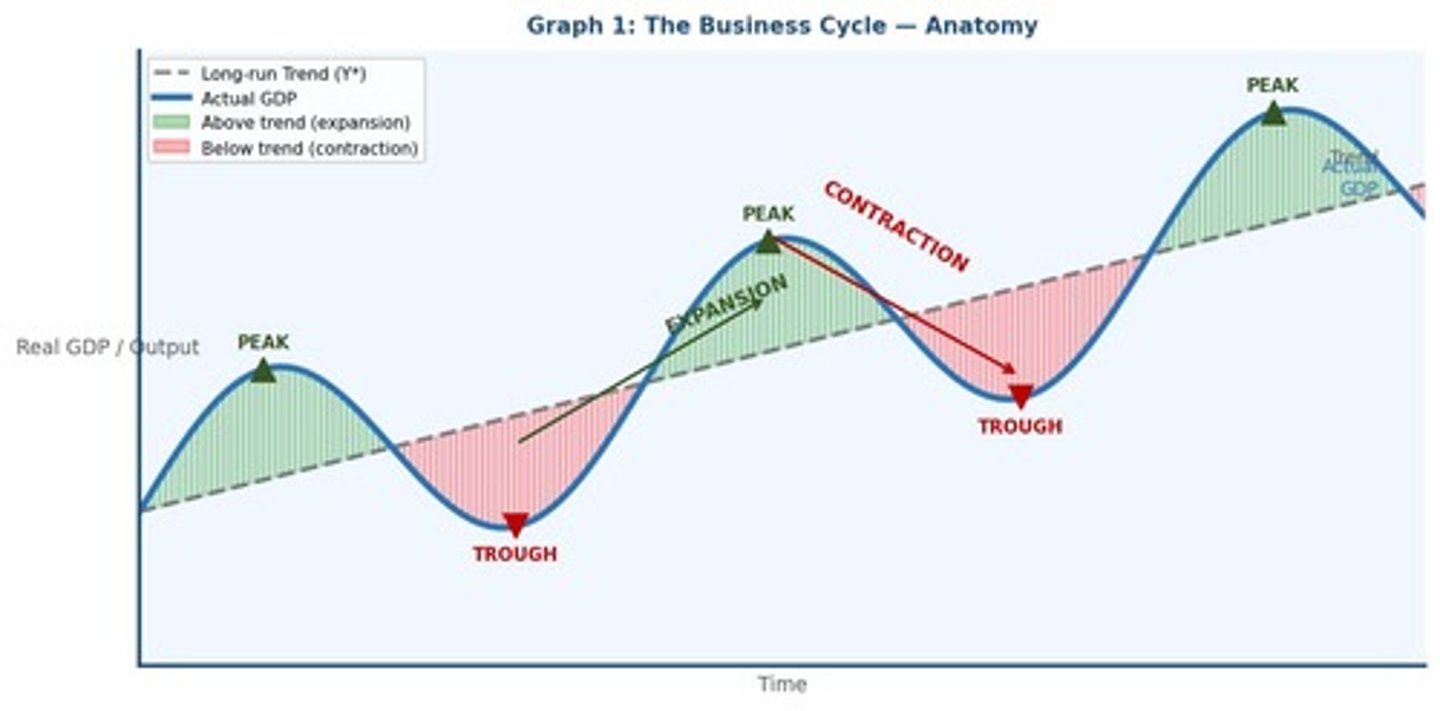
What are the five key features of a business cycle?
Peak, Trough, Expansion, Contraction (Recession), and Trend Line (Y*).
What does the peak of a business cycle represent?
The high point of an expansion where the economy is running hot.
What does the trough of a business cycle signify?
The low point of a contraction where the economy is at its worst.
What is an expansion in the context of a business cycle?
The period from trough to peak where output and employment are rising.
What is a contraction (recession) in a business cycle?
The period from peak to trough where GDP is falling and unemployment is rising.
What is the trend line (Y*) in a business cycle?
The long-run growth path that represents deviations of the business cycle above and below this line.
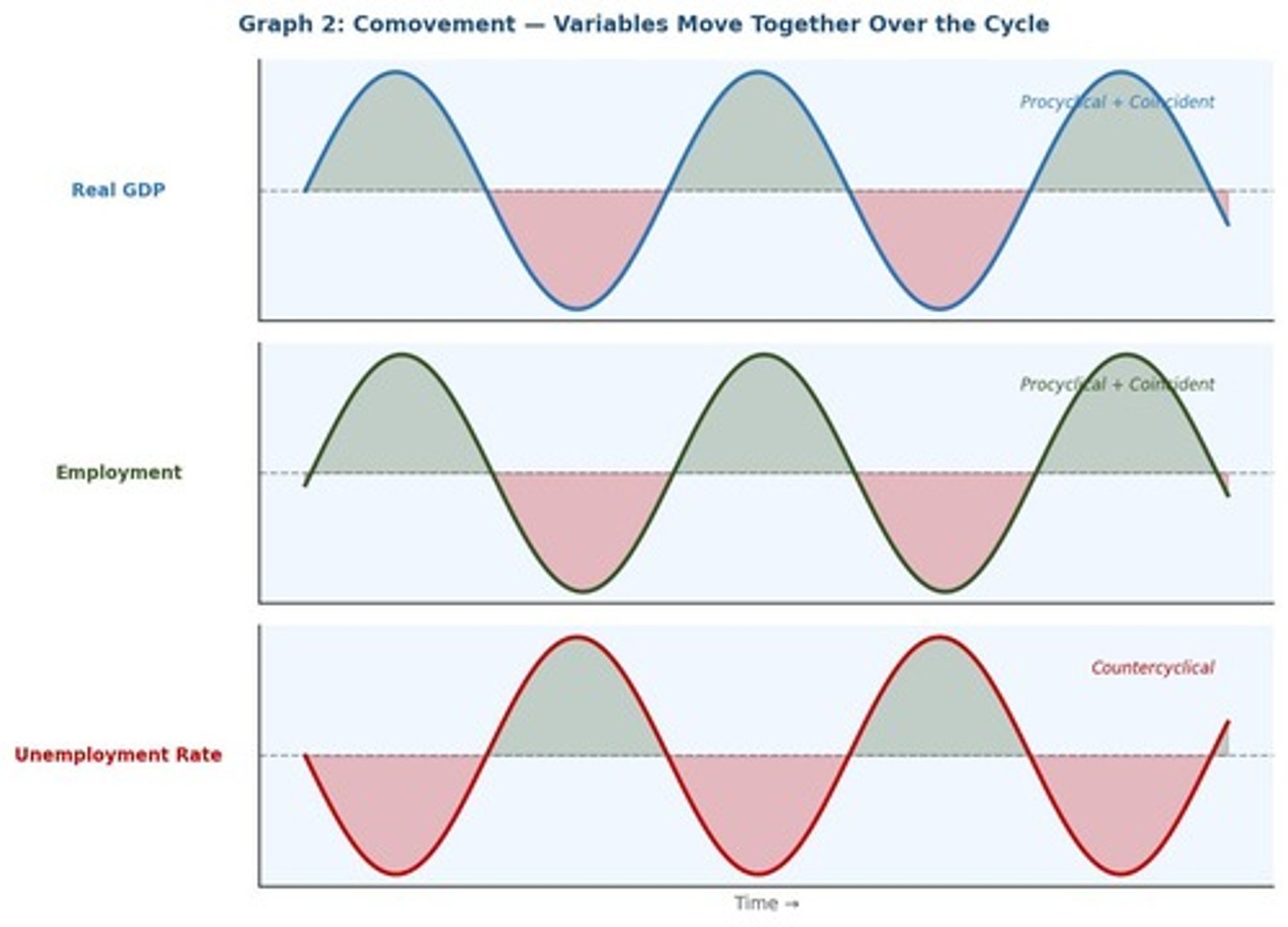
What does the property of comovement in business cycles mean?
Many economic variables move together in predictable patterns, not just GDP.
How are business cycles described as recurrent but not periodic?
Cycles happen repeatedly but not at regular fixed intervals or durations.
What does persistence refer to in business cycles?
Once started, expansions and contractions last; a single bad quarter is not a recession.
Are business cycles temporary?
Mostly yes, but some effects can be permanent, like a portion of output decline in a recession.
What is the key distinction between unemployment rate and employment level during a recession?
Unemployment rate recovers, but the employment level may not fully recover.
What characterized the Great Depression?
GDP fell by 30% and unemployment reached about 25%.
What was significant about the WWII expansion?
It was the most dramatic expansion ever, with GDP doubling and unemployment falling below 2%.
What caused the 1973-75 oil shock?
Oil prices quadrupled, leading to stagflation (high inflation and recession).
What was the cause of the 2007-09 financial crisis?
The housing bubble burst and the financial system collapsed, marking the worst post-WWII recession.
What is the classification of procyclical variables?
Variables that move in the same direction as real GDP.

What is a countercyclical variable?
A variable that moves in the opposite direction of real GDP, such as unemployment.
What does acyclical mean in terms of economic variables?
Variables that do not show a clear pattern relative to the business cycle.
What are leading variables?
Variables that peak and trough before GDP does, predicting future economic conditions.
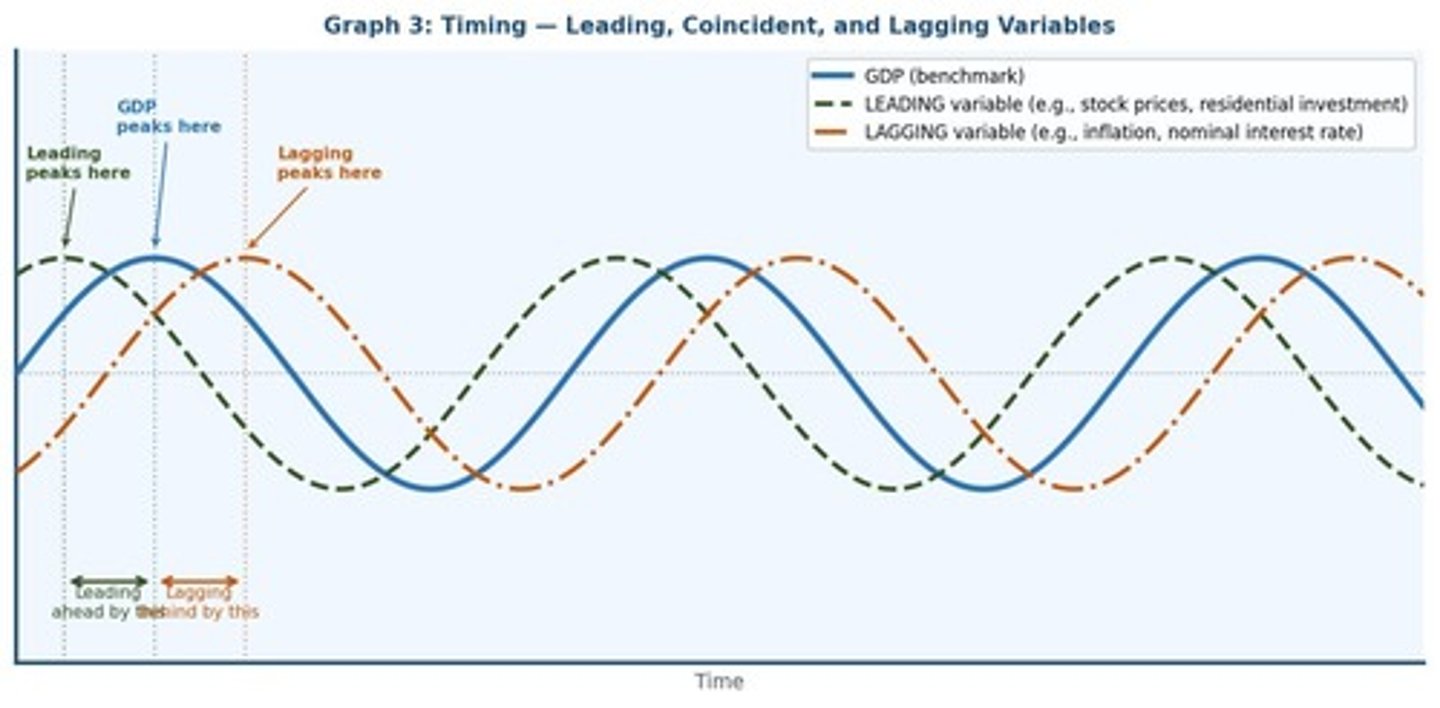
What are coincident variables?
Variables that peak and trough at the same time as GDP, tracking current economic conditions.
What are lagging variables?
Variables that peak and trough after GDP does, responding slowly to economic changes.
What is the direction and timing of real GDP?
Procyclical and coincident.
Why is investment more volatile than consumption?
Investment is driven by expected future profits, leading to larger swings during economic cycles.
What is the direction and timing of the unemployment rate?
Countercyclical with no clear pattern.
What is the implication of falling investment?
It indicates that the economy is in or headed for a recession.
What is the effect of composition bias on real wage measurement?
In a recession, the average measured wage may overstate wages due to the layoff of low-wage workers.
What is the direction and timing of nominal M2 growth?
Procyclical and leading.
What is the direction and timing of the inflation rate?
Procyclical and lagging.
What is the direction and timing of stock prices?
Strongly procyclical and leading.
What is the definition of a business cycle?
Fluctuation in aggregate activity that is recurrent but not periodic, lasting 1-12 years.
What are the four phases of a business cycle in order?
Expansion, Peak, Contraction, Trough.
What is comovement in the context of business cycles?
The phenomenon where multiple economic variables, such as GDP, employment, and consumption, move together in similar patterns.
Why does comovement matter?
It indicates common underlying shocks affecting the entire economy, allowing for the development of business cycle theories.
What is the Index of Leading Economic Indicators (LEI)?
An index published by The Conference Board that combines 10 leading variables to predict turning points in the business cycle.
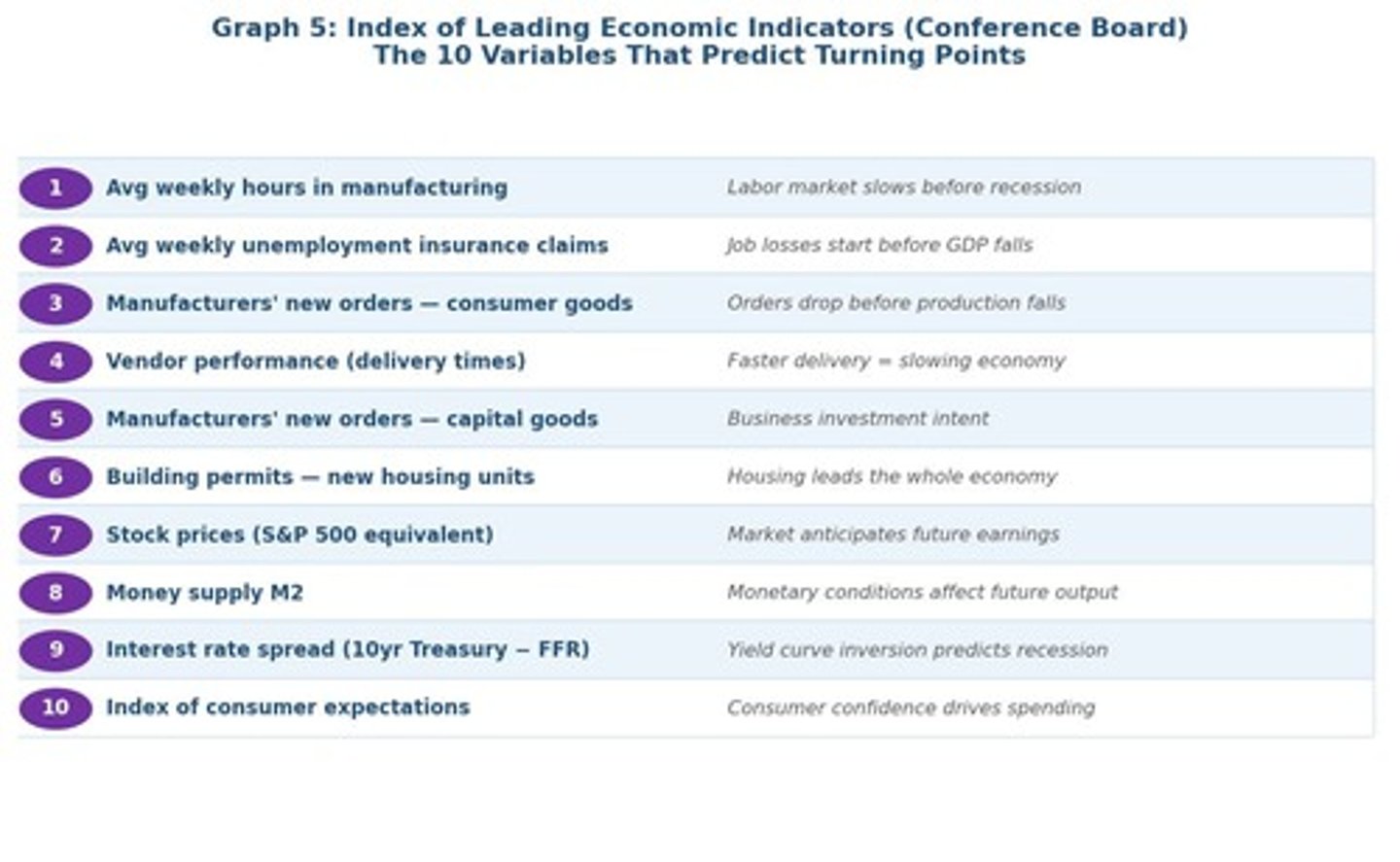
What does a decline in the LEI index for three consecutive months indicate?
A likely upcoming recession.
What is the significance of the yield curve spread?
An inverted yield curve (short-term rates higher than long-term rates) is a strong predictor of an impending recession.

What is the difference between procyclical and countercyclical variables?
Procyclical variables move in the same direction as GDP, while countercyclical variables move in the opposite direction.
What is an example of a procyclical variable?
Employment, consumption, or investment.
What is an example of a countercyclical variable?
The unemployment rate.
What is the timing of the real interest rate in business cycles?
Acyclical; it does not consistently move with GDP.
What is the impact of composition bias on wage data during recessions?
It can inflate average wage data as low-wage workers are laid off first.
What are the characteristics of leading economic indicators?
They predict peaks and troughs before GDP changes and are published quickly and frequently.
What does the average weekly manufacturing hours indicator signify?
Firms cut hours before layoffs, indicating a slowdown in economic activity.
What does the average weekly unemployment insurance claims indicator indicate?
Rising claims signal an increase in layoffs and potential job losses.
What is the relationship between stock prices and economic cycles?
Stock prices are procyclical and tend to fall before the economy turns down.
What is the role of consumer expectations in economic cycles?
Consumer confidence influences spending decisions, which can precede observable economic data.
What distinguishes Classical economic theory from Keynesian theory regarding business cycles?
Classical theory views prices as flexible and believes cycles are efficient responses to real shocks, while Keynesian theory sees prices as sticky and supports active policy intervention.
What was the GDP decline and unemployment rate during the Great Depression?
GDP fell by 30%, and unemployment reached 25%.
What is the significance of the 2008 financial crisis in relation to international business cycles?
It demonstrated how a recession in one country can transmit shocks globally through trade and financial linkages.
What is the timing of inflation in relation to GDP?
Inflation is procyclical and lagging, meaning it tends to rise after GDP increases.
What is the timing of stock prices in relation to GDP?
Stock prices are procyclical and leading, indicating economic trends before they materialize in GDP data.
What is the timing of residential investment in business cycles?
Residential investment is procyclical and leading, reflecting future economic conditions.
What does the term 'persistence' refer to in business cycles?
It indicates that cycles last for a while, and a single economic blip does not constitute a recession.
What is the significance of the 10 leading economic indicators?
They provide a framework for predicting economic turning points and understanding the business cycle.

