Astronomy Exam 2 Answers
 Studied by 0 people
 Call Kai
 Learn
Learn Practice Test
 Spaced Repetition
 Match
Match Flashcards
 Knowt Play
1/66

There's no tags or description
Looks like no tags are added yet.
Name | Mastery | Learn | Test | Matching | Spaced |
|---|
No study sessions yet.
67 Terms

What type of spectrum is shown in this image?
Emission Spectrum
The first neutron star / pulsar was discovered by:
Jocelyn Bell in 1960s
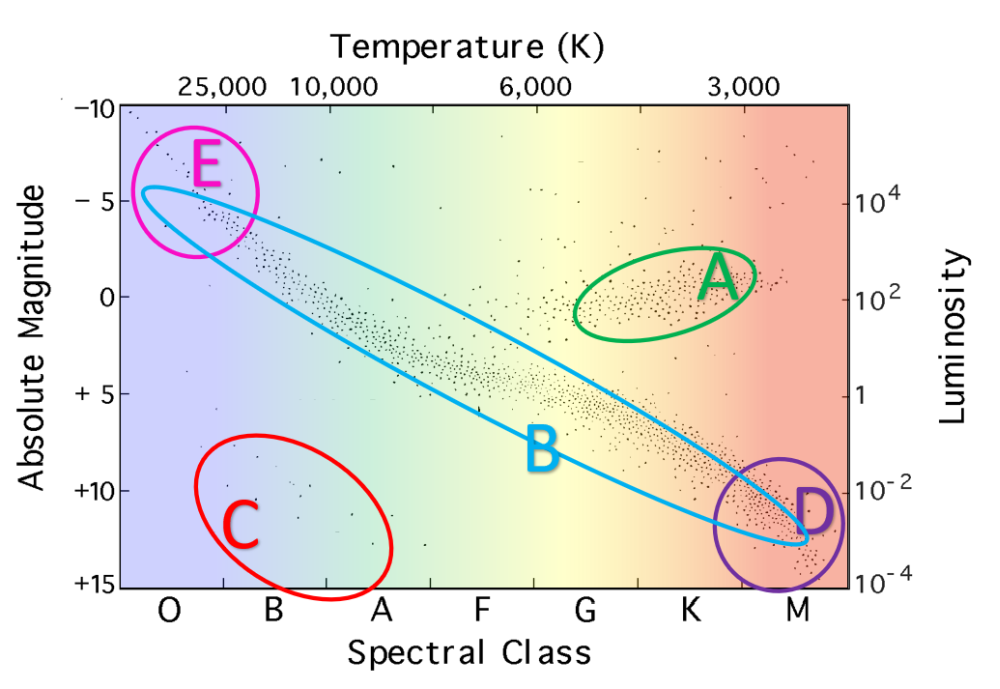
Which letter represents young, high mass stars?
E
This term describes the non-fusing mostly carbon, glowing, core of a sun sized star.
White Dwarf
Which of the following is NOT a characteristic of protoplanetary discs? (Are commonly found around new forming stars / Are frequently rotating. / Are forming planets for a new solar system / Are no larger than 5 AU from the protostar.)
Are no larger than 5 AU from the protostar
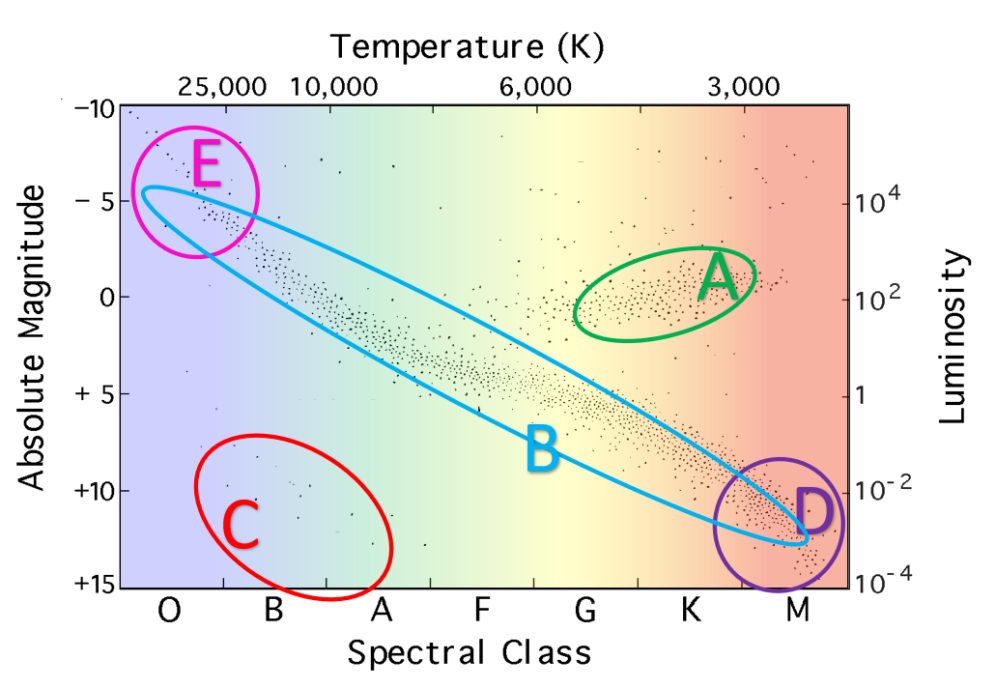
Which area of the diagram represents Red Giant stars?
A
According to most recent measurements, the age of the universe is:
Slightly less than 14 billion years
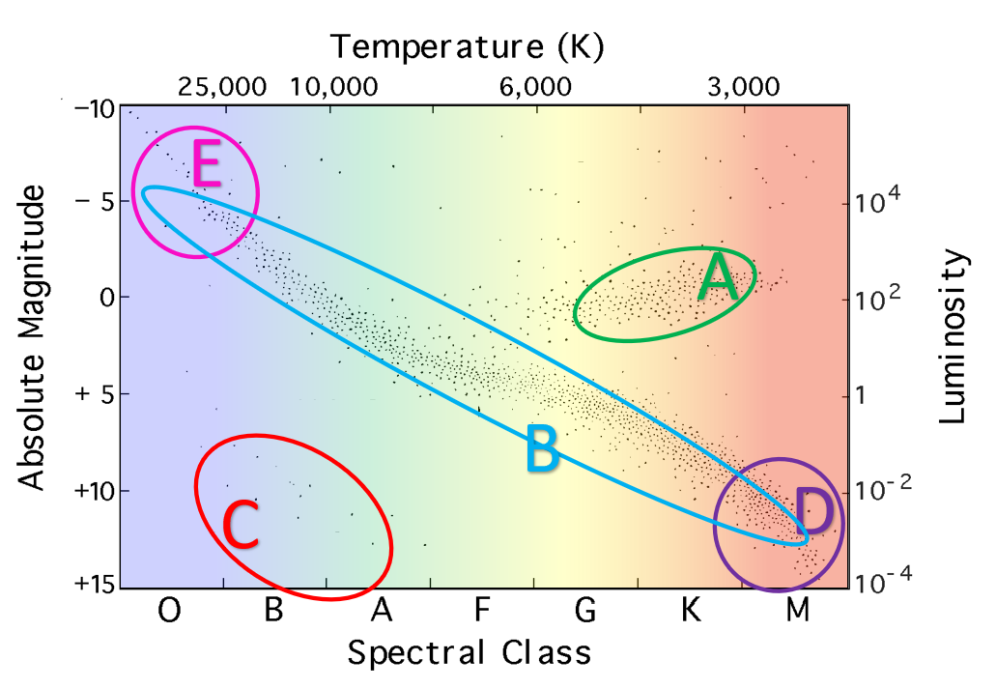
Our star (The Sun) likely will evolve into this type of star in 5-6 billion years from now.
A
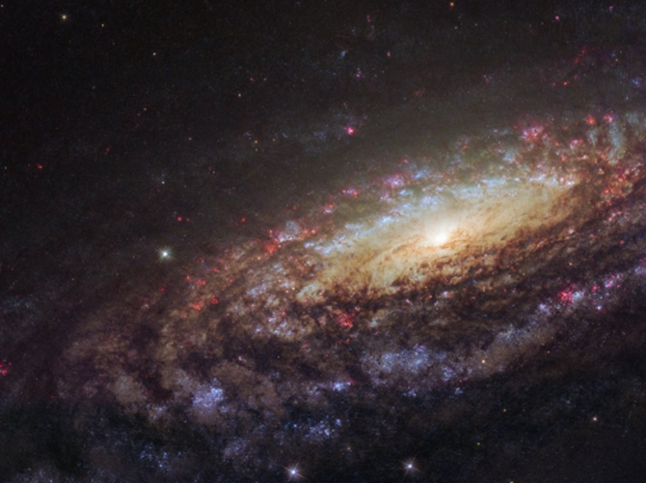
What type of object is shown in this image?
Spiral Galaxy
Which of the following is NOT true of Black Holes (they have an escape velocity greater than the speed of light / material falling into a black hole will lose all volume but preserve mass / No communication or light can exit the event horizon of a black hole / NASA is exploring the use of black holes for inter galactic travel)
NASA is exploring the use of black holes for inter galactic travel
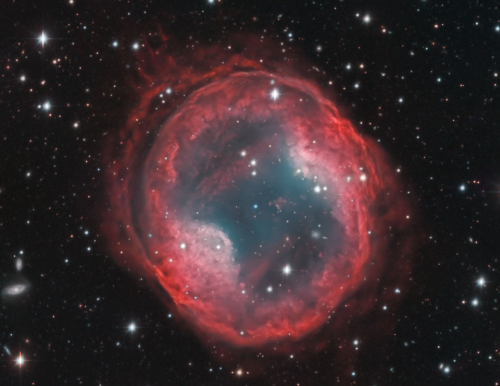
What type of object is shown in this image?
Planetary nebula
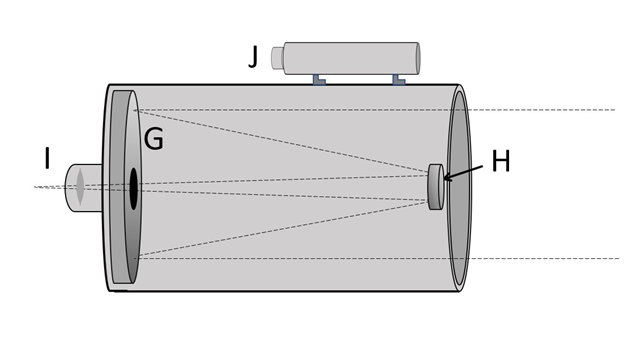
In this diagram, letter G represents:
Primary mirror
What is the size (diameter) of a black hole 100 X the mass of the Sun?
100 km
A high albedo shirt is cooler on a sunny day because:
it reflects solar energy
Which of the following is NOT true about parallax? (Stellar parallax is the most accurate way to measure stellar distance / Because it could not be observed visually, this is one reason Greeks rejected heliocentrism / 1 year is required for accurate measurements of 6 month parallax / Parallax may be used to measure the distance to all stars in the Milky Way)
Parallax may be used to measure the distance to all stars in the Milky Way
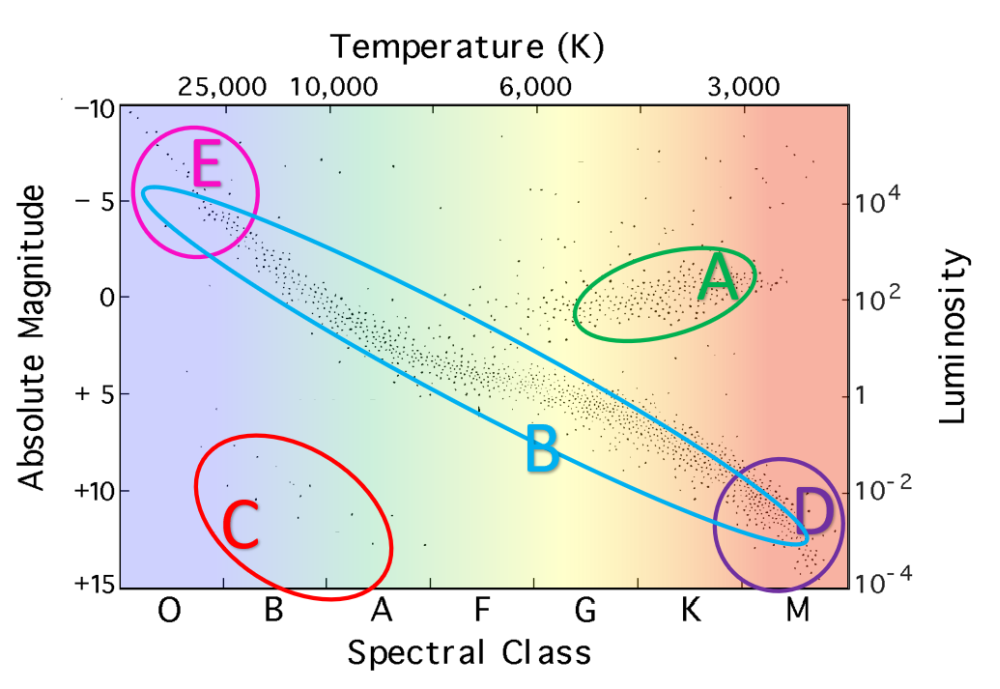
Which area of the following diagram most closely represents our Sun? (closest to which letter)
B
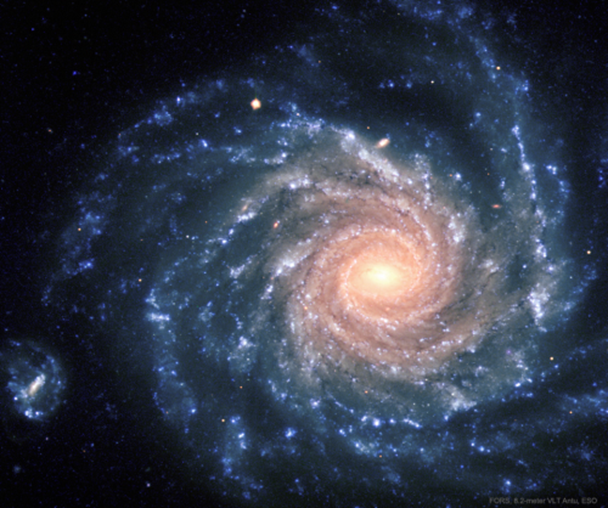
What type of object is shown in this image?
Spiral Galaxy
Which color (wavelength) of light has a higher frequency? (Purple / Gamma ray / Blue / Green / Ultraviolet)
Gamma ray
Using the following information, choose the star that gives off the greatest amount of light: (Proxima Centauri M 11.05 / Betelgeuse M -5.85 / Spica M -3.55 / Eta Carinae M -10.3)
Eta Carinae M -10.3
Generally, granulation, lighter and darker areas of the photosphere of the Sun are due to
Rising and sinking gasses (plasma) in the convective zone
In which of the following galactic objects is star formation likely?
Hydrogen emission nebula
The discovery of variable stars in the Andromeda galaxy led to the understanding that galaxies were composed of millions of stars at great distance. This discovery in the 1920s was made by:
Edwin Hubble
Δ λ/ λ = v/c c= 3X10⁵ km/s
Consider a moving astronomical object. What is the speed of motion relative to the observer if the 793 nm wavelength absorption line is shifted by 1.5 nm?
(Round to the nearest whole number and include units)
567 km/s
The most accurate method to measure the distance to stars:
Parallax
Which of the following is NOT true about sunspots? (Sunspots are disruptions in surface magnetic fields / Sunspots are frequently associated with solar flares / Sunspots are cooler than the surrounding surface / Sunspots are similar in size to terrestrial weather systems)
Sunspots are similar in size to terrestrial weather systems
The Milky Way is this type of galaxy:
Bar-spiral galaxy
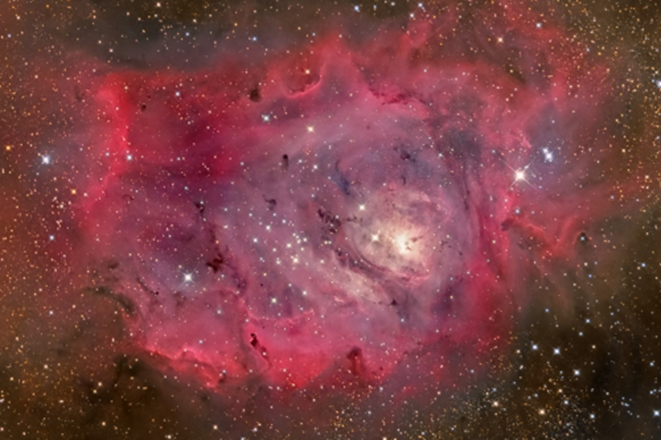
What type of object is shown in this image?
Star forming nebula
The Earth and the Universe are about the same age. (T/F)
False
Consider two stars of equal size A and B, If star A is 1000 K hotter than star B, which statement is true? (Star B is brighter / Star A is brighter / Star A and B give off equal amount of light, just in different colors / Not enough information given)
Star A is brighter
T = 2.9X10⁶/ λ(max)
Consider a glowing object, What is the Kelvin temperature of an object that is glowing with a peak wavelength of 447 nm?
(Include unit and round to nearest whole number)
6488 K
Light left-over from the earliest time after the formation of the Universe was discovered in this color:
Microwave radiation
The smallest type of galaxy
Irregular
Prior to 1920 many astronomers including H. Shapley thought that the “spiral nebula” were:
Near-by solar systems that were just forming.
The largest mass stars are:
~100 X heavier than the Sun
Which color (wavelength) of light has a higher frequency? (Radio / Yellow / X-ray / Ultraviolet / Red)
X-ray
A Parsec is…
the distance an object would be if it had one arc second of parallax in 6 months
I ∝ 1/r2
Assuming constant solar luminosity (light output from the Sun) Compared to the brightness at the Earth (1), what is the relative brightness of the Sun for a comet that is at a distance of 28 AU from the Sun?
(Use 4 decimal places in your answer NO UNITS NECESSARY)
0.0013
This is the zone of the Sun that is characterized by large clouds of plasma that gather around looping magnetic field lines.
Chromosphere
This type of reaction (change) is characterized by the changes in electron configuration between two or more elements:
Chemical change
Which type of explosion results from the final collapse of a single super-massive star?
Type II Supernova
Which of the following is NOT evidence for the Big Bang? (Galactic Red-shift / Cosmic Microwave Background radiation / Predicted abundance of simple elements / Existence of super-massive black holes)
Existence of super-massive black holes
Consider a nebula that is forming a star cluster, which of the following statements is true. (Approximately equal numbers of small, medium, and large stars will form. / There will be 4 X more small M class stars than Sun sized stars. / The largest stars take a longer time to form. / The largest stars with the greatest amount of fuel will exist for the longest time)
There will be 4 X more small M class stars than Sun sized stars
All of the following are true statements about the great supernova of the year 1054 EXCEPT. (The crab nebula has been studied in all wavelengths of the EM spectrum / The Supernova was documented by Chinese and Japanese astronomers. / The Supernova was documented in petroglyphs by Native Americans. / The supernova was documented by Western European Scientists.)
The supernova was documented by Western European Scientists
This zone of the Sun is characterized by hot gasses (plasma) rising and cooler material sinking.
Convective Zone
Of these objects, which has the greatest apparent magnitude (m) (The Sun / The Moon / Sirius / Alpha Centauri)
The Sun
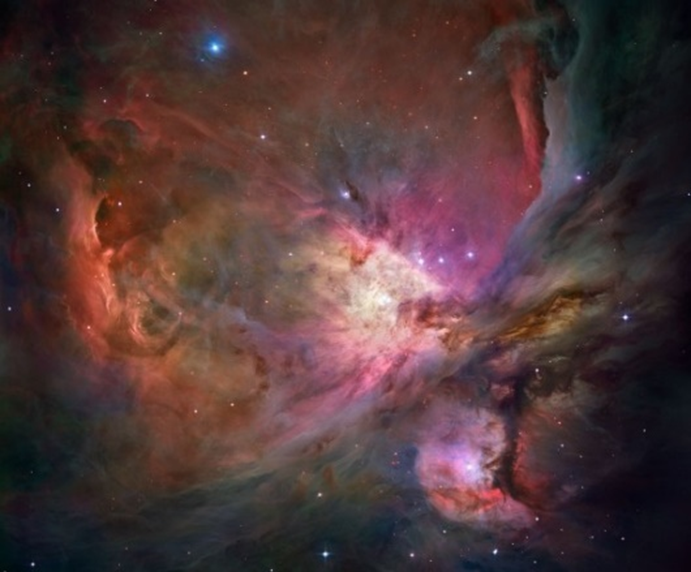
What type of object is shown in this image?
Star forming nebula
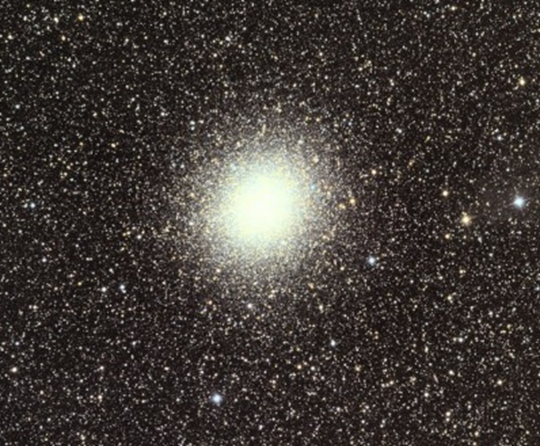
What type of object is shown in this image?
Globular star cluster
Using the following information choose the star that appears the brightest in the sky: Spica m 0.98 / Rigel m 0.12 / Alnitak m 1.47 / Bellatrix m 1.64)
Rigel m 0.12
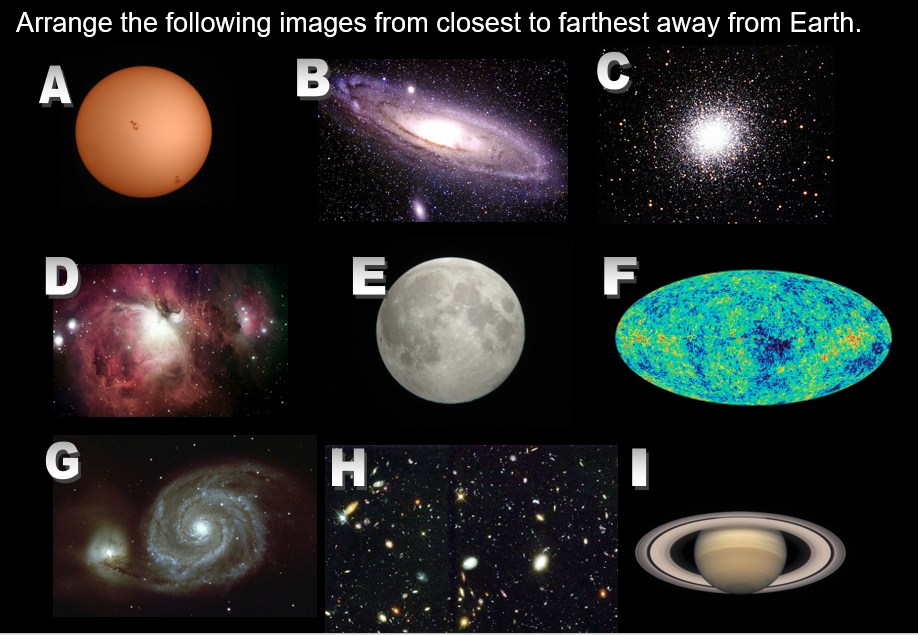
Arrange the following objects in order according to distance from the Earth.
(Near to Far)
E,A,I,D,C,B,G,H,F

What type of spectrum is shown in this image?
Continuous spectrum
Regarding emission spectra, the pink/purple colors emitted by hydrogen gas indicate:
electron transitions emitting specific colors of red and blue light
Which of the following chemicals is most important in the star formation process? (Oxygen / Helium / Iron / Hydrogen)
Hydrogen
Which frequency of light has the longest wavelength? (Red / Microwave / X-ray / Yellow / UV)
Microwave
Which of the following is NOT correct regarding the early universe? (The hot early universe was opaque to EM radiation (light) / The earliest detected light dates from 380,000 years after the Big Bang / Due to the expansion of space, any light waves from the early universe has been stretched beyond the visible spectrum. / The next generation space telescope is designed to pick up light from the moment of the Big Bang)
The next generation space telescope is designed to pick up light from the moment of the Big Bang
If an object is moving away from an observer, the light will be shifted…
towards the red side of the spectrum
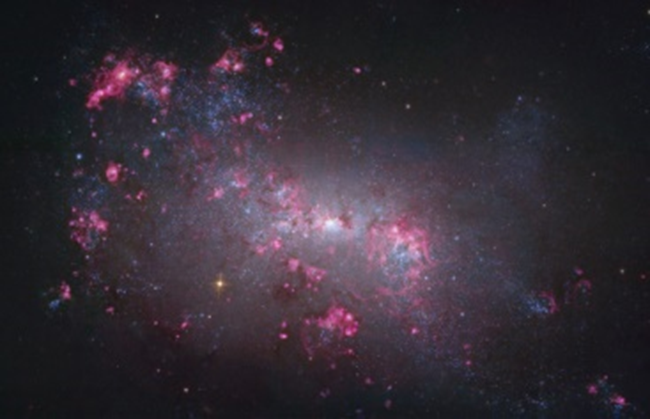
What type of object is shown in this image?
Irregular Galaxy
A light year is…
The distance light travels in a year
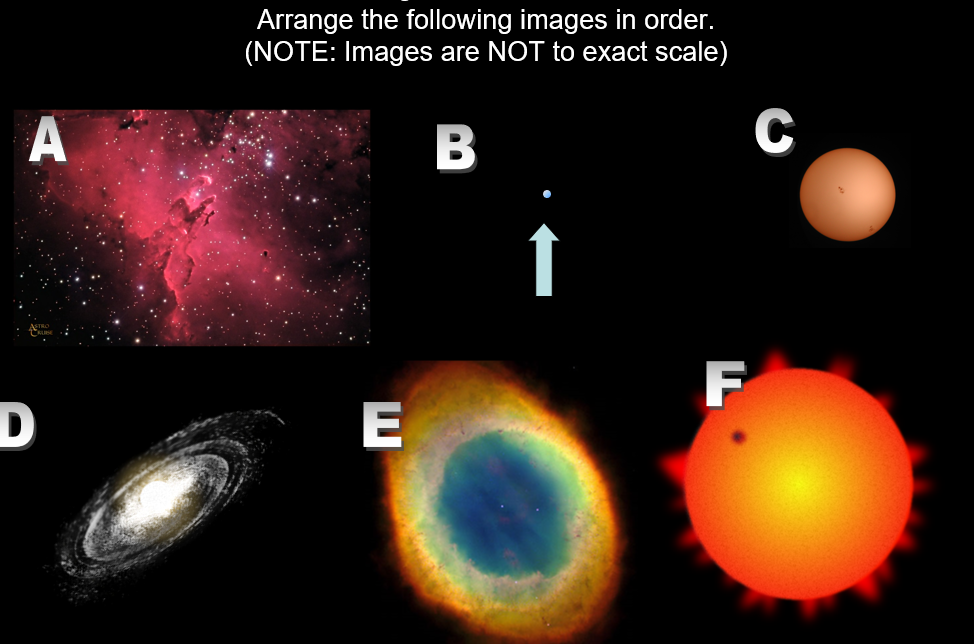
Arrange the following images and diagrams in order of stellar evolution.
Which of the following is NOT an actual motion of stars? (Parallax / Rotation / Orbit in binary system / Planet induced orbital changes)
Parallax
D = 1/p 1 pc = 3.26 ly
A star is measured to have a six month parallax angle of 0.08 arc seconds. What is the distance to this star in light years? (include units with your answer)
40.75 light years
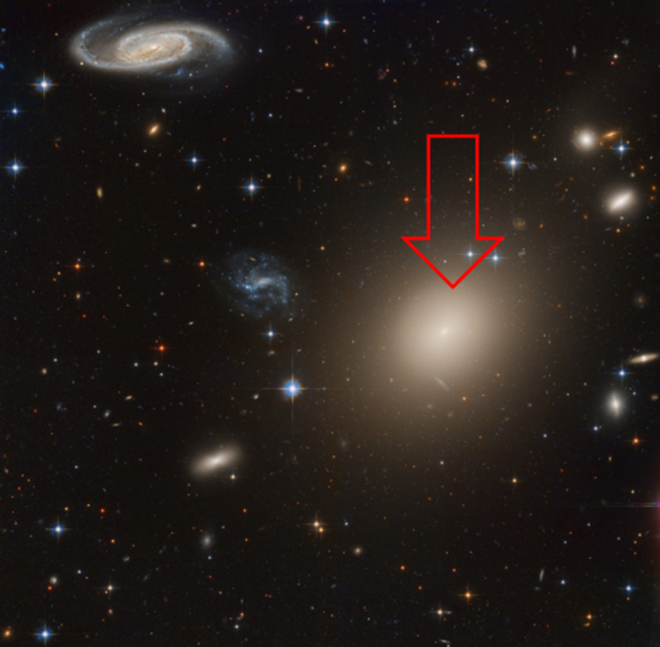
What type of object is shown in this image?
Elliptical Galaxy
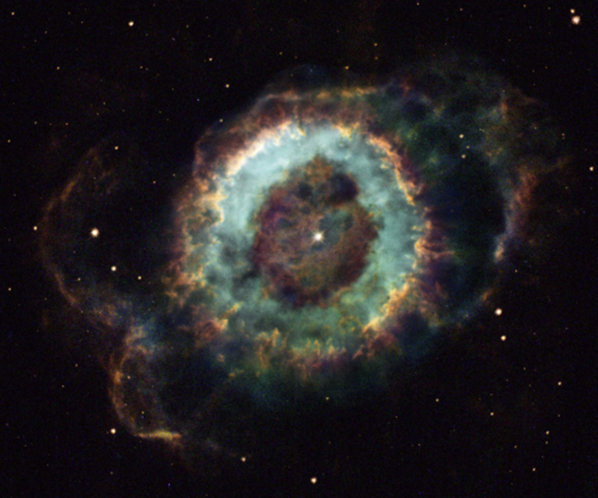
What type of object is shown in this image?
Planetary Nebula
This type of reaction (change) is characterized by splitting of heavier atomic nuclei
Nuclear Fission

What type of spectrum is shown in this image?
Absorption Spectrum
This type of reaction or change results in the loss (destruction) of mass:
a. Physical change
b. chemical change
c. nuclear fission
d. nuclear fusion
e. A and B only
f. C and D only
g. all of the above
F
Approximately what temperature is necessary to begin the nuclear fusion of Hydrogen?
10,000,000 K
When an object is heated, it will start to glow with thermal radiation in this color:
Infra-red
 Note
Note  Flashcards (69)