Pottery archeology
 Studied by 0 people
 Call Kai
 Learn
Learn Practice Test
 Spaced Repetition
 Match
Match Flashcards
 Knowt Play
1/18

There's no tags or description
Looks like no tags are added yet.
Name | Mastery | Learn | Test | Matching | Spaced | Call with Kai |
|---|
No analytics yet
Send a link to your students to track their progress
19 Terms
What is pottery?
Fired clay that is made into various shapes to have various purposes
Firing causes permanent ____ _____
chemical change
Often temper is added:
materials added to clay to change material properties and provide more structural durability
Methods of making pottery
Handmade and wheel made
Handmade pottery
pottery found in North America pre-contact
Pinching
Coiling
Paddle and anvil
Wheel made pottery
Use of pottery wheel
Developed in China and Mesopotamia
Stages of pottery
Raw Material acquisition
Raw Material preparation
Forming/shaping
Decoration (surface treatment)
Firing
Pottery organization
Cottage/household industry and craft specialization
Household production
Production is for members of the same household
Smaller and less intensive scale of production
Production roles are fluid
Scheduling is more fluid
Learning process tends to be more flexible
Craft specialization
Production is for or both members insides and outside household
Larger scale and more intensive production
Often associated with a social hierarchy controlling production
Crafts specialists with workshops
More rigid formalized learning
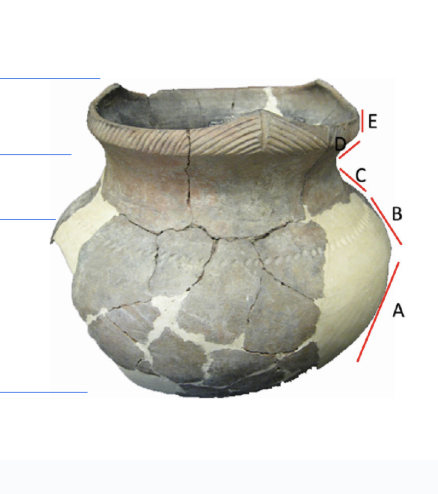
Rim letter
E
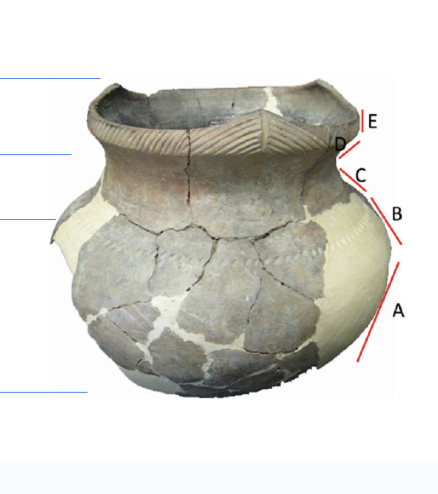
Neck letter
C
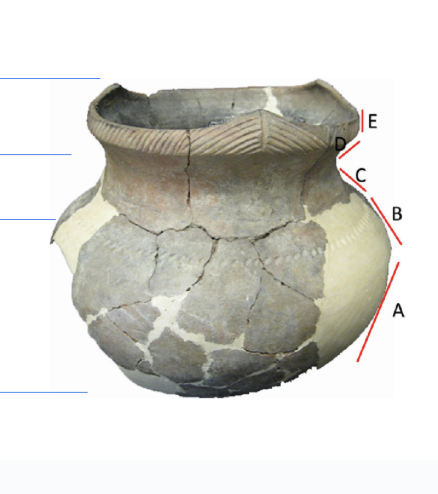
Body letter
B-A
Ways to study pottery
Macroscopic pottery traits
Microscopic pottery traits
Residue analysis
Experimental archaeology
Ethnoarchaeology
Macroscopic Pottery Traits
Pottery Decoration
Focus on identities through material culture
Formal traits
Focus on technological decisions
Two methods can be combined to look at social relation between identity and technology
Petrography
Microscopic pottery trait
Definition: method to study temper and paste of pottery
Identify sources of raw materials
Identify technological decisions related to social and ritual practices
Residue Analysis
Effective to understand use of pottery
Effective to understand foodways
Effective to collect data for carbon-based dating methods
Experimental Archaeology
Observer has control over variables to replicate past material things and past decisions
Effective to understand production decisions related to interactions between clay and potter
Cannot study social or ritual processes
Ethnoarchaeology
Archaeological approach that studies living groups to investigate questions related to past practices
Effective for studying broader chaîne opératoire stages
Allows for investigation of social and ritual questions
Important to recognize that ethnographic analogs cannot be directly tied to past behaviour
 Note
Note  Flashcards (34)