Lecture 3 in-class notes
 Note
Note Call Kai
 Learn
Learn Practice Test
 Spaced Repetition
 Match
Match Flashcards
 Knowt Play
1/21

There's no tags or description
Looks like no tags are added yet.
Name | Mastery | Learn | Test | Matching | Spaced | Call with Kai | Chat |
|---|
No analytics yet
Send a link to your students to track their progress
22 Terms
Role of Market Size on Product Variety (Schmookler 1966)
Greater market size => greater variety of potential solutions and R&D efforts go into making multiple varieties of the product.
Condition: demand must be heterogeneous. If homogeneous, there will be only 1 winning product suitable for all consumers.
Role of size of demand (Jacob Schmooklet 1966)
Bi-directional effect between demand and innovation:
demand may pull innovation
innovate may generate new demand
Induced Innovation (Hicks 1932)
Changes in relative factor prices spur inventions (to economize the use of expensive factors)
Example: If labor is expensive = more incentive to produce innovations that’ll enable sales.
Technology Push
Innovation starts with a discovery/invention. Linear process

Demand pull
Innovation starts with a market need. No demand = no innovations.
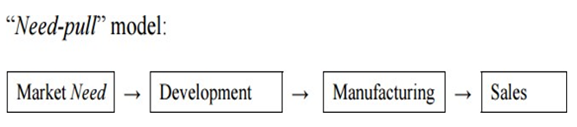
Main criticims of demand pull approach (2)
Mowery & Rosenburg (1979) and Dosi (1982):
Does not distinguish amont potentially limitless set of human needs
Since human needs are limitless, it would be untrue to say that NO needs were satisfied because a tech was developed
Does not explain why & when certain techs are developed rather than others
Examples of Technology Push
X-Rays, the internet, the airplane & mainframe computers
Examples of Demand Pull
digital X-Rays, cat scanners, pcs & and smartphones
Demand as a source of innovation
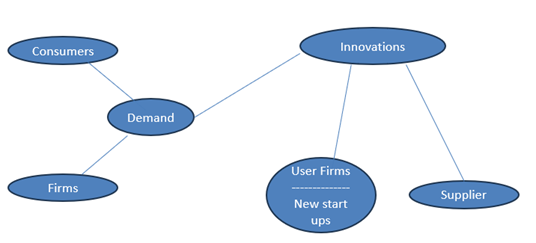
Users as Innovators (Myers and Marquis 1969)
Users play a significant role in innovation, with demand factors being relevant for 75% of successful innovations.
User-Producer Interactions (Lundvall 1992)
Feedback important (technical feedback, not simple)
Users have deep understanding of product
Mutual learning, since users and producers both have specific knowledge.
Effects that Characterize a Lead User (2) (Von Hippel 1982, 1985, 2005)
Knowledge effect
LUs experiment needs that the rest of users have not yet experienced.
Incentive effect
If a supplier fixes the product, it benefits me since I’m the one using it
Industrial Users: Innovate or Buy?
Manufacturers will be more focused on finding a compromise than finding the best solution
Risk of opportunism
Users not flexible regarding quality
When a user buys, they expect services as well
Principal-agent costs
Cost by the user to ensure that the manufacturer follows the interests of the principal.
Communities (Wellman et al. 2002)
“networks of interpersonal ties that provide sociability, support, information, a sense of belongingness and social identity”
Innovation communities (Von Hippel 2005)
“nodes consisting in individuals or firms interconnected by information transfer links that involves communication”
Co-invention
Innovation by seller/manufacturer and complementary innovations by buyer (in terms of organization, services, applications, products, etc.)
Co-creation
Collaborative development between complementary partners, such as a manufacturer and a user, to create new products or services.
For horizontal technologies
Open Innovation (Chesbrough 2003)
Firms should use external knowledge to accelerate internal innovations, and combines external ideas with internal ones.
Challenge: convert ext knowledge into new products & services.
Trademarks (TM)
Protection of signs or symbols that are capable of distinguishing the goods or services of a company.
Not an indicator of innovation, because they do not require novelty
Types of entrepreneurship (2)
User entrepreneurship
New firms founded by individuals who have innovative ideas.
User-industry spinouts
New firms founded by ex-employees of user firms that enter the supplier industry.
Two ways of entre from industrial demand
Vertical integration: When a user firm innovates and produces a component internally instead.
User-industry spinout.
Determinants of rate of diffusion (4)
Benefit received by the tech
Network effects
Cost of adopting new tech
Information & uncertainty
Demand size
Market structure
Industry environment
Cultural + social factors