Lecture 3 in-class notes
DEMAND, USERS AND INNOVATION
1 - DEMAND AS INCENTIVE TO INNOVATION
1.1 - JACOB SCHMOOKLER (1966) - THE ROLE OF THE SIZE OF DEMAND
The size of the market affects innovation: differences in the rate and direction of inventive activity depend on the relative size of demand
Empirical analysis: patents lag behind peaks of output of a commodity
Analysis of the railroad industry from 1846 to 1950: patents lag behind economic performance (measured in terms of firms’ profitability)
Size of demand affects the rate of innovation
Keep in mind that you may have bi-directional effects between demand and innovation, in the sense that…
demand may pull innovation,
but at the same time innovation may generate new demand!
1.2 - The role of the size of demand and market on product variety
We can also say that an increase in market size produces a greater variety of potential solutions. R&D investments can be spread among a variety of solutions
Why?
Innovation requires a fixed cost.
With an increase in market size, real or expected streams of profits generate a variety of R&D efforts and more than one variety of products.
However demand has to be heterogeneous.
If demand (consumers) is homogeneous and buys only the innovation that works best as a solution of the problem to be solved, an increase in market size would lead again to a dominant solution.
Large size market = incentive for innovation and to invest in R&D. If market size ++++, you may first invest in R&D in order to develop a few innovations. Also increases the variety of products. Condition is that demand must be heterogeneous. If homogeneous, theres only 1 winning product so theres no way for innovating and producing different varieties.
1.3 - HICKS (1932) - INDUCED INNOVATION
Originally: A change in the relative price of production is itself a spur to invention of a particular kind, directed at economizing the use of a factor which has become relatively expensive.
Relative factor prices will determine which processes are most convenient within the research portfolio of a given firm
Innovation is partly endogenous to the economic system
Example; If price of labor ++, more incentive to product innovations that’ll enable sales.
Induced to invest in labor savings
Innovation is sensitive to; Size of demand, change in relative factor prices…
1.4 - THE TECHNOLOGY PUSH - DEMAND PULL DEBATE
There were 2 ways to look at innovation.
Common way; Technology push
The innovation process starts with a discovery or an invention
Linear process
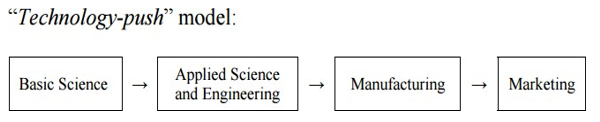
Demand pull: Well, we found out that demand can also be an incentive to innovation. If the market needs something, someone will make it!!
Innovations are developed in response to a market / demand need
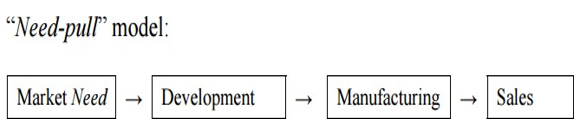 1.4.1 - THE BASIC HYPOTHESES OF THE DEBATE ON TECHNOLOGY PUSH/ DEMAND PULL
TECHNOLOGY PUSH: Needs are infinite.
Technological paradigms and trajectories guide innovative activity
It is the technology that defines and guides what is introducing demand.
Everything depends on technology. As soon as a certain tech is developed, then you will have the needs to match it.
DEMAND PULL: Innovations are developed when there is a demand.
Technology follows demand.
Here demand is examined as an incentive for innovation
No demand = no innovations
But Mowery and Rosenberg (1979) and Dosi (1982) criticize the market pull approach by saying that:
It does not distinguish among the various potentially limitless set of human needs
While it is true that innovations are developed when there is demand, human needs are limitless. So, certain needs are satisfied BECAUSE a certain technology was developed.
It does not explain why and when certain technological developments instead of others (and with a certain timing) occur
1.4.2 - EXAMPLES OF TECHNOLOGY-PUSH VS DEMAND-PULL
X-RAYS - Technology push
DIGITAL X-RAYS - Demand pull
CAT SCANNERS - Demand pull
MAINFRAME COMPUTER - Technology push
PERSONAL COMPUTER - Demand pull
THE INTERNET- Technology push
THE SMARTPHONE - Demand pull
THE AIRPLANE- Technology push
PENICILLIN- Technology push
CARDIO-ASPIRIN - A little bit of both
2 - DEMAND AS A SOURCE OF INNOVATION
Before Von Hippel:
The idea was that the supplier could innovate. Innovations would come from the suppliers, more or less frequently if the demand was large/reactive, etc.
Aka all the action was on the supplier. In a way, demand was passive. This model is absolutely still valid
With Von Hippel:
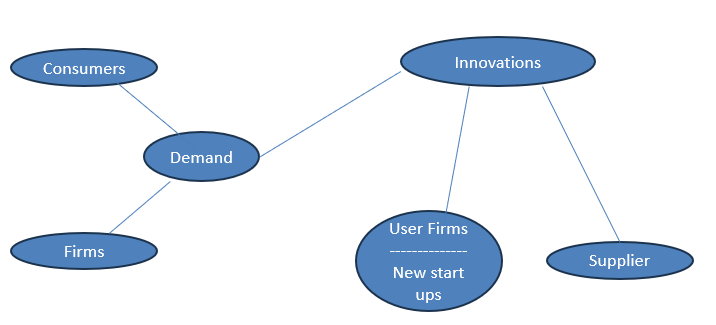
Demand can be a source of innovation, in the sense that innovations may emerge out of demand, and these innovations may gain big market shares etc.
In this theory, demand was mainly composed by users. But in an economy, intermediate demand is also composed my firms.
Actually, in the past, it was not true that demand by firm was passive. Lots of firms, through vertical integration, started producing the products that you buy (or even developing them at the extreme).
Therefore von Hippel was talking about users when talking about demand, and not about firms.
These new innovations/ideas/developments could be either produced by…
suppliers
the user firms
a new start up introduced by consumers
So… why, in 2002, did a Harvard Business Report say that;
Customers should not be trusted to come up with solutions; they aren’t expert or informed enough for that part of the innovation process (2002)
Well, there are two options;
Users in 2002, users did not innovate
Not schooled/educated enough before then, so didn’t know that/how they could innovate
Lack of network!! Nowadays w internet and so on, users are much more empowered for innovation
OR
The reporter simply did not see it
Lack of surveys and statistical analysis (lack of study of demand)
2.1 - USERS AS INNOVATORS: THE PIONEERS
The initial analysis was the one by Myers and Marquis in the US in 1969:
They developed a questionnaire and made interviews about 567 innovations in 5 different industries
For 21% of successful innovations, technological opportunity was relevant
For 75% of successful innovations, demand factors were relevant
(First interview questions that went in depth about demand as a source of innovation)
2.2 - SOME INITIAL DATA
Von Hippel came up with some interesting data…
Industry | % of innovations developed by users |
Scientific instruments | 77% |
Semiconductor equip. | 60% |
Product | % of users developing new products for their own use |
Printed circuit CAD software | 24% |
Library information system | 26% |
Surgical equipment | 22% |
Mountain biking equipment | 19% |
Extreme sporting equipment | 38% |
2.3 - THE DIFFERENT ROLE OF USERS
Users- producers interaction (MOST OBVIOUS)
Lead users
Users as innovators
Community of users
Co-inventions
Open innovation
2.3.1 - USER-PRODUCER INTERACTIONS
B.A. Lundvall, National innovation systems 1992
Feedback from users are important for innovation
Not just feedback in terms of I buy or I don’t buy, but in terms of getting improvements – how can I improve my design, what can I change to make it better? Are there problems w it etc.
Aka get technical feedback from users, not just a simple “Ill buy it or not”
User-producer interactions are quite common in certain industries, such as specialized suppliers industries.
Why is this important for many industries? Because the client literally uses the product – they’ll know how good it is, how bad it is, what could be changed etc.
The manufacturer doesn’t use it!! They just make it.
Users have a deep understanding of products usability, learn by using and exchange knowledge with producers about uses and demand features.
They give some application knowledge to suppliers, which is extremely important and beneficial to them
Users and producers have specific knowledge. Their interaction produce mutual learning.
BUT! The action is still on the suppliers side! As a user you don’t innovate or make a new product, you only give feedback and the supplier will change if needed:)
2.4 - VON HIPPEL (1982,1985,2005) - DEMAND AS A LOCUS OF KNOWLEDGE FOR INNOVATION: LEAD USERS
The concept of lead user:
Consumers who have major needs that will become general in the marketplace in the future
Lead users are characterized by experience in use and as customers
Two types of effects characterize them:
KNOWLEDGE EFFECT: they experiment needs that the rest of users will experiment much later
INCENTIVE EFFECT: they obtain greater benefits from satisfying their needs
They have all the incentive that the supplier modifies the product as the user suggests. If the supplier does what I tell them, I will benefit a lot (in terms of utility, performance, etc.)
This is what all companies from the supply side desperately look for!!
They are present in many industries
They are quite common in:
Software
Consumer outdoor products
2.5 - USERS CAN BE INNOVATORS (example)
1870s: Josephine Cochrane and the first machine that could clean dirty dishes.
She was tired of having her china dishes chipped.
This started the dish-washing machine industry.
Josephine Cochrane had several years of personal use and of display of the new device to her neighbors in her kitchen.
1986: her first patent
Then she founded the Cochrane Crescent Washing Machine company
2.6 - USERS CAN BE… AND WHY THEY INNOVATE
Individual consumers & Professionals (doctors, researchers…)
Users have direct and deep knowledge of the uses
Users may be the only actors that benefit directly from innovation
A lot of times the suppliers don’t have any incentive to satisfy your need… so you may be the only actor who directly benefits
They innovate because they cannot find on the market products or services with the characteristics that they want.
Heterogeneous preferences for characteristics: when consumers are not distributed uniformly, manufacturers prefer to produce for the majority of consumers.
Firms (didn’t note answers for this)
This makes a big difference in knowledge and motivation
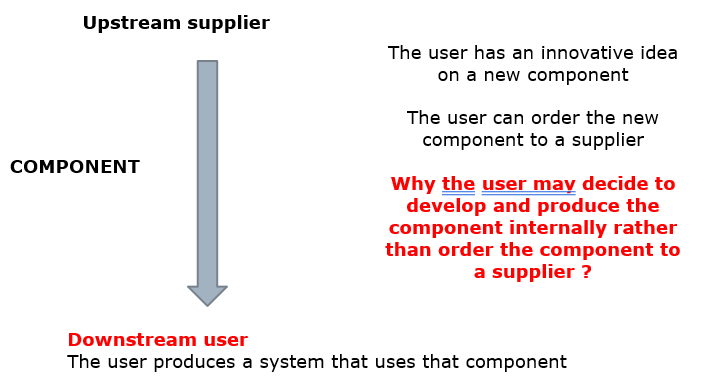
2.6.1 - CASE OF A COMPONENT REQUIRED BY A USER IN ITS PRODUCTION OF SYSTEM PRODUCTS
Can choose to remain a specialized system producer. I tell the supplier my idea, and the supplier will produce the component for me
User may lack the knowledge of production, pushing them to ask the supplier to produce them
Very time consuming to add the production of a completely new thing!! Complex, costly, etc.
Need to consider the frequency of use – if I use the machine 1-2 times per month, it would be better to get it from supplier. If I use it every day, it may be more practical to do it myself.
OR
I choose to produce myself, but then I become vertical integrated, and become a company that produces both components and systems.
Can save on agency costs
Frequent use of machine – better for me to make it myself
By outsourcing, less control over the quality of the component since it’s not me who makes it. If you want to monitor the supplier everyday to ensure the quality, it will cost you money at the end of the day
How important is it for your strategic relevance?? If you have the idea of a new component that realllyyy improves, maybe you won’t want to outsource – won’t want to tell the supplier about it, keep it inside.
INDUSTRIAL USERS: INNOVATE OR BUY?
The fact that industrial users have heterogeneous preferences and needs is not a sufficient condition to explain why they innovate by themselves.
Given that they have high willingness to pay, they might ask a manufacturer to produce a product with all the features they like, rather than producing it by themselves.
Some motivations refer to TCE (transaction cost economics)
Risk of opportunism: asset specificity in R&D and investments
Cost for the principal (the user) to ensure that the agent (the manufacturer) follows the interest of the principal
Cost for the agent to commit itself not to act against the principal’s interests
Differences in what is considered a desirable solution
Users are concerned only with obtaining the best technical solution that fits their needs
Manufacturers will be more concerned with finding a compromise solution that does not disrupt too much their existing routines and capabilities in design and production
Differences in innovation quality requirements
When users buy a product from manufacturers, they tend to expect a package of other services together with the product: full reliability, availability of replacement parts, maintenance services.
Moreover, buying users are not willing to accept forms of compromise that affect the actual quality. What if in a million- euro machine tool users find a cheap computer controller (even if it is completely fit for the requirements)?
A key factor is related to knowledge, routines, and capabilities
“Sticky” information (Von Hippel, 1994):
Cost of transferring information from a firm to another => knowledge context differs
The problem in the case of users:
Knowledge about needs / applications is located at the user site
Knowledge about problem-solving manufacturing capabilities is located at the manufacturer
Sometimes, it can be easier to transfer the second type of knowledge
2.7 - WHY MAY USERS REVEAL THEIR INNOVATIONS?
Common in medical equipment, sport equipment, software codes
If free revealed, the innovation becomes a public good.
Reasons:
Increase the reputation of the innovator
Increase the diffusion of the innovation
Fun and learning from participation in innovation communities- reciprocity
Norms of sharing
2.8 - COMMUNITIES OF USERS HAVE EMERGED
Communities are “networks of interpersonal ties that provide sociability, support, information, a sense of belongingness and social identity”
(Wellman et al. 2002)
Innovation communities are “nodes consisting in individuals or firms interconnected by information transfer links that involves communication”
(Von Hippel 2005)
MAIN CHARACTERISTICS OF COMMUNITIES
All members freely reveal their information.
Each user has different needs and different knowledge.
Adding more people to the community increases the probability that someone will get useful knowledge and information
Members usually assist each other
Communities can become specialized and collect a great amount of information on a certain subject/innovation category.
COMMUNITIES OF USERS IN SOFTWARE
Case of open source software. Linux was a great example.
Communities as facilitators of innovation
Users have an incentive to innovate and to reveal information: collective invention
The community of users is interested to diffuse the information
In some industries, innovations are shared and you can reveal information to the supplier (information communities)
2.9 - BEYOND USER INNOVATION. CO-INVENTION AND CO-CREATION
Co-invention:
Innovation by seller/manufacturer and complementary innovation by buyers in terms of organization, services, applications, products, etc.
Co-creation:
Collaborative development between complementary partners (such as a manufacturer and a user)
Technologies that are horizontal! Computers, steam engines, etc. can use those technologies in a lot of different interests.
OPEN INNOVATION
Henry Chesbrough (2003)
The OI framework is based on the idea that firms are better off by using external knowledge to accelerate internal innovations. Open innovation assumes that firms should use external ideas and combine them with internal ones.
The challenge is to convert external knowledge into new products and services
Example: InnoCentive (Jeppesen & Lakhani, 2010
A spinout from Eli Lilly, launched in 2001
A two-sided platform where “seekers” are firms or other organizations, looking for solutions to science-related problems, and “solvers” are individual scientists that compete for the best solution and a prize.
Knowledge is so pervasive, that firms no longer innovate within their own boundaries, but now use external knowledge (universities, etc.) = open innovation. Innovation sometimes needs to be open, requires other actors to help you innovate.
3 - A NEW INDICATOR: TRADEMARKS
3.1 - A USEFUL INDICATOR: TRADEMARKS (TM)
Trademark (TM): a sign capable of being represented graphically, particularly words, designs, letters, numerals, the shape of goods or their packaging, provided that such signs are capable of distinguishing the goods or services of one undertaking from those of other undertakings (EC- council regulation)
EC: TM can be registered in one or more than 45 product classes, gain protection in all member countries and have 10 years duration
The number of TM is higher than the number of patents!
TM: strong TM enhance firms reputation and allow firms to appropriate more profits in the market. Firms may apply a premium price which consumers are willing to pay, given the quality of the good they are buying, which is perceived or communicated via the TM
It has been found that TM-active firms create significantly higher value added (up to 30% more) than non-TM active ones
Related more to the product, to the market, and could be associated with demand. Usually quite helpful for companies because a trademark allows a trading price (?) on their product. Widely used by companies, and someone said TMs are an indicator of product innovation…. FALSE!!!! See below
Patents: protects inventions
TM : protect brands: they do not require technological novelty.
They require distinctiveness.
Lower level of detail than patents.
Informative examination process.
They may be complementary to patents
Some analysts stress that they may represent some “marketing innovations”
Protect brands, but not innovations. They protect the distinctiveness of the product, not its novelty. Help to differentiate products from one another. Theyre complementary to patents
Low-tech sectors:
Trademarks as indicator could be useful because patents are not available. Keep in mind however that TM do not indicate product innovations
High-tech sectors:
TM are often complementary to patents: there is a positive correlation between patents and TM
Heterogeneity across sectors (Schmoch 2003, Malmberg 2005)
Contrary to patents, TM are available for services. They can be a reliable indicator of ferment in product differentiation and product changes in services
Pharma: changes in products are correlated with TM
Auto and electro-mechanics: not high correlation between changes in products and TM, because of the broad use of model numbers and the rare use of TM
Used in both low and high tech.
What is good in low tech, is that since we don’t have lots of patents, at least there are trademarks as an indicator of some sorts..
4 - DEMAND AS SOURCE OF ENTREPRENEURSHIP, INNOVATION AND INDUSTRIAL DYNAMICS
Consumer or professional, may have an idea. May decide to give it to supplier or do a start up. If you are a firm and want to produce, you need to vertically integrate.
4.1 - TWO TYPES OF ENTREPRENEURSHIP
User entrepreneurship: new firms founded by individuals (consumer or professionals)
Cochrane and the dish-washer
Juvenile products
Skate boarding
Probe microscopy
User-industry spinouts: new firms founded by ex-employees of user firms (upstream)
4.2 - ENTRY FROM INDUSTRIAL DEMAND
Two ways of entry from industrial demand (i.e. user firms):
Vertical integration:
When a user firm that produces a final product innovates and produces a component internally (in- house).
User-industry spinouts:
When an independent start-up company originates from the user firm and enters the supplier industry
User-industry spinouts
In industries in which demand plays a key role in innovation, demand is heterogeneous and demand has many niches, the knowledge of applications may become a major source of entry of new independent firms. These new firms are spin-out from existing users. Why?
Knowledge about uses and applications is a key asset for the new firm in the focal industry and impacts positively on its survival.
Entry of small independent companies is possible in case of low fixed start-up costs and low capital equipment costs.
Heterogeneity of demand increases opportunities for users to exploit their specific knowledge in specific niches
THE CASE OF MICROELECTRONICS INDUSTRY
1010 start-ups founded between 1997 and 2007 in US and Europe
Information on firms, entry and survival or exit Information on founders:
Name, education, industry background
Adams Fontana and Malerba Organization Science 2016
You may have a lot of entrepreneurship, in certain industries, that come from spinouts.
ENTRY IN THE MICROELECTRONICS INDUSTRY
Pre-entry experience and firm survival:
Both spin-offs (entrants coming from other microelectronics firms) and user-industry spinouts (entrants coming from users-auto, computers, telecom, and so on) enjoy a higher survival (lower exit rate) with respect to inexperienced firms
User-industry spinouts perform relatively better then spin-offs
User-industry spinouts have direct application knowledge!
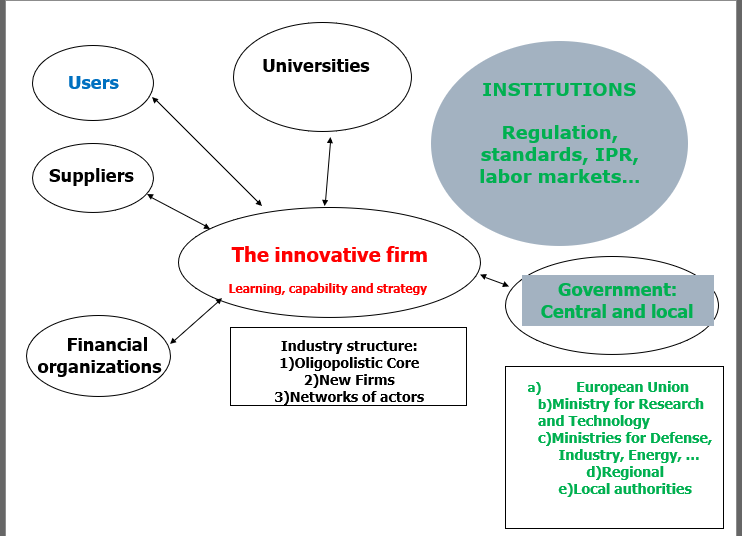
4.3 - USERS IN INNOVATION SYSTEMS
Keep in mind that in the innovation system, users play a major role.
5 - DEMAND AND DIFFUSION
The role of demand in innovation is different from the role of demand in the diffusion of an innovation.
Innovation is different from diffusion! Diffusion path is “sigmoid” (S-shaped)
Diffusion speed varies across innovations, industries and regions
Innovations change during the diffusion
Up to now, we discussed demand as an incentive to innovation, or a source of innovation.
Demand is ALSO important for the diffusion of innovation!! Not only for innovation itself! (we will not discuss this tho?)
5.1 - DEMAND AND THE DIFFUSION OF NEW PRODUCTS AND TECHNOLOGIES
Demand plays the key role in the diffusion of innovations
The characteristics of demand affect the rate and extent of the diffusion of a new technology
Consumers demand and industrial (firms) demand have very different characteristics: we will call them consumers and industrial users
5.2 - DETERMINANTS OF THE RATE OF DIFFUSION
Benefit received form the technology
Network effects
Costs of adopting the new technology
Information and uncertainty
Demand size
Market structure
Industry environment
Cultural and social factors