CLST200- Greek History - Test 1
 Studied by 0 people
 Call Kai
 Learn
Learn Practice Test
 Spaced Repetition
 Match
Match Flashcards
 Knowt Play
1/102

There's no tags or description
Looks like no tags are added yet.
Name | Mastery | Learn | Test | Matching | Spaced | Call with Kai |
|---|
No analytics yet
Send a link to your students to track their progress
103 Terms
Linear B
Bronze Age - only written records
Hallas
the homeland of the Greeks (Hellenes)
Early Greexe
• Sense of cultural identity but no country
Many different communities - no nation state/ empire only city-states (not big fans of each other)
Greeks thought they were either…..
Dorians, Ionians, Aeolians, Northwest Greeks and Arcadians. Each group shared a dialect.
Life in Greek mainland
• Hot climate - long summers and wet winters
• 80% of pop(even in classical time) were farmers.
• “Idea of farmer solider”
• Horses and cattle occupy a special niche
Oxen and mules for plowing
When does writing appear
History beings in the 8th cen - when writing started to appear. Early navigation shows cultural influences.
Schliemann and Evan’s
• Schliemann, inspired by homer, excavates at Troy and discovers “priam’s treasure”
• Before this people were interested in classical studies/ prehistory as a connection to the Greeks as their ancestors. (1871-73) the Greeks believed in the story of the Trojan war - as reality. It was very important cultural memory (the city existed)
• People were interested in excavating sites to find myths - archaeology was not considered a science or regulated - many sites were looted
• Then excavations at Mycenae, discovering rich, impressive remains of Mycenaean civilization. - by frank Calvert (Schliemann took over and took credit)
• Schliemann wanted to find were Homeric hero’s took place- Mycenae was such an important city - in myth and culturally that it was kept alive In public memory.
• Schilemann found royal tombs - showed that the civilization was an important regional power. - identified as tombs of Homeric hero’s by visitors (not true)
• Schilemann removed half the hill when excavating at Troy - although it allowed him to see many differently layers built on top of one another- not a good dating system
• Schilemann found many treasures during excavation- took pictures of treasures on his wife and published them
• Knossos was also excavated (Crete) by Evan’s
The Neolithic age
7000 BCE) sees the domestication of animals and plants
Around 3000
Greek craftsman’s mixed cooper wth tin to make a more durable bronze
• Starting in the Bronze Age ‘
• 2500 bronze and other metals
• These innovations come from the Levant- very deeply influenced (Egypt) - art, technology, constitutional systems, etc.
Greek Bronze ages
3 period - early, middle and late (Early finishes with a layer is destruction)
The Minoans
island of Crete was inhabited during the early Neolithic times
Early Minoans spoke a non-indo-Euro lang
The homeland of Crete slowly becomes a land of mall city-kingdoms
Earliest palace complex at Knossos around 1900 BCE
Palace emerging in other parts of the island
Palace-cantered economy engaged in international trade.
The palace seen today at Knossos dates to 1700BCE - palace was thought to be the centre of its own territory - administrative and used as storage(potentially as taxation) (first destroyed in an earth quake)
Minoans kept record of all their economic activities - recorded in Linear A (not been deciphered) (lang used to keep record .
Palace was richly decorated - Egyptian style etc. - extended network of trade and social contact.
Minoan art
• Much influence from Egypt
Minoan frescos also found in Mycenaean buildings
Early Mycenaeans
• Considered early Greeks - came to mainland Greece and the balkans- founded many settlements around the peninsula.
• Name given to the Mycenaeans because of the city Mycenae.-
• 1650 started the building of palaces and luxury burials (starting of a social higharchcy)
Greece is gradually transformed during the middle Bronze Age
Mycenaean Graves
• Shaft grades from 1600-1500 BCE
• Bronze weapons and eventually gold jewelry
• Attest to the economic velopment of Mycenaean civilization
• Around 1500 BCE nobles begin to inter their dead in the monumental theology tomb.
The later Mycenaeans
• Shaft grades from 1600-1500 BCE
• Bronze weapons and eventually gold jewelry
• Attest to the economic development of Mycenaean civilization
• Around 1500 BCE, nobles began to inter their dead in the monumental theology tomb.
The Mycenaeans took Minoan Crete
• Greeks from the mainland gained control of Crete around 1490 BCE - Knossos was mostly spared; other sites were destroyed.
• Mycenaeans accupyed many sites on Crete.
• As they grew, they raised in important and took over Minoan Crete (1500-1400). Many places were destroyed, but Knossos was turned into a Mycenaean palace.
• Palace complexes seen today dates from the 14th and 13th cen BCE
• Mycenaeans took palace organization from Minoans
• Final phase of Mycenaean power
• Megaton - rectangular courtyard, 4 columns- later passed on to the organization of Greek temples.
• Palace frescos in Minoan style.
The Linear B tablets
Indo-European lang
• Micheal Venturi’s dechiphered Linear B tablets in the 1950s - announced that the lang was a form of Greek
• The records gave scholars a lot of information about how the site states were organized. - religious information as well (very similar to Olympian gods)
The large cache of Linear B record found of Pylos tell us much about Mycenaean economy and society
Wanax
• The ”Wanax” (king) rules- next rank is “leader of the army”
Mycenaean economy and the palace
Luxurious standard of living for elites
Religious - Minoan and Mycenaean
• Both honoured their gods with procession, music, dance, gifts and animal sacrifice
• In Minoan art, a goddess is the main object of worship
• Minoan religion was focused on female cults - natural elements (animals and natural spaces)
• Linear B tables - Mycenaeans had a preference for a sky God (potentially early form of Zeus) palace was centre for religious activity
• Minoans and Mycenaean had chariot (unrelated to religion — warfare (not used to fight in but used to bring people to battle)
End of the Mycenaean civilization
• Just before 1200BCE, almost all palace centres (myc) were destroyed or abandoned.
• By 1100 BCE, Mycenaean kingdoms no longer existed
The entire eastern med suffered catastrophes at the time - Hittites collapsed and Egypt was attacked.
Greece Dark Age
Following the late Bronze age - the Greek world falls into a “dark age” as described by scholars.
Many civilizations collapsed (Hittites, Myceneans) with very little explanation due to the lack of literary sources at the time.
Dark age = Dark time in writing practices.
Sources for the Iron Age
Homer’s Iliad and Odyssey (8th-7th cent.)
Earliest Greek literature
Controversial value as sources
Product of oral tradition
Hesiods Theogony and Works and Days (c. 700
BCE)
Works and Days: set in Hesiod’s time & place- Explains farming traditions
Theogony: relation to Near-Eastern mythical traditions
Early Iron Age, following the “Dark Age”
Little to nothing left of the Mycenaean world
Towns abandoned, population plummets
Agricultural life remained much the same
Greeks master iron, which replaces bronze
Protogeometric pottery (c. 1050–900 BCE)
“Ionian Migration”: from mainland Greece across
the Aegean Sea and to the Anatolian coast (Ionia)
Important new Anatolian Greek settlements: Miletus,
Ephesus, Colophon, Chios, Samos
Society in the Early Iron Age
Extremely sparse material remains for the 11th & 10th
centuries
increase around 900 BCE
Small settlements (except Athens, Argos, Corinth)
Poor & scarce grave goods
Evolved from Mycenaean qasileu (Linear B tablets)
Archaeological evidence for Iron Age kingship at Nichoria
“Village chieftain’s house”
Rather modest by Mycenaean standards
Basileus
The office of basileus emerges as a paramount figure in the Iron Age state
Considered a King/ Chief of a polis/ smaller city
The chief basileus had a religious & judicial role in the community
Not a priest, but presides over public sacrifices
Sanctioned by Zeus
Iron Age Lefkandi
Largest Early Iron Age building yet found (160 by 30 feet, dated 950 BCE)
Another Mycenaean settlement that ‘revived’ after the Bronze Age collapse
Two burial shafts in the building’s central room
Shaft 1: Two pairs of horses
Shaft 2: Cremated man and inhumed woman
Man’s ashes preserved in Cypriot bronze amphora & accompanied by warrior’s gear in iron
Woman wearing gold jewelry and ‘heirloom’ adornments
High-status burial, but questions remain
Protogeometric pottery
Pottery is sign of Revival (c. 900-750 BCE)- people had time and materials to be experimenting and producing new forms of pottery.
Material progress quickened around 900 BCE
The Protogeometric pottery style evolves into the
Geometric style- Very popular in Athens
Proliferation of geometric designs (‘meander’)
Vases become larger, show-off pieces
Early 8th century: return of living creatures
Production of luxury crafts rises as trade with the Near East increases
Bronze returns to prominence
Homer and Oral Poetry
Nothing is known about the life of Homer
Debates on if Homer was real or a group of people
The Iliad and Odyssey began as oral poetry
Flexible methods of composition in performance
Poems eventually written down and “frozen” in one version
Myths were consistantly developing with time - Homer froze the myth in the context of the year it was written down.
Homeric epics centred around the Trojan War
Paris of Troy and Helen, the wife of Menelaus
Agamemnon leads a huge army of Achaean warriors to
Troy
Archaeology at Troy
Troy VI a walled citadel in the second millennium BCE
Evidence makes it the likeliest candidate for Homer’s Troy
Archaeology cannot prove that the Trojan War happened
But supporting evidence that a conflict involving Troy VI was the origin of an oral tradition resulting in Homer’s epics
Demos
The basic social unit of Homer’s Greece is the
demos: a territory and its “people”
In Linear B tablets, a village-community
A warrior basileus leads the demos
The demos contains other chiefs, also called basileis
Homeric society is a chiefdom society
Office/title of basileus passed from father to son
But basileus must be competent in war and peace
Loose power structure with no official ranking
Hetairoi
(“companions”) in raiding expeditions and war
Importance of reciprocity as the core of the leader-
people relationship
An ineffective or weak basileus will face challengers
for his position
E.g., Telemachus in the Odyssey
Boule
Institutions in Homeric government:
Council (boule) of chiefs and other influential men
Assembly of the people (= fighting males) in the agora
The demos made their will known by shouting
Real power in the polis resides in the council of elders
(boule)- before was just elderly heads of households- they had judicial powers
Members recruited from the highest magistrates
Influence of citizen assembly diminished- consist of freeborn males - free born people who were not apart of the Aristocracy.
Xenia
Diplomatic relations are often conducted
personally through the institution of xenia
“Guest-friendship”
A reciprocal relationship in which xenoi were pledged
to offer each other hospitality, protection, lodging,
etc., whenever one travelled to the other’s demos
Exchange of precious parting gifts
Assumed to be perpetual in a family
Example of Diomedes and Glaucus in the Iliad
Agathos
good and noble- a man who lives according to their title and ranking - good warrior) and Kakos (bad- cowardly, shuns battle- doesn’t respect hierarchies, poor ) - have poltical and economic reflections
○ Lengthy wars and raiding other groups.
○ Agathos Expected behaviour: bravery piety(gods), loyalty, self-control, hospitality, respect for women and elders.
- Homeric poems are about chiefs/warriors
- These chiefs are striving for social recognition - need to prove their worth
Timê
The striving for Timê- (value and respect) in war and all manner of competition in life.
- Critical importance of public recognition & visible markers of respect (i.e. a prize-geras)
- Being a winner was a big thing for the Greeks - contests, games and prizes.
- “Culture of shame” - (Achilles and Agamemnon) transgressing/ not meeting social expectation brig upon shame (guilt is internal- shame is external)
Iliad
Written in the Second half of the 8th cen
Focuses on Achilies’s anger and its consquences
covers only 41 days of the Trojan war
Achaeans Vs. trojans
Precontext
Paris (Prince of Troy) is caught up in a competition between the goddess Athena, Hera and Aphrodite, over who is the most Beautiful - Each give a prize for Paris picking them
Aphrodite promises Paris the most Beautiful women in the world as his wife - Hellen
Who already Married to Menaulusus
Paris picks Aphrodite and takes Hellen back to Troy - Insighting the Trojan war and calling Bacillus/ Kings from across the Aegean to fight
Plot highlights
Gods taking an active role in the War
Agamemnon taking the daughter of a priest of apollo as a prize - insighting the wrath of Apollo- unleashing a decease on the Greeks.
Agamemnon (Head Basilus- in charge) gives the girl back but takes Achillies Concubine instead.
Achillie decides not to fight (he is a demi-god and the best fighter in the Greek forces)
Trojan king is King Priam- Father of Paris
Paris ends up killing Achilies
Homeric women
No trace of misogyny yet -women are still consider subordinate (wives, concubines or daughters) women of standing and have freedom.
More social freedom than women of later periods
No political voice but part of public opinion
Women were valued for (beauty, skills, chastity and modesty. - under the strict control of male relatives.
Anthropomorphism
of the gods - Human like gods - like humans but more privileged and demanding (not morally good)
Gods= immortal and powerful but not almighty
Rise of a landowning Aristocracy
Pop Growth. And pressure on the land
- Th wealthy appropriate more of the best land
- By the early seventh century, an elite minority had become an aristocracy landowning class.
- Class conflict that will continue on..
- Within a century, as many as 30,000 people from all over Greece migrate to the south of Italy and Sicily.
Oikos
- Still an agrarian colony - not big cities but mostly villages.
- The smallest unit of Early Iron Age society was the Oikos (household)
- In this prearchiac/ archaic time - extended family living- patrilineal ( property passes down from father to son- daughter In law comes to live with husbands family)
- It was ideal to have more people In the Oikos.
- We learn from Homer - chiefs (Basileus) household - daughter husband come to live with them.- everyone would work.
- Keros (plot of land) (don’t need to remember the name) it does create issues - its important in Roman society to own your own plot
- Greeks didn’t believe in a happy afterlife
Wealthest owned which animal
Owning a bunch of animals is a display of wealth
Cattle was only owned by wealthy people.
The Greek Alphabet
Increased contact with the east produced the Greek alphabet in the late ninth/early eight cen BCE
Letters borrowed from the west Semitic (Phoenician) alphabet and applied to the sounds of the Greek lang
Writing spreads quickly in the Greek world and is put to many different uses once established
Huge advance over syllabic Linear B
Mass literacy was never achieved in Ancient Greece
First script that basically reproduced Greek speech - from this the Latin alphabet evolved.
Developments in the 8th cen
Art was also evolving - massive production of pottery for trade.
Athens becomes a centre for the production and trade of pottery - late geometric.
Huard in action scenes and pictorial narratives
Geometric designs become frames for the scenes
Pottery is also a type of chronology- dating the styles also dates the pots.
Bronze sculptures and metal work are also infused with new dynamism
Regional and local styles emerge
Around 720 BCE: onset of the “orientalizing style” of nar Eastern and Egyptian motifs.
Emergence of the temple as a public building- 8th cen
Earliest are smalll mud brick with wooden columns- much like human houses..- and shrines/alters
Erection of the first few large temple buildings - results from contact with other med societies.
Temples replace the chiefs house as the focus of a settlement. - votive offering in temples - reflect piety and status. - people are giving to the temple to show wealth
Panhellenism
- Along with the creation of major temple buildings- fostering a sense of shared Greek identity - shared belief In their ancestory. People who are in different demos’ are feeling more connected
- Rise of Panhellenic sanctuaries and festivals In the 8th cen
○ Olympia, Delos, Dodoma, and Delphi
Games at Olympic traditionally begin in 776
Aristotle
- Writing in the early 4th cen bCE- writing long after the addition of city states
he was interested in politics
- Discusses how villages came together to form city states. - he says polis are a result of partnerships of villages. - Oikos (family) join together to become a village and villages join to be a polis - says that city states are born out to necessity and nature
- Humans are naturally political - humans are different from other animals because they have speech.
Polis
Aristotle: a human belongs in a polis
The polis began to develop in the Archaic period
(750/700–480 BCE)
The formative era of Greece’s Golden Age
Trade and new ideas
The importance of the polis to the lives of
Individuals- Not a Greek but a “Athenian”, “Cretan” etc.
Sources for the Seventh and Sixth Centuries
- Alphabet is being reintroduced - we have evidence or dates and events being recorded.
Poems of Hesiod- takes about farming life (insight into daily life.
Fragments of poetry and philosophical treatises
Works of later historians preserve the bulk of information about this period
Public and private inscriptions carved on stone (and papairy)
Images and inscriptions on coins (from the sixth century)
More numerous architectural finds and artifacts
*Sculpture in bronze and stone
**Compared to the Classical period, the evidence is still meagre
Monumental buildings are being made out of stone.
The Formation of the City-State (Polis)
- a city state is a small territorial state that operates on its own
The characteristic social and political organization of
the Greeks
A geographical area comprising a city and its adjacent
territory, making up a single, self-governing political
unit
Plural: poleis; the citizens are called politai
Its two primary governmental organs are already
present in Homer: the assembly of fighting men and
the council of elders
Synoecism
Capital city as the focal point of the state-better coordinate system
Process of unification of the capital and the countryside: synoecism
(“uniting the oikoi”)
- Not all the Greek territories developed city states on their territories.
The politai identified themselves by the name of the capital
Different forms of synoecism depending on the size of the territory
For larger territories, more complex and not well-understood
Role of religion (country shrines) in promoting unity
Mostly voluntary and peaceful
Alternative to the polis: the ethnos
A people and its territory with no capital polis
Ethnos
A people and its territory with no capital polis
Archon and prytanis
Government in the Early City-States (2 of 2)
Each polis develops its own magistracies- not exactly the same - regional.
Much variation in offices and titles
Archon and prytanis were chief officers
Polemarchos, “war leader”
Limited term of office (usually, one year) and no consecutive terms
apoikia
Founding a colony (apoikia) required careful preparation
in the metropolis (“mother city”)
Responsibilities of the oikistes
Bonds of kinship and cult with the metropolis
Two phases of the colonizing movement
Euboeans: pioneers in colonizing Italy
Hellespont and Black Sea most attractive
Relations with native populations were complex
- 2 big waves of colonization
○ Mid 8th cen- directed toward southern Italy. -bay of Naples - established by Greeks of Eratraya
○ Second wave directed to - 7th cen
- Most of the colonies were founded in places where there were not many cities (had to live with local populations)
Colonies were only a partial remedy for land
ownership issues- many people did not want to leave the mother land.
Cyrene
- Battus was named as founder and Basileus
- Inscription says whoever has To go and doesn’t want to or tries to escape will be put to death - whoever helps them will also be put to death.
Area around the Euxine Sea- Greeks established many colonies in this area- very fertile , lot of wood and minerals
- Many of these settler became a hybrid of local culture
Hoi agathoi
('good men') In Archaic Greek social and political discourse hoi agathoi referred to aristocratic males, who were believed to be superior and entitled to a privileged place in polis life by virtue of their noble birth
hoi kakoi
referred to all nonaristocrats. hoi kakoi. "the bad", a name wealthy gave to poor people without noble ancestry,
hoi polloi
Meaning “The mass of people”
Three divisions: rich(12-20% of people), middling (Everyone else), and poor(20-30%)
Small farmers fell easily into debt
Thetes were hired in return for basic goods
Small upper class (12-20% of families)
Citizenship in Polis
Far from equal rights, especially for women(kinda citizens but not in a political sense)
Even in democratic poleis
But women always played important roles in the polis (only wealthy women)
Especially in religious matters
Also, responsible for the stability of the oikos
Civic responsibilities were divided unequally along economic lines
Slaves, ex-slaves, and resident aliens had no citizen rights
- Many Greek authors writing at Roman times - tell how Greeks did not extend citizenship to others.
Hesiod: the View from the outside
The Works and Days: set in the present
Town of Ascra near Thespiae
Hesiod and his cheating brother Perses
Sermonizing poetry (“wisdom literature”)
Addresses the middlers and the basileis
The ethic of hard work
Marriage and misogyny
*Not a champion of the oppressed
Written in first person
Poem about the fight for inheritance and the division of their fathers land after he dies.
Sermonizing because Hesiod is addressing his brother as well as his peers.
Addresses the Basileus - might have been the names of the officials - emphasizes their corruption.
Hesiod is a fairly well off land owner - not a champion of the poor.
Is a fairly annoyed middler who wants more say In public life, decision making process.
Pandoras jar
- Story of the first women - sermonizing poetry-gives advise
- Hesiod has misogynistic thoughts about women
- Warning for men to be careful about the wife they choose
The Hoplite Army
Battles between poleis fought by citizens
- The hoplite: heavily armed foot soldier
- Arranged in a tightly packed phalanx
- Simple tactics: charging forward
- Weapons and importance of the shield (hoplos)
○ More effective designs and stronger materials
- Collision and pushing
○ Violent but usually brief
- Not all citizens fought
The Battle of Mantinea
(418 BCE)
- From Thucydides, History of the Peloponnesian war
- The Spartan army, led by King Agis II, decisively defeated an allied force of Argos, Mantinea, and Athens to restore spartan prestige during the Peloponnesian war.
The Hoplite Army and the Polis
- Shift in Values from the individual to the polis
- Bravery in the battle as a cooperative value
○ Contrast with Homeric Warriors
- Fame and glory were to be earned in service to the polis
- "equalizing" effect of fighting in the Phalax ranks
- Challenge to the elitist ideology of natural superiority
- Emergence of non-aristocratic hoplites as a key political group
Their shift in attitude could determine swings in government.
Tyrannos
- 670-500 BCE: many poleis went through Tyranny
- Tyrannos: single ruler lacking traditional legitimacy
- Not many tyrants are known in detail
- Short-lived rules( max 3 generations)
- All tyrants came from within the Aristocracy
- Most had achieved prestiage in their polis before
- Aristocratic feuding contributed to the emergence of Tyranny
○ 7th and 6th centuries; struggle among gene (sg. Genos)
Stasis
conflict between groups within the city-state.
The intervention of a "strongman" to stop the feuds was often welcomed by the people (not the aristocrats
black-figure pottery
Corinth dominates the trade
red-figure pottery
- Athenians invented red-figure pottery around 530BCE
- Later sixth-cen vases: dipiction of the contemporary life of the upper class (Athletics, Symposia, erotic's, ect.)
Kouros and Kore
- Monumental sculpture was an Archaic innovation
○ Aestetic and technical inspiration from Egypt
○ Marble statues appeared around 650BCE
○ Bronze statues became common only In the 5th century
- Freestanding types: Kouros( boys with unkept hair) and Kore (Women)
- Set up by wealthy families as grave monuments or offerings in sanctuaries for self-advertisement
- Relief sculpture as temple decoration from about 700BCE
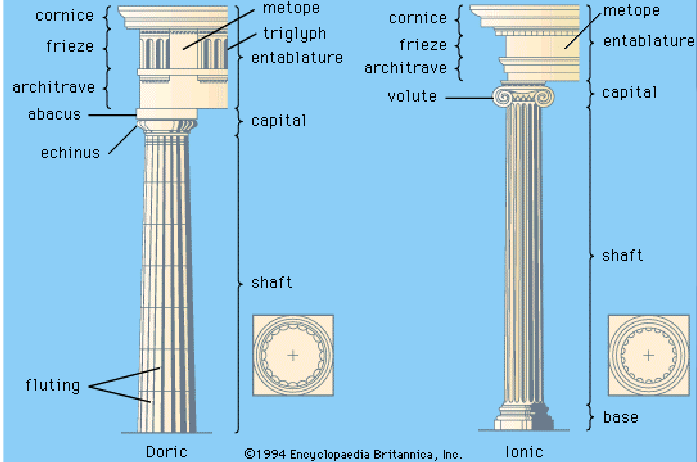
Doric vs Ionic
Lyric poetry
Range of Genres
- Roots in song for special occasions
- Musical accompaniment; various audiences
○ Solo songs and choral songs
- Mostly personal in subject and tone
○ Insight into private matters
○ Social attitudes of the elite and the middle strata
Xenophanes of Colophon
a bitter critic of the upper class & their display of
Luxury
Hipponax of Ephesus
writing as an urban hustler, attacks his enemies and humours his poverty
Sappho of Mytilene
the only known woman poet from her time
○ The “tenth Muse”
○ Close circle of women (“lesbian”)-
Examples of Panhellenic Religious Institutions
- The Greek world was divided politically but unified culturally, especially at Panhellenic gatherings
- Oracle of Apollo at Delphi
- Sanctuary of Zeus at Olympia: athletic games in honour of Zeus
- Other Panhellenic festivals modelled on it
- Only individual athletic contests
- Stadion, pankration, pentathlon, and equestrian events
- Prizes were symbolic wreaths (who wouldn’t like a crown of wild celery?)
First coin made in
Coins dated to the seventh cen in Lydia
diplomacy
Sparta begins using diplomacy to forge allies in the 6th cen
- Tensions were especially high in the Peloponnese
Sparta, Argos, and Corinth
proxeny
a formal, honorific relationship between a Greek city-state and an individual (a proxenos) from another city-state, which established a network of "public friends" to facilitate diplomatic and private interactions between states.
- Miltary alliances and treaties become more formal and longer-lasting
e.g. Amphictyony ("Association of neighbours"
Xenophon
- Xenophon: Born in Athens (c. 430 BCE), he relocated to Sparta as an exile
○ Served in the mercenary army of Cyrus the younger
○ Met many Spartans, including Agesilaus II
○ The Spartan constitution
Plutarch
Plutarch (c.46-126 CE): from Chaeronea in Boeotia
Nostalgia for the good old days of Greece
Five biographies of Spartan statesmen
Saying of the Spartans & sayings of Spartan Women
Read Aristotle's lost Constitution of Sparta
Thucydides
History of the Peloponnesian war
Iliad - Spartan Ruler(s)
Menelaus and Helen
what was the one Spartan Colony
Taranto (also known as Taras), founded in 706 BC in southern Italy. This exception to Sparta's general reluctance to send out colonies was a significant event
Spartan conquest of their neighbours
Military conquest of their neighbours in the as a response to the growing population's needs
Inhabitants of the Laconian Plain were reduced to helots (hereditary slaves of Sparta)
Perioeci
Those surrounding the city: perioeci
Remained free; no participation in government; served in the army
An essential part of the Spartan economy
First Messenian War
- Eighth century: Spartans invade Messenia
- First Messenian War: c. 740–720 BCE
- Messenian became helots and perioeci
- Conquests make Sparta one of the largest and richest city-states
- Fine pottery and metalwork
- Civil war over the division of the conquered land was avoided by exiling dissidents
- Foundation of Taras
Second Messenian War
(after 669 BCE)
- The surviving rebels were exiled to Sicily
- Revealed the risks of the helot system
- Transition to a military state
- Readiness for war over all other obligations
- Perpetual war against helots
- The economic system depended on helotry
○ After the conquest of Messenia, its territory was redistributed to the Spartans- every new born was given a plot after a Spartan plot of land
Helots also served in the military
The Spartan System
- The Spartan regime was totalitarian
- Spartan ideal: producing men fit for war & ready to die for the state
- Military service lasted until 60 years
Agoge
- Agoge, “upbringing”
- The process of creating warriors began at birth
- Official scrutiny of newborns
- Same education for all, by age groups
- Emphasis on hardiness and self-sufficiency
- Regular inspection by ephors
Ephebes
(ages 14–20): preliminary military service
syssition
- Essential stage: acceptance into a syssition (“dining group”)
- Fostered camaraderie and loyalty
- Each member had to contribute food
- Helots were forced to entertain
- Stigmatization of cowards (“tremblers”)
- The system eventually evolved due to the long Peloponnesian War & the shrinking population
Spartan Women
- Girls raised to bear strong soldiers
- Only Greek women whose upbringing was prescribed by the state and who were educated at state expense
- Outdoor exercise & good diet
- Childbearing: the only social obligation
- The educational system was organized according to age classes
- Management of domestic affairs
- Ownership and property gave Spartan women real authority
Homoioi
Spartans referred to themselves as homoioi (“men of equal status”)
Spartan life was frugal
even the wealthy attempted to not display wealth- system of equality that created unity .
Iron was used as currency until the end of the fifth century BCE
Goal: economic equality
Helot rebellion
464 BCE –
only ended in 455 with the rebels’ departure
after Sparta was hit by a really bad earth quake.
after 10 years, many of the rebels were able to leave the Peloponnesus
with aid of some Athenians.
Spartan “mixed constitution”
Dual hereditary kingship- possible that when the groups came together to form Sparta - two main families made a joint kingship
Always came from the same 2 families- Agiads & Eurypontids- office for life. Always went to the oldest sons of the 2 kings
Often had to remarry- if current wife didn’t produce an heir.
Served as a mutual- had the same powers. Able to check each other
“First among peers”-did not display wealth - model/point of reference for other-
citizens.Military, religious, and judicial powers
Division of labour- one and one (war/domestic affairs)
- Many ancient sources praised the Spartan government for its organization - mixed government, hierarchy, aristocracy and democracy - balanced itself out
The Gerousia
Gerousia: Council of Elders
- 28 men over the age of 60 (plus the two kings); served until death
- Wealthy, influential men
- Candidates elected by acclamation in the assembly
- Crowning achievement of any Spartan
- Legislative initiative
○ Power over assembly
- A criminal court for serious offenses
Ephors
Ephors: five overseers elected annually by acclamation (aged 30+)- one term office
- Supervised the kings and represented legal principles- supervised the good functioning of the government.
- One ephor was “eponymous”
- Could not be reelected & were audited
- Control over youth education
- In charge of krypteia (“secret police”)
Ecclesia
- All male citizens (30+) (citizens proper)
- Only voted on gerousia’s proposals
- Oligarchic element dominates overall
- Many ancient sources praised the Spartan government for its organization - mixed government, hierarchy, aristocracy and democracy - balanced itself out
The Peloponnesian League
- During archaic age that city states start entering into agreements and alliances.
- Policy of alliance rather than conquest
- Position of leadership- considered the most powerful city in the Peloponnese - had the best army in the region.
- Issue was the Harlet pop was very large- had no fleet
- “League” organized around 510–500 BCE by Sparta and all Peloponnesian states except Argos and Achaea
- Mutual protection (Sparta had no fleet)
- The states pledged to have the same friends & enemies as Sparta- help for Sparta
- Not an empire, but an alliance
- No tribute paid to Sparta
- Bicameral government
oliganthropia
By around 330 BCE, the number of full male Spartan citizens (Spartiates) had dropped dramatically from 8,000–9,000 to roughly 1,000. This steep decline, known as the “oliganthropia” (shortage of men), weakened Sparta’s military and political power.
Early Athens
- Important Mycenaean centre -collapsed at some point - but Athens was not as bad as the other Mycenaean centres.
- Presents signs of recovery - appearance of proto-geometric pottery. (1050 BCE) one of the major signs of recovery and growth.
- Gradual joining of towns in Attica
○ Ascribed unification toTheseus
- After the Early Iron Age, alll Attic settlements considered themselves “Athenian”
○ Belief in their own autochthony.
- Everyone Living in the Demos around Athens considered themselves Athenians.
Nine Archons
- Early government was aristocratic
- Nine Archons (meaning ruler, someone who governs)
○ Originally three: archon basileus, polemarch(commander of war), eponymous archon (prob added later -other judicial duties) (Archon and Eponymous gave their name to the year).
○ Six thesmothetati (law-makers) were added in the early 7th cen.
○ Annual elections from Eupatridae (“those with good ancestors”) (aristocratic family)
○ Council of the Areopagud (Ares hill)
§ Made of former archons - life membership
Oikos in Attica
- The Oikos in Attica were organized into four Phylai (tribes), phratries, (brotherhood) and -for the noble -Gene (clans)
○ Membership in a phratry was necessary proof of citizenship
○ Oikos in the same phratry were obligated to provide mutual legal support
- Mnt pantenicus - where the marble was mined
Cylon
- Around 632 BCE = Cylon attempted to becomes tyrant
○ Olympic victor, son-in-law of Theagenes of Megara
- Coup fails but results in a curse on the Alcmaeonid family
- The Archon Megacles was exiled with all his family and deceased relatives for sacrilege
- One of the only 2 events we know happened in the 7t. Cen
- Follows of Cylon take refuge in the sanctuary of Athena - can’t be killed in a temple - sanctuary.
- Archon says they can leave with their life- when they left- Archon killed them all. - considered Sacrilege
 Note
Note  Flashcards (24)