Trace Elements
 Call Kai
 Learn
Learn Practice Test
 Spaced Repetition
 Match
Match Flashcards
 Knowt Play
1/38

There's no tags or description
Looks like no tags are added yet.
Name | Mastery | Learn | Test | Matching | Spaced | Call with Kai | Chat |
|---|
No analytics yet
Send a link to your students to track their progress
39 Terms
Define “trace element”
Micronutrients/micro-minerals required in very small quantities but essential for normal function
List the 4 important trace elements (TE) limiting production in NZ
Limiting TE in temperate grassland production:
Cobalt
Selenium (vitE overseas)
Iodine
Copper
Grazing ruminants rely on pasture for TE (derived from soil) → Unknown true TE intake
Define “primary TE deficiency” and describe 4 contributing factors
Definition: Soil/plant deficiency influenced by
Certain districts
Different plants (ability to take up TE)
Different environment (eg. pugging changes TE concentrations)
Use of fertiiser
Define “secondary TE deficiency” and produce an example
Definition: Lack of TE absorption in animal (i.e. ingestion sufficient, but absorption is limited)
Example: Animal ingests sufficient Cu, but absorption is limited as Cu binds to Mo, S and Fe in the rumen
3 Types of TE problems seen on farm
Failing to supplement when needed → Poor production
Unnecessary supplementation → Wasted cost
Excessive supplementation → Toxicity (Se and Cu) and residues
TE deficiency can result in poor production BUT can also be an excuse for poor production
3 Reasons to assess TE on-farm
Diagnose deficiency when animals are performing poorly (+ clinical signs consistent with TE deficiency)
Ensuring sufficiency to ensure animals have sufficient reserves
Best approach → Proactive prevention of TE deficiency
Monitoring to ensure supplementation programme is adequate
5 Diagnostic steps to assess TE on-farm
History
Clinical findings
Relate changes in animal performance to liver/blood TE concentration (response relationship)
Soil/plant TE testing
Supplementation trials → Excellent data BUT time/$-consuming
2 Considerations when TE sampling a herd
Is the TE stored in the body?
YES → Sample storage site (liver) = Cu ± Co
NO → Sample blood = Se + Co
Is there significant TE variation within the herd?
YES → Need lots of samples = Cu ± Co
NO → Only few samples required (Se)
How to sample feed/pasture for TE testing
Collect bag of pasture with hand shears or scissor, ~1cm from surface
Remove grass and dry it with newspaper
Pack in paper bag and send to lab with submission test request form
Soil samples of MINOR diagnostic value (testing for macroelements)
Selenium: 2 Functions
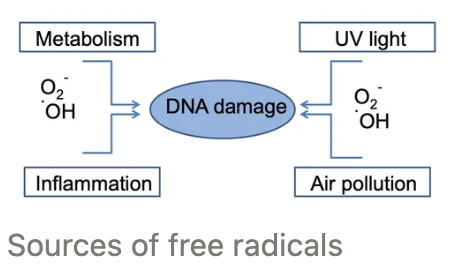
Helps protect cells against free radicals (antioxidant) from:
Metabolism
Inflammation
UV light
Air pollution
Maintains resistance to infection
Selenium deficiency: Predilection
Signalment
Season
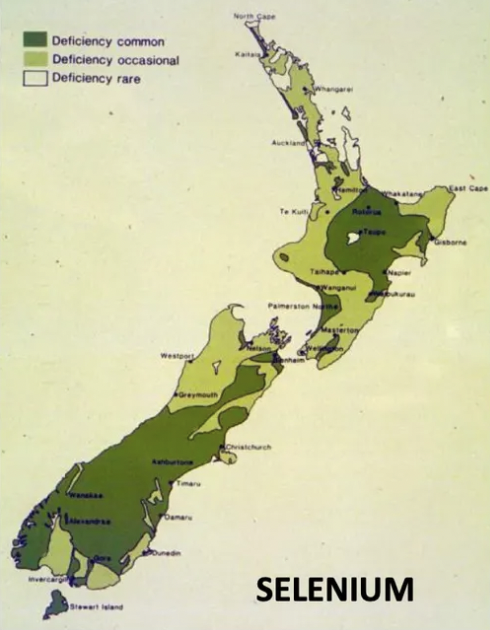
District
No species/season/region predilection (any species, any time, anywhere)
Deer have same RR as sheep BUT supplementation is conservative to prevent toxicity
Selenium deficiency: 6 Clinical signs
OBVIOUS
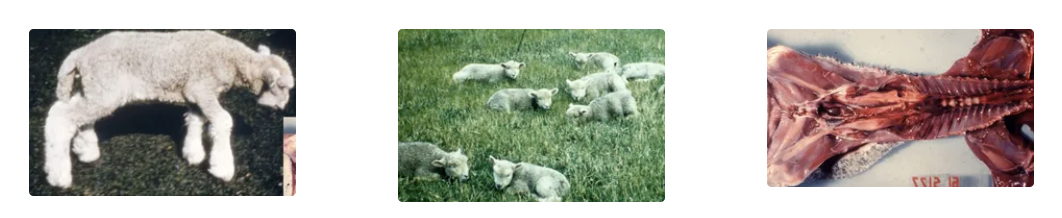
White muscle disease
Rare in NZ due to awareness of Se deficiency
MoA: Free radical damage to active muscle → Calcification → Loss of function and stiffness
Clinical Signs: Stiff heart, neck, diaphragm muscles (active muscles)
SUBTLE
Poor GR (always consider Se deficiency as a DDx)
Diarrhoea
Early embryonic death (sheep)
Decreased milk production
RFMs (dairy cattle)
Selenium deficiency: Sample selection
Number
Sample type
2 Test options + indications
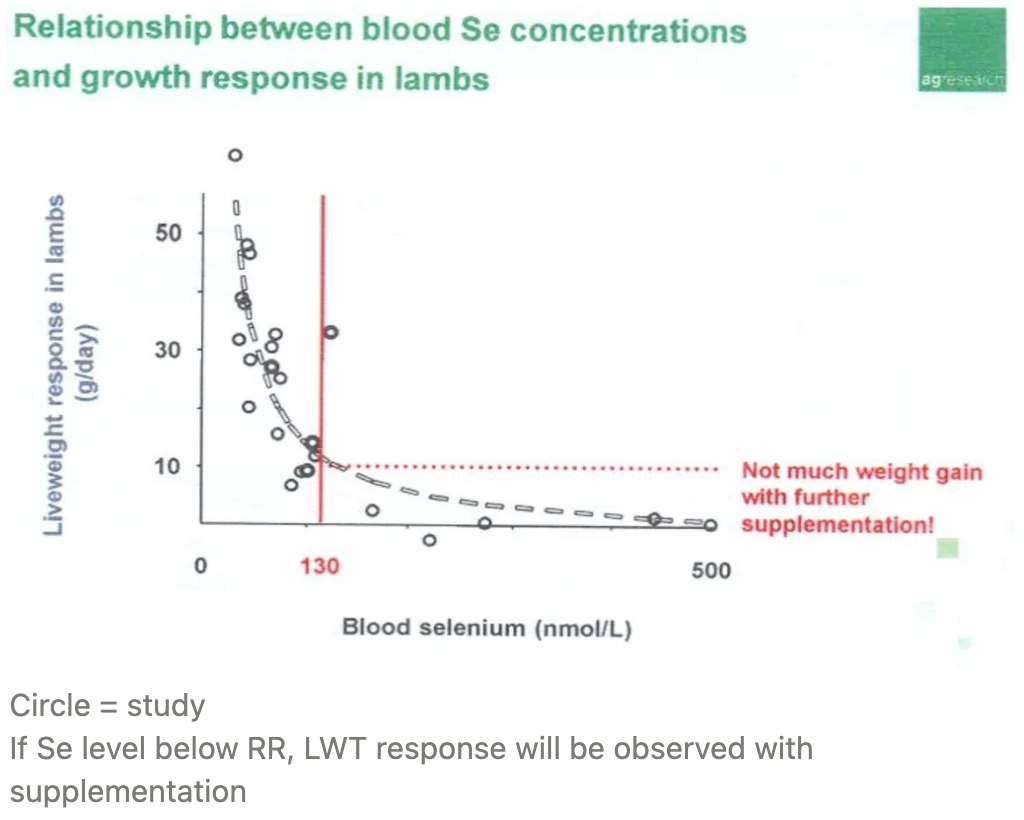
Correlation with production response
Number: 3 - 5 samples
Little variation between animals (ewes, hoggets, calves) assuming grazing same area and similar grazing management
Sample: Blood sample
EDTA (whole blood) = RBCs samples have a mixture of new RBCs (new Se levels) and old RBCs (Se levels over time)
Red top (serum)
± Liver
Test:
Glutathione peroxidase (GSH-Px) within RBCs
GSH-Px is a selenium-dependent enzyme located in RBCs
Because RBCs have a ~3 month lifespan, RBCs reflect long-term Se status
Sample: EDTA
Indication: No supplementation → Determine long-term Se deficiency of herd
Selenium within serum OR whole blood
Sample: EDTA OR red top
Indication: More reliable in determining when further supplementation is next required or identifying toxicity (short-term)
Correlation: For BOTH GSH-Px and blood Se, reliable RR correlated with production responses → Determine if Se supplementation will likely result in GR response
Cobalt deficiency: Predilection
Signalment
Season
District
Signalment: Lamb > Adult sheep > Cattle
Lack of good data for deer
Season: Spring and summer (lower [Co] in pasture due to higher growth rates → Dilution of Co)
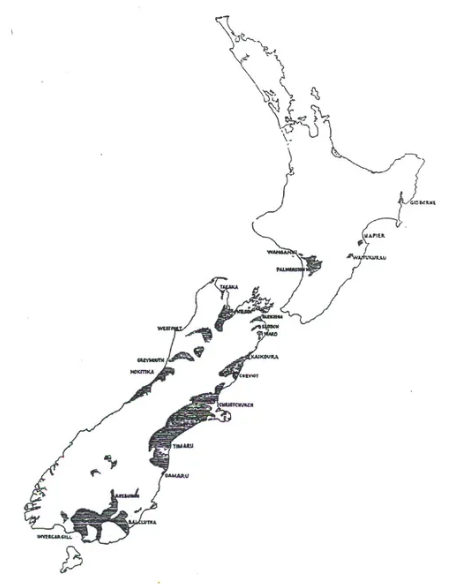
District: Bay of Plenty (volcanic soils)
Lake Taupo ash blown over the Bay of Plenty → Young volcanic soil with Co deficiency)
![<p><u>Signalment:</u> Lamb > Adult sheep > Cattle</p><ul><li><p>Lack of good data for deer</p></li></ul><p><u>Season:</u> Spring and summer (lower [Co] in pasture due to higher growth rates → Dilution of Co)</p><p><u>District:</u> Bay of Plenty (volcanic soils)</p><ul><li><p>Lake Taupo ash blown over the Bay of Plenty → Young volcanic soil with Co deficiency)</p></li></ul><p></p>](https://knowt-user-attachments.s3.amazonaws.com/a3b569ac-a8ec-4b6c-8526-2277e408cf96.png)
Cobalt: Function and source
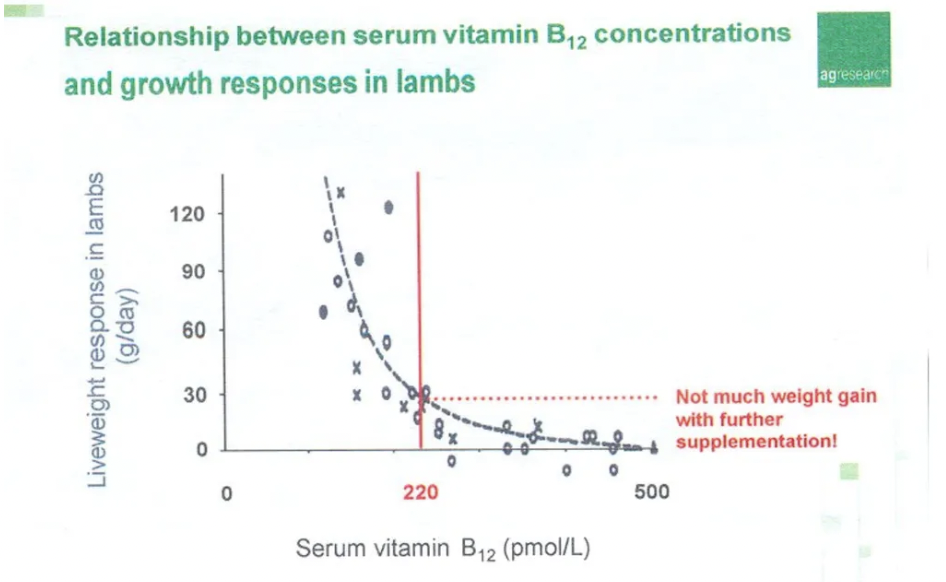
Function: Constituent of vitB12 which is part of the co-enzyme in the propionate → glucose pathway
No Co → No B12 → No enzyme for gluconeogenesis → Hypoglycaemia
Source: Co is incorporated into vitB12 by rumen microbes
Co administered ORAL only (parenteral administration → MUST be vitB12)
Cobalt deficiency: 4 Clinical signs
Ill-thrift and poor growth rates in lambs (post-weaning #1)
DDx: Parasitism, nutritional deficiency, Se or Co deficiency
Poor GR reported in cattle BUT very uncommon (Co supplementation often excessive in cattle but NOT harmful as vitB12 is NOT toxic)
SEVERE
Eye discharge
“Washy” wool
Anaemia
Cobalt deficiency: Sample selection
Number
Sample type
Correlation with production response
Number: 10 samples (reasonable variation in population)
Sample: Serum (red top) → Test for vitB12
Although most vitB12 stored in liver, serum is easier to collect AND equally as useful
Correlation: Test RR has good correlation with expected production response
Iodine: 3 Functions
Used to synthesise thyroid hormones which are important for:
Energy metabolism
Development of foetal brain, lungs, heart and wool follicles
Stimulate production of foetal lung surfactant
Iodine deficiency: Predilection
Signalment
Season
District
Signalment: Newborns #1 (foetal intake depends on dam's daily intake)
Goats > sheep > cattle (rare and no supplementation required)
Season: Winter/spring
Brassicas ± clover contain goitrogens which interfere with iodine uptake in the thyroid gland → Iodine deficiency
eg. Pregnant ewes grazing brassicas in Southland → Prevent with iodine supplementation during gestation
District: Manawatu, Canterbury planes, Otago Southland
Iodine deficiency: Clinical signs
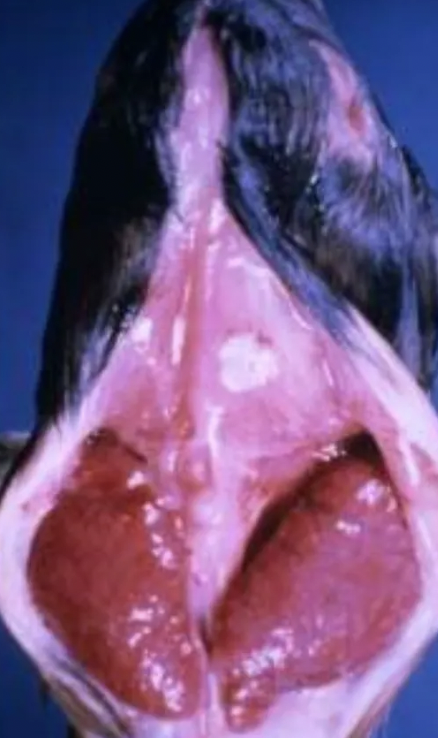
Goitre → Dystocia
Increased perinatal mortality due to
Reduced ability to generate energy/heat
Difficulty standing
Heart and lungs do not form
Cannot retain heat
Iodine deficiency: Sample selection
Number
Sample type
2 Types of tests
Number: ≥15 dead lambs
Sample: Thyroid (gm) : BWT (kg) ratio
Individual/mean > 0.7 - 0.8 → Goitre
Mean > 0.4 → Subclinical deficiency
Tests:
Lamb PM → Thyroid : BWT ratio
Ewe serum for iodine
-ve: Only measures intake over last 2 - 3 days
Iodine deficiency: Prevention
Supplement pregnant ewes with potassium iodine drench or Flexidine iodine injection prior to going onto crop
Copper deficiency: 5 Reasons why Cu is a complex TE
Interaction between Cu and other elements (secondary Cu deficiency much more common than a primary deficiency)
Large variation in animal levels/responses
Clinical signs of marginal deficiency are vague
No reliable production response RR
Toxic in overdose (chronic OR acute)
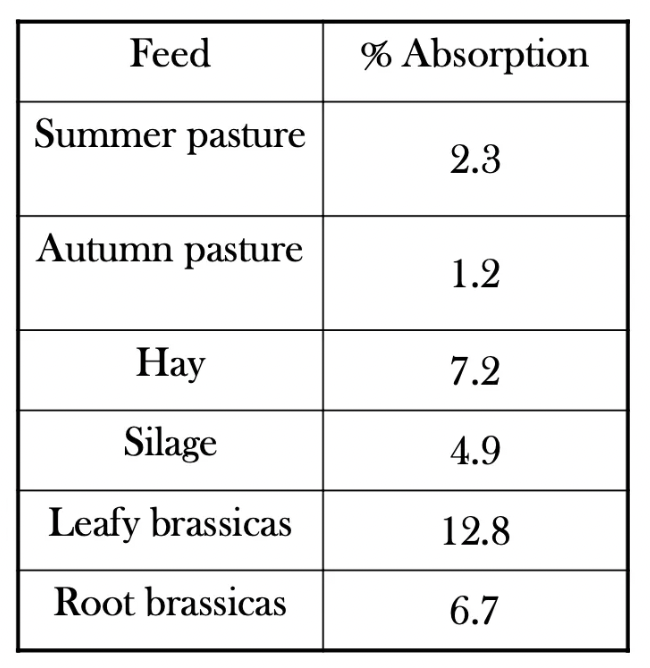
Copper deficiency: 5 Factors affecting Cu absorption
Age (high milk, low pasture = more Cu absorption eg. young cattle on milk)
Feed type
Season
Species/breed/individual variation (Texel sheep are very good at storing copper while Finn are poor)
Cattle/deer > sheep (Cu deficiency less common)
Wapiti > Red deer
Mo, S and Fe → Bind Cu in rumen and prevent absorption = #1 driver of Cu deficiency on-farm
Mo #1 in NZ due to application of lime to pasture → Increased pH to optimise pasture growth
Mo levels peak in spring
Soil type (eg. peat soils in Waikato)
Dietary requirements of Cu for growing deer
11mg/kg/d
Describe the maternal vs. progeny Cu relationship in fawns
Foetal fawns have much higher liver concentrations of Cu than mothers
Cu transported across placenta → Highly effective transfer of Cu from hind to fawn
eg. hind liver Cu = 100µmol/kg → fawn liver Cu = 600µmol/kg
Copper: 4 Functions
Function: Essential part of >12 enzymes involved in many functions via cytochrome oxidase (phospholipid synthesis)
Myelin formation (neurological function)
Elastin and collagen synthesis (joints and bone strength)
Erythropoiesis (anaemia)
Pigmentation
Copper deficiency: Clinical signs
Cattle (7)
Deer (5)
Sheep (2)
Cattle
Ill-thrift
Diarrhoea
Loss of coat colour and pigmentation
Skeletal defects (spontaneous fractures)
Anaemia
Decreased milk production
Decreased reproductive performance (reduced calving rates)
Deer
Ill-thrift and reduced GR
Poor coat
Bone fragility of fractures
Osteochondrosis in young fawns
Death pre-weaning → Reduced weaning %
Progressive lameness (bunny-hopping gait with knocking hocks)
Swollen joints (hock, carpus ± hip)
PM = Articular cartilage erosions and subchondral bone collapse
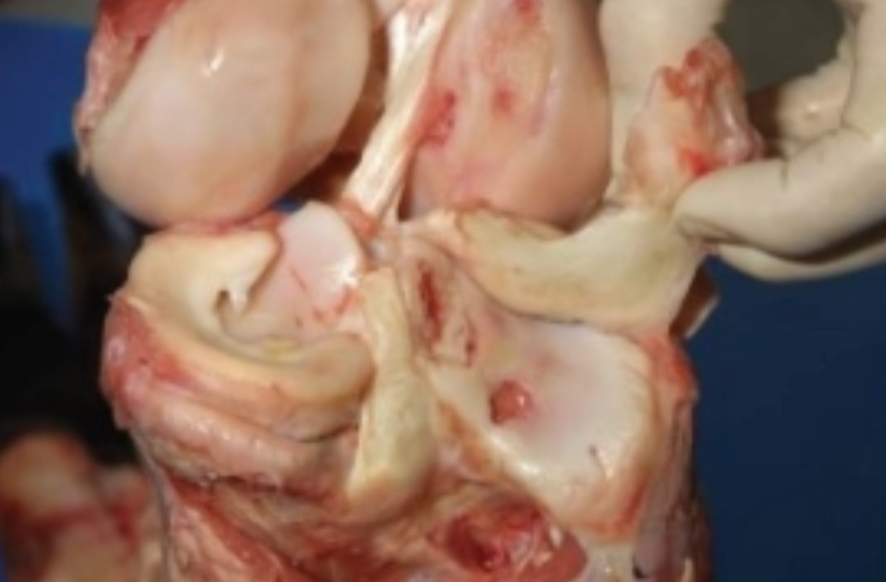
Enzootic Ataxia (Swayback) =
Signalment: 9 - 15m esp. Wapiti
Pathogenesis: Foetal fawns have much higher liver concentrations of Cu than mothers
Clinical Signs:
Staggering gait (esp. hindlimbs) and incoordination (difficulty walking in straight line)
Dog sit posture and difficulty standing
Victimisation signs (hair loss, bruising, bite marks and trauma)
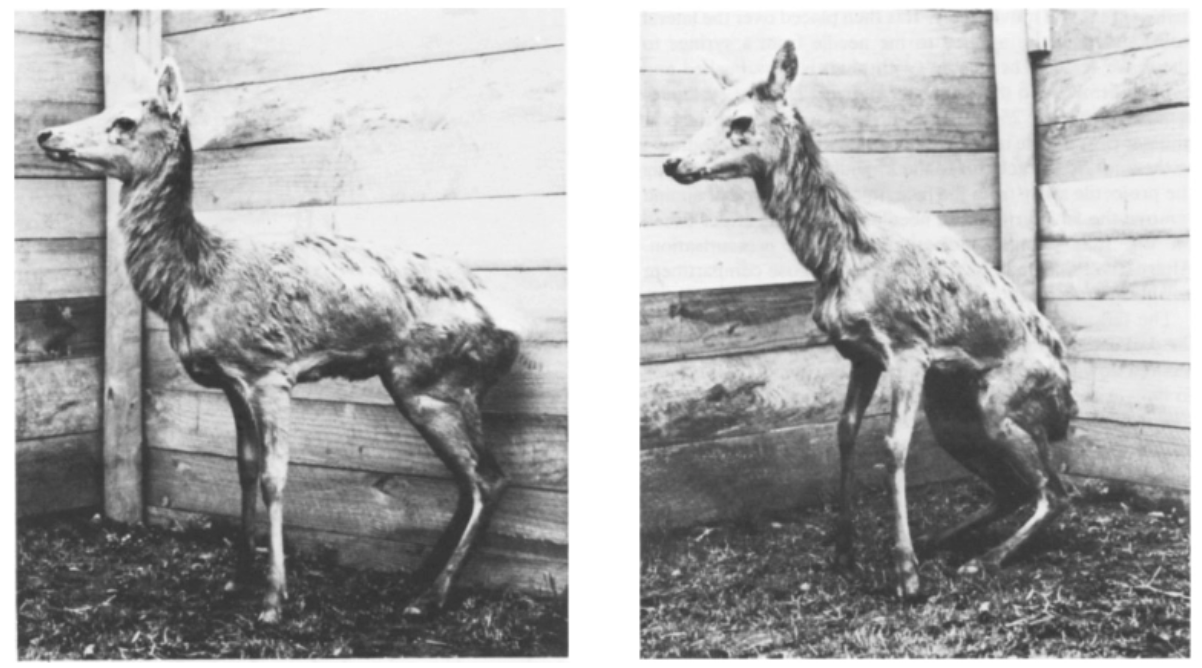
Diagnosis: Clinical signs → Confirm with histology = Bilateral demyelination of spinal cord
Prognosis: NEVER full recovery
Sheep: Uncommon Cu deficiency → Vet-only supplement (do NOT prescribe unless confident of deficiency due to risk of toxicity)
Swayback in lambs (congenital OR delayed)
Bone fragility
Copper deficiency: Sample selection
Number
Sample type
2 Types of tests
Number: ≥16 samples ideally (>7 recommended)
High variation BUT $$$ sampling
Sample: Liver biopsy = Stab incision between ribs with biopsy probe
Collection at meatworks or PM
Tests:
Liver biopsy #1 to assess sufficiency AND monitor
Serum okay to confirm deficiency but does NOT indicate Cu store in liver
Copper deficiency: Predicting response to Cu supplementation
No production response RR
Cu supplementation in “deficient” herds → No detectable production response
Decision to supplement based on risk assessment (combination of history, clinical signs, management system etc.)
No hard cut off like other three TE
Over-interpretation of SERUM copper concentration is dangerous
Liver samples #1 prediction
Must consider time of year and whether depleting (over winter) or repleting (spring)
Decision of supplementation ≠ Diagnosis of deficiency
Copper deficiency: Targets for Cu concentration in liver
Sufficient concentration
Aim in autumn/early winter (+ 4 reasons why)
Toxic concentration
Sufficient: Liver > 95µmol/kg = Adequate
Aim: Liver > 300µmol/kg in autumn and early winter as Cu levels are the lowest in spring (deplete over winter) due to
Soil dynamics in winter changing availability of Cu to animals (change in pH, water-logging)
Reduced feed intake in winter (ingest less Cu)
Eat more soil in winter due to mud splash and low grazing residuals (ingest more competing elements)
Cu demands increase in spring due to gestation and lactation
Toxic: Liver ~3000 - 4000µmol/kg
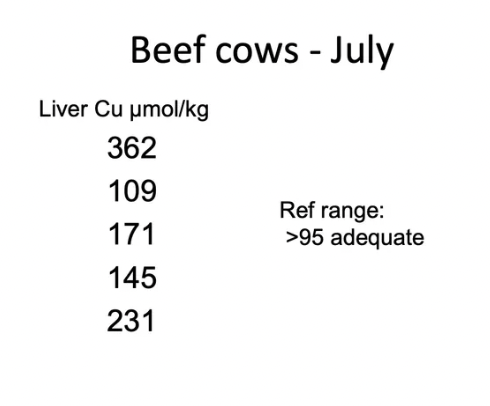
EXAMPLE: Beef cows in July
Question: Is supplementation necessary?
YES! Early winter → Expect Cu levels to decline more over winter → Deficiency in spring
Aim > 300µmol/kg
9 Options for TE supplementation
Oral dosing
Injection (short-acting & long-acting)
Addition to fertiliser (Co, Se)
Addition to water supply
Rumen boluses
Pour-on (Se; cattle and deer)
Pasture foliar sprays (Co)
Mineral licks?
Anthelmintics (most contain TEs BUT only useful for Se in animals being regularly drenched)
4 Options for Cu supplementation
Advantages
Disadvantages
Supplement | Advantage | Disadvantage |
|---|---|---|
Fertiliser (CuSO4) |
|
|
Oral drench |
| NOT practical (frequent animal manipulations) |
Copper capsules |
| Must select appropriate dose depending on weight |
Injectable Cu |
|
6 Options for Co supplementation (+ advantages and disadvantages)
Method | Advantages | Disadvantages |
|---|---|---|
Cobalt sulphate fertiliser |
|
|
Short-acting vitB12 injection |
|
|
Long-acting vitB12 injection |
|
|
Cobalt sulphate pasture foliar spray |
|
|
Oral bolus |
|
|
Oral dosing |
|
|
EXAMPLE:
History:
In early April Matt contacts you as he is unhappy with the growth rates of his 750 ewe hoggets, which are 3kg below target. They haven't been weighed since weaning in December, at which stage their weights were on target.
Matt tells you that the ewe hoggets have not received any specific trace element supplements although he has been drenching them for worms every 28 days with a mineralised drench. He had some trace element testing done about 10 years ago but he can't remember the results, however he thinks they were OK.
Questions:
2 Potential TE deficiencies involved
4 History questions
Sampling: For each TE, justify the sample selection
Cobalt and selenium deficiencies?
History:
Knowledge of location (known soil deficiencies?)
Copy of previous testing results? If not, which vet practice performed the testing
Soil or herbage testing performed?
Change in management this season? (eg. change in fertiliser type or application or other minerals)
Sampling:
Cobalt = 10x serum (red top tube) for vitB12
Reasonable variation in population
Ensure recent yarding as time off-feed artificially increases vitB12 levels
Selenium = x3 - 4 whole blood (EDTA) for GSH-Px
Little variation in population
Matt has recently drenched with mineral anthelmintic → Ensure drenching is keeping Se level adequate
Consider whole blood Se if no drenching was performed
EXAMPLE: How would you interpret the results? Are they relevant only to the ewe hoggets or can they also be extrapolated to other livestock on the farm?
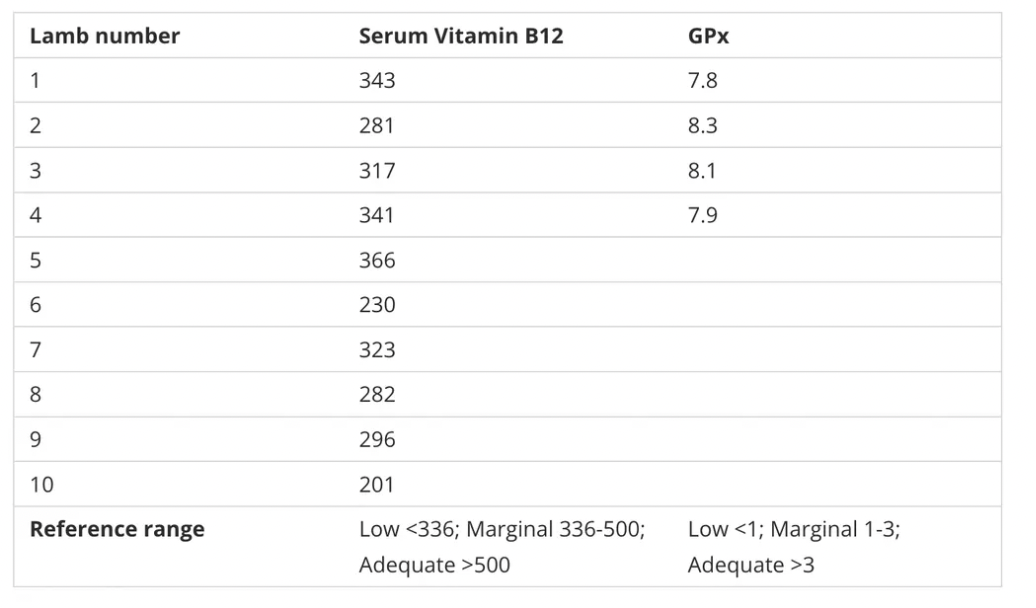
The Vitamin B12 levels are in the low to marginal range and this is almost certainly playing a role in the poor growth rates of these hoggets. Young growing sheep have the highest requirement for cobalt so it is likely that any other lambs/hoggets on the farm will also be affected. Adult sheep are unlikely to be affected. Cattle have a much lower requirement for cobalt than sheep and are very unlikely to be affected.
GPx levels are well into the adequate range and rules-out selenium deficiency as being a contributor to the poor growth rates in these ewe hoggets, at least over the past couple of months. The hoggets have been getting drenched every 28 days with mineralised anthelmintic which will raise their Se levels so we can't extrapolate these results to other livestock on the farm (except for those that have also been getting regularly drenched with mineralised anthelmintic).
EXAMPLE: Cobalt deficiency
Matt has 2,600 ewes which produce 3,200 lambs. 750 ewe lambs are retained as replacements while the remainder of the lambs are sold to slaughter between December (weaning) and August. He also runs 500 R1 and R2 dairy grazers.
The farm contour is a mix of steeper hill, medium hill and rolling hill. The ewes and ewe hoggets are mainly grazed on the steeper and medium hill country while the finishing lambs and dairy grazers are mainly grazed on the medium and rolling hill country.
The lambs/hoggets are the stock class on this farm which require supplementation.
Question: What supplementation option/s would you recommend to Matt? Justify your choices (note there are not necessarily any right or wrong answers).
Copper sulphate fertiliser is contraindicated as only the hogget lambs and ewes require the treatment and they make up a low proportion of the stock units on the farm. Because they will eventually graze the whole farm, the whole farm must have copper sulphate which becomes very expensive considering how small the proportion of their stock class is. Timing of fertiliser application must also be consistent
Short-acting vitamin B12 injections are cheap and target animals requiring supplementation. BUT repeated injections are required (good for lambs to slaughter soon after weaning, but not for smaller lambs that are kept for longer or replacements)
Long-acting vitamin B12 injections target animals which require supplementation and last long so repeated doses are unnecessary. BUT they are $$$. They are a good option for lambs going to be on farm for a long time (eg. replacements and small lambs that will take a long time to reach slaughter weight)
Pasture foliar spray is cheap and you can target-treat lamb paddocks. Because animals are not individually treated, it is less labour and stress of handling BUT it is not feasible on Matt’s farm due to undulating contour and requires a high labour output
Oral bolus is contraindicated as ewe hoggets and lambs have not yet reached this weight. In fact, by the time the lambs reach this weight, they will be almost ready for slaughter
Oral dosing is cheap and can be individually-targeted but the period of action is short which makes it contraindicated due to excessive labour and animal manipulations required
EXAMPLE:
In March you are contacted by Anaru and Christine who have recently purchased a local sheep and beef cattle farm along with the livestock already resident there. The farm is rather run-down and known to have poor production due to poor management and low inputs. Anaru and Christine are very motivated to improve the livestock performance on the farm and have asked you to come to the farm to develop an animal health plan.
Currently the farm is used as a breeding property. There are 4,200 ewes producing 4,300 lambs - 1200 ewe lambs are retained as replacements and the remainder are sold as store lambs at weaning in December. There are 260 breeding cows producing 215 calves. 60 heifer calves are retained as replacements while the remainder are sold at weaning which is next month, in April.
Question: The aim for this farm is to ensure TE sufficiency. In order to accurately do this, animal testing is required. Fill in the table below.
TE | Ideal Livestock Class to Test | Ideal Time of Year to Test | Ideal Sample to Collect | Ideal Number of Samples to Collect |
Co | ||||
Se | ||||
Cu | ||||
I |
TE | Ideal Livestock Class to Test | Ideal Time of Year to Test | Ideal Sample to Collect | Ideal Number of Samples to Collect |
Co | Lambs | Pre-weaning or at weaning | Serum vitB12 | 10 |
Se | ANY (assuming no recent supplementation and all grazing similar parts of the farm) | Anytime | GSH-Px whole blood | 3 - 5 |
Cu | Older cattle (R2 heifers and adults)
| Slaughter pre-winter from non-pregnant cows | Liver biopsy | 5 - 7 |
I | Lambs | Spring | PM thyroid (gm) : BWT (kg) | ≥15 |