ABIO 314 Microbiology Test 1
 Call Kai
 Learn
Learn Practice Test
 Spaced Repetition
 Match
Match Flashcards
 Knowt Play
1/132

There's no tags or description
Looks like no tags are added yet.
Name | Mastery | Learn | Test | Matching | Spaced | Call with Kai |
|---|
No analytics yet
Send a link to your students to track their progress
133 Terms
What is microbiology?
The study of the dominant form of life on earth, and the effect that microbes have on our planet and all of the living things that call it home
What kinds of organisms do microbiologists study?
Microorganisms, AKA microbes, which are life forms too small to be seen by the human eye.
What are microorganisms
A diverse group of generally minute simple life forms that include bacteria, archaea, algae, fungi, protozoa, and viruses
How are microorganisms diverse?
They are diverse in form, function, their habitats, and their physiology. Microorganisms can reside in almost all environments capable of supporting life. Some are single while others are multi-cellular
Contrast the biomass and number of cells of microbes to all other form of life on earth
Microorganisms are major fraction of earth's biomass
How long has microbial life been present on earth?
Microorganisms are the oldest form of life presiding our earth for near 3.8 and 4.8 billion years ago
Where are microbes found?
everywhere
What is the limiting factor to microbial life?
Temperature, Microbes are only capable of living in an evironemnt with a hospitable temperature. That being said, the range of suitable temperatures is quite large. Mircobes can not live in a volcano, for example, but can live very close to one.
How do microbes benefit society?
-produce many of our foods, beverages, medications, and vitamins
- required for normal human health (normal flora)
- can be taken in probiotic form
- used to clean out water through biodegredation
- used to clean up toxic wastes through bioremediation
What is the Human Microbiome?
the collection of all the microorganisms living in association with the human body. Most of these are not harmful or beneficial to the humans. Live on the surface and effect human life in terms of infectious disease, food, etc.
Contrast microorganisms to plants/animals
Microbes surround plants and animals, which were found on earth about 0.5 billion years ago.
What are three properties of microbial cells
Growth, evolution, metabolism
Growth
Nutrients from the environment are converted into new cellular materials to form new cells. (number not size)
Evolution
cells evolve to display new properties. Phylogenetic trees capture evolutionary relationships
What are four properties of some microbial cells
differentiation, communication, genetic exchange, motility
differentiation
some cells can form new cell structures such as spores
communication
cells interact with each other my chemical messengers
genetic exchange
cells can exchange genes by several mechanisms
motility
some cells are capable of self-propulsion
What is the three domain system?
Bacteria, Archaea, Eukarya
Who is the scientist responsible for developing the 3 domain system
carl woese
what is the marker gene used to develop the 3 domain system?
ribosomal rRNA structure gene - found relationships can be deduced by comparing the genetic information that's common to all organisms
What do all bacteria have in common?
They are prokaryotes that are usually undifferentiated single cells. They are 30 major phylogenetic lineages
what do all Archaea have in common?
They are prokaryotes that are less morphologically diverse than bacteria. Mostly undifferentiated cells with 5 well-described phyla. Associated with extreme environments. Lack any known parasites/pathogens of plants and animals
what do Bacteria and Archaea have in common
no membrane enclosed organelles, no nucleus, singular chromosome
What is the endosymbiont hypothesis?
The origin of mitochondria and chloroplast is from an endosymbiont, where an anicent archaea engulfed a bacteria and adopted it's structure.
How to write a bacteria species name?
Genus name and specific epithet. The whole name is italicized. The genus name is italisized and the specific epithet is not.
Who was the first person to directly observe bacteria?
Anton Van Leeuwenhoek
Where did the first observed bacteria originate from?
Scrapings from his teeth
Anto Van Leeuwenhoek
Made the first microscope to confirm the thread count of textiles. Found bacteria instead. Decided to observe his dental plaque and confirm his clean, healthy teeth
Robert Hooke
publishes drawings of fungus. Was first to describe microbes (fruiting structure of molds)
Louis Pasteur
created flasks with long curved necks and filled them with a nutrient-rich broth to test whether microorganisms come from the air. He found no growth in the broth, confirming his hypothesis that something living presides within the air. He also discovered alcohol fermentation, disproved the theory of spontaneous generation which lead to new sterilization methods and food preservation. He also developed the vaccine for anthrax, fowl cholera, and rabies
Joseph Lister
provided indirect evidence that microorganisms were agents of disease. He developed a surgery system to prevent microorganisms from entering wounds of his patients and found greater survival rates.
Robert Koch
He established the relationship between Bacillus antracis and anthrax using criteria that are now known as Koch's postulates. Hew developed agar, petri dish, and a method for isolating microorganisms
What is the germ theory of disease?
The theory that specific microscopic organisms are the cause of diseases
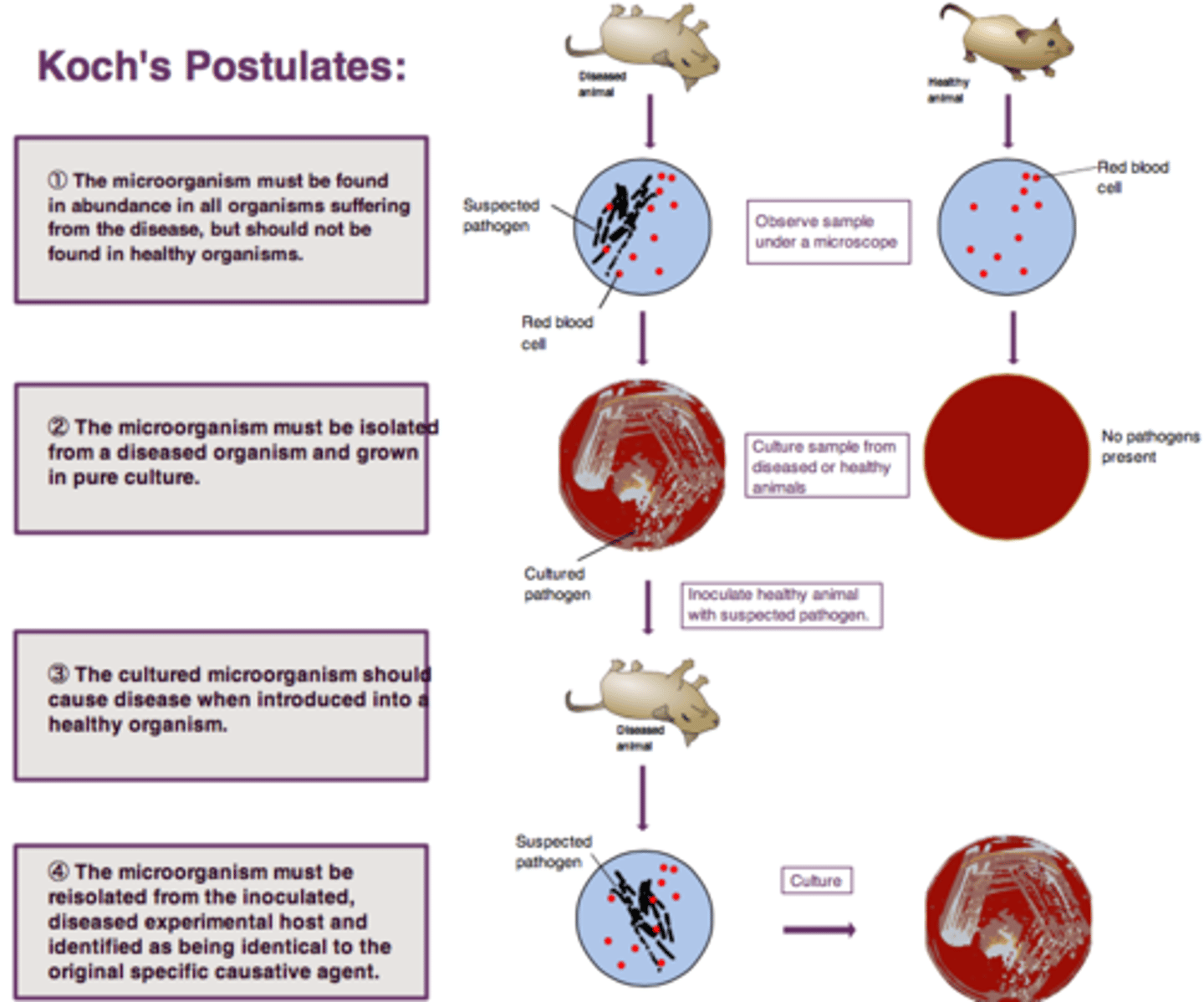
Koch's Postulates Definition
series of guidelines used to identify the microorganism that causes a specific disease
List all of Koch's postulates
1. The suspected pathogen must be present in all cases of the disease and absent from all cases of healthy animals
2. The suspected pathogen must be grown in pure culture
3. Cells from a pure culture of the suspected pathogen must cause disease in a healthy animal
4. the suspected pathogen must be reisolated and shown to be the same as the original
When and why are Koch's postulates not useful or practical?
Some organisms can not be grown in a pure culture, using humans to test for disease is unethical, and moleculer and genetic evidence may replace the limits imposed by Koch's postulates
What are three important properties for imaging bacteria with a microscope?
Magnification, contrast, resolution
magnification
make the object seem larger
contrast
ability to distinguish object from background
resolution
measure the closest distance between two points
what is the bending of light by a lens called?
refraction
what is resolution
the quantitative measure of the closest distance between two points at which they are clearly sperate entities
How is refraction defined?
using an objective lens with a larger numerical aperture and use shorter wavelength of light to improve the resolution with a light microscope
What is contrast?
The ability to distinguish organisms from their background in a microscope
What are two general ways to improve contrast?
Optique technique and stain samples
optique technique
Dark-feild, phase contrast, and brightfield
stain samples
chromogenic stains and fluorescence stains
What does Bright field look like?
Regular background and no illuminating light
What does phase contrast look like?
regular background wiht illuminating light
what does dark-field microscope look like?
darker background illuminating light and organelles
What is the main function of staining a microbial specimen?
straining improves contrast. Stains bind to specific cellular materials and can be used to highlight certain cellular materials during microscopy
What is a differential stain?
The use of two or more dyes that react differently with different kinds/parts of bacteria.
What property does the Gram stain use to differentiate bacteria?
these stains use the cell wall structure to differentiate bacteria
What is gram positive bacteria?
thick cell walls with large amounts of peptidoglycan. Retains crystal violet stain
What is gram negative bacteria?
outer cell membrane, thin peptidoglycan layer, and cell membrane. Stains pink
Does the gram stain work on archaea
No because they do not contain peptidoglycan in their cell walls which need to be present
What are the two components of a Fluorescent in situ hybridization probe?
1. Reporter component - fluorescent tag
1. specificity component - recognizes a gene or gene product such as DNA sequence, RNA sequence, or protein to bind to.
Compare and cotnrast fluorescent dyes and fluorescent proteins
Fluorescent dyes offer higher photostability and brightness compared to fluorescent proteins and do not require a maturation time. However, dyes are usually targeted to proteins of interest by antibody conjugates or peptide tags. This requires the fixation of cells, which renders measurement of genetic circuit dynamics impossible.
What is the main advantage fluorescent proteins
proteins contain fluorescent amino acids such as tryptophan, tyrosine, and phenylalanine. As a result, they also offer photostability and brightness and do not require fixation of cells
what are the two main types of electron microscopy?
Transmission Electron Microscope and Scanning Electron Microscopy
transmission electron microscope
to view cells and cell structure at higher magnification and resolution levels. Also used to limit or reduce scatter caused by electrons for clearer image
scanning electron microscopy
gives a 3d image of the cell
why is resolution hier with electron microscopy than with light microscopy?
the resolution is higher in electron microscopy because the wavelength of electrons is shorter than light
coccus (cocci)
spherical shaped bacteria
coccobacillus
short round rod, pill shaped
vibrio
curved rod, comma shaped
Baccilus
Long rod shaped bacteria
Spirillium/spirilla
zig zag shaped bacteria
Spirochetes
long, slender spiral-shaped bacteria
stalked bacteria
thin extensions of the cell wall from the main cell body
Diplococci
Spherical bacteria that grow in pairs and cause diseases such as pneumonia.
staphylococci
a group of about 30 species of bacteria that form irregular groups or clusters resembling grapes
streptococci
Pus-forming bacteria arranged in curved lines resembling a string of beads. They cause infections such as strep throat and blood poisoning.
tetrad
4 cocci in a square
what is the importance of the surface to volume ratio for a bacterial cell?
a surface to volume ratio controls how fast a cell grows, shapes, and can exchange nutrients and get rid of waste
an increase in the radius of a spherical cell yields what effects in the surface to volume ratio?
when radius increases, surface to volume ratio decreases
what is the function of the plasma membrane?
permeability barrier, protein anchor, energy conservation and consumption
what are the 5 bacterial macronutrients?
C, H, N, O, P, S
What are micronutrients and howare they different from macronutrients?
macronutrients are often requred in larger amounts, while micronutrients are required in trace amounts
what are three kinds of ways that molecules can enter bacteria cell through the membrane?
passive diffusion - not energy dependant
facilitated diffusion - not energy dependant
active transport - energy dependant
what are the two main types of bacterial cell walls?
gram positive (thick peptidoglycan on outermost layer and sometimes teichoic acid)
gram negative cell wall ( think layer of peptidoglycan surrounded by an outer membrane)
what is a peptidoglycan?
A rigid layer that provides strength. a mesh like polymer of identical subunits forming long strands composed of modified gluocse and amino acids
What is lipopolysaccharide?
a type of polysachharide molecule that is covalently bound to lipids
why is it important to medical microbiology?
LPS is one of the conserved microbial structures responsible for activating the innate immune response
what kind of bacteria have lipopolysaccharide?
gram negative
function of lipopolysaccharides
create a permeability barrier, contribute to negative charge of the cell, acts as an endotoxin
what is the function of porins
proins are transmembrane proteins that allow for non-specific transport of solutes
where are porins located?
in the outer membrane of gram negative bacteria cells
what is an aquaporin?
water channel protein in a cell
what is the function of the cell wall?
the function of the cell wall is to protect against osmotic lysis
teichoic acid
acid molecules embedded in the cell walls of gram positive bacteria. Their main function is to provide flexibility to the cell wall by attracting cations such as calcium and potassium
How does penicillin kill bacteria?
penicillin targets cell wall synthesis, leaving the cell susceptible to osmotic lysis
what is the glycocalyx?
a stickly or slimy material on the outermost layer of the cell that is composed of proteins or polysaccharides (capsule and slime layer)
what are the functions of the glycocalyx?
aid in attachments to solid surface ( biofilms and animals)
What are inclusions?
They are reserve deposits found in both pro- and eukaryotes.
examples of inclusions
storage inclusions for carbon, phosphate, amino acids, and glycogen
gas vacuoles, magnetosomes
pilli
think filamentous structures made of proteins that extend from the cells, enable the cell to stick to srufaces (longer and fewer than fimbriae)
fimbriae
short type of pilli that mediate attachments, enable the cell to stick to surfaces

