Biology exam 2 (Ch 8-
 Call Kai
 Learn
Learn Practice Test
 Spaced Repetition
 Match
Match Flashcards
 Knowt Play
1/153

There's no tags or description
Looks like no tags are added yet.
Name | Mastery | Learn | Test | Matching | Spaced | Call with Kai |
|---|
No analytics yet
Send a link to your students to track their progress
154 Terms
Compare parent offspring relationship in asexual reproduction
produces offspring that are all genetic copies of the parent and identical to each other
Compare parent offspring relationship in sexual reproduction
creates a variety of offspring (mix and match)
Explain how daughter prokaryotic chromosomes are separated from each other during binary fission
the cell replicates its chromosome
the copies move apart and the plasma membrane pinches
more cell wall is made, which eventually divides the parent cell into 2 daughter cells
Describe the structure of prokaryotic chromosomes
Describe the structure of eukaryotic chromosomes
Describe the phases of the cell cycle
2 Major phases
Interphase (Includes G1,S,G2 phases)
Mitotic phase (mitosis and cytokinesis)
List the stages of mitosis
Prophase, Prometaphase, Metaphase, Anaphase, Telophase, and Cytokinesis (Plants)
Events and Characteristics of Prophase
mitotic spindle forms (Centrosomes and fibers)
Centrosome encloses 2 centrioles
Chromatin fibers begin coiling up to form condensed chromosomes
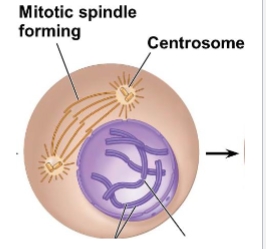
Events and Characteristics of prometaphase
Nuclear envelope breaks down
spindle fibers attach to kinetochores anchoring sister chromatids to poles
chromosomes move toward the center of the cell
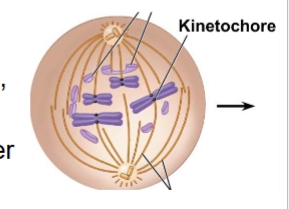
Events and Characteristics of metaphase
Chromosomes move to the cell equator and create metaphase plate
two sister chromatids are attached to opposite sides of the cell
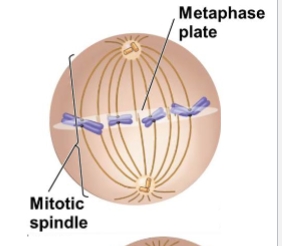
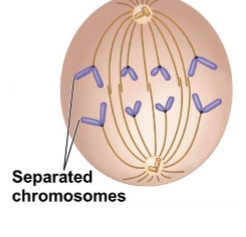
Events and characteristics of anaphase
Centromeres of each chromosome separate into two
sister chromatids are now individual chromosomes
spindle fibers pull the chromosome along, towards opposite poles
Events and Characteristics of telophase
chromosomes decondense making chromatin
nuclei reform
spindle disappears
two genetically identical nuclei have been produced
Events and characteristics of cytokinesis (animals)
divides the cytoplasm into 2 daughter cells via a cleavage furrow
events and characteristics of cytokinesis (plants)
division of the cytoplasm into 2 daughter cells via a cell plate
How does cell density control cell division?
Density dependent inhibition stops cells from dividing once cells bump into other cells.
How do chemical growth factors control cell division?
Most animal cells divide when stimulated by growth factors
a set of proteins within the cell controls the cell cycle
signals affecting critical checkpoints in the cell cycle determine whether cells grown or divide
binding of growth factors to specific receptors on the plasma membrane is necessary for cell division
Explain how cancerous cells are different than healthy cells
Cancer cells are a result of chromosome breakage and errors in DNA synthesis that can lead to mutations
mutations cause cancer cells to divide uncontrollably
cell cycle control system breaks down
cells lose specific function of normal cells
Cancer cells divide to form tumors (radiation and chemo interfere with cancer cell division)
Explain how chromosomes are paired
Somatic cells contain a specific number of chromosomes according to the species
humans have 46, 23 pairs of homologous chromosomes
the chromosomes of a homologous pair carry genes for the same characteristics at the same place (Locus)
Males have one pair that is not full homologous (XY)
Somatic cells
body cells
Gametes
eggs and sperm
haploid cells with a single set of chromosomes
Diploid
cells that have two sets of homologous chromosomes
Haploid
Cells with a single set of chromosomes
Why does sexual reproduction require meiosis?
Meiosis reduces the chromosome number from a diploid to a haploid to make gametes (eggs or sperm)
Mitosis
begins w/ diploid parent cells that have DNA duplicated during the previous interphase
produces 2 genetically identical diploid somatic daughter cells
meiosis
Begins w/ diploid parent cells that have DNA duplicated during the previous interphase
produces 4 genetically unique haploid gametes
meiosis 1
separates each homologous pair and produces two daughter cells, reduces the number of chromosomes (Diploid to haploid)
meiosis 2
in each of the cells the sister chromatids of each chromosome separate and results in 4 haploid cells
Stages of meiosis
prophase 1= homologous chromosomes pair and exchange corresponding segments (Crossing over)
Metaphase 1= Homologous chromosomes align
Anaphase 1= Homologous chromosomes separate
Telophase 1= Nuclear membranes reform
Meiosis 2 stages
Prophase 2= spindle fibers attach to sister chromatids
metaphase 2= the chromosomes align on the equator
anaphase 2= sister chromatids separate
telophase 2= nuclear membranes reform followed by cytokinesis
How is genetic variation is produced in sexually reproducing organisms?
random fertilization of eggs by sperm greatly increases genetic variation
Define true breeding organisms
Organisms that can transmit certain traits to all their offspring
pass down specific phenotypic traits to their offspring
appear similar to each other in appearance, respond similarly to the environment, and are homogenous for many traits that differentiate them from others members of the species
define hybrids
a genetically mixed organism that combines traits from two distinct parents
define the P generation
grandparents
define the F1 generation
parents
define the F2 generation
you and your siblings
Define homozygous
an organism that has 2 identical alleles for a gene
Define heterozygous
an organism that has two different alleles for a gene
define dominant allele
if the two alleles of an inherited pair differ, then one determines the organism’s appearance
define recessive allele
has no noticeable effect on the organisms appearance
define genotype
an allele pair
define phenotype
an observable trait
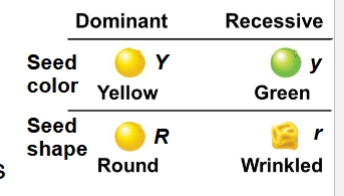
Define a monohybrid cross
investigates inheritance of a single gene/locus
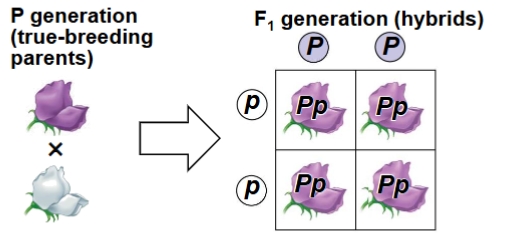
Define Punnett Square
shows the 4 possible combinations of alleles after gametes combine
Explain how Mendel’s law of segregation describes the
inheritance of a single character.
Four hypotheses
alleles account for variations in inherited characters
for each character, an organism inherits two alleles of a gene, one from each parent
If the two alleles of an inherited pair differ, then one determines that organism’s appearance and the other has no noticeable effect on the organisms appearance
The law of segregation
Law of Segregation
Each parent produces gametes representing its two alleles in equal proportions. The alleles are segregated into separate gametes
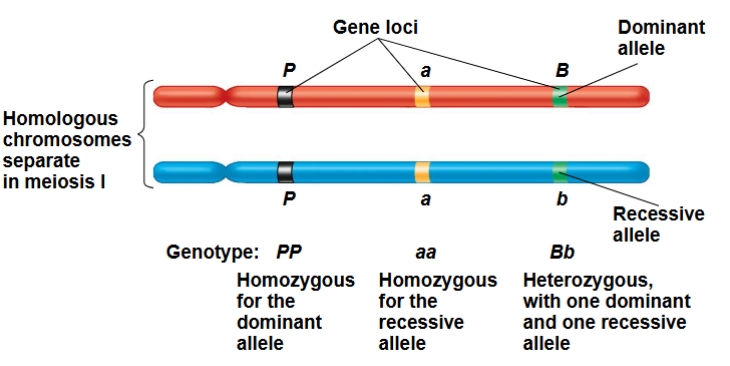
describe the genetic relationships between homologous chromosomes
carry alleles of the same genes at the same locations (loci)

Explain how Mendel’s law of independent assortment
applies to a dihybrid cross.
the alleles of a alleles of a pair segregate independently of other allele pairs during gamete formation
Explain how recessive disorders are inherited
the parents (heterozygotes) are carriers of the recessive allele for the disorder but are phenotypically normal
describe the inheritance patterns of incomplete dominance
the appearance of some F1 hybrids falls between the phenotypes of the two parental varieties
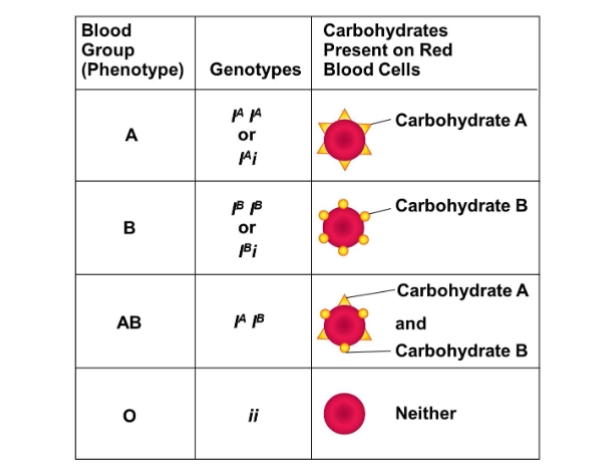
describe the inheritance patterns of multiple allelism
both alleles in a heterozygote are fully expressed
describe the inheritance patterns of codominance
both traits are expressed in heterozygotes
describe the inheritance patterns of pleiotropy
when one gene influences multiple characters
describe the inheritance patterns of polygenic inheritance
a single phenotypic character results from the additive effects of two or more gene (human skin tones)
Explain why human skin coloration is not sufficiently
explained by polygenic inheritance.
many traits are affected, in varying degrees, by both genetic and environmental factors
Define the chromosome theory of inheritance
genes occupy specific loci on chromosomes
chromosomes undergo segregation and independent assortment during meiosis
Explain the chromosomal basis of the laws of segregation and independent assortment.
• orientation of homologous chromosome pairs in
metaphase I → the law of independent assortment
• separation of homologous chromosomes in
anaphase I → the law of segregation
Explain how linked genes are inherited
they are located more closely together on a chromosome, it is more likely that they will be inherited together due to their physical proximity
explain how nonlinked genes are inherited
they get seperated during crossing over in meiosis, making inheritance appear independent
Explain how sex is genetically determined in humans.
Males have XY sex chromosomes for the process of developing testes
Females have XX sex chromosomes and the absence of the Y chromosome allows for the ovaries to develop
Describe patterns of sex-linked inheritance.
• A gene located on either sex chromosome is called a sex-linked gene.
• The X chromosome carries many X-linked genes that control traits unrelated to sex.
Structure of DNA
one of the 2 strands is a DNA polynucleotide (Chain of nucleotides
a nucleotide is made up of a phosphate group, 5 carbon sugar and a nitrogenous base (A,G,C,T)
nucleotides are formed by a sugar phosphate backbone
Structure of RNA
RNA nucleotide is made up of a phosphate group, 5 carbon sugars and a nitrogenous base (A,G,C,U)
Explain how the structure of DNA facilitates its
replication (e.g., complementary base pairing)
H bonds between bases hold the strands together
each base pairs with a complementary partner:
A→T and G→C (Both can go the other way)
What is the process of DNA replication
strands separate
each strand becomes a template for new free nucleotides
each new DNA helix has one old strand with one new strand
Transcription
DNA turns into RNA in the nucleus under the direction of DNA
Translation
RNA turns into Protein in the cytoplasm under the direction of RNA
How are the “languages” of DNA and RNA used to produce polypeptides
The genetic instructions for the amino acid sequence of
a polypeptide chain are written in mRNA (messenger
RNA) as a series of three-base “words” called codons.
Explain how eukaryotic RNA is processed before
leaving the nucleus.
RNA splicing
introns are spliced out
exons are spliced together
and a cap and tail are added
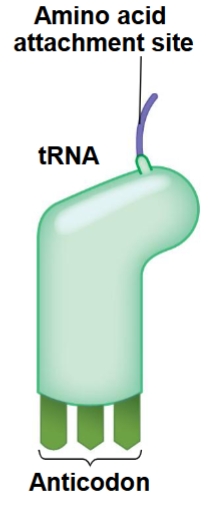
What is the structure of tRNA?
a folded molecule bearing a base triplet called an anticodon and a specfic attachemnt site at the other end
What is the function of tRNA in the process of translation?
tRNA aides the ribosome attached to the mRNA and translates its message into a specific polypeptide.

What is the structure of ribosomes?
Made of ribosomal RNA (rRNA) and proteins
have binding sites for tRNA and mRNA

What is the function of Ribosomes?
holds mRNA and tRNAs together and connects amino acids from the tRNAs to the growing polypeptide chain.

Describe the step-by-step process by which
amino acids are added to a growing polypeptide
chain. (Elongation)
mRNA moves one codon at a time relative to the ribosome
as mRNA moves, a tRNA with a complementary anticodon pairs with each codon adding its amino acid to the growing polypeptide chain
This continues until a stop codon reaches the ribosome’s A site (Termination)
Diagram of the overall process of transcription and translation
DNA —Transcription →RNA — Translation —> Polypeptide

What are the major types of mutations?
substitution, insertion, deletion
What are the causes of mutations?
changes in the genetic information in a cell
errors in DNA replication or recombination
physical or chemical agents called mutagens
What are the potential consequences of mutations?
could change an amino acid into a stop codon and would produce a prematurely terminated polypeptide
could be deadly or innovative (for your benefit)
Define Evolution
the change in the heritable characteristics of biological populations over successive generations.
Explain why the concept of evolution is a theory
It is widely accepted
broader than a hypothesis
generates new hypotheses
is supported by thousands of scientific studies
How does the concept of homologies support evolution?
Structural and molecular homologies reveal evolutionary relationships
What is the definition of Homology?
similarity resulting from common ancestry.
How does the concept of fossil records support evolution?
it reveals the historical sequence in which organisms have evolved.
What is the definition of fossils?
the imprints or remains of organisms that lived in the past and document differences between past and present organisms
What is the definition of Artificial Selection?
when humans choose desirable traits and breed only organisms with those traits
How does the concept of artificial selection support evolution?
if artificial selection can bring about so much change within a short time frame, then natural selection could modify species considerably over many generations.
How does the concept of DNA evidence support evolution?
there is a universal genetic code for all the organisms

How are evolutionary trees used to represent ancestral relationships?
they show which species share the same ancestral traits, helping scientists see who branched off first
What is Darwins 1st Postulate of Natural Selection
Trait variation- individuals vary in traits within populations
What is Darwin’s 2nd postulate of natural selection
Traits are heritable- Variations are passed from parents to offspring
what is darwins 3rd postulate of natural selection
more offspring are produced than can survive
what is Darwin’s 4th postulate of natural selection
Survival and reproduction are nonrandom-advantageous traits= survival of the fittest
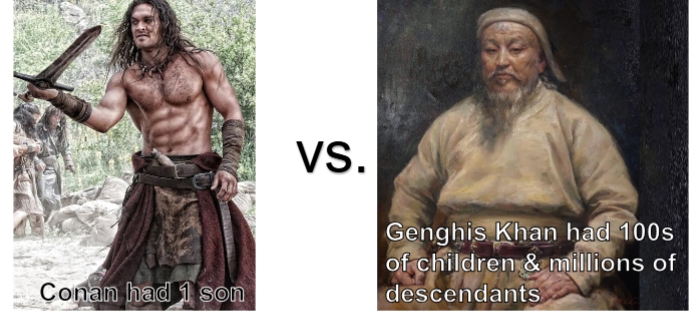
Explain the concept of fitness in an evolutionary sense
an organisms capacity for survival and reproduction in a specific environment.
what adaptations could lead to a greater fitness
higher disease resistance, predator evasion, speed, height, attractiveness to a mate etc
Explain why individuals cannot evolve
evolution happens to populations over generations
Explain why natural selection does not lead to perfect organisms.
selection can act only on existing variations (new alleles arise from mutations)
evolution co-opts existing structures and adapts them to new situations
What is an example of evolution?
Finches on the Galápagos Islands differed in size & shape of their beaks according to their diets (seeds, insects, fruit, nectar)
Bigger seeds=Bigger Beak

Explain how mutation produces genetic variation
the ultimate source of the genetic variation that serves as raw material for evolution.
Explain how sexual reproduction produces genetic variation
Fresh assortments of existing alleles (i.e., genetic variation) arise every generation from three random components of sexual reproduction:
1. crossing over in prophase I of meiosis
2. independent orientation of homologous chromosomes at metaphase I of meiosis
3. random fertilization.
What is the 1st main cause of evolutionary change
Natural Selection- differential survival and reproduction of individuals due to differences in phenotype
What is the 2nd main cause of evolutionary change
Genetic Drift- random changes in allele frequencies within a population
Explore top notes

