Bio 1B Protists
 Call Kai
 Learn
Learn Practice Test
 Spaced Repetition
 Match
Match Flashcards
 Knowt Play
1/33

There's no tags or description
Looks like no tags are added yet.
Name | Mastery | Learn | Test | Matching | Spaced | Call with Kai |
|---|
No analytics yet
Send a link to your students to track their progress
34 Terms
Protists are the informal name for
unicellular eukaryotes
Protists are the most […] of any other group of eukaryotes
Structurally and functionally diverse
Characteristics of protists include
[multiple choice]
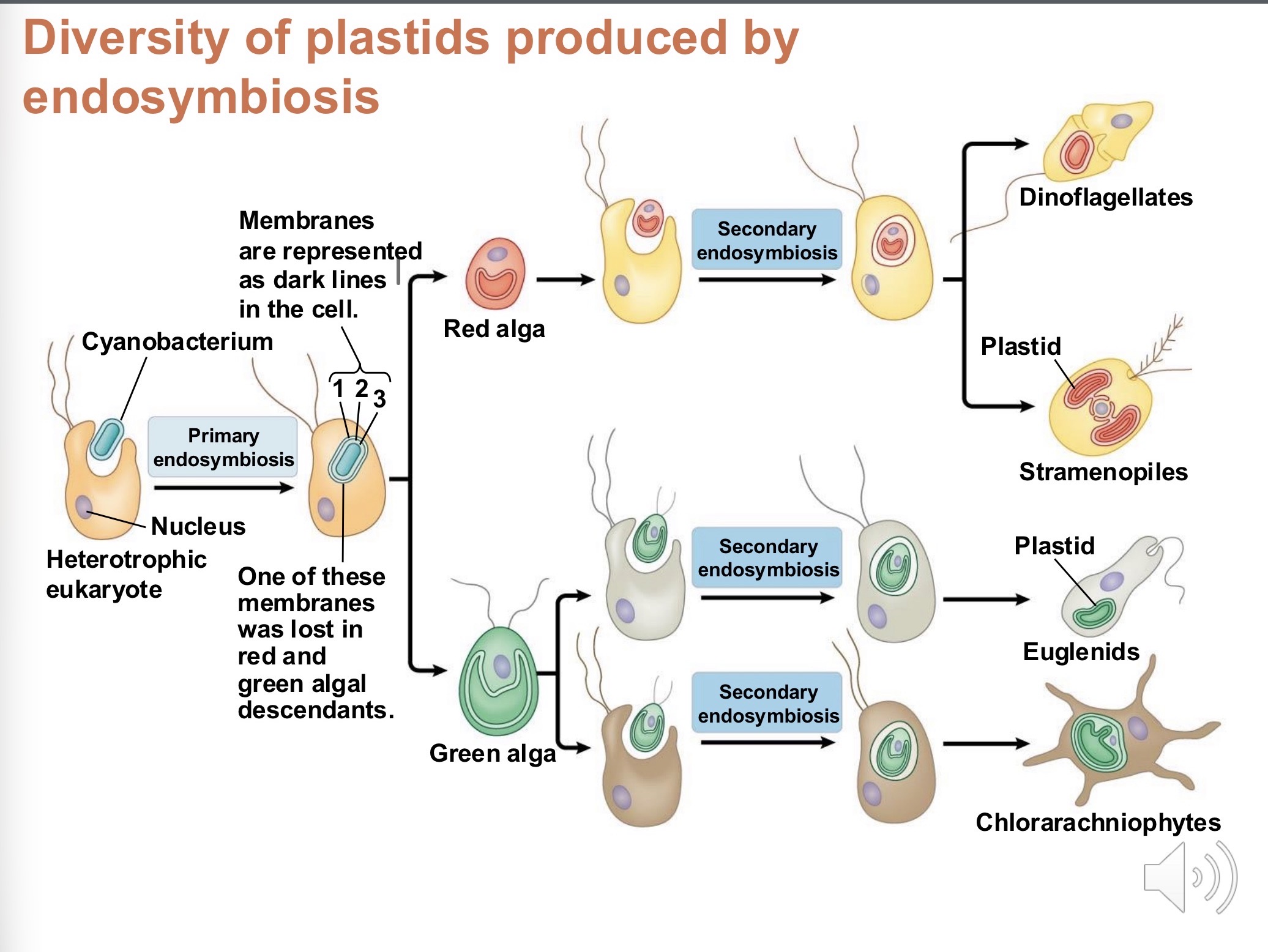
Protists’ diversity is due to
endosymbiosis
Mitochondria is a result of endosymbiosis and was engulfed by
an alpha proteobacterium
Plastids are a result of endosymbiosis and were engulfed by
a photosynthetic cyanobacterium
Plastids later evolved into
red and green algae, which respectively evolved into dinoflagellates + stramenophiles and euglenids + chlorarachniophytes
The four supergroups of protists are
Excavata, SAR (stramenophiles, alveolates, rhizarians), archaeplastida, unikonta
The main protists of the excavata supergroup are
Diplomonads, parabasalids, and euglenozoans
The main characteristics of both diplomonads and parabasalids are
A lack of plastids and modified mitochondria
Diplomonads and parabasalids primarily live in
Anaerobic environments
Euglenozoans are characterized by
A spiral or crystalline rod inside their flagella
Within the euglenozoa clade, there are two groups:
Kinetoplastids and euglenids
Do kinetoplastids include parasitic species?
Yes, examples include Trypanosoma brucei, which causes the African sleeping sickness, and Trypanosoma cruzi, which causes American trypanosomiasis
The main stramenophiles (from the SAR supergroup) are:
diatoms, golden algae, and brown algae
The main characteristic of stramenophiles is
the presence of both hairy and smooth flagella.
What is the ecological significance of golden and brown algae?
Golden and brown algae contain some of the most important photosynthetic organisms on the planet
What is the significance of diatoms?
Diatoms are a major component of phytoplankton and transport carbon dioxide from the atmosphere to the ocean floor
Do diatoms include parasitic species?
No, but some species produce biotoxins, an example is Pseudonitzchia, found in shellfish, anchovies, and sardines, and it produces domoic acid and can cause amnesiac shellfish poisoning
What is the origin of the name of golden algae?
Their yellow and brown carotenoids
What are some characteristics of brown algae?
It is the largest and most complex algae, it is multicellular, it includes what we commonly think of as seaweeds
Define alternation of generations
A variety of life cycles characterized by part of their life being diploid, usually after zygote formation and lasts a relatively short time, and the remaining majority of their life being haploid
The main protists of alveolates include
Dinoflagellates, apicomplexans, and ciliates
The main characteristic of alveolates are
Alveoli (as the name suggests), which contribute to maintaining the shape of the cell
Dinoflagellates are characterized by… and are abundant components of
cellulose plates, marine and freshwater plankton
What role do dinoflagellates have in coral reefs?
Dinoflagellates (specifically zooxanthellae) are symbionts of corals, and they maintain coral health and prevent coral bleaching
Apicomplexans are
Parasites of animals
Apicomplexans’ mode of infection involves
Using their apex, which consists of a special complex of organelles, to penetrate a host cell and their tissues, then propagating as sporozoites
Ciliates are characterized by… and have the ability to
Cilia (which they use to move and feed), genetically differentiate through conjugation
The main protists of rhizarians are
Radiolarians, foraminifera (forams), and cercozoans
The main characteristic of rhizarians is
Thread-like pseudopodia (bodily extensions used for feeding and moving)
Radiolarians are characterized by
A delicate, symmetrical internal skeleton composed of silica
The name for forams originated from… and contain…
Their porous, multichambered shells called tests (through which their pseudopodia extend), endosymbiotic algae

