topic 4- waves
 Studied by 0 people
 Call Kai
 Learn
Learn Practice Test
 Spaced Repetition
 Match
Match Flashcards
 Knowt Play
1/40

There's no tags or description
Looks like no tags are added yet.
Name | Mastery | Learn | Test | Matching | Spaced | Call with Kai |
|---|
No analytics yet
Send a link to your students to track their progress
41 Terms
Describe waves.
Waves transfer energy and information without transferring matter.
What is evidence for this?
Evidence of this for a water wave can be seen when a ball dropped into a pond bobs up and down, but the wave energy Travels outward as ripples across the surface of the pool.
What is frequency?
the number of waves passing a point each second, measured in hertz (Hz)
What is speed?
speed - measured in metres per second (m/s)
What is a period?
period -the time taken for one wavelength to pass a point. Period = 1/frequency
How can waves be described?
frequency
speed
wavelength and amplitude
period
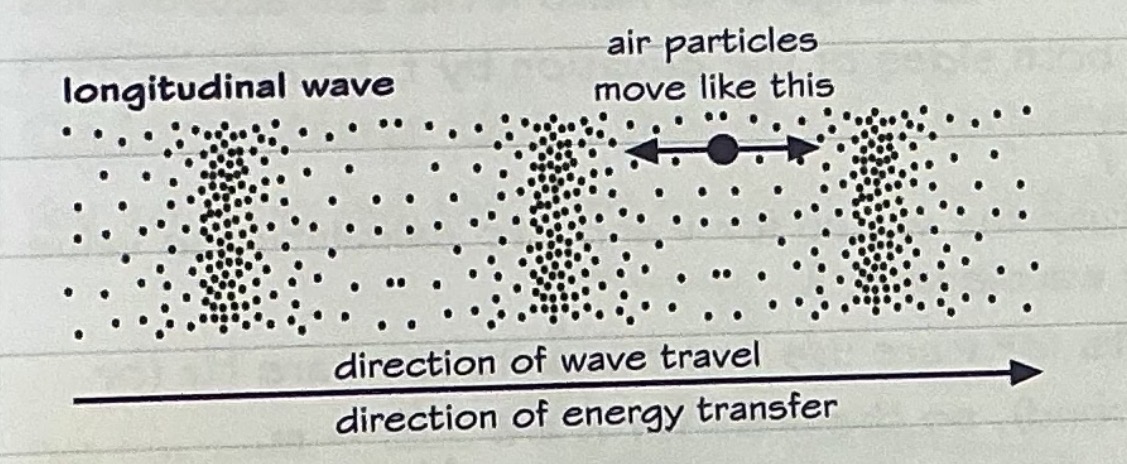
Describe longitudinal waves.
Sound waves and seismic P waves are longitudinal waves. The particles in the material the sound is travelling through move back and forth along the same direction that the sound is travelling.
Particles in a a longitudeinal wave move along the same direction as the wave.
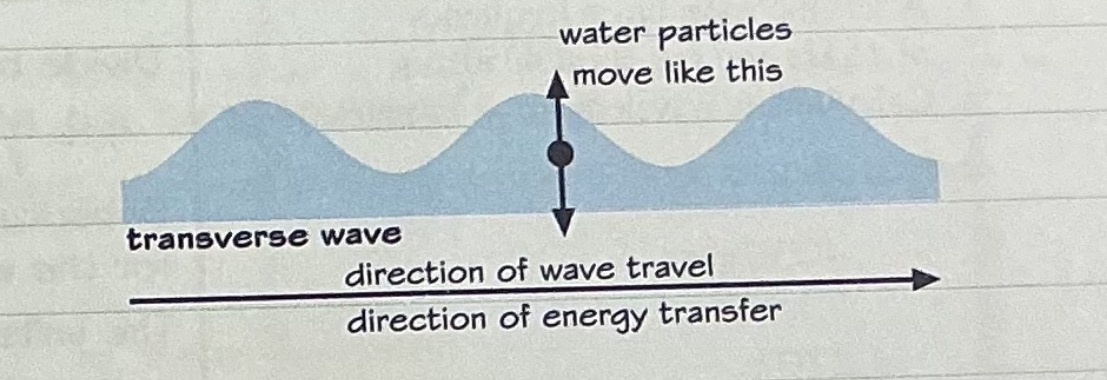
Describe transverse waves.
Waves on a water surface, electromagnetic waves and seismicS waves are all transverse waves. The particles of water move in a direction at right angles to the direction the wave is travelling.
Particles in a transverse wave move across the direction the wave is travelling.
Exam q: give two ways in which longitudinal and transverse waves are
A) similar (2 marks)
That both transfer energy without transferring matter and have an amplitude, speed, wavelength and frequency.
Exam q: give two ways in which longitudinal and transverse waves are
B) different. (2 marks)
Particles in a longitudinal waves vibrate along the direction of movement, whereas particles in a transverse waves move at 90 degrees to the direction of travel. They can also have different speeds, frequencies and wavelengths.
What is 1 method to calculate the speed of sound in air?
Method 1: using an echo.
Measure the distance from the source of the sound to the reflecting surface (the wall).
Measure the time interval, with a stopwatch, between the original sound being produced and the echo being heard.
Use speed distance ÷ time
(m/s)
to calculate the speed of sound in air.
Repeating the experiment a number of times over a range of distances will allow you to obtain accurate and precise results.
What is 2 method to calculate the speed of sound in air?
Method 2: using two microphones and an oscilloscope.
Set up the microphones one in front of the other at different distances in a straight line from a loudspeaker.
Set the frequency of the sound from the loudspeaker to a known, audible value.
Display the two waveforms on the oscilloscope. Measure the distance between the microphones.
Move the microphones apart so that the waveforms move apart by 1 wavelength.
Calculate the speed of sound using the equation: wavespeed _ trequency × wavelength
How can we calculate the speed of ripples on waters surface?
You can work out the speed of ripples on the surface of water using a ripple tank and a strobe.
What is the apparatus needed/method for this experiment?

Describe waves and boundaries.
Waves can shoe different effects when they move from one material to another. These changes can occur at the boundary or interface between the two materials.
What happens when a wave reaches the boundary between two materials what can happen to the wave?
Reflected
Refracted
Transmitted
Absorbed.
Why do these change?
Different substances reflect, refract, transmit or absorb waves in ways that vary with the wavelength.
Different wavelengths of radiation are absorbed by molecules in the atmosphere by different amounts.
What does the amount of reflection at a boundary depend on?
Densities of the materials. The greater the difference in densities, the more sound energy will be reflected
Describe sound waves at a boundary.
sound is transmitted through a material when the densities are similar.
Sound can be absorbed by materials. The amount of absorption depends on the material and the wavelength of the sound.
Sound is reflected when there is a big difference in the densities of the materials at an interface, for example between air and concrete.
Describe refraction.
Sound waves, water waves and light waves can all be refracted. Refraction can result in a change of both speed and direction. The direction does not change if the wavefronts trave perpendicular to the normal.
Describe sound waves traveling from cold air to warm air.
Sound waves travel slower in cooler, denser air than in warmer, less dense air.
Describe water waves travelling from deep water to shallow water.
Water waves travel faster in deep water than in shallow water. They can also change direction.
Describe light waves travelling from air to glass, then back to air.
Light waves can slow down and change direction when they pass from air to gas.
However what could happen in a special case.
When light, sound or water waves move from one material into another their direction does not change if they are moving along the normal.
Exam Q: A person blows a dog whistle. The dog is 200m away.
Explain why the dog will hear the whistle sooner on a warm day than on a cool day.
(3 marks)
Air temperature will affect the speed of sound. Air molecules at a higher temperature have more kinetic energy than air molecules at a lower temperature, so they vibrate faster. Since the air molecules vibrate faster, sound waves travel through the warmer air more quickly than through the cooler air.
What do waves produce?
Vibrations in solids, this is the process used by the ear to detect sound waves.
Describe vibrations and waves.
When objects vibrate, sound waves are produced. These sound waves are a series of oscillations that transfer energy from the source to the car.
Give example for vibrations and waves.
One example of this is the vibration of a guitar string to produce a musical note. The length, thickness and material of the string determines the frequency of the note. Once plucked, the string will vibrate at its natural frequency.
What frequencies can the human ear detect.
The human car can only detect frequencies in the range 20Hz to 20kHz. It does not hear direction of energy transfer frequencies below 20tz or above 20kHz.
Describe energy transfer.
Air molecules are forced to Vibrate by the source of the vibration. Energy travels Via a longitudinal wave until it reaches the ear.
How are sound waves produced?
When a drum is being played:
Drum skin begins to vibrate, particles of air are compresses together, drum skin springs back, particles of air move apart again, in the middle, particles of air are compressed together, wave or compresses particles moved inwards.
After the drum is hit, the vibrations of the drum will cause a longitudinal wave to move outwards from it.

How does the ear detect sound?
Sound waves are channelled down the ear canal and cause the eardrum to vibrate. These vibrations pass through the ear as further vibrations are then converted to an electrical signal and carried to the brain.

As you get older what happens to you hearing?
As you get older, the range of frequencies you can hear decreases. Older people may only be able to hear up to 12 kHz or even lower. Hearing loss can be caused by exposure to loud sounds or to sound over a long period of time.
What is the vibration of a solid the same as?
The frequency of vibration of a solid is the same as the frequency of the sound wave that is causing it to vibrate. Solids can be made to vibrate by these waves, but not for every frequency of the wave. So, the eardrum will not vibrate if the wave frequency is less than 20Hz or more than 20 kHz.
Exam q: Explain why the human ear can only hear sounds in the range from 20 Hz to 20000 Hz.
(2 marks)
Sound waves travelling from air into a solid are converted to vibrations and travel through the solid as a series of vibrations. This conversion of sound waves to vibrations in solids only works over a limited frequency range, which is from
20 Hz to 20 kHz.
What s ultasound?
sound waves with a frequency above 20000Hz (20kHz). Infrasound is sound waves with a frequency lower than 20Hz.
How does infrasound travel through earths core?
Infrasound is believed to travel through the earth as shockwaves from tsunami, volcanoes or earthquakes. Infrasound is also produced when meteors enter the Earth's atmosphere.
How can infrasound be detected in earths crust?
Scientists can detect this infrasound and track the path the meteor will take.
Infrasound waves can be detected from explosions under the ground. The infrasound waves can also help to determine the structure of rocks beneath the earth's crust.
What are ultrasound waves used for?
Ultrasound waves are used to make images of the inside of the body. Ultrasounds are not harmful, so it is safe to use them to scal foetuses (unborn babies).
How do pre-natal scans work?
The ultrasound waves are sent into the woman's body, and some of the sound is reflected each time it meets a layer of tissue with a different density to the one it has just pased through The scanner detects the echoes and a computer uses the information to make a picture.
Describe sonar waves.
Sonar uses pulses of ultrasound to find the depth of water beneath a ship. The sonar equipment measures the time between sending the sound and detecting its echo.
 Note
Note  Flashcards (71)