PHRM 808 Dr. Cushman Antibiotic Structures + Information

0.0(0)
studied byStudied by 0 people
0.0(0)
call with kaiCall with Kai
learnLearn
examPractice Test
spaced repetitionSpaced Repetition
heart puzzleMatch
flashcardsFlashcards
GameKnowt Play
Card Sorting

1/93

encourage image

There's no tags or description

Looks like no tags are added yet.

Last updated 4:19 PM on 2/1/26
Name
Mastery
Learn
Test
Matching
Spaced
Call with Kai

No analytics yet

Send a link to your students to track their progress

94 Terms

1
New cards

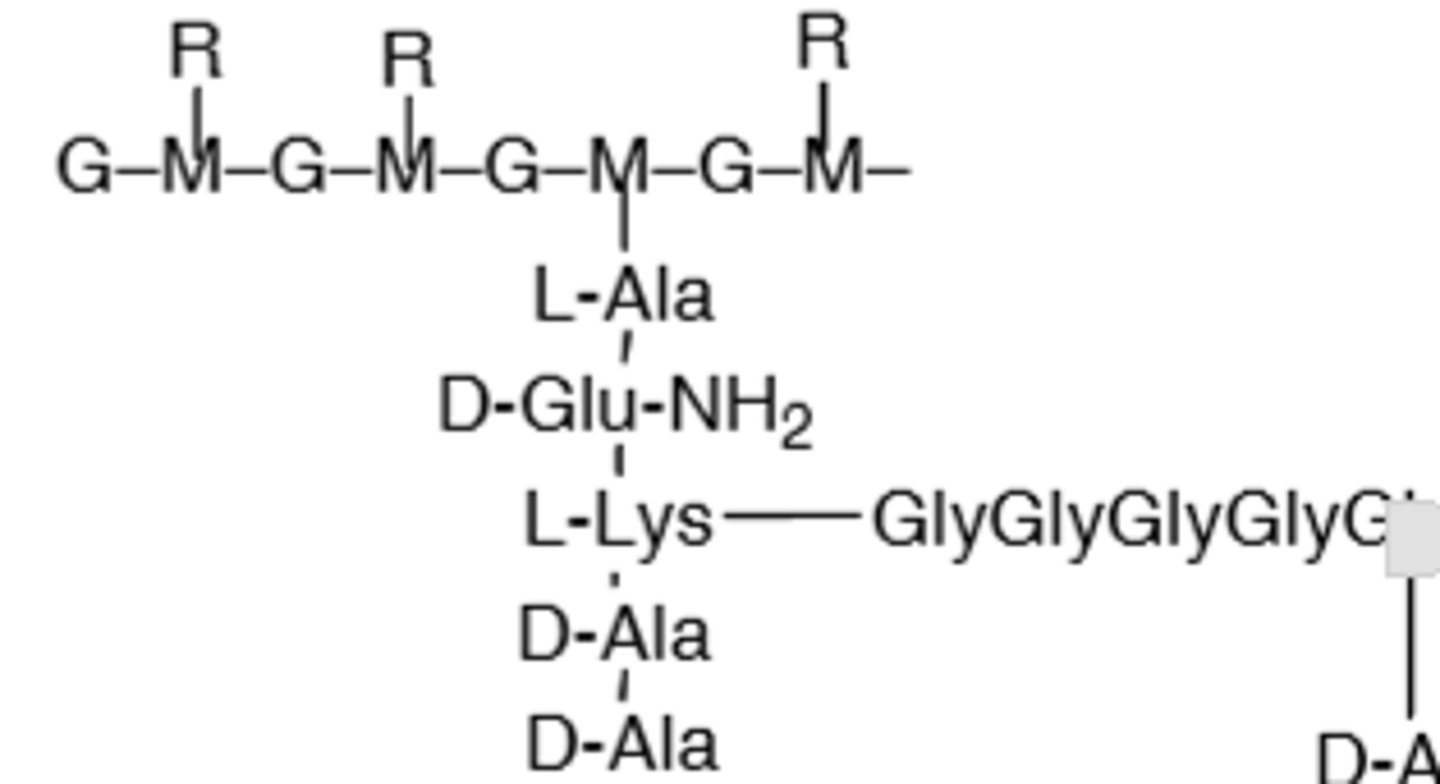
Strand That Connects to D-Ala

knowt flashcard image
2
New cards

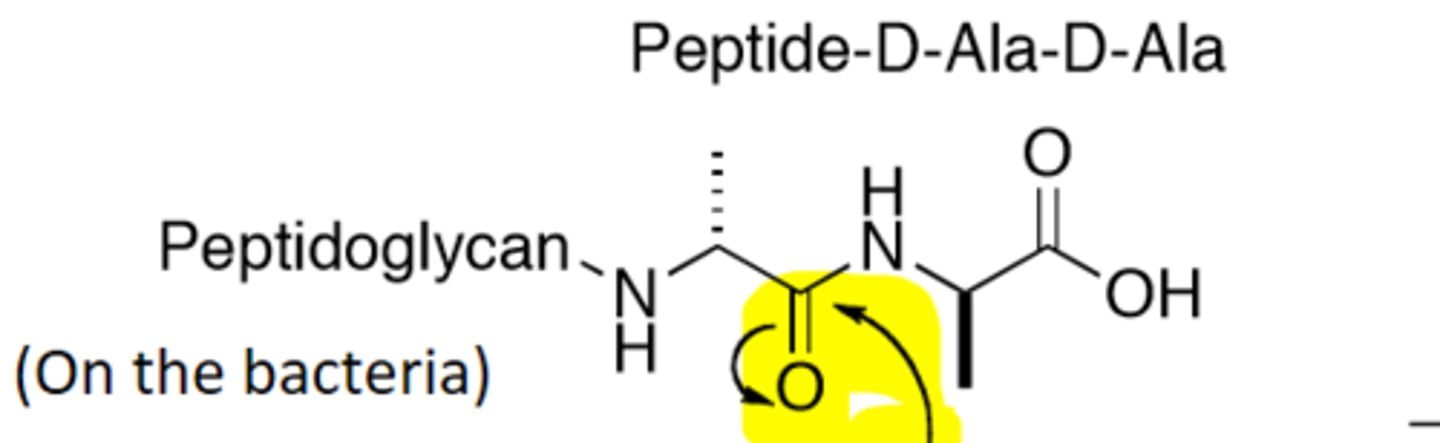
What is this

D-Ala-D-Ala terminal chain
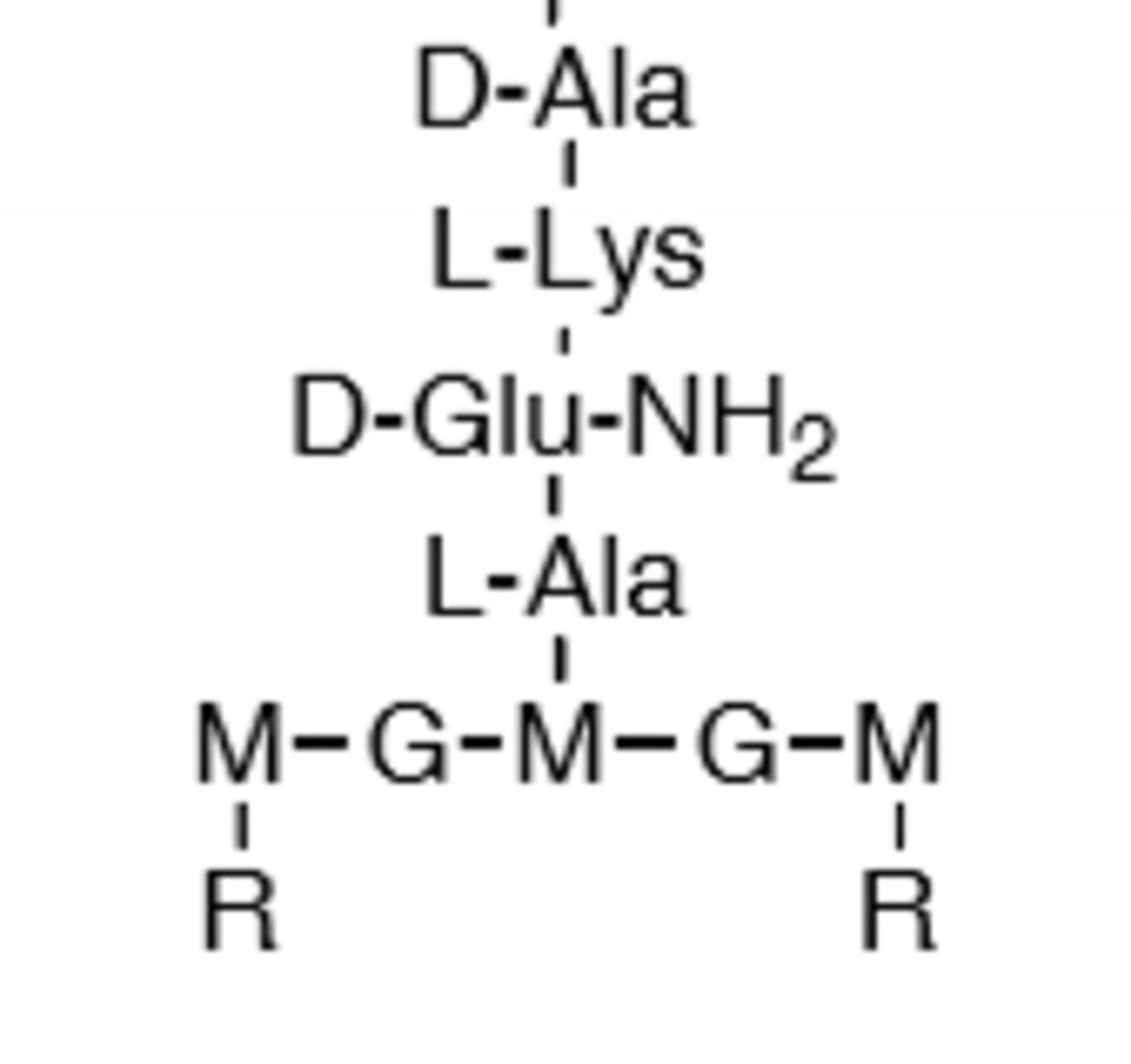
<p>D-Ala-D-Ala terminal chain</p>
3
New cards
<p>Peptide D-Ala-D-Ala</p>

Peptide D-Ala-D-Ala

knowt flashcard image
4
New cards
<p>Transpeptidase</p>

Transpeptidase

Can also be called Penicillin-Binding-Protein (PBP)
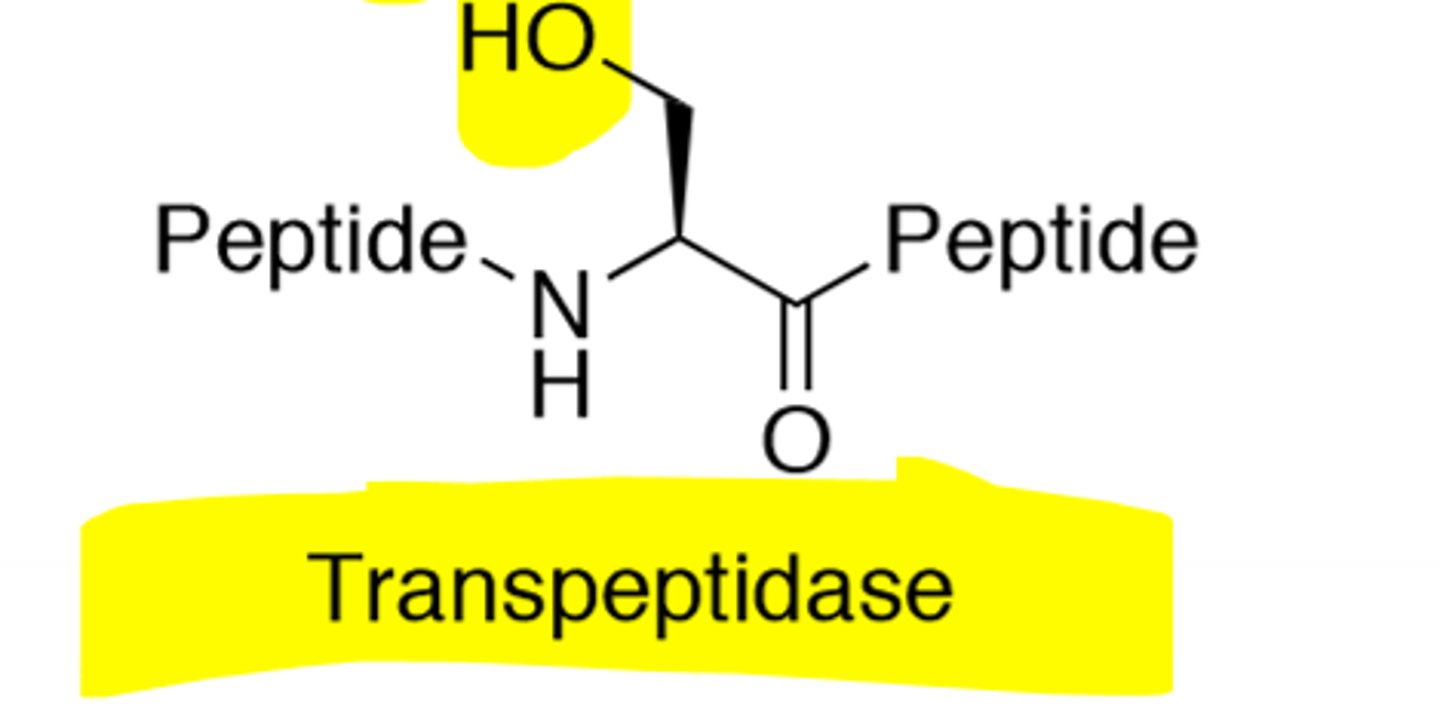
<p>Can also be called Penicillin-Binding-Protein (PBP)</p>
5
New cards
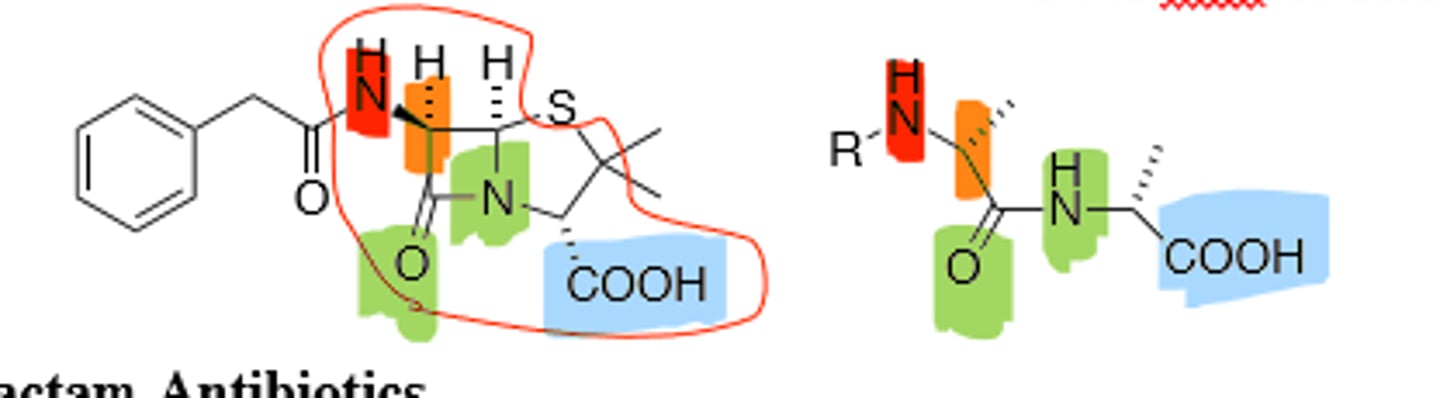
<p>B-Lactam (Left) vs D-Ala-D-Ala Structure (Right)</p>

B-Lactam (Left) vs D-Ala-D-Ala Structure (Right)
knowt flashcard image
6
New cards

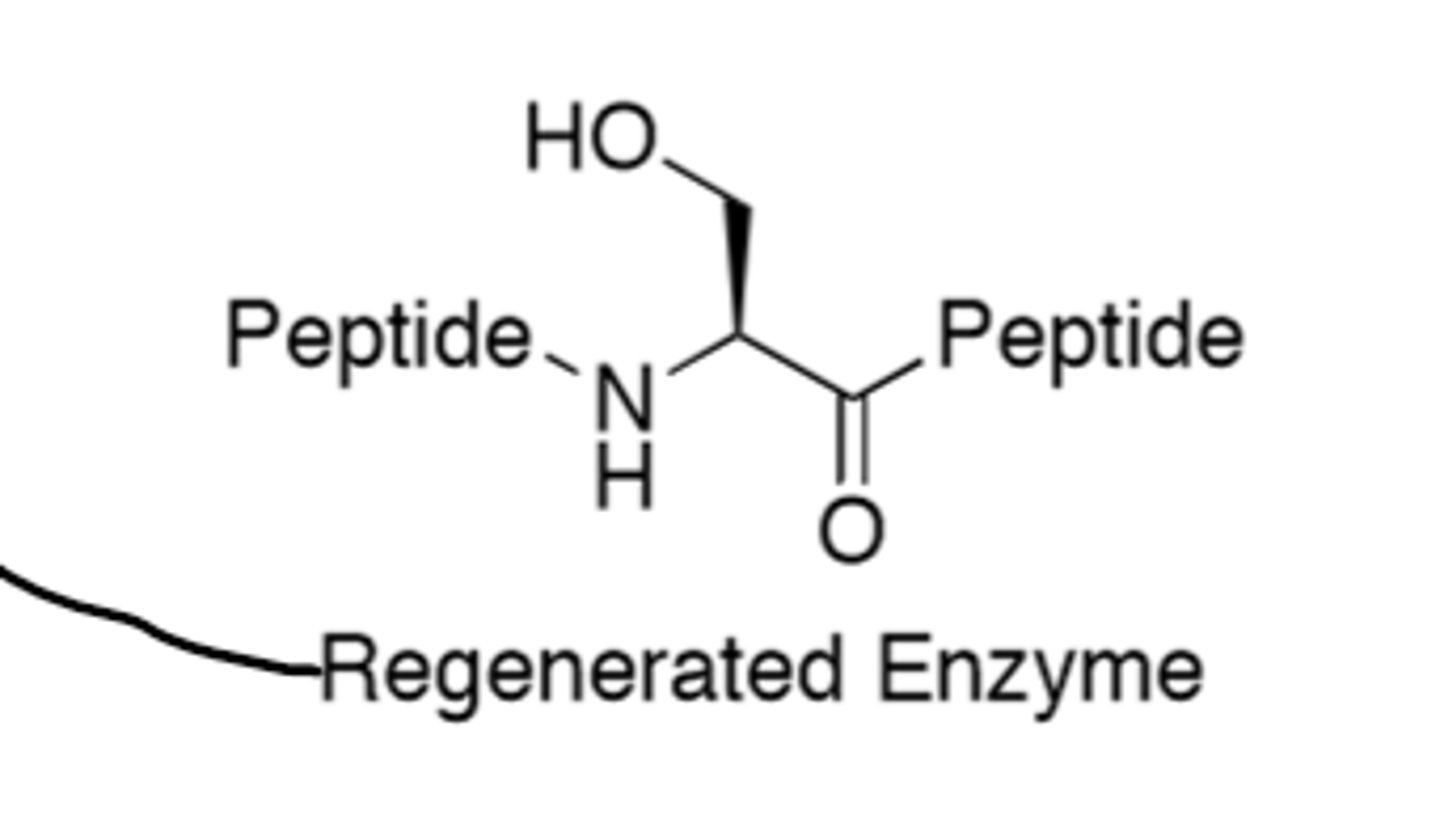
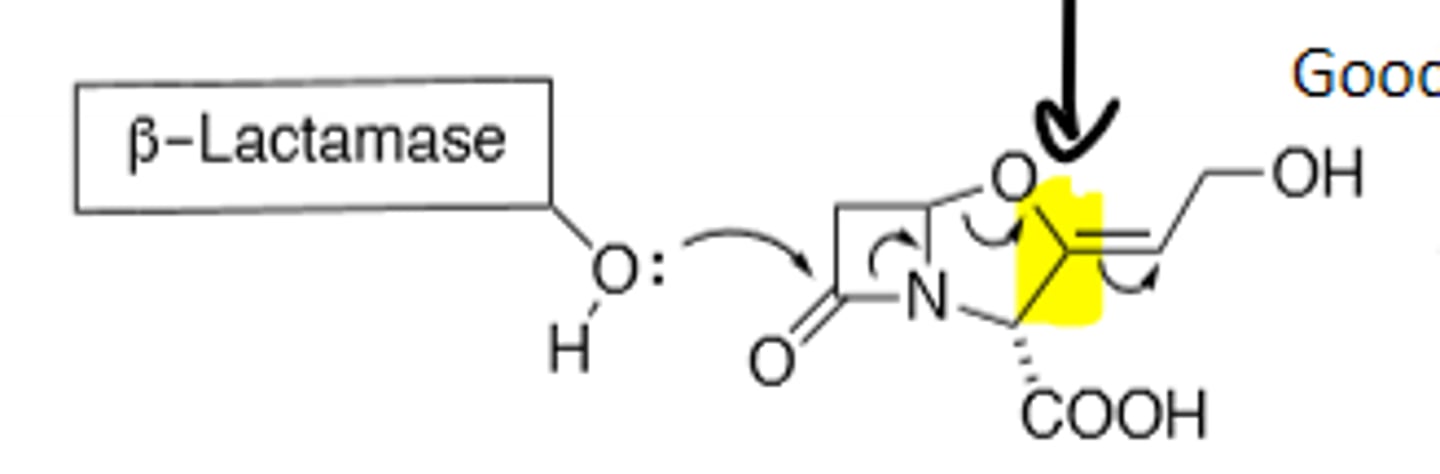
B-Lactamase Enzyme

knowt flashcard image
7
New cards

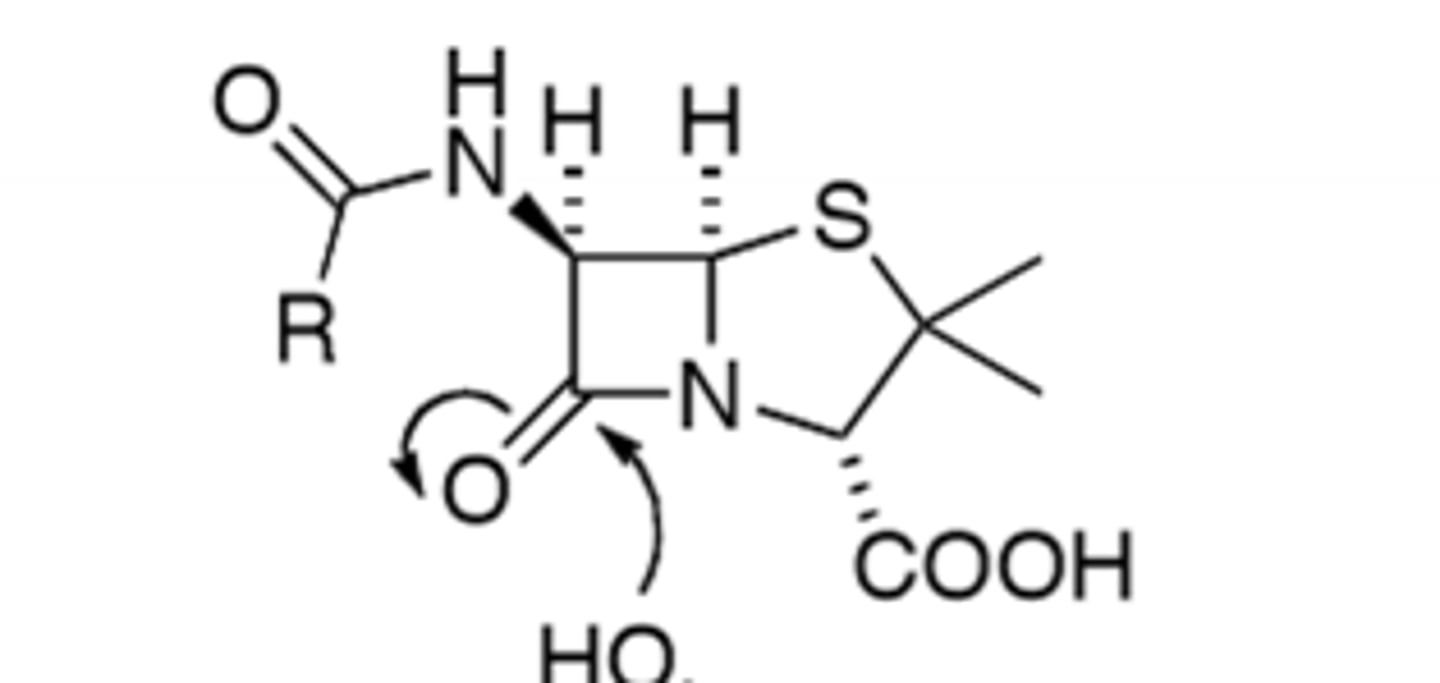
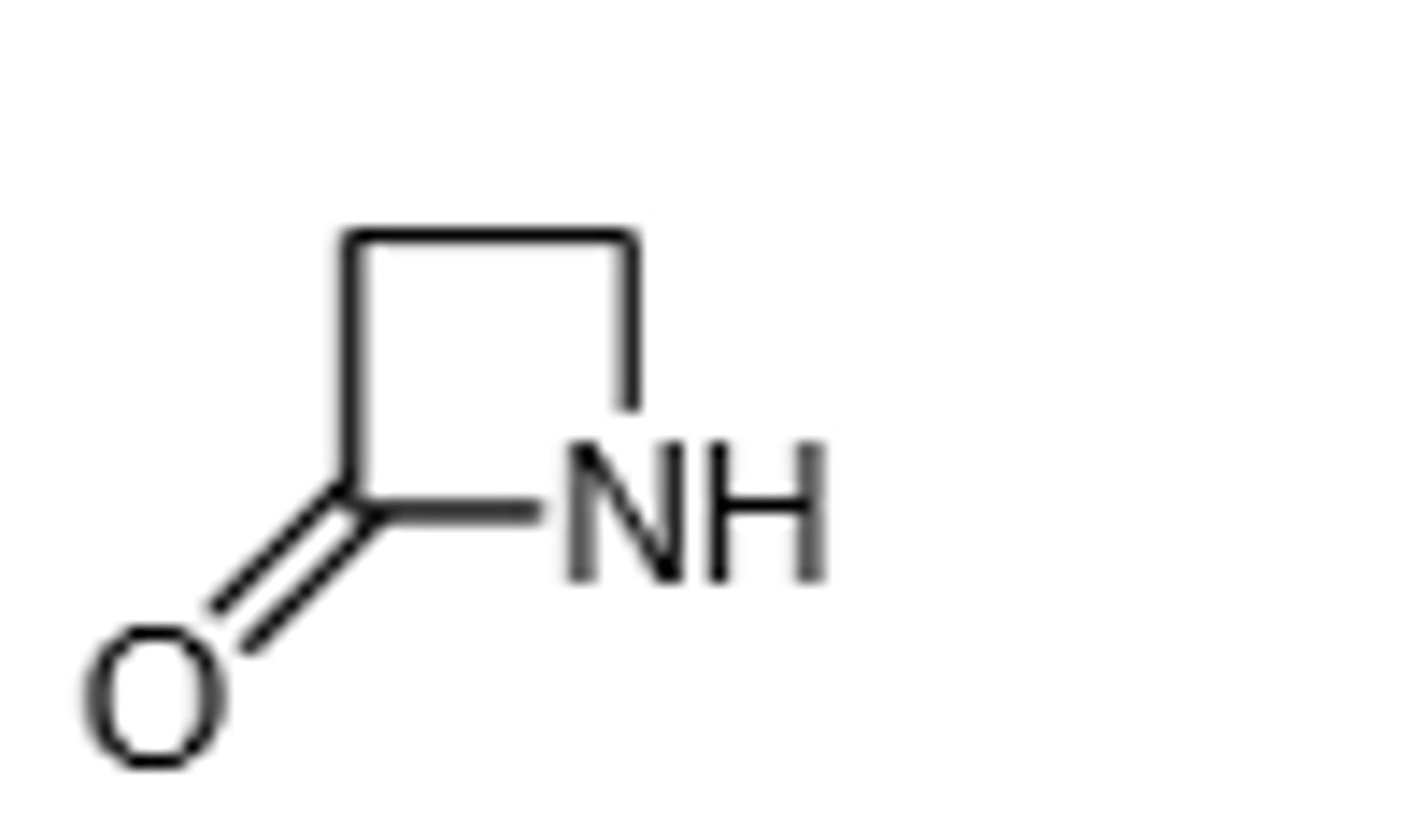
B-Lactam

knowt flashcard image
8
New cards

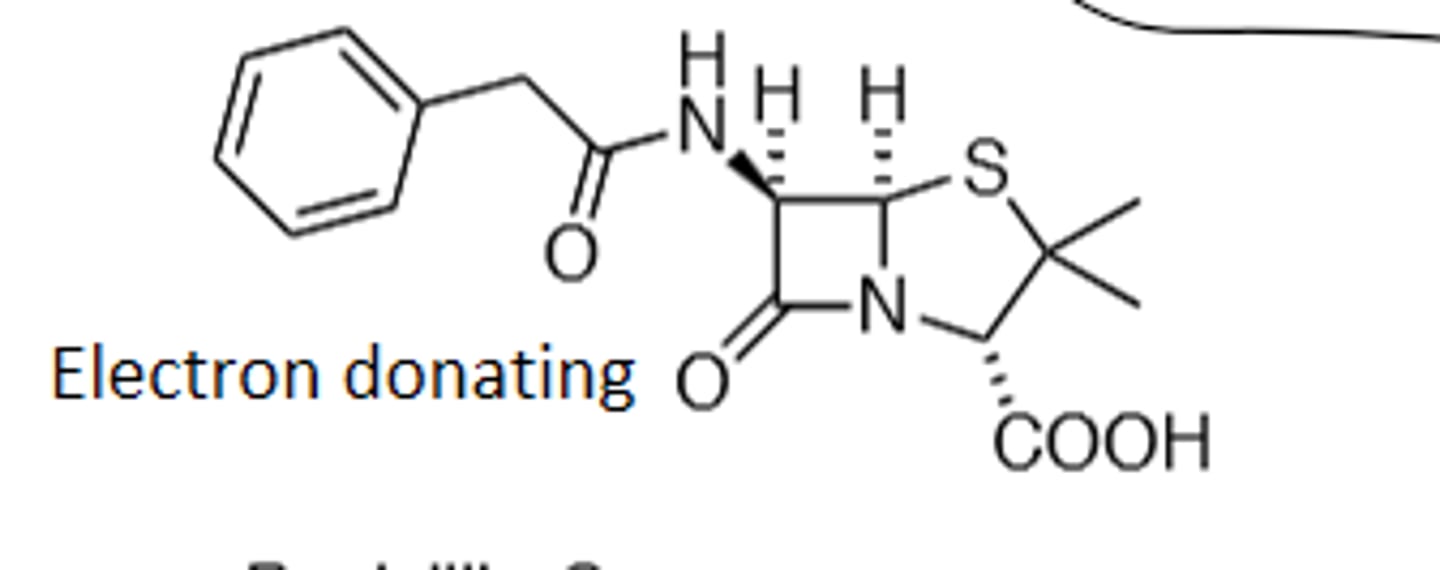
Penicillin G

Benzylpenicillin, B-Lactam, More Nucleophilic, B-Lactamase Sensitive, not orally available
<p>Benzylpenicillin, B-Lactam, More Nucleophilic, B-Lactamase Sensitive, not orally available</p>
9
New cards

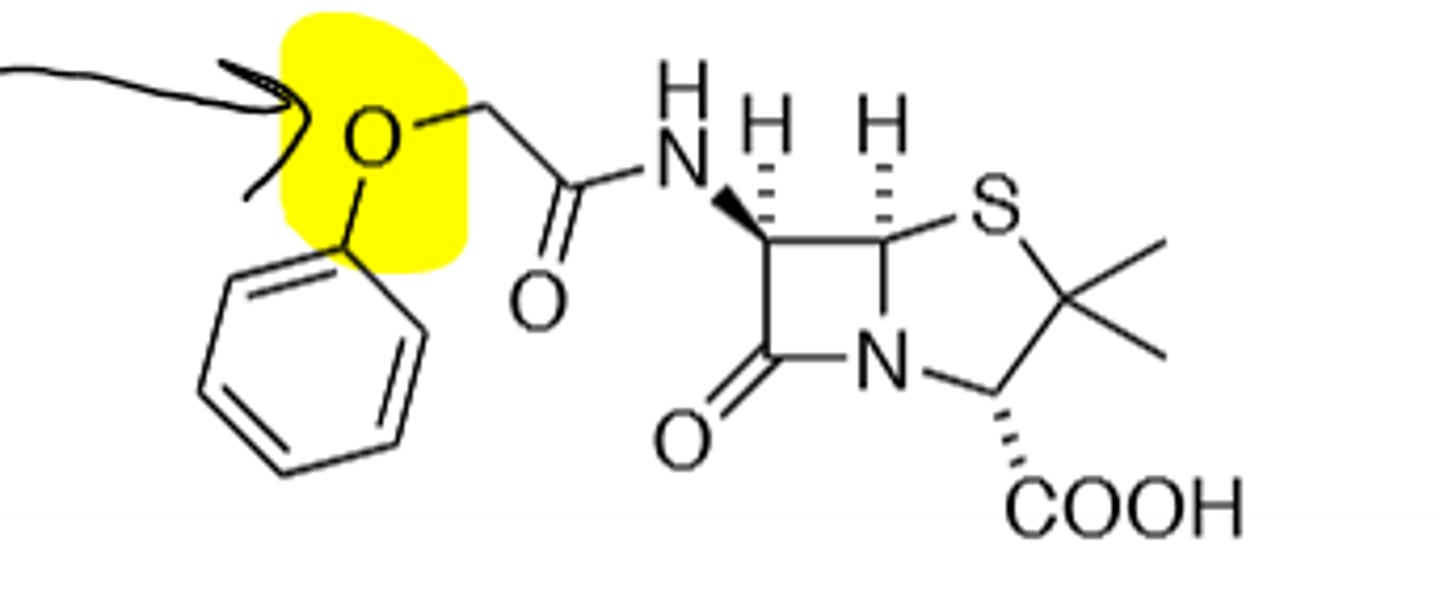
Penicillin V

Phenoxymethylpenicillin, B-Lactam, Much More orally available (Ether Oxygen), B-Lactamase Sensitive
<p>Phenoxymethylpenicillin, B-Lactam, Much More orally available (Ether Oxygen), B-Lactamase Sensitive</p>
10
New cards

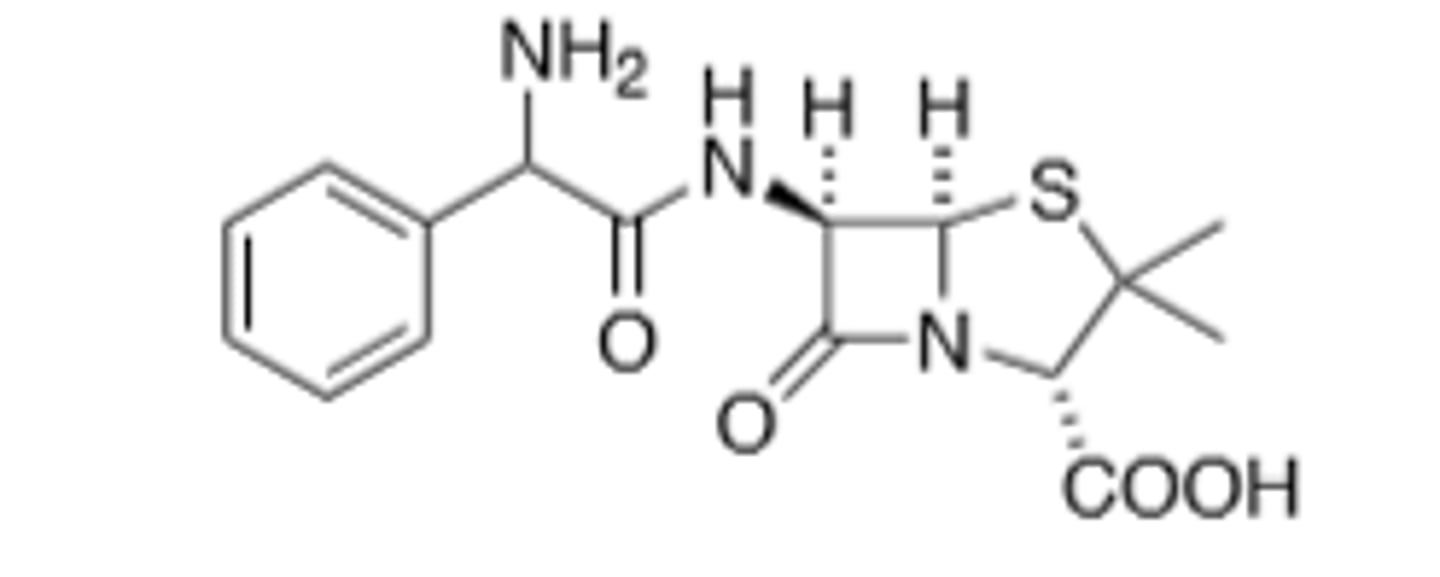
Ampicillin

B-Lactam, Broad Spectrum, NH2 protonated at physiological pH, B-Lactamsse Sensitive
<p>B-Lactam, Broad Spectrum, NH2 protonated at physiological pH, B-Lactamsse Sensitive</p>
11
New cards

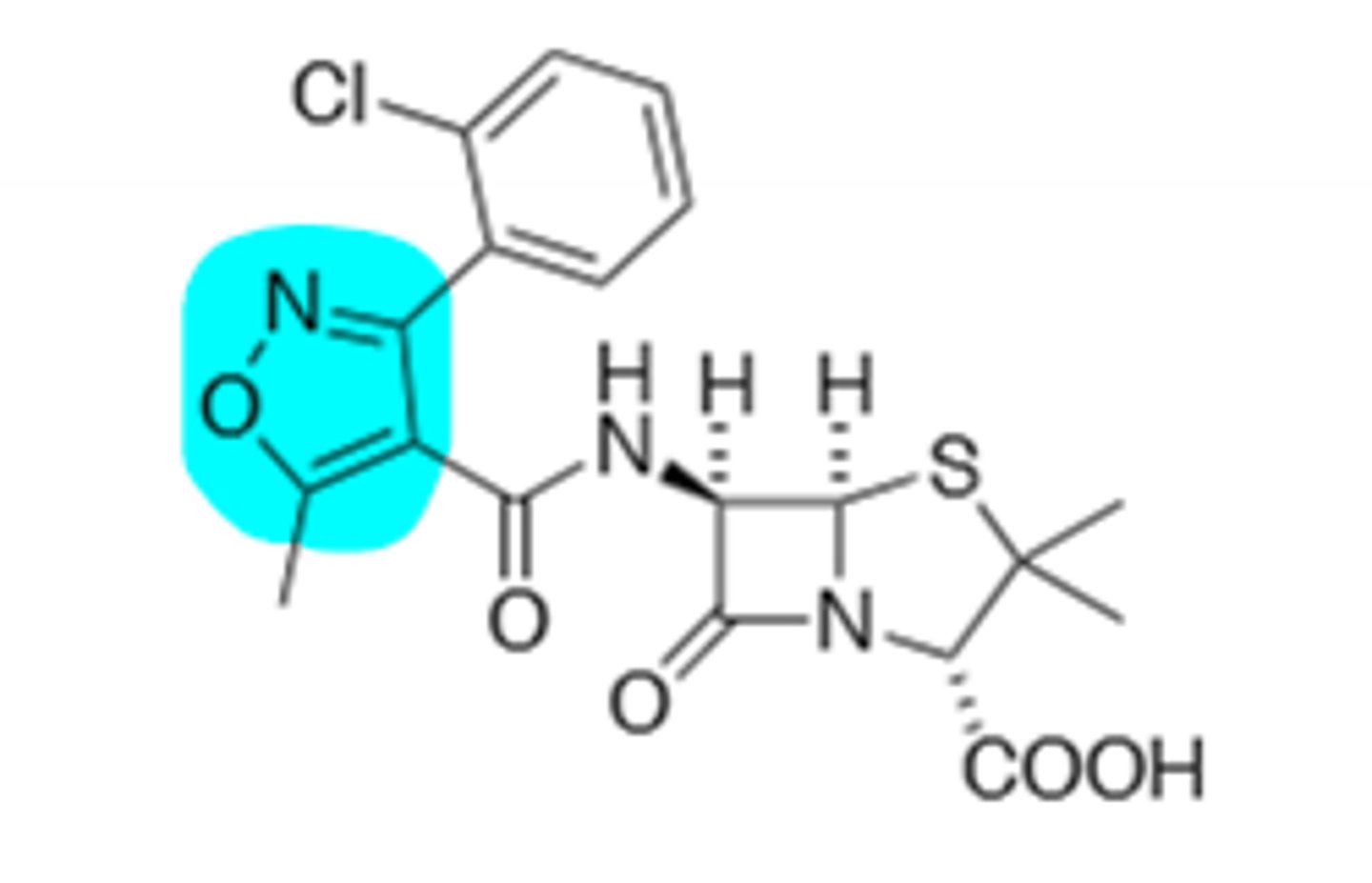
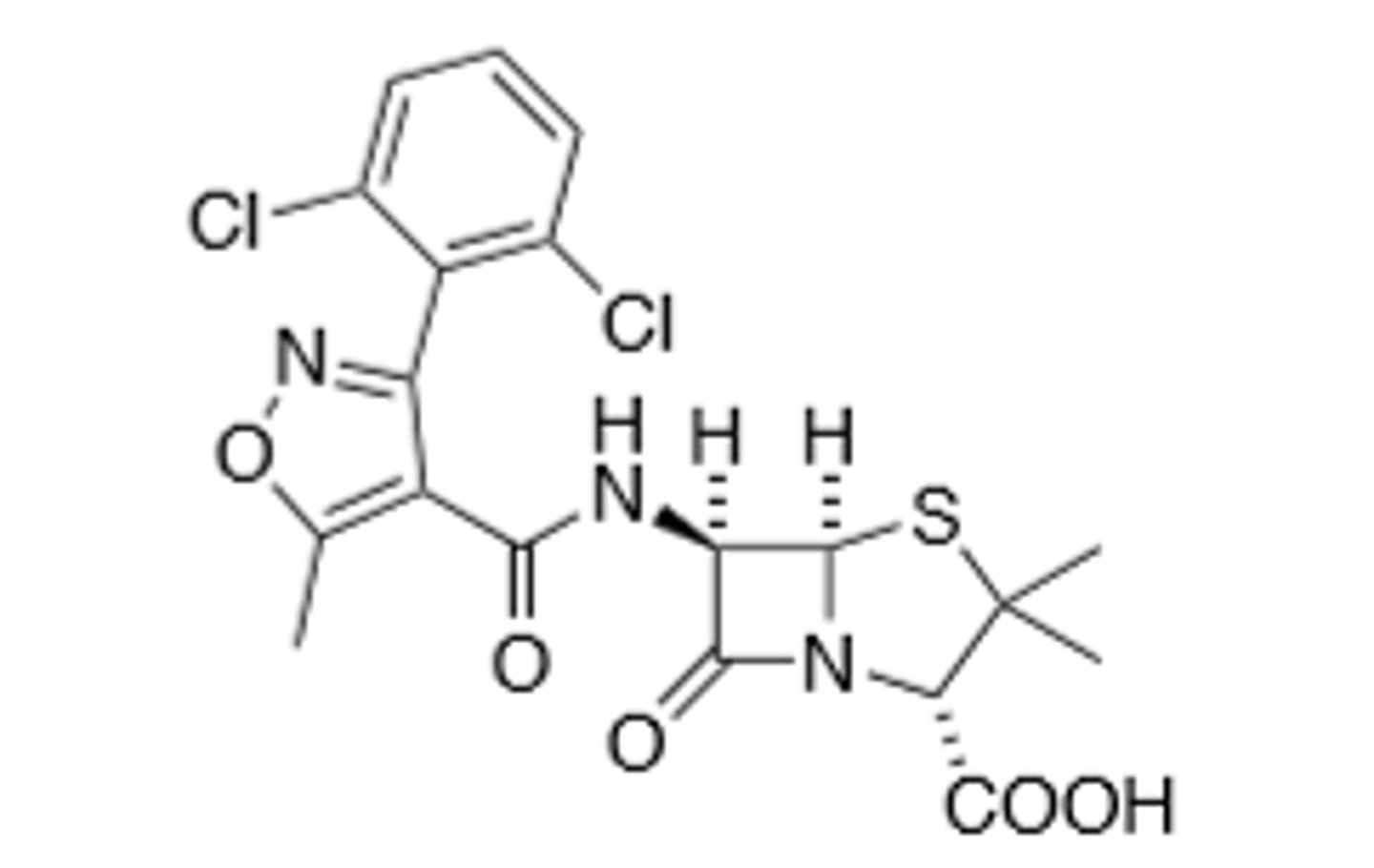
Dicloxacillin

B-Lactam Resistant, Lipophilic, Oral Only
<p>B-Lactam Resistant, Lipophilic, Oral Only</p>
12
New cards
<p>Probenecid</p>

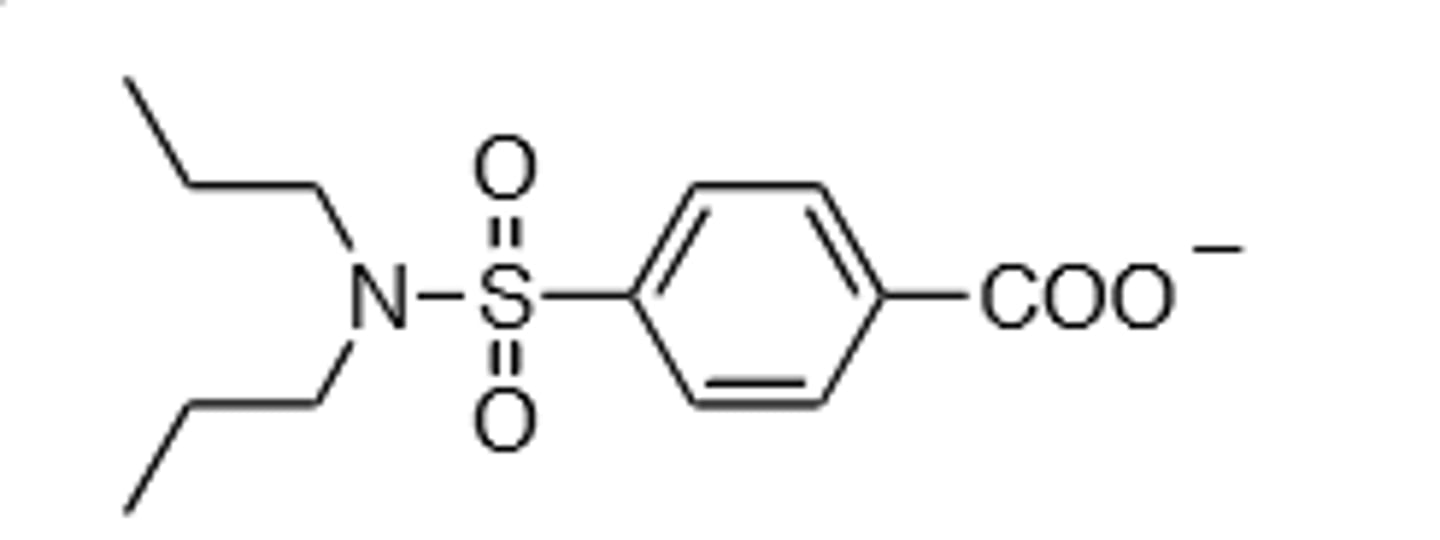
Probenecid

Increases half-life of Penicillin when co-administered
<p>Increases half-life of Penicillin when co-administered</p>
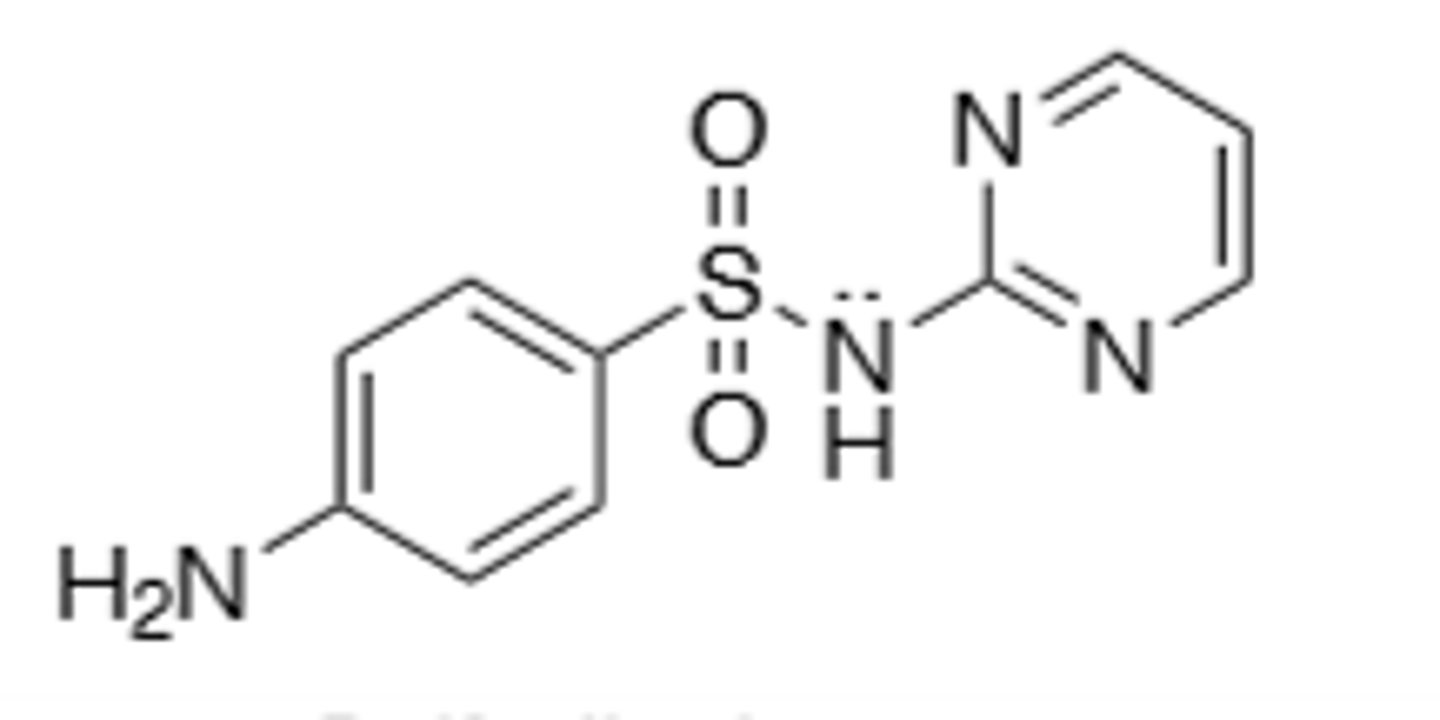
13
New cards

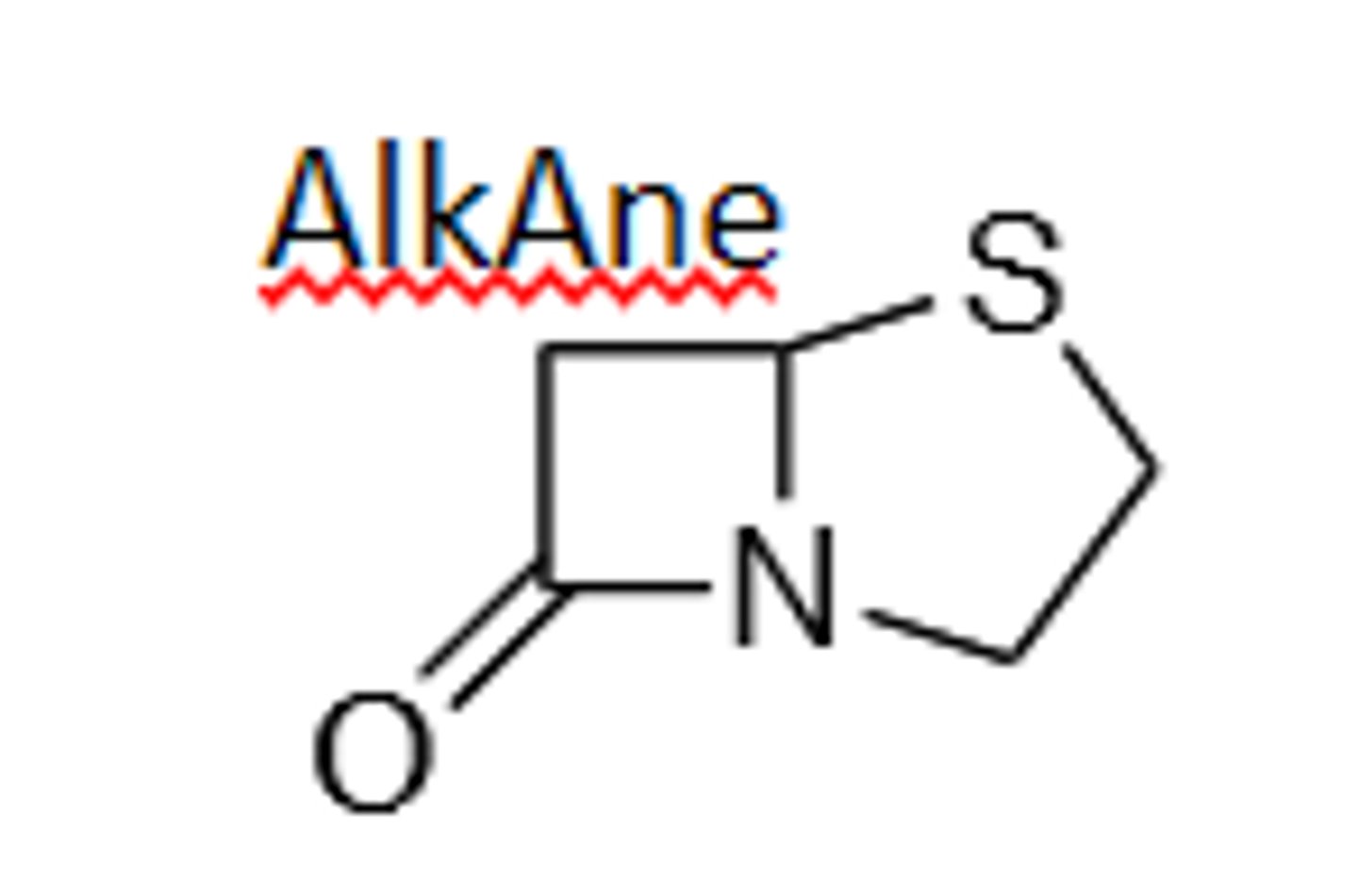
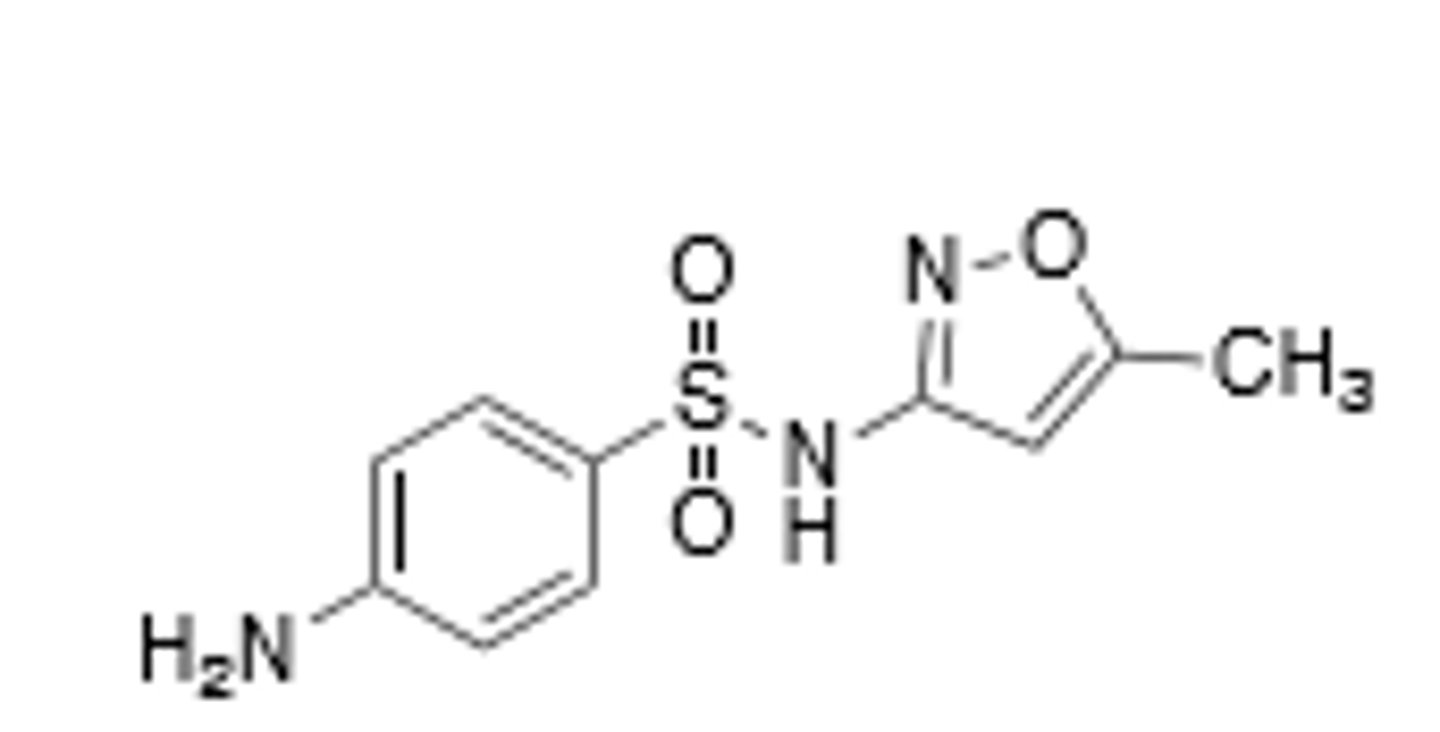
Penam

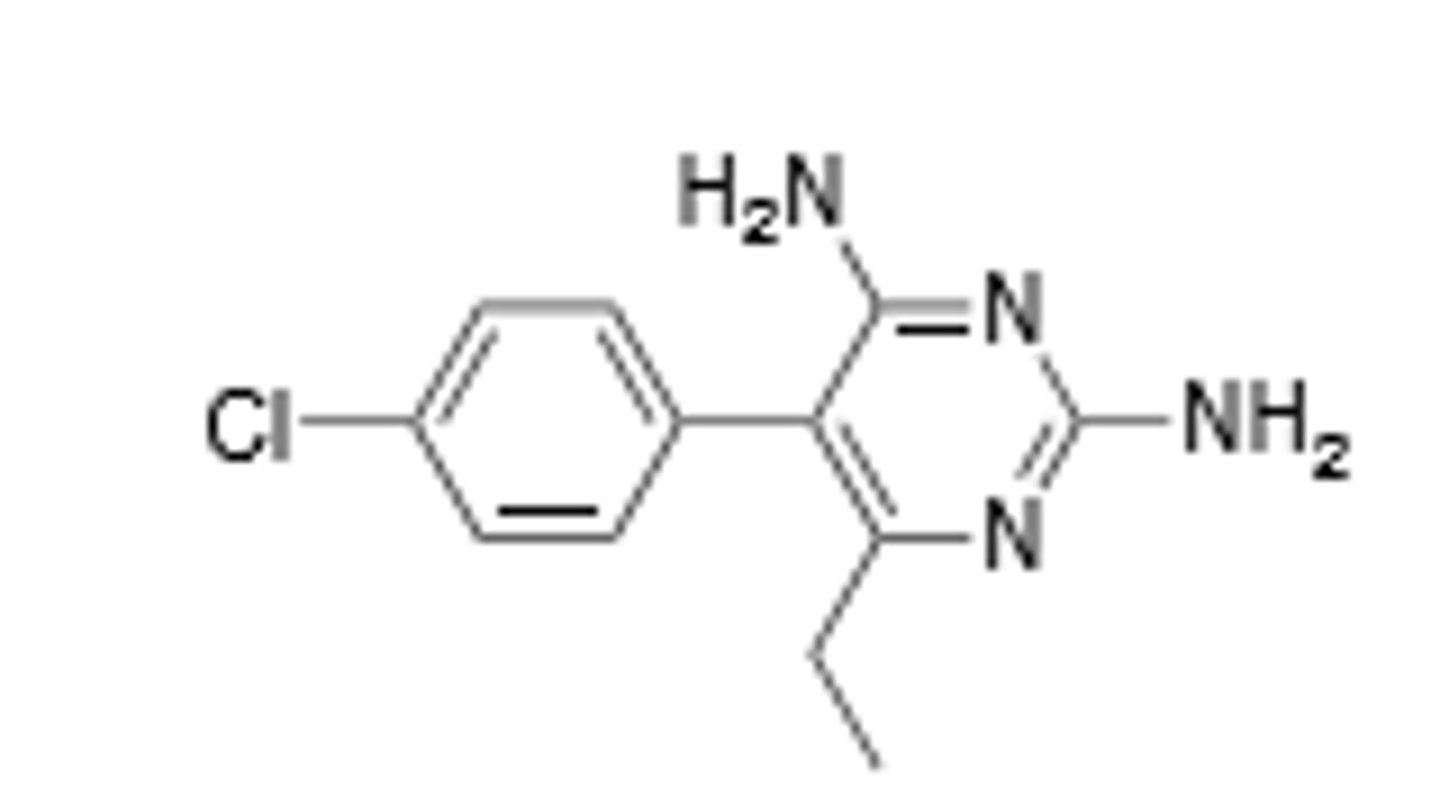
knowt flashcard image
14
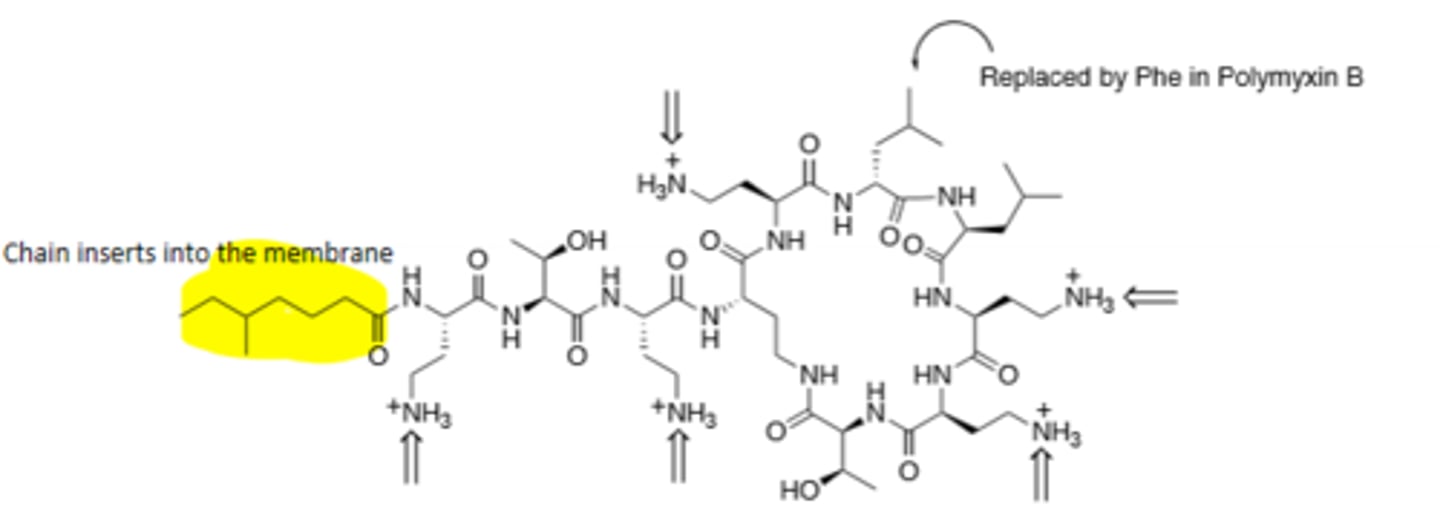
New cards
<p>Penem</p>

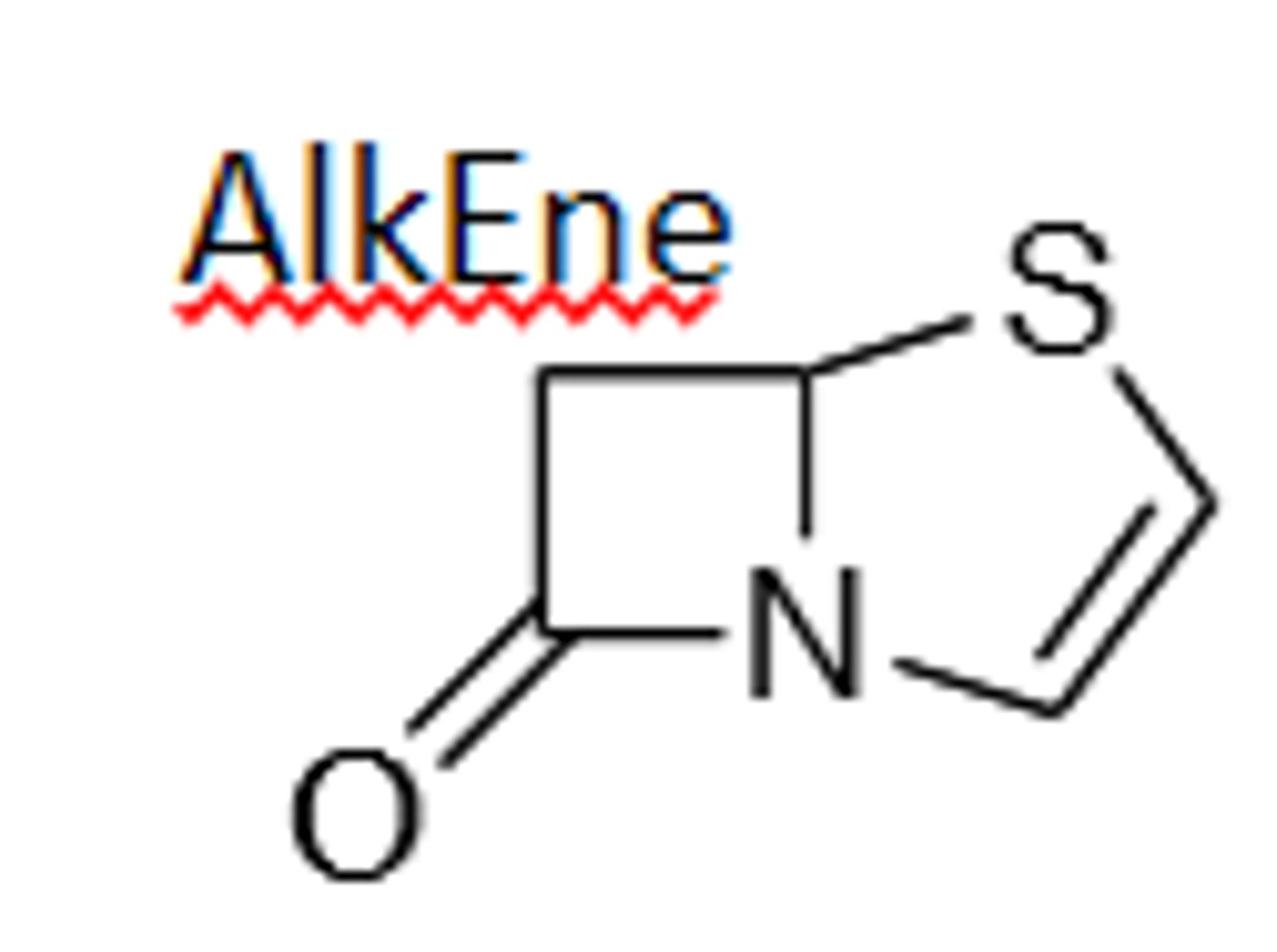
Penem

knowt flashcard image
15
New cards

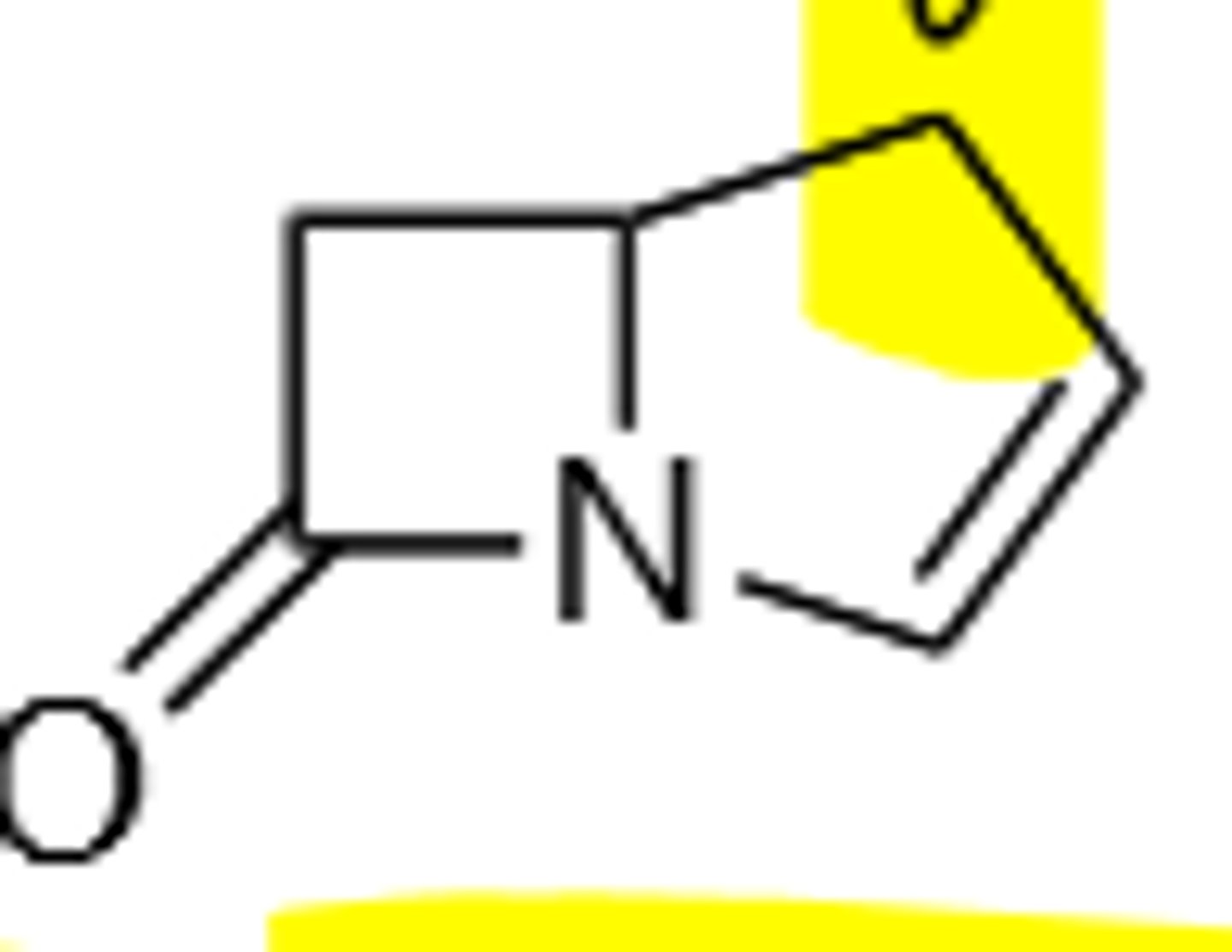
Carbapenem

knowt flashcard image
16
New cards

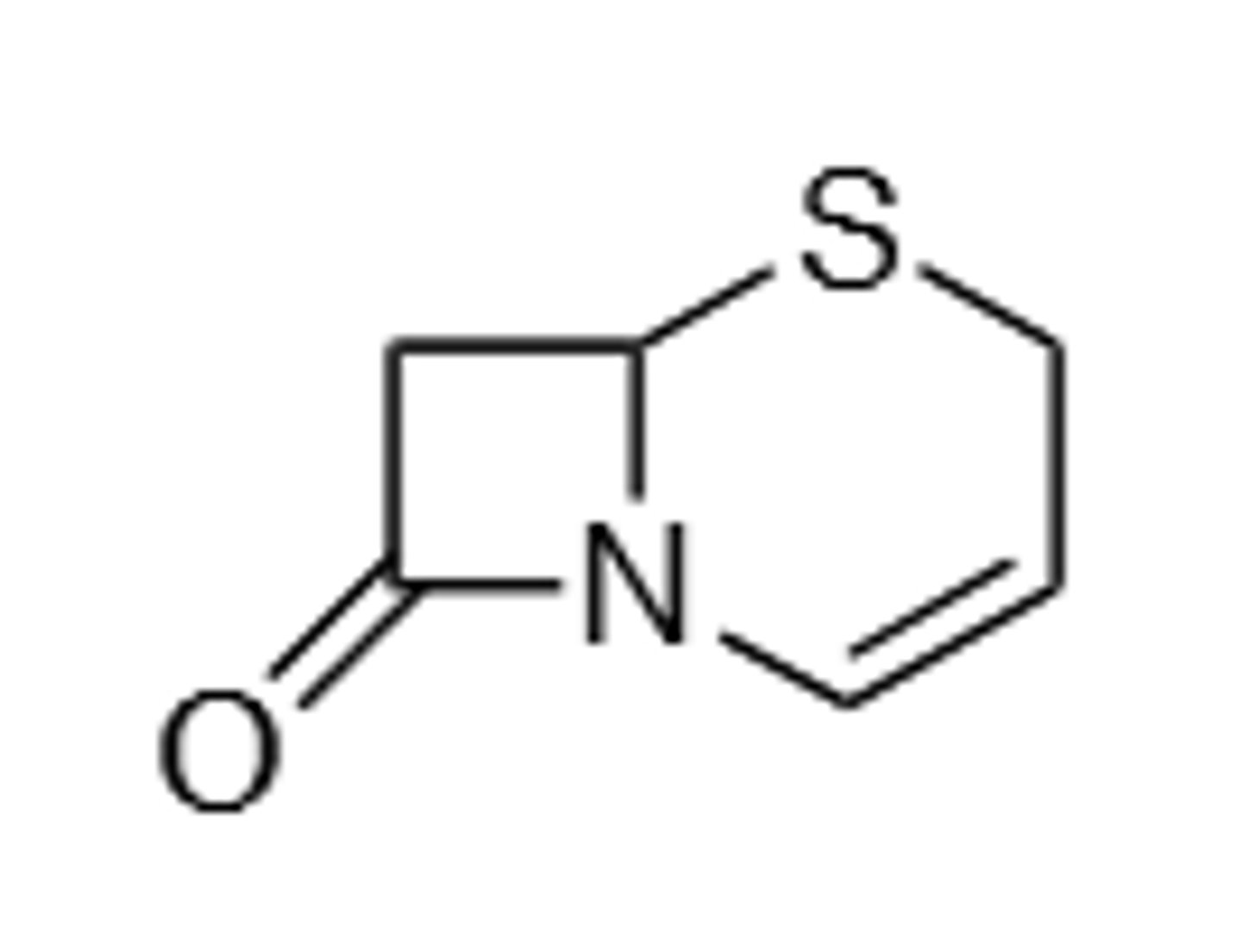
Cephem

knowt flashcard image
17
New cards
<p>Monobactam</p>

Monobactam

knowt flashcard image
18
New cards
<p>Methicillin</p>

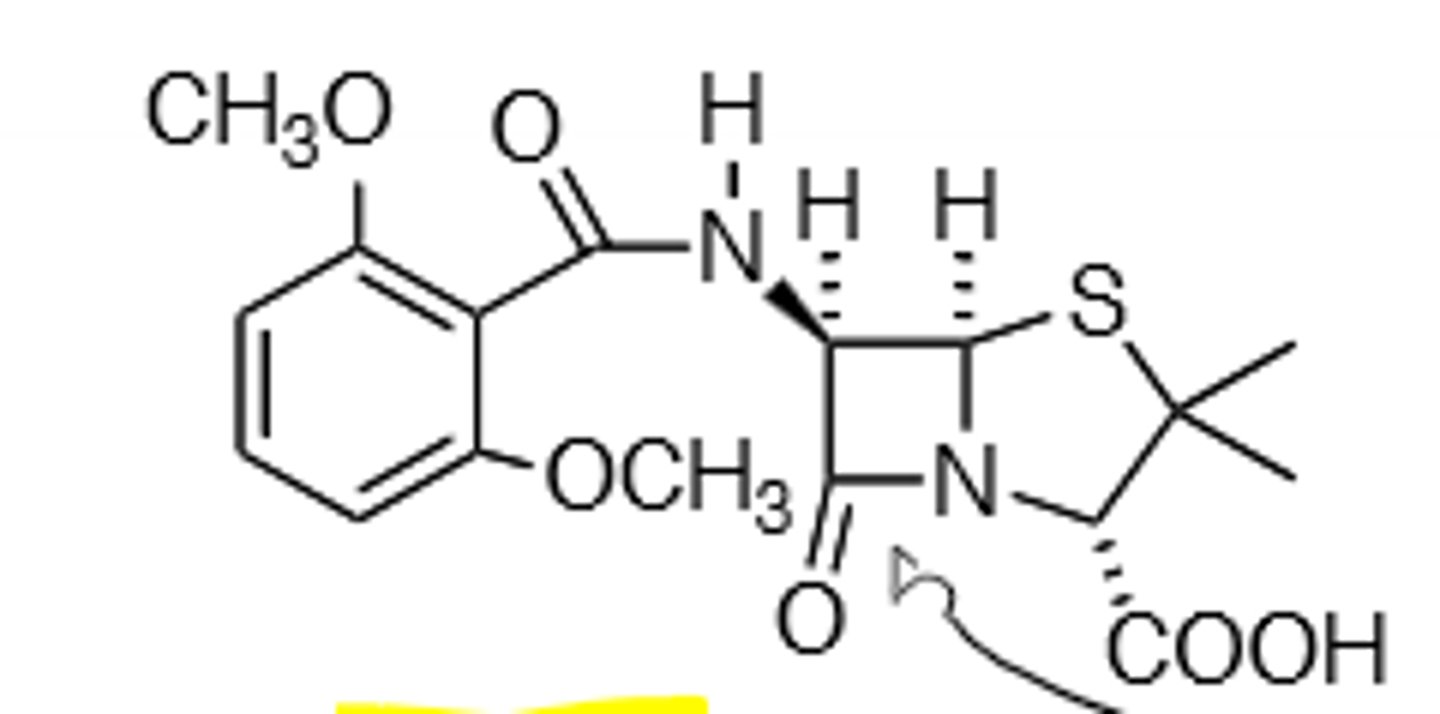
Methicillin

B-Lactamase Resistant, Injected
<p>B-Lactamase Resistant, Injected</p>
19
New cards

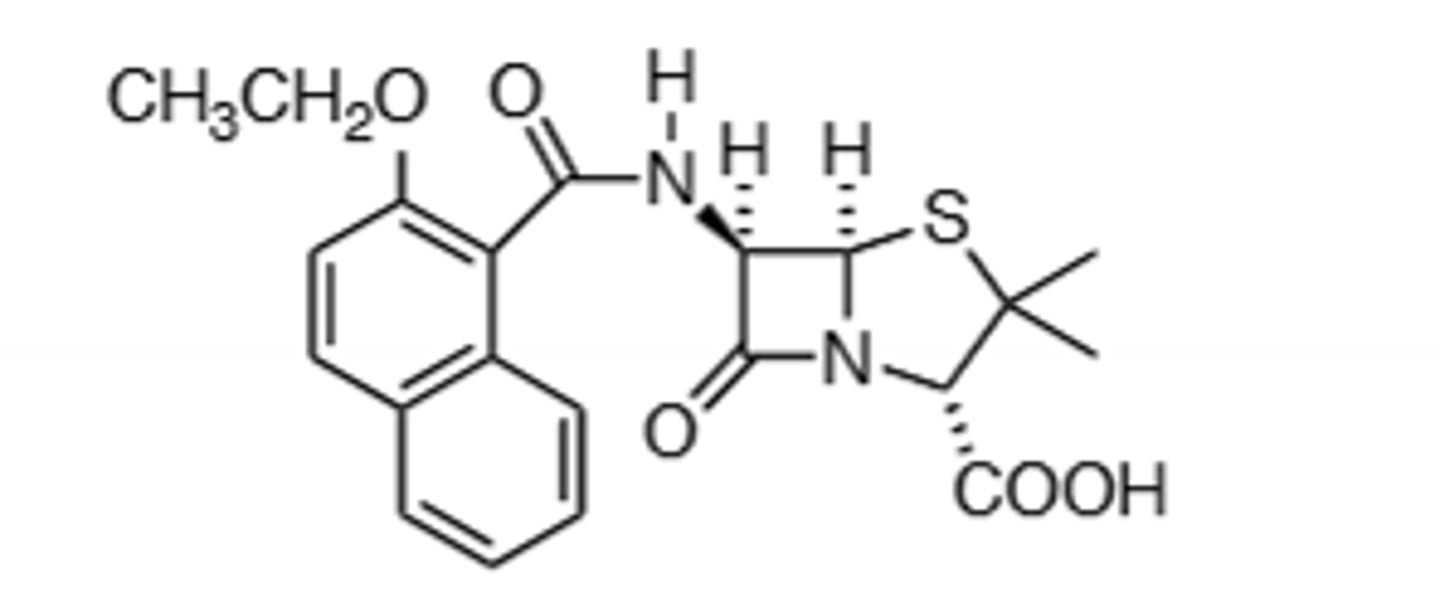
Nafcillin

B-Lactamase Resistant, Clinically identical to methicillin
<p>B-Lactamase Resistant, Clinically identical to methicillin</p>
20
New cards

Oxacillin

B-Lactamase Resistant, injected
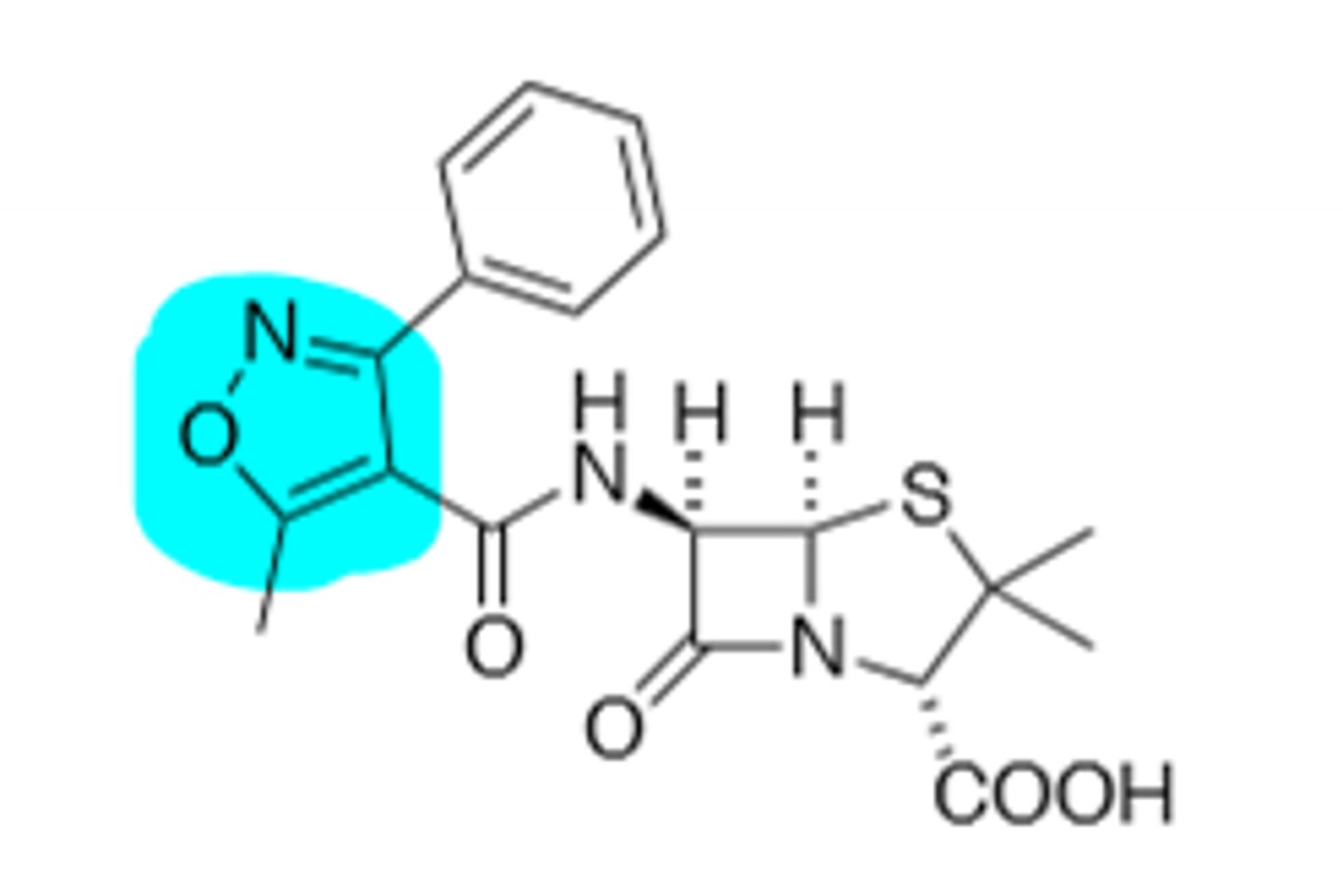
<p>B-Lactamase Resistant, injected</p>
21
New cards

Cloxacillin

B-Lactamase Resistant

<p>B-Lactamase Resistant</p>
22
New cards

Amoxicillin

Beta-Lactamase, better oral absorption than ampicillin, protonated at physiological pH (More broad spectrum)
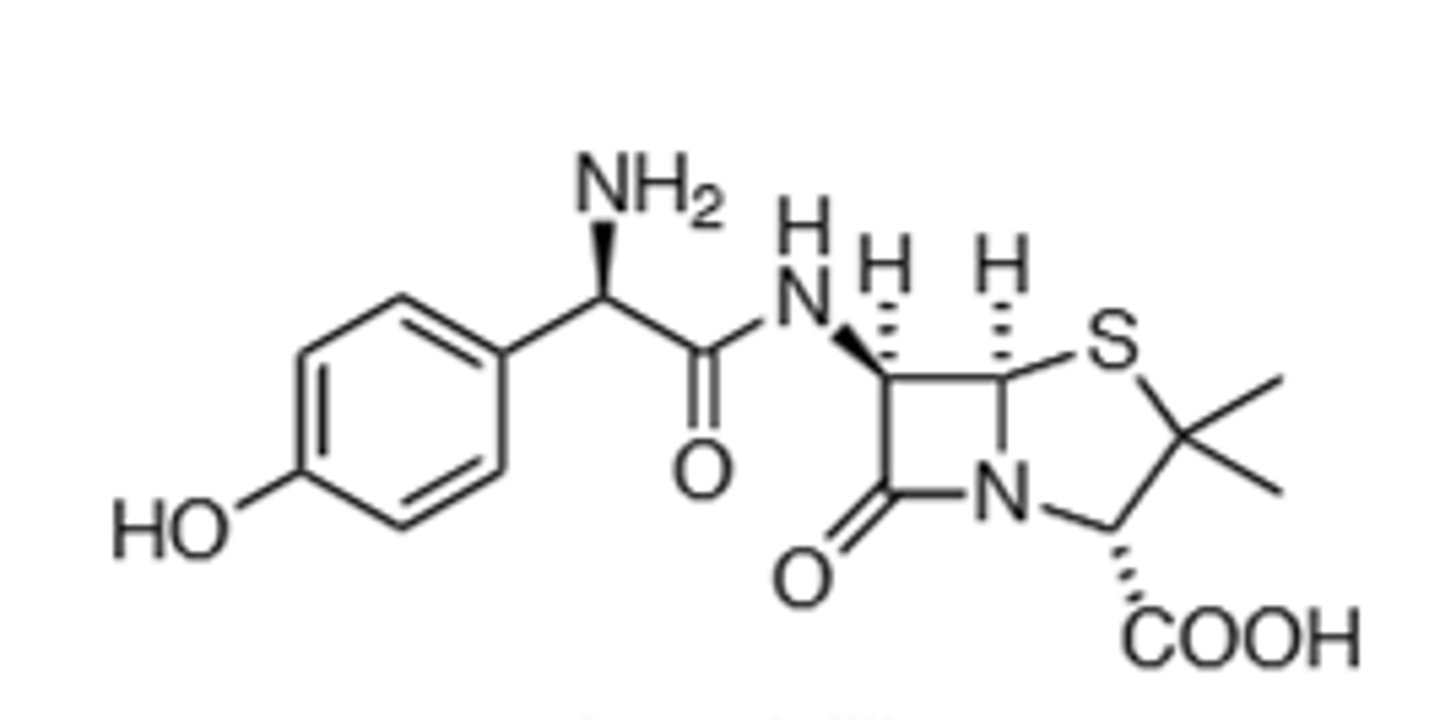
<p>Beta-Lactamase, better oral absorption than ampicillin, protonated at physiological pH (More broad spectrum)</p>
23
New cards

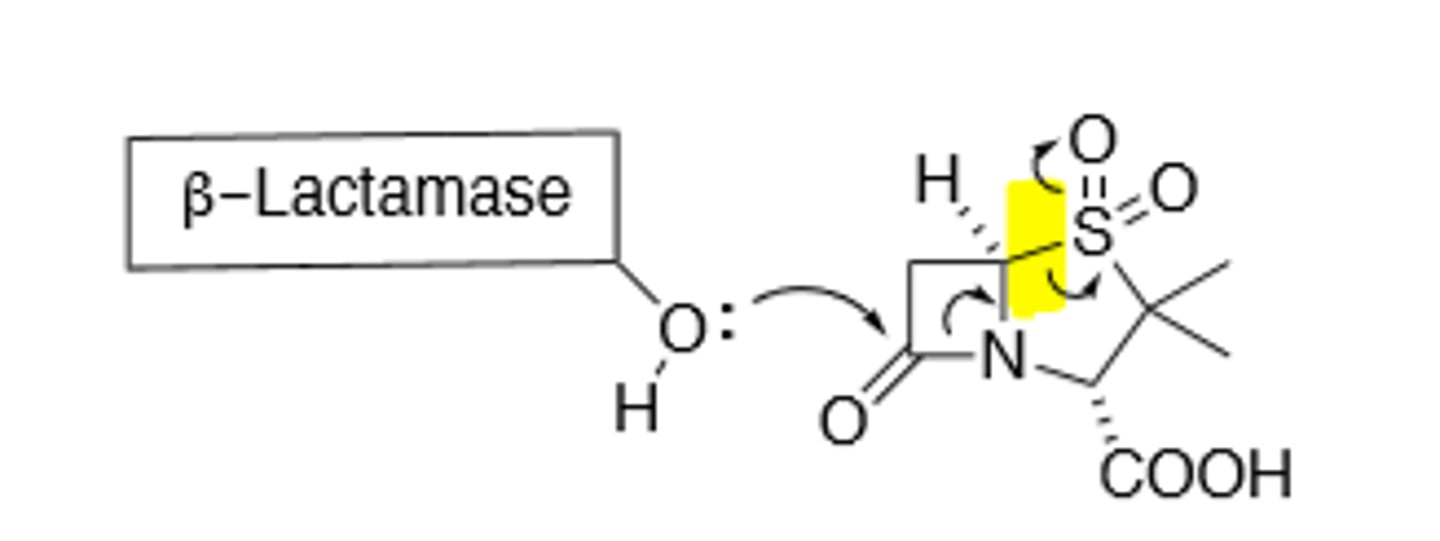
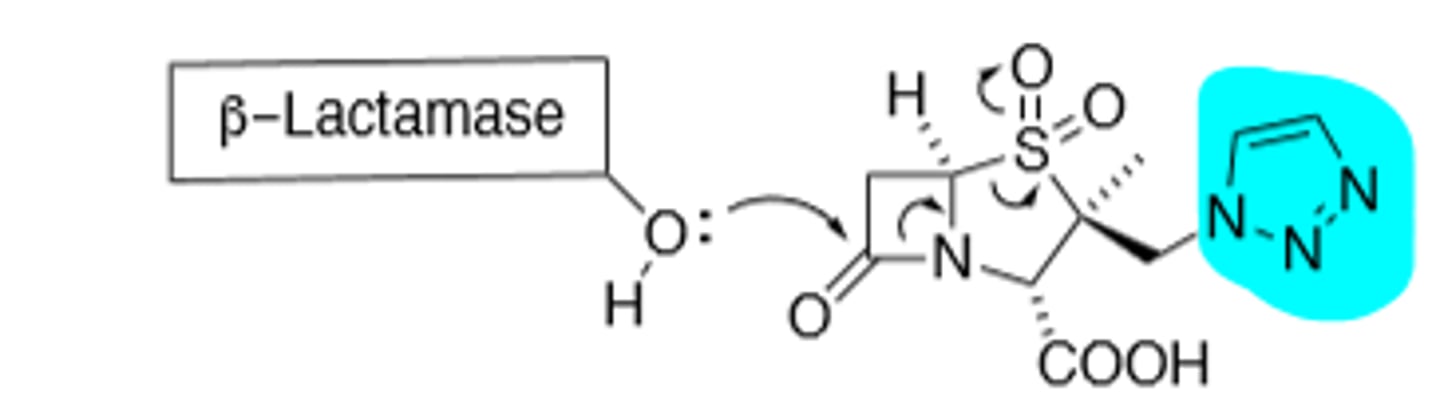
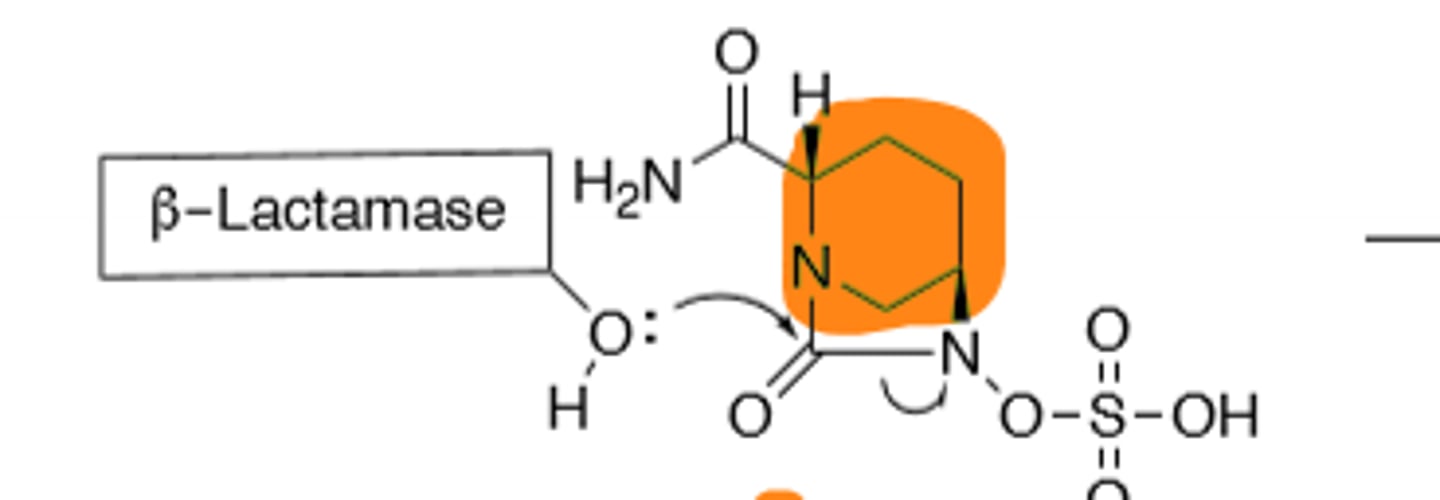
What is important for B-Lactamase inhibitors?

Must be able to open the ring, carbon is not going to get pulled off.

24
New cards

Clavulanic Acid

B-lactamase inhibitor

<p>B-lactamase inhibitor</p>
25
New cards

Sulbactam

B-lactamase inhibitor

<p>B-lactamase inhibitor</p>
26
New cards

Tazobactam

B-lactamase inhibitor

<p>B-lactamase inhibitor</p>
27
New cards

Avibactam

B-lactamase inhibitor

<p>B-lactamase inhibitor</p>
28
New cards

Amoxicillin + Potassium Clavulanate

Augmentin

3 multiple choice options

29
New cards

Ampicillin + Sulbactam

Unasyn

3 multiple choice options

30
New cards

Piperacillin + Tazobactam

Zosyn

3 multiple choice options

31
New cards

Ceftazidime + Avibactam

Avycaz

3 multiple choice options

32
New cards

Pipericillin

Penicillin, B-Lactamase Sensitive, Broad Spectrum (Side Chain expands spectrum), IV only
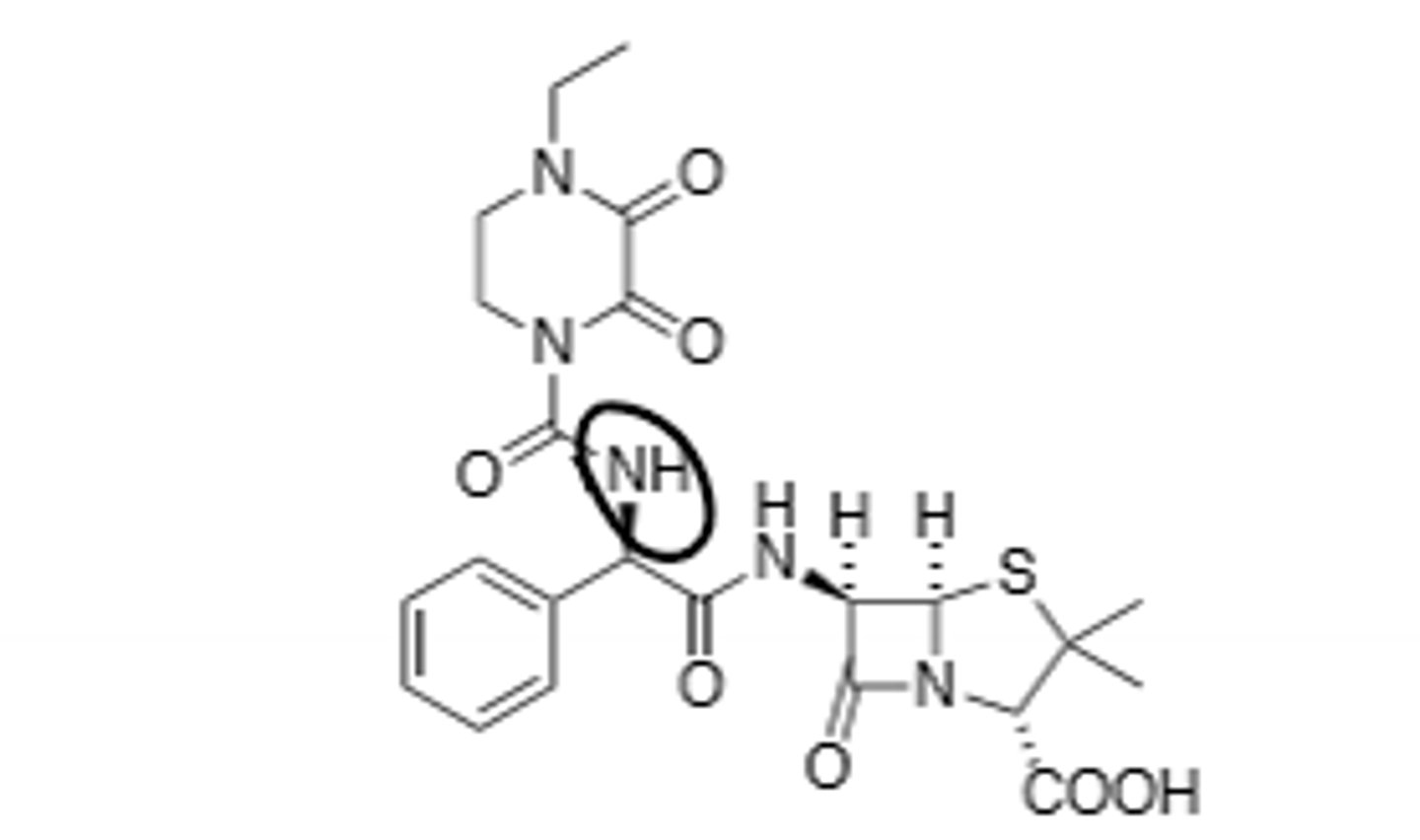
<p>Penicillin, B-Lactamase Sensitive, Broad Spectrum (Side Chain expands spectrum), IV only</p>
33
New cards

Cefazolin

1st Gen Cephalosporin, Good Leaving Group (Parenteral Administration)
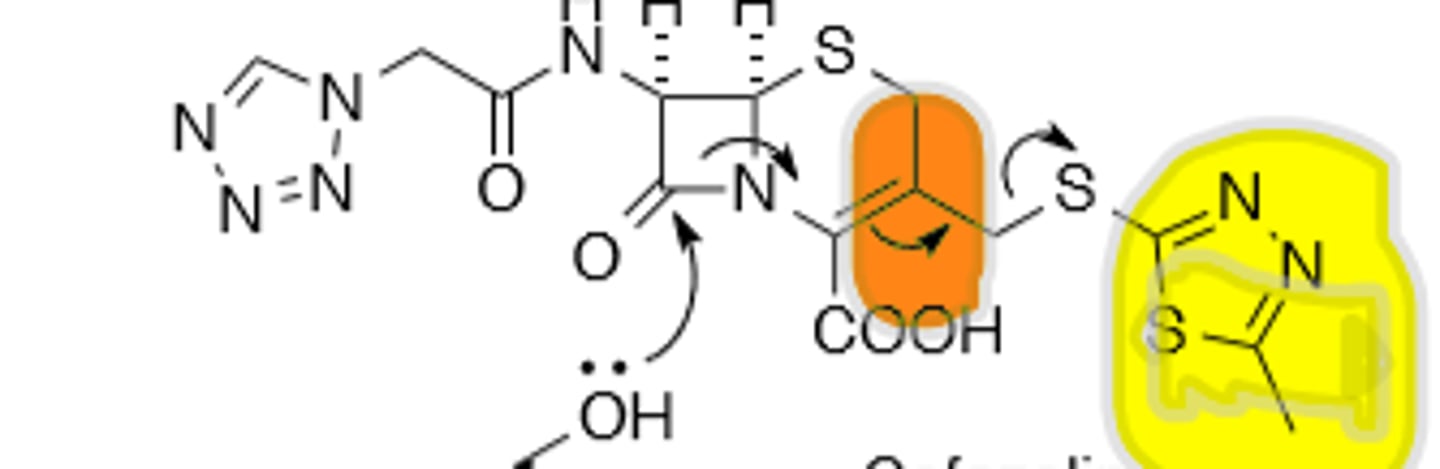
<p>1st Gen Cephalosporin, Good Leaving Group (Parenteral Administration)</p>
34
New cards

Orally active cephalosporins have what at C-3

Substituents that are not chemically active

35
New cards

Cephalexin

1st Generation Cephalosporin, Orally Active (Bad Leaving Group at C-3)
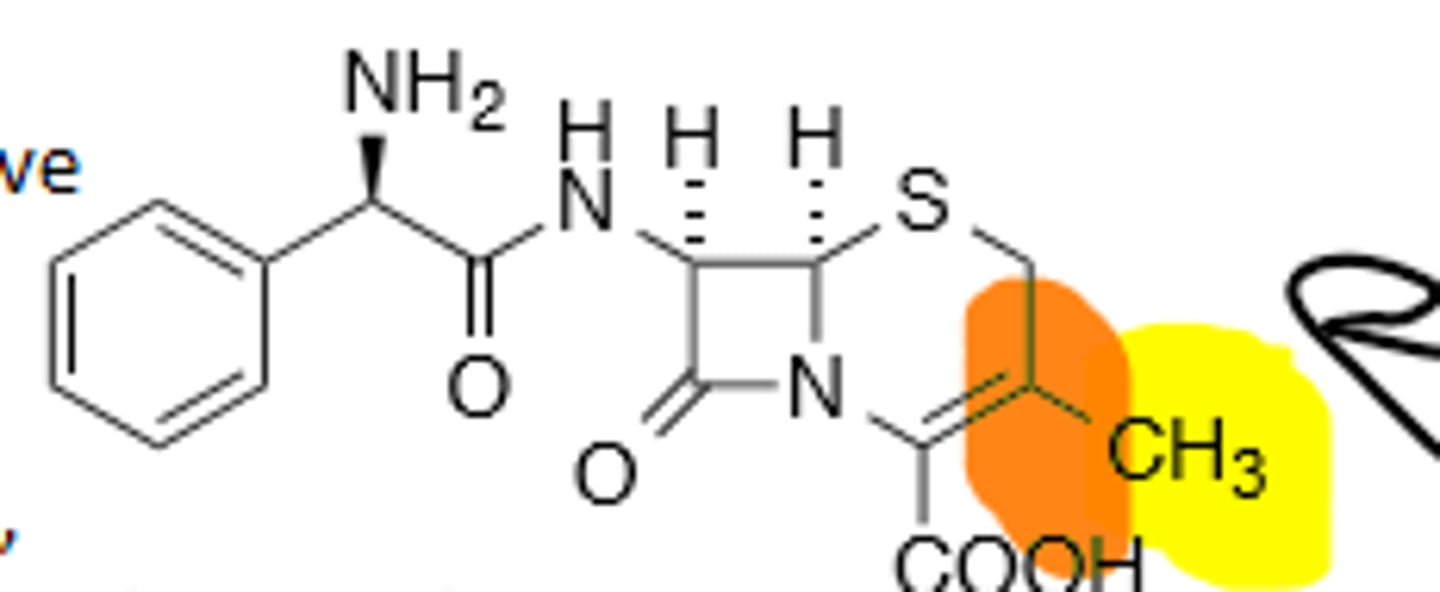
<p>1st Generation Cephalosporin, Orally Active (Bad Leaving Group at C-3)</p>
36
New cards

Cefuroxime

2nd Generation Cephalosporin, Bad Leaving Group due to carbamate resonance (Both oral and parenteral). More gram (-) coverage than first gen.
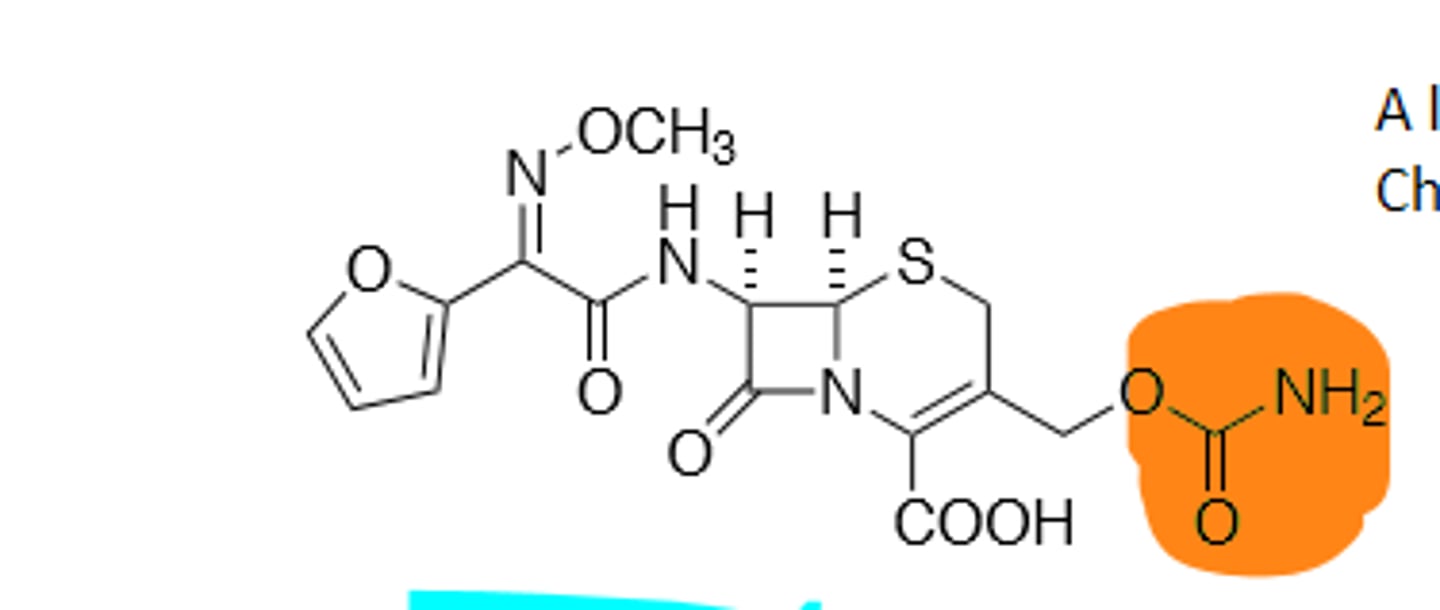
<p>2nd Generation Cephalosporin, Bad Leaving Group due to carbamate resonance (Both oral and parenteral). More gram (-) coverage than first gen.</p>
37
New cards

Ceftazidime

3rd Generation Cephalosporin, more gram (-) coverage, enhanced stability vs B-Lactamases, good leaving group (Parenteral only). Cross allergenicity with penicillins.
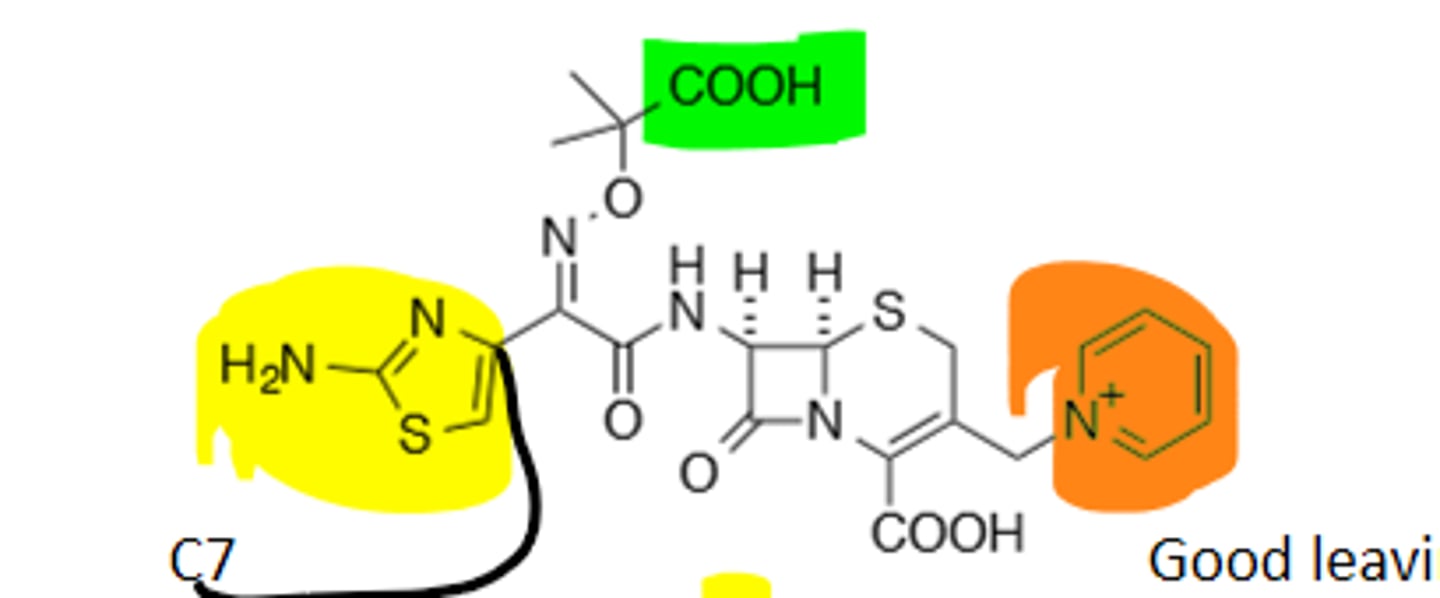
<p>3rd Generation Cephalosporin, more gram (-) coverage, enhanced stability vs B-Lactamases, good leaving group (Parenteral only). Cross allergenicity with penicillins.</p>
38
New cards

Cefexime

Third Generation Cephalosporin, Bad leaving group (Orally active), more gram (-) coverage, enhanced stability vs B-Lactamases
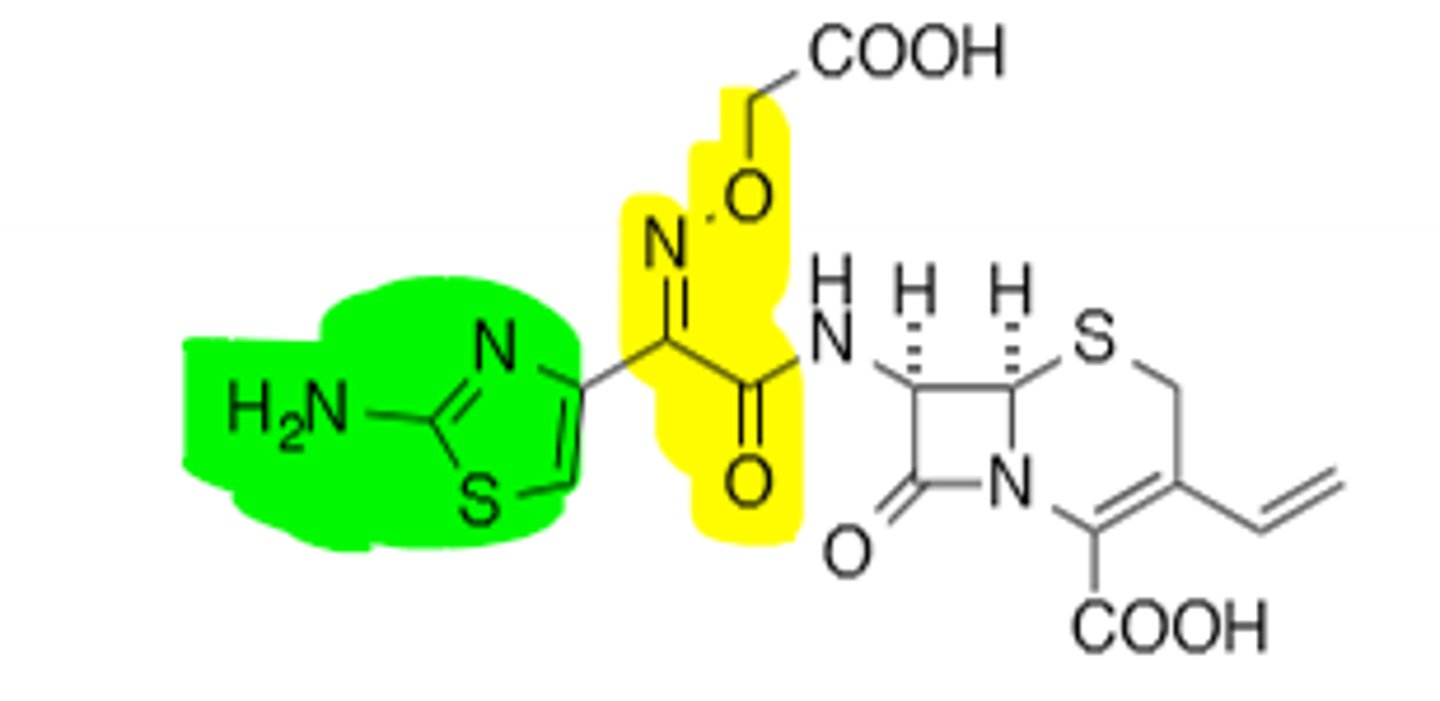
<p>Third Generation Cephalosporin, Bad leaving group (Orally active), more gram (-) coverage, enhanced stability vs B-Lactamases</p>
39
New cards

Cefepime

4th Generation Cephalosporins, Good leaving group (Parenterally Active), even more gram (-) coverage, first line in treating AmpC
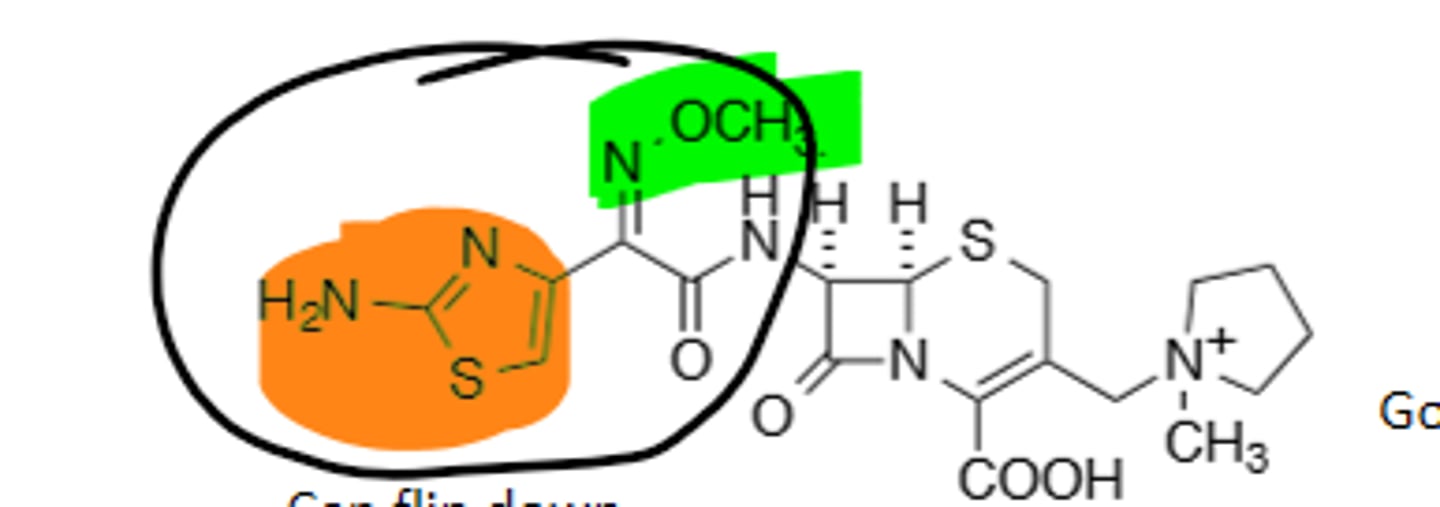
<p>4th Generation Cephalosporins, Good leaving group (Parenterally Active), even more gram (-) coverage, first line in treating AmpC</p>
40
New cards

Ceftaroline

5th Generation Cephalosporin, very broad spectrum coverage, agent can be used against MRSA, resistant to B-lactamases, good leaving group (Parenteral only), ceftaroline fosamil is the prodrug
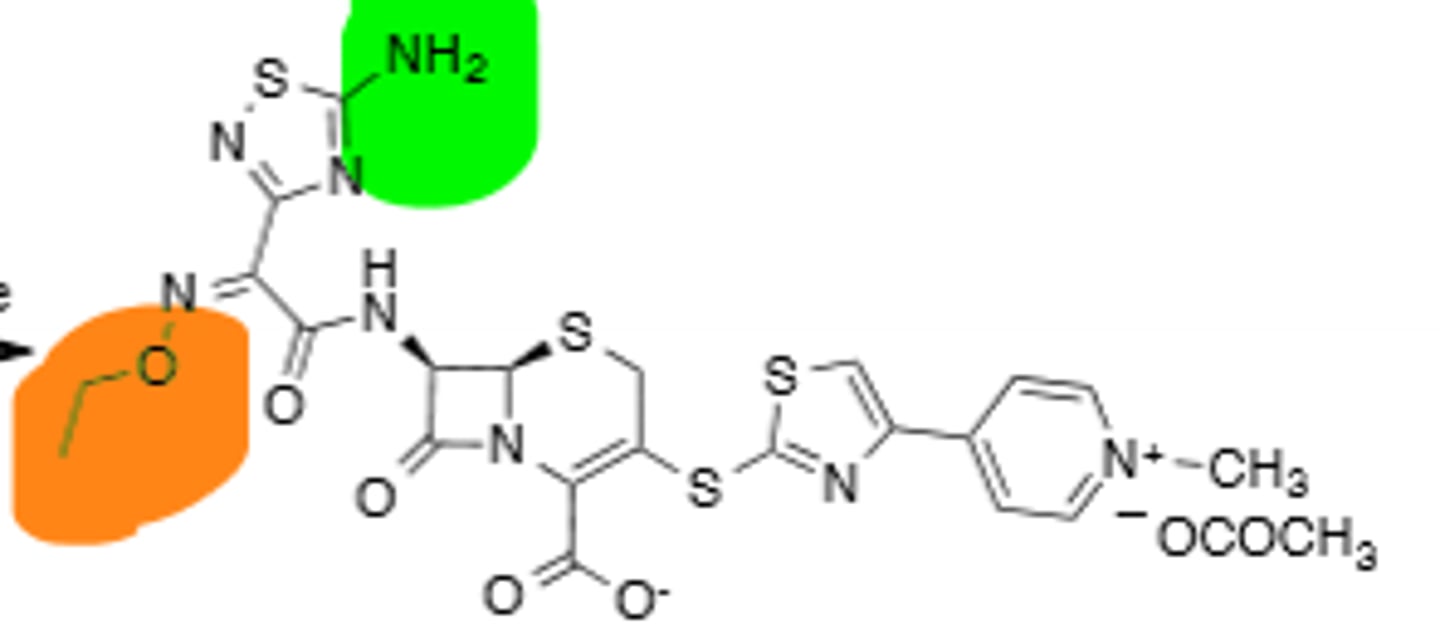
<p>5th Generation Cephalosporin, very broad spectrum coverage, agent can be used against MRSA, resistant to B-lactamases, good leaving group (Parenteral only), ceftaroline fosamil is the prodrug</p>
41
New cards

Cefotetan

Cephamycin, 2nd Generation Cephalosporin, Methoxyl Group (Pink) increases stability vs B-Lactamases, good leaving group (Parenteral), can cause hypothrombinemia (More prone to bruising), can cause disulfram reaction
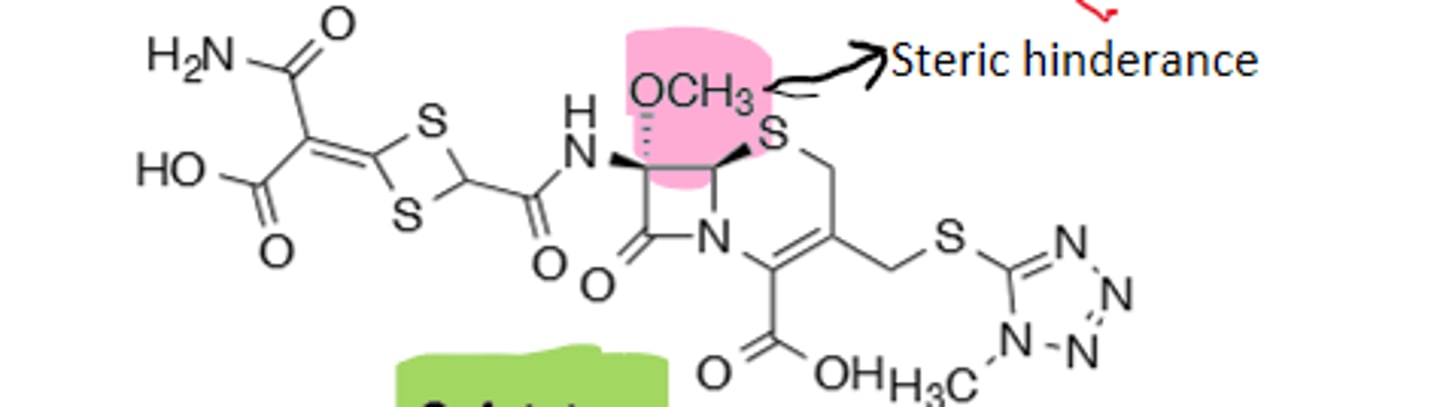
<p>Cephamycin, 2nd Generation Cephalosporin, Methoxyl Group (Pink) increases stability vs B-Lactamases, good leaving group (Parenteral), can cause hypothrombinemia (More prone to bruising), can cause disulfram reaction</p>
42
New cards

Imipenem

Carbapenem (Greater ring strain than penicillins), derivative of thienamycin (Too reactive to be used as a drug), hydrolyzed by renal dehydropeptidase-1 (Can overcome with cilastatin co-aministration), broad-spectrum and restricted use ("Magic Bullet")
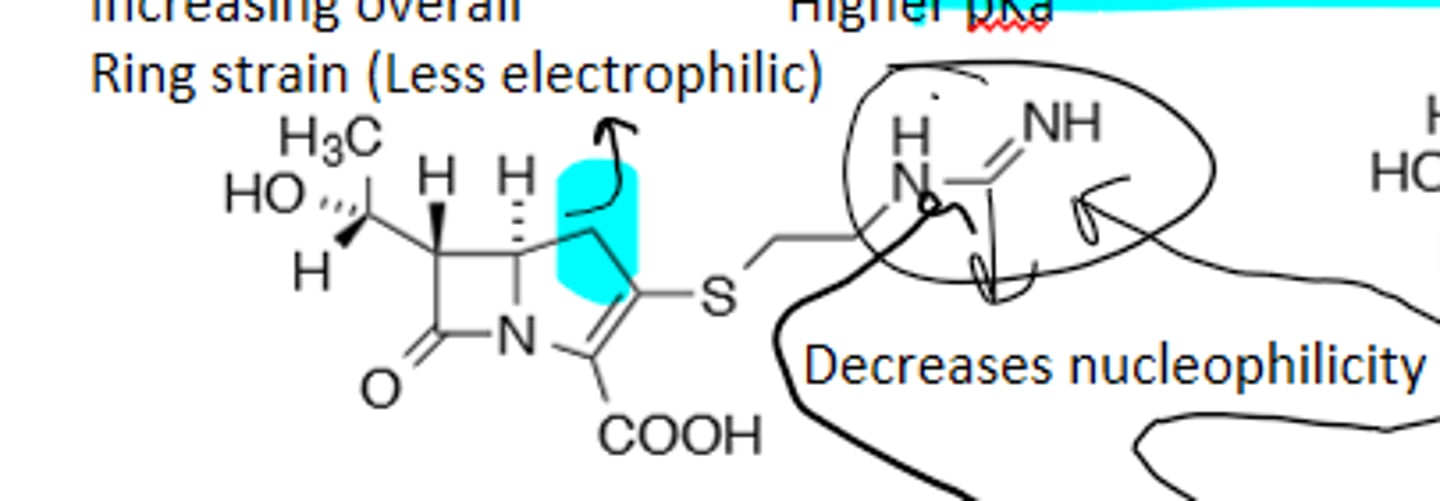
<p>Carbapenem (Greater ring strain than penicillins), derivative of thienamycin (Too reactive to be used as a drug), hydrolyzed by renal dehydropeptidase-1 (Can overcome with cilastatin co-aministration), broad-spectrum and restricted use ("Magic Bullet")</p>
43
New cards

Thienamycin

Origin of Imipenem, too reactive, as the primary amino group attacks the B-Lactam Ring intermolecularly, inactivates itself from therapeutic use.
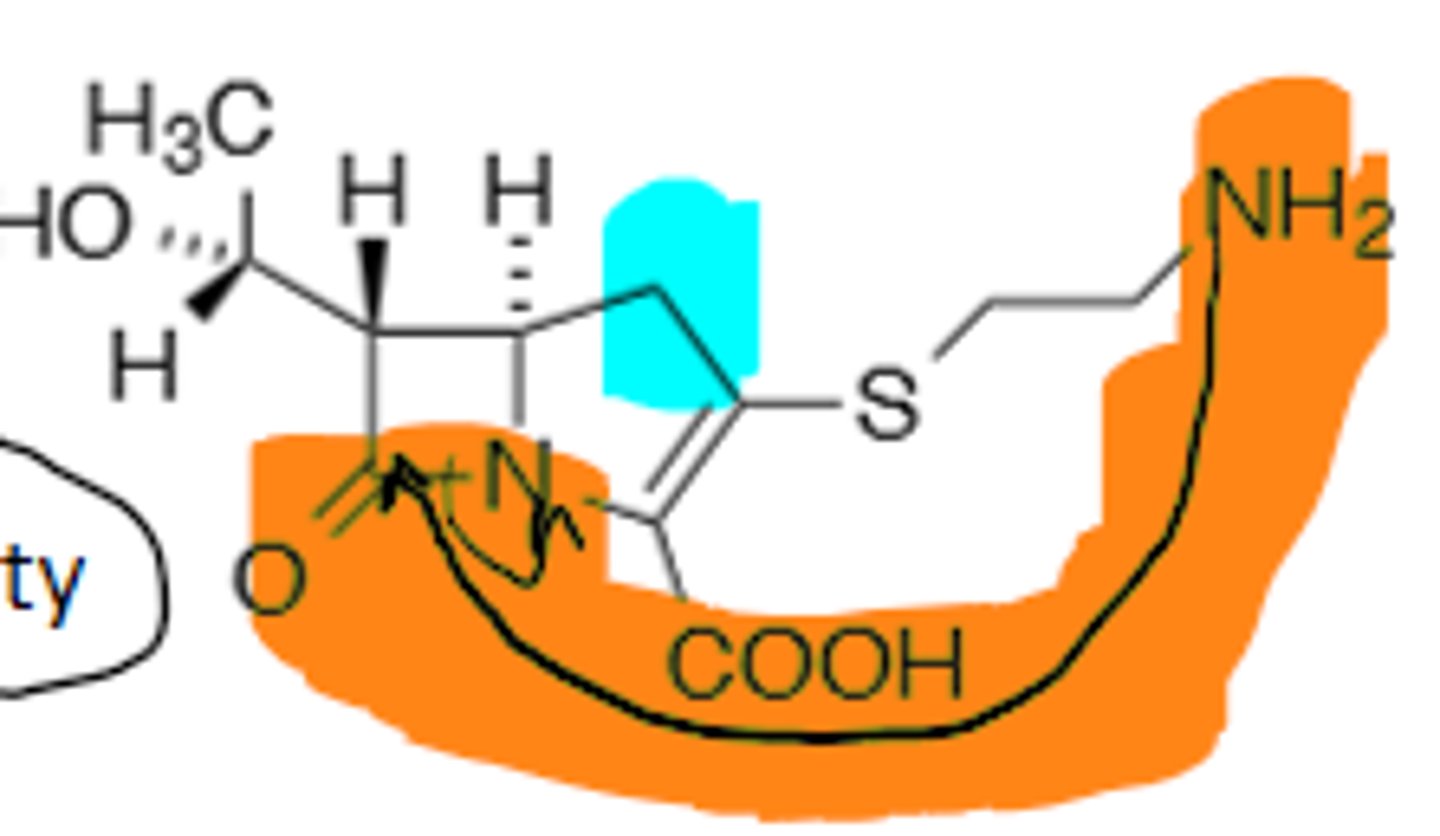
<p>Origin of Imipenem, too reactive, as the primary amino group attacks the B-Lactam Ring intermolecularly, inactivates itself from therapeutic use.</p>
44
New cards

Cilastatin

Use with imipenem to overcome renal dehydropeptidase-1 hydrolyzation, helps treat infections in the gut with imipenem. Administered parenterally with imipenem
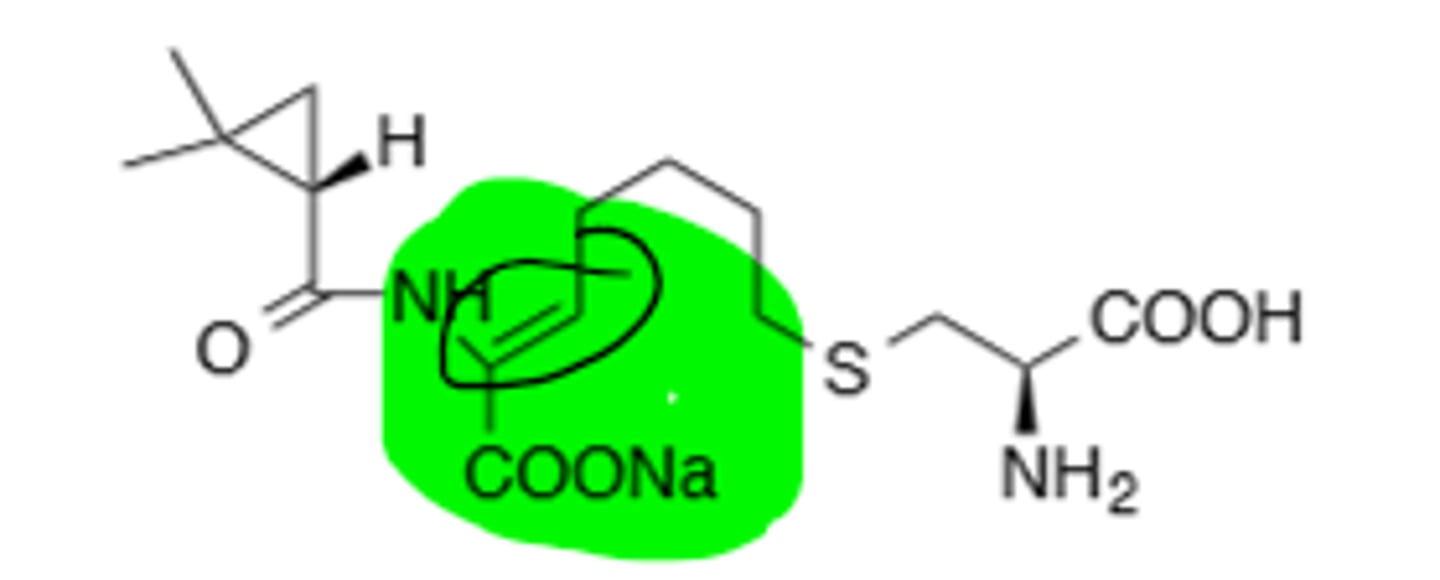
<p>Use with imipenem to overcome renal dehydropeptidase-1 hydrolyzation, helps treat infections in the gut with imipenem. Administered parenterally with imipenem</p>
45
New cards

Aztreonam

Monobactam, synthetic drug, sulfamic acid at the C-2 position to increase electronegativity for better reaction with transpeptidase. B-Lactamase resistant. No cross allergenicity with penicillins and cephalosporins (Except ceftazidime). Treats gram (-) bacteria.
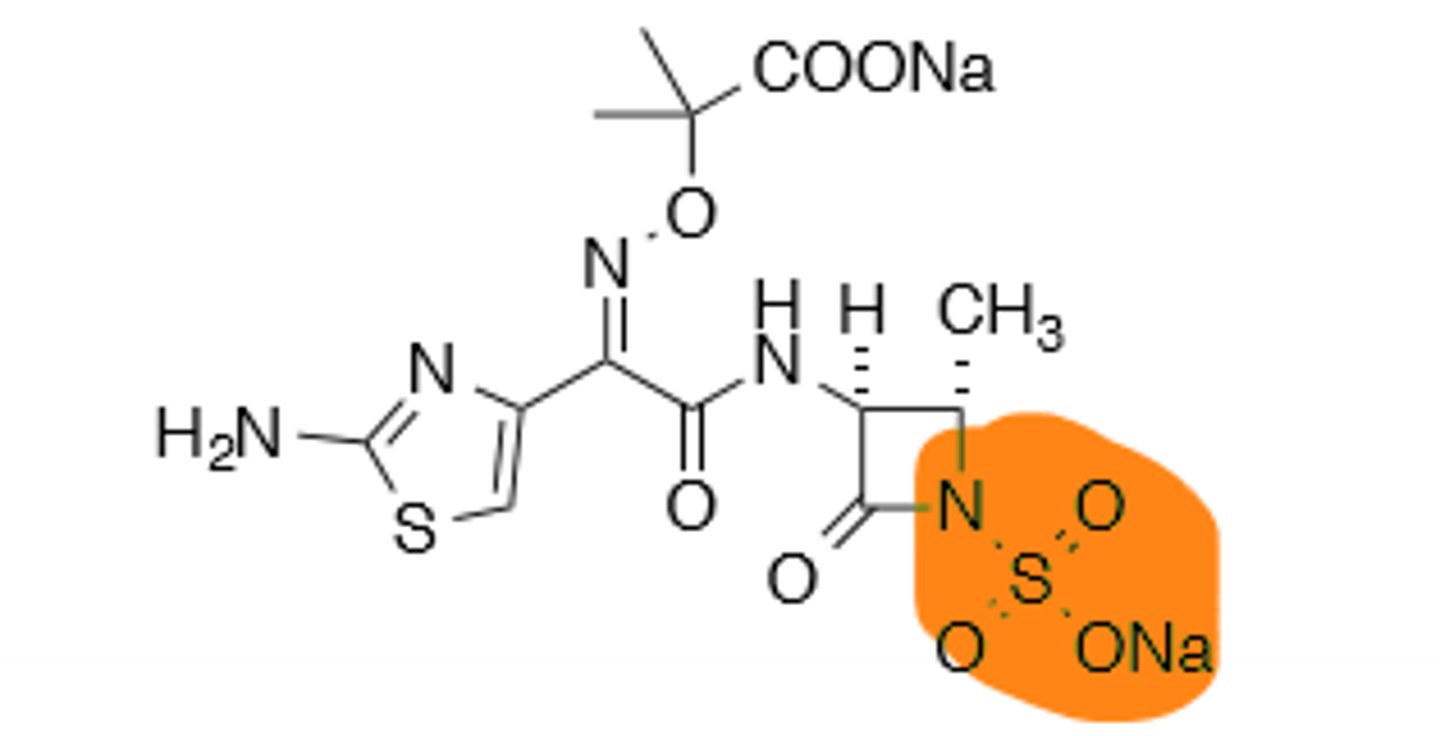
<p>Monobactam, synthetic drug, sulfamic acid at the C-2 position to increase electronegativity for better reaction with transpeptidase. B-Lactamase resistant. No cross allergenicity with penicillins and cephalosporins (Except ceftazidime). Treats gram (-) bacteria.</p>
46
New cards

Vancomycin

Glycopeptide, gram (+), binds to peptidyl side chain D-Ala-D-Ala terminus (Before cross-linking), also inhibits transglycosylation step, red skin rash occurs with high concentrations of drug, nephrotoxic, parenteral administration only
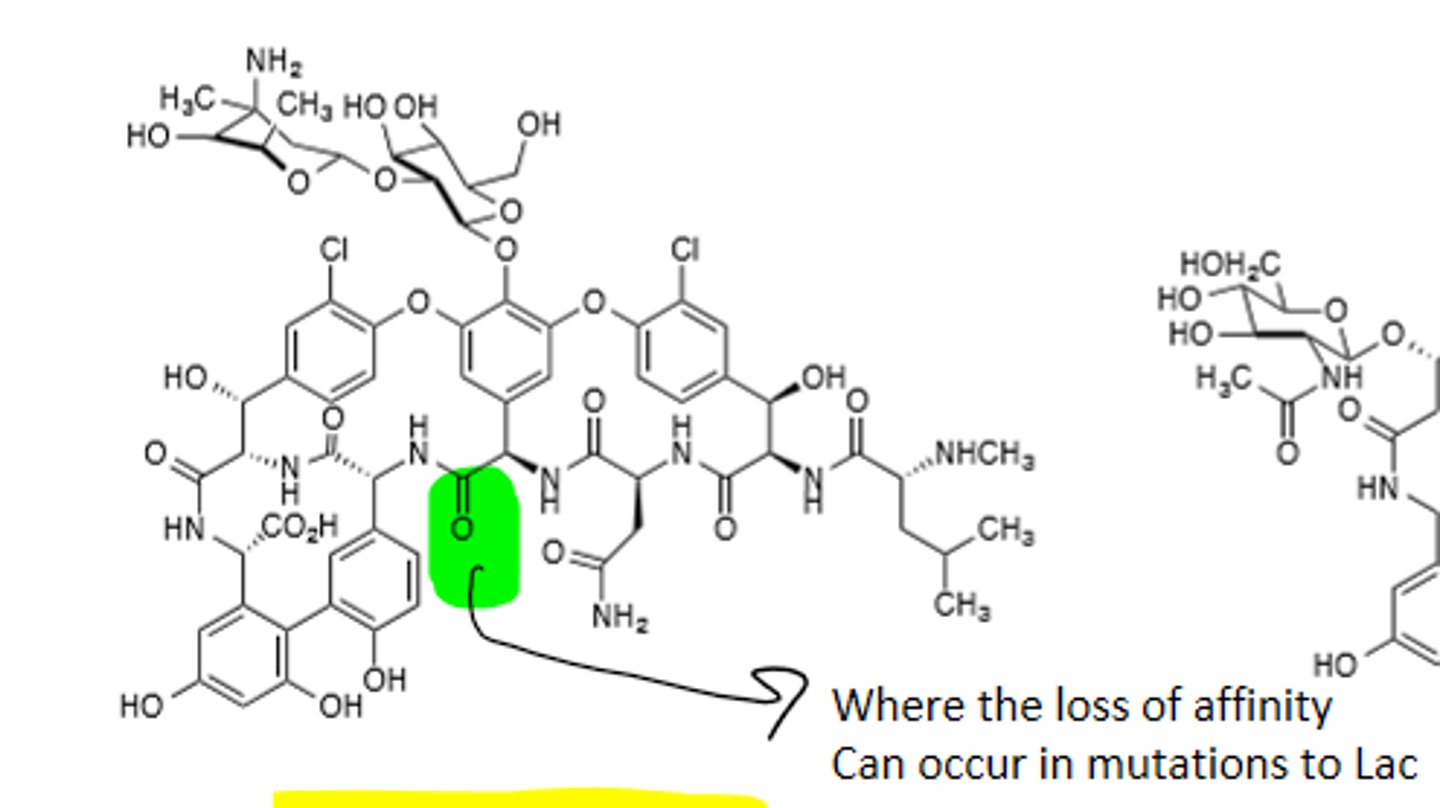
<p>Glycopeptide, gram (+), binds to peptidyl side chain D-Ala-D-Ala terminus (Before cross-linking), also inhibits transglycosylation step, red skin rash occurs with high concentrations of drug, nephrotoxic, parenteral administration only</p>
47
New cards

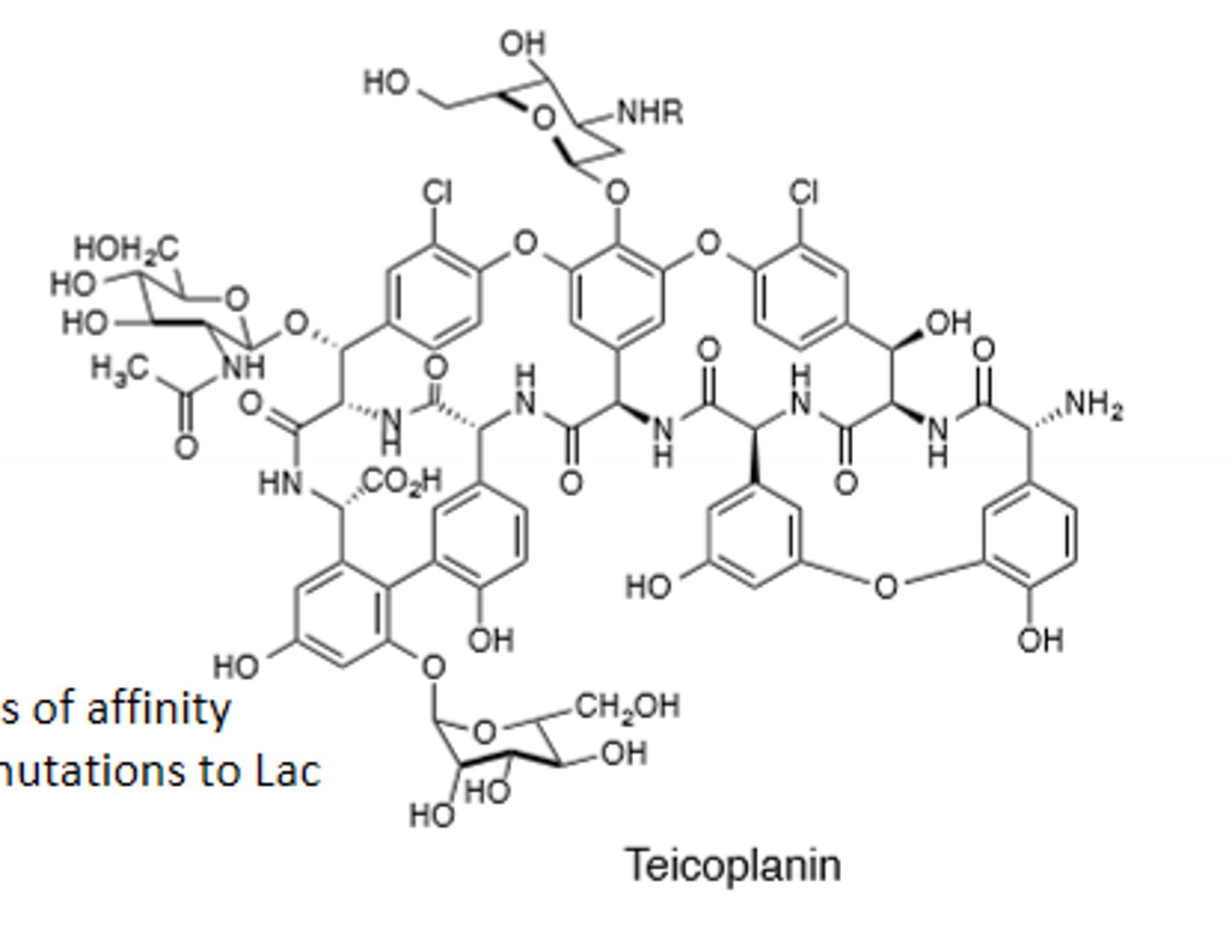
Teicoplanin

Glycopeptide, not approved for use in the United States
<p>Glycopeptide, not approved for use in the United States</p>
48
New cards

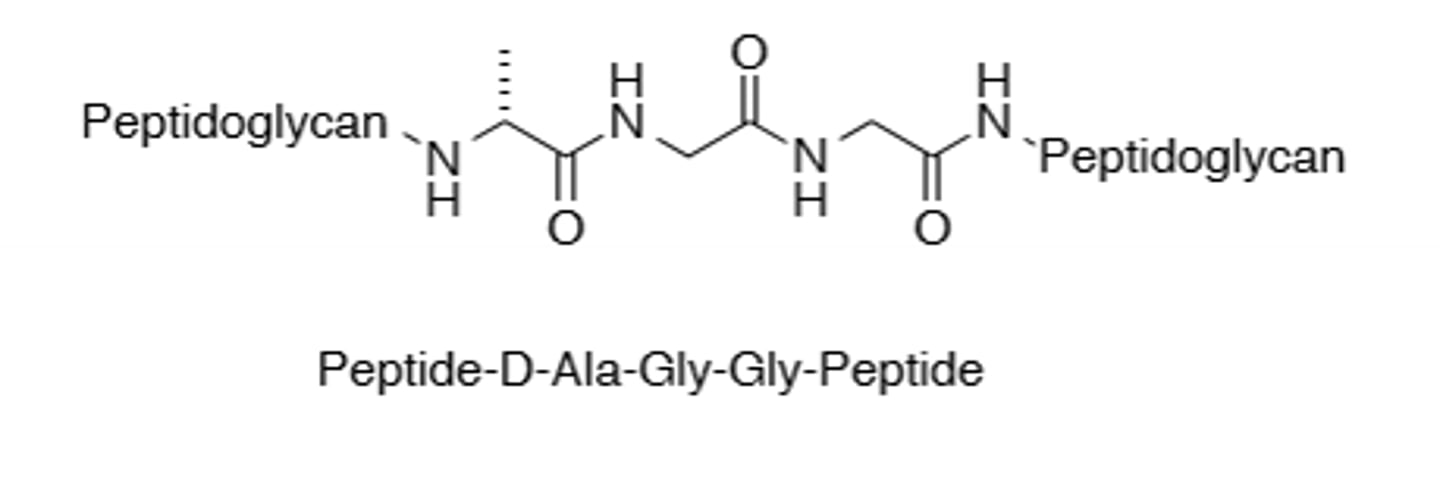
Peptide D-Ala-Gly-Gly-Peptide structure
knowt flashcard image
49
New cards

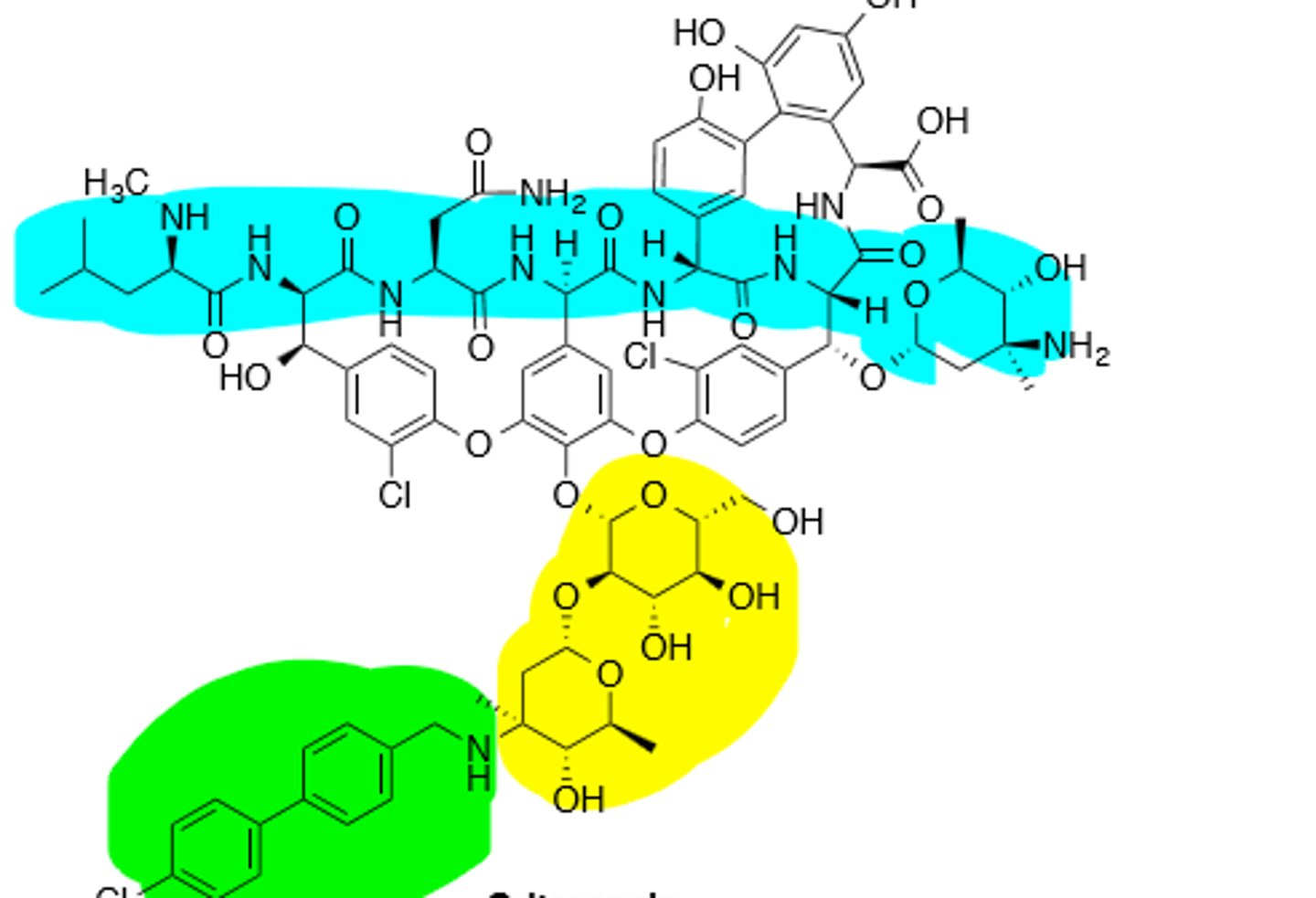
Oritavancin

Lipoglycopeptide, inhibits transpeptidation and transglycosylation, inhibits gram (+) bacteria, including MRSA. Extremely long half life (245 hrs)
<p>Lipoglycopeptide, inhibits transpeptidation and transglycosylation, inhibits gram (+) bacteria, including MRSA. Extremely long half life (245 hrs)</p>
50
New cards

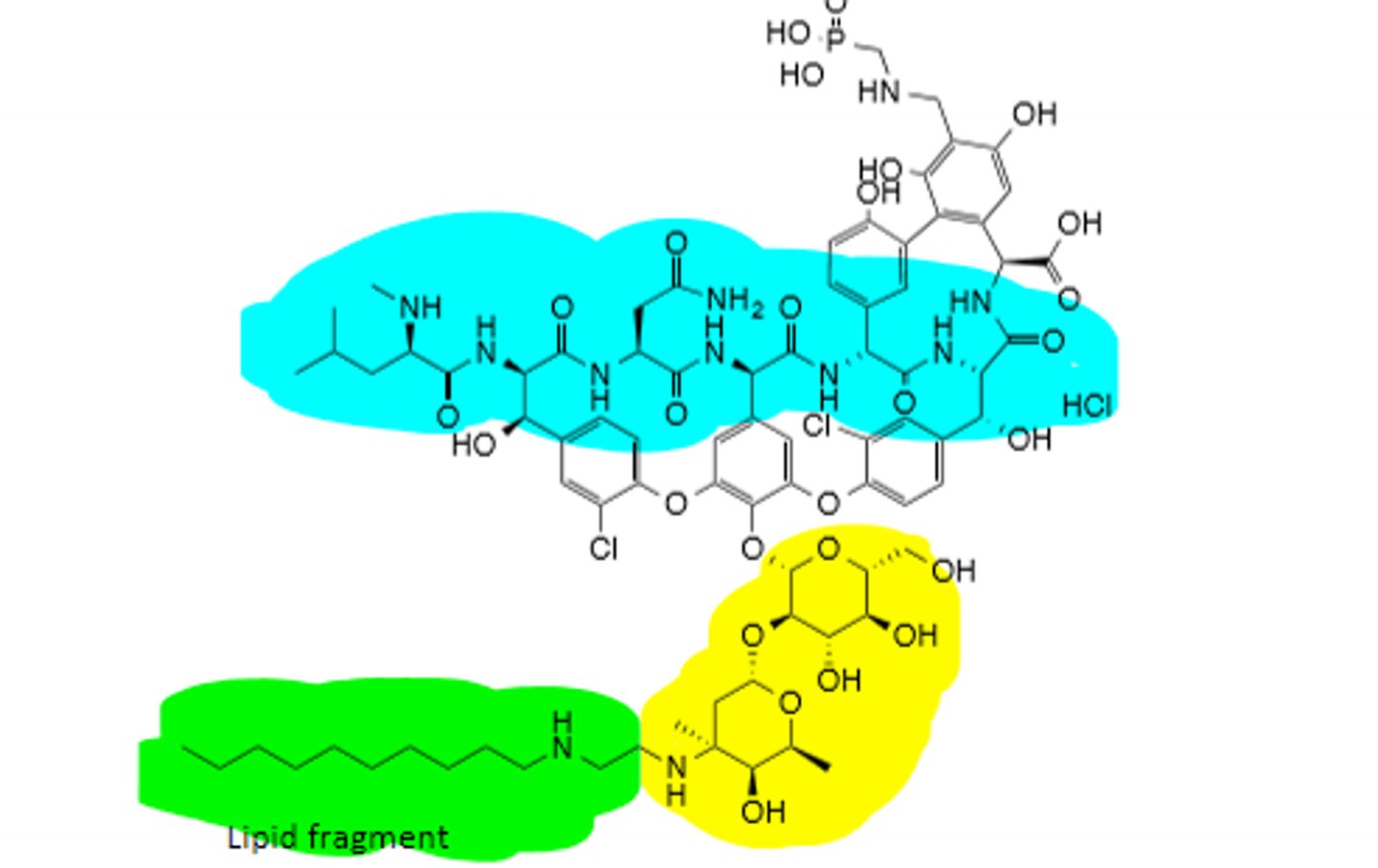
Telavancin

Lipoglycopeptide, binds to D-Ala-D-Ala terminus of the peptidoglycan in the cell wall (Gram (+)), also can treat MRSA, half life 7-9 hrs.
<p>Lipoglycopeptide, binds to D-Ala-D-Ala terminus of the peptidoglycan in the cell wall (Gram (+)), also can treat MRSA, half life 7-9 hrs.</p>
51
New cards

Dalbavancin

2nd Generation Lipoglycopeptide, identical MOA to vancomycin, gram (+) species only, can treat MRSA and MRSE, extremely long half life (204 hrs)
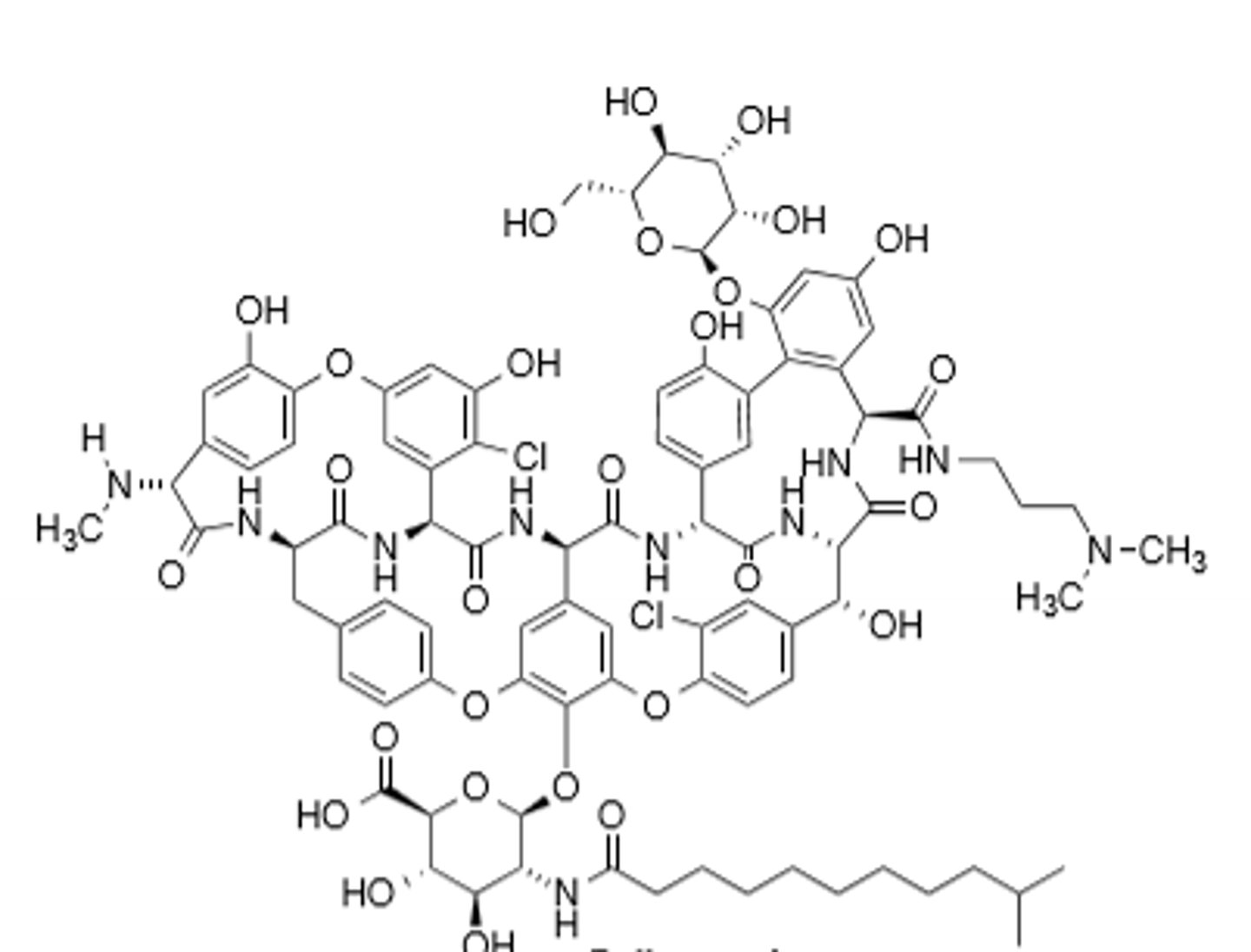
<p>2nd Generation Lipoglycopeptide, identical MOA to vancomycin, gram (+) species only, can treat MRSA and MRSE, extremely long half life (204 hrs)</p>
52
New cards

Quinupristin

Streptogramin, derivative of pristinamycin I and pristinamycin II, binds in ribosomal tunnel and causes blockage of tunnel, A2062 mutation creates resistance to this drug. Main resistance is a methylation in A2058 in the 23S rRNA causing decrease binding the the ribosome. Reserved for life-threatening gram (+) organisms. CYP3A4, concentrated in macrophages.
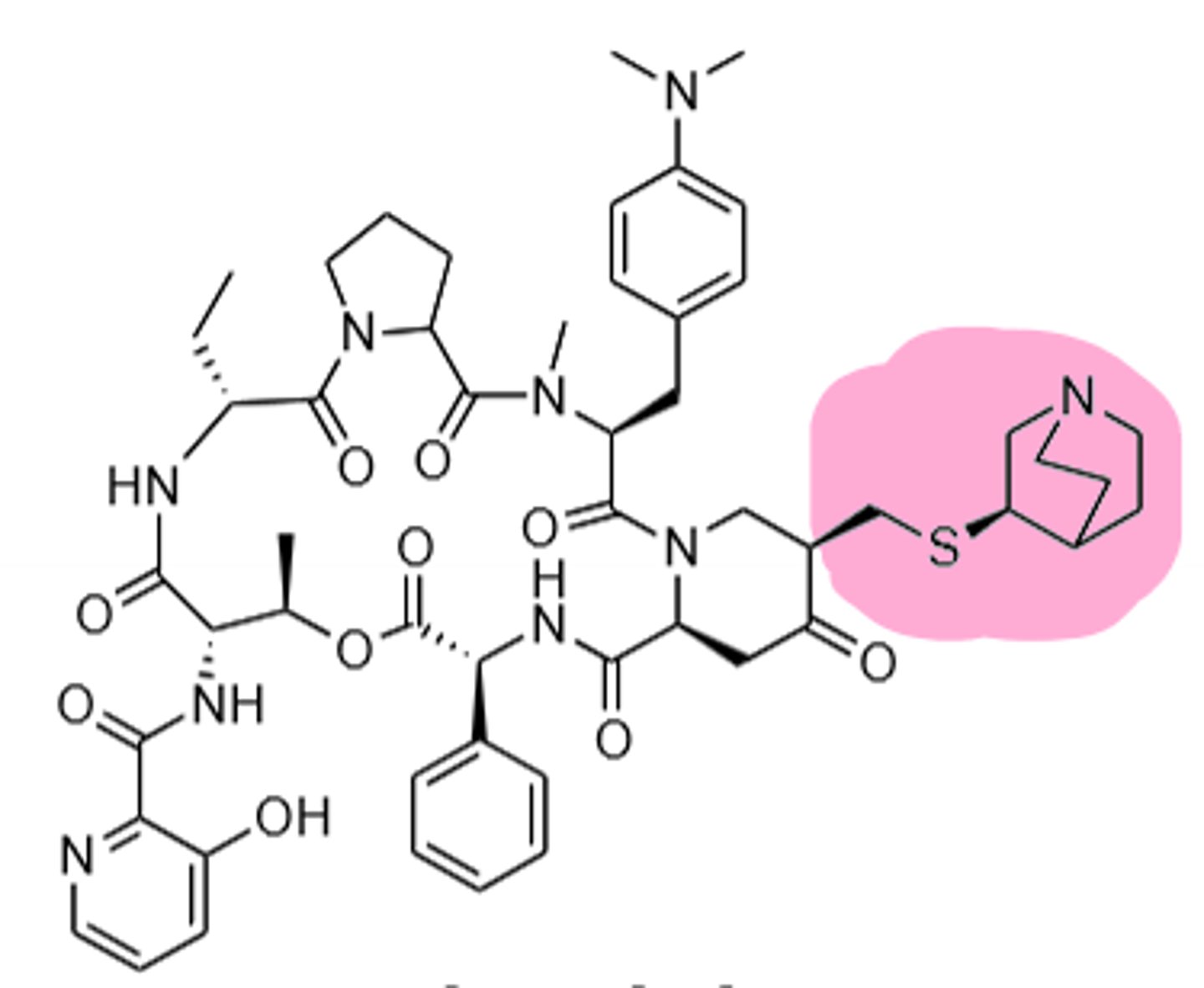
<p>Streptogramin, derivative of pristinamycin I and pristinamycin II, binds in ribosomal tunnel and causes blockage of tunnel, A2062 mutation creates resistance to this drug. Main resistance is a methylation in A2058 in the 23S rRNA causing decrease binding the the ribosome. Reserved for life-threatening gram (+) organisms. CYP3A4, concentrated in macrophages.</p>
53
New cards

Dalfopristin

Streptogramin, derivative of pristinamycin I and pristinamycin II, blocks the peptidyl transferase step in rRNA which blocks formation of peptide bonds between amino acids, A2062 mutation creates resistance to this drug. Main resistance is a methylation in A2058 in the 23S rRNA causing decrease binding the the ribosome. Reserved for life-threatening gram (+) organisms. CYP3A4, concentrated in macrophages.
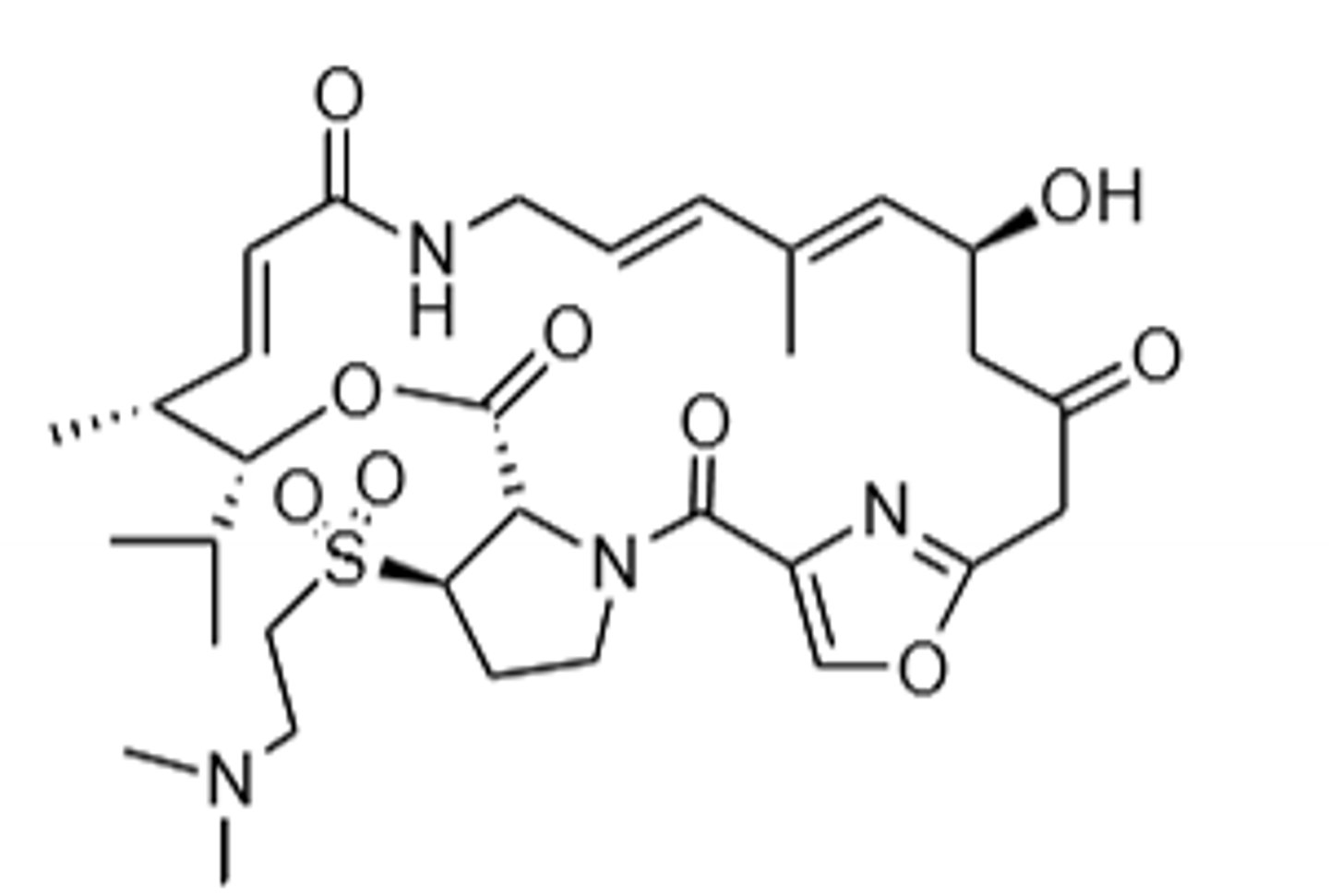
<p>Streptogramin, derivative of pristinamycin I and pristinamycin II, blocks the peptidyl transferase step in rRNA which blocks formation of peptide bonds between amino acids, A2062 mutation creates resistance to this drug. Main resistance is a methylation in A2058 in the 23S rRNA causing decrease binding the the ribosome. Reserved for life-threatening gram (+) organisms. CYP3A4, concentrated in macrophages.</p>
54
New cards

Linezolid

Oxazolidinone, binds to the 50S ribosomal subunit, inhibits protein synthesis at peptide elongation stage, specifically interacts with 23S rRNA inside the 50S subunit, good for drug resistant gram (+) bacteria, excellent oral bioavailability, but can be used IV as well, target site modification is the main form of resistance to reduce binding affinity to 23S rRNA, can cause tongue discoloration and oral thrush, must get CBC because thrombocytopenia risk, neuropathy after 6 months, *MAO-Inhibitor --> Watch with adrenergic and serotonergic agents, and food rich is tyramine.
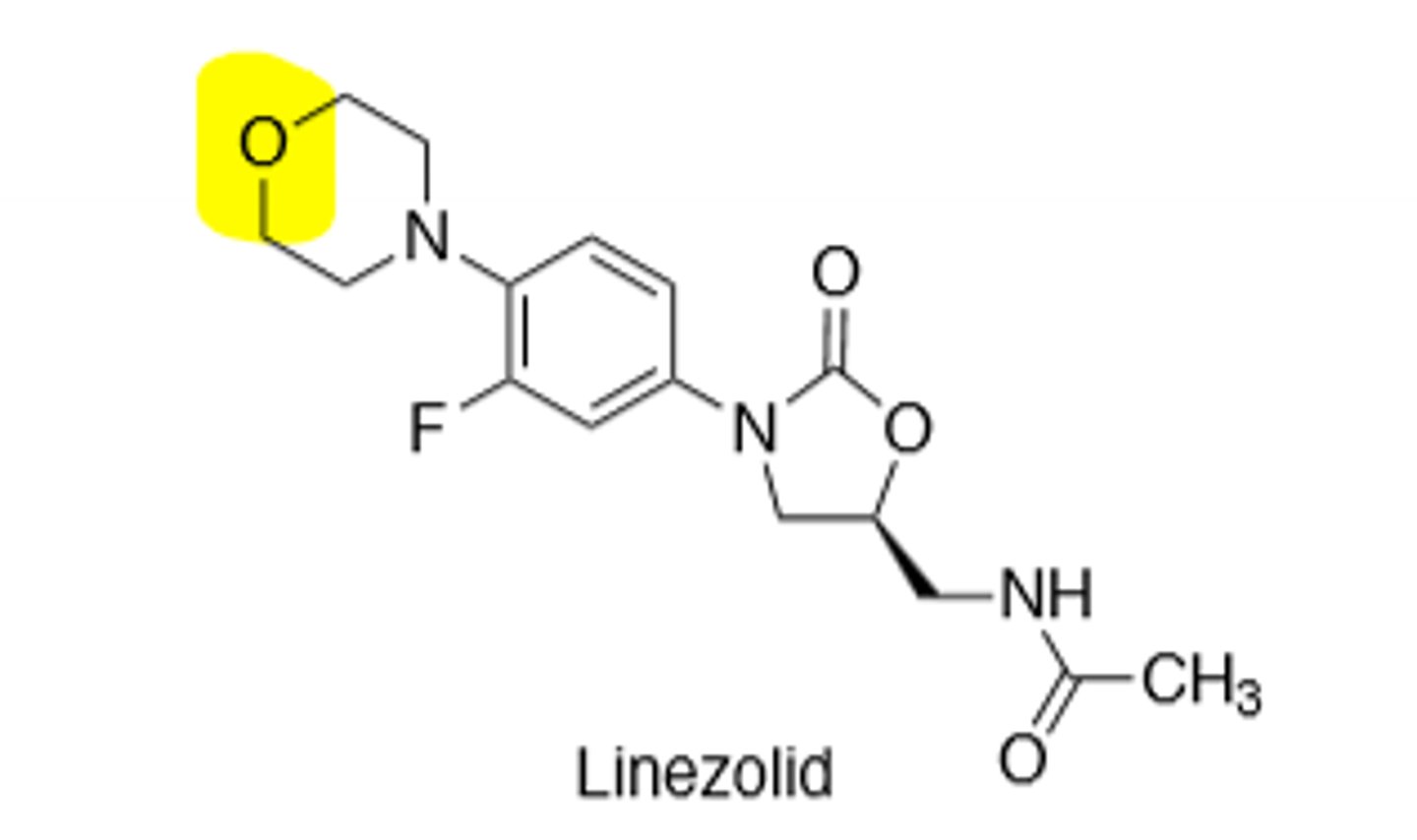
<p>Oxazolidinone, binds to the 50S ribosomal subunit, inhibits protein synthesis at peptide elongation stage, specifically interacts with 23S rRNA inside the 50S subunit, good for drug resistant gram (+) bacteria, excellent oral bioavailability, but can be used IV as well, target site modification is the main form of resistance to reduce binding affinity to 23S rRNA, can cause tongue discoloration and oral thrush, must get CBC because thrombocytopenia risk, neuropathy after 6 months, *MAO-Inhibitor --&gt; Watch with adrenergic and serotonergic agents, and food rich is tyramine.</p>
55
New cards

Tedizolid

Active metabolite of Tedizolid Phosphate, 2nd generation oxazolidinone, more potent than Linezolid vs MRSA, oral or IV administration, *MAO-Inhibitor --> Watch with adrenergic and serotonergic agents, and food rich is tyramine.
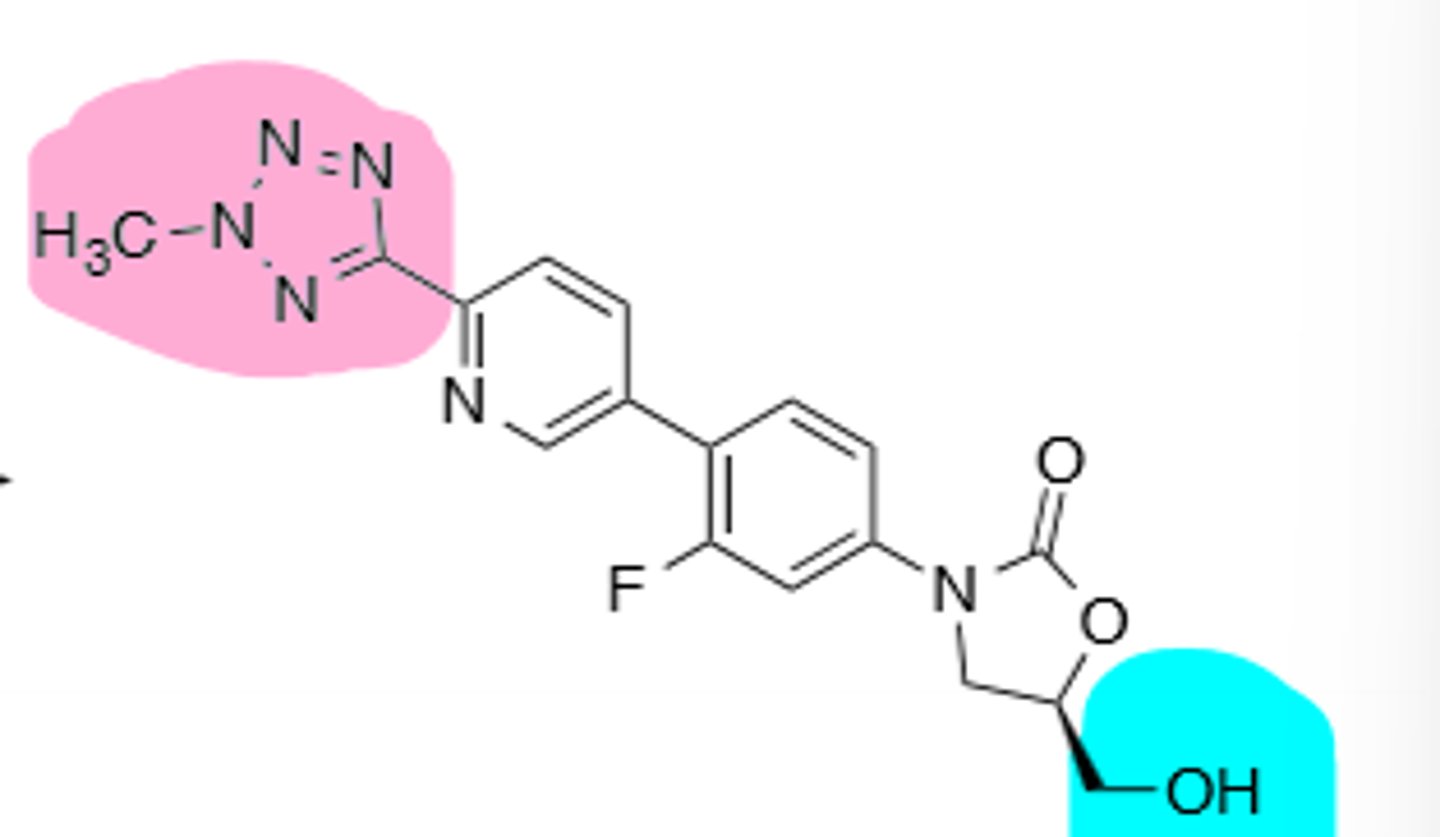
<p>Active metabolite of Tedizolid Phosphate, 2nd generation oxazolidinone, more potent than Linezolid vs MRSA, oral or IV administration, *MAO-Inhibitor --&gt; Watch with adrenergic and serotonergic agents, and food rich is tyramine.</p>
56
New cards

Streptidine

Core structure of the aminoglycosides, contain a 1,3-diaminocyclitol.
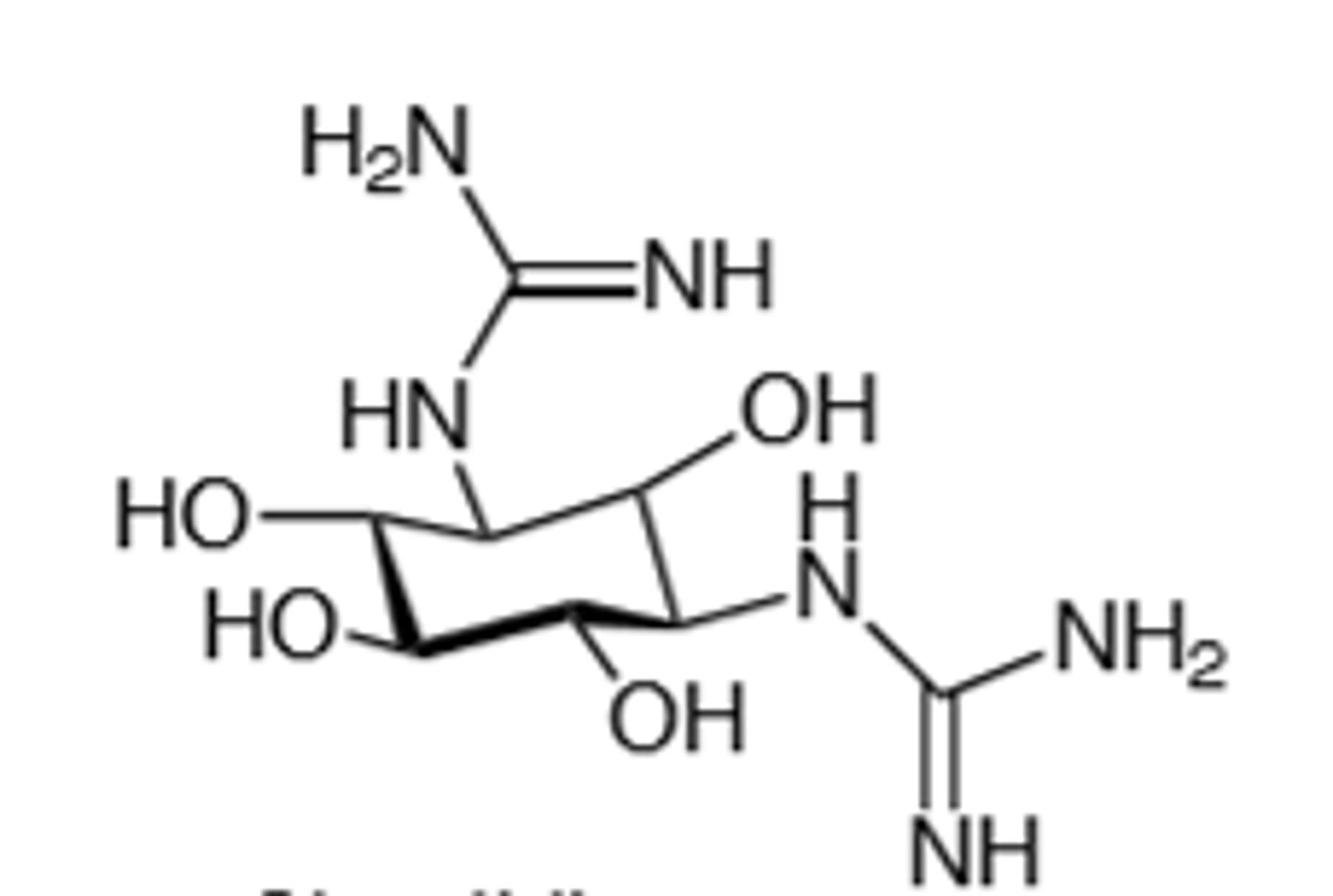
<p>Core structure of the aminoglycosides, contain a 1,3-diaminocyclitol.</p>
57
New cards

Amikacin

Synthesized from kanamycin A, aminoglycoside, inhibits bacteria metabolism by R-factors with presence of L-hydroxyaminobuteryl amide moiety. Ototoxic, nephrotoxic, can induce neuromuscular blockade, binds to 30S subunit and cause a frame shift mutation, inactivated by acetylation, adenylation, and phosphorylation, displace Mg and Ca ions to make membrane more permeable in gram (-), do not mix with penicillin, toxicity more likely if treatment exceeds 5 days, teratogen.
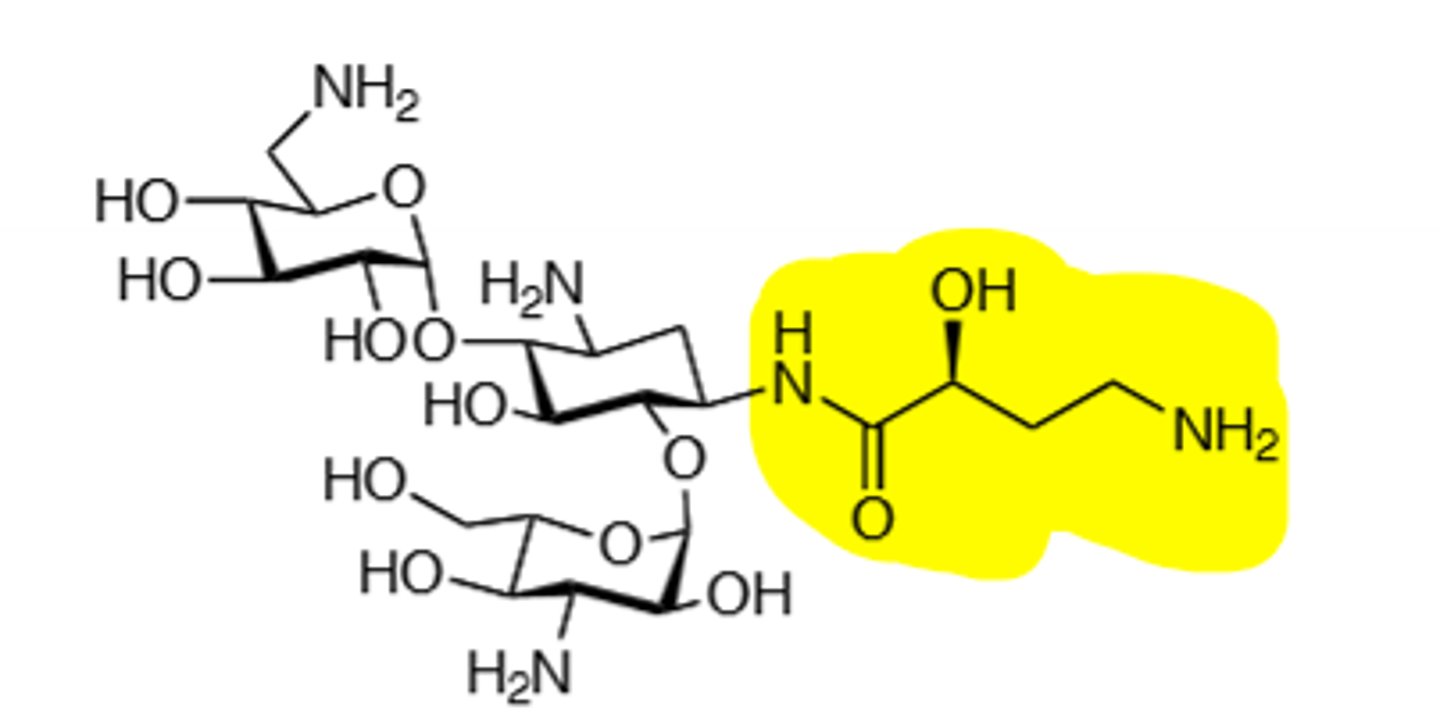
<p>Synthesized from kanamycin A, aminoglycoside, inhibits bacteria metabolism by R-factors with presence of L-hydroxyaminobuteryl amide moiety. Ototoxic, nephrotoxic, can induce neuromuscular blockade, binds to 30S subunit and cause a frame shift mutation, inactivated by acetylation, adenylation, and phosphorylation, displace Mg and Ca ions to make membrane more permeable in gram (-), do not mix with penicillin, toxicity more likely if treatment exceeds 5 days, teratogen.</p>
58
New cards

Tobramycin

Aminoglycoside, lacks a 3' hydroxyl group, so it cannot be phosphorylated at that position, treats gentamicin-resistant infections, broad spectrum. Ototoxic, nephrotoxic, can induce neuromuscular blockade, binds to 30S subunit and cause a frame shift mutation, inactivated by acetylation, adenylation, and phosphorylation, displace Mg and Ca ions to make membrane more permeable in gram (-), do not mix with penicillin, toxicity more likely if treatment exceeds 5 days, teratogen. Does not undergo phosphorylation
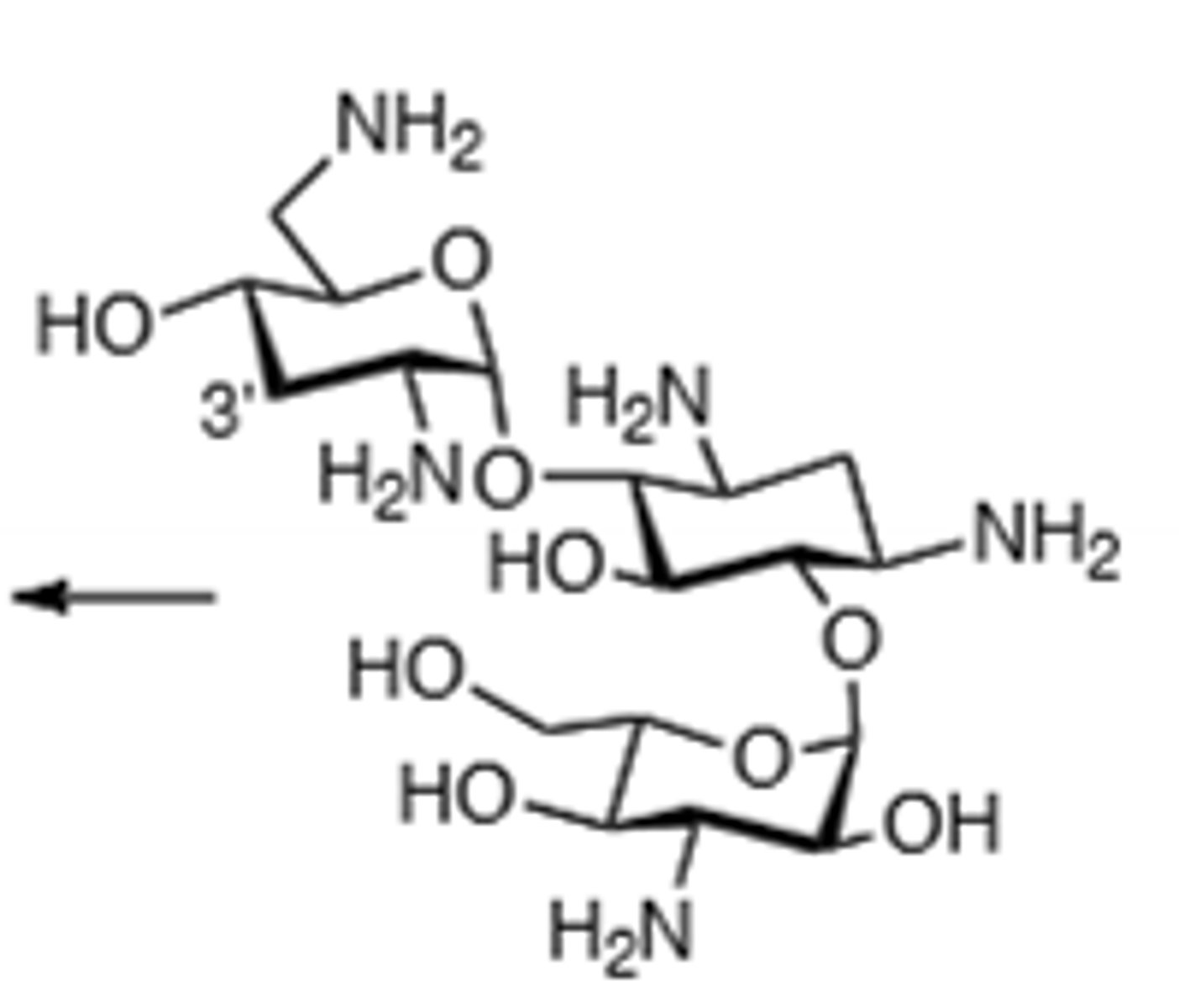
<p>Aminoglycoside, lacks a 3' hydroxyl group, so it cannot be phosphorylated at that position, treats gentamicin-resistant infections, broad spectrum. Ototoxic, nephrotoxic, can induce neuromuscular blockade, binds to 30S subunit and cause a frame shift mutation, inactivated by acetylation, adenylation, and phosphorylation, displace Mg and Ca ions to make membrane more permeable in gram (-), do not mix with penicillin, toxicity more likely if treatment exceeds 5 days, teratogen. Does not undergo phosphorylation</p>
59
New cards

Gentamicin

Aminoglycoside, broad spectrum (excluding gentamicin resistant infections). Ototoxic, nephrotoxic, can induce neuromuscular blockade, binds to 30S subunit and cause a frame shift mutation, inactivated by acetylation, adenylation, and phosphorylation, displace Mg and Ca ions to make membrane more permeable in gram (-), do not mix with penicillin, toxicity more likely if treatment exceeds 5 days., teratogen.
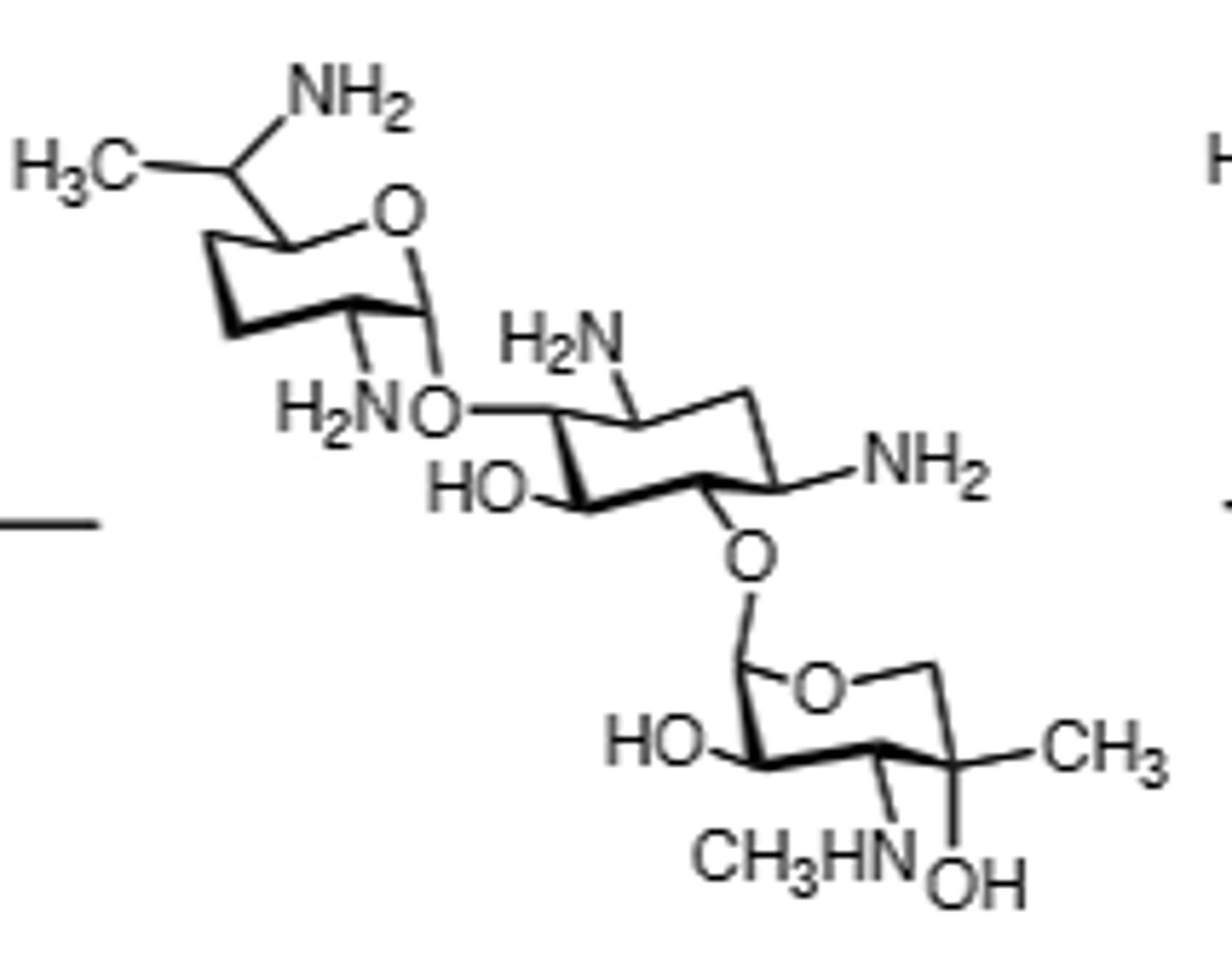
<p>Aminoglycoside, broad spectrum (excluding gentamicin resistant infections). Ototoxic, nephrotoxic, can induce neuromuscular blockade, binds to 30S subunit and cause a frame shift mutation, inactivated by acetylation, adenylation, and phosphorylation, displace Mg and Ca ions to make membrane more permeable in gram (-), do not mix with penicillin, toxicity more likely if treatment exceeds 5 days., teratogen.</p>
60
New cards

Neomycin B

Orally used aminoglycoside, suppress flora in travelers diarrhea, prophylactic GI surgery use. Ototoxic, nephrotoxic, can induce neuromuscular blockade, binds to 30S subunit and cause a frame shift mutation, inactivated by acetylation, adenylation, and phosphorylation, displace Mg and Ca ions to make membrane more permeable in gram (-), do not mix with penicillin, toxicity more likely if treatment exceeds 5 days, teratogen.
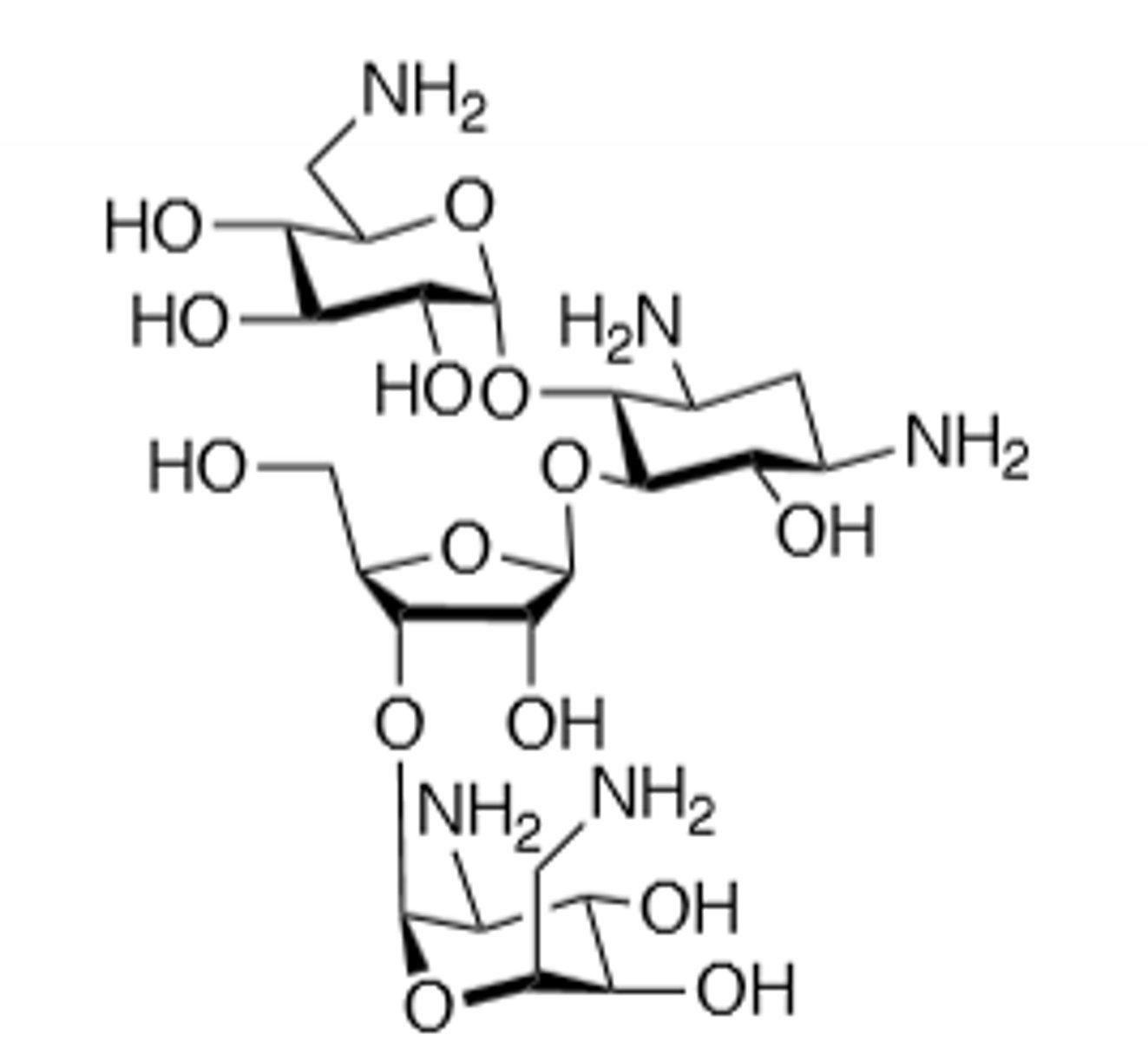
<p>Orally used aminoglycoside, suppress flora in travelers diarrhea, prophylactic GI surgery use. Ototoxic, nephrotoxic, can induce neuromuscular blockade, binds to 30S subunit and cause a frame shift mutation, inactivated by acetylation, adenylation, and phosphorylation, displace Mg and Ca ions to make membrane more permeable in gram (-), do not mix with penicillin, toxicity more likely if treatment exceeds 5 days, teratogen.</p>
61
New cards

Paromomycin

Orally used aminoglycoside, suppress flora in travelers diarrhea, prophylactic GI surgery use. Treat amoebic dysentery as well as dwarf tapeworm and beef tapeworm. Ototoxic, nephrotoxic, can induce neuromuscular blockade, binds to 30S subunit and cause a frame shift mutation, inactivated by acetylation, adenylation, and phosphorylation, displace Mg and Ca ions to make membrane more permeable in gram (-), do not mix with penicillin, toxicity more likely if treatment exceeds 5 days, teratogen.
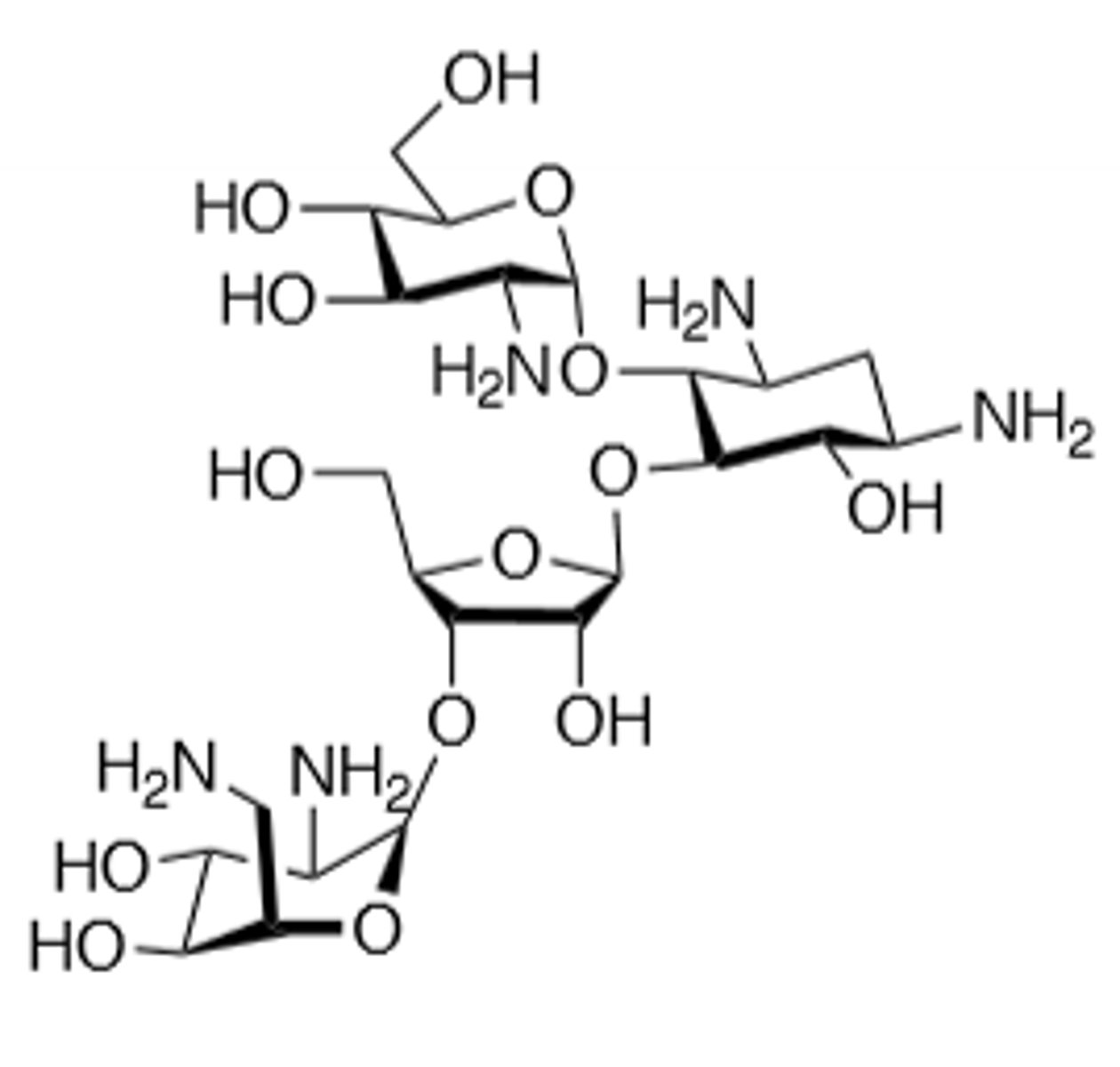
<p>Orally used aminoglycoside, suppress flora in travelers diarrhea, prophylactic GI surgery use. Treat amoebic dysentery as well as dwarf tapeworm and beef tapeworm. Ototoxic, nephrotoxic, can induce neuromuscular blockade, binds to 30S subunit and cause a frame shift mutation, inactivated by acetylation, adenylation, and phosphorylation, displace Mg and Ca ions to make membrane more permeable in gram (-), do not mix with penicillin, toxicity more likely if treatment exceeds 5 days, teratogen.</p>
62
New cards

Streptomycin

First aminoglycoside isolated, administered by deep IM injections, ototoxic, nephrotoxic, can induce neuromuscular blockade, binds to 30S subunit and cause a frame shift mutation, inactivated by acetylation, adenylation, and phosphorylation, displace Mg and Ca ions to make membrane more permeable in gram (-), do not mix with penicillin, toxicity more likely if treatment exceeds 5 days, teratogen.
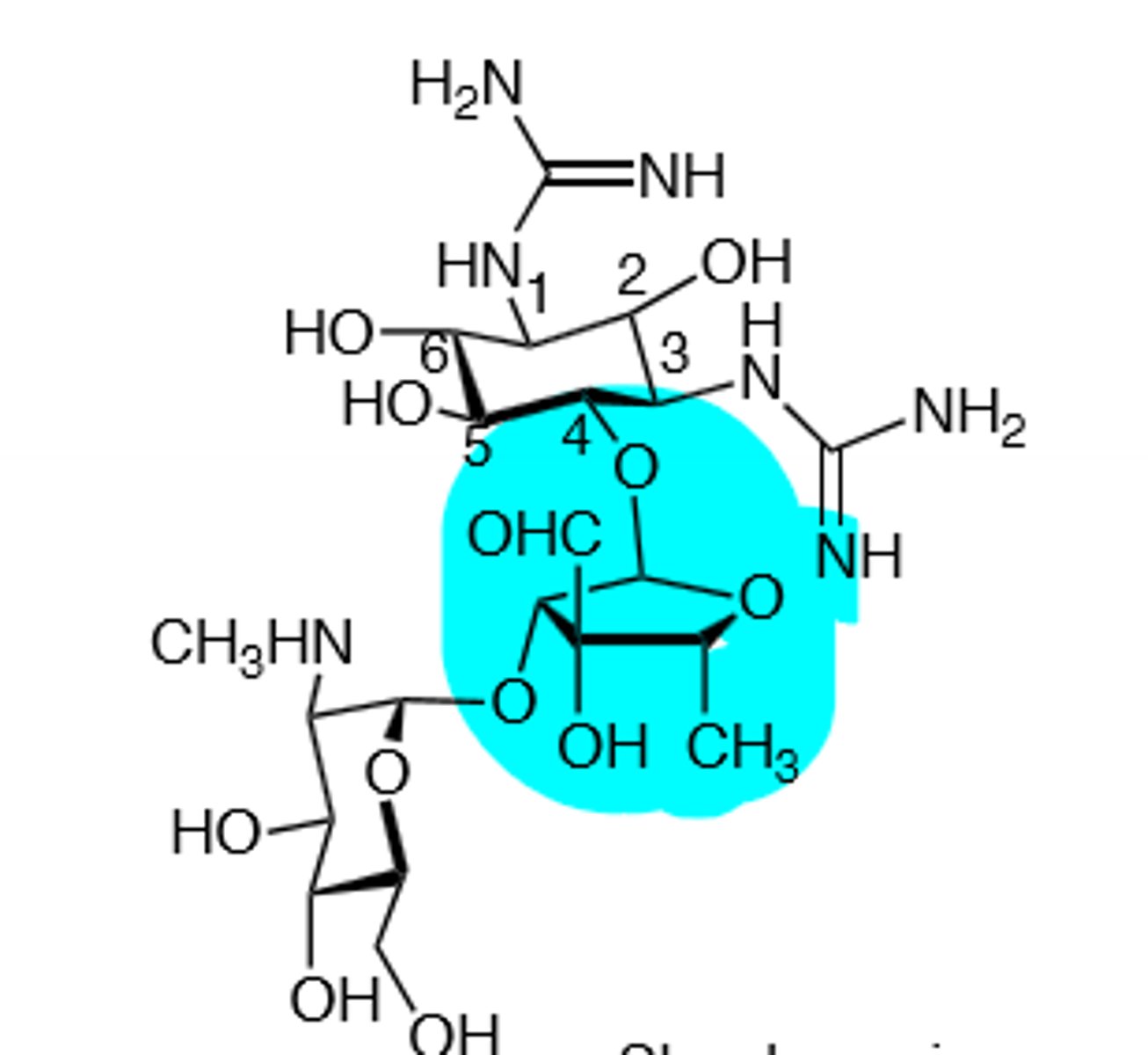
<p>First aminoglycoside isolated, administered by deep IM injections, ototoxic, nephrotoxic, can induce neuromuscular blockade, binds to 30S subunit and cause a frame shift mutation, inactivated by acetylation, adenylation, and phosphorylation, displace Mg and Ca ions to make membrane more permeable in gram (-), do not mix with penicillin, toxicity more likely if treatment exceeds 5 days, teratogen.</p>
63
New cards

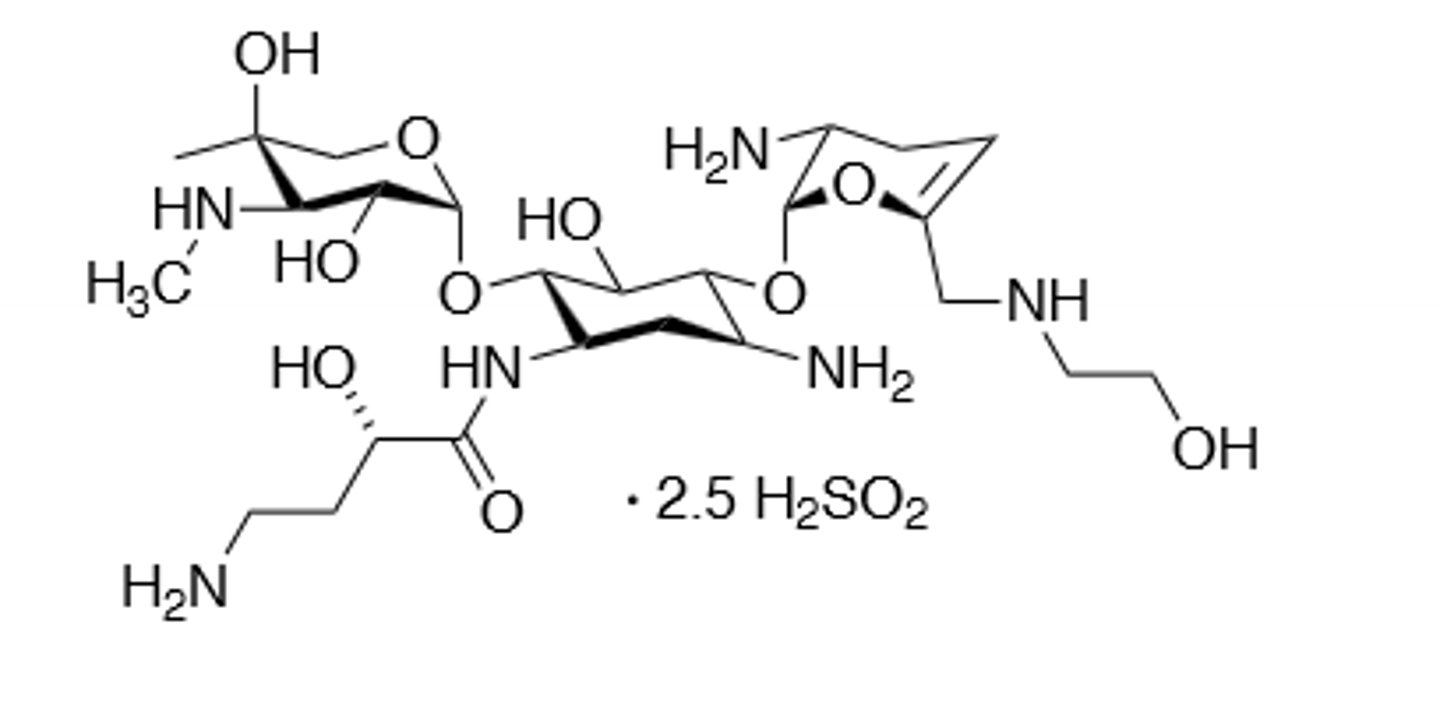
Plazomicin

Semisynthetic aminoglycoside, weight based dosing, ototoxic, nephrotoxic, can induce neuromuscular blockade, binds to 30S subunit and cause a frame shift mutation, inactivated by acetylation, adenylation, and phosphorylation, displace Mg and Ca ions to make membrane more permeable in gram (-), do not mix with penicillin, toxicity more likely if treatment exceeds 5 days, teratogen.
<p>Semisynthetic aminoglycoside, weight based dosing, ototoxic, nephrotoxic, can induce neuromuscular blockade, binds to 30S subunit and cause a frame shift mutation, inactivated by acetylation, adenylation, and phosphorylation, displace Mg and Ca ions to make membrane more permeable in gram (-), do not mix with penicillin, toxicity more likely if treatment exceeds 5 days, teratogen.</p>
64
New cards

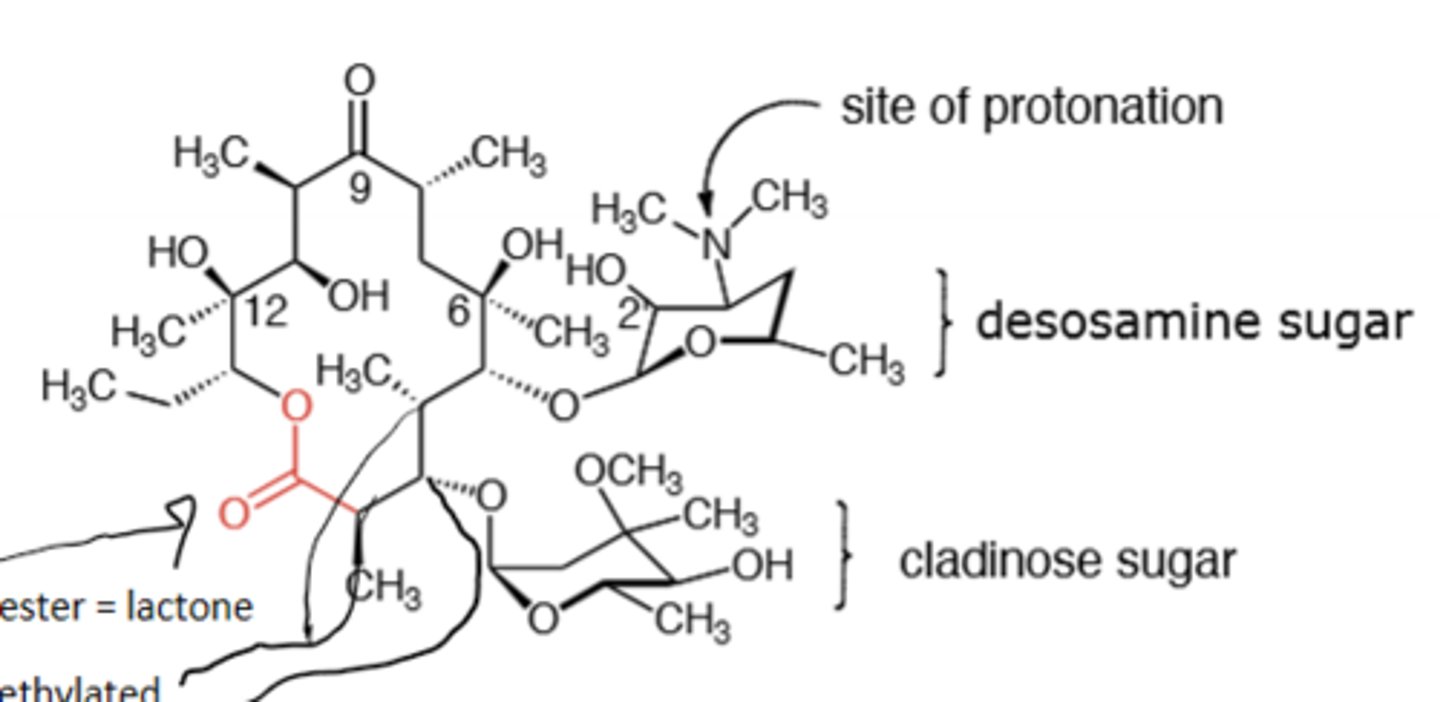
Erythromycin

Macrolide antibiotic, desosamine sugar is relevant for activity, polyketides that are produced by sequential addition of propionate groups to a growing chain, mainly for gram (+) but can be used broad spectrum. Binds to the 50S subunit of the ribosome and binds specifically to the 23S RNA subunit and inhibits translocation of peptidyl tRNA from the A site to the P site to inhibit peptide bond formation. Resistance comes via lactone ester hydrolase, methylation of an adenine base in the 23S rRNA (inhibits binding), reduction of 23S rRNA binding affinity via A2058 mutation, and via efflux pump. Resistance decreases with decreased use. Undergoes an acid-catalyzed ketal formation in acidic condition, so must be given with enteric coating when oral therapy. Metabolized via demethylation in the liver. CYP450 inhibitor. Highly concentrated in phagocytes, can cause pyloric stenosis in children where their moms took the drug during the late stages of pregnancy or while breast feeding.
<p>Macrolide antibiotic, desosamine sugar is relevant for activity, polyketides that are produced by sequential addition of propionate groups to a growing chain, mainly for gram (+) but can be used broad spectrum. Binds to the 50S subunit of the ribosome and binds specifically to the 23S RNA subunit and inhibits translocation of peptidyl tRNA from the A site to the P site to inhibit peptide bond formation. Resistance comes via lactone ester hydrolase, methylation of an adenine base in the 23S rRNA (inhibits binding), reduction of 23S rRNA binding affinity via A2058 mutation, and via efflux pump. Resistance decreases with decreased use. Undergoes an acid-catalyzed ketal formation in acidic condition, so must be given with enteric coating when oral therapy. Metabolized via demethylation in the liver. CYP450 inhibitor. Highly concentrated in phagocytes, can cause pyloric stenosis in children where their moms took the drug during the late stages of pregnancy or while breast feeding.</p>
65
New cards

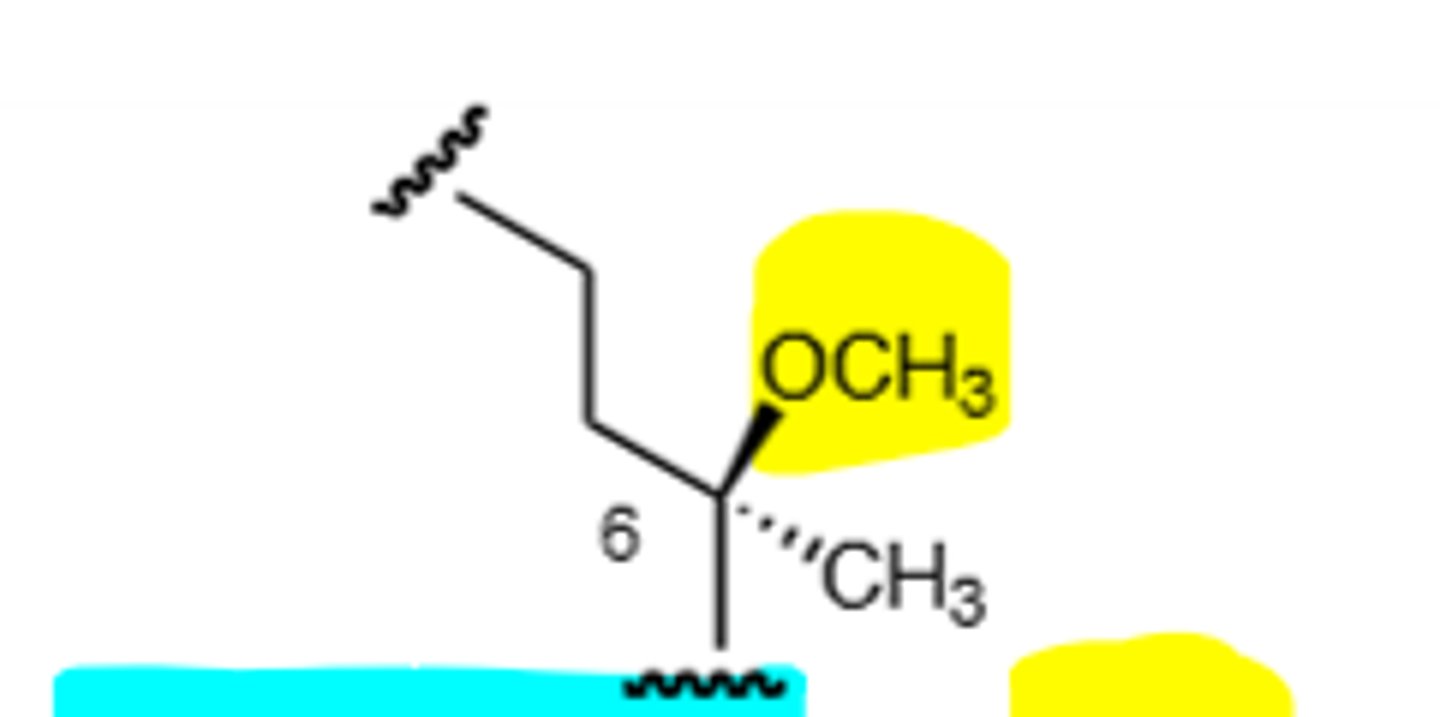
Clarithromycin

Macrolide antibiotic, desosamine sugar is relevant for activity, polyketides that are produced by sequential addition of propionate groups to a growing chain, mainly for gram (+) but can be used broad spectrum. Binds to the 50S subunit of the ribosome and binds specifically to the 23S RNA subunit and inhibits translocation of peptidyl tRNA from the A site to the P site to inhibit peptide bond formation. Resistance comes via lactone ester hydrolase, methylation of an adenine base in the 23S rRNA (inhibits binding), reduction of 23S rRNA binding affinity via A2058 mutation, and via efflux pump. Resistance decreases with decreased use. Replaces 6-OH with OCH3 to block ketal formation at low pH. CYP450 inhibitor.
<p>Macrolide antibiotic, desosamine sugar is relevant for activity, polyketides that are produced by sequential addition of propionate groups to a growing chain, mainly for gram (+) but can be used broad spectrum. Binds to the 50S subunit of the ribosome and binds specifically to the 23S RNA subunit and inhibits translocation of peptidyl tRNA from the A site to the P site to inhibit peptide bond formation. Resistance comes via lactone ester hydrolase, methylation of an adenine base in the 23S rRNA (inhibits binding), reduction of 23S rRNA binding affinity via A2058 mutation, and via efflux pump. Resistance decreases with decreased use. Replaces 6-OH with OCH3 to block ketal formation at low pH. CYP450 inhibitor.</p>
66
New cards

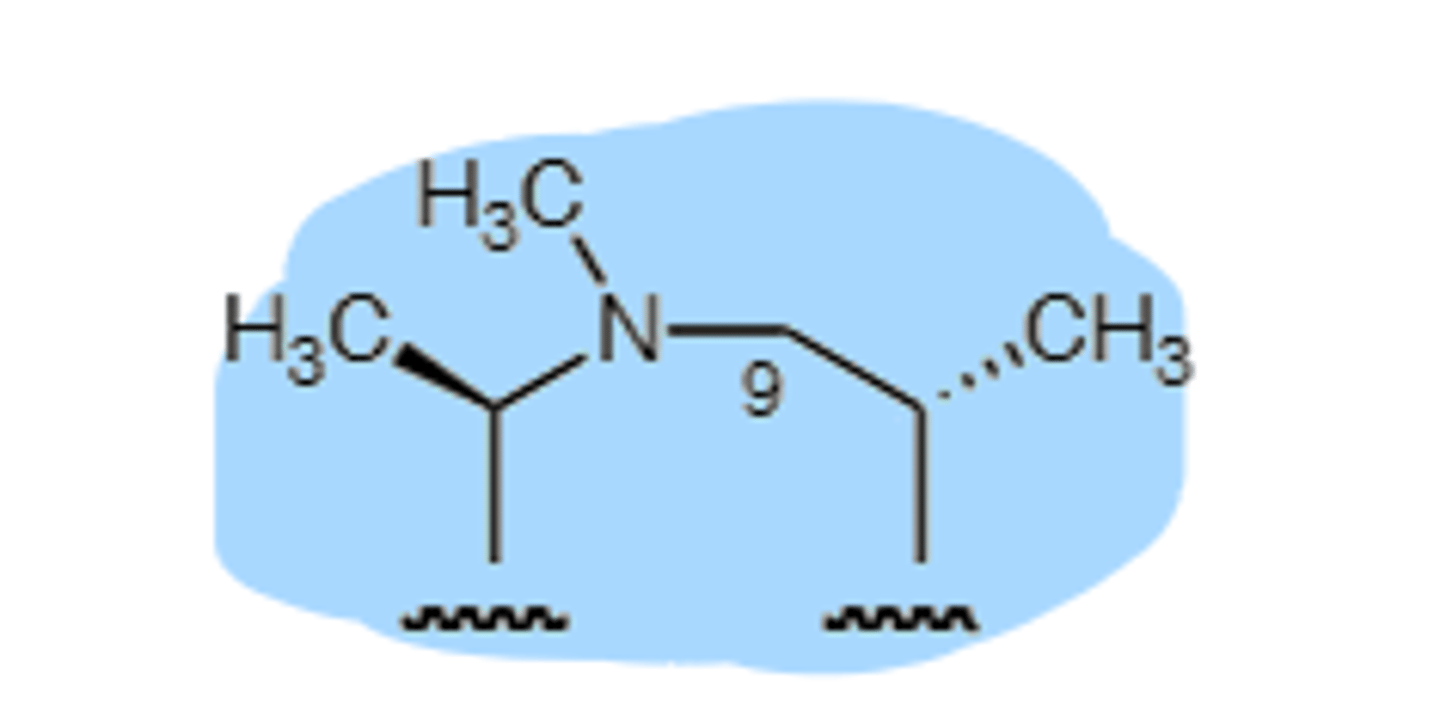
Azithromycin

Macrolide antibiotic, desosamine sugar is relevant for activity, polyketides that are produced by sequential addition of propionate groups to a growing chain, mainly for gram (+) but can be used broad spectrum. Binds to the 50S subunit of the ribosome and binds specifically to the 23S RNA subunit and inhibits translocation of peptidyl tRNA from the A site to the P site to inhibit peptide bond formation. Resistance comes via lactone ester hydrolase, methylation of an adenine base in the 23S rRNA (inhibits binding), reduction of 23S rRNA binding affinity via A2058 mutation, and via efflux pump. Resistance decreases with decreased use. N-methylated methylene amino moiety replaces the C-9 ketone to permanently block ketal formation
<p>Macrolide antibiotic, desosamine sugar is relevant for activity, polyketides that are produced by sequential addition of propionate groups to a growing chain, mainly for gram (+) but can be used broad spectrum. Binds to the 50S subunit of the ribosome and binds specifically to the 23S RNA subunit and inhibits translocation of peptidyl tRNA from the A site to the P site to inhibit peptide bond formation. Resistance comes via lactone ester hydrolase, methylation of an adenine base in the 23S rRNA (inhibits binding), reduction of 23S rRNA binding affinity via A2058 mutation, and via efflux pump. Resistance decreases with decreased use. N-methylated methylene amino moiety replaces the C-9 ketone to permanently block ketal formation</p>
67
New cards

Clindamycin

Synthesized from lincomycin (Too toxic), binds to 50S ribosomal subunit, similar to erythromycin MOA. Broad spectrum. Co-administered with pyrimethamine and leucovorin to treat AIDS patients. Pseudomembranous colitis and diarrhea limit the use of clindamycin, metabolized via P450 enzymes, topical application may cause contact dermatitis.
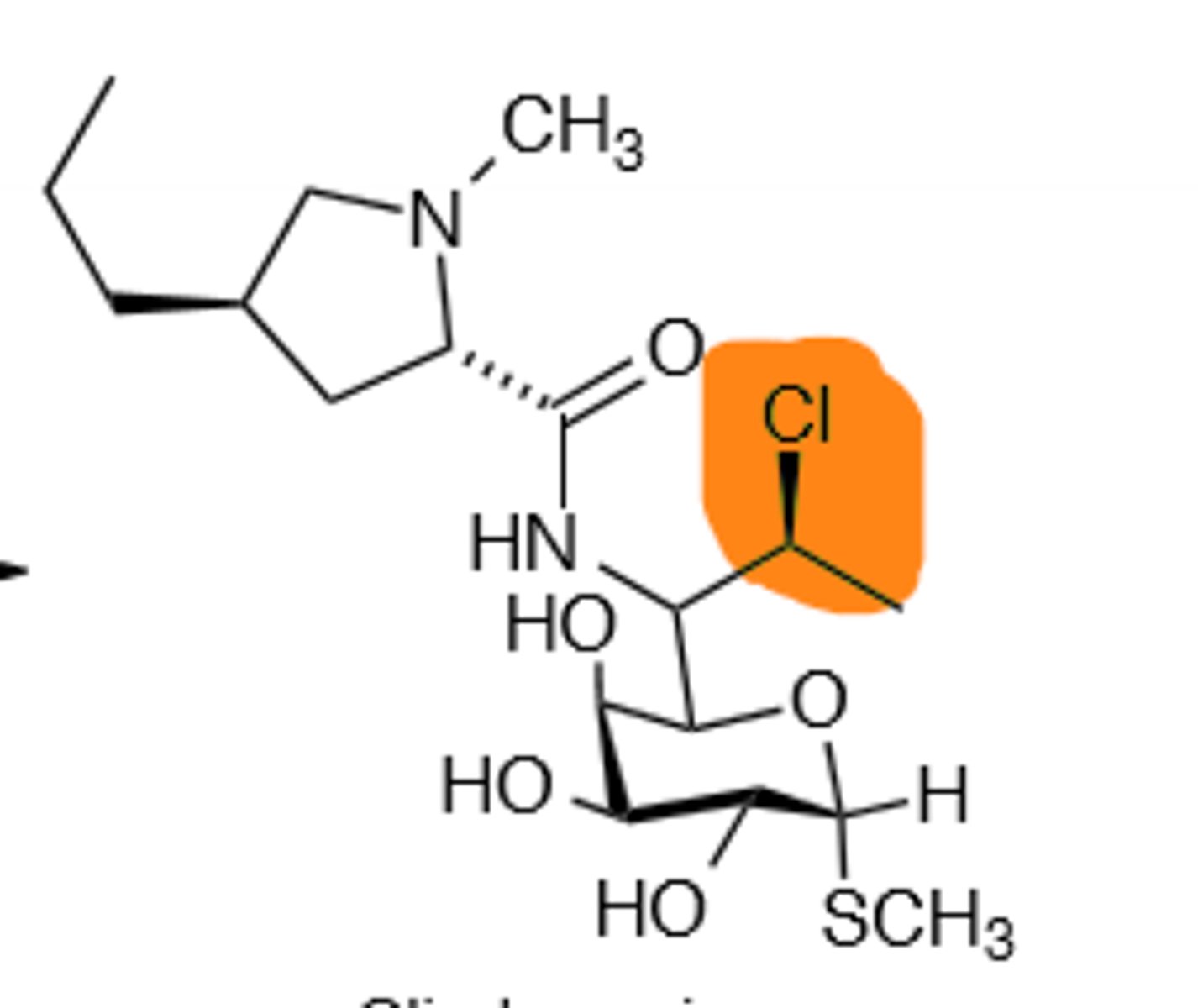
<p>Synthesized from lincomycin (Too toxic), binds to 50S ribosomal subunit, similar to erythromycin MOA. Broad spectrum. Co-administered with pyrimethamine and leucovorin to treat AIDS patients. Pseudomembranous colitis and diarrhea limit the use of clindamycin, metabolized via P450 enzymes, topical application may cause contact dermatitis. </p>
68
New cards

Tetracycline

Bind to the 30S ribosomal subunit and inhibit bacterial protein synthesis, mainly at the Tet1 site. Chelating agent, will bind to metal ions, which causes the drug to not get absorbed in the GI tract as well, avoid drinking milk to prevent 50% absorption decrease. broad-spectrum. Do not give to children while forming their permanent teeth (Discoloration occurs, becomes worse with photooxidation). Do not give after 4th month of pregnancy (Fetal bone deformation). Undergoes empirization in acidic conditions, and undergoes dehydration at the tertiary hydroxyl group, forming an inactive and severely nephrotoxic metabolite.
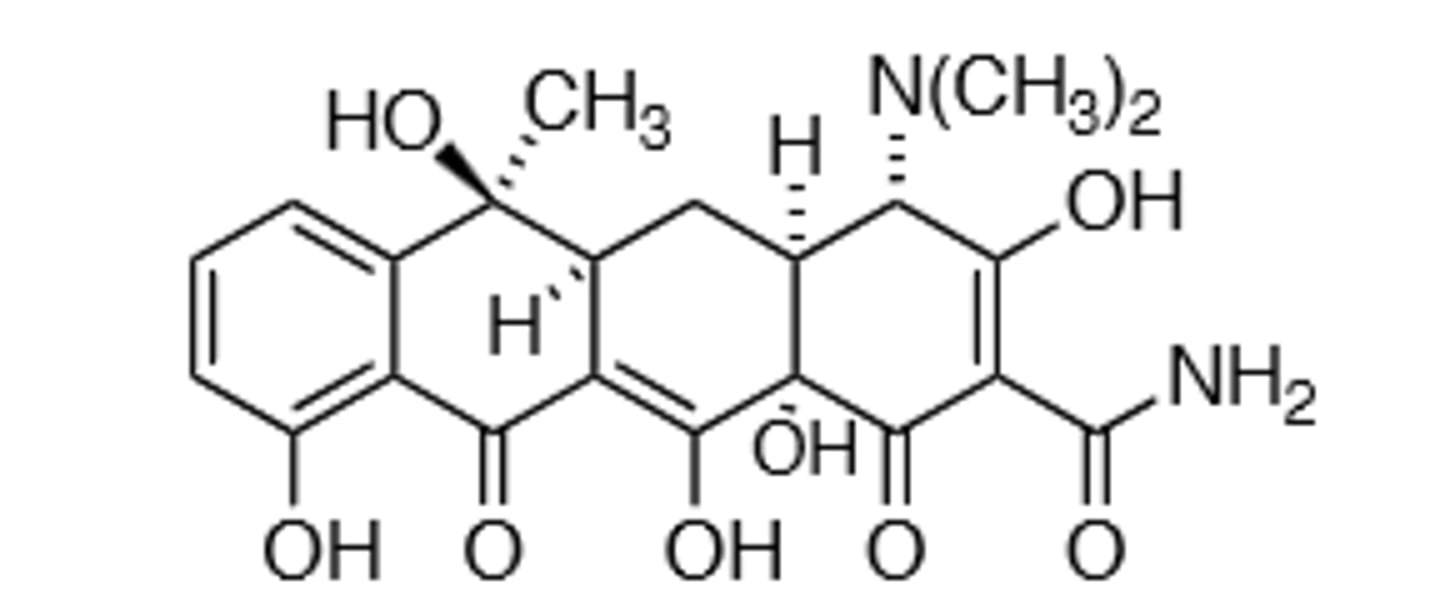
<p>Bind to the 30S ribosomal subunit and inhibit bacterial protein synthesis, mainly at the Tet1 site. Chelating agent, will bind to metal ions, which causes the drug to not get absorbed in the GI tract as well, avoid drinking milk to prevent 50% absorption decrease. broad-spectrum. Do not give to children while forming their permanent teeth (Discoloration occurs, becomes worse with photooxidation). Do not give after 4th month of pregnancy (Fetal bone deformation). Undergoes empirization in acidic conditions, and undergoes dehydration at the tertiary hydroxyl group, forming an inactive and severely nephrotoxic metabolite.</p>
69
New cards

Demeclocycline

Contains a secondary hydroxyl group instead of a tertiary hydroxyl group, which makes demeclocycline dehydrate slower than tetracycline, preventing the toxic intermediate from forming. Chelating agent, will bind to metal ions, which causes the drug to not get absorbed in the GI tract as well, avoid drinking milk to prevent 50% absorption decrease. broad-spectrum.
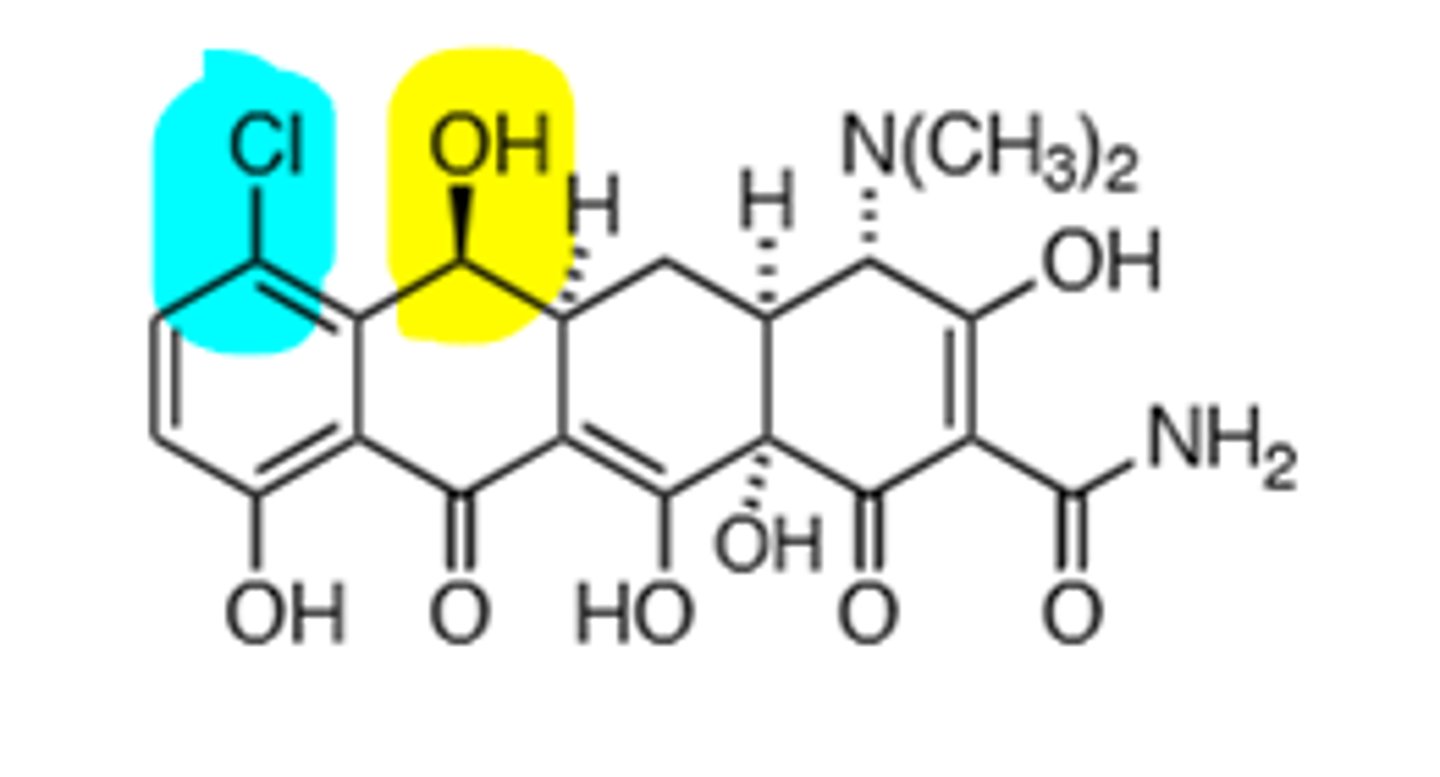
<p>Contains a secondary hydroxyl group instead of a tertiary hydroxyl group, which makes demeclocycline dehydrate slower than tetracycline, preventing the toxic intermediate from forming. Chelating agent, will bind to metal ions, which causes the drug to not get absorbed in the GI tract as well, avoid drinking milk to prevent 50% absorption decrease. broad-spectrum.</p>
70
New cards

Minocycline

Lacks a C-6 hydroxyl group, which means it does not undergo dehydration, synthesized from demeclocycline, 90-100% oral bioavailability, chelating agent, will bind to metal ions, which causes the drug to not get absorbed in the GI tract as well, avoid drinking milk to prevent 20% absorption decrease. broad-spectrum. Vestibular toxicities unique to this drug.
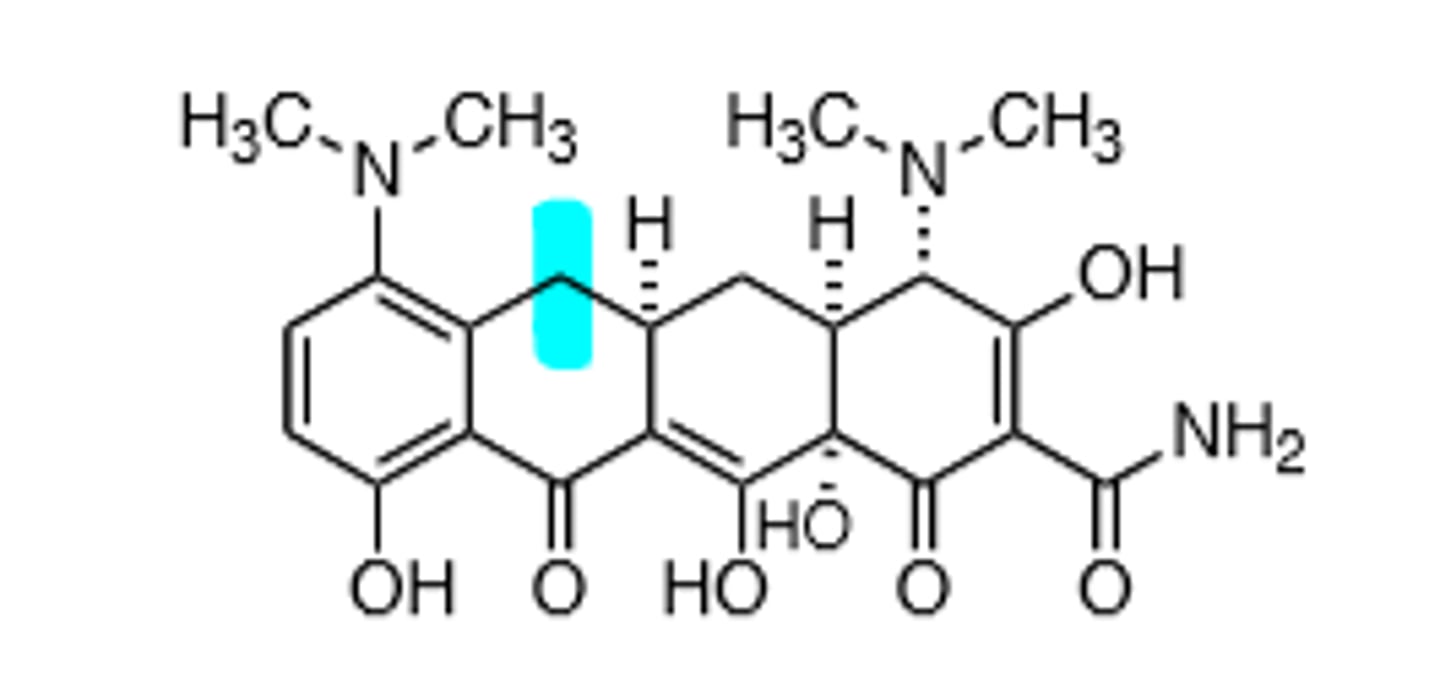
<p>Lacks a C-6 hydroxyl group, which means it does not undergo dehydration, synthesized from demeclocycline, 90-100% oral bioavailability, chelating agent, will bind to metal ions, which causes the drug to not get absorbed in the GI tract as well, avoid drinking milk to prevent 20% absorption decrease. broad-spectrum. Vestibular toxicities unique to this drug.</p>
71
New cards

Doxycycline

Synthesized from oxytetracycline, lacks a C-6 hydroxyl group, and does not undergo dehydration, fewer GI symptoms, 18-22 hour half life, 90-100% oral bioavailability. Chelating agent, will bind to metal ions, which causes the drug to not get absorbed in the GI tract as well, avoid drinking milk to prevent 20% absorption decrease. broad-spectrum.
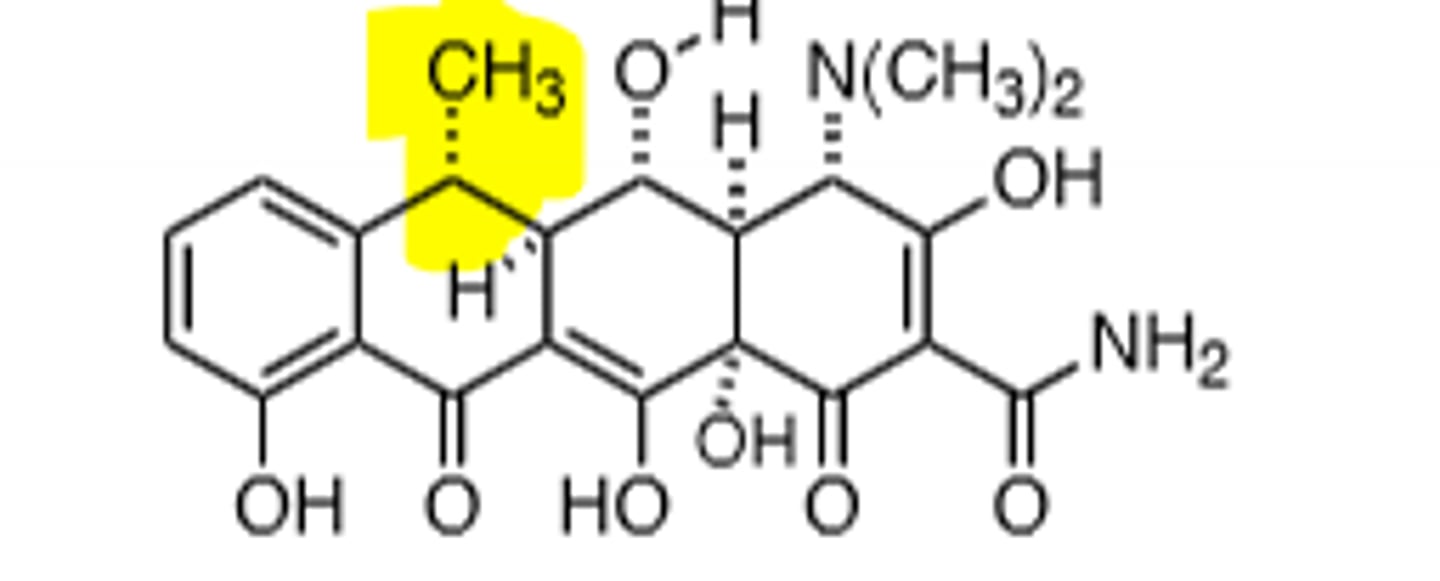
<p>Synthesized from oxytetracycline, lacks a C-6 hydroxyl group, and does not undergo dehydration, fewer GI symptoms, 18-22 hour half life, 90-100% oral bioavailability. Chelating agent, will bind to metal ions, which causes the drug to not get absorbed in the GI tract as well, avoid drinking milk to prevent 20% absorption decrease. broad-spectrum.</p>
72
New cards

Tigecycline

Derivative of minocycline, parenteral only, lacks a C-6 hydroxyl group, and does not undergo dehydration, overcomes modifications in ribosomal protection proteins from bacteria, Chelating agent, will bind to metal ions, which causes the drug to not get absorbed in the GI tract as well, broad spectrum
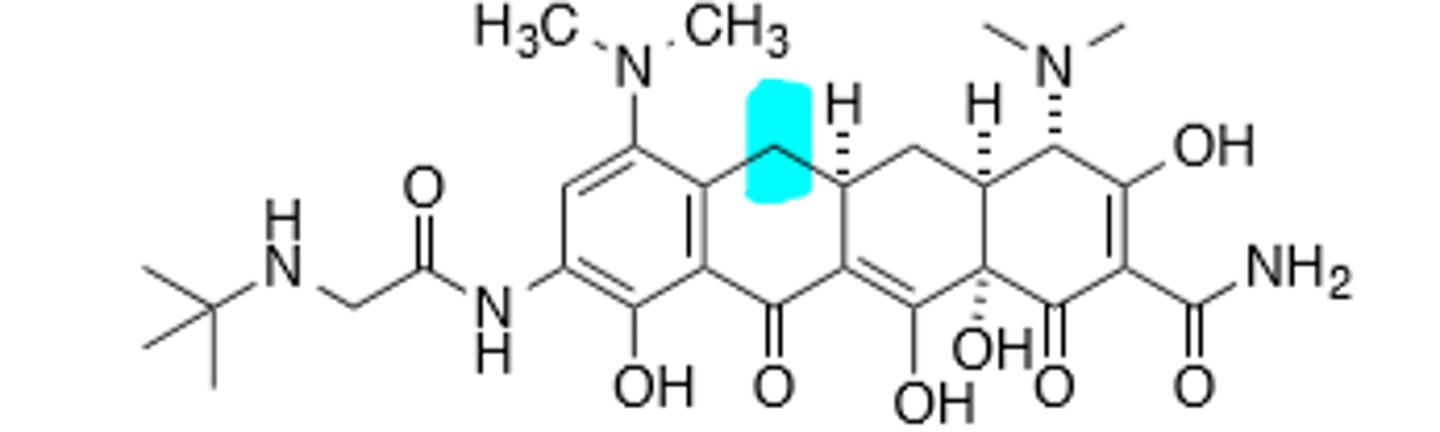
<p>Derivative of minocycline, parenteral only, lacks a C-6 hydroxyl group, and does not undergo dehydration, overcomes modifications in ribosomal protection proteins from bacteria, Chelating agent, will bind to metal ions, which causes the drug to not get absorbed in the GI tract as well, broad spectrum</p>
73
New cards

Sarecycline

Weight based dosing, newer tetracycline that overcomes ribosomal protection proteins, can cause fetal harm when administering to pregnant women, may interfere with action of penicillins due to mechanism of inhibiting 30S subunit in tetracyclines, can increase intracranial pressure --> (all tetracyclines). Chelating agent, will bind to metal ions, which causes the drug to not get absorbed in the GI tract as well, broad spectrum
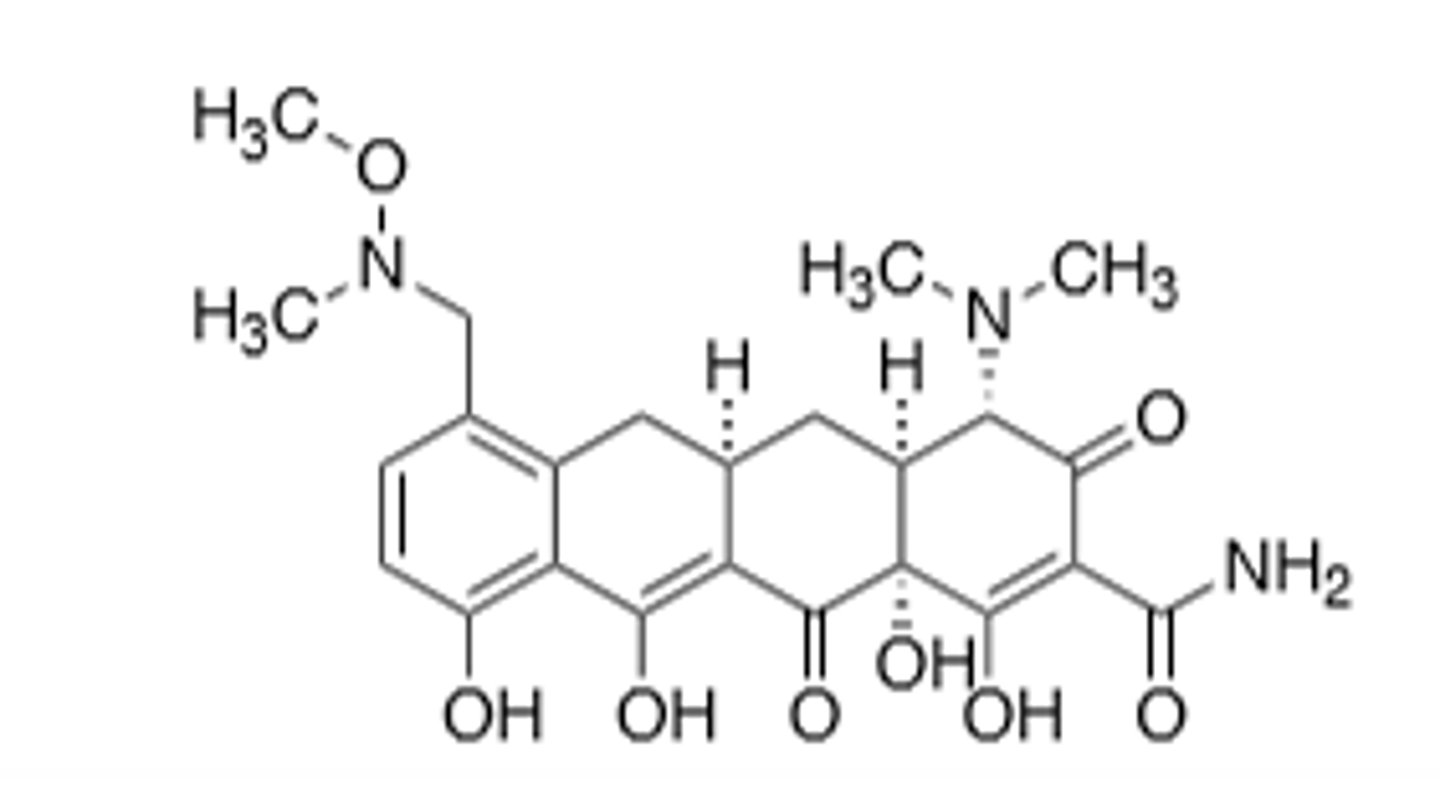
<p>Weight based dosing, newer tetracycline that overcomes ribosomal protection proteins, can cause fetal harm when administering to pregnant women, may interfere with action of penicillins due to mechanism of inhibiting 30S subunit in tetracyclines, can increase intracranial pressure --&gt; (all tetracyclines). Chelating agent, will bind to metal ions, which causes the drug to not get absorbed in the GI tract as well, broad spectrum</p>
74
New cards

Omadacycline

IV infusion only, broad spectrum, teratogenic, breast feeding not recommended, may depress prothrombin activity (Change anticoagulant dose). Chelating agent, will bind to metal ions, which causes the drug to not get absorbed in the GI tract as well.
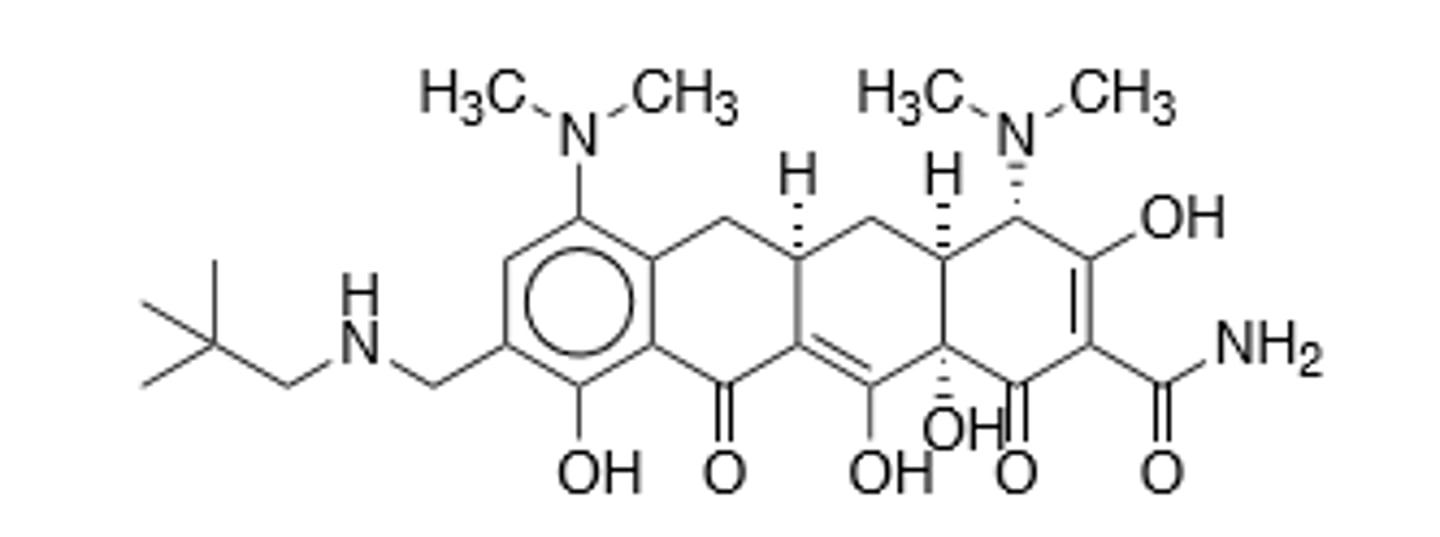
<p>IV infusion only, broad spectrum, teratogenic, breast feeding not recommended, may depress prothrombin activity (Change anticoagulant dose). Chelating agent, will bind to metal ions, which causes the drug to not get absorbed in the GI tract as well.</p>
75
New cards

Chloramphenicol

Binds reversibly to 50S ribosomal subunit (Near the site of erythromycin and clindamycin) and inhibits peptidyl transferase activity of the ribosome, lipid soluble but remains unbound to plasma proteins, penetrates all tissues including the brain. Resistance via reduced membrane permeability, mutation of 50S ribosomal subunit, elaboration of chloramphenicol acetyltransferase (bacteria cells), or metabolized the nitro group to an amino via NADPH (mammalian cells). Aplastic anemia risk (Highest with oral), will occur potentially months after treatment, bone marrow suppression, P450 inhibitor, concentration of drug increases with inflamed meninges.
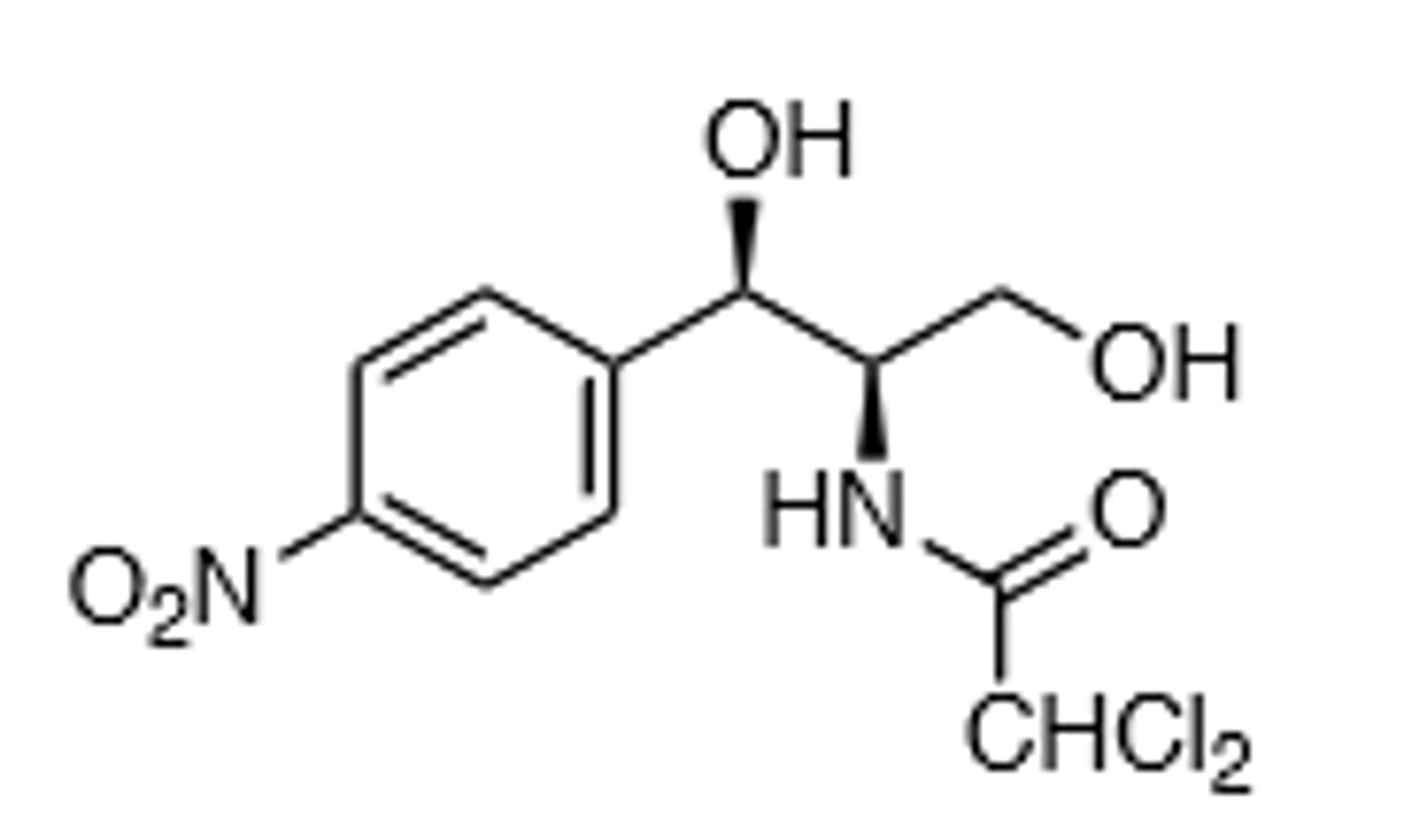
<p>Binds reversibly to 50S ribosomal subunit (Near the site of erythromycin and clindamycin) and inhibits peptidyl transferase activity of the ribosome, lipid soluble but remains unbound to plasma proteins, penetrates all tissues including the brain. Resistance via reduced membrane permeability, mutation of 50S ribosomal subunit, elaboration of chloramphenicol acetyltransferase (bacteria cells), or metabolized the nitro group to an amino via NADPH (mammalian cells). Aplastic anemia risk (Highest with oral), will occur potentially months after treatment, bone marrow suppression, P450 inhibitor, concentration of drug increases with inflamed meninges.</p>
76
New cards

Oxolinic Acid

First generation quinolone, activity more against gram (-) bacteria, only useful for treatment of lower urinary tract infections. Rare hallucinations, delirium, and sezirues in patients also taking NSAIDs and theophylline, don't give under the age of 18 due to growing tendons, risk of tendon rupture main resistance is point mutations in A and B subunit of DNA gyrase, leading to decreased binding affinity of quinolones to DNA gyrase.
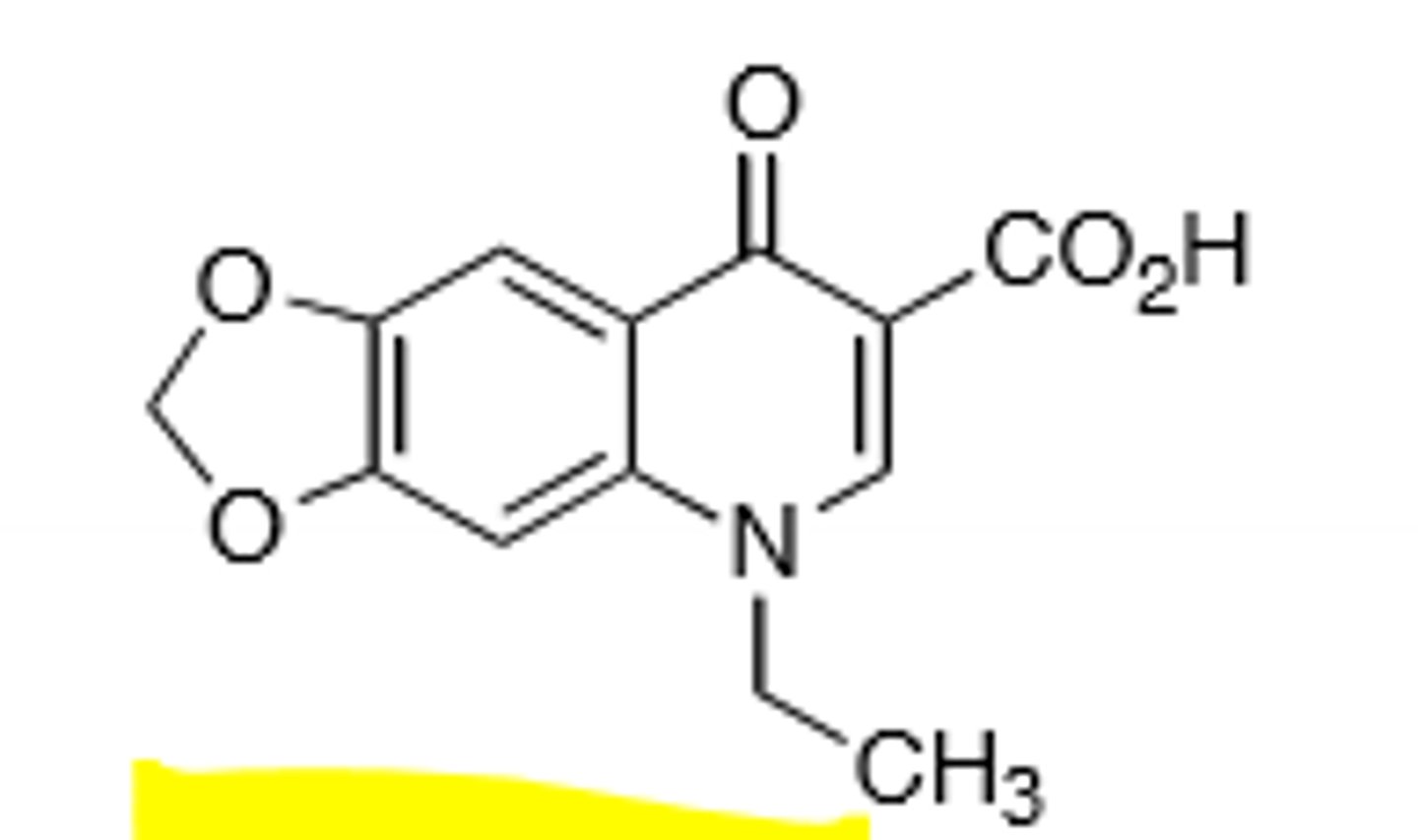
<p>First generation quinolone, activity more against gram (-) bacteria, only useful for treatment of lower urinary tract infections. Rare hallucinations, delirium, and sezirues in patients also taking NSAIDs and theophylline, don't give under the age of 18 due to growing tendons, risk of tendon rupture main resistance is point mutations in A and B subunit of DNA gyrase, leading to decreased binding affinity of quinolones to DNA gyrase.</p>
77
New cards
<p>Nalidixic Acid</p>

Nalidixic Acid

First generation quinolone, activity more against gram (-) bacteria, only useful for treatment of lower urinary tract infections. Rare hallucinations, delirium, and sezirues in patients also taking NSAIDs and theophylline, don't give under the age of 18 due to growing tendons, risk of tendon rupture main resistance is point mutations in A and B subunit of DNA gyrase, leading to decreased binding affinity of quinolones to DNA gyrase.
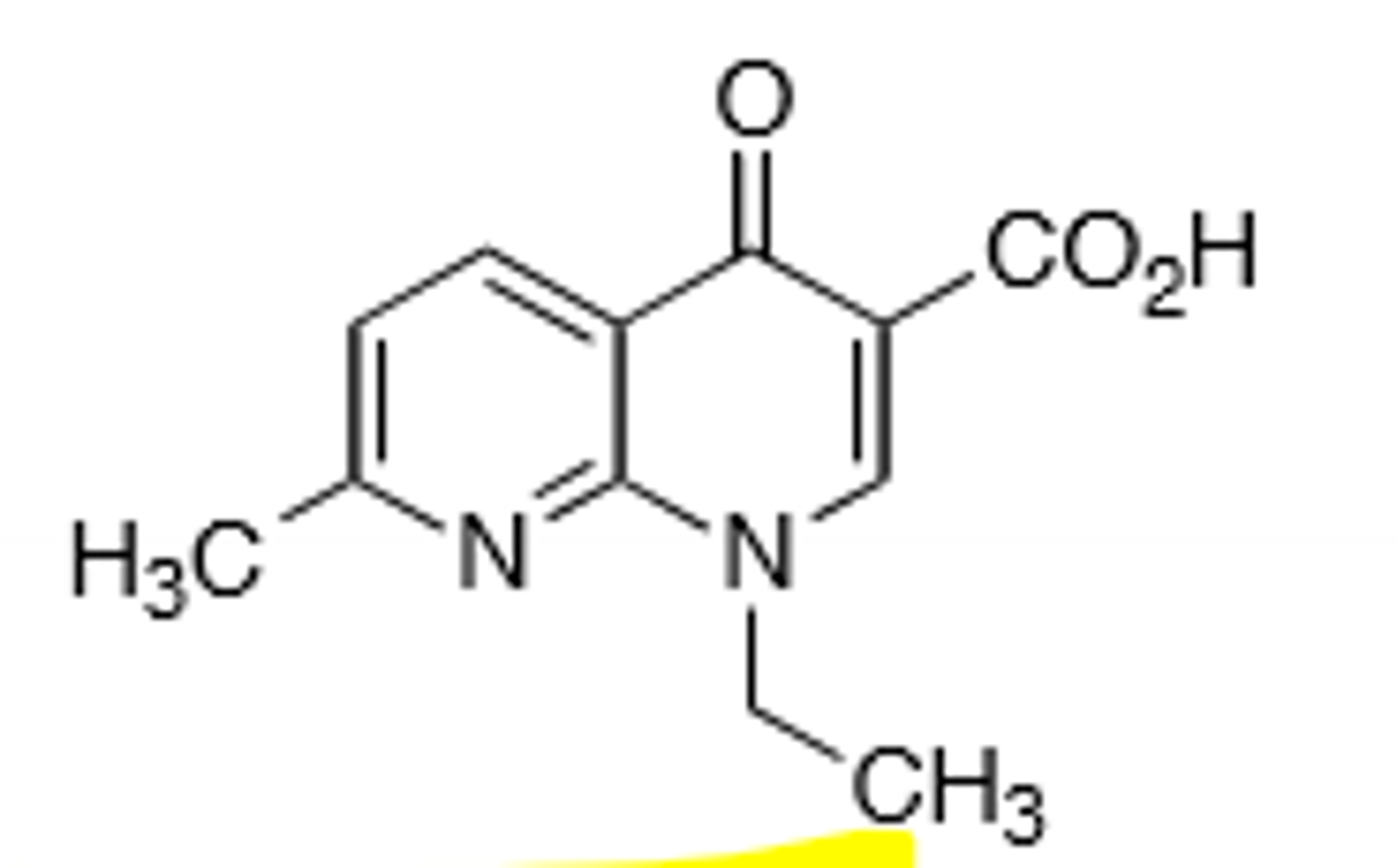
<p>First generation quinolone, activity more against gram (-) bacteria, only useful for treatment of lower urinary tract infections. Rare hallucinations, delirium, and sezirues in patients also taking NSAIDs and theophylline, don't give under the age of 18 due to growing tendons, risk of tendon rupture main resistance is point mutations in A and B subunit of DNA gyrase, leading to decreased binding affinity of quinolones to DNA gyrase.</p>
78
New cards

Ciprofloxacin

Second generation quinolone, has a fluorine substituent at C-6 and a heterocyclic ring (usually piperazine) at C-7. More gram (+) activity than first generation, but is the most potent gram (-) quinolone. Inhibits DNA gyrase and topoisomerase IV in bacterial DNA production. Rare hallucinations, delirium, and sezirues in patients also taking NSAIDs and theophylline, don't give under the age of 18 due to growing tendons, risk of tendon rupture main resistance is point mutations in A and B subunit of DNA gyrase, leading to decreased binding affinity of quinolones to DNA gyrase.
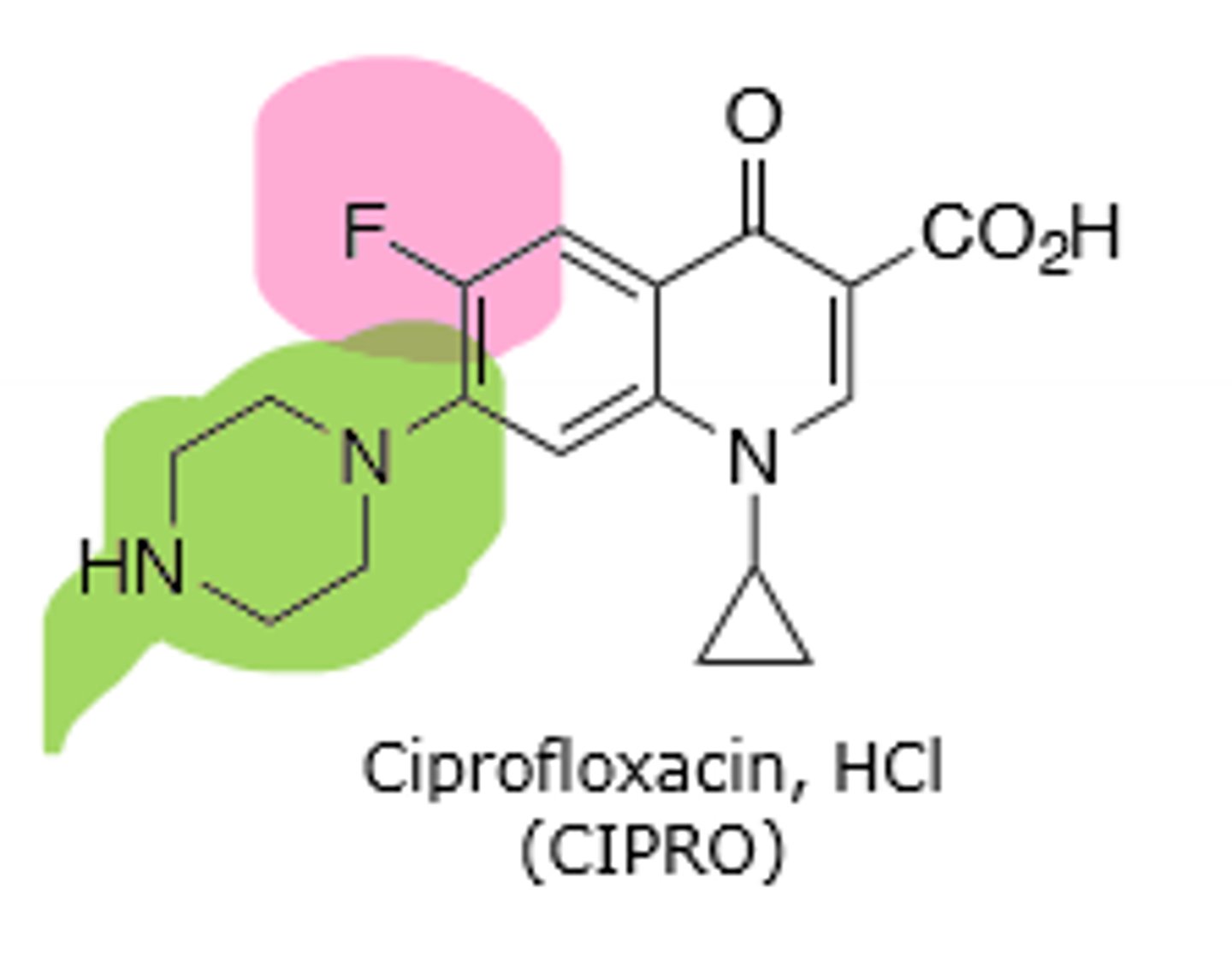
<p>Second generation quinolone, has a fluorine substituent at C-6 and a heterocyclic ring (usually piperazine) at C-7. More gram (+) activity than first generation, but is the most potent gram (-) quinolone. Inhibits DNA gyrase and topoisomerase IV in bacterial DNA production. Rare hallucinations, delirium, and sezirues in patients also taking NSAIDs and theophylline, don't give under the age of 18 due to growing tendons, risk of tendon rupture main resistance is point mutations in A and B subunit of DNA gyrase, leading to decreased binding affinity of quinolones to DNA gyrase.</p>
79
New cards

Levofloxacin

Third generation quinolone, improved activity against gram (+), but still hits gram (-). Inhibits DNA gyrase and topoisomerase IV in bacterial DNA production. Rare hallucinations, delirium, and sezirues in patients also taking NSAIDs and theophylline, don't give under the age of 18 due to growing tendons, risk of tendon rupture main resistance is point mutations in A and B subunit of DNA gyrase, leading to decreased binding affinity of quinolones to DNA gyrase.
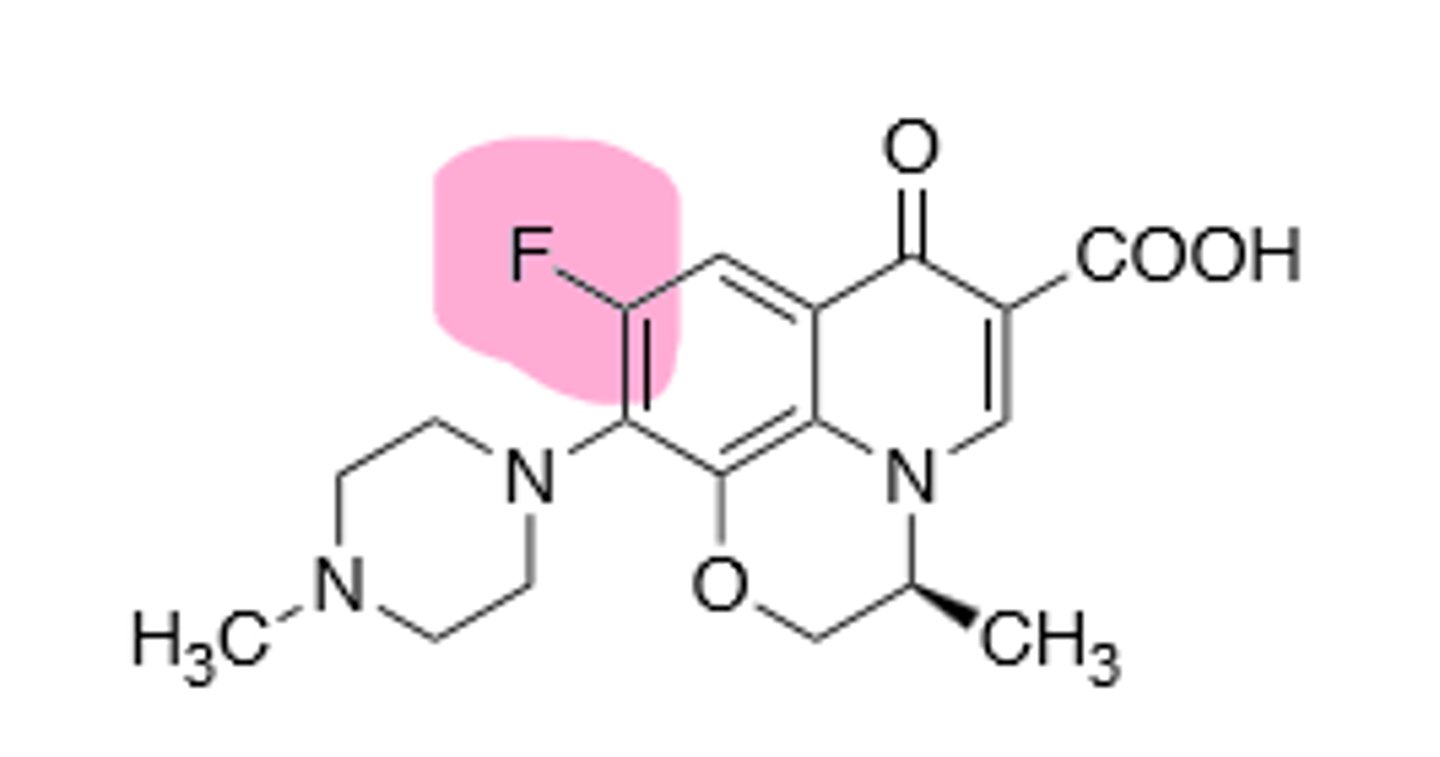
<p>Third generation quinolone, improved activity against gram (+), but still hits gram (-). Inhibits DNA gyrase and topoisomerase IV in bacterial DNA production. Rare hallucinations, delirium, and sezirues in patients also taking NSAIDs and theophylline, don't give under the age of 18 due to growing tendons, risk of tendon rupture main resistance is point mutations in A and B subunit of DNA gyrase, leading to decreased binding affinity of quinolones to DNA gyrase.</p>
80
New cards

Moxifloxacin

Fourth generation quinolone, considered a drug of last resort due to toxic side effects, improved activity against gram (+), but still hits gram (-). Inhibits DNA gyrase and topoisomerase IV in bacterial DNA production. Rare hallucinations, delirium, and sezirues in patients also taking NSAIDs and theophylline, don't give under the age of 18 due to growing tendons, risk of tendon rupture main resistance is point mutations in A and B subunit of DNA gyrase, leading to decreased binding affinity of quinolones to DNA gyrase.
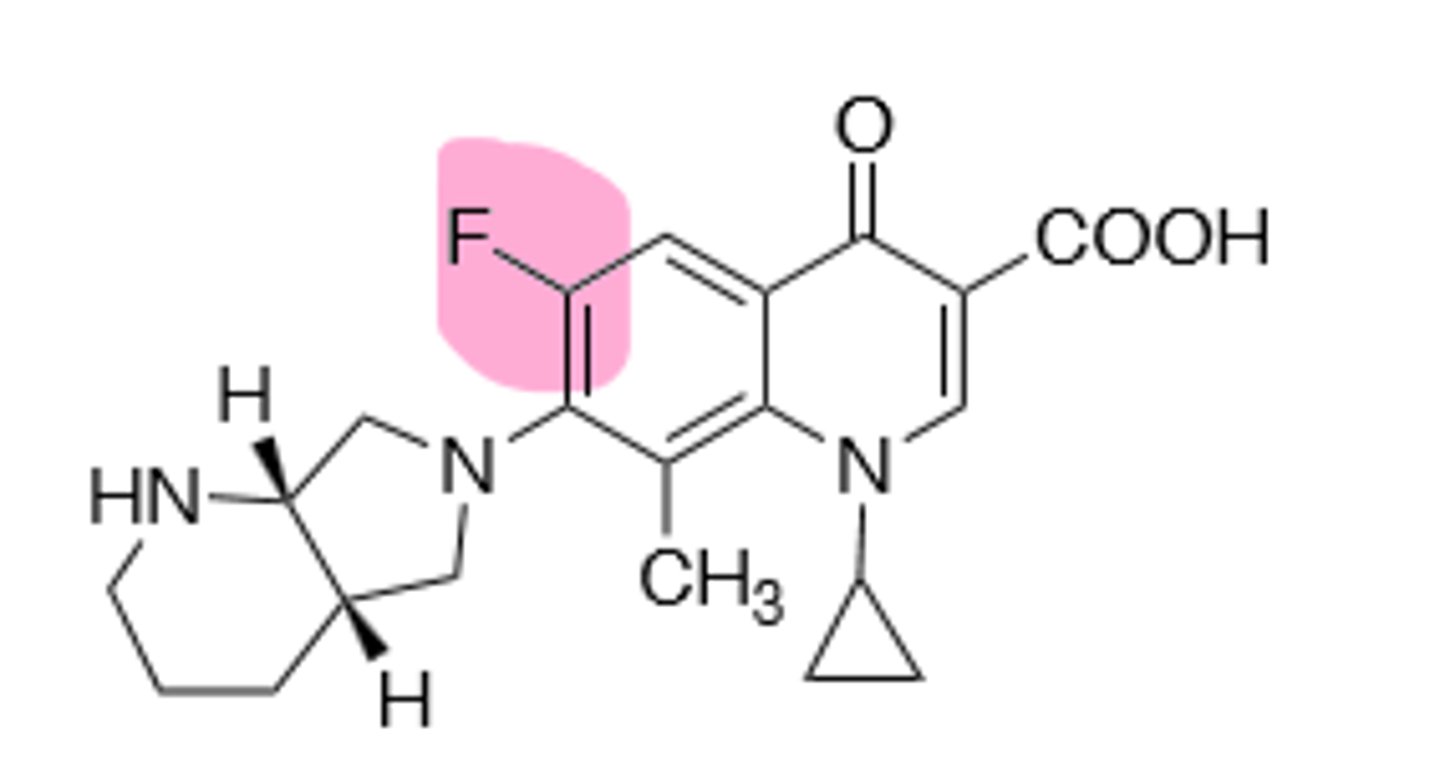
<p>Fourth generation quinolone, considered a drug of last resort due to toxic side effects, improved activity against gram (+), but still hits gram (-). Inhibits DNA gyrase and topoisomerase IV in bacterial DNA production. Rare hallucinations, delirium, and sezirues in patients also taking NSAIDs and theophylline, don't give under the age of 18 due to growing tendons, risk of tendon rupture main resistance is point mutations in A and B subunit of DNA gyrase, leading to decreased binding affinity of quinolones to DNA gyrase.</p>
81
New cards
<p>Ozenoxacin</p>

Ozenoxacin

New quinolone, no fluorine group, used to treat impetigo, overgrowth with nonsusceptible bacteria and fungi possible, improved activity against gram (+), but still hits gram (-). Inhibits DNA gyrase and topoisomerase IV in bacterial DNA production. Rare hallucinations, delirium, and sezirues in patients also taking NSAIDs and theophylline, don't give under the age of 18 due to growing tendons, risk of tendon rupture main resistance is point mutations in A and B subunit of DNA gyrase, leading to decreased binding affinity of quinolones to DNA gyrase.
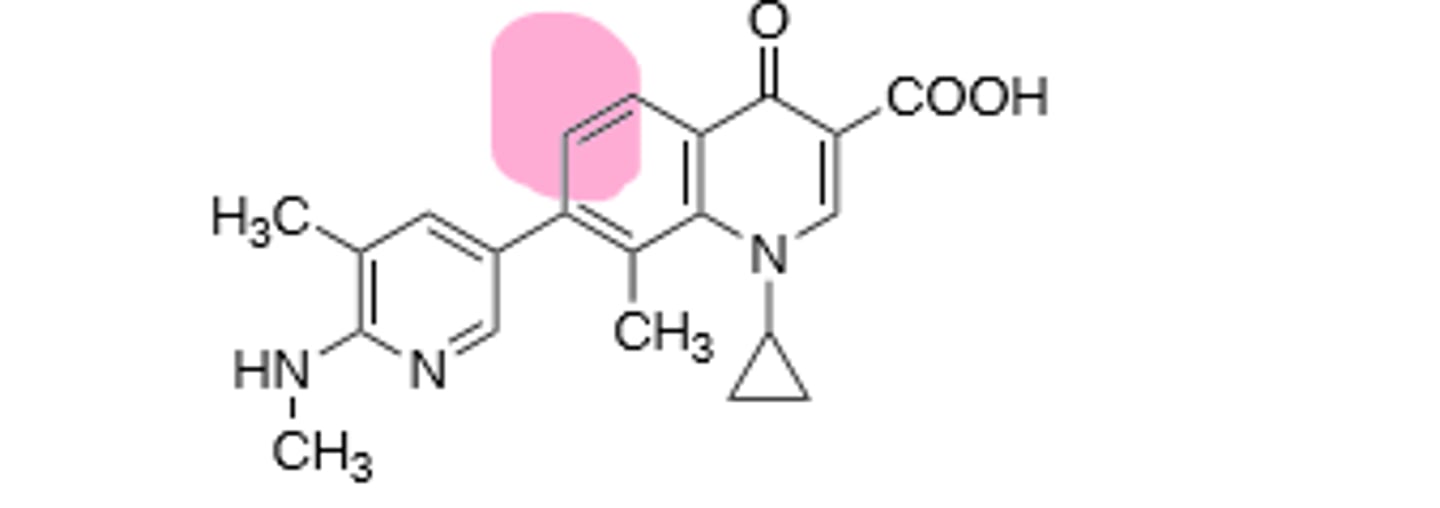
<p>New quinolone, no fluorine group, used to treat impetigo, overgrowth with nonsusceptible bacteria and fungi possible, improved activity against gram (+), but still hits gram (-). Inhibits DNA gyrase and topoisomerase IV in bacterial DNA production. Rare hallucinations, delirium, and sezirues in patients also taking NSAIDs and theophylline, don't give under the age of 18 due to growing tendons, risk of tendon rupture main resistance is point mutations in A and B subunit of DNA gyrase, leading to decreased binding affinity of quinolones to DNA gyrase.</p>
82
New cards

Delafloxacin

New quinolone, approved for oral or IV use, improved activity against gram (+), but still hits gram (-). Inhibits DNA gyrase and topoisomerase IV in bacterial DNA production. Rare hallucinations, delirium, and sezirues in patients also taking NSAIDs and theophylline, don't give under the age of 18 due to growing tendons, risk of tendon rupture main resistance is point mutations in A and B subunit of DNA gyrase, leading to decreased binding affinity of quinolones to DNA gyrase.
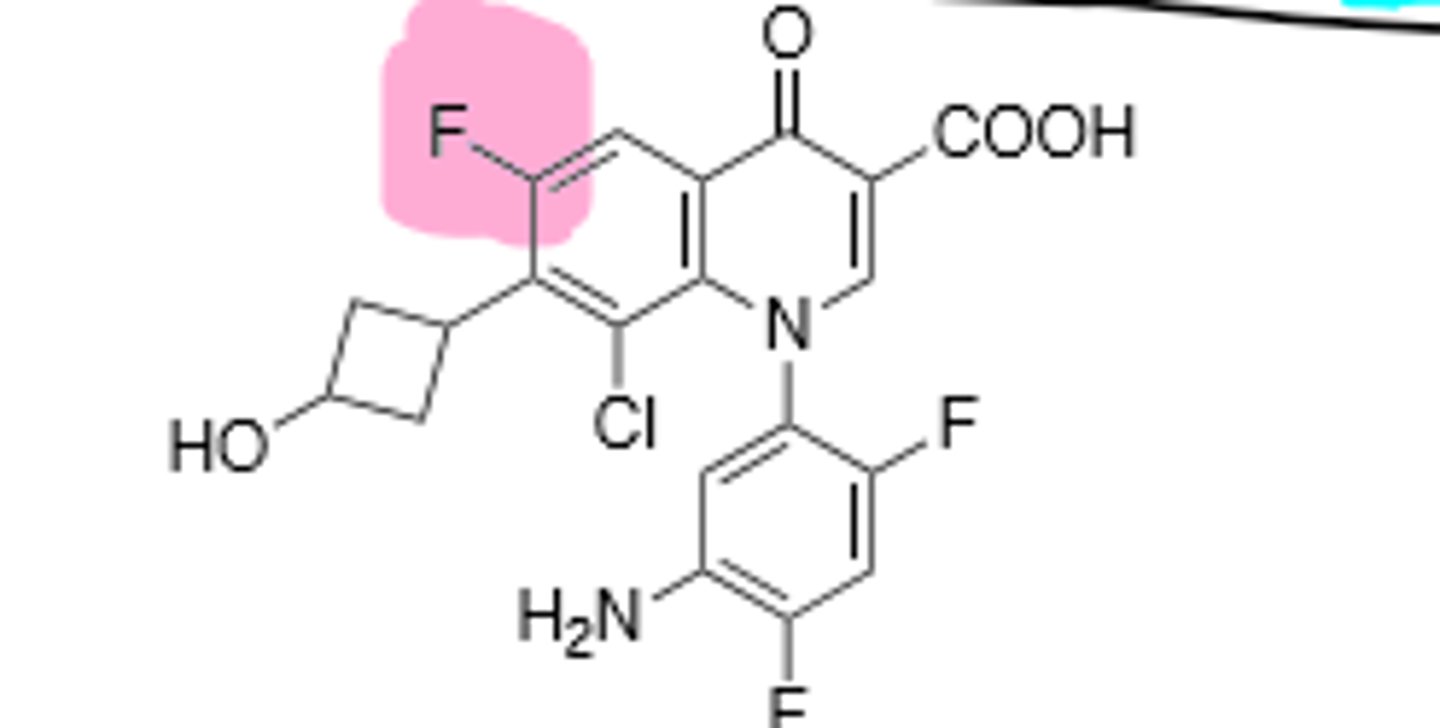
<p>New quinolone, approved for oral or IV use, improved activity against gram (+), but still hits gram (-). Inhibits DNA gyrase and topoisomerase IV in bacterial DNA production. Rare hallucinations, delirium, and sezirues in patients also taking NSAIDs and theophylline, don't give under the age of 18 due to growing tendons, risk of tendon rupture main resistance is point mutations in A and B subunit of DNA gyrase, leading to decreased binding affinity of quinolones to DNA gyrase.</p>
83
New cards

Gatifloxacin

New quinolone, approved for oral or IV use, improved activity against gram (+), but still hits gram (-). Inhibits DNA gyrase and topoisomerase IV in bacterial DNA production. Rare hallucinations, delirium, and sezirues in patients also taking NSAIDs and theophylline, don't give under the age of 18 due to growing tendons, risk of tendon rupture main resistance is point mutations in A and B subunit of DNA gyrase, leading to decreased binding affinity of quinolones to DNA gyrase. Associated with hypoglycemia and hyperglycemia in diabetic patients.
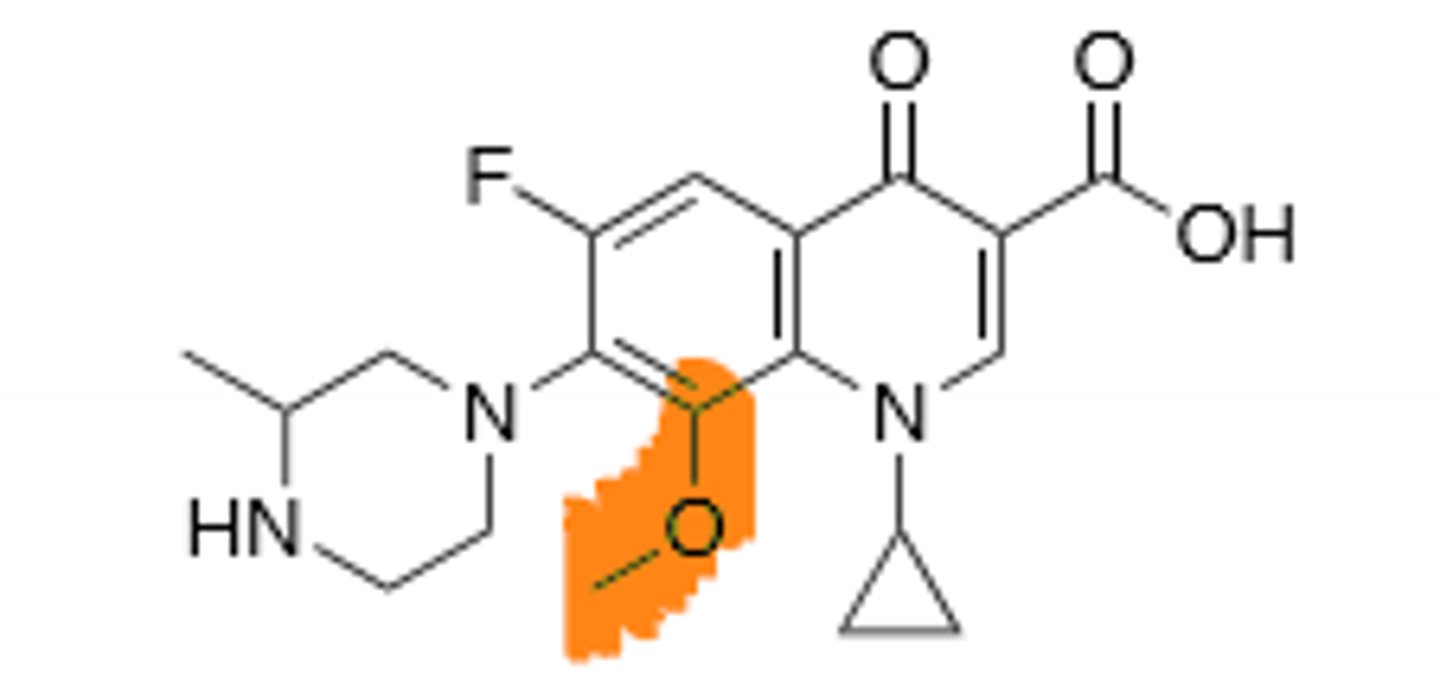
<p>New quinolone, approved for oral or IV use, improved activity against gram (+), but still hits gram (-). Inhibits DNA gyrase and topoisomerase IV in bacterial DNA production. Rare hallucinations, delirium, and sezirues in patients also taking NSAIDs and theophylline, don't give under the age of 18 due to growing tendons, risk of tendon rupture main resistance is point mutations in A and B subunit of DNA gyrase, leading to decreased binding affinity of quinolones to DNA gyrase. Associated with hypoglycemia and hyperglycemia in diabetic patients.</p>
84
New cards

Sulfanilamide

Sulfonamide, comes from prodrug prontosil, inhibition of p-aminobenzoic acid (PABA) into the folic acid nucleus, blocking Thymine synthesis in bacterial cells, preventing the creation of new DNA, leading to cell death. pKa of 10.4 allows drug to out compete PABA in physiologic pH, allowing for therapeutic effect. Broad spectrum. Commonly used in combination due to increased resistance mechanisms over the years. All drug class derivatives (Sulfas) are cross-allergenic. Crystalluria and hematopoietic disturbances, main resistance is from bacteria that cause overproduction of PABA, mutations in the target enzyme (dihydropteroate synthase), and mutations that decrease cell permeability. Metabolized by N-4-N-acetylation and sometimes N-1 glucuronidation
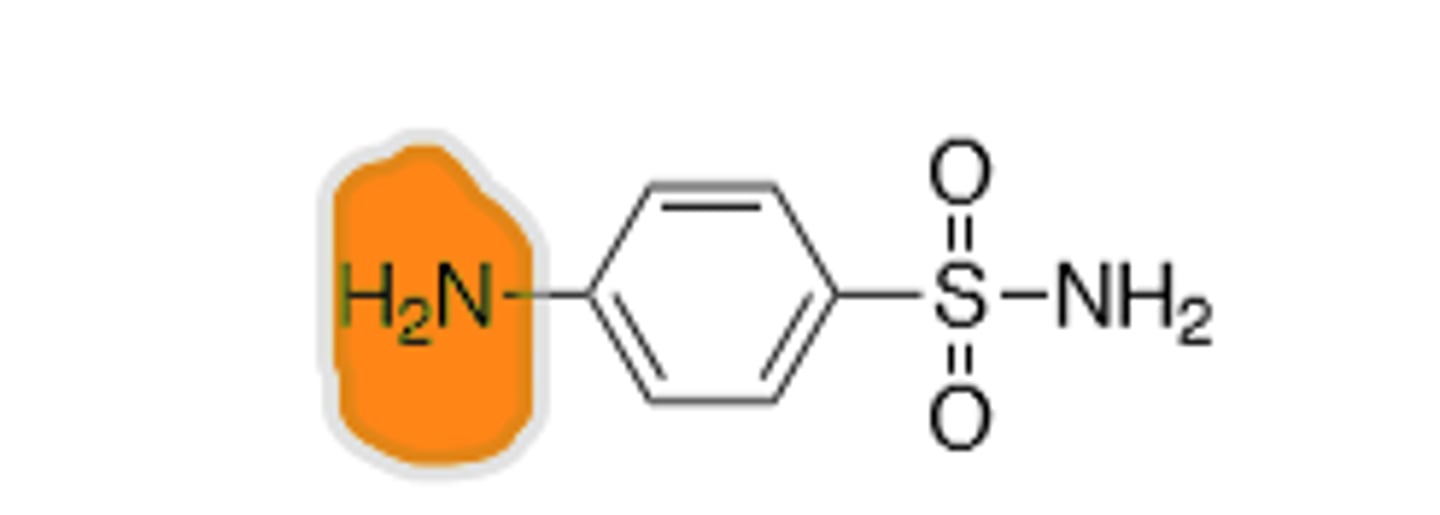
<p>Sulfonamide, comes from prodrug prontosil, inhibition of p-aminobenzoic acid (PABA) into the folic acid nucleus, blocking Thymine synthesis in bacterial cells, preventing the creation of new DNA, leading to cell death. pKa of 10.4 allows drug to out compete PABA in physiologic pH, allowing for therapeutic effect. Broad spectrum. Commonly used in combination due to increased resistance mechanisms over the years. All drug class derivatives (Sulfas) are cross-allergenic. Crystalluria and hematopoietic disturbances, main resistance is from bacteria that cause overproduction of PABA, mutations in the target enzyme (dihydropteroate synthase), and mutations that decrease cell permeability. Metabolized by N-4-N-acetylation and sometimes N-1 glucuronidation</p>
85
New cards

Sulfonamide Mechanism of binding to folic acid nucleus

The product is not capable of undergoing the next reaction --> No thymine
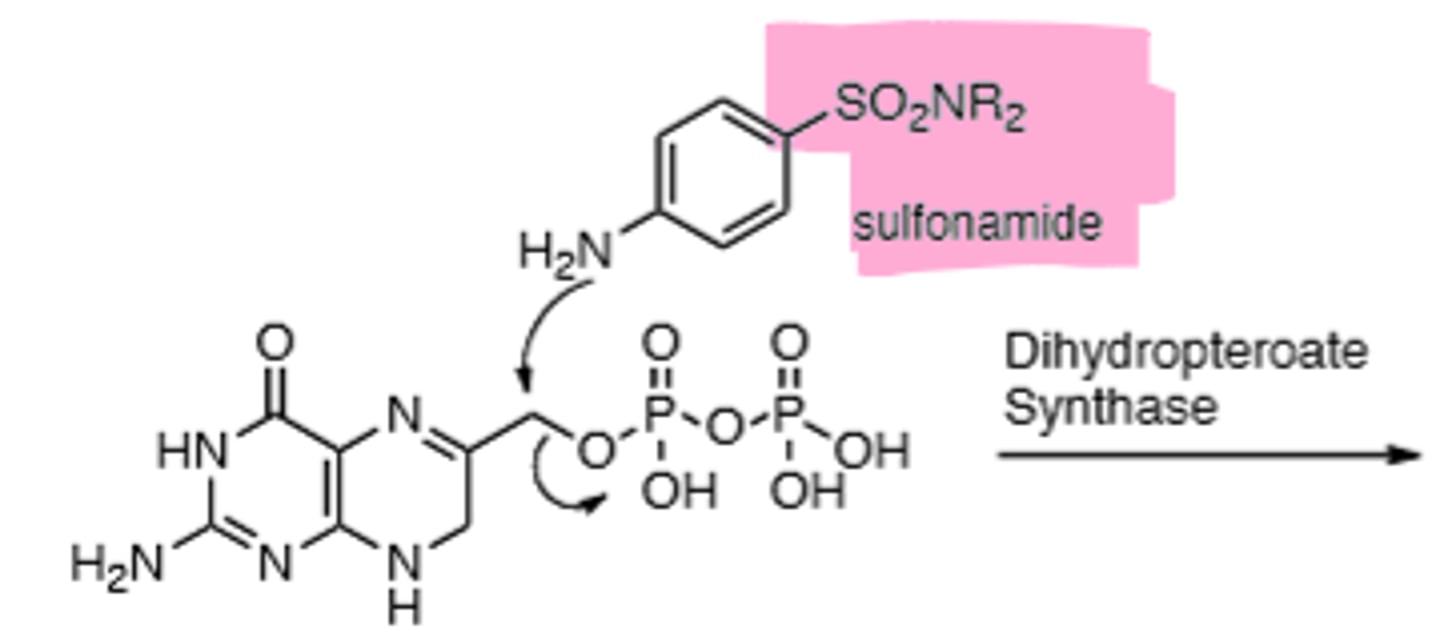
<p>The product is not capable of undergoing the next reaction --&gt; No thymine</p>
86
New cards

Sulfacetamide

Sulfonamide, comes from prodrug prontosil, inhibition of p-aminobenzoic acid (PABA) into the folic acid nucleus, blocking Thymine synthesis in bacterial cells, preventing the creation of new DNA, leading to cell death. Broad spectrum. Commonly used in combination due to increased resistance mechanisms over the years. All drug class derivatives (Sulfas) are cross-allergenic. Crystalluria and hematopoietic disturbances, main resistance is from bacteria that cause overproduction of PABA, mutations in the target enzyme (dihydropteroate synthase), and mutations that decrease cell permeability. Metabolized by N-4-N-acetylation and sometimes N-1 glucuronidation
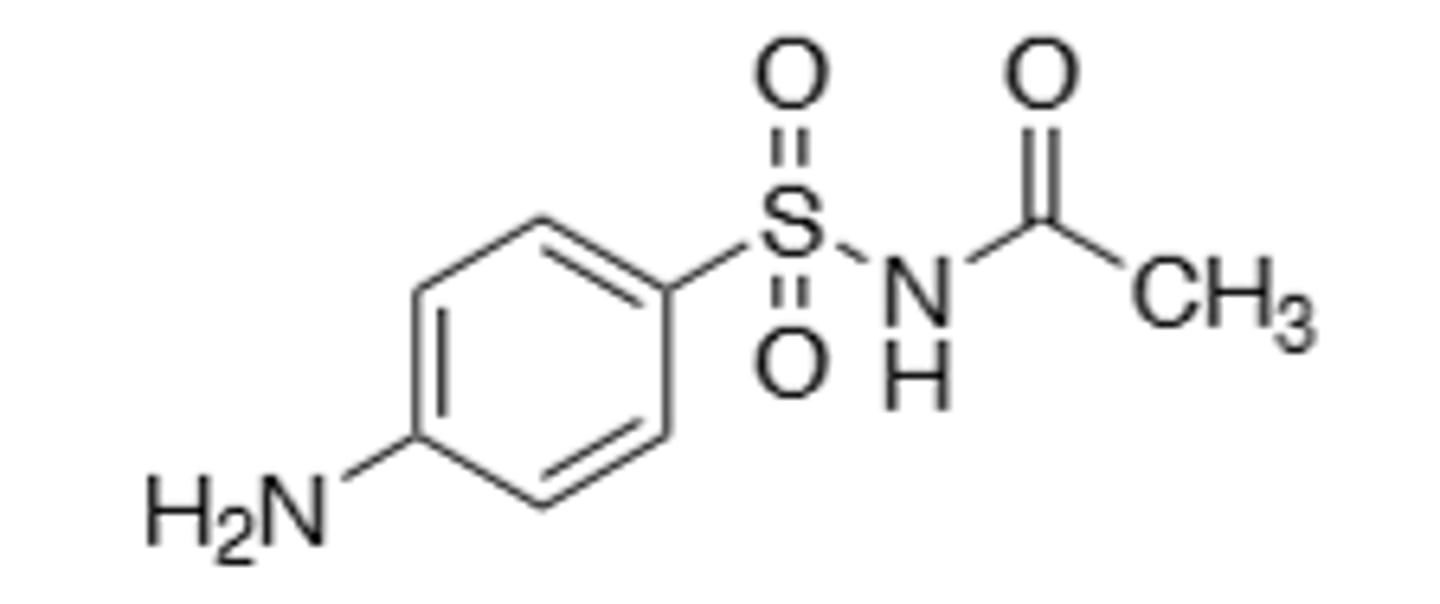
<p>Sulfonamide, comes from prodrug prontosil, inhibition of p-aminobenzoic acid (PABA) into the folic acid nucleus, blocking Thymine synthesis in bacterial cells, preventing the creation of new DNA, leading to cell death. Broad spectrum. Commonly used in combination due to increased resistance mechanisms over the years. All drug class derivatives (Sulfas) are cross-allergenic. Crystalluria and hematopoietic disturbances, main resistance is from bacteria that cause overproduction of PABA, mutations in the target enzyme (dihydropteroate synthase), and mutations that decrease cell permeability. Metabolized by N-4-N-acetylation and sometimes N-1 glucuronidation</p>
87
New cards
<p>Sulfadiazine</p>

Sulfadiazine

Sulfonamide, comes from prodrug prontosil, inhibition of p-aminobenzoic acid (PABA) into the folic acid nucleus, blocking Thymine synthesis in bacterial cells, preventing the creation of new DNA, leading to cell death. pKa of 6.6 allows drug to out compete PABA even more in physiologic pH, allowing for therapeutic effect. Broad spectrum. Commonly used in combination, especially with pyrimethamine due to increased resistance mechanisms over the years. All drug class derivatives (Sulfas) are cross-allergenic. Crystalluria and hematopoietic disturbances, main resistance is from bacteria that cause overproduction of PABA, mutations in the target enzyme (dihydropteroate synthase), and mutations that decrease cell permeability. Metabolized by N-4-N-acetylation and sometimes N-1 glucuronidation
<p>Sulfonamide, comes from prodrug prontosil, inhibition of p-aminobenzoic acid (PABA) into the folic acid nucleus, blocking Thymine synthesis in bacterial cells, preventing the creation of new DNA, leading to cell death. pKa of 6.6 allows drug to out compete PABA even more in physiologic pH, allowing for therapeutic effect. Broad spectrum. Commonly used in combination, especially with pyrimethamine due to increased resistance mechanisms over the years. All drug class derivatives (Sulfas) are cross-allergenic. Crystalluria and hematopoietic disturbances, main resistance is from bacteria that cause overproduction of PABA, mutations in the target enzyme (dihydropteroate synthase), and mutations that decrease cell permeability. Metabolized by N-4-N-acetylation and sometimes N-1 glucuronidation</p>
88
New cards

Sulfamethoxazole

Sulfonamide, comes from prodrug prontosil, inhibition of p-aminobenzoic acid (PABA) into the folic acid nucleus, blocking Thymine synthesis in bacterial cells, preventing the creation of new DNA, leading to cell death. Broad spectrum. Commonly used in combination, especially with trimethoprim due to increased resistance mechanisms over the years. All drug class derivatives (Sulfas) are cross-allergenic. Crystalluria and hematopoietic disturbances, main resistance is from bacteria that cause overproduction of PABA, mutations in the target enzyme (dihydropteroate synthase), and mutations that decrease cell permeability. Metabolized by N-4-N-acetylation and sometimes N-1 glucuronidation
<p>Sulfonamide, comes from prodrug prontosil, inhibition of p-aminobenzoic acid (PABA) into the folic acid nucleus, blocking Thymine synthesis in bacterial cells, preventing the creation of new DNA, leading to cell death. Broad spectrum. Commonly used in combination, especially with trimethoprim due to increased resistance mechanisms over the years. All drug class derivatives (Sulfas) are cross-allergenic. Crystalluria and hematopoietic disturbances, main resistance is from bacteria that cause overproduction of PABA, mutations in the target enzyme (dihydropteroate synthase), and mutations that decrease cell permeability. Metabolized by N-4-N-acetylation and sometimes N-1 glucuronidation</p>
89
New cards

Pyrimethamine

DHFR inhibitor, given with sulfadiazine
<p>DHFR inhibitor, given with sulfadiazine</p>
90
New cards

Colistin

Misc drug, last resort drug, displaces cations in the bacterial membrane, broad spectrum, given IM or intrathecally.
<p>Misc drug, last resort drug, displaces cations in the bacterial membrane, broad spectrum, given IM or intrathecally.</p>
91
New cards

Metronidazole

Misc drug, reduction of the (blue) nitro group leads to a radical ion that degrades bacterial DNA, selective cytotoxicity for anaerobic bacteria.
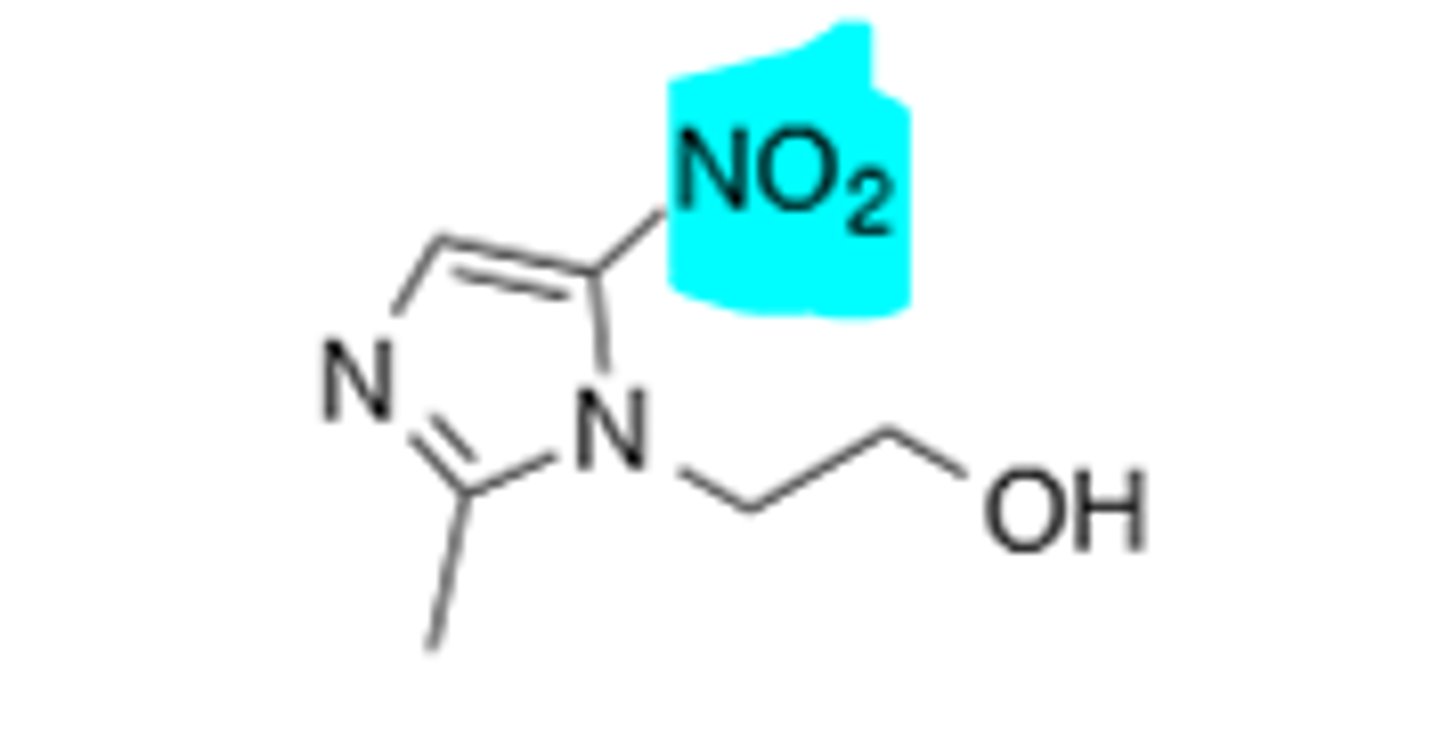
<p>Misc drug, reduction of the (blue) nitro group leads to a radical ion that degrades bacterial DNA, selective cytotoxicity for anaerobic bacteria.</p>
92
New cards

Metronidazole Nitro Group Radicalization

knowt flashcard image
93
New cards

Lefamulin Acetate

Selectively binds to peptidyl transferase center of the 50S ribosomal subunit to prevent protein synthesis.
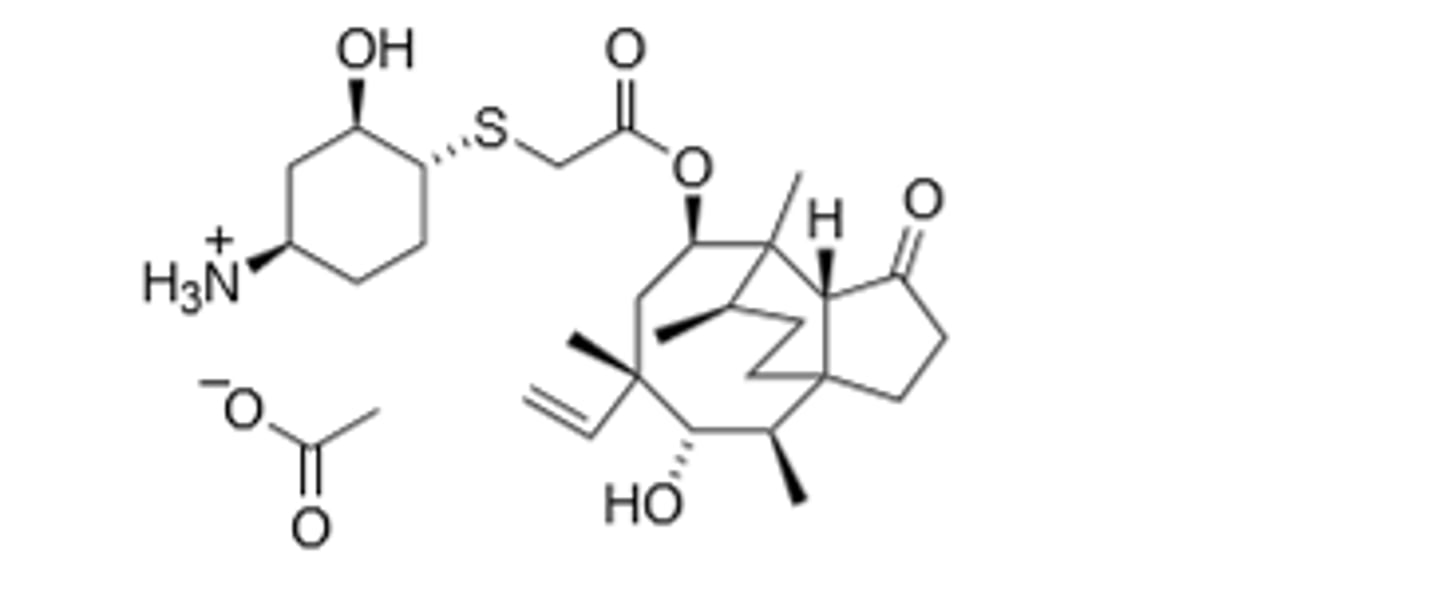
<p>Selectively binds to peptidyl transferase center of the 50S ribosomal subunit to prevent protein synthesis.</p>
94
New cards

Pretomanid

Inhibits mycolic acid biosynthesis through an unknown mechanism, and poisons mitochondria through nitric oxide generation
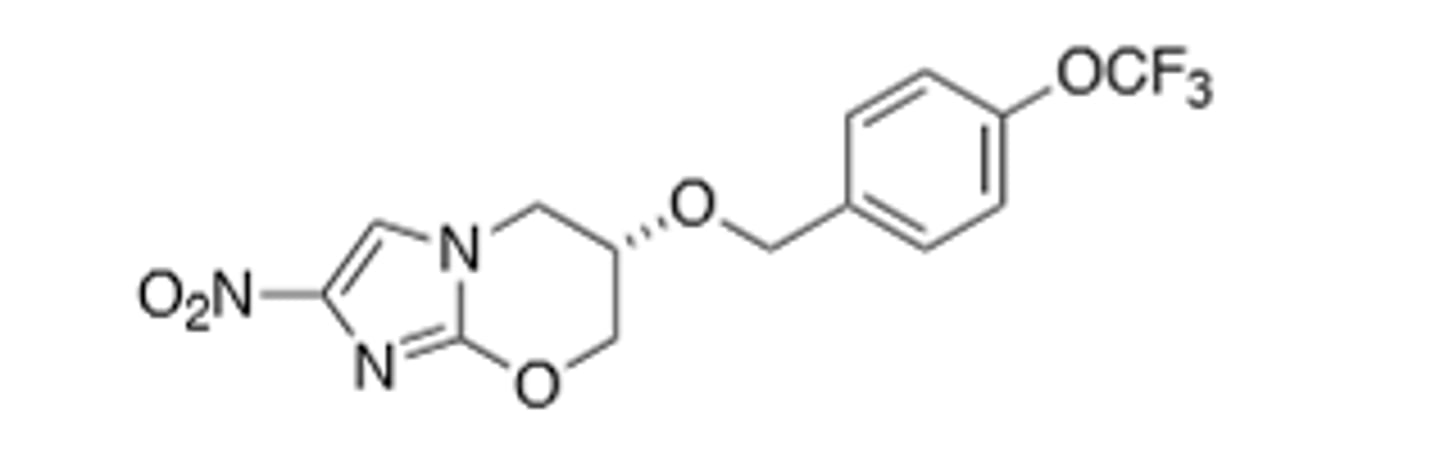
<p>Inhibits mycolic acid biosynthesis through an unknown mechanism, and poisons mitochondria through nitric oxide generation</p>