Chapter 13 - Social cognition
 Studied by 0 people
 Call with Kai
 Learn
Learn Practice Test
 Spaced Repetition
 Match
Match Flashcards
 Knowt Play
1/33

There's no tags or description
Looks like no tags are added yet.
Name | Mastery | Learn | Test | Matching | Spaced | Call with Kai |
|---|
No study sessions yet.
34 Terms
Autism spectrum disorder
A group of neurodevelopmental mentral disorders that include autism, Asperger’s syndrome, childhood disintegrative disorder, and pervasice developmental disorder not otherwise specified. Characterized by deficits in social cognition and social communication odten associated with an increase in repetitive behavior or obsessive interests
Autoscopic phenomena
A visual body illusion that affects the entire body. Out-of-body hallucinations, autoscopic hallucinations, and heautoscopy are three types
Default network
A network of brain areas that is active when a person is at wakeful rest and not engaged with the outside world.
Embodiment
The feeling of spatial unity between the “self” and the body
Empathic accuracy
The ability to accurately infer the thoughts, feelings, and/or emotional state of another person.
Empathy
The ability to experience and understand what others feel while still knowing the difference between oneself and others.
Experience sharing theory (simulation theory)
A theory proposing that we do not need to have an elaborate theory about the mind of others in order to infer their thoughts or predict their actions. We simply observe someone else’s behavior, simulate it, and uise our own mental state produced by thet simulation to preduct the mental state of the other.
False-belief task
A task that measures the ability to attribute false beliefs to others
Imitative behavior
The spontaneous and uncontrolled mimicking of another person’s behavior that is sometimes exhibited by patients with frontal lobe damage.
Joint attention
The ability to monitor someone else’s attention by observing that person’s gaze or actions and directing one’s own attention similarly.
Mental state attribution theory (theory theory)
A theory proposing that we acquire a commonsense “folk psychology” and use it, somewhat like a scientific theory, to infer the thoughts of others.
Reversal learning
An attempt to teach someone to respond in the opposite way from what they were previously taught
Self-reference effect
An effect rooted in the theoretical perspective that the recall or information is related to how deeply the information was initially processed. The superior memory for information that is encoded in relation to oneself.
Social cognitive neuroscience
An emerging field of brain science that combines social-personality psychology and cognitive neuroscience with the goal of understanding the neural mechanisms involved in the social interaction of humans
Theory of mind (mentalizing)
The ability to attribute mental states such as beleifs, desires, thoughts, and intentions to others and to understand that they may be different to one’s own.
Xenomelia
A rare condition in which able-bodied individuals report experiencing a lifelong desire for the amputation of one or several of their limbs because they fo not feel that the limb belongs to their body
• Compared to touch on accepted body parts and in controls, touch on the undesired limb elicited no cortical response in the right superior parietal lobule.
• Findings by Chamachandran were replicated by group in Zurich: Cortical thickness is decreased (blue) in the superior parietal lobule (SPL) and increased (red) in the central sulcus (CS) in participants with xenomelia compared with control participants.
• Also, cortical surface area is decreased in the anterior insular cortex (AIC), primary somatosensory leg representation (S1 leg), secondary somatosensory cortex (S2), and inferior parietal lobule (IPL) of participants with xenomelia.
Anatomical substrates of social cognition
• Humans have unique social skills compared to other species.
• Prefrontal cortex is important in cognitive control and also social cognition.
• Ventromedial prefrontal cortex (vmPFC) is important for selfreferential processing.
• Orbitofrontal cortex important for processing reward but also important in social cognition (see case of Phineas Gage).
• Prefrontal cortex develops much later and as a result social cognition also develops throughout childhood and adolescence.
• Research in rats showed to social deprivation in child/adolescence greatly impedes rat’s social development.
• Socially deprived rats show increased aggression, anxiety and fear.
• But also interaction with nonplayful and atypical rat results in social deficits.
Paradigms of social cognition (Socrates’s know thyself)
• Knowing yourself involves the physical you (“Is this my arm?”) as well as unobservable essence of you (your traits, memories, experiences, etc.)
• Self-referential processing: people remember information much better when it relates to themselves compared to others.
• Self-referential effect may be due to the self having a unique mnemonic organization and also more knowledge about oneself.
• MPFC activity increases with self-referential processing.
• Greater activity of the medial prefrontal cortex (MPFC) is associated with self-referential processing when compared to processing words in relation to another person (“other”) or in relation to the printed format of the words.
Klein et al
• Is sense of self linked with memories of past behaviours of oneself?
• Self-Judgment condition in which participants had to describe whether a certain personality trait word was applicable to them
• Autobiographical condition: retrieve when you exhibited this personality trait
• Definition condition: define the personality trait word.
• 2 weeks later participants performed same tasks but half of adjectives were previously seen and other half were new.
• If self-description rely on searching episodic memory for examples, participants should be faster when asked about a personality characteristic that they considered in relation to themselves.
• Results revealed that this was not the case.
• Thus, these results suggest that judgments about self-descriptions are not linked to recall of specific past behaviours.
• Patient studies support this conclusion.
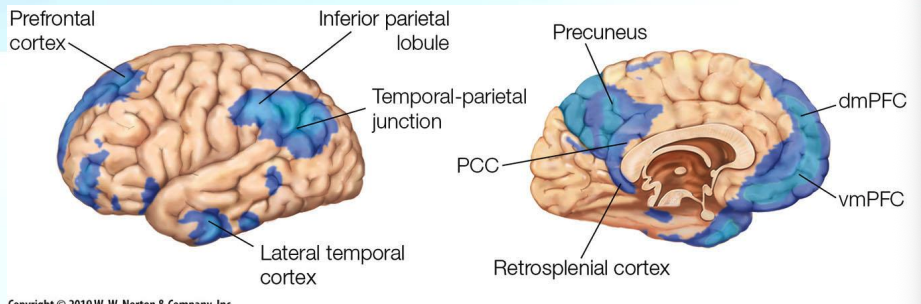
Default mode network
• Combined data from nine positron emission tomography (PET) studies showing the regions that were most active during passive tasks (in blue), which is referred to as the default mode network (DMN). The lateral (left) and medial (right) surfaces of the left hemisphere are shown.
• Activity in the dorsomedial prefrontal cortex (dmPFC) increases during tasks that involve self-referential mental activity or self-focused attention and decreases during tasks that involve externally focused attention.
• This finding is consistent with the observation that during goal-directed behaviors, self focused attention decreases, and it also indicates that at baseline, some degree of selfreferential mental activity should be engaging this region—a suggestion that has been supported by functional imaging data.
Self-perception as a motivated process
• Various studies have shown that people have unrealistically positive self-perceptions:
• 70% of high school students rank themselves as above average in leadership skills.
• 93% of college professors believe they are above average at their work.
• More than 50% of people believe they are above average in intelligence, physical attractiveness etc.
• Less deactivation in the anterior cingulate was associated with rating positive personality traits in comparison to negative personality traits. vACC = ventral anterior cingulate cortex.
• These results suggest that the vACC is important for distinguishing positive selfrelevant information from negative self-relevant information.
Orbitofrontal damage and self-perception
• However, accurate selfperception is essential for appropriate social behavior.
• Patients with orbitofrontal damage tend to have unrealistically positive self-views along with inappropriate social behavior.
• Yet question is: is behavior of orbitofrontal patients due to lack of insight into their own behavior or because they are unaware of social norms?
• Beer et al (2006): videotaped healthy controls, orbitofrontal and lateral prefrontal cortex patients while they engaged in a structured social interaction with a stranger.
• The stranger made conversation with the participants by asking them a series of questions
• Unlike the other two groups, orbitofrontal patients tended to bring up impolite conversation topics.
• When shown the video, they became embarrassed by their social mistakes.
• OFC is important for spontaneous, accurate selfperceptions and that rather than being unaware of social norms, OFC patients demonstrate lack of insight.
Body ownership and embodiment
• Embodiment: feeling of spatial unity between the “self” and the body.
• Blanke (2002) stimulated angular gyrus/TPJ in patients during surgical procedure.
• This created an ”out-ofbody”(OBE) experience for the patient.
• During an OBE, a person seems to be awake yet sees his body and the world from a location outside his physical body.
Autoscopic phenomena: including OBE (damage to right temporoparietal cortex)
• The second AP is autoscopic hallucination: people do not feel they left their body but they see a double of themselves in extrapersonal space. (right temporo-occipital or parieto-occipital cortex)
• The third AP is heautoscopy: the experience of seeing a double in oneself in extrapersonal space but being unsure of whether one feels disembodied or not. (left temporoparietal lesions)
neural correlates of experience sharing theory
• mPFC self/other overlap may be dependent on how similar we perceive ourselves to the other person: the more similar the more overlap in mPFC activity.
• However, other researchers suggest it is the level of relatedness (familiarity, closeness, emotional importance etc.) between people that determines mPFC self/other overlap: similar mPFC is active for romantic partners even though they perceived themselves as being different.
Mirror neurons
• Mirror neurons (MNs) are also often use as explanation for understanding others.
• Michael applied cTBS (theta-burst stimulation) to premotor cortex (PMC) which is known to activate during action observation.
• Task involved three component of action understanding: motion (simple) task, proximal (intermediate) task, distal goal (complex) task.
• cTBS over hand area in PMC resulted in decreased recognition of hand movements but not lip movement. cTBS to lip area decrease recognition of lip movement but not recognition for hand movement.
• These findings show that somatotopic regions in PMC play causal role in understanding action understanding and there is overlap between mechanisms of action understanding and action performance.
Empathy and neurological responses
• Empathy is our capacity to understand and respond to the unique affective experiences of another person and MNs may play a mechanistic role.
• fMRI study found that experience of disgust and perception of facial expressions of disgust activate similar regions within the anterior insula.
• Also, the magnitude of insula activation when observing facial expressions of disgust increases with the intensity of the other person’s facial expression of disgust.
• Both ACC and insula are similarly activated when we experience pain ourselves and seeing pain in romantic partner.
• Those participants who scored high on empathy questionnaire showed the greatest activation in ACC and insula.
Self-other distinctions
• Murray et al (2012) performed metaanalysis of 23 fMRI studies and 2 PET studies that compared self-relevant processing against processing of close others and of public figures.
• Anterior insula was active when appraising and processing information about the self and close others but not about public figures.
• Ventral and dorsal ACC showed activity for self-specific processing and was not active during appraisal of close others and public figures.
• Thus ventral and dorsal ACC is active for self related stimuli and self-reflection and action monitoring.
Modulation of empathetic responses
• Decety conducted study in Taiwan in acupuncturist versus controls in perceiving non-painful and also painful stimulation.
• Controls has more activity in insula and ACC during painful stimulation
• Acupuncturists had more activity in mPFC and TPJ (involved in selfregulation).
• Thus, activation of MNs can be modulated by goal-directed processes
• Viewing subjectively positive plays (when the rival team failed) increased the response in the ventral striatum, whereas failure of the favored team and success of the rival team activated ACC and insula and correlated with subjective pain rating. (Cikara et al, 2011)
Neural correlates of Mental State Attribution Theory
Participants either had to make inference about the personality in the picture or had to remember which order statements were presented in relation to a particular face
• Both conditions require participants to think about other people, but only the impression formation task requires to think about the internal states of those people.
• Results revealed that the mPFC is more active in impression formation task than sequencing task.
• mPFC important for reasoning about mental states of other
• Then in main experiment, researchers found that TPJ is activated when participants were presented with the information about a mental state compared to information about a social background or life event. (Saxe)
• Currently: multiple hypotheses. Overall, TPJ is likely to play a role in specialized reasoning about mental states of others, whereas mPFC supports broader reasoning about other people, including – but not limited to – their mental states.
Role of superior temporal sulcus
• Pelphrey et al examined nonverbal cues and mentalizing.
• Participants watched an animated woman who directed her attention either toward or away from a checkerboard.
• Activity in the STS was prolonged when participants looked away from the checkerboard (incongruent condition).
• The researchers conjectured that when the figure unexpectedly did not look at the target, observers were surprised and reformulated their expectation. This process takes longer, so the STS activity was prolonged in the incongruent condition.
Autism Spectrum Disorder and the mental state of disorders
• ASD is associated with a number of anatomical differences compared to controls.
• ASD have hyperconnectivity (increased connectivity) with frontal cortex as well as decreased long-range connectivity and decreased reciprocal interactions with other cortical regions.
• ASD compared to controls have different white matter connectivity in various parts in the brain (including frontal cortex). No single brain region is associated with ASD.
• DMN involved in social, emotional and introspective processing; and ASD have abnormal activity in DMN.
• In participants with ASD, there is no change in MPFC activity when they are switching from a resting state or doing an active task (number task).
• Evidence suggests that MPFC is not active as much in ASD compared to controls.
• Researchers found reduced vmPFC and vACC activity in ASD compared to controls in all judgment tasks as well as resting state condition, suggesting activation reductions are independent of task.
• However, activity in dmPFC and PCC was decreased in ASD vs controls for the internal task, but slightly increased during external task.
• Thus, these findings suggest that social deficits in ASD are due partially to the fact that their brains are not being constantly prepared for the type of social though that marks social cognition.
Mirror neurons in ASD
• Researchers have wondered whether there is a link between MNN and ASD.
• Cattaneo designed an experiment to understand motor intentions in ASD and control children.
• The task involved reaching, grasping and bringing the object to mouth or container.
• Task was done by themselves and also observing an experimenter doing it.
• Measured the mylohyoid (MH) muscle involved in the mouth opening.
• In typical development (TD) children MH was activated early in reaching and grasping phases of both carrying out a grasping-for-eating task (figure a) and observing a grasping-for-eating task (figure c).
• In ASD children, the MH was only activated in bringing-to-the-mouth action (figure b) and no MH activity occurred during observation of the task (figure d).
• This suggests that individual motor acts are not integrated into an action chain in ASD children, so they lack a full comprehension of the intention of others.
Social knowledge and the OFC
• Orbitofrontal cortex (OFC) is important for applying appropriate rules in social setting.
• Stones and colleagues tested OFC patients in a social task (Jeanette and Anne and the vase).
• OFC patients did not perform well on the test and exhibit decreased ability to apply their social knowledge to certain scenarios.
• Beer et al. (2003) found that OFC patients use unflattering nicknames for the experimenter compared to controls.
• OFC patients were not embarrassed.
• Without awareness of their mistakes, OFC patients never generate the emotional feedback they need to change their future behaviour.
Moral decisions (The trolley problem)
• Greene et al argued that the level of personal involvement is different in both scenarios. One is more distanced and one is more involved.
• fMRI results revealed distinct neural activations of personal vs impersonal decisions.
• Impersonal decisions activated lateral PFC and bilateral parietal lobe (both involved in working memory)
• Personal decisions activated medial PFC, PCC and amygdala.
• These studies suggest that the differences in our moral decisions are related to the extent that we permit emotions to influence our decisions about what is morally acceptable.
 Note
Note  Flashcards (87)