Psych 1101 Cornell FINAL
 Studied by 0 people
 Call Kai
 Learn
Learn Practice Test
 Spaced Repetition
 Match
Match Flashcards
 Knowt Play
1/117

There's no tags or description
Looks like no tags are added yet.
Name | Mastery | Learn | Test | Matching | Spaced | Call with Kai |
|---|
No analytics yet
Send a link to your students to track their progress
118 Terms
Psychology
Scientific study of mind and behavior
What is scientific explanation?
satisfying explanation invokes a simple right-to-the-point question.
Problems in the practice of science?
- Replicability
-p-hacking
- fraud
replicability
Run the study again.
- Allows you to examine if a finding isreliable
- Replications can be tricky to interpret
- Design differences
- Underpowered failed replications
- Replication successes that are inconsistent withoriginal
p-hacking
exploiting researcher degrees of freedom to get significant results
p- hacking example
Does Psych 1101 make students happier?
• 2 groups: psych 1101 vs. control class(oceanography)• Outcome: ratings of happiness
• Researcher degrees of freedom:
- When do we end data collection?
- Do we exclude students who did not attend xnumber of classes?
- Which questions do we use to measure happiness?
- Do we "control for" baseline levels of happiness?
Fraud
making up or manipulating data
- False positive psychology
- Prevalence of questionableresearch practices
Pre-Registration
Data analysis plan posted before they are analyzed
What is the importance of pre-registration?
- Distinguishes confirmatory/exploratory analyses
- Reduces p-hacking
What does it mean to say that a study is "underpowered"?
Power: capacity to detect effects assuming they are there
Many studies do not collect sufficient observations to detect the effects
Correlation vs. Causation
Correlation is the relationship between between two variables probability that the variables are closely related to one another.
Causation the determination that one variable causes—is responsible for—an effect.
Falsifiability
the ability of a claim to be tested and—possibly—refuted
Three dimensions of methods
observation vs. experiment, lab vs field, self-report vs behavior
Observation vs. Experiment
observational designs provide good data but they cannot determine causality vs isolating variables in order to determine causality, Control vs. Experimental, Random assignment
The dependent variable
Measure the outcome
Independent Variable (IV)
Manipulate something
lab vs field
lab takes place in a laboratory environment under controlled conditions. Fieldwork is more random and spontaneous.
self report vs behavior
behavioral measures responses to uncommon stimuli in structured situation, whereas self-report measures ask participants to reflect on their behaviors across a variety of unstructured situations
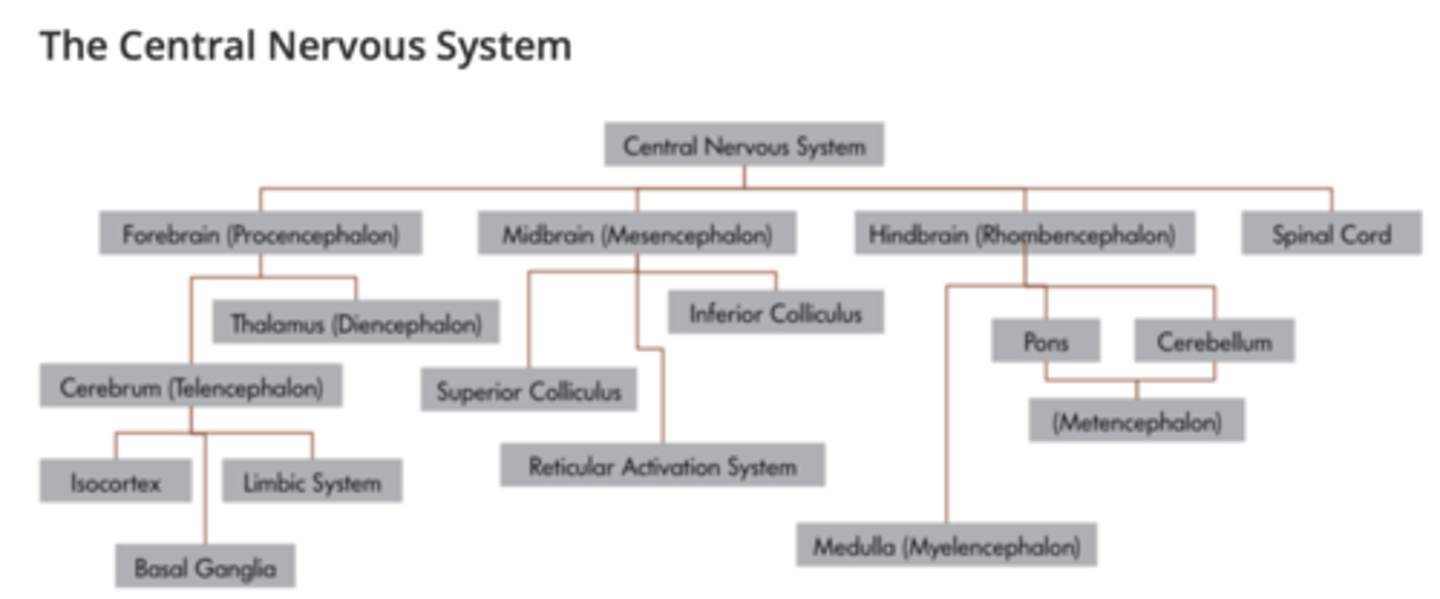
Central Nervous System (CNS)
divided into a number of important parts including the spinal cord
4 main parts:
1. Forebrain (Procencephalon)
2. Midbrain (Mesencephalon)
3. Hindbrain (Rhombencephalon)
4. Spinal Cord
Left and Right Hemispheres of the Brain
brain is divided into two halves
Left Brain
- resoning
- language
- right hand control
Right Brain
- creativity
- left hand control
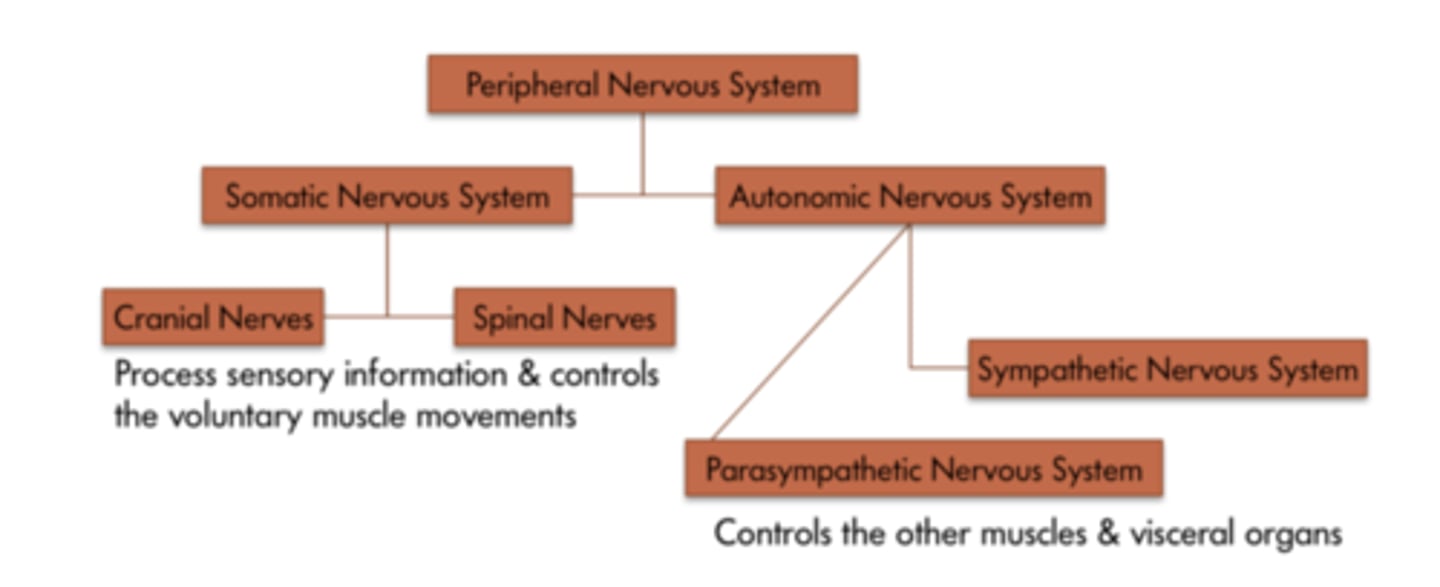
Peripheral Nervous System (PNS)
Peripheral divided into somatic and autonomic nervous systems
Autonomic nervous: sensory information an involunterary muscles movement.
Somatic nervous system: volitional actions
Localization vs plasticity
Argument between people who think that the brian is one or the other.
Neuroplasticity: Changes in the physical structure and functional organization of the brain due to experience
- learning
- re-mapping of sensory cortex
- can occur after brain damage
- can be positive or negative
ex. Daniel Kish uses echolocation( sound) to navigate the world as a blind man
Localization: the idea that certain functions have certain locations or areas within the brain.
ex. seeing words, hearing words, reading words, and generating verbs
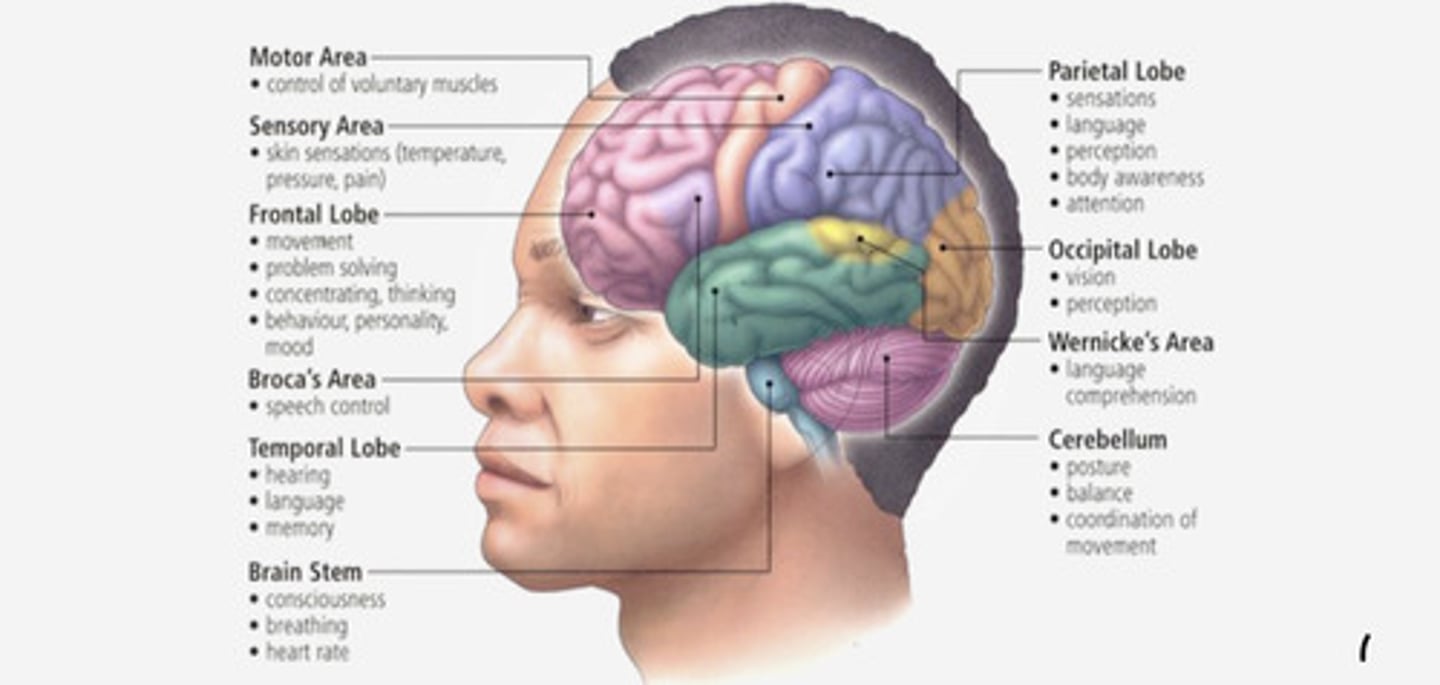
Basic structures of the brain associated with psychological functioning
know the ones associated with perception and sensation.
The parietal lobe is a cerebrum area just behind the central sulcus engaged with somatosensory and gustatory sensation.
- sensations
- language
- perception
- body awareness
Occipital lobe- The back part of the cerebrum, which houses the visual areas.
- vision
- perception
Frontal: movement, problem-solving, mood personality
Temporal: learning, language, memory
cerebrum: consists of left and right hemispheres that sit at the top of the nervous system and engage in various higher-order functions, and movements.
imaging methods
Neuroimaging tools are used to study the brain in action
Functional magnetic resonance imaging (fMRI)
- relies on blood flow in the brain.
- measures the changes in oxygen levels in the blood and does not require any substance to be injected into the participant.
- good spatial resolution and poor temporal resolution
- not very precise when the activity occurred.
Computerized axial tomography (CAT) or MRI scanners
reveal high precision structures in the brain and can help detect changes in gray or white matter.
Positron emission tomography (PET)
measures brain activity by detecting the presence of a radioactive substance in the brain that is initially injected into the bloodstream and then pulled in by active brain tissue.
- records blood flow in the brain.
Electroencephalography (EEG),
measures the electrical activity of the brain
- greater temporal resolution (millisecond precision rather than seconds)
Diffuse optical imaging (DOI)
A neuroimaging technique that infers brain activity by measuring changes in light as it is passed through the skull and surface of the brain.
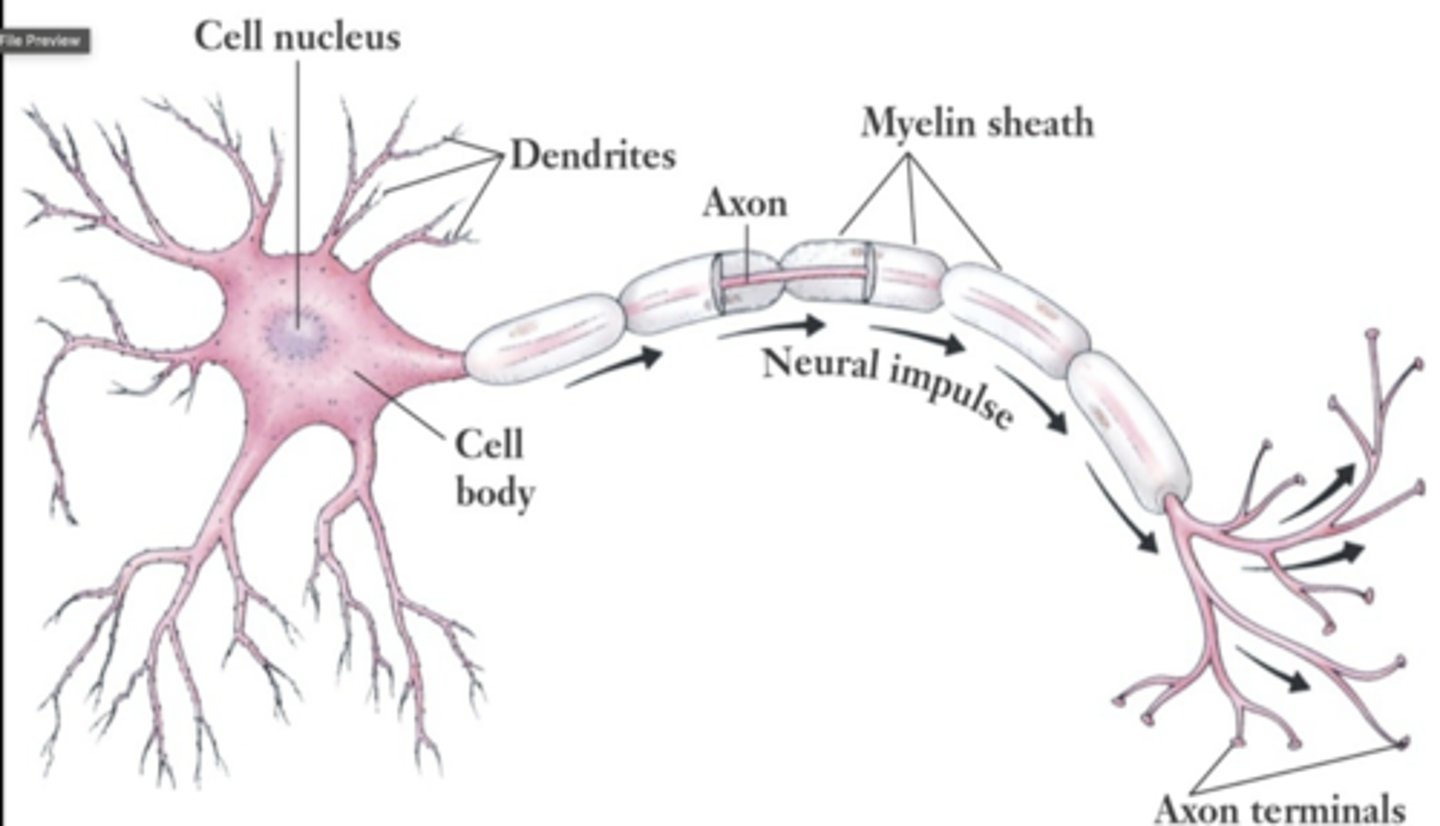
Structure of a Neuron (axon, dendrite, etc.)
Sensory (afferent) neurons, motor (efferent) neurons,interneurons
• Characterized by all-or-nothing response
Primary neurotransmitters and their functions (incl. how certain drugs act by increasing or decreasing these)
GABA (gamma-aminobutyric acid)
- main inhibitory neurotransmitter in the brain (low GABA linked to generalized anxiety disorder)
Endorphins
- relief from pain or the stress of vigorous exercise and produce feelings of pleasure and well-being (responsible for pleasure of sex/orgasm, eating appetizing foods, etc.). Acetylcholine
- stimulates muscle movement, memory, arousal, attention, mood Norepinephrine/noradrenaline
- affects eating habits
- major role in alertness and wakefulness, fight-or-flight Dopamine
- called monoamines, produces both excitatory and inhibitory effects
- several functions: learning, attention, and movement
- gives you the feeling of reward through pleasure and addiction
ex. cocaine and amphetamines act by boosting dopamine. Too much dopamine-boosting and you'll get amphetamine psychosis.
Serotonin
- important in regulating mood, sleep, impulsivity, aggression, and appetite
How Drugs Affect Neurotransmitters
- influence the chemical precursors of a transmitter substance
- prevent the storage of the transmitter substance in vesicles
- inhibit or stimulate the release of the transmitter substance
- block postsynaptic receptors
- block reuptake of free-floating transmitter substance
Agonists and Antagonists
Agonists are substances that bind to synaptic receptors and increase the effect of the neurotransmitter.
Antagonists also bind to synaptic receptors but they decrease the effect of the neurotransmitter.
Sensation
acquiring basic/raw information about theworld through the five senses
Perception
- making sense of the information,changing it into something useful
Perception is a difficult problem
- The mind uses a number of “tricks” to make sense of all of the incoming sensory information efficiently.
ex. visual perception: our mind makes certain assumptions about the environment despite having limited data to work with. Happens quickly, automatically, uncontrollably
- Shadows make surfaces darker
ex. When we see a surface in shadow, we automatically assume it is lighter than it look
Transduction
turning sensations into what the brain can use, the conversion of one form of energy into another.
- Brain transduces incoming information (e.g., light waves, soundwaves, particles)
Binocular vs Monocular Depth cues
Binocular disparity
- images giving slightly different info to each eye
Monocular depth cues
- depth cues that are able to be perceived without both eyes. ex.
> Relative Height: Things at a distance look like their base is higher.
> Relative Size: Objects farther away from other objects are smaller (Fig.
Convergence
at close distances, how much your eye is "crossed" gives the brain info about depth.
Gestalt properties of object perception
- similarity- your brain lumps things together when they have a similar texture
- proximity- your brain lumps things together because they are close together
- closure: incomplete information your brain completes for you, brain automatically closing that gap
- common movement: when things move together you are more likely to perceive as objects
- good continuation: one line seems continence so don't perceive them as two
The McGurk Effect
- when a person perceives that another's lip movements do not correspond to what that individual is saying.
- occurs when an individual perceives a mismatch between the auditory speech sounds they hear and the visual movements they see while someone is speaking.
The stages of sleep and their associated brain waves
Stage 1
• Stage when first
falling asleep (hypnagogia)
. theta waves
Stages 2 through 3/4
(slow-wave sleep)
• light sleep
•processing of memories
• high-intensity brain waves
• 55% of all sleep
Stage 3
• sleep lightens
• greater muscle relaxation
- Delta waves
- makeup 20-25% of sleep
REM sleep
• rapid eye movement
• resemble beta waves
• Brain waves similar to
wakefulness
• associated with dreaming
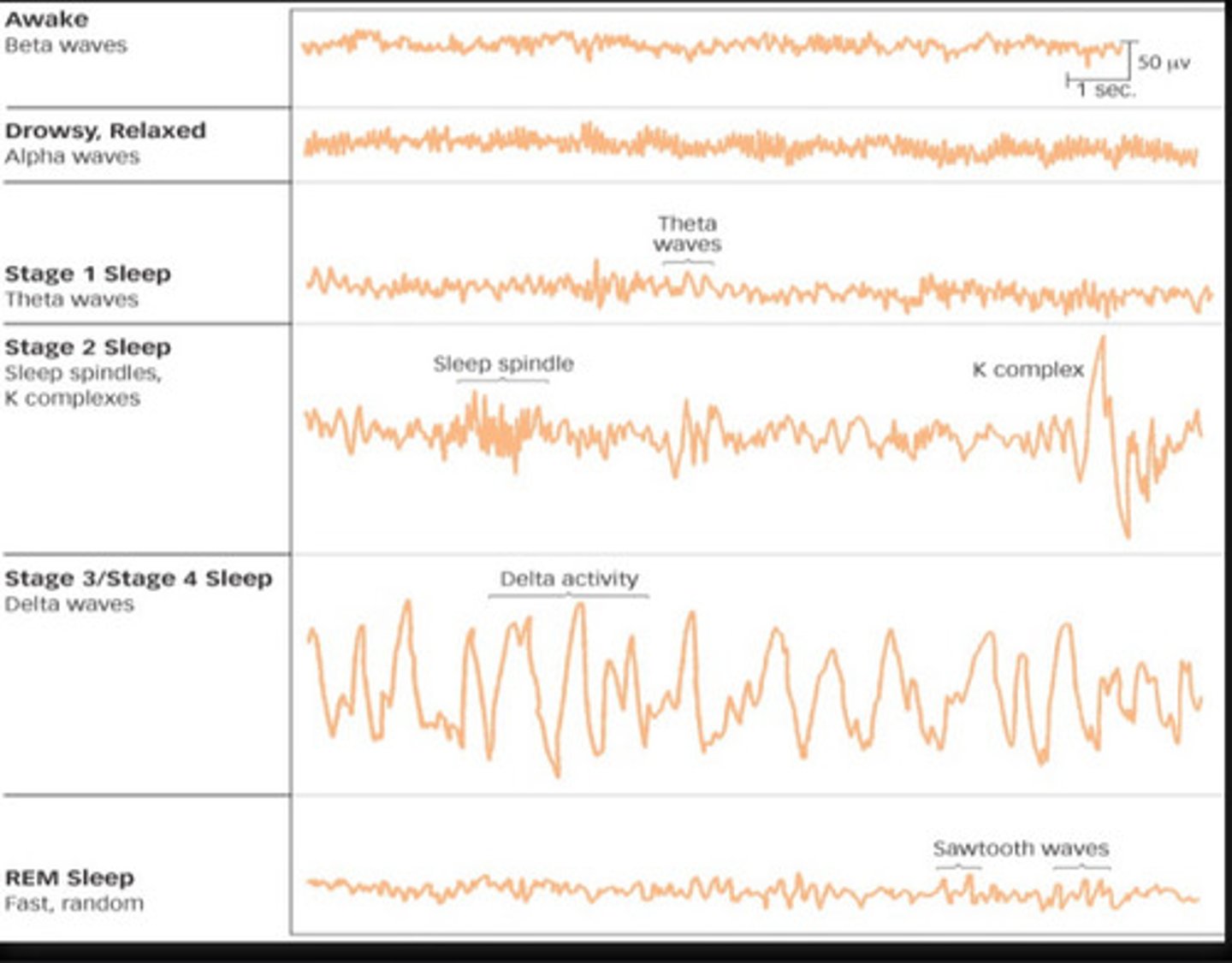
What happens during REM sleep?
• EEG patterns that
resemble beta waves of alert
wakefulness
• Muscles most relaxed
• Rapid eye movements occur
• Dreams occur
• Four or five sleep cycles occur in a
typical night's sleep
Primary theories as to why we sleep
Conservation
• Comparing energy use from sleep to wake shows that there is little gained
Restoration
• The body is recuperating at a genetic level
Memory consolidation/neural synthesis
• important connections are linked, strengthened
• we do better at memory tasks when we "sleep on it"
• we are more creative when rested
Common sleep disorders
Insomnia
Sleep Apnea
Narcolepsy
Sleep Paralysis
Night Terrors
REM Behavior Disorder (RBD)
Insomnia
• difficulty in falling or staying asleep
Sleep Apnea
• person stops breathing for brief periods
while asleep
Narcolepsy
• sudden sleep attacks occur in the middle of
waking activities
Sleep Paralysis
• the experience of waking up unable to move
Night Terrors
• abrupt awakenings with panic and intense emotional arousal
• occurring during slow-wave sleep Somnambulism (sleepwalking)
• non-REM parasomnia (2-14% of children)
REM Behavior Disorder (RBD)
• Disorder in which people act out their dreams
Freud's three part structure of the mind (and how each isdescribed)
• Id - "dumb," driven by instinct, present from birth
- can't distinguish reality vs. fantasy
-operates according to the pleasure principle
- unconscious mind
• Ego develops out of the id in infancy
-understands reality and logic
-mediator between id and superego
- conscious mind
• Superego
-internalization of society's moral standards
-responsible for guilt
- unconscious mind
Freud's stages of psychosexual development (and associated ages)
Oral Stage (Birth - 1 Year)
Anal Stage (1 - 3 Years)
Phallic Stage (3 - 5 Years)
Latency Stage (5 - Puberty)
Genital Stage (Puberty On)
Oral Stage (Birth - 1 Year)
• mouth associated with sexual pleasure
• Weaning a child can lead to fixation if not correctly
• can lead to personality passivity, gullibility, immaturity, and unrealistic optimism.
Anal Stage (1 - 3 Years)
• Anus is associated with pleasure
• Toilet training can lead to fixation if not handled correctly
• can lead to retentive or expulsive behaviors in adulthood, or a personality: compulsiveness
Phallic Stage (3 - 5 Years)(Oedipus Complex)
• Focus of pleasure shifts to the genitals
• Oedipus complex (boys) or Electra complex (girls)occurs at this stage
• can lead to excessive masculinity in males and the need for attention or domination in females
Latency Stage (5 - Puberty)
• Sexuality is repressed
• Children participate in hobbies, school, and same-sex friendships, and derive pleasure from those
Genital Stage (Puberty On)
• Sexual feelings re-emerge and are oriented toward others
• Sexuality is consensual and adult, rather than solitary and infantile
•Healthy adults find pleasure in love and work
•Fixated adults have their energy tied up in earlier stages
Memory Is The
Processing Of Information
The Stages of Memory
Sensory Memory (like a “buffer”)
- Unattended information is quickly lost
Short-term Memory (like RAM)/Working Memory
- Unrehearsed information is quickly lost
Long-term Memory (permanent(ish) storage)
- Information is lost over time
What happens in a dichotic listening task?
- wearing headphones and presented with two different streams of audio, you cant process both
- simple to shift attention and focus on one and decode one stream
- you can flip back and forth
Primacy/Recency effects
learning new information, you are most likely to remember the things that you study first (the primacy effect) as well as those things you study last (the recency effect).
What is Inattentive Blindness?
The failure to notice a fully visible, but unexpected, object or event when attention is devoted to something else.
ex. the cocktail party effect: hearing background chatter all over the place at a party but you are not attending to those conversations, but every once in a while you hear your name
Encoding Specificity (e.g., context-dependent memory/Scuba Study)
Context-Dependent Memory
- Physical location• e.g., studying in the same room as the exam is taken
- Physiological Context
• mood-dependent effects
- State-dependent memory (e.g., learning/testing during alcohol intoxication)
Scuba Study
- divers were given 38 unrelated words (heard all words twice, through their scuba gear).
- The words were given to them underwater vs on land
• 24 hours later, they were then given a memory (recall) test, underwater or on land
Three main types of learning and how they differ from each other (habituation, classical, operant conditioning)
1. Habituation (non-associative)
- decline in the tendency to respond to stimuli that are familiar due to repeated exposure
ex. clock ticking, traffic noise, trains•
- keeps us focusing on new objects and events
2. Classical (Pavlovian) Conditioning (associative)
- learning of an association based on the repeated presentation of paired stimuli
3. Operant (Instrumental) Conditioning (associative)
- is a process by which humans and animals learn to behave in such a way as to obtain rewards and avoid punishments.
• Be able to know which is the UCS, CS, UCR, CR.•
> Unconditioned Stimulus (US or UCS) such as food or shock that causes a reflexive response
> Paired with a neutral stimulus (like a bell, light, or tone) that does not normally cause a reflexive response, the Conditioned Stimulus (CS)
> Conditioned Stimulus causes the response without the need for the Unconditioned Stimulus
> unconditioned response (UCR): natural (unlearned) behavior to a given stimulus
> Conditioned response (CR)
The response that is elicited by the conditioned stimulus after classical conditioning has taken place.
Positive Reinforcement
A "reinforcer" is the thing that increases the behavior
> Can be "Primary" (e.g., food) or "Secondary" (e.g., money)
Negative Reinforcement
rewarding someone by removing a BAD thing (e.g., an umbrella stops the rain)
(do not ever forget this, please.)•
Punishment
you all know this one—negative consequences in response to an unwanted behavior.
What is spontaneous recovery? (Recognize examples)•
Recovery of a response that occurs with time after extinction. > Can occur after extinction in either classical or instrumental conditioning.
ex. For example, imagine you strongly associate the smell of chalkboards with school detention. Now one day, after entering a new building for the first time, you suddenly catch a whiff of a chalkboard, and WHAM!, the agony of detention returns.
What is stimulus generalization?
stimuli that are similar to the conditioned stimuli will predictably cause the conditioned response. The more dissimilar the less likely it will cause the conditioned response.
The "Garcia Effect"—what it is and why it was an important demonstration.
Taste Aversion•
- found that rats given sweetened water, then exposed to radiation (to induce nausea)
- rats avoided the sweet water after only one trial
organisms are biologically prepared to learn this association
- conscious awareness is not necessary since sickness can occur hours later
- only some kinds of stimuli work (pairing nausea with tones or lights has no effect)
What are display rules?
rules that are learned early in life that specify the management and modification of emotional expressions according to social circumstances.
ex. Compared to Japanese and American students who were watching a film depicting a disgusting surgical procedure Japanese students were much less expressive (they maintained neutral expressions) than American students, but only when watching a film in the presence of an authority figure
What are the primary functions of emotions?
- Motivation to act
-Physiological arousal
- Subjective feeling
- Changes in thought
- Changes in expression (body and face)
What sort of evidence would be needed to argue that something likeemotions are universal?
Cultural transmission
- Expressions of other cultures seen on TV, movies, magazines, newspapers, direct contact
- To get around the problems: Test a completely isolated culture
ex. Papua, New Guinea study
- pre-literate, hunter-gatherer culture
- isolated from the West
- no access to movies, television, literature
- a limited chance for cross-cultural transmission
- recognition of emotional faces would be stronger evidence of the universality
Why do researchers think that there is evidence for the universality of some emotional expressions?
• Observe it across a wide variety of cultures
• Observe it early in life
• Observe it across species, especially close evolutionary relatives
• Demonstrate that it does not require a lot of learning/input
ex. Emotional Expression Studies
- people from: the U.S., England, Germany, Sweden, France, Switzerland, Greece, Japan, and Mexico
•Collect photos of emotional expressions
•Show photos to subjects
• asked to match a photo to emotional term
What is emotional valuation, and how do values placed on emotional states differ between cultures (especially Eastern vs Western cultures)?
- culture shapes emotion, starting with emotional response
- Japanese-American infants more reactive than Chinese-American infants
- what cultures value their ideal emotional state and what id that preferred emotional stated
ex. Asking kids which one they would rather be, excited smile or happy. Kids choose the more excited smile. Kids in the West choose a high arousal excited state. Twainis and Asian students much less valuing excited positivity.
- looking at a children's book and coding for how big the smile is, more pictures of a calm smile in Eastern books rather than Westerners.
Know the basic structure of the prisoners dilemma
A classic paradox in which two individuals must independently choose between defection (maximizing reward to the self) and cooperation (maximizing reward to the group).
- Economic game where you are asked to imagine that you and someone else have been arrested for a crime. Then asked to confess and integrated in a separate room.
- If the police tell you you confessed, they will be more lenient
if you both confess to the crime in separate rooms and be given a mid-level sentence of 5 years.
- If they confess and they don't say anything then you're screwed.
- If you both keep your mouth shut then minimum sentence of a year.
- If you know they are going to keep their mouth shut and you say that you both did it then your partner is locked up for twenty years.
ex. professor doing extra credit on the exam
What is free riding?
A situation in which one or more individuals benefit from a common-pool resource without paying their share of the cost.
What is diffusion of responsibility?•
When deciding whether to help a person in need, knowing that others could also assist relieves bystanders of some measure of personal responsibility, reducing the likelihood that bystanders will intervene.
ex. courtyard murder/rape
Know the basic definition of empathy, and how we know psychopaths might not have it.
The ability to vicariously experience the emotions of another person.
Psychopaths don't have the basic response of distress, people would don't have the basic response, of empathy. They don't seem to have that feeling when others are struggling.
- Factor 1: "Aggressive narcissism"
- Factor 2: "Socially deviant lifestyle"
Psychopathy is an Emotional Deficit
- Reduced skin conductance response (SCR) to distress and fear in others
- Impaired startle response to threatening and distressing (mutilated bodies, victim being harmed) images
- Abnormal conditioned fear response
- Behaviorally uninhibited temperament• Reduced amygdala volume
- They do not learn well from their mistakes
Know the difference between the moral theories of consequentialism and deontology
Consequentialism = a decision is morally correctif and only if it brings about better consequences.
Deontology = a decision is morally correct if itadheres to principles (such as "do not harminnocent people")
Know Piaget's stages of sensorimotor development (and their associated ages)
Four stages that Piaget hypothesized were the sensorimotor stage (birth to 2 years), the preoperational reasoning stage (2 to 6 or 7 years), the concrete operational reasoning stage (6 or 7 to 11 or 12 years), and the formal operational reasoning stage (11 or 12 years and throughout the rest of life).
Object Permanence
Task in which infants below about 9 months of age fail to search for an object that is removed from their sight and, if not allowed to search immediately for the object, act as if they do not know that it continues to exist.
Conservation problem
Problems pioneered by Piaget in which the physical transformation of an object or set of objects changes a perceptually salient dimension but not the quantity that is being asked about.
Challenges to Piaget's theory
- researchers who study cognitive development ask whether changes in children’s thinking are gradual and continuous or sudden and discontinuous.
- The most basic question about child development is how nature and nurture together shape development. Nature refers to the genes we receive from our parents. Nurture refers to the environments, social as well as physical, that influence our development.
What is bounded rationality?
Model of human behavior that suggests that humans try to make rational decisions but are bound due to cognitive limitations.
What are heuristics, and what is their relationship tobiases? (Know anchoring and framing)
Heuristics—mental shortcuts that serve as guides to making judgments and decisions without having to go through all that calculation, biases are created by the tendency to short-circuit a rational decision process by relying on a number of simplifying strategies:
Framing
The bias is systematically affected by how information is presented while holding the objective information constant.
Anchoring
The bias to be affected by an initial anchor, even if the anchor is arbitrary, and to insufficiently adjust our judgments away from that anchor
What do "system 1" and "system 2" describe?
System 1 Our intuitive decision-making system, which is typically fast, automatic, effortless, implicit, and emotional.
System 2 Our more deliberative decision-making system, which is slower, conscious, effortful, explicit, and logical.
What is the gambler's fallacy?
In a game of roulette, the ball has landed on“black” 7 times in a row. What are the chances that it will land on“black” again? When an individual believes that a certain random event is less likely or more likely to happen based on the outcome of a previous event or series of events.
What is confirmation bias and what is motivated skepticism?
Confirmation bias favors information that is consistent with our beliefs We search for, attend to, remember, and use information that provides evidence for our beliefs.
Motivated skepticism Shows that people are motivated to accept facts that are consistent with their desires/beliefs. Don’t think too hard if it agrees with you• But if it disagrees with you, then work hard to disprove.
ex. bringing people in take the paper in your mouth and dip it into the solution to see if it changes color if the paper doesn't change color and stays the same then you have the disease, but it never changes color and found that if you thought it was supposed to change or not then they would keep trying.
What does "g" refer to in intelligence theory?
Short for "general factor" and is often used to be synonymous with intelligence itself.
ex. G captures something basic about mental capacity (e.g., how efficient your brain is), or that IQ tests sample a lot of overlapping capacities(some tasks require memory + speed, others require speed + reasoning)
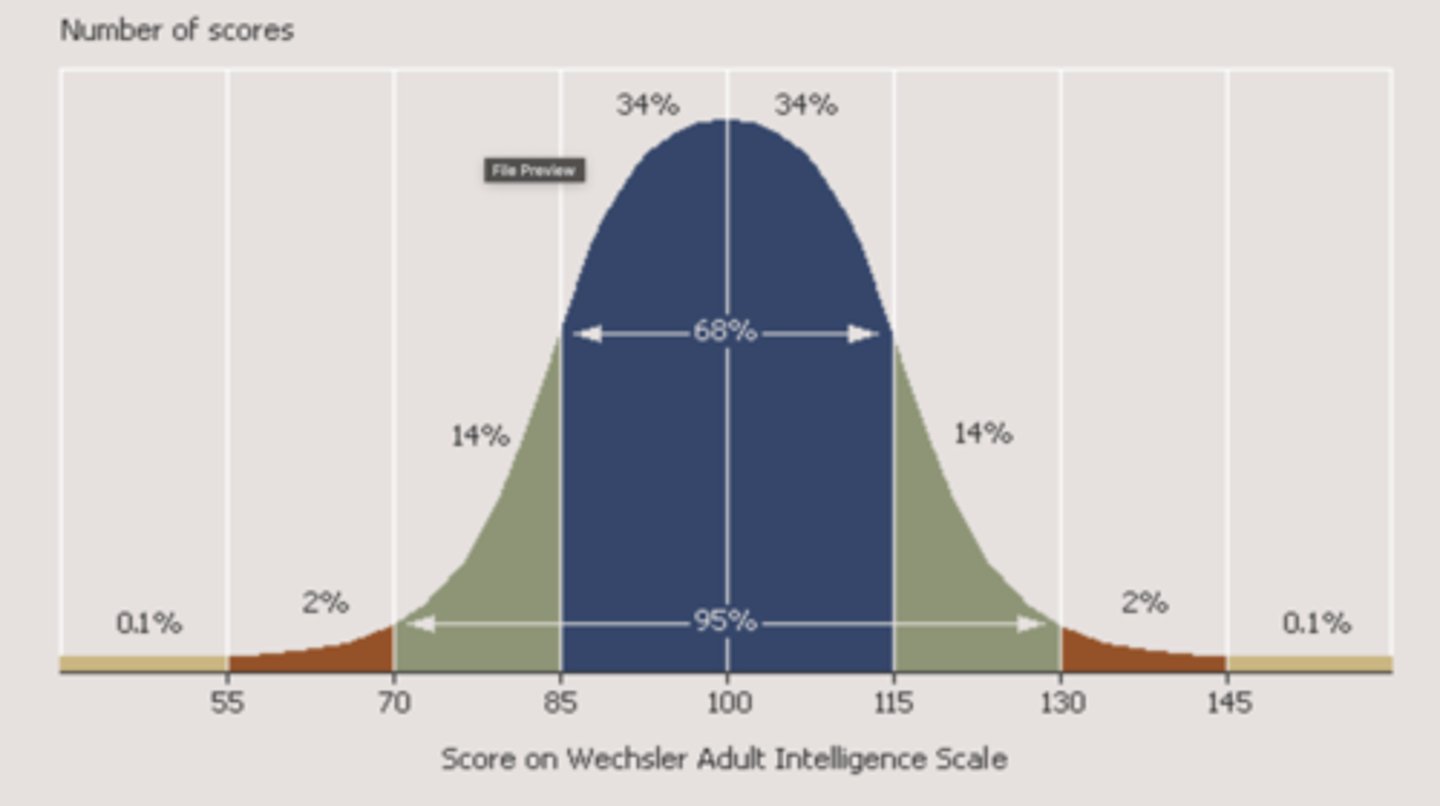
What is the average IQ, and what does the distribution look like? (e.g., what percent fall into +/- 1 Standard Deviation?)•
the average IQ is 100, normal bell curve distribution. 1 standerad deviation is 15 points in IQ.
What is the Flynn effect, and why wasn't it obvious for awhile?
The effect demonstrates that overtime people seem to be getting smarter. Flint found that the raw score improves over time. This could be attributed to nutrition, low environmental pollution, and education.
How heritable is IQ?
Genetics contribute to everything including genetics. Heritability doesn't tell us a person's intelligence is due to genes vs environment or anything about which genes cause a trait.
ex. to find heritability compute the correlation between the IQ (or any trait) of identical twin siblings (who share, roughly, 100% of their DNA) Then the correlation between the IQ of fraternal twin siblings (who share the same DNA as other non-twin siblings share).• Assumption: both children are raised by the same parents, in the same environment. Differences seen should be genetic differences.
What ways have been shown to improve IQ in children? (And what ways don't work?)
Anything you practice, you can get better at, IQ tests are designed with tasks that most people wouldn’t practice
In early childhood:
- Nutrition found in breastmilk•
- A year of training mothers to provide enriched cognitive environments
- Interactive reading
- Sending children to preschool
In school-aged children:
- Teaching children a musical instrument
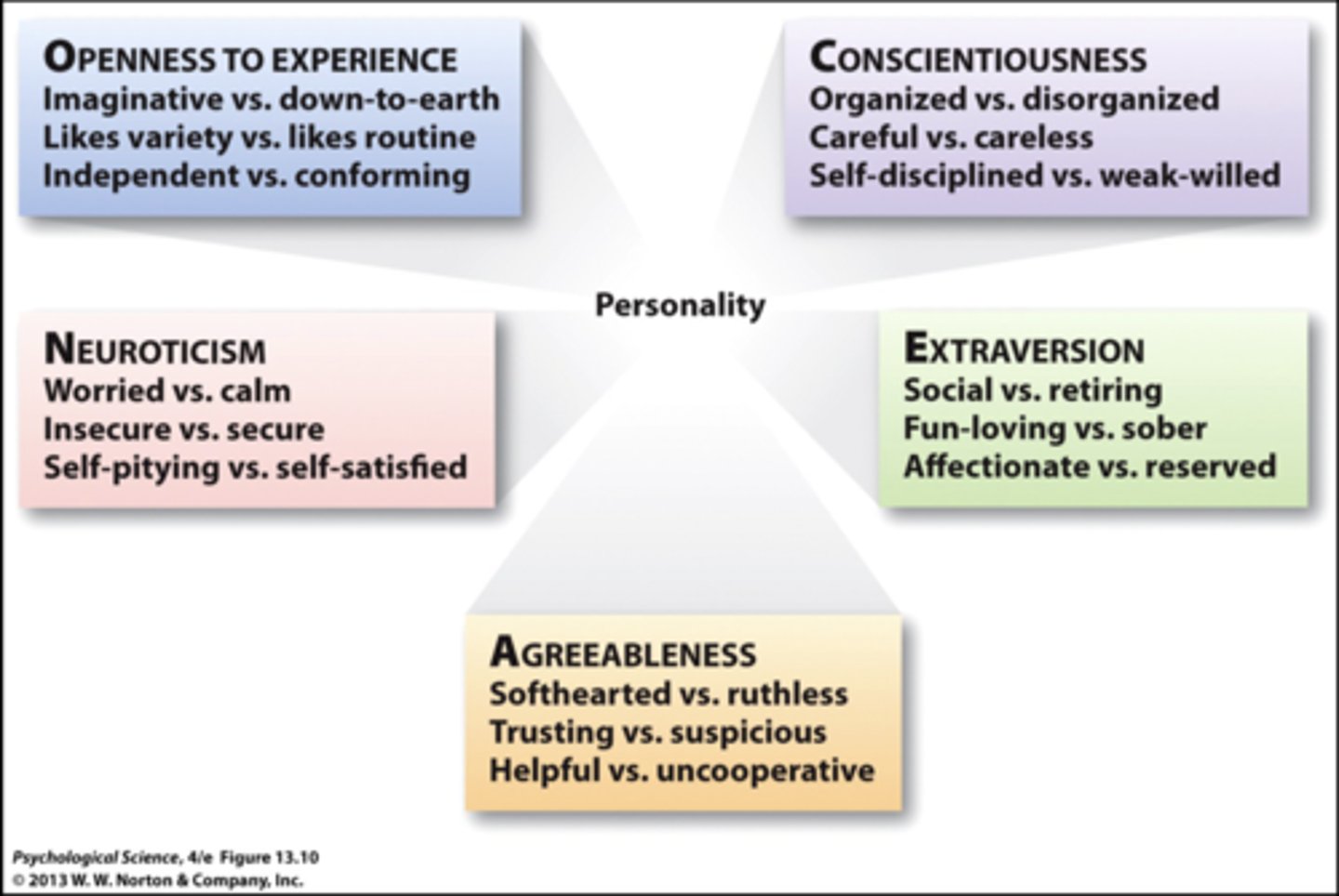
Know the big 5 personality traits (OCEAN) and their basic descriptions
Openness to experience: reflects a person’s tendency to seek out and appreciate new things, including thoughts, feelings, values, and experiences.
- imaginative vs. down-to-earth
- like vareity vs. likes routiine
- Independent vs. conforming
Conscientiousness: reflects a person’s tendency to be careful, organized, hardworking, and to follow rules.
- organized vs. disorganized
- careful and careless
- self -disciplined vs. weak-willed
Extraversion (also often spelled extroversion): reflects a person’s tendency to be sociable, outgoing, active, and assertive.
- social vs. retiring
- funloving vs. sober
- affectionate vs. reserved
Agreeableness: reflects a person’s tendency to be compassionate, cooperative, warm, and caring to others. People low in agreeableness tend to be rude, and hostile, and to pursue their interests over those of others.
- Softhearted vs. ruthless
- trusting vs. suspicious
- Helpful vs. uncooperative
Neuroticism: reflects the tendency to be interpersonally sensitive and the tendency to experience negative emotions like anxiety, fear, sadness, and anger.
- Worried
vs. calm
- insecure vs. secure
- Self-pitying vs. self satisfied
lexical hypothesis
The lexical hypothesis is the idea that the most important differences between people will be encoded in the language that we use to describe people. Therefore, if we want to know which personality traits are most important, we can look at the language that people use to describe themselves and others.
Know what valid and reliable means in terms of measurement
- informant ratings are particularly valuable when self-ratings are impossible to collect or when their validity is suspect They also may be combined with self-ratings of the same characteristics to produce more reliable and valid measures of these attributes
.Self-report personality tests show impressive validity to a wide range of important outcomes.
What are the most stable personality traits, and differentialvs absolute stability?
The most stable personality traits are extraversion and conscientiousness.
Differential stability relative to others (rank order) vs Absolute Stability measured absolutely (e.g, actual score on a personality test)
 Note
Note  Flashcards (20)