Chapter 4: Network Layer: Data Plane
 Call Kai
 Learn
Learn Practice Test
 Spaced Repetition
 Match
Match Flashcards
 Knowt Play
1/58

Earn XP
Description and Tags
4.1-4.5
Name | Mastery | Learn | Test | Matching | Spaced | Call with Kai |
|---|
No analytics yet
Send a link to your students to track their progress
59 Terms
Where is the network layer implemented?
in hosts at the network edge and in routers in the network core
What types of travel actions refer to forwarding?
any action that doesn’t involve going a different rout than originally planned (that would be routing)
What actions are primarily in the network-layer dataplane?
looking up address bits in an arriving datagram header in the forwarding table
dropping a datagram due to a congested (full) output buffer
moving an arriving datagram from a router’s input port to output port
What are actions that occur in a per-router control-plane approach?
a router exchanging msgs w/ another router, indicating that the cost for it (the sending router) to reach a destination host
routers send info abt their incoming & outgoing links to other routers in the network
What quality-of-service garuntees are part of the Internet’s best-effort service model?
none of the other services listed here are part of the best-effort service model. evidently, best-effort service means no garuntees at all!
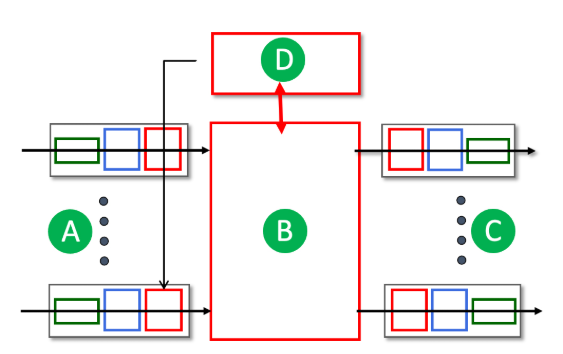
What is A’s function and is it in the network-layer data plane or control plane?
input ports, data plane
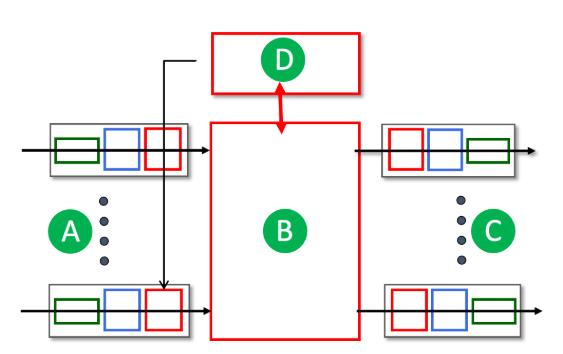
What is B’s function and is it in the network-layer data plane or control plane?
switching fabric, data plane
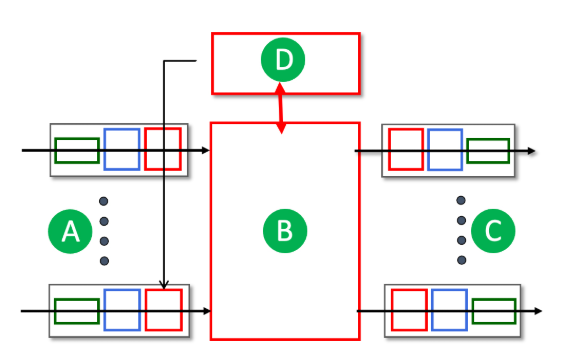
What is C’s function and is it in the network-layer data plane or control plane?
output ports, data plane
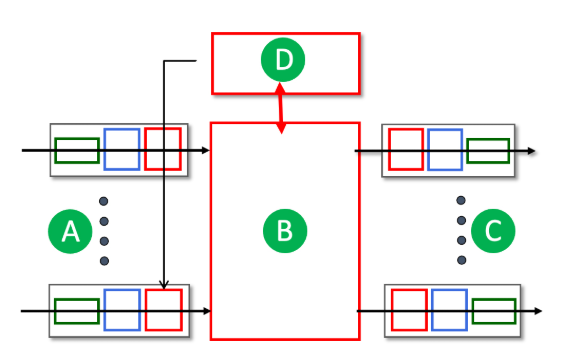
What is D’s function and is it in the network-layer data plane or control plane?
routing processor, control plane
Where in a router is the destination IP address looked up in a forwarding table to determine the appropriate output port to which the datagram should be directed?
At the input port where a packet arrives.
Where in a router does "match plus action" happen to determine the appropriate output port to which the arriving datagram should be directed?
At the input port where a packet arrives.
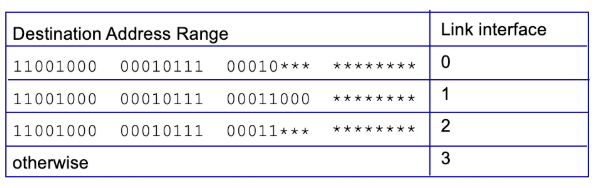
Consider the following forwarding table below. Indicate the output to link interface to which a datagram with the destination addresses below will be forwarded under longest prefix matching. (Note: The list of addresses is ordered below. If two addresses map to the same output link interface, map the first of these two addresses to the first instance of that link interface.)
1) 11001000 00010111 00010010 10101101
This is the first destination address in the list that maps to output port 0.
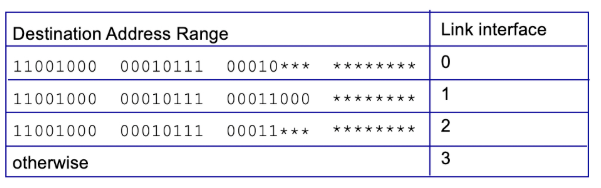
Consider the following forwarding table below. Indicate the output to link interface to which a datagram with the destination addresses below will be forwarded under longest prefix matching. (Note: The list of addresses is ordered below. If two addresses map to the same output link interface, map the first of these two addresses to the first instance of that link interface.)
2) 11001000 00010111 00011000 00001101
This is the first destination address in the list that maps to output port 1.
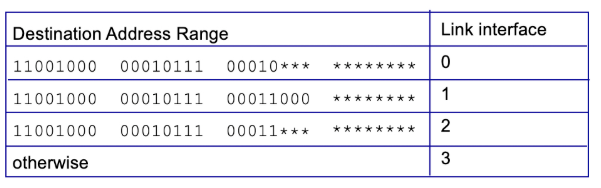
Consider the following forwarding table below. Indicate the output to link interface to which a datagram with the destination addresses below will be forwarded under longest prefix matching. (Note: The list of addresses is ordered below. If two addresses map to the same output link interface, map the first of these two addresses to the first instance of that link interface.)
3) 11001000 00010111 00011001 11001101
This is the first destination address in the list that maps to output port 2.
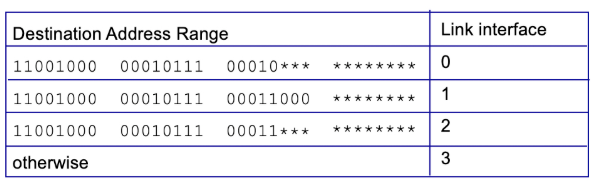
Consider the following forwarding table below. Indicate the output to link interface to which a datagram with the destination addresses below will be forwarded under longest prefix matching. (Note: The list of addresses is ordered below. If two addresses map to the same output link interface, map the first of these two addresses to the first instance of that link interface.)
4) 10001000 11100000 00011000 00001101
This is the first destination address in the list that maps to output port 3.
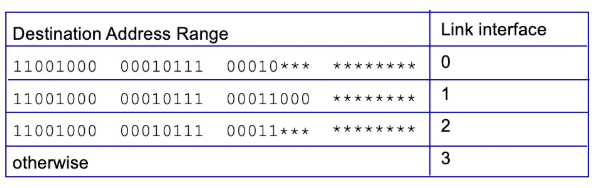
Consider the following forwarding table below. Indicate the output to link interface to which a datagram with the destination addresses below will be forwarded under longest prefix matching. (Note: The list of addresses is ordered below. If two addresses map to the same output link interface, map the first of these two addresses to the first instance of that link interface.)
5) 11001000 00010111 00011000 11001111
This is the second destination address in the list that maps to output port 1.
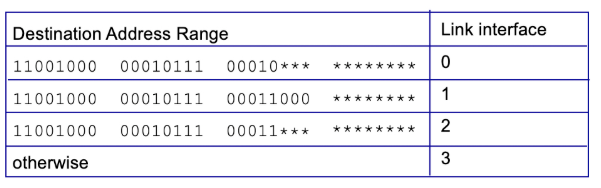
Consider the following forwarding table below. Indicate the output to link interface to which a datagram with the destination addresses below will be forwarded under longest prefix matching. (Note: The list of addresses is ordered below. If two addresses map to the same output link interface, map the first of these two addresses to the first instance of that link interface.)
6) 11001000 00010111 00010001 01010101
This is the second destination address in the list that maps to output port 0.
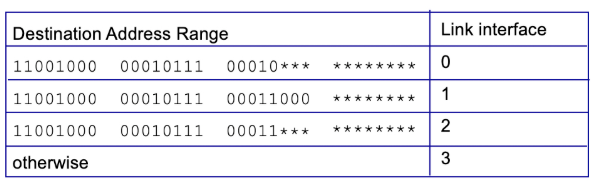
Consider the following forwarding table below. Indicate the output to link interface to which a datagram with the destination addresses below will be forwarded under longest prefix matching. (Note: The list of addresses is ordered below. If two addresses map to the same output link interface, map the first of these two addresses to the first instance of that link interface.)
7) 11001000 00010111 00011101 01101101
This is the second destination address in the list that maps to output port 2.
Suppose a datagram is switched through the switching fabric and arrives to its appropriate output to find that there are no free buffers. In this case:
The packet will either be dropped or another packet will be removed (lost) from the buffer to make room for this packet, depending on policy. But the packet will definitely not be be sent back to the input port.
What is meant by Head of the Line (HOL) blocking?
A queued datagram waiting for service at the front of a queue prevents other datagrams in queue from moving forward in the queue.
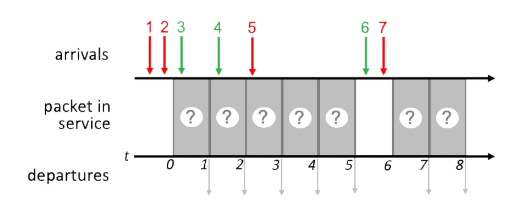
Consider the pattern of red and green packet arrivals to a router’s output port queue, shown below. Suppose each packet takes one time slot to be transmitted, and can only begin transmission at the beginning of a time slot after its arrival. Indicate the sequence of departing packet numbers (at t = 1, 2, 3, 4, 5, 7, 8) under FCFS scheduling.
Give your answer as 7 ordered digits (each corresponding to the packet number of a departing packet), with a single space between each digit, and no spaces before the first or after the last digit, e.g., in a form like 7 6 5 4 3 2 1).
1 2 3 4 5 6 7
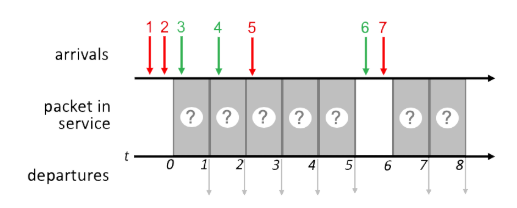
Consider the pattern of red and green packet arrivals to a router’s output port queue, shown below. Suppose each packet takes one time slot to be transmitted, and can only begin transmission at the beginning of a time slot after its arrival. Indicate the sequence of departing packet numbers (at t = 1, 2, 3, 4, 5, 7, 8) under priority scheduling, where red packets have higher priority.
Give your answer as 7 ordered digits (each corresponding to the packet number of a departing packet), with a single space between each digit, and no spaces before the first or after the last digit, e.g., in a form like 7 6 5 4 3 2 1).
1 2 3 5 4 7 6
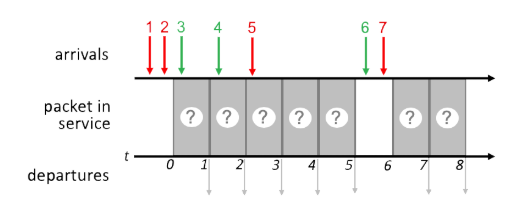
Consider the pattern of red and green packet arrivals to a router’s output port queue, shown below. Suppose each packet takes one time slot to be transmitted, and can only begin transmission at the beginning of a time slot after its arrival. Indicate the sequence of departing packet numbers (at t = 1, 2, 3, 4, 5, 7, 8) under round robin scheduling, where red starts a round if there are both red and green packets ready to transmit after an empty slot.
Give your answer as 7 ordered digits (each corresponding to the packet number of a departing packet), with a single space between each digit, and no spaces before the first or after the last digit, e.g., in a form like 7 6 5 4 3 2 1).
1 3 2 4 5 7 6
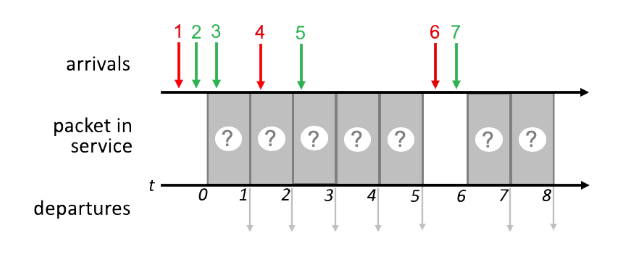
Consider the pattern of red and green packet arrivals to a router’s output port queue, shown below. Suppose each packet takes one time slot to be transmitted, and can only begin transmission at the beginning of a time slot after its arrival. Indicate the sequence of departing packet numbers (at t = 1, 2, 3, 4, 5, 7, 8) under FCFS scheduling.
Give your answer as 7 ordered digits (each corresponding to the packet number of a departing packet), with a single space between each digit, and no spaces before the first or after the last digit, e.g., in a form like 7 6 5 4 3 2 1).
1 2 3 4 5 6 7
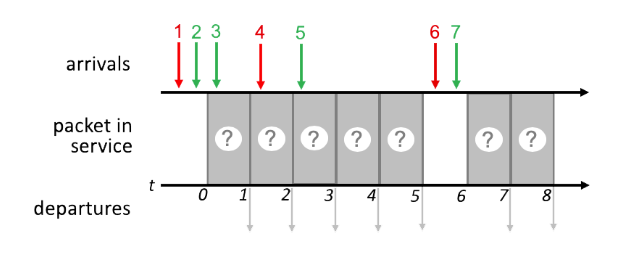
Consider the pattern of red and green packet arrivals to a router’s output port queue, shown below. Suppose each packet takes one time slot to be transmitted, and can only begin transmission at the beginning of a time slot after its arrival. Indicate the sequence of departing packet numbers (at t = 1, 2, 3, 4, 5, 7, 8) under priority scheduling, where red packets have higher priority.
Give your answer as 7 ordered digits (each corresponding to the packet number of a departing packet), with a single space between each digit, and no spaces before the first or after the last digit, e.g., in a form like 7 6 5 4 3 2 1).
1 2 4 3 5 6 7
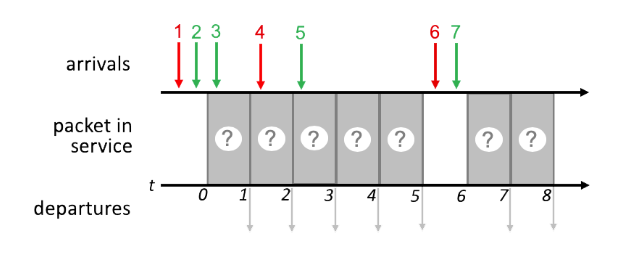
Consider the pattern of red and green packet arrivals to a router’s output port queue, shown below. Suppose each packet takes one time slot to be transmitted, and can only begin transmission at the beginning of a time slot after its arrival. Indicate the sequence of departing packet numbers (at t = 1, 2, 3, 4, 5, 7, 8) under round robin scheduling, where red starts a round if there are both red and green packets ready to transmit after an empty slot.
Give your answer as 7 ordered digits (each corresponding to the packet number of a departing packet), with a single space between each digit, and no spaces before the first or after the last digit, e.g., in a form like 7 6 5 4 3 2 1).
1 2 4 3 5 6 7
What are the principal components of the IPv4 protocol?
Packet handling conventions at routers (e.g., segmentation/reassembly)
IPv4 addressing conventions.
IPv4 datagram format.
What is the function or use of this field in the IP header, with its description?
Version field
This field contains the IP protocol version number.
What is the function or use of this field in the IP header, with its description?
Type-of-service field
This field contains ECN and differentiated service bits.
What is the function or use of this field in the IP header, with its description?
Fragmentation offset field
This field is used for datagram fragmentation/reassembly.
What is the function or use of this field in the IP header, with its description?
Time-to-live field
The value in this field is decremented at each router; when it reaches zero, the packet must be dropped.
What is the function or use of this field in the IP header, with its description?
Header checksum field
This field contains the Internet checksum of this datagram's header fields.
What is the function or use of this field in the IP header, with its description?
Upper layer field
This field contains the "protocol number" for the transport-layer protocol to which this datagram's payload will be demultiplexed - UDP or TCP, for example.
What is the function or use of this field in the IP header, with its description?
Payload/data field
This field contains a UDP or TCP segment, for example.
What is the function or use of this field in the IP header, with its description?
Datagram length field
This field indicates the total number of bytes in datagram.
What are true statements regarding an IP address?
If a router has more than one interface, then it has more that one IP address at which it can be reached.
An IP address is associated with an interface.
If a host has more than one interface, then it has more that one IP address at which it can be reached.
What is meant by an IP subnet?
A set of devices that have a common set of leading high order bits in their IP address.
A set of device interfaces that can physically reach each other without passing through an intervening router.
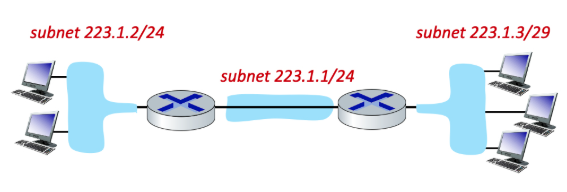
Consider the three subnets in the diagram.
What is the maximum # of interfaces in the 223.1.2/24 network?
256
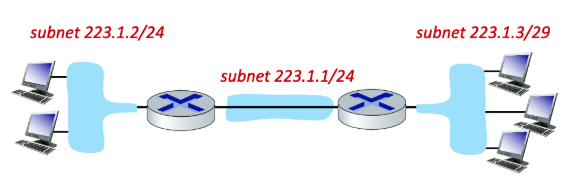
Consider the three subnets in the diagram.
What is the maximum # of interfaces in the 223.1.3/29 network?
8
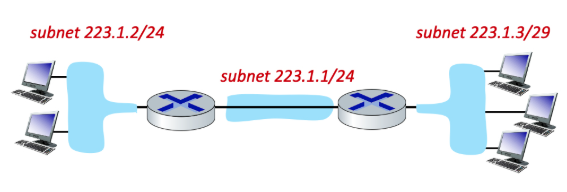
Consider the three subnets in the diagram.
What are examples of addresses that can not be used by an interface in the 223.1.3/29 network?
223.1.3.16
223.1.2.6
223.1.3.28
What is meant by saying that DHCP is a "plug and play" protocol?
No manual configuration is needed for the host to join the network.
What are true statements about a DHCP request message?
The transaction ID in a DHCP request message will be used to associate this message with future DHCP messages sent from, or to, this client.
A DHCP request message is sent broadcast, using the 255.255.255.255 IP destination address.
A DHCP request message may contain the IP address that the client will use.
What are fields that occur ONLY in the IPv6 datagram header (i.e., appear in the IPv6 header but not in the IPv4 header)?
The flow label field.
128-bit source and destination IP addresses.
What is the purpose of the Dynamic Host Configuration Protocol?
To obtain an IP address for a host attaching to an IP network.
Destination-based forwarding, which we studied in section 4.2, is a specific instance of match+action and generalized forwarding.
What phrase below which best completes the following sentence: "In destination-based forwarding, ..."
... after matching on the destination IP address in the datagram header, the action taken is to forward the datagram to the output port associated with that destination IP address.
What are match+actions that can be taken in the generalized OpenFlow 1.0 match+action paradigm that we studied in Section 4.4?
... after matching on the port number in the segment's header, the action taken is to forward the datagram to the output port associated with that destination IP address.
... after matching on the destination IP address in the datagram header, the action taken is to forward the datagram to the output port associated with that destination IP address.
... after matching on the source and destination IP address in the datagram header, the action taken is to forward the datagram to the output port associated with that source and destination IP address pair.
... after matching on the port number in the segment's header, the action taken is to decide whether or not to drop that datagram containing that segment.
... after matching on the 48-bit link-layer destination MAC address, the action taken is to forward the datagram to the output port associated with that link-layer address.
... after matching on the destination IP address in the datagram header, the action taken is to decide whether or not to drop that datagram.
What fields in the frame/datagram/segment/application-layer message can be matched in OpenFlow 1.0?
IP source address
Upper layer protocol field
IP destination address
IP type-of-service field
Source and/or destination port number
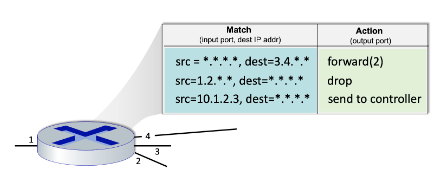
Consider the figure below that shows the generalized forwarding table in a router. Recall that a * represents a wildcard value. Now consider an arriving datagram with the IP source and destination address fields indicated below. For this source/destination IP address pair, indicate a matching rule.
Note: assume that a rule that is earlier in the table takes priority over a rule that is later in the table and that a datagram that matches none of the table entries is dropped.
Source: 1.2.56.32 Destination:128.116.40.186
Rule 2, with action drop
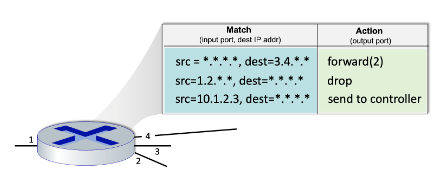
Consider the figure below that shows the generalized forwarding table in a router. Recall that a * represents a wildcard value. Now consider an arriving datagram with the IP source and destination address fields indicated below. For this source/destination IP address pair, indicate a matching rule.
Note: assume that a rule that is earlier in the table takes priority over a rule that is later in the table and that a datagram that matches none of the table entries is dropped.
Source: 65.92.15.27 Destination: 3.4.65.76
Rule 1, with action forward(2)
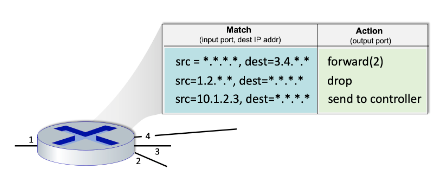
Consider the figure below that shows the generalized forwarding table in a router. Recall that a * represents a wildcard value. Now consider an arriving datagram with the IP source and destination address fields indicated below. For this source/destination IP address pair, indicate a matching rule.
Note: assume that a rule that is earlier in the table takes priority over a rule that is later in the table and that a datagram that matches none of the table entries is dropped.
Source: 10.1.2.3 Destination: 7.8.9.2
Rule 3, with action send to controller
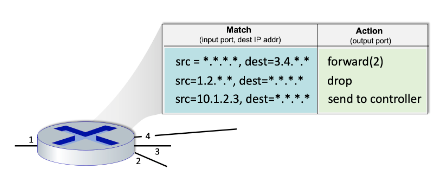
Consider the figure below that shows the generalized forwarding table in a router. Recall that a * represents a wildcard value. Now consider an arriving datagram with the IP source and destination address fields indicated below. For this source/destination IP address pair, indicate a matching rule.
Note: assume that a rule that is earlier in the table takes priority over a rule that is later in the table and that a datagram that matches none of the table entries is dropped.
Source: 10.1.34.56 Destination: 54.72.29.90
No match to any rule.
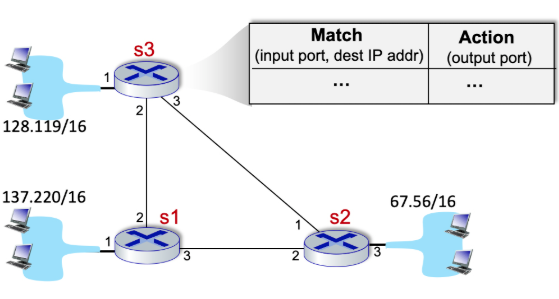
Consider the network below. We want to specify the match+action rules at s3 so that only the following network-wide behavior is allowed:
traffic from 128.119/16 and destined to 137.220/16 is forwarded on the direct link from s3 to s1;
traffic from 128.119/16 and destined to 67.56/16 is forwarded on the direct link from s3 to s2;
incoming traffic via port 2 or 3, and destined to 128.119/16 is forwarded to 128.119/16 via local port 1.
no other forwarding should be allowed. In particular s3 should not forward traffic arriving from 137.220/16 and destined for 67.56/16 and vice versa.
What are rules to include in s3's flow table to implement this forwarding behavior? Assume that if a packet arrives and finds no matching rule, it is dropped.
Input port:1 ; Dest: 137.220/16 Action: forward(2)
Input port: 3; Dest: 128.119/16 Action: forward(1)
Input port: 1; Dest: 67.56/16 Action: forward(3)
Input port: 2; Dest: 128.119/16 Action: forward(1)
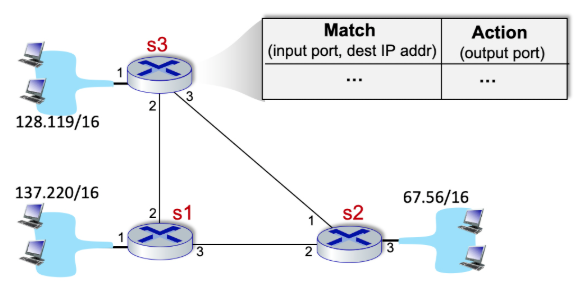
Consider the network below. We want to specify the match+action rules at s3 so that s3 acts only as a relay for traffic between 137.220/16 and 67.56/16. In particular s3 should not accept/forward and traffic to/from 128.119/16.
From the list of match+action rules below, select the rules to include in s3's flow table to implement this forwarding behavior. Assume that if a packet arrives and finds no matching rule, it is dropped.
Input port: 2; Dest: 67.56/16 Action: forward(3)
Input port: 3; Dest: 137.220/16 Action: forward(2)
What is meant by generalized forwarding (as opposed to destination-based forwarding) in a router or switch?
Any of several actions (including drop (block), forward to a given interface, or duplicate-and-forward) can be made based on the contents of one or more packet header fields.
What are network devices that can be thought of as a "middlebox"?
HTTP cache
Network Address Translation box
HTTP load balancer
What protocol (or protocols) constitutes the "thin waist" of the Internet protocol stack?
IP
What are true statements regarding the "end-to-end principle"?
The end-to-end argument advocates placing functionality at the network edge because some functionality cannot be completely and correctly implemented in the network, and so needs to be placed at the edge in any case, making in-network implementation redundant.
The end-to-end argument allows that some redundant functionality might be placed both in-network and at the network edge in order to enhance performance.
What is meant when it is said that the Internet has an “hourglass” architecture?
The Internet protocol stack has a “thin waist” in the middle, like an hourglass. The Internet Protocol (IP) is the only network-layer protocol in the middle layer of the stack. Every other layer has multiple protocols at that layer.
In the US, which of the following services has been regulated by the Federal Communications Commission (FCC) going back into the 20th century?
Telecommunication services.

