Biochem Ch 11: Membrane Structure and Dynamics
 Call Kai
 Learn
Learn Practice Test
 Spaced Repetition
 Match
Match Flashcards
 Knowt Play
1/100

There's no tags or description
Looks like no tags are added yet.
Name | Mastery | Learn | Test | Matching | Spaced | Call with Kai |
|---|
No analytics yet
Send a link to your students to track their progress
101 Terms
What is one KEY function of membranes?
Separate the cell from the environment, but not be completely impermeable
Do prokaryotes contain membrane bound organelles?
No! Only eukaryotes do
All membranes on different organelles have slightly different…
Functions and composition
Lipids molecules can spontaneously…
Form membranes, grow, and split! Though, these processes are usually regulated by proteins
What are the 3 components of a membrane?
Lipids (especially phospholipids)
Sterols
Proteins
Has you go up to higher organisms starting from prokaryotes, how does the membrane composition change?
You get a higher percentage of sterols by weight, and less protein by weight
Membranes are __ tuned for the specific role they must play
tuned
Amphipathic def
Have a polar end and a non-polar end
Membrane lipids are ___
amphipathic
What is the driving force pushing membrane lipids together?
The hydrophobic effect
The polar heads of membrane lipids are always…
sticking out into aqueous solution
What are the 3 major structures that can form when put into water?
Micelle
Bilayer
Liposomes
What does the formation of those three different structures depend on?
The type/shape of a lipid, and the concentration
Describe micelles
A sphere of lipids, with the hydrophobic tails in the middle and hydrophilic heads sticking out.
Individual lipids are wedge-shaped (ex: fatty acids, only one tail).
Aggregation is concentration dependent- at a certain conc, you can’t get the micelle any bigger, so you just get more of them.
Describe a membrane bilayer.
Two leaflets of lipid monolayers, as one leaflet isn’t stable.
Cylindrical lipids (lipids with two tails).
Hydrophobic fatty acid tails packed inside.
Describe a Liposome.
Can be used for transport.
Small bilayers fold in on themselves and form spherical vesicles that fuse readily with cell membranes or with each other.
Central aqueous cavity.
Sometimes used to try and transport drugs into cells, but it’s not fully successful.
T or F: membranes are very rigid
False! Things can move within the membrane.
Which type of lipid diffusion in a bilayer is very fast?
Lateral diffusion.
The hydrophobic interactions are maintained if lipids are shifted, as are the H-bonds between the polar heads and water.
Which type of lipid diffusion in a bilayer is very slow?
Transverse diffusion (“flip flop”).
Barely occurs.
Energetic penalty dehydration of the polar head group by moving it into the hydrophobic intermembrane space.
What are the 3 main enzymes that can catalyze transverse movement?
Flippase
Floppase
Scramblase
Describe flippases.
P-Type ATPase
Moves phosphoamino lipid from the outer leaflet to the inner leaflet.
Requires ATP.
Can move the lipid against its conc. gradient
Describe floppases.
ABC Transporter
Moves phospholipids from the inner to outer leaflet
Can use ATP because it can move against the conc. gradient
Describe a scramblase.
Can move lipids in either direction, but need to move down the conc. gradient.
Doesn’t require ATP.
What is the generally accepted model for membranes?
Fluid mosaic model
How can membrane fusion be mediated?
Proteins can orient the membranes correctly so that fusion is more likely
What are some examples of membranes needing to be flexible/ fusable?
Sperm/egg fusion
Separation of plasma membrane during cell division
Endo/exo cytosis
Describe neurotransmitter release
Controlled by SNARE proteins.
Chemical signals (neurotransmitters) in vesicles released into the synapse
SNARE proteins help orient the membranes and make fusion quicker
T-SNAREs on target membrane (in this case, the plasma membrane)
V-SNAREs on vesicle
Q-SNAREs are regulatory proteins that are calcium induced
When theV and T SNAREs come in close proximity, they" “zip up” and pulls the membranes in, bringing them close together, bending them, and induces tension to make it more likely that they’ll fuse.
You first get hemifusion.
Then you get full fusion, and release of neurotransmitters into the plasma membrane
About __% of all proteins in humans are membrane proteins!
25%
Integral def
Embedded in the lipid bilayer, always membrane associated.
Hard to study/extract because they exist solely in membranes.
Peripheral def.
NOT embedded in the bilayer, interacting with other membrane proteins at the surface of the membrane
Amphitropic def
Found both in the cytosol and membrane, typically a post-translational modification allows them to interact directly with membranes, which allows them to move on and off the membrane.
What is a primary post-translational modification that can happen to amphitropic proteins so that they’ll stick into the membrane.
Attaching a lipid on to one of the protein’s amino acids.
What does GPI stand for.
Glycosyl phosphatidylinositiol
Describe a GPI anchor’s structure
Phosphate glycosidic linkage at the C-terminus
Phosphate group attached to 4 mannose sugars, last of which is attached to an n-acetylglucosamine sugar.
GlcNAc is ether linked to an Inositiol, which is linked to a phosphate group, then the hydrophobic tail which is inserted into the membrane
GPI anchor is so complex but it allows for…
A high degree of regulation
How can you extract integral proteins?
Use a strong detergent, like SDS, to solubilize the protein and form micelles around the protein. The hydrophobic tails of the SDS will surround the hydrophobic surface of the protein.
What kind of secondary structure is good for integral proteins?
Helices
How can you tell where a protein will insert into a membrane based on seq?
Hydrophilic region → Hydrophobic region → Hydrophilic region
Hydropathy index
More hydrophobic an amino acid is, higher # on index. Strong - # if hydrophilic.
Can scan the amino acid seq of a protein for regions of high hydrophobicity.
What is a Kyte-Doolittle Hydropathy plot?
Can measure BLOCKS of amino acids rather than individual to reduce noisiness.
What is a common protein motif for integral proteins?
7 transmembrane helices
What type of protein exemplifies the 7 helix motif?
G-coupled protein receptors (GPCRs)
Role of GPCRs
Receive and transduce signals
Describe the general mechanism of action of GPCRs
The GPCR receives a signal, and becomes activated via a conformational change.
Upon activation, the receptor binds to a G-protein and then releases it to let it go transduce that signal
What’s another integral membrane motif we can get?
B-barrels!
T or F: certain cellular compartments can occur without separation by a membrane
T! They’re called “phase separated cellular compartments”
What’s an example of a phase separated cellular compartment?
Nucleolus
Phase separated cellular compartments are made by…
Self-aggregation of molecules, and typically occur via changes in conc of those molecules.
What kind of molecules can generally diffuse across membranes easily?
Small, non-polar molecules (O2, N2, CH4)
What kind of molecules can not diffuse across a membrane?
Polar or charged groups (mostly hydrophobic things with a small polar region can diffuse across very slowly)
What are examples of uncatalyzed transport?
Simple diffusion
Ion Channels
Difference between unsaturatable and saturatable kinetics
Unsaturable: you can increase the conc.infinitely (not really) andthe rate of diffusion will continue to go up
Saturable: There is a “Vmax” to the rate of diffusion that will not depend on increasing the conc anymore
Uncatalyzed transport is an example of ___ kinetics
Unsaturable
Ion channels are selective “___” that often have gates that open and close. Can only transport __ molecules.
“Holes”, small
Transporters have __ kinetics
Saturable
What are the two kinds of transporters?
Passive transporters
Active transporters
Primary
Secondary
Describe Passive transporters
ONLY can transport along the electrochemical gradient, doesn’t use energy
Describe active transport
Requires energy, because they can transport against an electrochemical gradient.
Primary active transport
Directly hydrolyze ATP to get the energy to do something
Secondary active transport
Coupling an uphill reaction with a downhill reaction following a conc gradient.
Passage of hydrophilic molecules through the lipid bilayer is very energetically ____
Unfavorable- desolvating the hydrophilic molecule has an extremely high activation energy
How do transporters catalyze transport?
Lowers the activation energy of transport by maintaining the solvation of the molecule, rather than stripping it
Can replace H-bonds, make center of transporter very hydrophilic.
Transporters are very ___ to a molecule or class of molecules
Specific
In passive transport, the solute conc inside and outside the cell ___, meaning one can never ___ the other.
Equilibrates, exceed
Uniport def
Transporter that only moves 1 thing at once
Symport vs antiport
Symport: moves two things in the same direction
Antiport: moves two things in opposite directions
Glucose permease is a ___ transporter and thus is ___
Passive, saturable
Glucose permease is commonly found in…
RBC
RBCs get most of their energy from…
Glycolysis
The conc of glucose in the blood is kept at a constant ___mM
5
Glucose permease has a ___ cavity than can ___ to allow glucose to pass through
Hydrophilic, flip
Transporters have saturable kinetics because…
They don’t have a tunnel like channels, they have a cavity that must flip
Transporters have __ conformations
2 → outward and inward facing
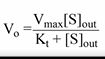
Equation for transporter kinetics
Thermodynamics of transport equation
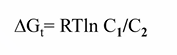
At equi, free energy change of transport is __, which means…
0, which means it’s equally likely that the solute will move in ether direction
Free energy change doesn’t tell us ___, it tells us ___
Speed, propensity
Free energy equation when its ions involved
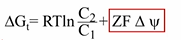
Nearly all eukaryotic cells keep a __ voltage inside their cells
Negative
How do human cells typically maintain lower conc of ions inside the cell than outside?
The sodium-potassium pump, which pumps out 3 sodium ions for every 2 potassium ions brought in
Transport inside out = ___, transport outside in = ___
Positive, negative
Examples of primary active transport
Ca+2 transport within muscle cells, Sodium/potassium pump
Describe Ca+2 transport within muscle cells
Sarcoplasmic reticulums are basically membrane-bound bags of calcium, that have a pump to allow the muscle cell to pump “out” calcium ions when it needs to contract
The pump that does this is the SERCA pump- active transport
SERCA has a nucleotide binding domain (binds ATP) and a phosphorylation domain, that when phosphorylated, induces a conformational change.
Describe the sodium/potassium pump
For each ATP, 3 sodium exit and 2 potassium enter
Active transport
Results in a buildup of + charge outside the cell
Pump is electrogenic → creates an electrical potential across the membrane
Example of secondary active transport
Lactose transporter
Describe the bacterial lactose transporter
Coupled with the movement of protons (via a proton pump). Symport of lactose and protons
Pumping of protons builds up a + conc. in the periplasmic space. This results in the transporter’s side chains (Glu and Arg) becoming protonated, and flipping conformations.
Moves lactose against its concentration gradient and with it, moves protons with its conc. gradient
What kind of transport is the EmrE Efflux Pump?
Secondary Active Transport
Significance of the EmrE pump?
Responsible for antibiotic resistance
Pump antibiotics out of the cell
Ion channels/porins are ___
Unsaturable
Ion channels have __
gates
What are the two regulatory systems for ion channels?
Voltage gated or ligand gated
You just have to open a channel __ and then the molecules will __ flow through
Once, freely
Why is the potassium channel extremely selective?
Because of the orientation of the sidechains in the holes
Aquaporins are channels for ___
Water
Aquaporins can move___ molecules of water per second
109
In eukaryotic cells, what organelles are part of the endomembrane system?
ER, golgi, lysosomes and vesicles, mitochondria, nucleus and chloroplasts
In what organelle are most membrane proteins and lipids synthesized
ER
Liquid ordered state of lipids occurs at temps ___ physiological, and liquid disordered occurs at temps __ physiological
Below, above
What does FRAP stand for and measure
Fluorescence recovery after photobleaching
measures the rate of lateral diffusion of lipids in a membrane
Glucose enters erythrocytes via passive transport involving ___
GLUT1

