Lecture 4- Animals in their Environments
 Call Kai
 Learn
Learn Practice Test
 Spaced Repetition
 Match
Match Flashcards
 Knowt Play
1/22

There's no tags or description
Looks like no tags are added yet.
Name | Mastery | Learn | Test | Matching | Spaced | Call with Kai |
|---|
No analytics yet
Send a link to your students to track their progress
23 Terms
How do small-bodied animals deal with stresses vs large-bodied animal?
Small-bodied animals use behavior; large-bodied animals have fewer behavioral options (depend more on physiological defenses to survive)
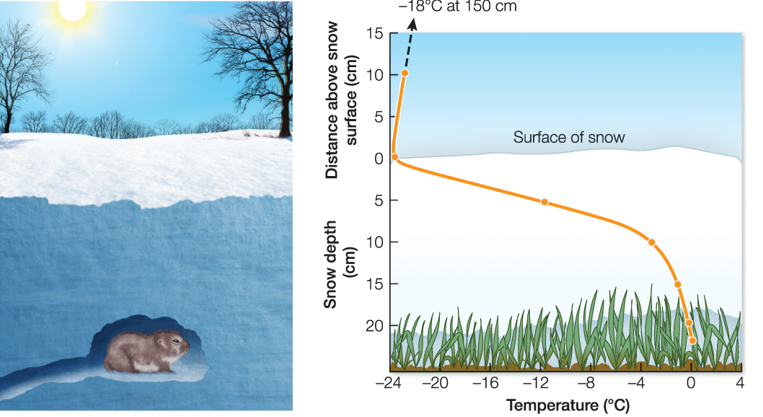
Challenge #1: Cold Extremes (small animal)
Ex. Lemming (small rodent in Arctic) using a snow tunnel; creating an insulated space by modifying their environment.
Challenge #1: Cold Extremes (large animal)
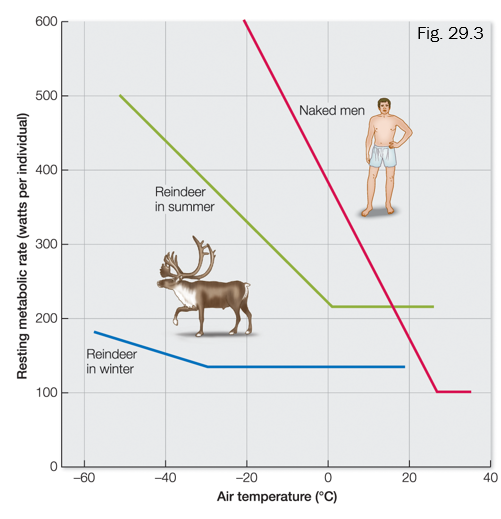
Ex. Reindeers have good insulation and regional hypothermia (allows tissues in appendages to be cooler than the core tissues- tissues in appendages don’t freeze).
Has specialized physiological defenses against cold temperatures (exhibit phenotypic plasticity between summer & winter)
Challenge: Preventing Heat Loss 1
Solution: Countercurrent heat exchange system between arteries & veins in the limbs conserves heat.
Ex. Arctic Snow Fox
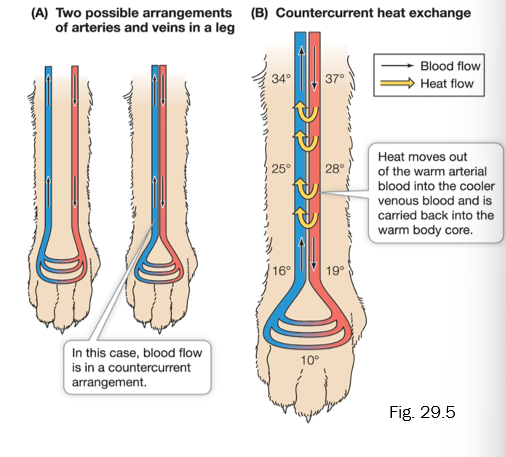
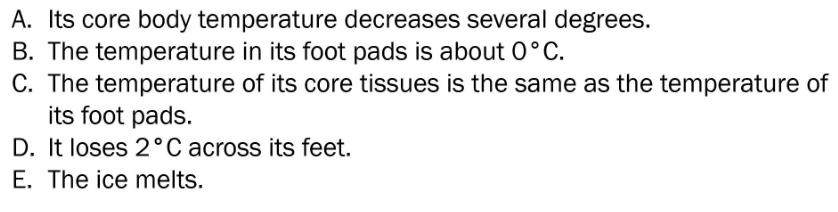
When an Arctic Fox walks across ice:
B. The temperature in its foot pads is about 0 degrees Celsius
Challenge: Preventing Heat Loss 2
Hibernation: State of low body temperatures & thermal conformity that persists for a long period of time in winter.
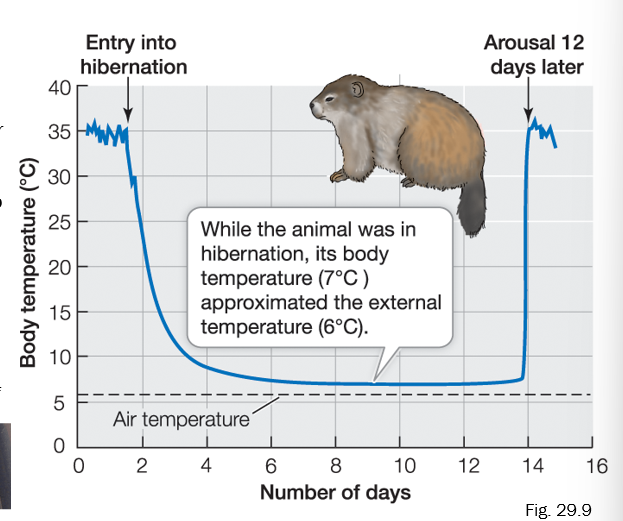
Core temperature for all animals is ______
37 degrees Celsius
Metabolic depression
Biochemically induced reduction of metabolic rate due to hibernation.
Hibernation allows for what?
Allows for core body temperature to match external temperatures.
Allows for animal to live on body fat or stored food collected the previous summer
Challenge #2: Heat extremes (small animals)
Main challenges include: lack of water and high temperatures)
Small mammals (ex. kangaroo rats) are mostly nocturnal & stay in burrows during the day.
Ex. Lizards use burrows & small patches of shade or stay close to ground surface.
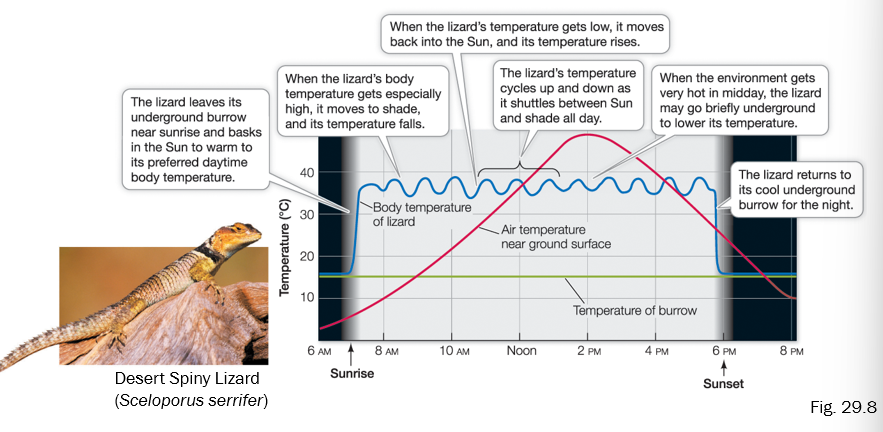
Challenge #2: Heat extremes (large animals)
Main challenges include: lack of water and high temperatures)
Ex. Grant’s gazelle can tolerate a rise in core body temperature to abt 46 degrees C, reducing water needs bc they don’t sweat. (Also have a countercurrent system to keep brain cooler)

Challenge #3: Water & Salt Balance (osmotic problems)
Freshwater fish→ Too much water
Marine fish→ Too little water
Salt-loaded diets→ Need mechanisms for salt excretion
Mussel/Crabs→ Fluctuation in salinity
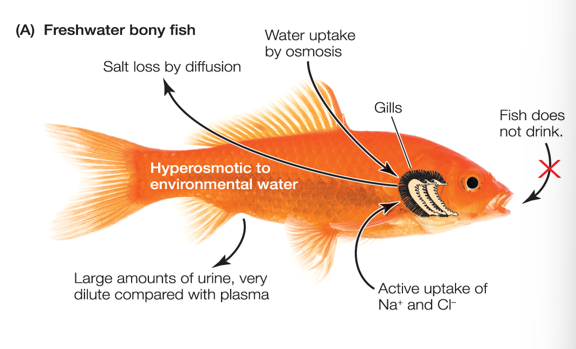
Water & Salt exchange: Freshwater Fish
Freshwater fish are hyperosmotic to fresh water: water passes in across gills & other membranes by osmosis.
Freshwater fish does not drink water!
Fish produce large volumes of dilute urine, & actively transport Na+ & Cl- back across the gills into the body: hyperosmotic regulators
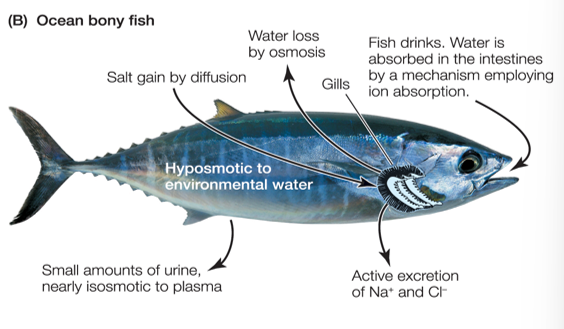
Water & Salt Exchange: Ocean Bony Fish
Bony fishes are hyposmotic to seawater: tend to lose water by osmosis & gain ions by diffusion
Energy must be expended to compensate: drink seawater to gain water, in the intestine, ions are pumped out, & excess ions are excreted: hyposmotic regulators
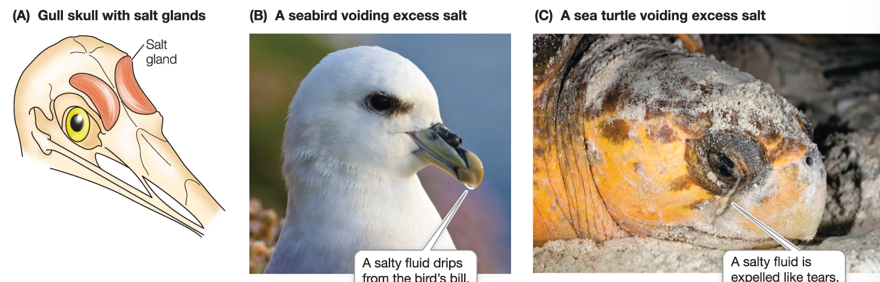
Water & Salt Exchange: Seabirds, ocean lizards, & sea turtles
These animals eat seaweeds & invertebrates with high osmotic pressure but this excess salt from these foods is excreted by salt glands that use energy from ATP.
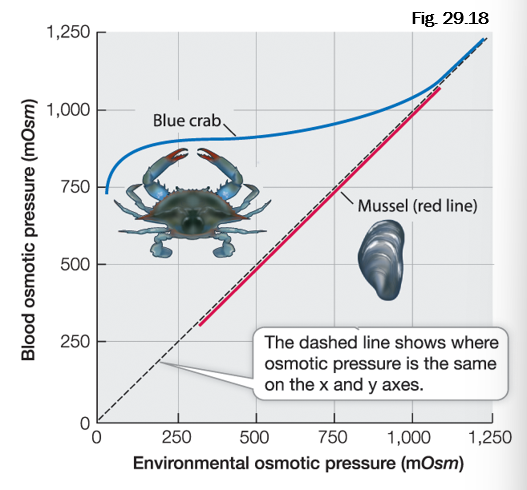
Water & Salt Exchange: Mussels/ crabs
Most marine invertebrates are osmotic conformers: osmotic pressure of body fluids is always the same as the water.
Some coastal invertebrates (blue crab): maintains a constant internal osmotic pressure despite experiencing a range of external salinities.
Challenge #4: Environmental Variability
Phenotypes can change in response to environmental change
Phenotypic plasticity
An individual’s ability to display different phenotypes at different times during its life; one genotype expresses two or more phenotypes.
Acclimation (or acclimatization)
Phenotype change resulting from long-term exposure to a particular environment
Fishes are models of molecular adaptation to temperature: how? Phenotypic plasticity!
Have enzymes (that exist in multiple molecular forms) for metabolic functions. Ex. Polar species have forms that function well at polar temperatures, but do not work well at warm temperatures.
Ex. Fish exposed to pollutants. Cytochrome P450 enzymes are important in detoxifying environmental toxins such as halogenated aromatic hydrocarbons (HAHs).- Fishes that live in polluted waters have higher levels of P450 & are more capable of detoxifying toxins
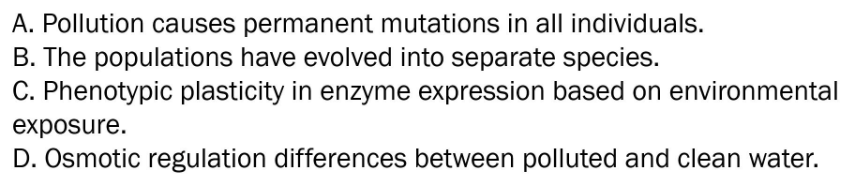
Fish Pop. A lives in water with high levels of industrial pollutants, while Pop. B lives in clean offshore water. When both populations are brought into the lab & raised under identical clean-water conditions, Population A still shows much higher baseline activity of detoxification enzymes (cytochrome P450). What does this most likely illustrate?
C. Phenotypic plasticity in enzyme expression based on environmental exposure.
Challenge #4: Time keeping
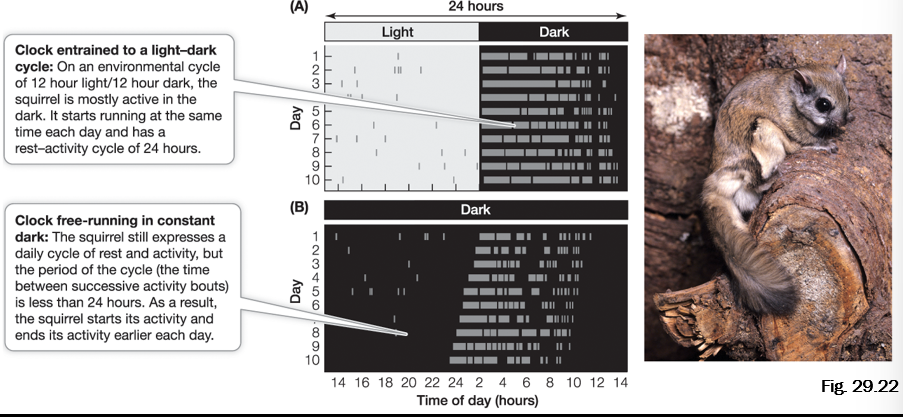
Animals have biological clocks tuned to cycles in their environment
Mechanisms for synchronization
External or exogenous cues- presence of light or darkness.
Endogenous biological clock- a self-contained, metabolic mechanism of keeping track of time
Circadian or daily biological clocks= most common
Lunar (circatidal) & annual (circannual) clocks
Free-run- no external cues