Module 4: Descending Motor Systems
 Studied by 1 person
 Call Kai
 Learn
Learn Practice Test
 Spaced Repetition
 Match
Match Flashcards
 Knowt Play
1/47

Earn XP
Description and Tags
Descending systems: from cortex to movement
Name | Mastery | Learn | Test | Matching | Spaced | Call with Kai |
|---|
No analytics yet
Send a link to your students to track their progress
48 Terms
what is monoplegia?
paralysis of one single limb
what is paraplegia, and how can it occur?
when both lower extermities are involved (paralyzed), results from a complete spinal cord injury below the level of the thoracic vertebrae.
what is tetraplegia and how does if occur?
paralysis of all four limbs, typically due to cervical spinal cord injury.
what is the difference between upper and lower motor neurons?
Upper motor neurons originate in the cortex and control lower motor neurons, which are located in the brainstem or spinal cord and directly innervate muscles
how many neurons are involved in the motor pathway compared to teh sensory pathway?
where the sensory pathway required a 3 neuron pathway, motor neuron pathways only require an UMN and a LMN and the two work together as a 2 neuron pathway that is responsible for movement
what do descending motor pathways influence?
voluntary movement, postural control, muscle tone and reflex activity
how are tracts named?
based on their origin and termination- the first part of the name is the structure of origin, the second part is the structure of termination. For example, the corticospinal tract originates in the cortex and terminates in the spinal cord.
does where a tract synapses in the ventral horm affect what it controls?
yes, the location will affect with muscles and which groups are affected- for example, lateral synapses are for more distal muscles, and medial for more proximal and the trunk, posterior are for flexors muscles, anterior are extensors
what do medial motor pathways control?
axial and proximal muscles, gross movements and postural muscles
what do lateral motor pathways control?
control distal limb muscles and fine skilled movements (fractionation)
how are motor tracts functionally divided?
they are divided into whether they are pyramidal tracts or extrapyramidal tracts (which is based on where the cell bodies arise from- the pyramidal cells in the cerebral cortex/M1 or the midbrain and brainstem nuclei)
what are extrapyramidal tracts primarily responsible for?
involuntary and automatic control (tone, posture, equilibrium)
what are the two major pyramidal tracts, and how are they classified?
corticospinal tract and corticobulbar tract, are named due to their direct path from teh cerebral cortex to the spinal cord
what does the corticospinal tract supply compared to the corticobulbar tract?
motor innervation to the muscle of the body while corticobulbar supplies the muscles of the head and neck
what are the four extrapyramidal tracts?
the rubrospinal, the reticulospinal, the vestibulospinal, and the tectospinal tracts
which CST is the primary/largest and most important descending motor tract?
the lateral corticospinal tract
describe the pathway of the LCT
originates in M1 in the cortex, travels through the internal capsule, the cerebral peduncles in teh midbrain, the pons, the medullary pyramids, where it decussates in the caudal medulla (at the pyramidal decussation) and terminates at all levels of the spinal cord, though predominantly at the cervical and lumbar enlargements
what is the function of the LCT?
controls coluntary motor control of contralateral limbs, controls fractionated movements and fine movements of distal parts of extremities
how is the internal capsule somatotopically organized?
most lateral are the legs, then the trunk, then the arm, and most medial is the face
how are the cerebral peduncles somatotopically organized?
the legs are most lateral, then the trunk, then the arms, then the face is most medial
what part of the white matter of the spinal cord does the LCT travel through?
more laterally and posteriorly in the lateral funiculus
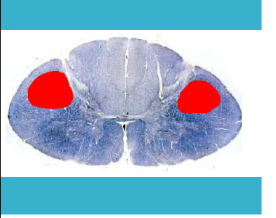
where would a lesion of the LCT in the right side of the spinal cord cause paralysis?
on the right side (ipsilateral)
where would a lesion in the basilar pons (to the LCT) cause paralysis?
on the contralateral side
what is the pathway of the anterior corticospinal tract?
same as the LCT until it gets to the decussation- the 10% of the fibers that do not cross become the ACT and these fibers innervate muscles on the same side of the body, as well as come on the contralateral side (a bilateral tract)
what is the function of the ACT?
facilitates motor neurons to the neck, the shoulder, and the trunk muscles- controls bilateral axial and girdle muscles. also involved in gross and postural movements of the trunk and proximal muscles
where in the white matter of the spinal cord does the ACT travel?
in the medial and anterior portions
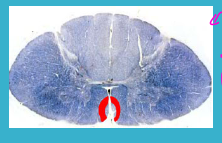
why does the ACT have bilateral influences?
some axons decussate in the anterior white commissure of the spinal cord when it reaches the level of the target neuron and projects onto LMNs of axial and proximal muscles
what is the pathway of the rubrospinal tract?
begins in the red nucleus of the midbrain, immediately decussates in teh ventral tegmental decussation, then travels through the lateral part of the brainstem (the pons, medulla), and into the spinal cord where it travels through the lateral funciculus and terminates in the ventral horn of cervical segments (very close to the LCT- why its the LCTs little helper!)
what is the function of the rubrospinal tract?
acts primarily on the flexor muscles of the upper extremity and contributes to control of the upper limb distal muscles (though just shaping of the hand and NOT fine dexterity)
what is the laterality of the rubrospinal tract?
contralateral
where does the rubrospinal tract recieve information from (at the red nucleus)?
pyramidal cells in the motor cotrex, the cerebellum (for info about proprioception, etc)
where in the white matter of the spinal cord can axons of the rubrospinal tract be found?
in the lateral funiculus, just lateral to the axons of the LCT
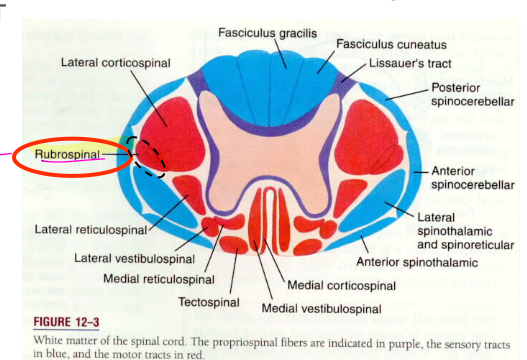
what is the primary muscle innervated by the rubrospinal tract?
flexors of the UE
why is the reticulospinal tract considered the most “primitive” tract?
it refects basic motor functions and play a role in early reflex movements
what is the origination pathway of the reticulospinal tract?
arise form cells within the reticular formation of the brainstem
what is the function of the reticulospinal tract?
controls the bilateral postural muscles and proximal lumb muscles, coordinates muscular activity of the trunk and proximal limb muscles, and plays an active role in proximal limb control and reaching
what is the reticular formation, and what is it involved in?
the center or core part of the brainstem that gives rise to the reticulospinal motor tract, is involed in vital function (breathing, cardiac)
how does the reticulospinal tract contribute to bilateral control?
it has cell bodies that arise from the reticular formation eithin the pons which projects ipsilaterally to the entire length of the cord and cells bodies that arise from the reticular formation within the medulla which projects bilaterally to all levels of the spinal cord
where does the reticulospinal cord terminate in the spinal cord?
in the anteiror and medial funiculus of the spinal cord, just outside the ventral horn
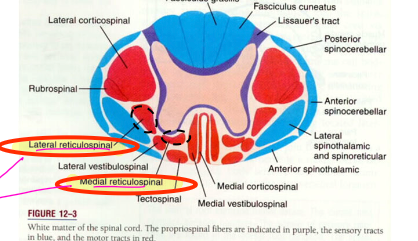
what is the relationship between the CST and the reticulospinal tract?
the motor cortex (lateral CST) sends projects to both sides of the brainstem to the cells of origin of the RST, where is it able to keep the RST ‘in check’ by regulating the automatic and patterned motor outputs controlled by the RST. see the emergence of these fixed and stereotyped movements when there is a loss of the lateral CST
what is the origin of the vestibulospinal tract?
in the brainstem from the lateral and medial vestibular nuclei (therefore is divided into two pathways— the lateral vestibulospinal and medial vestibulospinal)
what is the function of the vestibulospinal tract?
controls automatic or involuntary brainstem motor control to primarily the axial and proximal motor pools, contributes to upright postural control, antigravity muscle control (extensors), and adjusting the head position in response to changes in posture and stimuli. plays an important role in control of muscle tone, antigravity muscle, and postural reflexes
where does the vestibulospinal tract recieve input from?
vestibulocochlear nerve for linear and angular acceleration of the head and the cerebellum for proprioception (which allows it to aid the nervous system in telling the muscles how to contract)
where does the medial vestibulospinal tract terminate?
mainly in the medal part of the ventral horm in ipsilateral cervical and upper throacic segments of the spinal cord, which projects bilaterally to the cervical cord for control of the neck muscles
where does the lateral vestibulospinal tract terminate?
terminate in the cervical and lumbar segements of the spinal cord and project ipsilaterally to all levels of the spinal cord that activate antigravity msucles that control posture and balance
what helps keep the VST in check?
the red nucleus (from the rubrospinal tract) sends projections to inhibit this system to prevent excessive activation of the extensor muscles- if there s disruption of this inhibition then see excessive extensor tone
where does the tectospinal tract originate?
in the superior colliculius (in tectum)
what is the function of the tectospinal tract?
coordinates head and eye movement, executes spinal reflexes to visual and auditory stimuli, also plays a role in spatial awareness
 Note
Note  Flashcards (34)