Turkel - Oxidase Positive Bacilli
 Call Kai
 Learn
Learn Practice Test
 Spaced Repetition
 Match
Match Flashcards
 Knowt Play
1/82

There's no tags or description
Looks like no tags are added yet.
Name | Mastery | Learn | Test | Matching | Spaced | Call with Kai |
|---|
No analytics yet
Send a link to your students to track their progress
83 Terms
Vibro
Aeromonas
Plesiomonas
Chromobacterium
What genuses comprise the Oxidase (+) Bacilli?
Oxidase (+)
Catalase (+)
Nitrate (+)
Indole (+)
List the biochemicals that Vibro, Aeromonas, Plesiomonas, and Chromobacterium test positive for.
V. metschnikovii
V. gazogenes
All genuses are Oxidase (+) except which two species?
V. metschnikovii
V. gazogenes
All genuses are Nitrate (+) except which two species?
Brackish/marine:
- Vibrio
Fresh:
- Aeromonas, Plesiomonas, Chromobacterium
Separate the genuses based on their type of water they typically inhabit.
- Ingestion of contaminated water/seafood
- Exposure of disrupted skin/mucosal surfaces to contaminated water
What are the possible modes of transmission for the "Water Bugs"?
In between fresh and salt water
Describe the salinity for brackish water.
- Darting
- "shooting star" motility
Describe motility behind Vibrio spp.
Habitat:
- Brackish, salt water; plankton, egg masses; human carriers (uncommon)
Transmission:
- Fecal-oral: Ingestion of contaminated water via washing, swimming, cooking or ingestion of contaminated shellfish/other seafood
Disease:
- Cholera [O1/O139]
- Non-O1/immunocompromised: bacteremia, wound infections, ear infections (Otitis media)
TCBS:
- Yellow (Sucrose +)
MISC:
- Does NOT require NaCl
Describe the following for Vibrio cholerae:
- Habitat
- Transmission
- Disease
- TCBS
- Misc
Habitat:
- Brackish, salt water
Transmission:
- Exposure to contaminated water
Disease:
- Septicemia
- Wound infections
- Ear infections
TCBS:
- Yellow (Sucrose +)
MISC:
- Puffer fish neurotoxin
Describe the following for Vibrio alginolyticus:
- Habitat
- Transmission
- Disease
- TCBS
- Misc
Habitat:
- unknown
Transmission:
- unknown
Disease:
- Septicemia
- possible gastroenteritis
TCBS:
- Yellow (Sucrose +)
MISC:
- Oxidase (-)
Describe the following for Vibrio metschnikovii:
- Habitat
- Transmission
- Disease
- TCBS
- Misc
Habitat:
- brackish/salt water
Transmission:
- Ingestion of contaminated water or seafood
Disease:
- wound infection
- gastroenteritis
TCBS:
- Green
MISC:
- N/A
Describe the following for V. parahaemolyticus.
- Habitat
- Transmission
- Disease
- TCBS
- MISC
Habitat:
- brackish/salt water
Transmission:
- Ingestion of contaminated water or seafood
- Wound exposure
Disease:
- wound infection
- septicemia
- possible gastroenteritis
TCBS:
- Green
MISC:
- N/A
Describe the following for V. vulnificus.
- Habitat
- Transmission
- Disease
- TCBS
- MISC
Straight to slightly curved with a single polar flagellum
What is the gram stain morphology of Vibrio cholerae?
- Cholera toxin
- Motility
- Pili
- Mucosinase
- Bloody stools/fever not usually present
- Hyperinfectivity within human host
List the virulence mechanisms for V. cholerae.
Cholera Toxin
- "Rice Water Stools"
- Stools contains: mucus, epithelial cells, electrolytes, bacteria
- Can lose as much as 1 liter/hour
- released in small intestine
Describe the pathogenicity behind the cholera toxin.
Children, due to low fluid in their developing systems
What demographic typically suffers most when infected with V. cholera?
Why?
O1
O139
List the serogroups for V. cholerae (2).
V. cholerae O1
If agglutination is observed in serogroup O1 antisera, what is this identified as?
V. cholerae O1
Which V. cholerae serogroup is responsible for all RECENT outbreaks?
V. cholerae O1
Which is the main V. cholerae serogroup identified GLOBALLY?
- Classical
- El Tor
Name the two biotypes for V. cholerae.
O139 Bengal
Which other serogroup can produce disease similar to V. cholera?
Banglades (SE Asia)
Where was O139 Bengal discovered?
making cholera enterotoxin
What ability of serogroups O1 and O139 increases potential to cause epidemics?
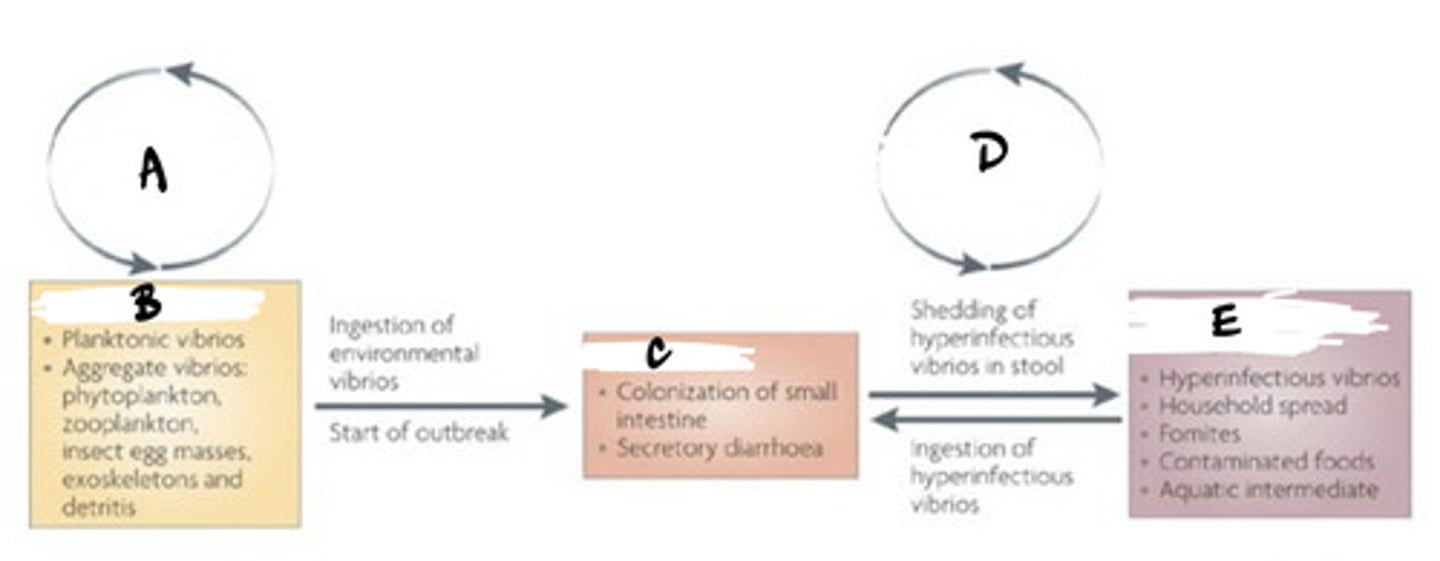
A. Persistence of V. cholerae
B. Aquatic reservoir
C. Human host
D. Amplification by fecal-oral spread
E. Intermediate during an outbreak
Using the context clues of the chart, label each section from A-E.
a. 100,000 cases
b. 95% = Mild, asymptomatic
5% = Life threatening
There are 3-5 million cases of Cholera per year.
a. How many cases account for deaths?
b. Differentiate asymptomatic cases vs. life threatening cases.
- profuse, water diarrhea
- vomiting, leg cramps
- rapid loss of body fluids --> dehydration and shock
- death can occur in hours without treatment
Describe the characteristics behind life threatening cases of Cholera.
Areas with inadequate hygiene, sanitation, and water treatment
What areas are at risk for infection and spread?
- Haiti
- Yemen
- Mexico
- Dominican Republic
- Cuba
Where in the world are current cases found in?
2-5 days
What is the incubation period for Cholera?
- Immediate replacement of fluids/salts through diarrhea
How is treatment presented to an individual going through Cholera infection?
For the prevention of cholera caused by serogroup O1 in adults 18-64 years old traveling to cholera-affected areas
FDA Approved in June 2016
Describe Vaxchora.
- Immunity was nonexistent, 100% of population was susceptible
- Linked to Nepalese peacekeeper housing leaking sewage
- Now endemic to the region (810,000 cases with nearly 10,000 deaths)
On October 10, 2013, the U.N. was sued for bringing cholera to Haiti in efforts of providing aid to the massive earthquake, causing an outbreak that killed thousands.
Describe the immunogenicity of the incident, what was it linked to, and the outcome in cases and deaths.
Yemen
1/4 of cases were children < 5 years
In 2017 and 2019, what country accounted for 84 and 93% of all cholera cases?
What portion of the cases were children under 5 years of age?
- City water plant
- 58 people killed; 1,293 sickened in 3 days
In the ongoing Sudan civil war, what was targeted by the paramilitary group that caused a cholera outbreak?
What was the death toll/infectivity and in how many days was it accumulated in early stages of the war?
a) Jon Snow
b) Contaminated water pump
- A mother washed a baby's diaper with the well water and dropped a dirty diaper into leaky cesspool near the well
c) Koch, 1883
a) Who was the individual that discovered the source of the cholera outbreak that hit London in 1854?
b) What was the source and how did the outbreak occur?
c) Who/when isolated V. cholera later on?
>600 deaths, with 500 deaths in 10 days
How many deaths were accumulated over the 1854 London Cholera outbreak?
Bacteria enters body while in contaminated water
- rapidly progressive (septicemia --> death)
How does a wound infection occur in reference to V. vulnificus?
After ingestion of raw, undercooked seafood, notably oysters and clams
- 75% of infections have underlying liver disease
How does septicemia occur in V. vulnificus?
Extra-intestinal infections:
- Bacteremia
- Ear infections
- Wound infections
What type of infections does V. alginolyticus feature?
Puffer Fish
- produces a potent neurotoxin (tetrodotoxin)
V. alginolyticus is found in what animal reservoir?
V. parahaemolyticus
What Vibrio spp. causes a mild-moderate cholera-like diarrheal disease?
- Nausea
- Vomiting
- Abdominal cramps
- Self-limiting
Describe the symptoms of the mild "cholera-like" diarrheal disease association with V. parahaemolyticus.
Hemolysin
What is the virulence factor featured with V. parahaemolyticus?
Fecal-oral:
- primarily infected by ingesting raw/undercooked oysters
- most cases in summer/fall
What is the mode of transmission for V. parahaemolyticus?
Food poisoning:
- 24 hour incubation
V. parahaemolyticus was an important cause of what in Asia (Japan/Taiwan)?
- A. hydrophilic
- A. caviae
- A. veronii
What species comprise the Aeromonas hydrophila group?
Found in fresh and salt water
- can also be found din produce, meats, and seafood
Where is Aeromonas hydrophila group predominantly found in?
- Gastroenteritis
- Septicemia
- Osteomyelitis
- Pneumonia
- Wound Infections
What infections are featured among the Aeromonas hydrophila group?
- Necrotizing fasciitis
What is a feature within wound infections for the Aeromonas hydrophilia group?
- Oxidase (+)
- Citrate (+)
- Indole (+)
- VP (+)
- ONPG (+)
- TCBS: Yellow
List the following biochemical reactivity for Aeromonas hydrophila:
- Oxidase
- Citrate
- Indole
- VP
- ONPG
- TCBS Color
Y. enterocolitica
What does Aeromonas hydrophila mimic on the CIN agar?
EMB
MAC
SS
HE
BA w/ Ampicillin
What media can Aeromonas hydrophila grow on? (5)
Shigella
What genus antisera may Plesiomonas shigelloides agglutinate?
- DNA homology
- only member that is Oxidase (+)
Plesiomonas shigelloides was moved to the Enterobacteriaceae based on what?
How does it differ from the rest of the Enterobacterales?
Found in water, soil, animals (shellfish, freshwater fish, lizard, cats, dogs)
Where can Plesiomonas shigelloides be found in?
Intestinal:
- Diarrhea
Extra-intestinal:
- Wound
- Bacteremia
- Meningitis
What is the main symptom of each infection associated with Plesiomonas shigelloides?
- BAP
- MAC
- HE
What plates can plesiomonas shigelloides grow on (3)?
Inositol-brilliant green-bile salts (IBB) agar
What is the selective media for Plesiomonas shigelloides?
P. shigelloides
- White/pink
Enterics
- Green or Pink
How does P. shigelloides appear on the IBB agar in comparison to other Enterics?
- Salt Requirement and Tolerance Test (NaCl)
- String Test
- O/129 Susceptibility Test (Vibriostatic Test)
What are the special tests for Vibrio, Aeromonas, and Plesiomonas spp.?
Vibrios (String +) from Aeromonads (String -)
Describe what the String Test helps differentiate.
Vibrios and distinguishes them from other oxidase (+) GNRs
What does the O129 Susceptibility test help distinguish?
P. shigelloides (S)
Aeromonas spp. (R)
Vibrio (V)
Susceptibility of O129 in reference to P. shigelloides, Aeromonas spp, Vibrio spp
Purple or violet
What pigment does Chromobacterium violaceum produce?
Wound Infections:
- Acquired from exposure of disrupted skin to contaminated soil or water
- Can lead to fulminant, life-threatening, systemic infections
Chromobacterium violaceum is a common organism in what type of infection?
Food poisoning:
- Gastroenteritis
- Diarrhea
- Septic arthritis
Campylobacter spp. are a major cause of....
Person-to-Person:
- Daycare
- Nursing/Residential Homes
- Oral-anal sexual contact
How is Campylobacter spp. spread?
- C. coli
- C. jejuni
What are the two Campylobacter spp. that are thermophilic, which prefer 42 C?
- Curved GNR
- S-shaped or "Seagull-wing" and many form spirals
What are key gram stain characteristics of Campylobacter spp.?
- Most require microaerophilic (5-10% O2 conditions
- Capnophilic (8-10% CO2)
What atmospheric conditions do Campylobacter spp. require/like?
Oxidase (+)
Catalase (+)
Nitrate (+)
Motility (+ darting)
List the following biochemical tests for Campylobacter spp.:
- Oxidase
- Catalase
- Nitrate
- Motility
42 C, but can also grow at 37 C
At what temperature does C. jejuni grow at?
C. fetus
What Campylobacter spp. does NOT grow at 42 C?
Campylobacter jejuni
What is the most common cause of bacterial gastroenteritis in the world?
- Guillain-Barré syndrome; demyelination
What neurologic disorders are associated with Campylobacter jejuni?
Antibody cross reactivity between Campylobacter and neural tissue
What is the theory behind the neurological affects of Campylobacter jejuni in reference to Guillain-Barre syndrome
- Stool
- Rectal swabs
- Blood
- Material from infected body sites
What specimens are acceptable for Campylobacter spp.?
- Gray to pink or yellowish-gray
- Some may have tailing effect along streak line
- Some slightly mucoid-looking
Describe the colonial morphology of Campylobacter spp.
Catalase (+)
Growth at 25 C (-)
Growth at 42 C (+)
Hippurate (+)
Cephalothin (R)
Nalidixic acid (S)
Indoxyl acetate (+)
Nitrate (+)
List the following biochemical results for C. jejuni:
- Catalase
- Growth at 25 C
- Growth at 42 C
- Hippurate
- Cephalothin
- Nalidixic acid
- Indoxyl acetate
- Nitrate
Catalase (+)
Growth at 25 C (-)
Growth at 42 C (+)
Hippurate (-)
Cephalothin (R)
Nalidixic acid (S)
Indoxyl acetate (+)
Nitrate (+)
List the following biochemical results for C. coli:
- Catalase
- Growth at 25 C
- Growth at 42 C
- Hippurate
- Cephalothin
- Nalidixic acid
- Indoxyl acetate
- Nitrate
Catalase (+)
Growth at 25 C (+)
Growth at 42 C (-)
Hippurate (-)
Cephalothin (S)
Nalidixic acid (R)
Indoxyl acetate (+)
Nitrate (+)
List the following biochemical results for C. fetus:
- Catalase
- Growth at 25 C
- Growth at 42 C
- Hippurate
- Cephalothin
- Nalidixic acid
- Indoxyl acetate
- Nitrate

