Topic 5: Viruses and Fungi
 Call Kai
 Learn
Learn Practice Test
 Spaced Repetition
 Match
Match Flashcards
 Knowt Play
1/32

There's no tags or description
Looks like no tags are added yet.
Name | Mastery | Learn | Test | Matching | Spaced | Call with Kai |
|---|
No analytics yet
Send a link to your students to track their progress
33 Terms
What are the characteristics of a virus?
Viruses are non-cellular
biologically inert(not alive)
obligate intracellular parasites
cannot reproduce independently
can infect various organisms
cannot be observed using a light microscope.
How do viruses differ from bacteria?
Viruses are intracellular parasites,
lack a plasma membrane
do not reproduce via binary fission
do not possess RNA and DNA simultaneously
lack ATP-generating metabolism
do not have ribosomes
are not sensitive to antibiotics.
What is a virion?
A complete, fully developed infectious viral particle.
What two components make up a virion?
A core nucleic acid and a protein coat called a capsid.
What are the four main types of viral morphology?
Icosahedral, enveloped, helical, and complex viruses.
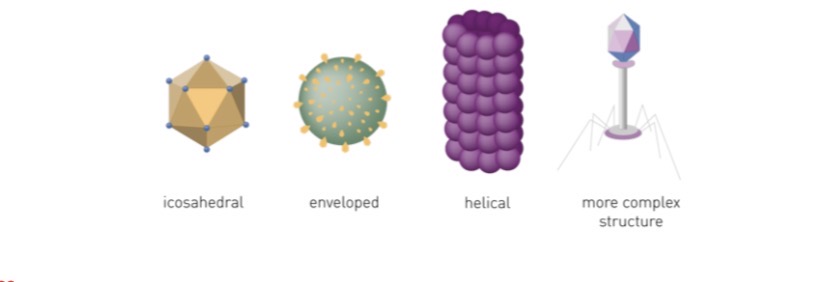
What defines an icosahedral virus?
It has a spherical shape with 20 sides, each composed of an equilateral triangle.
What is an enveloped virus?
A virus surrounded by a membrane made of lipids, proteins, and carbohydrates.
What is a helical virus?
A virus that resembles long rods, with a helical structure around its viral genome.
What is the Baltimore Classification System?
A classification scheme devised by David Baltimore that categorizes viruses based on their nucleic acid type.
What are the six key stages of the viral replication cycle?
Attachment
Penetration
Uncoating
Biosynthesis
Assembly
Release.
What occurs during the attachment stage of viral replication?
The virus recognizes and binds to specific receptors on the host cell membrane.
How do enveloped and naked viruses enter host cells?
Enveloped viruses enter via fusion or endocytosis, while naked viruses enter via receptor-mediated endocytosis.
What happens during the uncoating stage?
The viral capsid is removed, releasing the viral genome into the host cell.
What is biosynthesis in the viral replication cycle?
The process where the virus replicates its genome and synthesizes proteins using the host's machinery.
What is the difference between the lytic and lysogenic cycles in bacteriophages?
The lytic cycle results in the death of the host cell, while the lysogenic cycle allows the host cell to remain alive.
What is a bacteriophage?
A virus that specifically infects bacteria.
What is the function of capsomeres?
They are the protein units that make up the viral capsid.
What is the difference between ssRNA and dsRNA viruses?
ssRNA viruses have single-stranded RNA, while dsRNA viruses have double-stranded RNA.
What happens during the release stage of viral replication?
New virions exit the host cell, often causing cell lysis or budding.
What is the lytic cycle of a bacteriophage?
Attachment: The bacteriophage attaches to the host bacterial cell and injects DNA.
Biosynthesis: The phage nucleic acids use the host cell machinery to synthesis viral components. Host DNA is degraded by phage-encoded enzymes.
Maturation/Assembly: The new viral components are assembled into virions
Release: Host cell is lysed, and new virions are released
In the lysogenic cycle, what is the term for the phage DNA integrated into the bacterial host chromosome?
Prophage.
What is a key characteristic of a lysogen?
A bacteria containing a prophage.
What can induce the prophage to reactivate the lytic pathway?
Nutrient deprivation, damage to host cell DNA, or cell stress.
Virulent and Temperate viruses
Virulent phage can only replicate via the lyPc cycle.
• Temperate phage can replicate via the lyPc OR lysogenic cycle.
What is a key difference between animal viruses and bacterial viruses?
The entire virion of an animal virus enters the host cell, not just the nucleic acid.
What is the purpose of a plaque assay?
To quantify the number of infectious virions present in a volume of fluid.
What is the composition of the fungal cell wall?
The cell wall is made of chitin.
What is the role of ergosterol in fungi?
It is a component of fungal membranes and is targeted by antifungal drugs.
What are dimorphic fungi?
Fungi that can switch between yeast and mould forms, such as Histoplasma capsulatum.
What are mycoses?
Fungal infections caused by pathogenic or opportunistic fungi in humans and animals.
What are mycotoxins?
Toxic secondary metabolites produced by certain fungi that serve ecological roles.
Types of fungal infections
Superficial Mycoses: Limited to the outermost layers of skin and hair.
Cutaneous Mycoses: Affect the keratinised layers of the skin, hair, and nails.
Subcutaneous Mycoses: Involve deeper layers of skin, subcutaneous tissue, and sometimes muscle.
Systemic Mycoses: Involve internal organs and systems, often originating in the lungs.
Opportunistic Mycoses: Occur in immunocompromised individuals, caused by fungi that are not normally pathogenic.
Fungal budding
Asymmetrical and smaller daughter cell

