Unit 5 - Homestasis
 Studied by 0 people
 Call Kai
 Learn
Learn Practice Test
 Spaced Repetition
 Match
Match Flashcards
 Knowt Play
1/43

Earn XP
Description and Tags
Yaaaaa
Name | Mastery | Learn | Test | Matching | Spaced | Call with Kai |
|---|
No analytics yet
Send a link to your students to track their progress
44 Terms
What is homeostasis?
Our body’s tendency to maintain internal conditions despite external conditions
How does our body react with homeostasis?
Physiological responses: -Internal chemical reactions. ex. breakdown and production of glucose to regulate blood sugar levels
-Unconcious physical changes. ex. sweating, shivering
Behavioural responses : -Carry out a conscious physical change/An action an organism takes to keep its internal environment stable, ex. seeking a warm spot when cold, or eating when hungry
How do we react to overheating?
Physiological : -sweating, dilation of blood vessels, thirsty
Behavioural: -drink water, find shade
How do we react to frostbite?
Physiological: -shivering, constriction of blood vessels
Behavioural: -putting on gloves, seeking places with warmth, moving around to create heat
What is a feedback mechanism?
a process where the output of a system influences its input
in the context of homeostasis, it is used to maintain a stable internal environment by counteracting or amplifying changes
What is a negative feedback loop?
process which stabilizes itself by reducing its output when the output’s effects are too great
What are some examples of negative feedback loops?
Body temperature
Breathing
Water balance
Blood sugar
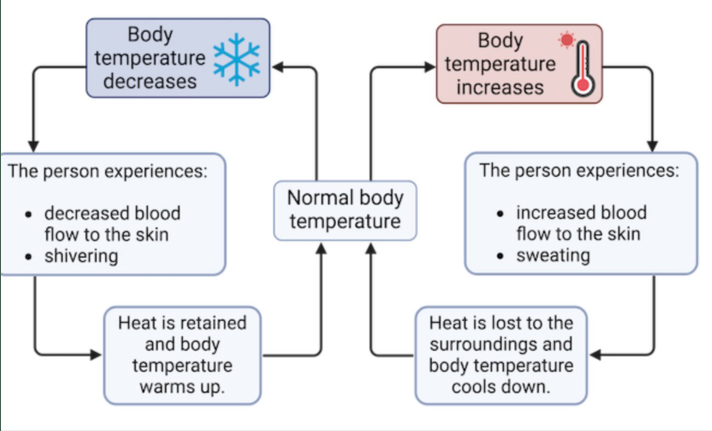
Thermoregulation
What is thermoregulation?
Biological process of maintaining a stable internal body temperature.
Typically around 37°C in humans.
Works by balancing heat production with heat loss.
Heat loss through mechanisms like sweating.
Heat production through mechanisms like shivering.
What is osmoregulation
Osmoregulation is the process of maintaining the body’s water and salt balance.
Keeps levels of water, ions, and solutes stable inside the body.
Prevents the body from becoming too diluted (too much water) or too concentrated (too little water).
Mainly controlled by the kidneys.
Helps maintain proper blood pressure and cell function.
How it does it:
Kidneys filter the blood and adjust how much water is reabsorbed or released.
Too much water → kidneys make dilute urine (release more water).
Too little water → kidneys make concentrated urine (save water).
ADH hormone tells kidneys when to conserve or release water.
How blood pressure is affected:
More water kept in the body → higher blood volume → blood pressure increases.
More water released in urine → lower blood volume → blood pressure decreases.
Why is osmoregulation important in humans?
It acts as our mechanism to regulate osmotic pressure
It balances our water and salt, which we need
Without osmoregulation, there would be a lot of toxic waste and water in humans
We live on land and lose water constantly through breathing, sweating, and waste. We must continuously replace this lost water and regulate salts to keep our internal environment balanced.
What is osmotic pressure?
Osmotic pressure is the force created by differences in solute concentration across a semi-permeable membrane.
It pulls water from an area of low solute concentration to high solute concentration.
Higher solute concentration = higher osmotic pressure.
Helps control the movement of water in and out of cells.
Important for maintaining cell shape, fluid balance, and overall homeostasis
What is a positive feedback loop?
a process where an initial change triggers a response that amplifies the original change
Examples of positive feedback loops
childbirth
blood clotting
What is excretion?
the process of removing metabolic waste products and other toxic substances from the body
Why do we excrete?
To function, it is essential to excrete waste from cells and the body in general
To maintain homeostasis, we must excrete to regulate our ionic balance and pH balance
What are the two main functions of the excretory system?
Regulates fluids and waste
Concentrates (gathers) waste and expels it from the body
What do we excrete?
certain metabolites must be eliminated, like nitrogenous compounds (since nitrogen is bad for us)
When the body processes things during metabolism like proteins etc, it produces waste molecules
What is waste?
When we break down nitrogenous waste products (amino acids and nitrogenous bases from eating certain animals), they turn into amine groups, which are toxic waste.
Ammonia:
Product of deamination (removing N⁺ group).
Results from breakdown of proteins.
Occurs in liver.
Urea:
Ammonia produces it.
Occurs in liver.
Uric acid:
Formed from the breakdown of amino acids.
Single-celled organisms
Have an advantage in excretion because they have a high surface area, so they use simple diffusion only.
They are always in contact with the external environment.
Their internal environment is hyperosmotic to the surroundings.
They have contractile vacuoles that pump out excess water to expel it.
What challenge do single-celled organisms face?
Because they are directly exposed to the external environment, any change in surrounding solute concentration causes immediate osmotic stress.
This can lead to potential cell damage in single-celled organisms.
What are complex organisms?
Most complex organisms do not have constant contact with the external environment
Therefore, the excretory system takes on different forms to help excrete since they are in contact with the external environment, making it harder to excrete
What organs help us excrete?
Lungs:
Excrete carbon dioxide through exhaling
Liver:
Converts amino acids to urea to excrete
Large Intenstine:
Removes waste
Kidneys:
Filters blood and removes waste
What does the Human Urinary System do?
Eliminate waste products and foreign matter from the body
What is the Human Urinary system composed of?
Kidneys
Ureters
-Transport urine from kidneys to bladder
Bladder
-stores urine
-releases urine during urination
Urethra
-carries urine out of bladder
What are the 3 main structures of the kidney?
Cortex
Outer layer of the kidney
Medulla
Inner layer of kidney
Renal Pelvis
Hollow cavity that connects the kidney to the ureter
What are the 3 main functions of the kidney?
Remove waste
Balance blood pH
Maintain water balance
What is a nephron?
Tiny part of kidney
Filters waste from the blood (in the kidney)
How does blood filtering occur in the nephron?
Begins at the glomerulus (which is surrounded by bowman’s capsule)
Glomerulus receives blood from affarent arteriole, once filtered, it exits through efferent arteriole
Blood is finally carried to peritubular capillaries
How does the filtering of certain components occur in the nephron?
High blood pressure in the glomerulus pushes some components through the semipermeable membrane into Bowman’s capsule.
• These components enter the proximal convoluted tubule in the renal cortex.
• The filtrate descends into the medulla through the loop of Henle.
• It rises into the distal convoluted tubule.
• At this point, it is urine and goes into the collecting duct to the renal pelvis.
• By this point, all non-waste substances should have been reabsorbed.
• The ureter empties the remains into the bladder.
• Takes water, ions, small nutrients, molecules (amino acids, glucose), nitrogenous waste.
• Does not take blood cells, platelets, or plasma proteins, which continue through the capillaries.
What are the steps of the formation of urine?
Filtration
Reabsorption
Secretion
What happens in the reabsorption step in the Nephron?
Some components entering Bowman’s capsule are not waste and must be reabsorbed in the proximal and distal tubules.
Ions are reabsorbed at the proximal convoluted tubule and returned to body cells.
Specialized ion pumps (proteins) transport sodium (Na⁺), and when sodium is reabsorbed, chlorine (Cl⁻) and bicarbonate move with it.
Throughout the proximal and distal tubules, glucose, amino acids, salts, and water are reabsorbed to different extents.
Reabsorption continues until everything needed is fully reabsorbed; excess is excreted in the urine.
What happens in the secretion step in the nephron?
Waste products enter (are secreted in) the tubule to be removed as urine
Wastes are secreted at several points during the urine formation process
At the Proximal Convoluted Tubule:
Urea, Uric acid, Creatine, some drugs, H+ and NH4+
Loop of Henle:
Urea
Distal Convoluted Tubule:
-H+, K+, and NH4+ (ammonium)
What are terms for the different concentrations? Specific to osmosis
Solution with a higher solute concentration is Hyperosmotic
Solution with lower solute concentration is Hypoosmotic
Balanced : isoosmotic
Why is osmoregulation and excretion connected?
Osmoregulation keeps water and ion levels stable.
Excretion removes toxic wastes.
Both happen in the kidneys in the nephron.
When the nephron removes wastes, it also adjusts water and ions — so excretion and osmoregulation are automatically linked.
What does ADH do?
ADH (antidiuretic hormone) is released from the pituitary gland to regulate the body’s water balance.
Osmoreceptors in the hypothalamus detect when blood osmotic pressure increases.
When this happens, the receptors trigger the release of ADH.
ADH signals the kidneys to reabsorb more water, lowering blood osmotic pressure.
ADH also increases thirst, encouraging the organism to drink more water.
Both actions help restore proper hydration.
How do kidneys help regulate blood pressure and blood pH?
The kidneys help control blood pressure and blood pH. To maintain blood pressure, they adjust the amount of water in the blood. The hormone aldosterone signals the kidneys to reabsorb more sodium (Na⁺), and water follows the sodium back into the blood by osmosis. This increases blood volume and raises blood pressure to a healthy level. To regulate blood pH, the kidneys release hydrogen ions, which form carbonic acid, and bicarbonate, which acts as a base. Together, this keeps the blood’s pH balanced.
What is Diabetes Mellitus bruh????
Condition that happens when your pancreas cannot produce a hormone called insulin
Overtime filters in the kidney become leaky:
Excess sugar builds up within nephrons
This increases the solute concentration in that part of the nephron. Higher solute concentration = higher osmotic pressure, which means water is “pulled” toward the glucose instead of being reabsorbed into the blood.
Creates water-build up (hence why it becomes leaky)
This reduces water reabsorption, causing more water to stay in the urine. This is why people with diabetes Mellitus need to urinate frequently and are very thirsty
Why do we need Insulin?
Essential for maintaining glucose levels, as without it, blood glucose(sugar) levels will raise
What is Diabetes Inspidus?
Imbalance of fluid in the body
Causes destruction of ADH-producing cells of the hypothalamus
Healthy people urinate around 1-3L, people with this urinate about 19L.
Very thirsty, frequent urination
What is Nephritis?
Inflammation of the Nephrons
Affects blood vessels within glomerulus
Alters permeability of the nephron, making it so proteins and large molecules can pass
No mechanism to absorb proteins, therefore they remain in nephron
Frequent urination
What are Kidney Stones?
Cluster of crystals that are formed from a build-up oxalates, phosphates, and carbonates which then combine with calcium to form the stone
What are the two categories of kidney stones?
1. Akaline stones
Urine becomes more alkaline (pH higher than normal) from infections
2.Acid stones
Urine is too acidic, contains high levels of uric acid
Kidney stones can become sharp and painful, and will try to pass through kidney into ureter
Treatment:
Shock treatment
Surgery
How are kidney diseases diagnosed?
Diagnosed by a urinalysis
If glucose, protein, RBC, WBC, present than be concerned
Can also be diagnosed by other stuff like blood test
What are the 2 kinds of Kidney Disease treatments?
Dialysis
Used when your kidney barely functions
Filtration machine acts as an artificial kidney
2 types:
Hemodialysis
Peritoneal Dialysis
Kidney Transplant
Used when complete loss of function in kidney
May need dialysis in combination of the new kidney until it begins to work
 Note
Note  Flashcards (52)