Ap euro unit 1 vocab
 Studied by 1 person
 Call Kai
 Learn
Learn Practice Test
 Spaced Repetition
 Match
Match Flashcards
 Knowt Play
1/85

There's no tags or description
Looks like no tags are added yet.
Name | Mastery | Learn | Test | Matching | Spaced | Call with Kai |
|---|
No analytics yet
Send a link to your students to track their progress
86 Terms
Renaissance
Moving on from the middle ages or "rebirth". Changes in art, architecture, literature, science, technology, politics, religion
Humanist/Humanism ⭐
Emphasis on education and the individual during the Renaissance. Movement where people began to look for answers to life's questions from within rather than from the church. Petrarch was the father of humanism
Secularism ⭐
An indifference to religion and a belief that religion should be excluded from civic affairs and public education.
Individualism ⭐
giving priority to one's own goals over group goals and defining one's identity in terms of personal attributes rather than group identifications
Civic Humanism ⭐
humanism with the added belief that one must be an active and contributing member to one's society
Virtù ⭐
The quality of being able to shape the world according to one's own will
Oligarchy
A government ruled by a few powerful people
Venice
- Merchant Oligarchy
- Longest lasting
- Maritime Power
Florence
- centre of renaissance in 14th-15th century
- Medici
- Signoria
- Il Duomo
Milan
- Sforza family
- Military dictorship
Naples
- France: 1266-1435
- Spain: 1435-onward
Papal States
- Papal theocracy
- Patrons
- Borgia family
Italian Wars
1494- 1559. Wars fought between Valois and Habsburg Dynasties for control of Italy. Many other monarchs involved. The Habsburgs won. Italian ideas spread to the North during this time. Spain replaces Italy as power center of Europe.
Renaissance Man ⭐
A man during the renaissance who embraced it all around by being, educated, knowledgeable, and good at many things
Patronage of the Arts ⭐
Wealthy groups, individuals, families and the church spent money on art to display wealth, status, and power
Medici Family ⭐
Giovanni de Medici - Founder (banker)
Cosimo de Medici - The Elder
Lorenzo de Medici - The Magnificent
Pope Leo X
Pope Clement VII
Medici Chapel (Basilica of San Lorenzo, Chapel of Princes, Medici Tomb, Michelangelo, New Sacristy)
Realism
A type of painting in the Renaissance that was very realistic
Single Point Perspective and Leading Lines ⭐
Techniques used in Renaissance painting to draw the eye to a specific point
Medium
material that art is made out of
Fresco ⭐
wall mural on plaster
Tempera ⭐
egg tempera on wood. a medium during the renaissance
Chiaroscuro ⭐
Light, shadowing in art
Northern Renaissance ⭐
Gradually spread Northward. Late 15th-16th century. Wealthy patrons importing Italian culture
Naturalism
is it another word for Realism a type of painting during the renaissance that was very realistic
Northern Humanism ⭐
or christian humanism was social reform based of christian values. classical + christian culture = ethical way of life
valued personal and societal improvements as well as education
Erasmus: In Praise of Folly ⭐
He was a famous northern humanist. He translated greek and latin versions of the new testament. In Praise the Folly he criticized the Roman Catholic Church, but not too much. Thought education was the key to reform
Thomas More in Utopia ⭐
He was a civic humanist. Protested abuses in contemporary society.
Flemish (Flanders)
the artistic equals of Italian painters & were admired in Italy; Flanders had the most painters in Northern Europe and attracted many promising young painters from other countries. Flemish painters were masters of the oil medium and used it primarily to portray a robust and realistically detailed vision of the world around them. (Flanders is a dutch speaking part of belgium and the speak flemish)
Johannas Gutenberg
Blacksmith. Made the printing press. Gutenberg's bible
Printing Press
Enabled people to be able to read stories from far away places. Made it easier to publish ideas and share them.
Moveable Type
Individual characters made of wood or metal that can be arranged and then used over again
Vernacular Language ⭐
The way that people speak and communicate in a specific region. Printing press allowed it to change from area to area
Centralization
Government that put all power into the hands of one person
New Monarchs
- consolidation of power
- foundation of modern nation-states
- rise in nationalism
- never achieved absolute power
- establishing a monopoly on tax collection, military force, dispensing of justice
- gaining the right to determine their subjects religion
Secular States
countries that have no state religion and in which religion has no direct influence on affairs of state or civil law
The Empire / Holy Roman Empire
- NOT a new monarchy
- Opposition from princes, large landowners/ aristocrats, and clergy
Golden Bull
The agreement in 1356 to establish a seven-member electoral college of German princes to choose the Holy Roman Emperor
Habsburg ⭐
A German royal family that climbed their way through the ranks by marrying
Electors
a person who votes
Wars of the Roses
(1455-1485) civil war for the English crown between the York (white rose) and Lancaster (red rose) families. It hurt trade agriculture, and the domestic industry.
House of York / House of Lancaster
Two houses that fought during the Wars of the Roses.
Henry Tudor / Henry VII ⭐
King during the War of Roses, under him the monary sank lower and lower. With other members of government they worked to restore royal prestige, end the power of nobility, and to establish law and order on a local level.
Henry VIII ⭐
Had a lot of wives. Created the church on England because the catholic church would not let him divorce one of his wives
Elizabeth 1
established religious institutions throughout europe that combine catholic and protestant teachings
Parliament
A body of representatives that makes laws for a nation
Aragon and Castile
2 strong spanish kingdoms that dominated the weaker one of, Navarre, Portugal, and Granada, and the Iberian Peninsula. They won these territories for christianity. When the two families married it still did not unify spain, until they had children.
Ferdinand and Isabella ⭐
Ferdinand of Aragon and Isabella of Castile were Spanish rulers, whose children unified the nation. Ferdinand and Isabella are the ones that sent columbus and magellan on their explorations around the world.
1492
The year the Granda was added to spain
Granada
A large territory that Spain gained after Isabella and Ferdinand commissioned it to be taken
Reconquista ⭐
The struggle between Christians and Muslims in the Iberian peninsula during the middle ages. Ended after spain gained Granada
Conversos / New Christians
The people that converted from judaism to christianity. A large amount of the jewish population in spain was forced to convert to christianity due to them being blamed for the plague.
Age of Exploration
Time period during the 15th and 16th centuries when Europeans searched for new sources of wealth and for easier trade routes to China and India. Resulted in the discovery of North and South America by the Europeans.
New World
the name given by Europeans to the Americas, which were unknown to most Europeans before the voyages of Christopher Columbus
Gold, God, Glory
motives for exploration (come on apush kids you got this one)
god-religion
gold-economy
glory-personal pride
Mercantilism
The belief that there was a set amount of wealth in the world and that having more colonies would increase the percentage of wealth a nation had.
Bullionism
nation's policy of accumulating as much precious metal as possible while preventing its outward flow to other countries
Missionaries
religious missions to settle a region and teach the natives of that region about christianity (aka force them to partake in it)
Cartography
science or art of making maps
Navigational advances
Advancements in ship design, navigational instruments, and weapons during the 15th century.
-magnetic compass
-Geometric Quadrant (used to measure the height of the North Star to determine latitude)
-Mariner's astrolabe (used to measure the height of the North Star to determine latitude)
-guns
-cannon
-gun powder
-cross staff (measured the angle between the horizon and the sun or stars, to determine latitude and direction)
-Caravel (small highly-maneuverable ship)
-Lateen Sail (allowed boats to sail against the wind)
Viceroy
a governor who ruled as a representative of a monarch
Hernando Cortez and the Aztecs (Mexica Empire)
-He was sponsored by spanish governor on cuba, est Vera Cruz, made himself military commander
-Moctezuma (Montezuma) grew powerful through conquest, but were not disease resistance (destroyed by small pox)
Inca Empires and Francisco Pizarro
He landed on Pacific coast of South America with many man and horses
-The leadership and conquests of Pachakuti
-Administration, buildings, and roads
-Takes advantage of Civil War - Lima becomes new capital of Spanish Empire in Peru
Prince Henry the Navigator (Portuguese)
Sent others to explore for him, made very first explorer school, first person to value exploring
Bartholomeu Dias and Cape of Good Hope
Portuguese explorer who in 1488 tried to get across the southern tip of Africa but was forced to turn around due to poor conditions.
Vasco de Gama and India
Tried to get across the same Cape as Bartholomeu, but was successful. Founded the Sea route to India and brought back many spices to portugal and spain
Christopher Columbus
you know who he is
Amerigo Vespucci - Mundus Novus
Realized that Columbus had discovered the New World and had not gotten to India. He wrote the first document to describe the Americas as contents separate from Asia (This letter was title Mundus Novus)
Ferdinand Magellan - The Pacific
First European to cross the pacific. Also the first European to circumnavigate the globe. Portuguese but sailed for spain
Conquistadors
Early-sixteenth-century Spanish adventurers who conquered Mexico, Central America, and Peru
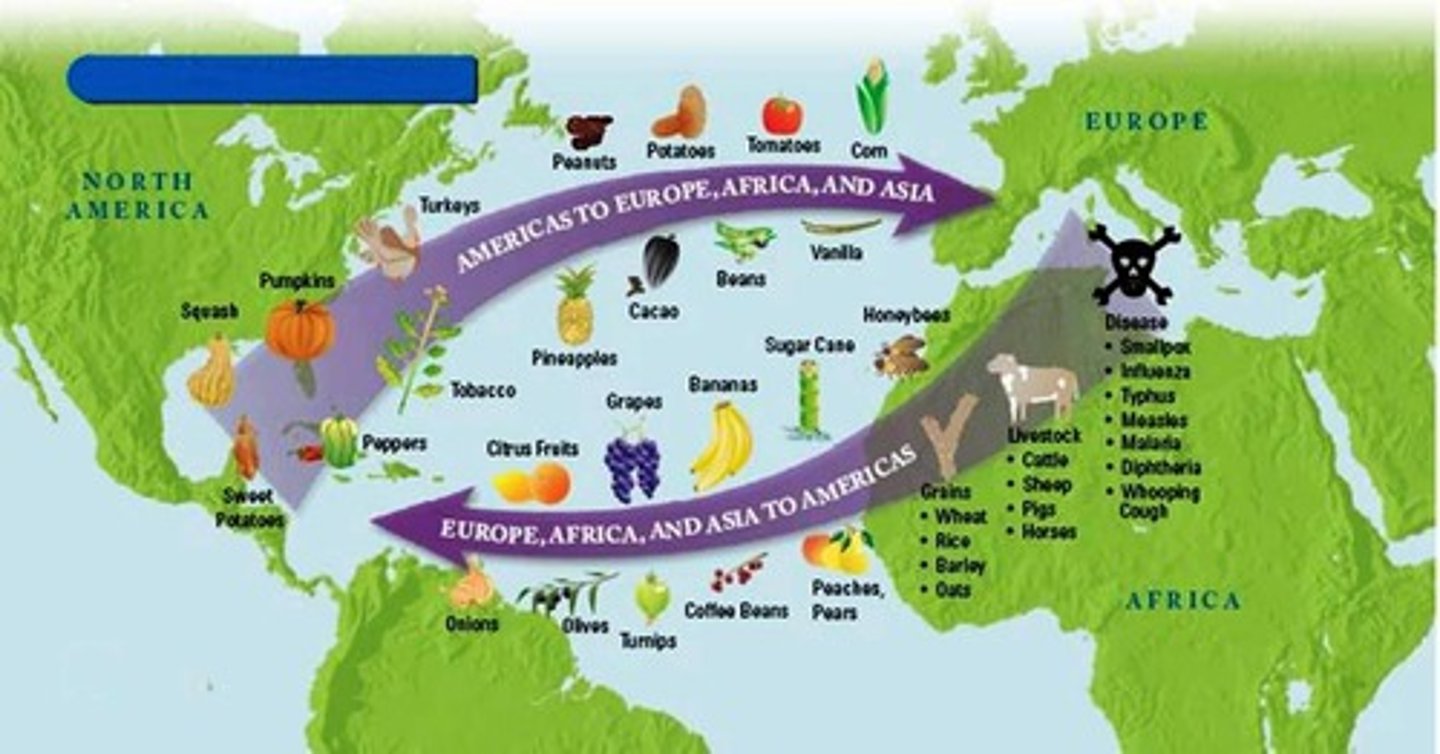
Columbian Exchange
The exchange of plants, animals, diseases, and technologies between the Americas and the rest of the world after Columbus's voyages
Subjugation of Native People
the act of defeating the Native people and ruling them in a way that allows no freedom. In this case forcing them to work
The encomienda system
-Spaniards collect tribute from Native Americans and use them as workers
-they protect the Natives, pay them wages, guide them
-they actually brutally exploited them - plantations & mines
Virginia and Jamestown
Founded in 1607 by john smith for the british crown
Purpose was for trade and profits
thrived off of tobacco
Quebec
First permanent French settlement in North America, founded by Samuel de Champlain
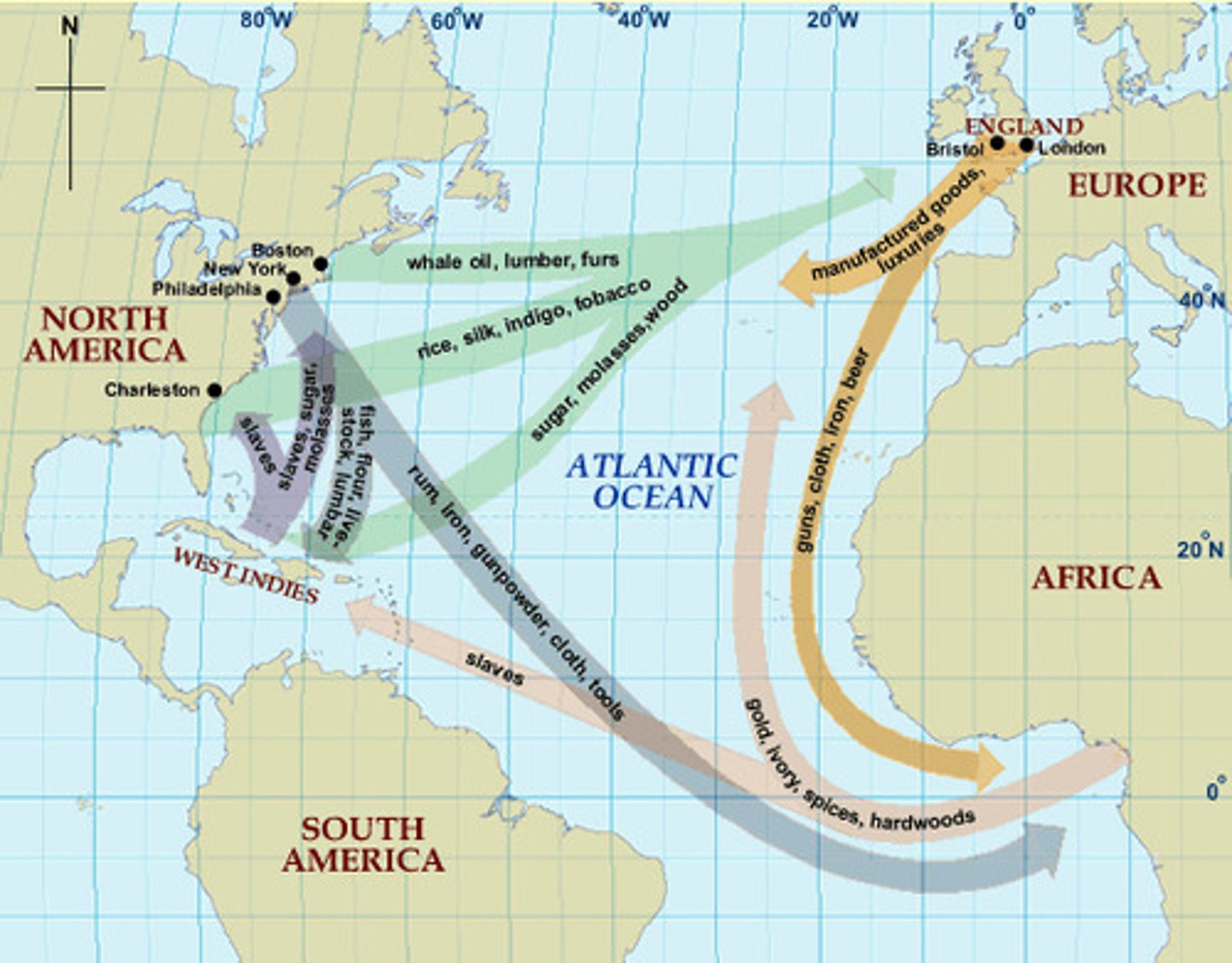
Triangular Trade
Slaves were brought from Africa to the caribbean, sugar, tobacco, and other luxuries were shipped to Europe. Europe then shipped guns, food, and other weapons to africa
commercial capitalism
economic system in which people invest in trade or goods to make profits
guilds
Association of merchants or artisans who cooperated to protect their economic interests
Amsterdam
trade hub of the netherlands, the bank was one the first to implement systems that paved the way for modern banking
London
A large city in England where the ling and queen lived, large trade hub
Subsistence agriculture
the production of food primarily for consumption by the farmer's family
Field rotation
When the location of the field was changed to allow the soil to stay fertile
Price Revolution
A rise in the price of goods between 1500-1650 due to increase of gold and silver. Also population growth
Serfdom
Feudal system, the use of serfs to work the land in return for protection against barbarian invasions-was still being used in eastern europe
Social Dislocation
disrupting an established order so that it can't continue
Little Ice Age
Temporary but significant cooling period between the fourteenth and the nineteenth centuries; accompanied by wide temperature fluctuations, droughts, and storms, causing famines and dislocation.
Family banking houses (Fugger)
A German family that were very successful banks in the 15th and 16th century
 Note
Note  Flashcards (58)