2nd/3rd Trimester Placenta and Umbilical Cord (Ch. 56 & 57)

0.0(0)
Studied by 0 people
call kaiCall Kai
learnLearn
examPractice Test
spaced repetitionSpaced Repetition
heart puzzleMatch
flashcardsFlashcards
GameKnowt Play
Card Sorting

1/44

encourage image

There's no tags or description

Looks like no tags are added yet.

Last updated 7:45 PM on 3/28/26
Name
Mastery
Learn
Test
Matching
Spaced
Call with Kai

No analytics yet

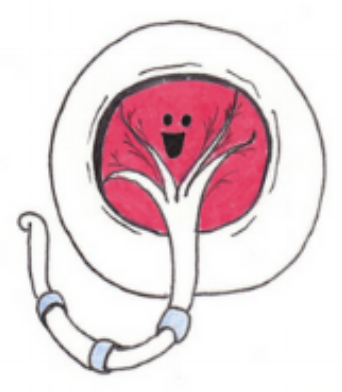
Send a link to your students to track their progress

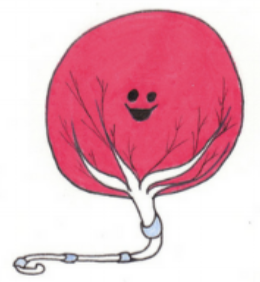
45 Terms

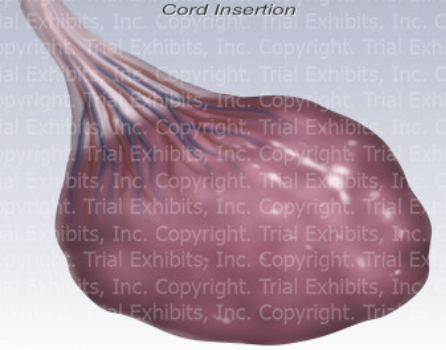
1
New cards

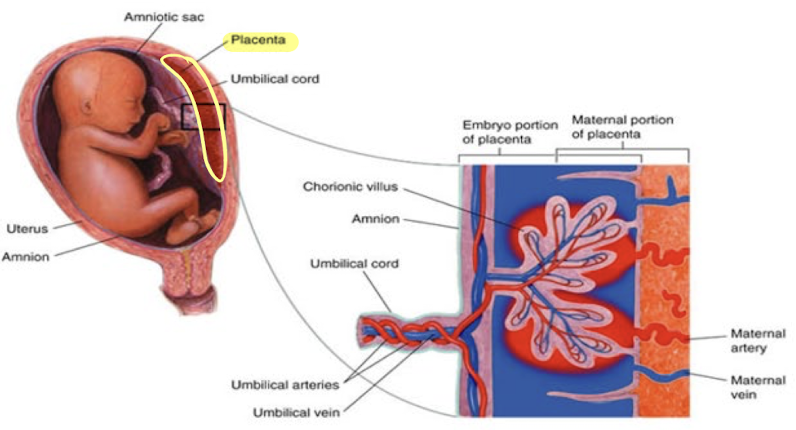
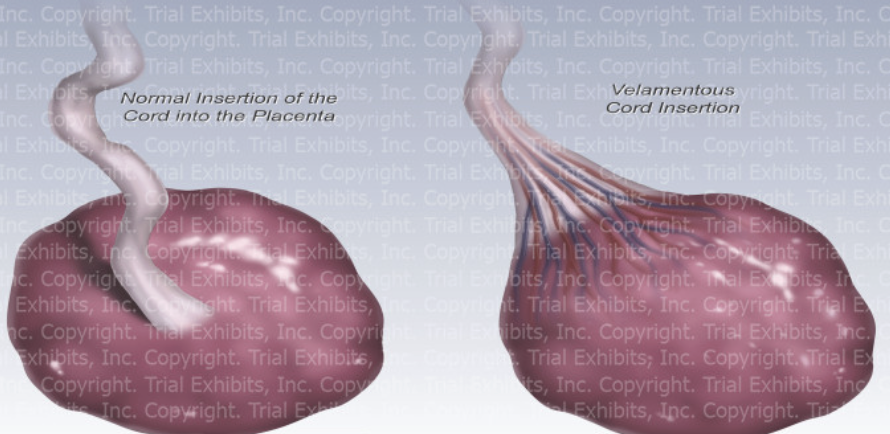
T/F: placenta is a multifunctional organ

True—it acts as baby’s lung (supply oxygen), kidneys (filter waste), and GI and immune systems (deliver nutrients and antibodies)

2
New cards

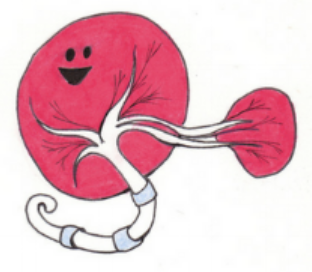
placenta

  • major role in exchanging oxygenated maternal blood with deoxygenated fetal blood

  • develops from trophoblastic cells

<ul><li><p><span style="color: red;">major role in <strong>exchanging oxygenated maternal </strong>blood with <strong>deoxygenated</strong> <strong>fetal</strong> blood</span></p></li><li><p>develops from trophoblastic cells</p></li></ul><p></p>
3
New cards

what are the functional units of the placenta?

chorionic villi

4
New cards

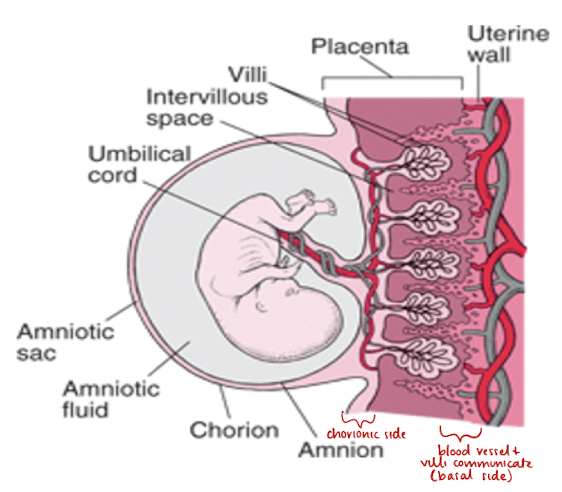
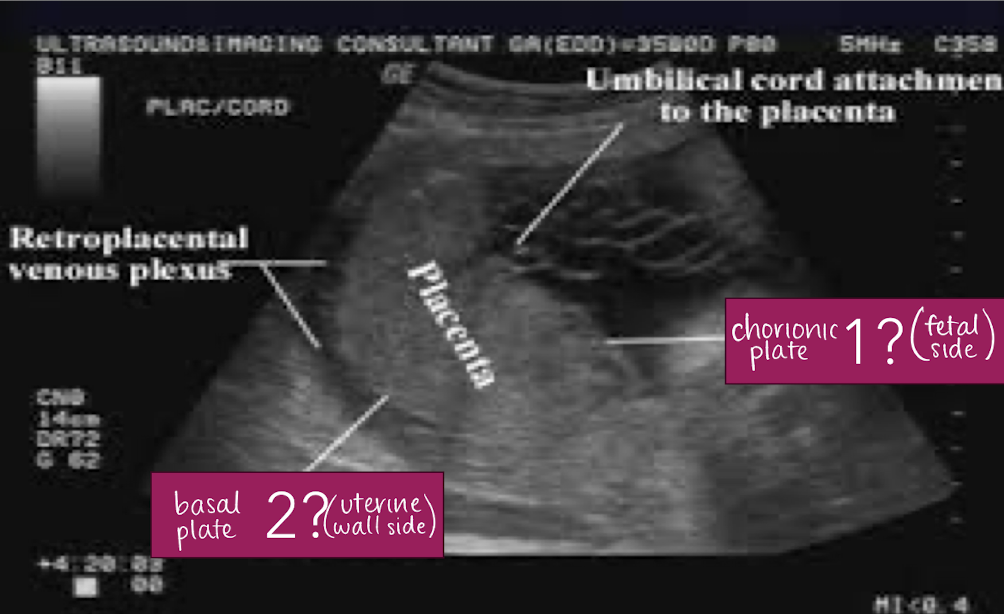
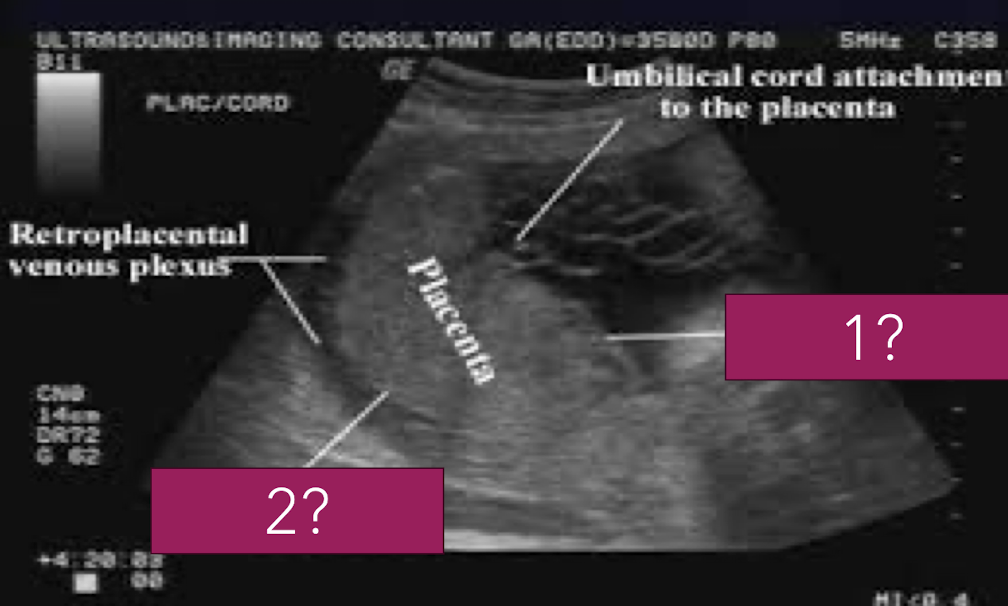
placenta anatomy

divided into 2 parts

  1. chorionic plate (fetal surface)

  • surface facing amniotic fluid

  • continuous with chorion

  1. basal plate (maternal surface)

  • surface facing uterine wall

  • continuous with decidua basalis

<p>divided into 2 parts</p><ol><li><p><span style="color: red;"><strong><u>chorionic plate</u></strong></span> (<span style="color: red;">fetal surface</span>)</p></li></ol><ul><li><p>surface facing amniotic fluid</p></li><li><p>continuous with chorion</p></li></ul><ol start="2"><li><p><span style="color: red;"><strong><u>basal plate</u></strong> </span>(<span style="color: red;">maternal surface</span>)</p></li></ol><ul><li><p>surface facing uterine wall</p></li><li><p>continuous with <span style="color: red;">decidua basalis</span></p></li></ul><p></p>
5
New cards

placenta plate facing amniotic fluid/fetus is called…

chorionic plate

6
New cards

placenta plate facing uterine wall/mom is called…

basal plate
7
New cards
term image
knowt flashcard image
8
New cards

placenta physiology: 3 functions

  • respiration (supply oxygenated blood to baby)

  • excretion (remove waste produce and deoxygenated blood)

  • nutrition

9
New cards

placenta physiology: hormones

  • placenta produces and secretes:

    • HCG

    • estrogen

    • progesterone

10
New cards

placenta fully develops at __ weeks

15

11
New cards

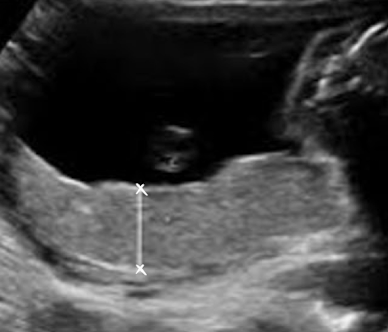
what is a normal placenta size?

2 to 4 cm AP thickness

12
New cards

measuring technique for placenta

  • measure in AP dimension

  • thickest portion perpendicular to uterine wall

  • DO NOT include uterine wall in measurement

  • typically measure after 23 weeks

<ul><li><p>measure in AP dimension</p></li><li><p>thickest portion <span style="color: red;">perpendicular to uterine wall</span></p></li><li><p><span style="color: red;">DO NOT include uterine wall in measurement</span></p></li><li><p>typically measure after 23 weeks</p></li></ul><p></p>
13
New cards

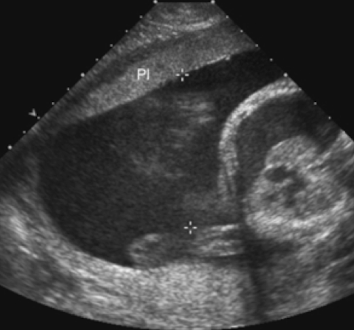
causes for large placenta

  • diabetes

  • anemia

  • hydrops

  • torch infections

<ul><li><p>diabetes</p></li><li><p>anemia</p></li><li><p>hydrops</p></li><li><p>torch infections</p></li></ul><p></p>
14
New cards

3 causes for small/thin placenta

  • infection

  • intrauterine growth restriction (IUGR)

  • aneuploidy (chromosomal abnormality)

<ul><li><p>infection</p></li><li><p>intrauterine growth restriction (IUGR)</p></li><li><p>aneuploidy (chromosomal abnormality)</p></li></ul><p></p>
15
New cards

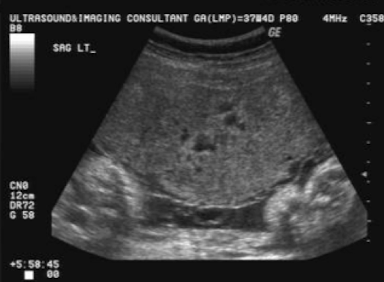
SONO: placenta

  • homogeneous

  • pebble-gray—mildly more echogenic compared to uterine wall

    • may be more echogenic in 1st trimester

  • smooth borders

  • highly vascular structure

  • rim of myometrium outside placenta should be noted

  • prominent maternal vessels may be seen posterior to placenta (anechoic tubes)

  • placental lakes may also be seen in placenta
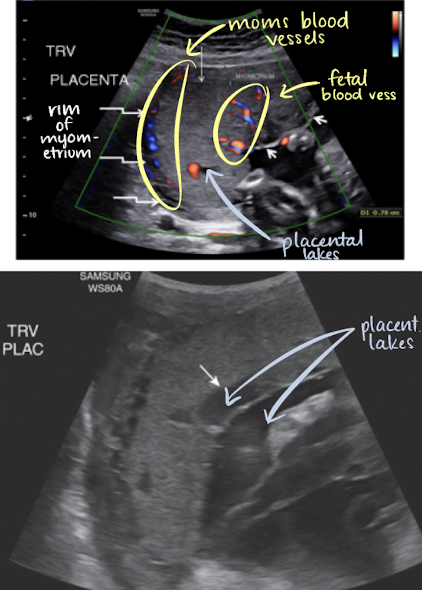
<ul><li><p><span style="color: yellow;">homogeneous</span></p></li><li><p>pebble-gray—mildly <span style="color: yellow;">more echogenic</span> compared to uterine wall</p><ul><li><p>may be more echogenic in 1st trimester</p></li></ul></li><li><p>smooth borders</p></li><li><p>highly <span style="color: yellow;">vascular</span> structure</p></li><li><p>rim of myometrium outside placenta should be noted</p></li><li><p>prominent maternal vessels may be seen posterior to placenta (anechoic tubes)</p></li><li><p><span style="color: yellow;">placental lakes</span> may also be seen in placenta</p></li></ul><p></p>
16
New cards

what to document when evaluating the placenta:

  • size/shape/position

  • cord location

  • abruption

  • hematoma

  • location (previa)

17
New cards

describing placental location in uterus and in relation to cervical os

  1. in uterus

  • anterior

  • posterior

  • fundal (in uterine fundus)

  1. in relationship to cervical os

  • close to os

  • away from os

  • covering os

    • if covering internal os, that is called previa
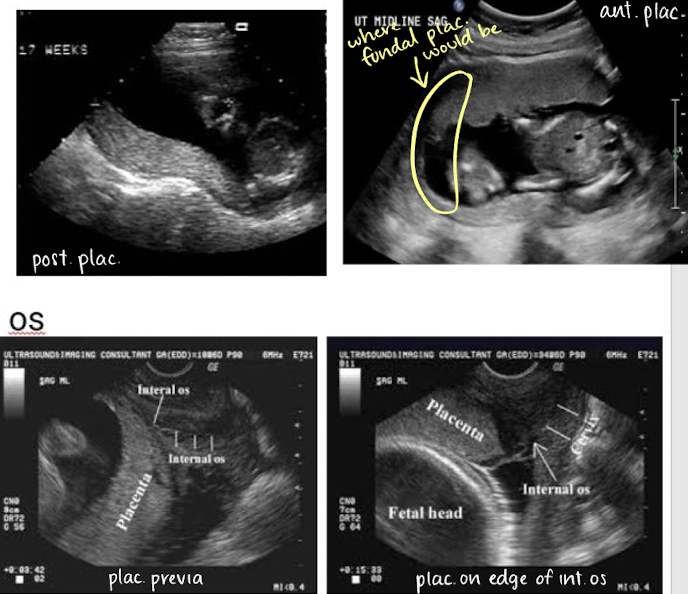
<ol><li><p><u>in uterus</u></p></li></ol><ul><li><p><span style="color: yellow;">anterior</span></p></li><li><p><span style="color: yellow;">posterior</span></p></li><li><p><span style="color: yellow;">fundal</span> (in uterine fundus)</p></li></ul><ol start="2"><li><p><u>in relationship to cervical os</u> </p></li></ol><ul><li><p><span style="color: yellow;">close to os</span></p></li><li><p><span style="color: yellow;">away from os</span></p></li><li><p><span style="color: yellow;">covering os</span></p><ul><li><p>if covering internal os, that is called <em>previa</em></p></li></ul></li></ul><p></p>
18
New cards

3 ways placenta appearance can be temporarily altered

  1. placental migration

  2. distended bladder

  3. Braxton-Hicks contraction

19
New cards

placental migration

  • refers to when placenta changes position in uterine cavity

  • primarily explained by 2 theories:

    • LUS growth theory (when expanding uterus pulls placenta upward)

    • trophotropism theory (atrophic placenta in areas of low blood supply)

  • location of placenta can be identified in 1st trimester
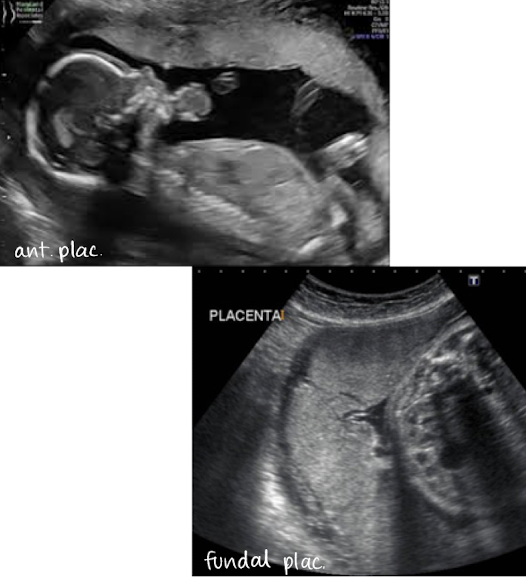
<ul><li><p>refers to when <span style="color: red;">placenta changes position in uterine cavity</span></p></li><li><p>primarily explained by 2 theories: </p><ul><li><p><span style="color: yellow;">LUS growth theory</span> (when expanding uterus pulls placenta upward)</p></li><li><p>trophotropism theory (<span style="color: yellow;">atrophic placenta in areas of low blood supply</span>)</p></li></ul></li></ul><ul><li><p>location of placenta can be identified in 1st trimester</p></li></ul><p></p>
20
New cards

distended bladder

  • changing bladder shape can create appearance of placental movement or a change in placental shape

  • full bladder can elongate cervix and give false impression of previa

  • emptying bladder allows cervix to be in normal position

** have patient empty bladder and reimage if previa is seen
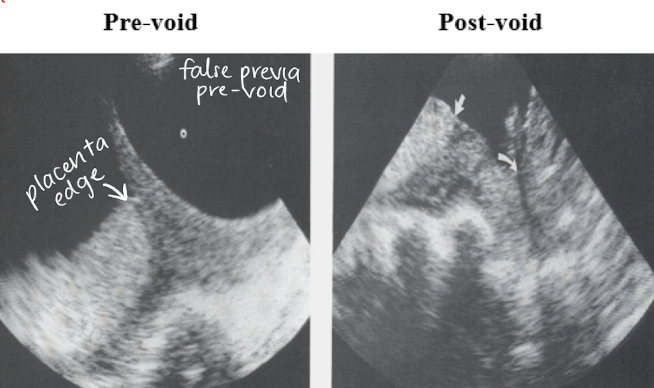
<ul><li><p>changing bladder shape can create appearance of placental movement or a change in placental shape</p></li><li><p><span style="color: red;">full bladder can elongate cervix and give false impression of previa</span></p></li><li><p><span style="color: yellow;">emptying bladder</span> allows cervix to be in normal position </p></li></ul><p></p><p>** have patient empty bladder and reimage if previa is seen</p><p></p>
21
New cards

Braxton-Hicks contraction

  • practice/false contractions

  • transient myometrial (uterine wall) contraction

  • created appearance of a placenta mass (distorts placenta shape)
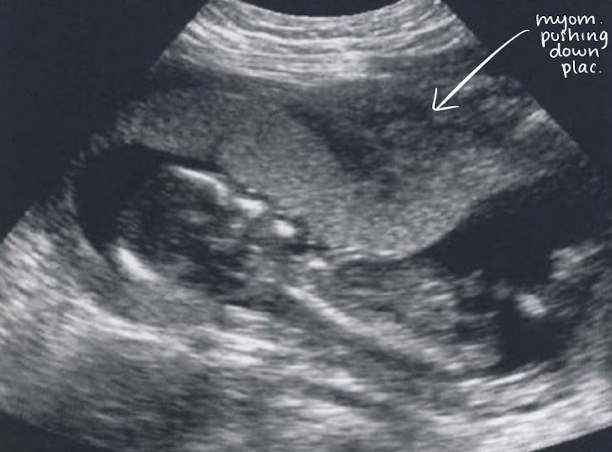
<ul><li><p>practice/false contractions</p></li><li><p>transient myometrial (uterine wall) contraction</p></li><li><p><span style="color: red;">created appearance of a placenta mass</span> (distorts placenta shape)</p></li></ul><p></p>
22
New cards

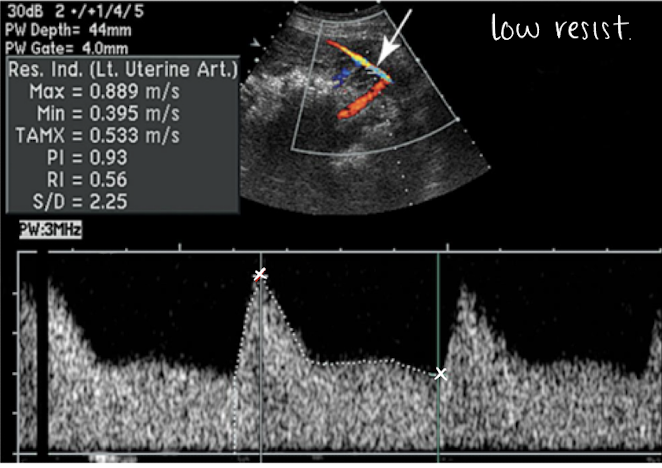
placental PW doppler and SONO evaluation

uterine artery PW (varies based on trimester):

  • high RI flow pattern in 1st trimester

  • low RI flow pattern in 2nd trimester

    • lots of blood flow going through uterine artery to get to placenta and supply baby with oxygen

SONO evaluation:

  • use optimal gate, gain, scale, placement

  • measure waveform and RI

<p>uterine artery PW (varies based on trimester):</p><ul><li><p>high RI flow pattern in 1st trimester</p></li><li><p>low RI flow pattern in 2nd trimester</p><ul><li><p>lots of blood flow going through uterine artery to get to placenta and supply baby with oxygen</p></li></ul></li></ul><p>SONO evaluation:</p><ul><li><p>use optimal gate, gain, scale, placement</p></li><li><p>measure waveform and RI </p></li></ul><p></p>
23
New cards

4 permanent placental variations

  1. succenturiate lobe

  2. circumvallate or circummarginate

  3. battledore cord insertion

  4. velamentous cord insertion

24
New cards

succenturiate lobe

  • aka accessory placental lobe

  • one or more accessory placental lobes

25
New cards

circumvallate or circummarginate

  • rare (1-2% of pregnancies)

  • chorionic plate (fetal side) is smaller than normal —> amnion and chorion membranes fold back around the edges of placenta

    • ”double back”

26
New cards

battledore cord insertion

  • aka marginal cord insertion

  • cord attaches at edge of placenta

  • “battledore” means badminton racket —> placenta is woven racket and cord is the handle

  • 7-9% of pregnancies

  • MC in twins

27
New cards

battledore cord insertion is usually ok, but could lead to…

  • IUGR (intrauterine growth restriction)

  • preterm labor

  • fetal distress during labor

  • risk of placental abruption

28
New cards

velamentous cord insertion

  • RARE (0.1-0.8 of pregnancies)

  • cord attaches to fetal membranes (amnion and chorion) increase of placental disc

  • fetal arteries and vein are UNPROTECTED by Wharton’s Jelly at insertion

  • high risk of cord compression, trauma, and rupture—especially during labor

29
New cards

delayed umbilical cord clamping

  • babies are born with 2/3 of their blood

  • 1/3 of their blood is still in placenta

  • umbilical cord clamping/cutting is not done immediately after birth

    • wait 30-60 seconds after birth to allow more blood to transfer from placenta to baby

  • benefits:

    • babies have higher hemoglobin

    • higher iron

    • better transition to breathing outside

** now a widely recommended as standard care
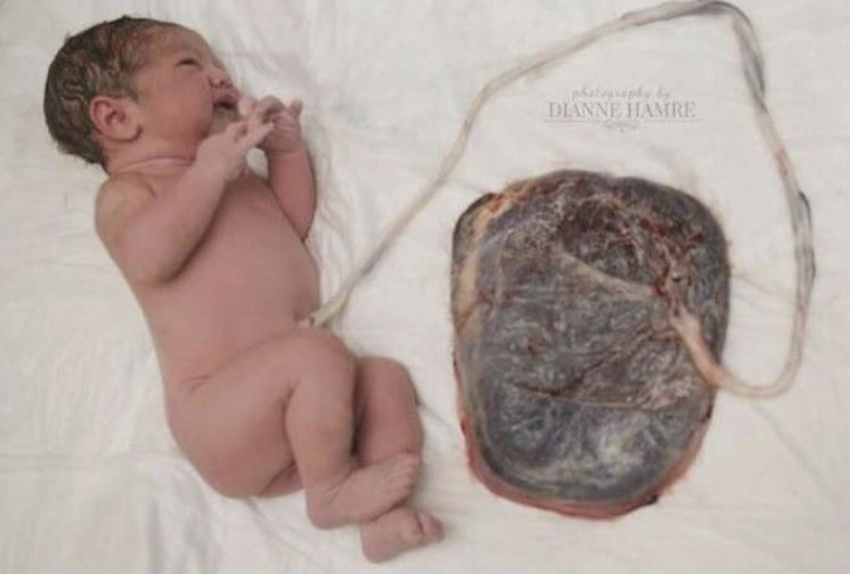
<ul><li><p>babies are born with 2/3 of their blood</p></li><li><p>1/3 of their blood is still in placenta</p></li><li><p>umbilical cord clamping/cutting is not done immediately after birth</p><ul><li><p>wait 30-60 seconds after birth to allow more blood to transfer from placenta to baby</p></li></ul></li><li><p>benefits:</p><ul><li><p>babies have higher hemoglobin</p></li><li><p>higher iron</p></li><li><p>better transition to breathing outside </p></li></ul></li></ul><p></p><p>** now a widely recommended as standard care</p>
30
New cards

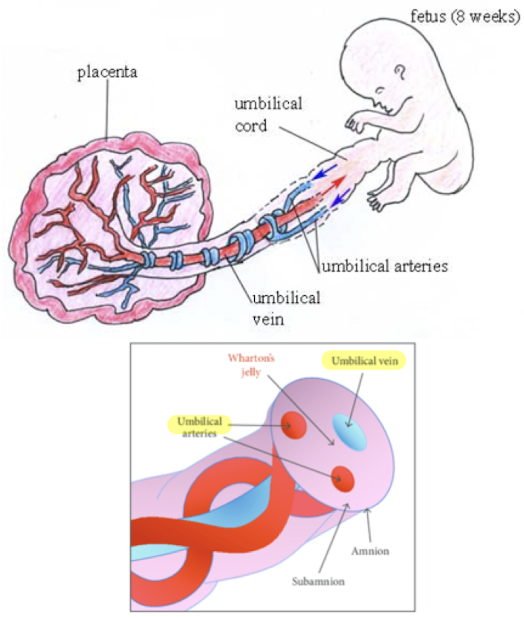
umbilical cord

  • connecting yolk stalk and allantois ducts become the umbilical cord

    • allantois connect to fetal bladder (abdominal/fetal cord insertion point)—becomes belly button

  • allantoic vessels become umbilical vessels

  • surrounded by mucoid connective tissue: Wharton’s Jelly

  • cord covered by amniotic membranes

  • normal diameter: 1-2 cm

<ul><li><p>connecting <span style="color: yellow;">yolk stalk </span>and <span style="color: yellow;">allantois ducts become</span> the <span style="color: yellow;">umbilical cord</span></p><ul><li><p>allantois connect to fetal bladder (abdominal/fetal cord insertion point)—becomes belly button</p></li></ul></li><li><p>allantoic vessels become umbilical vessels</p></li><li><p><span style="color: red;">surrounded by mucoid connective tissue: Wharton’s Jelly</span></p></li><li><p>cord covered by amniotic membranes</p></li><li><p><span style="color: red;">normal diameter: 1-2 cm</span></p></li></ul><p></p>
31
New cards

umbilical cords have how many vessels

  • 2 smaller arteries, 1 large vein

  • single umbilical artery (2 vessel cord) is found in 1% of singleton births

    • can be isolated

    • can be associated with congenital malformation

** umbilical arteries and vein functions opposite from typical a. and v.
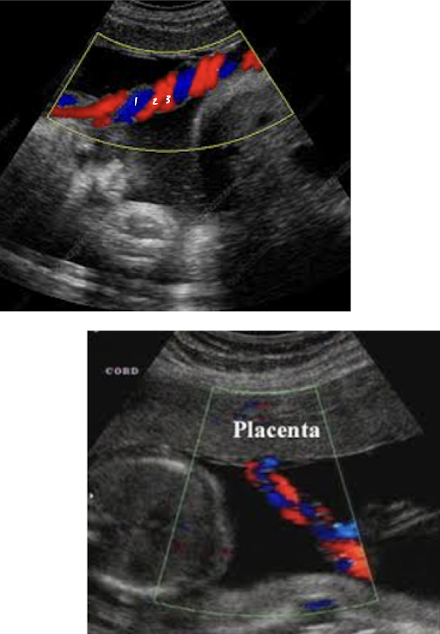
<ul><li><p><span style="color: rgb(255, 115, 115);">2 smaller arteries</span>, <span style="color: rgb(120, 156, 255);">1 large vein</span></p></li><li><p>single umbilical artery (2 vessel cord) is found in 1% of singleton births</p><ul><li><p>can be isolated</p></li><li><p>can be associated with congenital malformation</p></li></ul></li></ul><p></p><p>** umbilical arteries and vein functions opposite from typical a. and v.</p>
32
New cards

umbilical arteries

  • 2 umbilical arteries carry deoxygenated blood from fetus to placenta

    • umbilical arteries can be noted on either side of bladder at fetal insertion
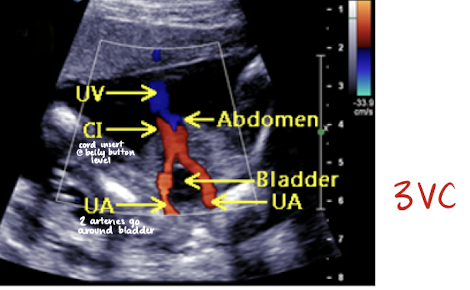
<ul><li><p>2 umbilical arteries carry <span style="color: red;">deoxygenated</span> blood from fetus to placenta</p><ul><li><p>umbilical arteries can be noted on either side of bladder at fetal insertion</p></li></ul></li></ul><p></p>
33
New cards

umbilical vein

1 umbilical vein carries oxygenated blood from placenta to fetus

34
New cards

umbilical cord color Doppler

  • color Doppler is used to visualize umbilical arteries and vein

  • the bladder, when full, is seen between 2 umbilical arteries

  • umbilical cord should be images in cross section and with color Doppler at level of bladder to confirm the number of cord vessels
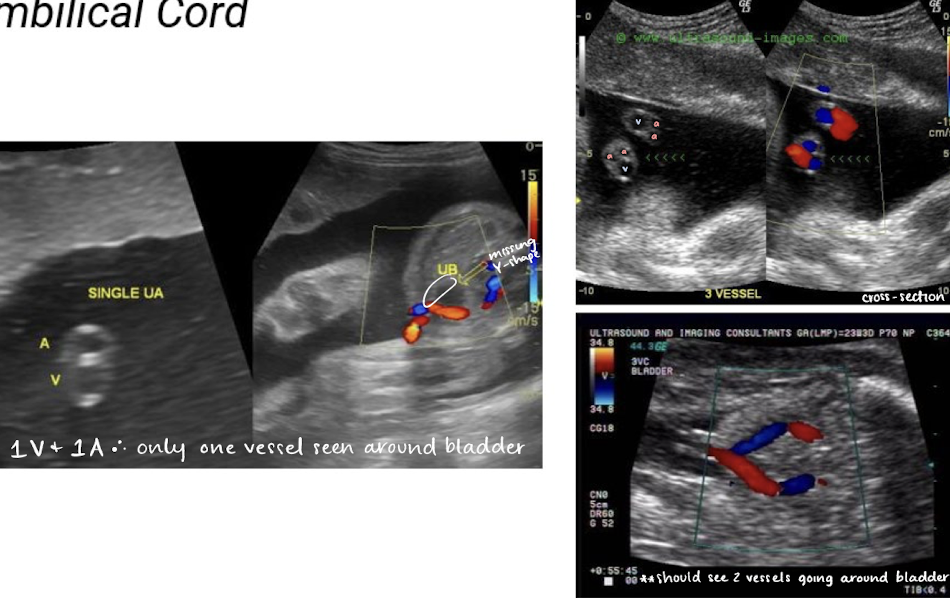
<ul><li><p>color Doppler is used to visualize umbilical arteries and vein</p></li><li><p>the bladder, when full, is seen between 2 umbilical arteries</p></li><li><p>umbilical cord should be images in cross section and with color Doppler at level of bladder to confirm the number of cord vessels</p></li></ul><p></p>
35
New cards
<p>type of placenta?</p>

type of placenta?

succenturiate lobe (accessory placenta)
36
New cards
<p>type of placenta?</p>

type of placenta?

circumvallate/circummarginate (chorionic plate is smaller than basal plate —> folded membranes)
37
New cards
<p>type of placenta?</p>

type of placenta?

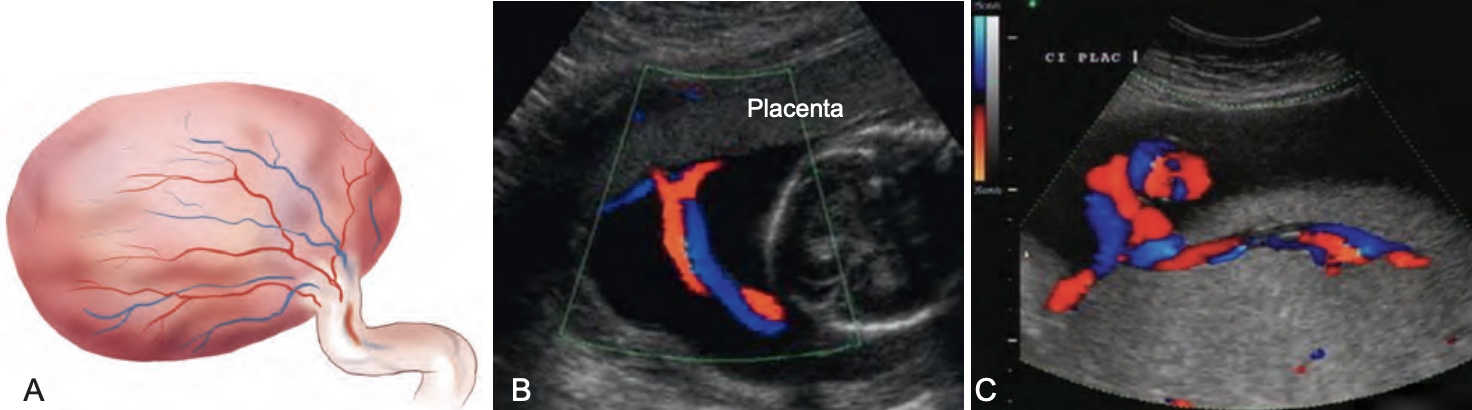
battledore cord insertion (umbilical cord attaches to edge of placenta, rather than center)
38
New cards
<p>type of placenta?</p>

type of placenta?

velamentous cord insertion (umbilical cord inserts into fetal membranes rather than placenta)
<p><span style="color: yellow;">velamentous cord insertion</span> (umbilical cord inserts into fetal membranes rather than placenta)</p>
39
New cards
<p>type of placenta?</p>

type of placenta?

battledore cord insertion

40
New cards

chorion frondosum

“portion of chorion that develops into fetal portion of the placenta” (chorionic plate)

41
New cards

chorionic villi

“microscopic vascular projections from chorion that combine with maternal uterine tissue to form placenta”

42
New cards

which part of the decidua surrounds the chorionic sac?

decidua capsularis

43
New cards

which part of the decidua unites with the chorion to form the placenta?

decidua basalis

44
New cards

placenta accreta vs. placenta increta vs. placenta percreta

placenta accreta

  • growth of chorionic vlli superficially to myometrium; not does penetrate through myometrium

placenta increta

  • growth of chorionic villi deep into myometrium

placenta percreta

  • growth of chorionic villi through the myometrium to the uterine serosa

45
New cards

Wharton’s jelly

mucoid connective tissue that surrounds the vessels within umbilical cord

Explore top notes

note
Between two words
Updated 508d ago
0.0(0)
note
AP Lang Midterm Review
Updated 684d ago
0.0(0)
note
Covalent Bonding
Updated 1219d ago
0.0(0)
note
Particle Motion in Gases
Updated 1263d ago
0.0(0)
note
Unité 2- Comprendre le Christ
Updated 576d ago
0.0(0)
note
Nervous System
Updated 1162d ago
0.0(0)
note
Between two words
Updated 508d ago
0.0(0)
note
AP Lang Midterm Review
Updated 684d ago
0.0(0)
note
Covalent Bonding
Updated 1219d ago
0.0(0)
note
Particle Motion in Gases
Updated 1263d ago
0.0(0)
note
Unité 2- Comprendre le Christ
Updated 576d ago
0.0(0)
note
Nervous System
Updated 1162d ago
0.0(0)

Explore top flashcards

flashcards
English Narration
36
Updated 292d ago
0.0(0)
flashcards
Poetry test
42
Updated 1063d ago
0.0(0)
flashcards
household chores
43
Updated 1049d ago
0.0(0)
flashcards
Test: The Cold War - Final Exam
80
Updated 313d ago
0.0(0)
flashcards
Generic/brand top200B
100
Updated 1067d ago
0.0(0)
flashcards
AP HuG Unit 2 Vocab
68
Updated 1259d ago
0.0(0)
flashcards
Face
32
Updated 526d ago
0.0(0)
flashcards
Bio final
97
Updated 1205d ago
0.0(0)
flashcards
English Narration
36
Updated 292d ago
0.0(0)
flashcards
Poetry test
42
Updated 1063d ago
0.0(0)
flashcards
household chores
43
Updated 1049d ago
0.0(0)
flashcards
Test: The Cold War - Final Exam
80
Updated 313d ago
0.0(0)
flashcards
Generic/brand top200B
100
Updated 1067d ago
0.0(0)
flashcards
AP HuG Unit 2 Vocab
68
Updated 1259d ago
0.0(0)
flashcards
Face
32
Updated 526d ago
0.0(0)
flashcards
Bio final
97
Updated 1205d ago
0.0(0)