L2.1: APPLICATION OF BIOSTATISTICS IN COMMUNITY AND PUBLIC HEALTH
 Studied by 0 people
 Call Kai
 Learn
Learn Practice Test
 Spaced Repetition
 Match
Match Flashcards
 Knowt Play
1/113

There's no tags or description
Looks like no tags are added yet.
Name | Mastery | Learn | Test | Matching | Spaced |
|---|
No study sessions yet.
114 Terms
Biostatistics
The language of public health
Incidence
measures the number of new cases of a disease over time. It reflects the risk of getting the disease.
Prevalence
measures the number of existing cases at a specific point in time. It reflects how widespread the disease is.
Burden
reflects how a disease persists, how many people are affected, and how interventions influence the number of cases.
Burden
If prevalence is prolonged, it is referred to as __
Prevalence
is usually measured over a year or a decade, and it accounts for the total number of people who have the disease. It is not easily reduced because there is no follow up. We do not know who recovered or not.
Incidence
With __, constant screening is done because new cases appear and the healthy population is monitored, which allows us to differentiate who has the disease and who does not.
Quantify health problems (burden, prevalence, incidence)
Detect outbreaks (epidemic thresholds, clustering)
Evaluate programs (nutrition, HIV, TB, immunization)
Generate evidence for policy decisions (PPAN, NTP, Dengue Prevention)
Monitor community health status (FHSIS, eKonsulta, LGU scorecards)
Biostatistics enables public health practitioners to (5)
Outbreak
An increase in cases alone does not automatically mean an __.
Outbreak
In detecting __, we have to consider epidemic thresholds
Outbreak
No matter how many cases there are, an __ occurs only when the number exceeds what is normally expected.
Baseline data
Serve as our point of reference. For instance, last year’s flu cases or last year’s dengue cases help us determine what is normal for a given period.
+2
If the current number of cases exceeds the baseline by (1)__ standard deviations, this indicates an (2) . If it exceeds by only (3) __ standard deviation, it is just an (4)_ , meaning we should stay vigilant in case an outbreak develops later.
WHAT IS (1)?
Outbreak
If the current number of cases exceeds the baseline by (1)__ standard deviations, this indicates an (2)_ . If it exceeds by only (3) __ standard deviation, it is just an (4)_ , meaning we should stay vigilant in case an outbreak develops later.
WHAT IS (2)?
+1
If the current number of cases exceeds the baseline by (1)__ standard deviations, this indicates an (2)_ . If it exceeds by only (3) __ standard deviation, it is just an (4)_ , meaning we should stay vigilant in case an outbreak develops later.
WHAT IS (3)?
Alert
If the current number of cases exceeds the baseline by (1)__ standard deviations, this indicates an (2)_ . If it exceeds by only (3) __ standard deviation, it is just an (4)_ , meaning we should stay vigilant in case an outbreak develops later.
WHAT IS (4)?
+2
The true indication of an outbreak is __ standard deviations above the baseline.
Outbreak
exceeds the seemingly normal number of cases of the same period (there is a time component).
U=U
is a DOH health promotion program that focuses on HIV transmission. It states that if a PLHIV (person living with HIV) is regularly tested and undergoing treatment to control the viral load, an undetectable viral load means the virus is untransmittable.
Undetectable equals Untransmissible
U=U stands for __
Zero
According to a DOH health promotion program, if a PLHIV has a viral load near __, the person can no longer transmit the virus.
Person living with HIV
PLHIV stands for__
National TB Program (NTP)
For TB: We have the (1)__, which includes vaccination for TB prevention. The (2)__ vaccine is given to neonates within the first three months of life.
WHAT IS (1)?
BGC
For TB: We have the (1)__, which includes vaccination for TB prevention. The (2)__ vaccine is given to neonates within the first three months of life.
WHAT IS (2)?
Biostatistics
(1)__ provides the evidence needed to decide whether to institutionalize programs. (2)__ can support enacting programs into law or issuing operational guidelines for implementation.
WHAT IS (1)?
Evidence
(1)__ provides the evidence needed to decide whether to institutionalize programs. (2)__ can support enacting programs into law or issuing operational guidelines for implementation.
WHAT IS (2)?
Holistic
Our public health approach must be __. We should design solutions at the population level while also promoting health in general at the individual level.
Field Health Services Information System
FHSIS stands for __
FHSIS
Routine surveillance and field monitoring of health indicators.
eKonsulta
A telemedicine platform used to extend clinical consultation, reporting, and case management remotely
LGU scorecards
Local government unit performance reports that include morbidity and mortality rates and other key indicators.
Determinants of health
These provide your overall health status. Your health can be affected by these determinants.
Determinants of health
This is where the idea of “you are a healthy person but you have these sets of characteristics” comes in.
Socio-economic status
Demographic factors
Environmental factors
Behavioral risk factors
Characteristics that make up your determinants of health (4)
Health status
Individually, your __ can be viewed in terms of mortality rates, morbidity/disability, and well-being
Mortality rates
are important when evaluating services
Morbidity
Refers to how many people get sick
Disability
Refers to how many people who get sick lose the capacity to partake in daily or societal functions
Well-being
concerns how you view your health or life, and it also affects your health status
Health system
The determinants of health provide information to the (1)__, which is very comprehensive. In terms of policy, financing, and human resources, these determinants guide how we should offer services. The services we offer then influence (2)__. These health system components help either improve well-being or reduce morbidity and mortality.
WHAT IS (1)?
Health utilization and coverage
The determinants of health provide information to the (1)__, which is very comprehensive. In terms of policy, financing, and human resources, these determinants guide how we should offer services. The services we offer then influence (2)__. These health system components help either improve well-being or reduce morbidity and mortality.
WHAT IS (2)?
Primary data
Collected by the researcher firsthand to suit his/her objectives
Secondary data
Derived from another source that may have other objectives for collecting the data
Query
Primary Data:
__(1)
__(1.1)
__(1.2)
__(1.3)
__(2)
__(2.1)
__(2.2)
WHAT IS (1)?
Observation
Primary Data:
__(1)
__(1.1)
__(1.2)
__(1.3)
__(2)
__(2.1)
__(2.2)
WHAT IS (2)?
Interviews
Questionnaires
Focus group discussion
Primary Data:
__(1)
__(1.1)
__(1.2)
__(1.3)
__(2)
__(2.1)
__(2.2)
WHAT IS (1.1), (1.2), and (1.3)?
Direct observation
With measuring tools
Primary Data:
__(1)
__(1.1)
__(1.2)
__(1.3)
__(2)
__(2.1)
__(2.2)
WHAT IS (2.1) and (2.2) ?
Interview
For __ in public health, this is not simply a basic survey. Our lens in public health is to seek determinants of health. When you _ someone in the community, you ask questions related to these determinants.
Focus group discussion
In terms of children, how can you engage with them? You can conduct __ in the form of storytelling. From there, you can observe the child’s learning. This is a primary query type. Your act of asking questions is the query.
True
You can also incorporate observation into storytelling sessions
review of records
electronic databases
Two types of secondary data
Census
Type of review of records:
This can be used because it is a public document
Registries
Type of review of records:
These are also public documents, such as death, birth, and marriage registries.
False
Marriage is not included in registries because it helps us understand the reproductive capacity of a nation.
Census
Registries
Hospital records
Insurance records
School records
Types of review of records (5)
Ethics clearance
For Hospital records, Insurance records, and School records — you need extensive review or (1)__ to access them. These are sensitive data sources. Individually, patients and students have personal information that must be protected. It is not outright prohibited to use these sources, but you must justify how, when, and where the data will be used. This is where the concept of (2)__ becomes essential, as we are dealing with (3)__.
WHAT IS (1)?
Anonymity
For Hospital records, Insurance records, and School records — you need extensive review or (1)__ to access them. These are sensitive data sources. Individually, patients and students have personal information that must be protected. It is not outright prohibited to use these sources, but you must justify how, when, and where the data will be used. This is where the concept of (2)__ becomes essential, as we are dealing with (3)__.
WHAT IS (2)?
Data Privacy
For Hospital records, Insurance records, and School records — you need extensive review or (1)__ to access them. These are sensitive data sources. Individually, patients and students have personal information that must be protected. It is not outright prohibited to use these sources, but you must justify how, when, and where the data will be used. This is where the concept of (2)__ becomes essential, as we are dealing with (3)__.
WHAT IS (3)?
Electronic databases
A type of secondary data that are usually open-source—open to the public, open access, and free to use. However, there must still be fair use. Even if access is free, the data should be used for academic, research, or public health purposes.
False
Even if access to electronic databases is free, the data should never be used for academic, research, or public health purposes.
Descriptive study
Cross-sectional study
Case-control study
Cohort study
Experimental study
Examples of primary data based on the method of collection (5)
Cross-sectional study
Which type of primary data based on the method of collection:
In terms of time, you collect data only once. In a specific period of time, dito ka lang nag-collect. (If longitudinal, there would be a time range.)
Case-control study
Which type of primary data based on the method of collection:
we compare those with the condition to those without.
Cohort study
Which type of primary data based on the method of collection:
we group participants into cohorts.
Experimental study
Which type of primary data based on the method of collection:
We can test treatments or interventions. Examples include testing the effectiveness of tawa-tawa against dengue, or the effectiveness of papaya against dengue or dengue hemorrhagic fever.
Observational research
Which descriptive research methods:
record behavior as it occurs without manipulating the variables
Survey research
Which descriptive research methods:
send surveys to selected groups and use the data to inform business decisions
Case study
Which descriptive research methods:
study multiple parties and compile findings into one case study on a subject
Interviews
Which descriptive research methods:
interview one party to gather data on a specific individual’s experience
Census
Which type of secondary data based on the method of collection:
Population-based
__ - it involves a large amount of data (four years’ worth) that needs to be synthesized for population planning. In a _, the total population is accounted for, meaning everyone is included.
Civil registry
Which type of secondary data based on the method of collection:
Population-based
__ - This includes birth certificates, reports of birth, marriage certificates, and death certificates.
Population survey
Which type of secondary data based on the method of collection:
Population-based
__ - These can be conducted, but a specific number of households must be calculated to participate. Even in population surveys, sampling is usually applied; the survey may only cover a portion of the population.
census and civil registration
Classification based on the group of individuals from whom data were obtained:
Total Population
sample survey or population survey
Classification based on the group of individuals from whom data were obtained:
Representative subpopulation
civil registration
Classification based on frequencey by ehich data are generated:
Continuous
census and sample survey
Classification based on frequencey by ehich data are generated:
Periodic
Individual-level (patient charts, outpatient registers)
Which type of secondary data based on the method of collection:
Institutional-based
__ - In community and public health, these sources are useful for examining biomarkers, monitoring how many patients undergo check-ups, and assessing individual health data within an institution.
Service-level (EPI reports, TB program data)
Which type of secondary data based on the method of collection:
Institutional-based
__ - These sources show the coverage of programs. For example, how many TB patients are enrolled in DOTS (Directly Observed Treatment, Short-course), where medication intake is closely monitored. This level evaluates service delivery and program effectiveness.
Resource-level (HR inventory, facility readiness)
Which type of secondary data based on the method of collection:
Institutional-based
__ - These sources assess your institution’s capacity to support public health programs.
Primary data
Which type of data is this:
Strengths
High control over measurements
Flexible and specific to research objectives
Better ability to stratify by sex, age, barangay, socioeconomic group
Secondary data
Which type of data is this:
Strengths
Timely (updated regularly, unlike primary data which is usually periodic), cheap, readily accessible
Useful for trend analysis (10-20 years) (registries are secondary data and allow trend analysis)
Enables large-scale population inferences
Primary data
Which type of data is this:
Limitations
Expensive (especially if you are collecting the data yourself) and time-consuming (without careful planning, data collection can be difficult)
Potential recall bias (interviews) (it can be challenging to follow up for clarifications; missing responses may need to be omitted)
Small sample sizes in barangay studies
Secondary data
Which type of data is this:
Limitations
Data may not align with research objectives (some variables may be unnecessary)
Incomplete fields (e.g., missing cause of death; the immediate cause in hospital records may not be that accurate)
Harder to stratify (barangay-level data often unavailable; data may be generalized)
Data requirement
Consideration in Selecting the Type of Source of Data
What indicators do you need? Anong mga determinants of health yan?
Sensitivity issues
Consideration in Selecting the Type of Source of Data
STI data, adolescent health, household income
Logistics
Consideration in Selecting the Type of Source of Data
manpower, training, cost
Data quality & utility
Consideration in Selecting the Type of Source of Data
completeness, consistency, validity
True
When it comes to presenting data that is less than 10, it has to be textual.
Textual
Type of Data Presentation in Community and Public Health:
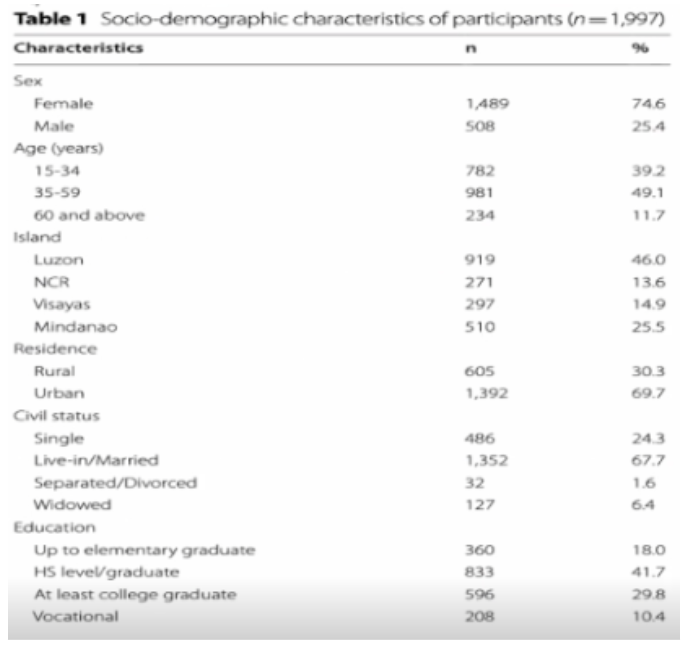
A total of 2,303 individuals participated in the national health literacy survey, of which 2,146 respondents were able to complete the questions on functional health literacy. Cases with missing data for at least one variable were excluded from the analysis for this study. The final set of data used in the analysis included 1,997 participants (86.7%). Those categorized as having adequate FHL were 62.7%. The results for objective no.1 is presented in Table 1 (baseline assessment of the FHL level by characteristics of study participants).
Reference: Tejero, L. M. S., Siongco, K. L. L., Pinlac, P. A. V., Co, K. C. D., & Tolabing, M. C. C. (2022). Associations of functional health literacy with socioeconomic and demographic status among Filipinos. BMC Public Health, 22(1), 2198.
Frequency tables
Type of Data Presentation in Community and Public Health:
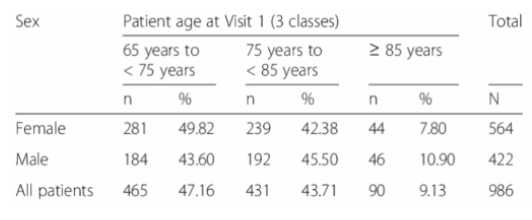
Categorical summary tables
Type of Data Presentation in Community and Public Health:
2×2 tables
Type of Data Presentation in Community and Public Health:
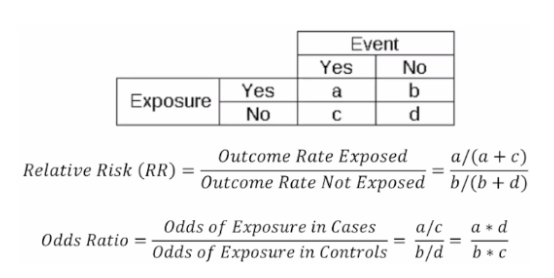
Risk Ratio
used for cohort
Aka relative risk, incidence rate, or attack rate
Compares the risk (probability) of developing an outcome among exposed individuals to the risk among unexposed individuals over a defined period of time.
number of new cases ÷ total population at the start of study
Formula for incidence
Incidence in exposed ÷ Incidence in unexposed
Formula for risk ratio (cohort)
Odds ratio
used for case control and cohort
Compares the odds of exposure (or outcome) between two groups
odds of exposure among cases/odds of exposure among controls
Formula for odds ratio (case control)
odds of disease among exposed ÷ odds of disease among unexposed
Formula for odds ratio (cohort)
Odds ratio
Only measure of association that can be used by case control studies
Exposed cases ÷ Unexposed cases
Formula for Exposure odds among cases
 Note
Note  Flashcards (141)