a&p lab: lung volume
 Call Kai
 Learn
Learn Practice Test
 Spaced Repetition
 Match
Match Flashcards
 Knowt Play
1/18

There's no tags or description
Looks like no tags are added yet.
Name | Mastery | Learn | Test | Matching | Spaced | Call with Kai |
|---|
No analytics yet
Send a link to your students to track their progress
19 Terms
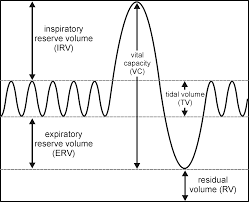
tidal volume
volume of air breathed in & out without conscious effort
inspiratory reserve volume (IRV)
additional volume of air that can be inhaled with maximum effort after normal inspiration
expiratory reserve volume (ERV)
additional volume of air that can be forcibly exhaled after normal exhalation
vital capacity (VC)
total volume of air that can be exhaled after maximum inhalation
VC = TV + IRV ERV
residual volume (VR)
volume of air remaining in lungs after maximum exhalation (lungs can never be completely emptied)
total lung capacity (TLC)
VR + RV
minute ventilation
volume of air breathed in 1 minute
(TV) (breaths/ min)
.
.
what’s spirometry used for
analyzing flow rate of air passing into & out of lungs
maximal inspiration
contraction of diaphragm downward & movement of ribs upward & outward, expanding thoracic cavity
forced expiration
rapid contraction of chest & abdominal muscles, relaxing diaphragm
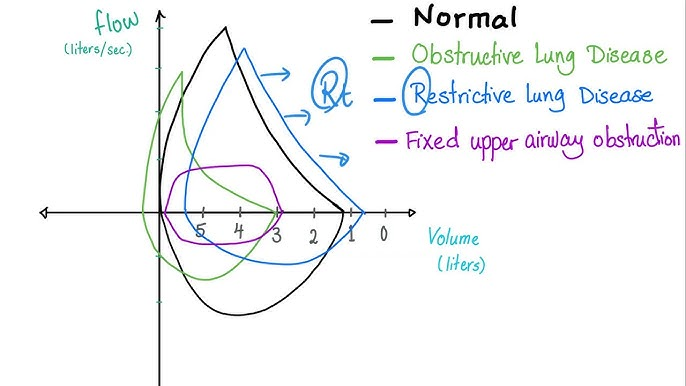
flow rates are graphed as ___
-in normal lungs: __
-latter portion of expiration curve represents ___
flow volume loops
-in normal lungs: air is rapidly expelled early in the process of forced expiration
-latter part: emptying of small airways (terminal bronchioles)
forced vital capacity (FVC)
total exhaled air, from maximum inhalation to maximum exhalation
forced expiratory volume (FEV1)
volume of air expelled in first second of forced exhalation
FEV1/FVC measured as percentage
.
peak expiratory flow (PEF)
highest point on exhalation graph
restrictive disorders
any disease that affects expansion of lung tissue resulting in reduction in vital capacity
*obstructive disorders
diseases that interfere with patency of airways resulting in & increase in airflow resistance
-forced expiratory volumes are used to asses obstructive disorders

