Intestinal Nematodes part 1
 Call Kai
 Learn
Learn Practice Test
 Spaced Repetition
 Match
Match Flashcards
 Knowt Play
1/184

Earn XP
Description and Tags
Phylum Nematoda
Name | Mastery | Learn | Test | Matching | Spaced | Call with Kai |
|---|
No analytics yet
Send a link to your students to track their progress
185 Terms
Nematode
Means “thread-like”
Nema
“Thread”
Nematode general characteristics
Elongated, cylindrical, unsegmented worms with tapering ends, have separate sexes.
Dioceious
Separate sexes
Monocious
harbor both reproductive structure on a single individual. Can self pollinate and fertilize themselves.
Types of Ova
Fertilized egg (Single celled Structure) (Embryo or protopolasm)
Embryonated (Larval developed)
L1 - L2
Immature/larval referred to as FEEDING STAGE
Rhabditiform Larva.
L1 - L2 stage
Rhabditiform
L3 - L4
Filariform larva
Mature Larval Stage
Closed moutth/non feeding stage
L4
Adult Form
Embryonated Egg
Larval inside the egg/ova
Sometimes harbor the L3 which is the infective stage
Diagnostic Stage
Ova
Larva
Intestinal Nematodes in Small Intestine (CASH)
Capillaria Philippinensis
Ascaris Lumbricoides
Strongyloides Stercoralis
Hookworms (infecting humans)
Large Intestinal roundworm, roundworm of man
Ascaris lumbricoides
Ascariasis (roundworm infection)
intestinal infection caused by the parasitic roundworm Ascariasis lumbricoides
Unfertilized egg (A. lumbricoides)
Do not undergo development
Unfertilized egg shape (A. lumbricoides)
Varies
Unfertilized egg: Embryo (A. lumbricoides)
Unembryonated - Amorphous mass of protoplasm
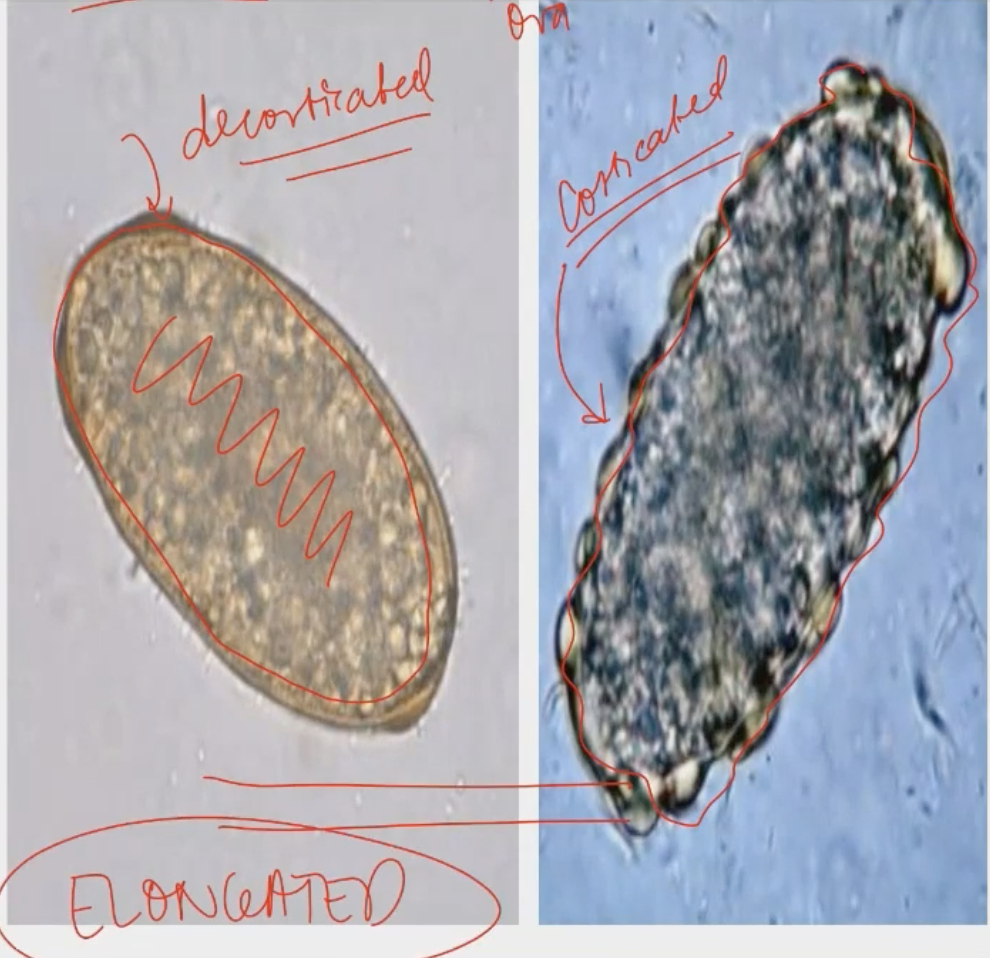
Unfertilized egg (A. lumbricoides ova)
Elongated
both decorticated and corticated
Fertilized Egg
Single celled/multi celled protoplasm
Embryo
Embryonated Egg
Larva inside
Unfertilized Egg: size (A. lumbricoides)
85-95 UM by 34-45 UM
Fertilized/embryonated egg: SIZE (A. lumbricoides OVA)
40-47 um by 30-50 um
Fertilized/embryonated egg: shape (A. lumbricoides OVA)
Rounder than nonfertilized
Fertilized/embryonated egg: embryo (A. lumbricoides OVA)
Underdeveloped unicellular embryo
Fertilized/embryonated egg: shell (A. lumbricoides OVA)
Thick Chitin
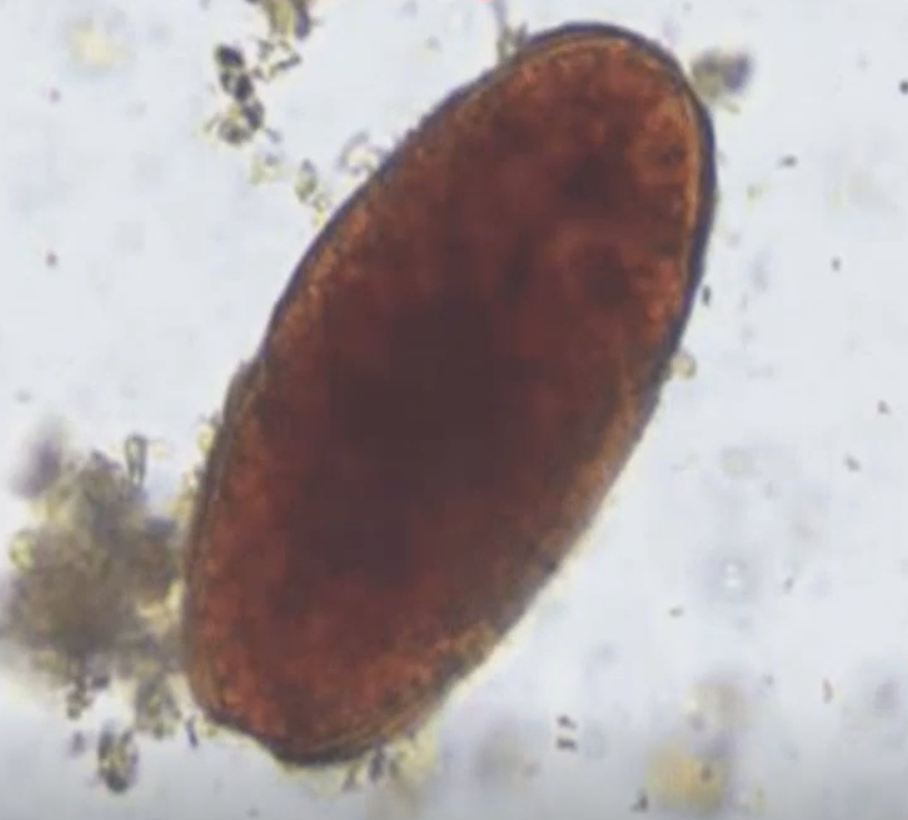
Unfertilized egg of A. Lumbricoides
Elongated
protoplasm mass inside
decorticated (usually)
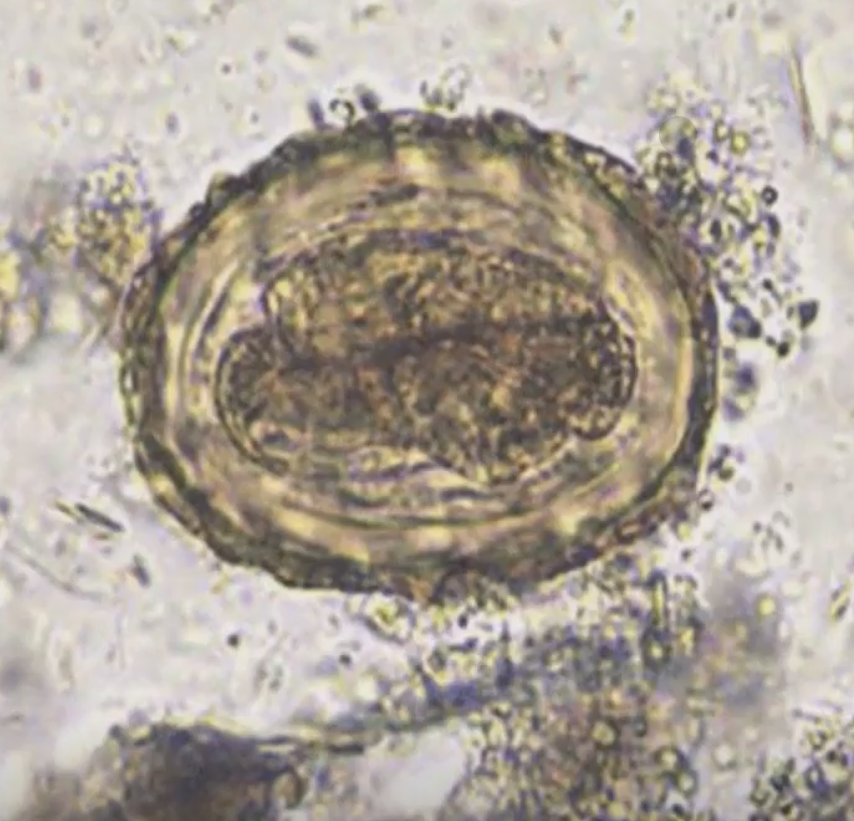
Fertilized egg (A. lumbricoides ova)
Single cell protoplasm
Almost larvalike (embryonated)
A. lumbricoides female parameter: size
22-35 cm
A. lumbricoides female parameter: color
Cream white, pink tint
A. lumbricoides female parameter: tail
Pencil lead thickness
A. lumbricoides male parameter: size
up to 30 cm
A. lumbricoides male parameter: color
Cream white, pink tint
A. lumbricoides male parameter: tail
Prominent incurved tail
A. lumbricoides amount of lips:
Trilobate lips - three lips
A necessary step mostly in intestinal nematodes especially A. lumbricoides to gain oxygen and continue further development
Heart to lung migration
The sudden migration of parasites they don’t normally infect and is mainly due to response of treatment
Erratic response
Ascariasis asymptomatic or not?
Ascariasis usual infection of 10-20 worms may not show symptoms.
Ascariasis pneumonitis: pathophysiology
chest pain, cough, fever, increased eosinophil (with heart to lung migration)
Lung infiltration, asthmatic attacks, and edema of the lips, difficulty in breathing
Ascaris lumbricoides treatment:
Albendazole & Mebendazole (mebendazole being the usual)
The most common intestinal nematode of man
Ascaris lumbricoides
What type of somatic muscle arrangement is found in Ascaris lumbricoides?
Polymyarian type
Name the parasite with three lips and sensory papillae.
Ascaris lumbricoides
What is the function of lips and papillae? (A. lumbricoides)
Feeding + sensory (touch/chemical detection)
How can you identify a male Ascaris?
Posterior end is ventrally curved
Has two copulatory spicules
How can you identify a female Ascaris?
Posterior end is straight
No spicules
Larger in size
What is the function of spicules in male Ascaris?
Help in copulation (sperm transfer)
Describe the reproductive system of the female.
aired organs (two ovaries, oviducts, uteri)
Occupy posterior two-thirds of the body
Describe the reproductive system of the male.
Single long, tortuous tubule
Why is the female reproductive system larger?
To produce and store a large number of eggs
What is Pepsin Inhibitor-3 (PI-3) in Ascaris lumbricoides?
👉 A protein secreted by the parasite that inhibits the host’s digestive enzyme pepsin
Q2. What is the function of PI-3?
👉 It protects the parasite from digestion in the host’s stomach by inhibiting pepsin
Why is PI-3 important for parasite survival?
👉 It allows Ascaris to:
Resist host digestive enzymes
Survive in the harsh gastrointestinal environment
What is phosphorylcholine in Ascaris?
A molecular component on parasite secretions/surface involved in immune modulation
What is the function of phosphorylcholine?
It suppresses lymphocyte proliferation
Why is suppression of lymphocyte proliferation important for the parasite?
It helps the parasite:
Evade the host immune response
Survive longer inside the host
Name two biochemical adaptations of Ascaris lumbricoides for survival in the host.
Pepsin Inhibitor-3 (protects from digestion)
Phosphorylcholine (suppresses immune response)
Q7. Classify the following adaptations: PI-3 and phosphorylcholine.
PI-3 → Anti-digestive adaptation
Phosphorylcholine → Immunomodulatory adaptation
How does Ascaris lumbricoides overcome host defenses?
Inhibiting digestive enzymes (PI-3)
Suppressing immune cell activity (phosphorylcholine)
What is present inside a fertilized egg of Ascaris lumbricoides?
An ovoid mass of protoplasm (fertilized ovum/zygote)
What is meant by “ovoid mass of protoplasm” in Ascaris egg?
It refers to the single fertilized cell (zygote) that will develop into an embryo
How long does it take for a fertilized egg to develop into a larval stage?
About 10–14 days under favorable conditions
Why is the fertilized egg considered infective only after development?
Because it must contain a fully developed larva to infect the host
Differentiate the contents of fertilized and unfertilized Ascaris eggs.
👉 Fertilized egg:
Ovoid mass of protoplasm
Develops into embryo
👉 Unfertilized egg:
Disorganized refractile granules
No development
Which type of egg undergoes larval development? Why?
Fertilized egg, because it contains a viable zygote
What type of larval migration occurs in Ascaris lumbricoides?
Hepato-tracheal migration
Q2. What does “hepato-tracheal migration” mean?
Migration of larvae from intestine → liver → lungs → trachea → back to intestine
When these eggs are ingested, they hatch in the ____ of the small intestines
Lumen, then releasing the larvae.
Hepato-tracheal migration takes:
14 days
Development of egg-laying adult form is: (A. lumbricoides)
9-11 weeks after ingestion
The life span of an Adult worm: (A. lumbricoides)
1 year.
Female ascaris produces about ______ eggs per day?
200,000 eggs
How long for a fertilized egg to developed into the infective stage in the soil environment? (A. lumbricoides)
2-3 weeks.
How long can embryonated eggs survive in tropical and subtropical regions?
From a few months up to about 2 years
Loffler’s phenomenon
Allergic reaction/immunologic reaction caused by the parasite.
Also known as Whipworm
Trichuris trichiura
Infection of T. trichiura
Trichuriasis, whipworm infection
3rd most common helminth; found primarily in warm climates
T. trichiura (whipworm)
Trichuris trichiura ova parameter: fertilized: size
50-55 by 25 um
Trichuris trichiura ova parameter: fertilized: shape
barrel, foot-ball shaped,
hyaline bi-polar plugs
Trichuris trichiura ova parameter: fertilized: embryo
Unicellular; underdeveloped
Trichuris trichiura ova parameter: fertilized: shell:
Smooth yellow brown because of bile contact
Bi-polar plugs functions:
Portal of entry - nutrients
Protection (harmful substances) (Desiccation)
Portal of exit - larva once maturation
Trichuris trichiura ADULT parameter: adult (male & female): Size:
2.5 - 5 cm long
Males usually smaller than femles
Trichuris trichiura ADULT parameter: adult (male & female): Anterior End
Colorless
Resembles a whip handle
Contains slender esophagus
Trichuris trichiura ADULT parameter: adult (male & female): Posterior end
Pinkish gray
Resembles whip itself
Contains digestive and reproductive system
Males: possess prominent curled tail
Feeding mechanism of whipworm of Trichuris trichiura
Anterior part attached to the intestinal mucosa.
Trichuris trichiura habitat:
Large intestine
Cecum
Colon
Rectal Prolapse
Trichuris trichiura: Pathophysiology
Trichuris trichiura (children) : pathophysiology
Ulcerative colitis, chronic dysentery, severe anemia, and possible growth retardation
Trichuris trichiura (ADULT) : pathophysiology
inflammatory bowel disease, weight loss, weakness, and mucoid or blood-y diarrhea
T. trichiura male (size)
30 to 45 mm
T. trichiura female (size)
35 to 50 mm
T. trichiura female characteristics
blunt posterior end
T. trichiura male characteristics
Coiled posterior with a single spicule and retractile sheath
Approximate number of eggs lay by T. trichiura female
3,000 to 10,000 eggs per day
T. trichiura eggs (measurement)
50-54 um by 23 um
How long does the T. trichurae larva remain in the intestinal villi after penetration?
3 to 10 days
A pore forming protein secreted by T. trichiura, allows them to inbed their entire whip-like portion into the intestinal wall
TT47
T. trichiura process upon ingestion of embryonated egg to adult worms
12 weeks.

