L9: Social Psychology [PSYC1001-1A]
 Studied by 3 people
 Call Kai
 Learn
Learn Practice Test
 Spaced Repetition
 Match
Match Flashcards
 Knowt Play
1/70

There's no tags or description
Looks like no tags are added yet.
Name | Mastery | Learn | Test | Matching | Spaced | Call with Kai |
|---|
No analytics yet
Send a link to your students to track their progress
71 Terms
[From previous lecture (8)]
Personality predicts behaviour, but sometimes, social influences overrides our personal will & autonomy
Stanley Milgram’s experiment (overview)
The Milgram Shock Experiment, conducted by Stanley Milgram in the 1960s, tested obedience to authority.
Participants were instructed to administer increasingly severe electric shocks to another person, who was actually an actor, as they answered questions incorrectly.
Milgram’s experiment — Aim & Method
Aim:
Studied obedience to authority, exploring whether individuals would obey instructions to harm another person because an authority figure told them to.
Method:
An authority figure instructed participants to administer increasingly intense electric shocks to a “learner” (an actor), who feigned pain and distress.
Mlgram’s experiment — Results & Conclusion
Results:
A significant percentage of participants obeyed the authority figure and administered the maximum level of shocks, despite their apparent discomfort.
Conclusion:
The study demonstrated that ordinary people are surprisingly likely to obey authority figures, even when those orders conflict with their own moral beliefs.
What does Milgram’s experiment show us?
We are susceptible to social influences because we value social bonds.
Social pain by the Cyberball paradigm
Attachment & Emotional bonding (in L7)
The Cyberball paradigm
A standard experimental tool in psychology used to study the effects of social exclusion or ostracism in a controlled, virtual environment.
We feel pain at the slightest sign of social rejection.
It harms self-esteem and psychological well-being.
Attachments
Emotional bonding that facilitates cuddling rather than feeding (in the context of animals)
Our cognitive systems
We are often lazy, busy or cognitively preoccupied, thus we choose to prioritise social cognitions.
System 1 — Heuristics
System 2
Heuristics
Mental shortcuts
Effective & persistent; Built through previous experiences and choices (schemas)
Can be wrong
These initial beliefs are hard to change, even in the face of opposite evidence
The perseverance effect
Stereotypes (Heuristics)
A fixed, oversimplified mental shortcut about a group of people, assuming all members share certain traits (like being good at math or lazy), regardless of individual differences
The Halo effect (Heuristics)
A cognitive bias where your overall impression of someone (good or bad) dictates your judgment of their specific, unrelated traits.
E.g, Believing a physically attractive person is also more competent, honest, or friendly.
Attributions (Heuristics)
They are based on past patterns of behaviour (which may bear little predictive value)
Internal attribution
Based on dispositions and internal factors of the actor (e.g., personality traits)
External attribution
Based on situational factors that are external (and uncontrollable) to the actor
Attributions being prone to error (Heuristics)
To save our limited cognitive resources, we avoid “what-ifs”
Correspondence bias
Correspondence bias
The tendency to view behaviour as the result of disposition, even when the behaviour can be explained by the situation in which it occurs
Dispositional attributions give us certainty (as if everything is easily explained
Defensive attributions (Heuristics)
Self-serving bias
I earned an A in Henry’s class! (Bolster self-esteem)
Henry gave me a C in his class… (Protect self-esteem)
Just-world beliefs
Good things happen to good people; bad things happen to bad people
Victim-blaming & rape myths
Self-serving bias
Attributing success to dispositional factors while attributing failure to situational factors
Group-serving bias
An organisation tends to attribute success to its dispositional characteristics, but blames failures on the situation.
Actor-observer bias
Occurs when we emphasise dispositional attributions to explain the behaviour of others, while emphasising situational attributions to justify our own behaviour.
E.g, If my friend and I both flunked a test, it’s because I was sick, and they didn’t study hard enough.
Social Problems arising form S1 thinking
Stereotypes → Prejudice
A negative prejudgment of another person based on their membership in a group (e.g, sex, race, ethnicity)
The problem of aggregation — overgeneralising individual differences to inter-group differences
Prejudice leading to overgeneralisation
Starts with a negative belief (stereotype) about a group
Then, using limited experiences or biased information to assume all members share that trait, ignoring individual differences
Then, creating heuristics that confirm the bias, even when evidence contradicts it, making it hard to change the oversimplified view
Prejudice leading to discrimination
Discrimination
Unfair behaviour that may or may not be due to stereotypes & prejudice
May / May not be expressed immediately
Can be “positive” (e.g, tokenism in the workplace)
Can be unconscious
Correll et al. (2002)
“The Police Officers’ Dilemma”
They studied racial bias in split-second decisions, finding people are quicker to shoot armed Black suspects than armed White suspects, and slower not to shoot unarmed Black suspects, demonstrating how stereotypes influence automatic threat assessment, especially under time pressure.
Constructed in a computer game setting
Cultural influences on Attribution
Individualistic cultures (US & other Western nations)
Stress individual achievement & competition
Members are more likely to demonstrate correspondence bias
Collectivist Cultures (many East Asian nations)
Traditionally, values cooperation as a means of attaining family and work group goals
Members tend to place more emphasis on situation than the members individually
Attitudes
A positive or negative evaluation that predisposes behaviour towards an object, person or situation
Networks of Attitudes
The A.B.C’s:
Affect (i.e, emotions)
Behaviour
Cognition
Affect (Attitude)
Addressed emotional responses to the object
Information about your future career may make you feel helpless, confused, or angry.
Behaviour (Attitude)
Reflects in the way people respond to the object.
After hearing about that information, you may schedule an appointment with your A.A. to discuss your future.
Cognition (Attitude)
Includes your beliefs about the object
After hearing the news about your future career, you may begin to worry that you’ve chosen the wrong major or that the news was inaccurate.
Attitude Formation
From the basis of our personal experiences
Absorbed from contact with peers, parents, and other close influences
Learning principles also play an important role:
Operant conditioning suggests that approval / disapproval shapes attitudes
Classical conditioning suggests that a positive attitude toward stimuli is associated with positive outcomes
Attitude & Behaviour
The relationship is bidirectional
Positive attitude → Approach behaviour
Negative attitude → Avoidance behaviour
Behaviours also influence attitudes
Cognitive dissonance
A state of psychological discomfort from holding contradictory thoughts or beliefs.
When the mind and behaviour are in conflict
We need to resolve the conflict → by looking for justifications inside or outside of our system
Cognitive dissonance & justification
Condition 1
There is sufficient external justification
The experimenter is a nice person; I’m doing this for him.
Condition 2
Insufficient external justification; seek internal justification
The experimenter is a rude person; I can’t be really doing this for him
Cognitive consistency
A preference for holding congruent attitudes and beliefs
Attitude change & Persuasion
Cognitive dissonance can produce an attitude change, but it doesn’t occur in response to a direct effort by another person.
Persuasion occurs, via a change in attitude, in response to information provided by another person
The Elaboration Likelihood Model (ELM)
A model that predicts responses to persuasive messages by distinguishing between the central & peripheral routes to persuasion.
Central route
Peripheral route
Central route (ELM)
Occurs when a person considers persuasive arguments carefully & thoughtfully
Analysis of the quality of the argument
Peripheral route (ELM)
Occurs when a person responds to peripheral cues without carefully considering the quality of the argument.
Uses heuristics, or rules of thumb
Focus on the speaker’s credibility, appearance
Intonation
Emotional appeals
Prejudice
A prejudgement, usually negative, of another person on the basis of membership in a group
Social Identity
Refers to people’s sense of who they are, based on the groups to which they belong (Tajfel & Turner, 1879)
Develops into the categorisation of an “out-group” & an “in-group”
Leads to “group comparison”
Social Identity Theory (S.I.T)
People build a positive social identity and self-esteem through group membership.
People perceive the group they are members of (in-group) more positively than people who aren’t (out-group)
Stereotype threat
The fear that one will confirm a negative stereotype about a group to which they belong
When people are faced with a stereotype threat, they often get nervous and perform worse, thus confirming the stereotype.
Reducing prejudice
Increased contact can reduce it, but not just any contact.
Allport (1954) suggested 4 criteria for positive contact:
Equal standing
Common Goals
Cooperation
Support from authorities or customs
Social Norms
Usually unwritten / implicit rules for behaviour in social settings
Types of individual behaviours in a group
Conformity – Normative social influence / Informational social influence
Obedience – Investigated in the Stanford Prison Study
Social loafing & diffusion of responsibility
Conformity
Matching one’s behaviour and appearance to perceived social norms in order to be accepted
Why do people conform?
Informative Social Influence (useful in ambiguous situations)
E.g, if you’re uncertain about what to do, observing the behaviours of others and conforming to them can be helpful
Normative Social Influence (To fit in)
Gaining Approval/Avoiding Rejection: Humans fear exclusion; conforming helps us feel accepted and liked, preventing feelings of insecurity or being an outcast.
Social facilitation & Social inhibition (Individual behaviour in a group)
Where an individual's performance on a task improves when others are present, especially for simple or well-learned tasks, but worsens for complex or new tasks (social inhibition)
Deindividuation (Individual behaviour in a group)
A state where people lose their sense of personal identity, self-awareness, and personal responsibility in a group setting
People start acting out in more radical ways
E.g, The KKK members
Group polarisation (Individual behaviour in a group)
When a group's shared opinion becomes more extreme after discussing a topic, compared to the initial opinions of the individuals.
Conformity and desire for affiliation contribute to this
E.g, It’s like chatting with friends about a movie you only mildly disliked, and by the end, you all hate it because your opinions were amplified through discussion.
Groupthink (Individual behaviour in a group)
When a group priorities harmony over critical thinking, leading members to suppress their doubts and agree with the majority, even if the decision is irrational or flawed, to avoid conflict and maintain unity.
Social loafing
Reduced motivation and effort shown by individuals working in a group
E.g, A student not contributing much to a group project because they know others will do the work (free-riding)
Compliance
Agreement with a request from a person with no perceived authority
We are more likely to comply with requests presented by attractive people (McCall, 1997; Lynn & Simons, 2000)
Reciprocation
In which we feel obligated to give something back to people who’ve given something to us.
It’s one of the most powerful tools of social influence (Gouldner, 1960).
“The Foot in the Door” technique
Starts with an irresistible small request (”Where’s the medical school?”)
Followed up by a larger one (“Could you show me the way?”)
Dissonance – Action inconsistency
Effective in gaining compliance
“Door-in-the-face” scenario
Where you first ask for a huge, unreasonable favour that's likely to be rejected
Then immediately follow up with the smaller, actual request you wanted all along.
This makes the second request seem much more reasonable & increasing the chance of compliance due to reciprocity
The low-balling strategy
Designed to gain compliance by making a very attractive initial offer to induce a person to accept the offer, only to then make the terms less favourable.
Obedience
Compliance with the request from an authority figure
Mere exposure effect (importance of proximity in relationships)
A situation in which repeated exposure increases liking.
Attitude alignment
The extent to which individuals change their attitudes in such a manner as to bring their attitudes into closer alignment with the attitudes of another person (or group of persons).
Robert Stemberg’s triangular model of love
Distinguishes the foundations of different types of relationships along the dimensions:
Intimacy
Passion
Commitment
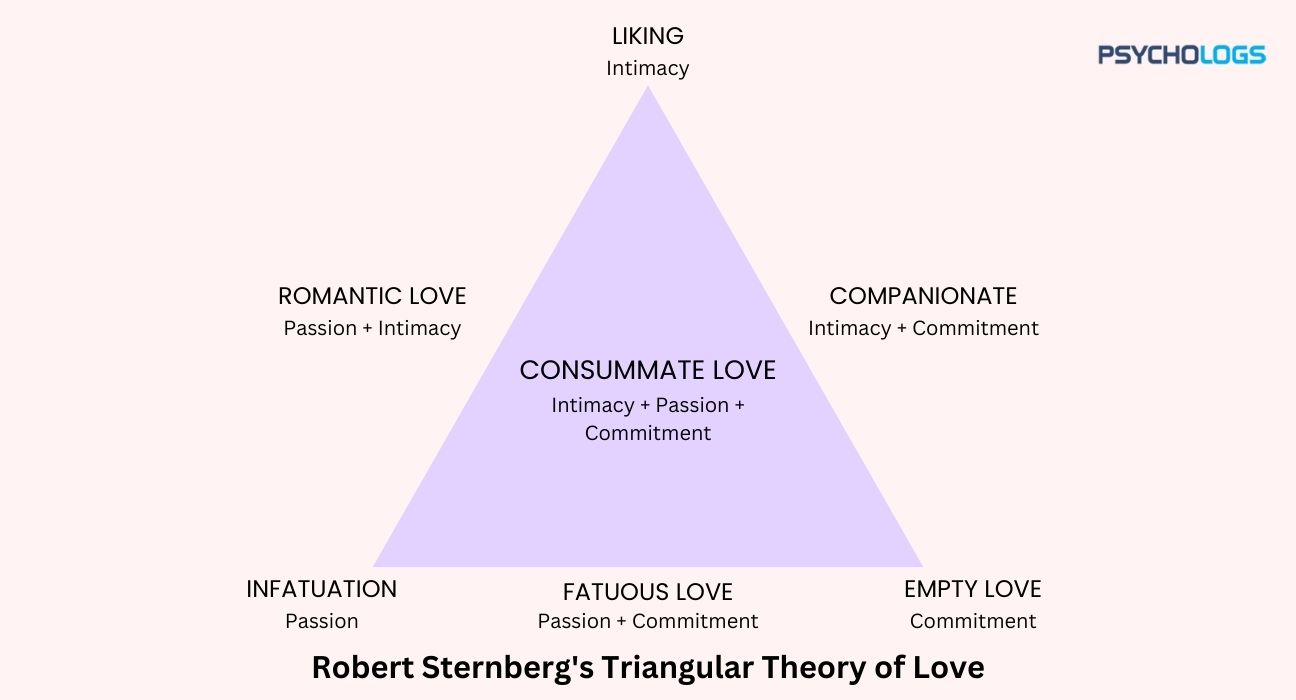
Stemberg’s Three types of Love
Type | Combines | Excludes |
Romantic love | Intimacy + passion | Commitment |
Companionate love | Intimacy + commitment | Passion |
Consummate love | Intimacy + commitment + passion | Nothing |
Choosing between cooperation & competition
“The Prisoner’s Dilemma” (Poundstone, 1992)
A scenario showing how 2 rational individuals, acting in their own self-interest (like confessing to a crime), often lead to a worse outcome for both than if they had cooperated (stayed silent).
Bystander intervention
The study of situational variables related to helping a stranger, most notably the decreased likelihood of helping as the number of bystanders increases
Probably influenced by a sense of individual responsibility
Altruism
Helping others without personal gain or with personal cost
Influential Factors:
Number of potential helpers available
Relatedness to person needing help
Punishment for selfishness
Conscious desire to help
Sense of personal responsibility
Aggression
The conscious intent to harm others. Several forms of aggression are:
Instrumental aggression
Relational aggression
Defensive aggression
Passive aggression
Maternal aggression
Instrumental aggression
Intentional harm, usually physical, done to others to obtain a goal
E.g. attacking a person to steal their purse / wallet.
Relational aggression
Harms another person’s social standing through behaviours such as ignoring, excluding, and gossiping
Defensive aggression
The person may do harm to others in self-defense
Passive aggression
In which people who aren’t comfortable being openly aggressive get what they want under the guise of still trying to please others
Maternal aggression
A rather common phenomenon (in the animal word, and occasionally humans), in which sickly or unwanted offspring are killed
Biological psychology of Aggression
Prenatal exposure to high levels of androgens increases the aggressive play of male & female preschoolers (Reinisch et al., 1991)
Serotonin levels are negatively correlated with aggressive behaviour
 Note
Note  Flashcards (24)