HITT EXAM 2 - (3 & 4)
 Call Kai
 Learn
Learn Practice Test
 Spaced Repetition
 Match
Match Flashcards
 Knowt Play
1/217

There's no tags or description
Looks like no tags are added yet.
Name | Mastery | Learn | Test | Matching | Spaced | Call with Kai |
|---|
No analytics yet
Send a link to your students to track their progress
218 Terms
Bones (oss/e, oss/i, oste/o, ost/o)
Act as the framework for the body, protect the internal organs, and store calcium.
Bone Marrow (myel/o)
Red bone marrow helps form red blood cells. Yellow bone marrow stores fat.
Cartilage (chondr/o)
The smooth, rubbery, blue-white connective tissue that acts as a shock absorber between bones.
Articular cartilage (ar-TICK-you-lar KAR-tih-lidj) covers the surfaces of bones where they articulate to form joints.
Makes smooth joint movement possible and protects the bones from rubbing against each other
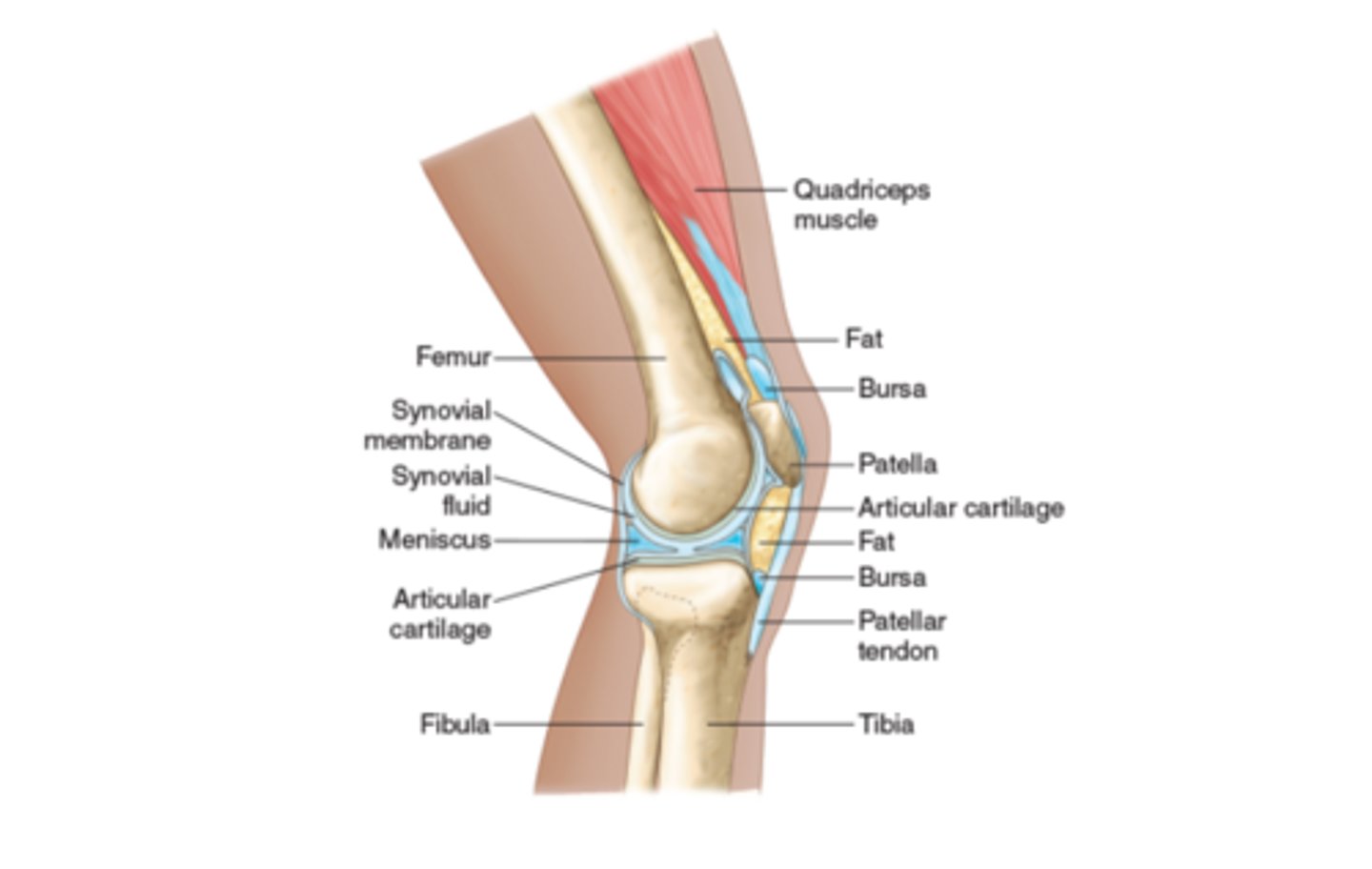
Ligaments (ligament/o)
Connect one bone to another.
Synovial Membrane (synovi/o, synov/o)
Forms the lining of synovial joints and secretes synovial fluid.
Synovial Fluid (synovi/o, synov/o)
Lubricant that makes smooth joint movements possible.
Bursa (burs/o)
Cushions areas subject to friction during movement.
Muscles (muscul/o , my/o , myos/o)
Make body movement possible, hold body erect, move body fluids, and produce body heat.
Fascia (fasci/o) = A band of connective tissue that envelops, separates, or binds together muscles or groups of muscles (plural, fasciae or fascias).
Cover, support, and separate muscles. Fascia is flexible to allow muscle movements.
Tendons (ten/o, tend/o, tendin/o)
Attach muscles to bones.
ankyl/o
crooked, bent, stiff
por/o
A small opening
chondr/i , chondr/o
cartilage
cost/o
rib
crani/o
skull
-desis
to bind, tie together
kyph/o
bent, hump
lord/o
curve, swayback, bent
-ago
Diseased condition
-scopy (suffix)
visual examination
lumb/o
lumbar, lower back
myel/o
spinal cord, bone marrow
oss/e , oss/i , ost/o , oste/o
bone
scoli/o
curved, bent
spondyl/o
(spondyl means vertebrae, and -osis means abnormal condition or disease).
vertebrae, vertebral column, backbone
acetabulum (***-eh-TAB-you-lum)
cup-shaped socket in the hip bone
allogeneic (al-loh-jen-EEH-ick)
allo = different
derived from a different individual
ankylosing spondylitis (ang-kih-LOH-sing spon-dih-LYE-tis)
Anky = crooked
inflammatory arthritis affecting the spine
arthrodesis (ar-throh-DEE-sis)
surgical fusion of a joint
arthroscopy (ar-THROS-koh-pee)
minimally invasive surgery on a joint
autologous (aw-TOL-uh-guss)
derived from the same individual
a-vascular necrosis (ay-VAS-cue-ler neh-KROH-sis)
vascular = blood vessle
death of bone tissue due to lack of blood supply
callus (KAL-us)
thickened skin or bone tissue
chondromalacia (kon-droh-mah-LAY-shee-ah)
softening of cartilage
comminuted fracture (KOM-ih-newt-ed)
bone fracture in which the bone is shattered into many pieces
clon/o
violent action
fibr/o
fibrous tissue, fiber
-ia
abnormal condition, disease, plural of -ium
kines/o, kinesi/o
movement
-plegia
paralysis, stroke
-rrhexis
rupture
tax/o
coordination, order
ten/o, tend/o, tendin/o
tendon, stretch out, extend, strain
ton/o
tone, stretching, tension
abduction (ab-DUCK-shun) - movement away from the midline of the body
adduction (ah-DUCK-shun) - movement toward the midline of the body
abnormal fibrous band that holds structures together
adhesion (ad-HEE-zhun)
ataxia (ah-TACK-see-ah) -
(a- means without, tax means coordination, and -ia means condition).
lack of muscle coordination
atonic (ah-TON-ick)
lacking normal muscle tone
atrophy (AT-roh-fee)
wasting away or decrease in size of a body part
bradykinesia (brad-ee-kih-NEE-zee-ah)
(brady- =slow, kines = movement, and -ia = condition).
slowness of movement
carpal tunnel syndrome (KAR-pul)
condition caused by compression of the median nerve in the wrist
chronic fatigue syndrome
disorder characterized by extreme fatigue that doesn't improve with rest
circumduction (ser-kum-DUCK-shun)
circular movement of a limb
compartment syndrome
condition caused by increased pressure within a muscle compartment
contracture (kon-TRACK-chur)
shortening of muscle or tendon
dorsiflexion (dor-sih-FLECK-shun)
movement that bends the foot upward at the ankle
dyskinesia (dis-kih-NEE-zee-ah)
abnormal, uncontrolled movements
dystonia (dis-TOH-nee-ah)
muscle contractions that cause twisting and repetitive movements
electromyography (ee-leck-troh-my-OG-rah-fee)
diagnostic procedure to assess the health of muscles and the nerve cells that control them
epicondylitis (ep-ih-kon-dih-LYE-tis) - (epi- means on, condyl means condyle, and -itis means inflammation)
inflammation of the tendons surrounding the elbow
ergonomics (er-goh-NOM-icks)
ergo = work, nomics = laws
study of people's efficiency in their working environment
exercise physiologist (fiz-ee-OL-oh-jist)
specialist who studies the body's responses to physical activity
fibromyalgia (figh-broh-my-AL-jee-ah)
fibro = tissues, my = muscles, algia = pain
chronic condition characterized by widespread pain
ganglion cyst (GANG-glee-on SIST)
noncancerous lump filled with jelly-like fluid
heel spur
bony growth on the underside of the heel bone
hemiparesis (hem-ee-pah-REE-sis) - (hemi- means half, and -paresis means partial or incomplete paralysis
weakness on one side of the body
hemiplegia (hem-ee-PLEE-jee-ah)
paralysis of one side of the body
hernia (HER-nee-ah)
CELE- protrusion of an organ through the wall of the cavity that contains it
hyperkinesia (high-per-kye-NEE-zee-ah)
excessive movement or activity
hypotonia (high-poh-TOH-nee-ah)
decreased muscle tone
impingement syndrome (im-PINJ-ment SIN-drohm)
condition where shoulder tendons are trapped during arm movement
innervation (in-err-VAY-shun)
supply of nerves to a specific body part
insertion
where the muscle ends by attaching to a bone or tendon
The flexor carpi muscles and the extensor carpi muscles
Make flexion (bending) and extension (straightening) of the wrist possible
intermittent claudication (klaw-dih-KAY-shun)
claudication = limp
pain in the leg muscles during exercise due to inadequate blood flow
muscular dystrophy (DIS-troh-fee)
(dys- means bad, ton means tone, and -ia means condition)
group of diseases that cause progressive weakness and loss of muscle mass
myasthenia gravis (my-as-THEE-nee-ah GRAH-vis)
chronic autoimmune neuromuscular disease causing weakness
myoclonus (my-OK-luh-nus),
(my/o means muscle, clon means violent action, and -us is a singular noun ending)
sudden, involuntary muscle jerks
Myofascial (my-oh-FASH-ee-ahl)
my/o means muscle, fasci means fascia, and -al means pertaining to
myoparesis (my-oh-pah-REE-sis)
myo - muscle, paresis - WEAK
weakness of muscle
myorrhaphy (my-OR-ah-fee)
(my/o means muscle, and -rrhaphy
surgical suturing of a muscle
neuromuscular (new-roh-MUS-kyou-lar)
pertaining to the relationship between nerves and muscles
oblique (oh-BLEEK)
muscle slanted at an angle
origin - near midline
Where the muscle begins. The origin is the less movable attachment.
paraplegia (pahr-ah-PLEE-jee-ah)
paralysis of the lower half of the body
physiatrist (fiz-ee-AT-rist)
medical doctor specializing in rehabilitation
plantar fasciitis (PLAN-tar fas-ee-EYE-tis)
inflammation of the plantar fascia
polymyositis (pol-ee-my-oh-SIGH-tis)
inflammatory disease affecting multiple muscles
pronation (proh-NAY-shun)
rotation of the forearm or foot inward
quadriplegia (kwad-rih-PLEE-jee-ah)
paralysis of all four limbs
sarcopenia (sar-koh-PEE-nee-ah) - (sarc/o means flesh, and -penia means deficiency)
loss of muscle mass due to aging
shin splint
pain along the shin bone
singultus (sing-GUL-tus)
involuntary contraction of the diaphragm causing hiccups
sphincter (SFINK-ter)
muscle that controls the opening and closing of a passage
sprain
injury to a ligament caused by stretching or tearing
tendinopathy (ten-din-OP-ah-thee)
disease of a tendon
tenodesis (ten-ODD-eh-sis)
(ten/o means tendon, and -desis means to bind or tie together)
surgical procedure to stabilize a tendon
tenolysis (ten-OL-ih-sis)
(ten/o means tendon, and -lysis means to set free/ Destruction)
surgical procedure to free a tendon from adhesions
tenosynovitis (ten-oh-sin-oh-VYE-tis)
inflammation of the sheath surrounding a tendon

