moment-turning affect of force
 Call Kai
 Learn
Learn Practice Test
 Spaced Repetition
 Match
Match Flashcards
 Knowt Play
1/18

There's no tags or description
Looks like no tags are added yet.
Name | Mastery | Learn | Test | Matching | Spaced | Call with Kai |
|---|
No analytics yet
Send a link to your students to track their progress
19 Terms
what is a moment?
the turnign effect of a force about a pivot
size of moment/moment of force (also called torque) equation
moment(Nm)= force (N) x perpendicular distance from pivot(M)
M = moment in newton metres (Nm)F = force in newtons (N)
d = perpendicular distance of the force to the pivot in metres (m)
what does turning effect depend on?
-The magnitude of the force applied
-The perpendicular distance of the force from the pivot
how to reduce force requried usign pivot
increase perpendicular distance form pivot which creates larger moment so less force required to move. If pushed at any other angle other then 90 degrees then a smaller moemnt produced as the perpendicular distance between the line of action and the pivot is smaller. You can decrease moment by decreasing f or d. To have the biggest turnign effect force the ine of action of the force should be perpendicualr to the object.
what is pivot point
point which teh object can rotate about
exampels involvign moemnts
Using a crowbar to prize open something Turning a tap on or off A wheelbarrow Scissors
what is resultant force of momentum and equation
It is the rate of hcange of momentum
resultant force=change in momentum/time
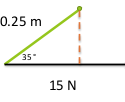
how to calcualte moment of an object not perpendicualr to force?
A force of 15 N is acting 0.25 m away from the pivot point of an object at an angle of 35 °.
In order to calculate the moment, the perpendicular distance needs to be calculated first:
Using trigonometry, sin 35 = O/H.
sin 35 = perpendicular distance/0.25
perpendicular distance= 0.25 sin 35
Moment = force x perpendicular distance
Moment = 15 x 0.25 sin 35
Moment = 2.2 Nm
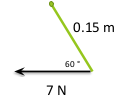
calcualte moment
Moment = F x d
Moment = 7 x 0.15 sin 60
Moment = 0.91 Nm
what is law of conservation of momentum
when two or more objects act on eachother, their total momentum remains constant provided no external forces are acting. mass x velocity to left
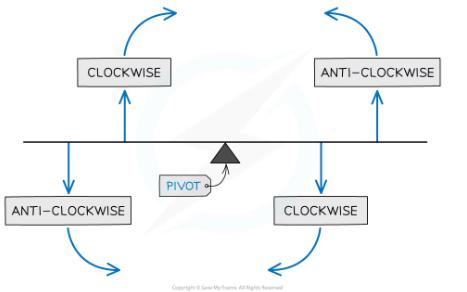
what is principle of moments?
when the sum of clockwise moments equals the sum of anticlockwise moments about the pivot and there is no (0) resultant/net force-object is balanced
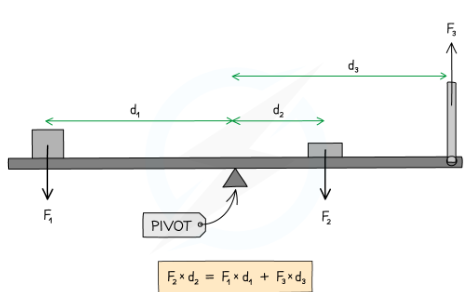
Equilibrium means
there is no resultant force or moment. Object keeps doing what its oding without chnage
conditions for equilibrium
-The forces on the object must be balanced
-There must be no resultant force
-The sum of clockwise moments on the object must equal the sum of anticlockwise moments-there must be no resultant moment
-principle of moments must apply
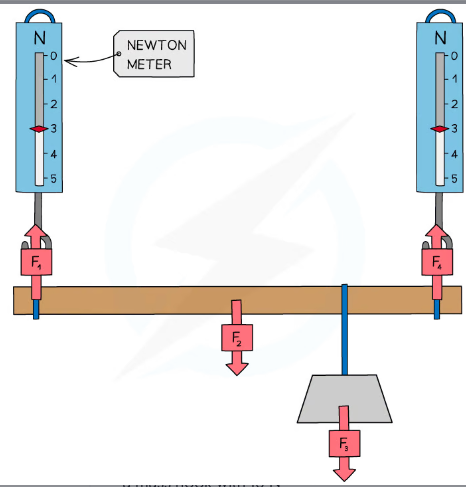
experiment to show equilibrium (jsut read)
method: take beam and replace supports with newton meters
Use a meter ruler for the beam
Suspend it via two Newton meters, one on each side, that each hang from a clamp stand
F1 is the reading given on the left side Newton meter and F4 is the reading given on the right
Create a loop of string, tie a tight knot and slide the ruler through it
F3 will be the weight of a mass hook with 10 N weights suspended from this string
F2 is the weight of the beam OR
find centre of mass of the ruler (measure both sides and get midpoint). Balance the ruler on the pivot,mark and record
Find the weight/mass of the rule. Place the pivot between the 100g mass and the mark you made. Record d2 and d. Repeat by mvoign mass . F1D1
what is centre of gravity?
point where the gravitational force/weight/mass of object appears to act.Where teh mass/weight appears to be cocnentrated. (located at point of symmetry).If we support the ruler at this point, there is no turning moment in any direction about the point, and it balances. The centre of gravity is sometimes called the centre of mass. When an object is not pivoted through its COG the weight of the object will produce a turning effect.
when is an object stable?
when its centre of gravity lis above its base. A stabel obejct is difficult to push over-when pushed and released it will return to its original position. As soon as its COG passes over the edge of its base there will be a resultant force and it will topple.
hwo to increase stability?
the wider base an object has, the lower its centre of gravity/mass and it si more stable.
experiment to calcualte centre of gravity of a card?
When an object is suspended from a point, the object will always settle so that its centre of gravity comes to rest vertically below the pivoting point (the pin.) Method:
hang up irregualr object. Suspend shape from location near an edge and drop a plump linefrom same place
mark position of plumb line/thread
repeat the above steps with teh card suspended form different places
where these lines intersect is teh COG
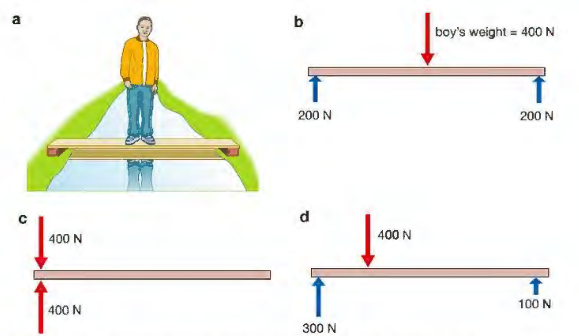
what happens to moment of a plank when a boy is palced in the centre?
-The beam above is placed on two supports. There is no single pivot for the beam to rotate around and therefore has a net moment of zero.
-Each pivot WILL however have a moment. These moments must be equal in size but opposite in direction.
-The beam is also not moving vertically which means the forces acting on it are balanced. The weight of the boy = the reaction forces from the points on the supports (ignoring the weigh of the beam).