3. Heritability
 Studied by 0 people
 Call Kai
 Learn
Learn Practice Test
 Spaced Repetition
 Match
Match Flashcards
 Knowt Play
1/51

There's no tags or description
Looks like no tags are added yet.
Name | Mastery | Learn | Test | Matching | Spaced | Call with Kai |
|---|
No analytics yet
Send a link to your students to track their progress
52 Terms
What did Francis Galton contribute to the beginnings of the heritability debate?
first popularised the distinction between nature and nurture
interested in intelligence, personality, physical traits
proposed that abilities are inherited in the same way physical traits are
What methods did Francis Galton use which informed his contributions?
looking at obituaries in The Times newspaper for familial relations and their connection to ‘eminence’ and found that close relatives of eminent people were far more likely to be eminent than distant relatives
also surveyed 190 royal society fellow, asked about birth order, parents details to determine if scientific prowess was due to nature or environment
acknowledged there was an overlap - need to look at similarities and differences between people with different levels of shared genes
What is the degree of relationship?
How much genetic information is shared
first-degree relatives share 50% e.g. parents and siblings
second-degree relatives share 25% e.g. grand-parents
third-degree relatives share 12.5% of genes e.g. great-grandparents, first cousins
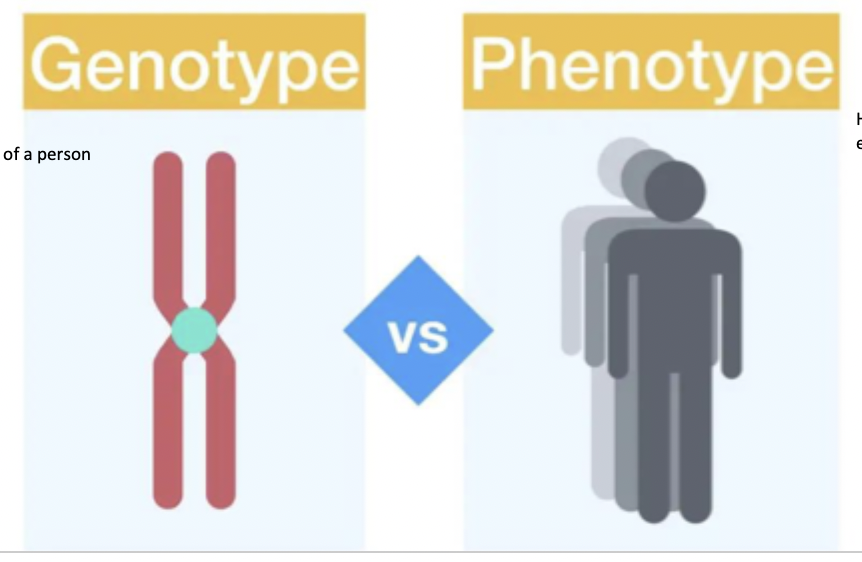
What is genotype and phenotype?
genotype - individual genetic makeup of a person
phenotype - how that genetic makeup is expressed through observable traits
What is shared variability?
how much of the difference between two people can be explained by genes - expressed as a percentage
How do we explain shared variability is parent and child are quite difference?
high variability/ proportion of shared variance is low
How do we explain shared variability is parent and child are very similar?
low variability/ proportion of shared variance is high
What are the two broad techniques for determining heritability estimates?
behavioural approaches
DNA/physiological approaches
What is the procedure of family studies? (a behavioural approach)
parents and children share 50% genes
measure intelligence, then compare performance
If similar can assume genetic influence on intelligence
What are strengths and limitations of family studies?
easy to get samples
but difficult to separate out genes and environment
What is the logic and procedure of twin studies? (a behavioural approach)
MZ share 100% of DNA. DZ share 50%
compare phenotype between MZ and DZ to examine relative influence of genetics
children have the same environments → natural comparison between genetic similarity (MZ V DZ) so can assume impact of genes
What are key strengths and limitations of twin studies?
natural control over gene similarity
however, MZ twins may be treated more similarly than DZ
and twins might not represent the whole population
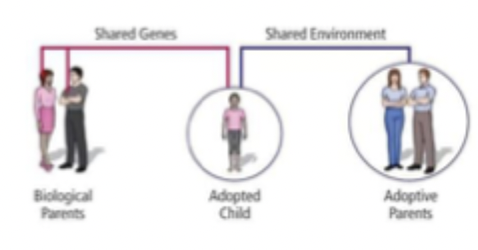
What is the logic/procedure of adoption studies?
same genes, different environments
ideal is to study adopted twins
What are strengths of adoption studies?
study both genes and environment separately. nearest to ideal design
tease out genes/environment
What are limitations of adoption studies?
families are matched deliberately - not random
adopted families are not always representative (higher SE)
contact with birth parents can blur the line
prenatal environment may have impact
What were the key findings of Ridley 1999 regarding heritability of intelligence based on behavioural/family studies?
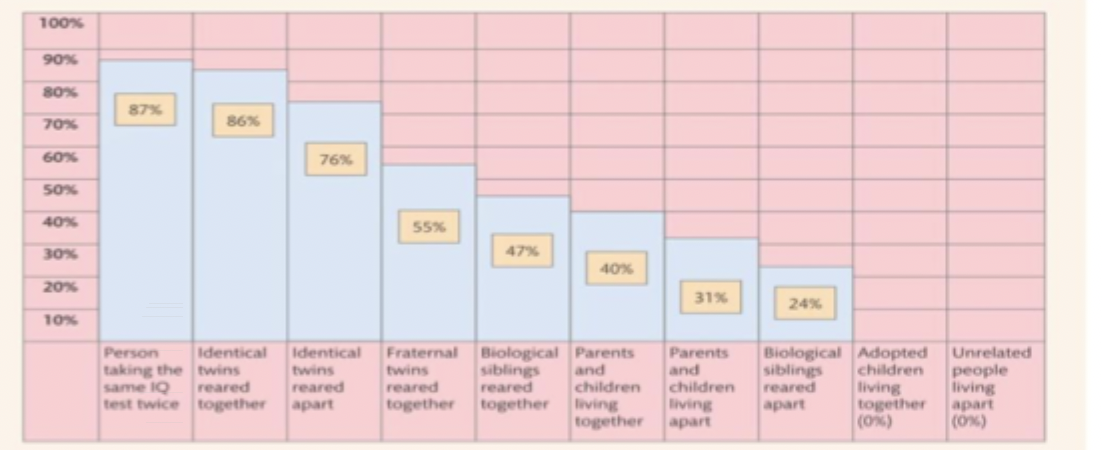
variability decreases from identical twins reared together (86%) and identical twins reared apart (76%) suggesting that the environment must play some part but genetics have large role
shared variability is 0% for adopted children living together. Same environment but different biology. No correlation suggests genetics must play some part
What were the heritability estimates for intelligence made by eysenck and the Bell curve book and what might be a limitation?
estimated heritability of intelligence is quite high
69% Eysenck (1979)
74% Bell Curve book (Herrnstein and Murray 1994)
But all evidence so far uses behaviour methods - making assumptions about physiology/DNA
What is a Genome-Wide Association Study?
considers the entire set of genetic material of a large group of people - searching for genetic variations
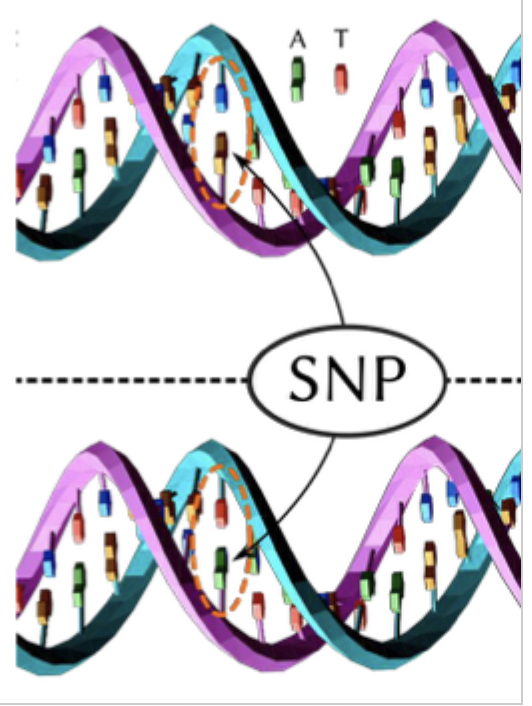
What is a Single Nucleotide Polymorphism (SNP or ‘Snips’)
The small variations that are being searched for in a genome-wide associations study
scientists want to identify SNPs that occur more frequently in people with, for example, high or low intelligence
How did Davies et al (2011) use DNA to directly explore intelligence?
directly considered heritability of intelligence using genome-wide data looking for SNPs and phenotype data (measures of cognitive traits associated with intelligence)
compared 3511 unrelated, middle/older adults
What did Davies et al (2011) find using DNA to directly explore intelligence?
found that 40-50% of variation in intelligence is associated common SNPs
supports genetic heritability in intelligence
How did Deary et al. (2012) investivate the genetic contribution to the stability of intelligence across the life span?
noticed people who score high on intelligence tests as children tend to score similarly as adults or older adults
measure intelligence at 11 then again at 65, 70, 79 (2000) unrelated individuals
combined this is DNA analysis
examined more than 500,000 genetic markers (SNPs) to see how genetically similar these individuals were despite not being related
What did Deary et al. (2012) find regarding the genetic contribution to the stability of intelligence across the life span?
People who were more genetically similar:
had more similar childhood IQ
had more similar older-age IQ
and showed more similar stability
suggests there is a genetic contribution to the stability of intelligence across the life span. However it’s estimated to only be 38%
Is there a single intelligence gene?
there is no single gene that dictates intelligence
intelligence is polygenic
thousand of genetic variants each contribute tiny effects
a single SNP might explain 0.002% of variation in intelligence
genes do influences broader process which might influence intelligence e.g. synaptic development
What are 4 environmental influences on intelligence?
biological (not genetic)
family environment
school and education
culture
What is involved in the biological environmental influence on intelligence?
nutrition
prenatal factors (e.g. drinking and smoking)
What might be involved in the family environment influence on intelligence?
shared and non-share environments
SES (large influences - estimated IQ variation of 45 points
birth order (first born has highest IQ then decreases)
family size (larger family - lower IQ)
What is the nature of the school and education influence on intelligence?
it is bidirectional
education ←> intelligence
What is involved in the culture influence on intelligence?
linked to implicit ideas of intelligence
contributes to what kinds of intelligence develops
What are the two different ways genes/ environment interact to produce the phenotype?
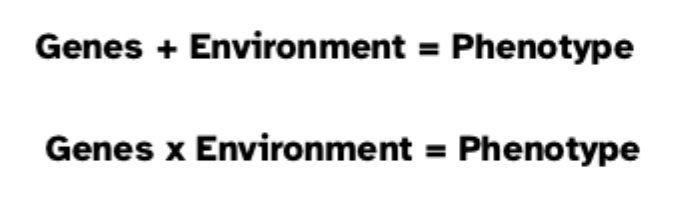
What are the 4 different considerations for genetic heritability?
genetic potential
gene-environment correlation
differential susceptibility
moderating factors
What is the genetic potential consideration for genetic heritability?
child may have the genes for high intelligence: whether it’s realised is dependent on the environment
with stimulating school/ home environment they may be able to reach their potential
the environment changes the size of genetic impact
What is the gene-environment correlation consideration for genetic heritability?
those that have the genes might undertake behaviours which will lead to higher intelligence e.g. choosing harder books to read, joining clubs
genes shape the environment they’re in which is then shping their outcome in terms of intelligence
What is the differential susceptibility consideration for genetic heritability?
some genetic profiles make a child more sensitive to their environment
genetic profile will make them more malleable to whatever is going on
if positive environment - will flourish more
What are moderating factors as a consideration for genetic heritability?
other things that affect the strength of the interaction
What are 5 considerations of the GxE interaction?
estimates only tell us about groups/society - not individuals
intelligence is an abstract concept - not a concrete definition/ biological basis
genetic variation depends on dominance
assortative mating: pair up with similar others
twin/adoption studies
What is The Bell Curve (1994) what were the main general things reported
book published containing same/similar negative ideas around intelligence
reported how intelligence is genetic
focus on the rise of the “cognitive elite”
increased intelligence → increased chance of success
intellectual inferiority of some cultural groups
What were the 6 main arguments of the bell curve?
There is such a thing as a general factor of intelligence upon which humans differ
IQ tests are designed to measure ‘g’ and are mostly accurate
IQ scores match implicit theories of intelligence
IQ score are stable, although not perfectly so
properly administered IQ tests are not biased against social, ethnic, economic or racial groups
cognitive ability is substantially heritable 40-80%
What was involved in the Bell Curve’s main theme of the cognitive elite?
Intelligence is more important than social class/wealth in uni admissions
allow intelligent people to get certain jobs
cognitive elite distinct because of separation through education and jobs
intelligence is the basis of the class system
What was involved in the Bell Curve’s main theme of the socioeconomic variables and IQ?
Suggest than an individual’s intelligence is more important than SES for predicting economic and social welfare
What was involved in the Bell Curve’s main theme of the relationship between race and intelligence?
described evidence for the higher IQ of asian-americans and lower IQ of African-American in comparison to white Americans
What was involved in the Bell Curve’s main theme of the ideas implications for social policy?
Women with a lower IQ tend to have more children, so the population of those with lower IQ is increasing
immigrants contribute towards this
this will increase societal problems associated with low IQ (e.g., crime)
implicit in these stated arguments then is that groups of people in America with lower intelligence (e.g., immigrants and African-Americans) are potentially part of this social problems.
What did Herrnstein and Murray argue that the best way to tackle the ‘problems’ outline in the Bell curve book?
not to use affirmative action (support) as measures such as these have led to a decrease in intelligence within education and the workplace
its failed in the past and if intelligence genetic then it won’t help anyway
also argue that resources should be shifted from supporting underprivileged population to supporting the ‘cognitive elite’. society will improve because the workforce will improve
What were the consequences of the bell curve book?
initially quite positive response but prompted the APA to put together a taskforce headed by ulric neisser
taskforce to represent wide range of views and opinions on intelligence
What was one of the conclusions of the taskforce put together after the Bell Curve book?
While the average IQ scores between African American and White Americans may differ, there is no definite evidence to suggest this is due to genetics. It is more likely to be cultural
What is the flaw with the Bell Curve 1 assumption that G exists and differs?
more empirical evidence of this now, but research not as clear back then
no expert consensus yet
What is the flaw with the Bell Curve 1 assumption that IQ tests measure g and are accurate?
can be some debate over this, given the context around the origins of g and around its testing and development
What is the flaw with the Bell Curve 1 assumption that IQ scores match implicit theories of intelligence?
maybe western ideas, but there are some differences across cultures and sub-cultures
even within one culture our ideas can shift and change
What is the flaw with the Bell Curve 1 assumption that IQ scores are stable?
quite but not perfectly (e.g. deary 2000 said around 60)
and consider ideas around malleable and fixed intelligence
What is the flaw with the Bell Curve 1 assumption that IQ tests are not biased?
tests themselves may not be biased, but the theories behind them could be
What is the flaw with the Bell Curve 1 assumption that cognitive ability is substantially heritable?
based on less robust research methods that were available at the time
large estimate range (40-80), and difficult to use to explain group differences
What are 3 issues with the stats and evidence used in The Bell Curve?
Correlations between SES and intelligence are not causations. SES can be bound up with multiple confounding factors
Measure validity: studies using self-report measures for SES with children and no additional checks
Problematic research studies: over-reliance of certain academics and cherry-picking results
 Note
Note  Flashcards (32)