CSAD 125: Test 2 Study Guide
 Call Kai
 Learn
Learn Practice Test
 Spaced Repetition
 Match
Match Flashcards
 Knowt Play
1/137

There's no tags or description
Looks like no tags are added yet.
Name | Mastery | Learn | Test | Matching | Spaced | Call with Kai |
|---|
No analytics yet
Send a link to your students to track their progress
138 Terms
What is the cause of FASD (fetal alcohol spectrum disorder)?
Prenatal exposure to alcohol :(
What are the 2 general characteristics of ARNDs (alcohol-related neuro-developmental disorder)?
1. Characterized by CNS damage rather than growth deficiencies
2. May NOT have distinct facial characteristics
What is the cause of ARNDs?
Prenatal exposure to alcohol :(
What are the general characteristics of ASD?
1. Symptoms fall on a continuum
2. Deficits in social-emotional reciprocity
3. Deficits in nonverbal communicate behaviors used for social interaction
4. Deficits in developing, maintaining, and understanding relationships
5. Severely limited behavior, interest, and activity repertoire
6. Disturbances in responses to sensory stimuli
7. Disturbances in speech and language, cognition, and non-verbal communication
8. Disturbances in capacity to appropriately relate to people, events, and objects
9. Lack of social behaviors, affection, and social play
10. Hyperlexia
What are examples of disturbances in responses to sensory stimuli exhibited by someone with ASD?
1. Hyper and/or hypo-stimulation in hearing, vision, touch, motor, smell, and taste
2. Self-stimulation behaviors (stimming)
What are 4 characteristics of deficits in social-emotional reciprocity exhibited by someone with ASD?
1. Abnormal social approach
2. Failure of back-and-forth interactions
3. Reduced sharing of interests, emotions, or affect
4. Failure to initiate or respond to social situations
What are 3 characteristics of deficits in nonverbal communicative behaviors used for social interactions exhibited by someone with ASD?
1. Poorly integrated verbal and non-verbal communication
2. Deficits in understanding use of gestures and nonverbal cues
3. Lack of usage of nonverbal cues or expressions
What are 4 characteristics of deficits in developing, maintaining, and understanding relationships exhibited by someone with ASD?
1. Difficulty adjusting behavior to social context
2. Difficulty in sharing imagination
3. Difficulty in making and keeping friends
4. An absence of interest in peers
What is the ratio of how many boys have hyperlexia compared with how many girls have it?
7:1, boys to girls
What is hyperlexia?
A spontaneous ability to read, frequently by 2.5-3 years of age with little reading comprehension common in children in ASD
A child with hyperlexia has intense preoccupation with what 2 things?
1. Letters
2. Words
A child with hyperlexia exhibits extensive word recognition/decoding by what age?
5 years old
What are 4 language characteristics of a child with hyperlexia?
1. Language and cognitive disorders in reasoning and perceiving relationships
2. Delayed language
3. Difficulty with connected language in all modalities
4. Difficulty integrating language with context to make meaning
What are 4 language characteristics of someone with ASD?
1. Communication problem (Often 1st red flag)
2. Poor social interaction, language, and communication skills
3. Speech can be robotic-like/lack prosody/rhythm
4. May demonstrate immediate or delayed echolalia
What are 3 examples of communication problems that can be exhibited by someone with ASD?
1. Failure to begin gesturing or talking
2. No interest in others
3. Lack of verbal responses
What percent of people with ASD have typical language?
25%
What percentage range of people with ASD are non-speaking?
25-60%
What may help some people with ASD?
Augmentative and alternative communication (AAC)
What are 12 examples of pragmatics issues exhibited by someone with ASD?
1. Decreased joint attention
2. Difficulty initiating and maintaining conversations
3. Limited overall communication functions
4. Difficulty matching language form and context
5. May perseverate and/or bring up inappropriate topics
6. Immediate and delayed echolalia
7. Routinized utterances
8. Few gestures/ misinterpreting gestures
9. Overuse of question form
10. Asocial/ solitary monologues
11. Speaker-listener roles NOT well-developed
12. Poor eye contact/ seeming to use peripheral vision
What are examples of difficulty with semantics exhibited by someone with ASD?
1. Underlying meaning of words NOT used as a memory aid
2. Inappropriate answers to questions
What are 3 examples of syntactic/morphological issues exhibited by someone with ASD?
1. Difficulty with pronoun use and verb endings
2. Superficial, structured sentences with little attention to meaning
3. Overly dependent on word order
What a description of how having ASD affects phonology?
1. It is often disordered, but variable within the child/some apraxia connection
2. This is the least affected aspect of language in many cases
What is comprehension like for someone with ASD?
Impaired overall and most noticeably in conversations
What are 8 possible biological causal factors of ASD?
1. 65% have abnormal brain patterns, hypergrowth at some periods, longer axonal length, different volume at different points of development
2. Incidence correlations found between autism and prenatal complications, fragile X syndrome, Rett syndrome, Tourette's, and family history of ASD
3. Possible seizures
4. HIGH levels of seratonin
5. Abnormal cerebellum development
6. Multifocal brain disorders
7. Neural subcortical impairment
8. Possibly a multiple gene genetic link
Are their any social-environmental causal factors of ASD?
No
What are 4 possible causal processing factors for ASD?
1. Difficulty analyzing and integrating information; fixating on one aspect of incoming stimuli, impacting the ability to discriminate
2. Overall processing is gestalt and chunks are stored and reproduced identically, impacting organization; input NEVER seems to get taken in as a whole and analyzed into parts
3. Storage of these gestalts may overload memory
4. HUGE problems transferring or generalizing learned info from one context to another
What are the 2 general characteristics of CVA?
1. Damage is usually specific and localized
2. Prognosis generally good for recovery or partial recovery over time
What are the 4 language characteristics of someone who has experienced a CVA?
1. Syntax usually recovers quickly, but may be less strong in the presence of increased linguistic demand
2. Word retrieval may have extreme difficulties both in terms of speech and accuracy
3. Language comprehension decreases at first and HIGHER level academic and reading problems may persist
4. Persistent subtle pragmatics difficulties are common
What is the cause of a CVA?
A portion of the brain is denied oxygen :(
What are the 12 general characteristics of TBI?
1. Diffuse brain damage
2. Results range from full recovery to vegetative state, depending on damage
3. Long-term disability is common
4. Cognitive, physical, behavioral, academic, and linguistic deficits
5. Psychological maladjustment, leading to social disinhibition
6. Lack of initiative
7. Distractibility
8. Inability to adapt quickly to new situations
9. Perseveration
10. Frustration
11. Anxiety
12. Depression
13. Is diffuse brain damage resulting from an external physical force
What is social disinhibition?
"Acting out"
What are 3 cognitive-communication deficits that can be exhibited by a TBI survivor?
1. Attention problems
2. Memory problems
3. Executive function problems
What are 3 characteristics in semantics that may be exhibited by a survivor of a TBI?
1. Word retrieval and naming deficits
2. Vocab may be intact, but difficulty describing objects persists
3. Automatized, over-learned language and contextualized language ("Hi, how are you?") relatively unaffected
What is the phonology of a TBI survivor like?
Few difficulties with phonology, through dysarthria or apraxia may exist secondary to injury
What are 8 characteristics of comprehension for a TBI survivor?
1. Problems due to inattention and processing speed
2. Poor auditory comprehension and reading comprehension
3. Sentence comprehension secondary to syntax and semantics problems
7. Routinized, everyday comprehension unaffected
8. Non-abstract vocab usually unaffected
What is the hallmark of TBI?
Difficulty with pragmatics
What are pragmatics characteristics of a TBI survivor?
1. Off-topic, ineffectual, inappropriate comments
2. Lengthy explanations
3. Appropriate eye contact (contrast w/ASD)
4. Less complex narratives with reduced sentence complexity, although story grammar and cohesion may be intact
What are the 3 possible causal factors of TBI?
1. Biological and physical factors cause the language characteristics observed
2. Information processing is affected, particularly attention, organization, storage, and retrieval
3. Long-term memory prior to the trauma is usually intact
What are the 4 general characteristics of Non-specific language impairment (NLI)?
1. General delay in language development
2. Nonverbal IQ of 86 or lower (but NOT as low across the board as intellectual disability)
3. NO obvious sensory or perceptual deficits
4. Perform MORE poorly than SLI kids on some language tasks and take longer to generalize the rules
What is the cause of Non-specific language impairment (NLI)?
May have more of a genetic link, as indicated by twin studies
What are the 7 general characteristics of someone who has experienced neglect and abuse?
1. Developmental difficulties across the lifespan can result
2. Many traumatized children experience biological brain changes characterized as hyperarousal
3. Hyper-vigilant state
4. Apprehension
5. Fear
6. Attention difficulties
7. Restlessness
What are the 3 semantics characteristics of someone who has experienced neglect and abuse?
1. Limited expressive vocab
2. Few decontextualized utterances
3. MORE "here and now" discussion
What is the syntax/morphology like of someone who has experienced neglect and abuse?
Shorter, less complex utterances
What is the phonology like of someone who has experienced neglect and abuse?
Similar to peers
What is the comprehension of someone who has experienced neglect and abuse?
Auditory and reading comprehension affected
What is the hallmark language issue of someone who has experienced neglect and abuse?
Pragmatics
What are the 5 pragmatics characteristics of someone who has experienced neglect and abuse?
1. Poor conversation skills
2. Unable to discuss feelings
3. Short conversations
4. Few descriptive utterances
5. Language used to meet an end with little social exchange or affect
What are 3 biological causal factors of neglect and abuse?
1. Poor maternal health, substance abuse, poor pediatric services, and poor nutrition ALL affect brain development and maturation
2. Physical abuse may lead to neurological damage
3. Lack of environmental stimulation negatively affects brain development
What are 2 social-environmental causal factors of neglect and abuse?
1. Learned strategies to cope/survive interfere with rain development in areas of social-emotional learning; interaction with these children is often reduced
2. If insecure attachment is achieved secondary to abusive or neglectful parenting, an apprehensive child may result
What are the 2 general characteristics of dyslexia?
1. Affects 15-17% of the total population
2. Characterized by difficulties in accurate, fluent word recognition when decoding words as well as spelling difficulties
What are the 7 language characteristics of someone who has dyslexia?
1. Phonological awareness problems
2. Phonological memory problems
3. Rapid Automatic Naming (RAN) deficits, leading to decreased reading fluency, which negatively impacts reading comprehension
4. Decreased reading fluency, negatively impacting reading comprehension
5. Comparable verbal IQ scores and/or listening comprehension to TD peers
6. Below average decoding
7. Nonsense or non-real word reading is below real word reading (word attack skill problems)
What is the cause of dyslexia?
1. Researchers have found several genes that are linked to reading and language processing issues
2. There are brain differences people people who have dyslexia and those who don't
What is the cause of hyperlexia?
An obsession with numbers and letters that leads to a much higher reading level than their age
What are the 5 general characteristics of selective mutism?
1. Relatively rare
2. Child does NOT speak in some situations but may speak normally in others
3. Girls nearly 2x as affected as boys
4. Social anxiety
5. EXTREME shyness
What are the language characteristics of someone who has selective mutism?
1. Language impairment (30-50% of those with selective mutism)
2. Second language learning (silent periods)
What is the cause of selective mutism?
Can be caused by social-emotional problems
What are the 3 general characteristics of non-verbal learning disorder?
1. Defined as a developmental brain disorder that impairs a child's capacity to perceive, express, and understand non-linguistic signs
2. Generally expressed as a pattern of impaired functioning in the nonverbal domains, with higher functioning in the verbal domain
3. Can be math-specific, ADD, visual-specific dyslexia, or a learning disability
What are the 8 language characteristics of someone who has non-verbal learning disorder?
1. Difficulty with spatial relationships and perceptions
2. Slow motoric performance on non-verbal tasks with hypervigilance to details vs "big picture"
3. Talkative
4. Reliant on verbal mediation
5. May NOT be aware of manipulation or deception
6. Poor social judgement
7. Frequent avoidance of novel situations
8. Comorbidity with depressive or anxious symptoms
What is the cause of non-verbal learning disorder?
The exact cause of NVLD is unknown, but the disorder is believed to be related to the right hemisphere of the brain, which is involved in imagination, visual awareness, spatial abilities, and the recognition of social cues.
What are the 3 goals of language assessment?
1. Providing a diagnostic label (least important part)
2. Accurately describing the complex language systems of the individual child (MOST important part)
3. Recommending treatment, follow-up, or referral
What are 5 reasons to perform a language assessment?
1. Delayed development
2. Diagnosis of some kind (medical, ASD genetic, etc.)
3. Communication issues
4. Learning concerns
5. Referral from an adult (parents, teachers, doctor, etc.)
What are parent interviews in the context of a language assessment?
Asking the child's parents what differences they have noticed in the child, when they first noticed these differences, and how these differences are progressing
Why are parent interviews important in a language assessment?
They give the clinician a sense of what is really going on from the perspective of someone who knows the child really well and spends a lot of time with the child
What are the 2 main types of testing for a language assessment?
1. Formal approaches
2. Dynamic assessment (formally called "informal assessment")
A standard score of 76-77 or 7th percentile is equal to what?
1.5 standard deviations below the mean score
On norm-referenced procedures, how is performance summarized?
Using standard scores and percentiles
What is a bell curve?
Distribution of scores in which the bulk of the scores fall toward the middle, with progressively fewer scores toward the "tails" or extremes
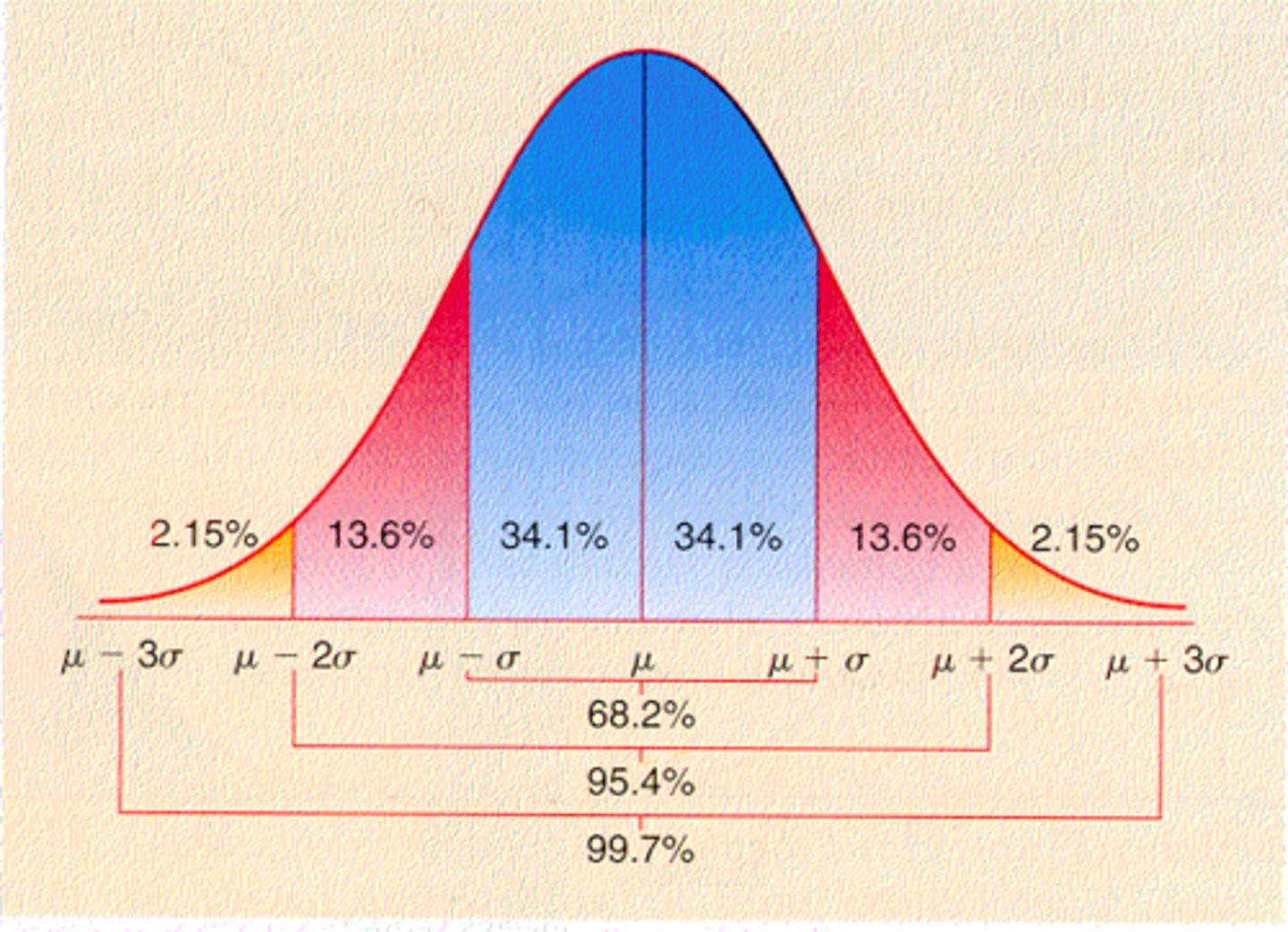
What is the qualifying standard score and percentile for language therapy in CA schools?
- 7th percentile (based on mean score= 50th percentile)
- Standard Score 76-77 (based on mean score = 100)
- NOTE: Both of these measures are equal to 1.5 standard deviations below the mean score
What are criterion-referenced tests of language assessment?
A standardized psychometric procedure that compares a child's present performance to past performance and/or is descriptive in nature
What are descriptive approaches in language assessment?
Approaches to language assessment that allow for MORE naturalistic expression, but that yields data that is MORE difficult to quantify/qualify
What are 2 descriptive approaches in language assessment?
1. Language sampling
2. Observation
What are 2 types of language sampling?
1. Spontaneous
2. Conversational
Is spontaneous language sampling or conversational language sampling the BEST indicator of a child's language abilities?
Spontaneous language sampling
What are 3 tools that can be used to to conduct a spontaneous language sample?
1. Frog series by Mercer Mayer (has NO words)
2. Wordless books
3. Play activities
Conversational sampling requires what?
Probing
How can a clinician conduct a conversational language sample?
Pick a topic that the child is interested in to elicit conversation with them
What 3 areas of language can language sampling be used to assess?
1. Use (pragmatics)
2. Content (semantics)
3. Form (syntax and morphology)
What are the 3 disadvantages of language sampling?
1. Level of expertise needed for analysis
2. Time needed to collect
3. The reliability and validity of the sample is often subjective
What are 2 protocols that exist to help with the collection of a language sample?
1. SALT
2. Sugar
What is informal assessment in language assessment?
Dynamic assessment
What are 6 points to consider when conducting a dynamic language assessment?
1. Does the child speak AAE?
2. What is the child's first language, if he or she is learning English as a second language?
3. How many years has the child been exposed to English as a second language?
4. How many years will it take the child to become fluent in English as a second language?
5. Most tests of language are biased and therefore are culturally-limited
6. Is there an interpreter, cultural expert, or language expert whom you as a clinician can consult?
What does normative testing do?
Measures isolated skills while imposing group criteria on the individual student
Who does a complete assessment need to assess?
The individual!
Can normative testing alone assess the individual?
No
What are the 3 positive aspects of dynamic approaches to language assessment?
1. Flexibility
2. Allowing for notation of pragmatic behaviors
3. Allowing us to note different behaviors in different environments
What technique should a clinician use when using a dynamic approach to language assessment?
Test-teach-retest technique
What is the test-teach-retest technique concerned with?
A child's ability to learn instead of his or per past performance
What are 4 skills that are looked for in the test-teach-retest technique?
1. Ability to attend to, perceive, and recall info
2. Ability to understand explanations
3. Ability to relate past info to new info
4. Ability to infer and generalize
What is dynamic assessment in language assessment?
Informal assessment
What things should a clinician determine in a language assessment?
1. Whether or not a problem exists
2. The causal-related factors
3. The overall intervention plan (if one is warranted)
4. Recommendations for caregivers and teachers
What are methods of observation in a language assessment?
1. Most natural: home and classroom environment with caregivers and peers
2. Clinical settings: With toys and both structured and non-structured conversational activities with caregiver or other others and with items from home (try to keep as typical as possible)
3. Can also use checklists, parent interview forms, or developmental norms
What are 3 tips for conducting an observation language assessment?
1. Take detailed, accurate notes describing what was observed
2. Infer and make hypotheses only later
3. Refer to developmental language charts
What 5 main things should a clinician observe when conducting an observation language assessment?
1. Form of language
2. Content of language
3. Use of language
4. Rate of speech
5. Sequencing
What are 7 things to look for when assessing a child's language form?
1. Single words
2. Phrases
3. Sentences
4. Negatives
5. Interrogatives
6. Passives
7. Elaboration
What are 2 things to look for when assessing a child's language content?
1. Does the child respond appropriately to various question forms?
2. Does the child confuse words from different semantic classes?
What are 4 things to look for when assessing a child's use of language?
1. Does the child ask for info and help?
2. Replies
3. Statements
3. Conversational turn-taking
4. Introduction of topics to conversation
3. Maintaining conversational topics through turns
4. Repairing conversational breakdowns
What are 5 things to look for when assessing a child's rate of speech?
1. Is it too slow?
2. Is it too fast?
3. Are there pauses between conversational turns or before words or utterances?
4. Does the child frequently use fillers?
5. Does the child make word substitutions?
What are 2 things to look for when assessing a child's sequencing abilities?
1. Can the child relate events in a sequential fashion based on order of occurrence?
2. Can the child discuss recent past events or recount stories/narratives?
What are 7 ways to assess a child's pragmatic skills (use of language)?
1. Test of Pragmatic Language (TOPL)
2. Pragmatics profile of CELF-4
3. Storytelling
4. Topic discussion
5. Parent/teacher/caregiver checklists
6. Conversational samples
7. Observations in MORE than one setting
What is a test that can be used to assess a child's phonological processing?
Comprehensive Test of Phonological Processing (CTOPP-2), including subtests of sound blending, sound matching, memory, rapid naming of colors, numbers, letters, and objects

