Water and carbon cycles
 Studied by 1 person
 Call with Kai
 Learn
Learn Practice Test
 Spaced Repetition
 Match
Match Flashcards
 Knowt Play
1/95

Earn XP
Description and Tags
complete
Name | Mastery | Learn | Test | Matching | Spaced | Call with Kai |
|---|
No study sessions yet.
96 Terms
What is a system composed of?
outputs - leaving the system
inputs - entering the system
stores - where matter/energy builds up in the system
transfers/flows - movement in the system
boundaries - limits to the system (eg watershed)
what are open and closed systems?
open = receive inputs and transfer outputs of energy/matter with other systems
closed = when energy can come and go from the system but material cannot
what is dynamic equalibrium
a state where imputs and outputs remain balanced. if changes occur in the system feedback with counteract this to keep the balance
positive feedback = when events amplify the impact of the original event (increases the effect of change)
negative feedback = events decrease the impacts of the original event (reduces the effect of change)
Are the carbon and water cycles open or closed systems?
at a local scale they are open and interact with other local systems (ie, inputs and outputs are not balanced)
at a global scale they are closed
What is the input of the water cycle at a local scale?
precipitation
any water that falls to the earths surface is an input (snow, hail, rain etc)
there are 3 types of rainfall:
convectional - due to heat by sun, warm air rises, condenses and falls as rain
relief - warm air forced up by a barrier (eg mountains) causing it to condense and fall as rain
frontal - warm air rises over cool air when two bodies of air at different temps meet and as warm air is less dense, it rises over. it condenses at higher altitudes and falls again
What are 3 outputs of the water cycle at a local scale?
evapotranspiration - Evapotranspiration is the water loss occurring from the processes of evaporation and transpiration.
transpiration - occurs in plants when they respire through their leaves releasing water that they absorb through their roots
streamflow - water leaving a drainage basin bias streams which drain the basin. may flow as tributaries into other rivers or straight into lakes and oceans.
What are examples of flows in the water cycle at a local scale?
infiltration
percolation
throughflow
surface runoff (overland flow)
groundwater flow
streamflow
stemflow
define infiltration, percolation and throughflow…
infiltration is water moving from above ground into the soil. infiltration capacity is how quickly infiltration occurs. grass, and tree roots etc create passages for water flow increasing infiltration. if precipitation occurs at a greater rate than infiltration overland flow will occur - moderate/fast
percolation is water moving from the ground into porous rock or rock fractures. percolation rate is dependent on the fractures/permeability of the rock - slow
throughflow is water moving through soil into streams or rivers. the speed of the flow is dependent on the type of soil. eg clay has smaller pores (higher field capacity) so slower flow rate. sandy soils drain quickly as they have lower field capacity and larger pores (and channels made from small animals) - moderate/fast
define field capacity
the water remaining in a soil after it has been thoroughly saturated and allowed to drain freely, usually for one to two days.
define surface runoff, groundwater flow, streamflow and stemflow…
surface runoff (overland flow) is water flowing above ground as sheetflow (lots of water flowing over a large area) or rills (small channels unlikely to carry water then there is no rainfall) - fast
groundwater flow is water moving through rocks - usually slow but varies
streamflow is water moving through established channels - fast
stemflow is flow of water being intercepted by plants and trees, down a stem, leaf or branch - fast
what are 5 stores in the water cycle at a local scale?
soil water - water in soil utilised in plants - mid term
groundwater - water in pore spaces of rock - long-term
river channel - water in rivers - long-term
interception - water intercepted by plants - short-term
surface storage - water stored in puddles, ponds, lakes etc - variable
what is the water table?
upper layer of pore spaces and fractures that get saturated. used to assess drough conditions, health of wetland etc.
what is the water balance?
the balance between inputs to the system from precipitation, and outputs from evapotranspiration. water balance will change based on physical factors, especially in seasonal variations of temperature and precipitation
what formula does the water balance use?
precipitation = total runoff + evapotranspiration ± (change in) storage
what factors 5 create change in the water cycle on a local scale?
deforestation
storm events
seasonal changes
agriculture
urbanisation
What is the impact of deforestation on the WC at a local scale?
less interception by trees so surface runoff increases
soil no longer held together by roots so water storage in soil deacreases.
fewer plants so transpiration decreases
What is the impact of storm events on the WC at a local scale?
large amount of rainfall quickly saturates ground to field capacity, no more water can infiltrate leading to increased runoff
there is less time for percolation to occur so runoff is higher than if the same amount of rainfall fell over a prolonged period
means intense periodic rainfall less effective at replenishing water stores than prolonged rainfall
What is the impact of seasonal changes on the WC at a local scale?
spring = more vegetation growth so increased interception
summer = less rain so ground may be harder and more impermeable encouraging surface runoff
autumn = less vegetation growth to less interception, more rainfall
winter = frozen ground may be impermeable. snow discourages runoff and takes time to melt, slowing down processes
What is the impact of agriculture on the WC at a local scale?
pastoral farming (livestock) - livestock such as pigs, cattle and sheep trample ground, reducing infiltration
arable farming (crops) - ploughing increases infiltration by creating looser soil, decreasing runoff. digging, drainage ditches increase surface runoff and streamflow
hillside terracing (rice padi fields) - increases surface storage and decreases runoff
irrigation - can lead to groundwater depletion
What is the impact of urbanisation on the WC at a local scale?
creating roads and buildings increases surface runoff due to impermeable surfaces reducing infiltration
increased flood risk
green roofs and sustainable urban drainage systems (SUDS) use grass and soil to reduce amount of impermeable surfaces to deal with urban flooding
what is field capacity of soil?
the maximum amount of water that soil can contain.
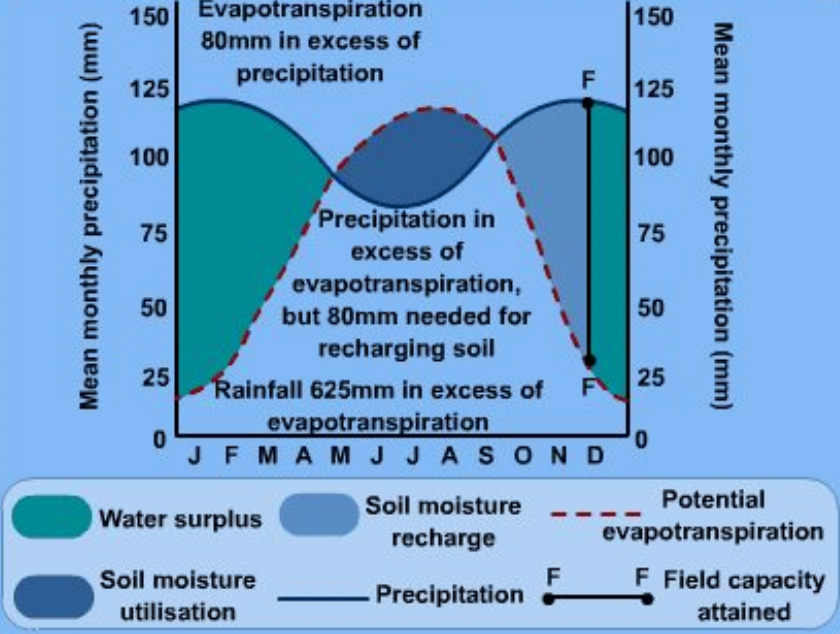
What is the soil water budget?
what is it dependent on?
shows the annual balance between inputs and outputs and their impact on soil water storage/availability. each year is different
dependent on many factors
type, depth and permeability of soil and bedrock.
ammount of rainfall in previous year
vegitation cover etc
What is the seasonal variation of the soil budget?
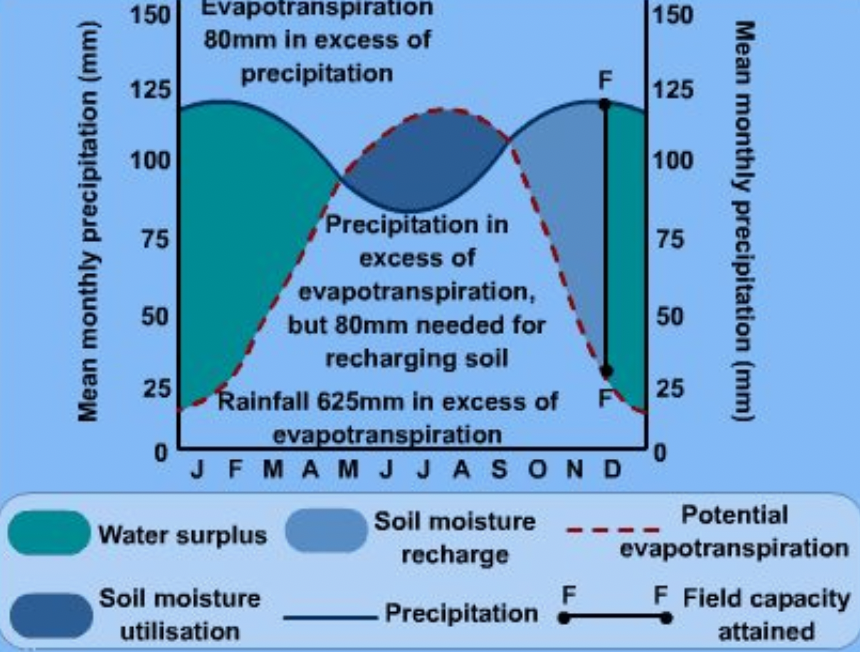
autumn - - soil moisture recharge input (precip) > output (evapotranspiration), deciduous trees lose their leaves and lower temp = less photosynthesis
winter - soil moisture recharge/surplus potential evapotranspiration reaches minimum due to temp. precip (infiltration and percolation) refill the water table
spring - feb/march soil moisture surplus plants start to grow again and potential evapotrans increases as temp gets higher and plants start photosynthesising.
summer - hotter weather leads to utilisation of soil water as evapotranspiration and rainfall is minimum. outputs are greater than inputs so soil water starts depleting. soil water deficit may occur if there is long summer and spring and less winter rainfall or drought in previous year.
the cycle then repeats
What are the percentages of water distribution in the global water cycle?
there are many stores
largest is oceans - 97% of global water
freshwater - 2.5%
glaciers and ice caps/sheets
groundwater
surface and other freshwater such as permafrost, lakes, swamps, rivers and living organisms
the rest is other saline water
what 4 areas can water in the global WC be stored in?
lithosphere
hydrosphere
cryosphere
atmosphere
What are aquifers?
underground water stores
unevenly distributed on a global scale
How long do various stored globally hold water?
aquifers =100s to thousand of years based on depth
glaciers = 20-100 years
lakes = 50-100 years
soil = 1-2 months
what is the main determining factor of cloud formation and rainfall?
global atmospheric circulation model
explain the global atmospheric circulation model
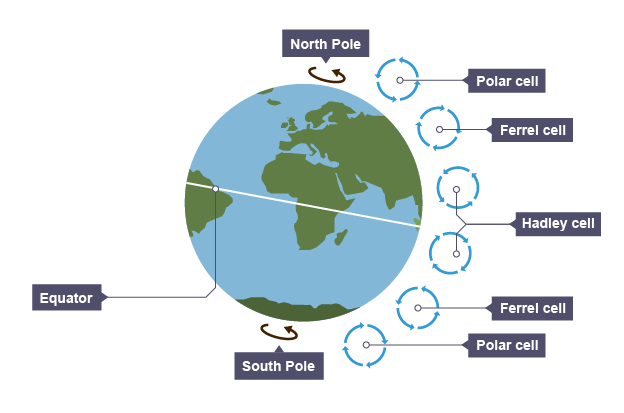
driven by the equator, ‘hottest part of the Earth where air rises, leading to low pressure and rainfall.
air reaches the edge of the atmosphere, it cannot go any further and so it travels north/south.
air becomes colder and denser, and falls, creating high pressure and dry conditions at around 30° north and south of the equator. (tropics of cancer and capricorn)
Air rises again at around 60° and descends again around 90°
cells alternate in direction due to the coriolis effect
explain the Hadely cell in global atmospheric circulation…
The first cell from the equator.
when air from the equator reaches the atmosphere:
air starts to move both north/south towards the poles.
at about 30° north/south, air cools and sinks forming the subtropical high-pressure zone.
air becomes warmer and drier. This creates an area of little cloud and low rainfall, where deserts are found.
The air completes the cycle and flows back towards the equator as the trade winds.
explain the feral cell in global atmospheric circulation…
occurs between 30º and 60º N/S
Air on the surface pulled towards the poles, forming the warm winds.
These winds pick up moisture as they travel over the oceans. At around 60 degrees N/S, meet cold air, which has drifted from the poles.
warmer air from the tropics is lighter than dense, cold polar air, so rises
This uplift of air causes low pressure at the surface and the unstable weather conditions that are associated with the mid-latitude depressions. Much of our wet and windy weather in the UK is determined by this.
explain the polar cell in global atmospheric circulation…
At poles, air is cooled and sinks towards the ground forming high pressure, known as the Polar high.
then flows towards the lower latitudes. At about 60 degrees N and S, the cold polar air mixes with warmer tropical air and rises upwards.
The boundary between the warm and cold air is called the polar front.
What is the ITCZ?
low pressure zone on the equator which has heavy rainfall - associated with monsoons.
zone moved in the seasons to the north and south due to movement of the sun
What are 5 natural processes that cause change in the water cycle at a global scale?
seasonal changes
storm events
droughts
El Nino and La Nina
Cryospheric processes
combination of both natural and human activity cause greatest changes to the WC
How may seasonal changes cause change in the water cycle at a global scale?
winter
reduced flows of water due to water stored as ice
reduced interception due to trees losing leaves and reduced photosynthesis
summer
less precipitation and more evapotranspiration due to higher temp and trees having leaves
How may storm events cause change in the water cycle at a global scale?
cause sudden increase increase in rainfall, leading to recharge and flooding (usually temporary changes)
How may droughts cause change in the water cycle at a global scale?
cause depletion of major stores to deplete and flows decrease
may be long term as they become more common due to climate change
What is el nino and its effects on the global WC?
weakening or reversal of the typical trade winds, warm surface waters of the pacific Ocean.
causes changes to weather patterns increasing rainfall in some areas (eg south america) and drought in others (eg australia).
occurs every 2-7 years
will likely increase in probability due to climate change
What is la nina and its effects on the global WC?
The counterpart of el nino occurring every 2-7years having the opposite effects of el nino
will likely increase in probability due to climate change
How may cryospheric processes cause change in the water cycle at a global scale?
reservoir for freshwater.This stored water is released gradually into the water cycle through processes such as melting, sublimation, and runoff.
due to global warming almost all worlds glaciers are shrinking. if all melted sea level would rise almost 60m
positive feedback loop as warming climate melts ice the albedo effect it altered exposing darker surfaced and increasing radiation absorbed, leading to warming of the earth
what are 3 human impacts on the global water cycle?
farming practices →
ploughing breaks up surface, increasing infiltration
crops can increase intercept and evapotransp
animal faming compacts soil reducing infiltration and increasing runoff
irrigation removes water from local rivers decreasing flow
land use change →
deforestation decreases interception and evapotrans, however increases infiltration
construction reduced infiltration and increases runoff
water abstraction →
reduced volume of water in surface stores as water taken from aquifers to meet human water demands if often less than input into them, depleting water stores
what are flood hydrographs?
graph to show how a drainage basin responds to a rainfall/storm event
what are the 6 key components of a flood hydrograph?
discharge = volume of water passing through the cross section of a river at any one point, measured in cumecs (cubic meters) and made up of baseflow and stormflow
falling limb = represents discharge decreasing
rising limb = represents discharge increasing
lag time = time between peak rainfall and peak discharge
baseflow = level of groundwater flow
bankfull discharge = maximum capacity of river
What are flashy and subdued hydrographs?
flashy = short lag time and high peak discharge (often a storm event)
subdued = long lag time and low peak discharge
What are the characteristics if a flashy hydrograph?
short lag time
high peak discharge
steep rising and falling limbs
higher flood risk
What are the characteristics if a subdued hydrograph?
long lag time
low peak discharge
shallow rising and falling limbs
lower flood risk
What natural factors can contribute to a flashy hydrograph?
high rainfall intensity - higher discharge potential, soil reaches field capacity, decreases lag time
small/circular basin - rain reaches central river quicker, reducing lag time
impermeable underlying geology - less percolation and more throughflow
antecedent rainfall - rainfall day before meaning ground is saturated
precipitation type - hail/snow melts slower increasing lag time
vegetation cover - interception
What human factors can contribute to a flashy hydrograph?
urbanisation
deforestation
agriculture
What are 5 transferes in the carbon cycle at a local scale?
photosynthesis
respiration
combustion
decomposition
carbon sequestration
explain the process of photosynthesis in the carbon cycle…
living organisms (photoautotroughs) covert CO2 and water into oxygen and glucose, using energy from light
occurs when chlorophyll in leaves of the plant react with co2
during day plants absorb more co2 than they emit but at night photosynthesis stops and they respire
overall they absorb more co2 than they emit so they are net co2 absorbers and net oxygen producers
what is the formula for phtosynthesis?
co2 + water → light energy → oxygen + glucose
explain the process of respiration in the carbon cycle…
occurs when plants and animals covert oxygen and glucose into energy, leaving the waste products of CO2 and water.
therefor it is chemically opposite to photosynthesis
oxygen + glucose → water + CO2
explain the processes of decomposition and combustion in the carbon cycle…
combustion - when fossil fuels/organic matter are burned, they emit the CO2 that was locked inside them
decomposition - dead living organisms are broken down by decomposers (eg bacteria and detritivores) which respire returning the CO2 to the atmosphere. Some matter is also returned to the soil increasing carbon matter in it.
Explain the processes of weathering and erosion in the carbon cycle…
carbonation weathering →
occurs when CO2 in air mixes with rainwater creating carbonic acid, which aids erosion of rocks such as limestone.
carbon then moves through WC into the oceans
marine organisms use carbon in water to build their shells
explain the process of diffusion in the carbon cycle…
the oceans absorb CO2 from the atmosphere which has increased ocean acidity by 30% since pre industrial times causing coral bleaching etc
explain the process of burial and compaction in the carbon cycle…
when shelled marine organisms die they fall to the sea floor and are compacted to create limestone
organic matter from vegitation and decaying marine organisms is also compacted to create fossil fuel deposits
explain the process of carbon sequestration in the carbon cycle…
transfer of crabon from the atmosphere to others stores in both natural and artificial ways.
plants sequester carbon in photosynthesis and store carbon in it’s mass
factories are also using carbon sequestrationin the from of carbon capture and storage (CCS). CO2 is captured and transported via pipeline to depleated gas fields and saline aquifiers.
What are the advantages and disadvantages of human carbon sequestration?
advant
can be fitted into existing power stations
captures 90% of CO2 produced
CO2 in demand by coca-cola, beer, plant growth etc so pipelines of liquid CO2 already exist
potental to capture half the worlds emissions
disadvant
high cost
incraeses in energy demand of power stations
may not be space/money to fit theminto existing power stations
poses potential environmental risks such as leakage or seepage into groundwater or the atmosphere.
what is a sere?
each phase of an ecosystem succession
carbon cycle occurs here at a local scale (eg drainage basin in the WC)
can reate to specific enviroments
vegetation sucession occurs when a plant community develops and becomes more complex over time.
define an ecosystem sucession and a lithosere sucession…
the changing phases of dominant plant species occupying a particular climatic habitat or ecosystem.
e.g. at the end of the last ice advance as the ice sheets melted and bare landscape was revealed, it did not take long for plants to start to colonise the exposed glacial till and rock surfaces.
lithosere sucession is a form of ecosystem succession involving the transformation of bare rock into rich habitats
explain how the carbon cycle functions on a lithosere environment →
The primary source of carbon = atmospheric CO2 absorbed by primary colonizers that are capable of photosynthesis, they grow and spread, they begin to contribute to rock weathering processes. breakdown of rock releases carbon
decomposers = bacteria and fungi recycle nutrients, including carbon.
ecosystem matures, organic matter accumulates. including dead plant material and other organic debris Carbon becomes sequestered within this organic matter. (humus etc) later turning into soil and storing more carbon
Vegetative Succession: more complex plant species such as shrubs and trees begin to colonize the area. further carbon sequestration through photosynthesis
what is the climatic climax in a sere?
the final stage of a sere where the environment reaches dynamic equilibrium and any changes will be counterbalanced by feedback loops (eg in a lithosere, climatic climax is when plant sucession no longer progresses)
What are 4 different seres and their relative environments?
different surfaces give rise to different types of sucession:
lithosere = bare rock
halosere = salty environment
psammosere = sand coastal environement
hydrosere = freshwater environment
What are carbon sinks and carbon sources?
carbon sink is any store of carbon that takes in more rabon than it emits (eg tropical rainforests)
carbon sources are stores of carbon that emit more than they take in (eg dammaged tropical rainforests)
what are the two primary sources of carbon emmisions since 1750 (fuels) (-2012)?
coal = 673Gt (giggatonnes)
oil = 496 Gt
What are the 6 main stores of global carbon in order of magnitude?
marine sediments and sedimentary rocks - lithosphere
rock cycle and continental drift recycle the rock over time long-term store by variable
oceans - hydrosphere
- carbon constantly being utilised so variable in duration of store
fossil fuel deposits - lithosphere
- used to be rarely changing over time but due to technology to exploit them they are now variable
soil organic matter - lithosphere
- can store carbon for 100s of years, but changes in lang use, (eg deforestation, agriculture) are changing the store so is mid-term.
atmosphere
- human activity has caused a 40% increase in atmospheric CO2 since industrial revolution so variable in duration
terrestrial plants - biosphere
- vulnerable to climate change and deforestation so forest carbon storage in declining fast so is mid-term store but very variable
what sphere holds the most carbon?
lithosphere
what is the pattern of change in carbon storage in trees globally?
forests are declining in tropical areas (south hemisphere) and growing in the northern hemisphere. this is supported by evidence showing …
tropical areas in brazil and indonesia have decreased in carbon stocks in past 25 years
russia, USA and China have seen increases
what are some ways that forests are changing in carbon storage?
non-tropical forests in europe and estern asia increased carbon sequestration due to plantation and conversion of agricultural land
rate of deforestation has decreased from 9.5 million hectares in 1990s to 5.5 per year as of 2015
brazil has most carbon stored on land and most forested areas
China has the largest proportion of afforested area
what is the NPP
net primary produtivity - the amount of carbon absorbed by forests
can be nehative or positive depending on the proportion of carbon absorbs to carbon released
What natural processes can cause changes to the carbon cycle over time?
wildfires
volcanic activity
permafrost thawing
How can wildfires cause changes to the carbon cycle over time?
transfer carbon to the biosphere in the form of CO2. this is released from the burning of organic matter (combustion)
initaially can cause huge loss of vegetation ( loss of photosynthesis)
can encourage the growth of plants in the long term (due to dead plants providing nutrients to the soil), increasing photosynthesis and carbon sequestration
altercations of the ecosystems carbon cycle may occur if they are unable to recover fully from the effects of the fire.
How can volcanic activity cause changes to the carbon cycle over time?
carbon stored in the earth is released into the atmosphere as CO2 gas.
generally the impacts on the cycle are minimal
in some eruptions can create gas cloud that can block out the sun, temporarily preventing photosynthesis.
increases in fertility of land due to ash after the events
How can cryospheric processes cause changes to the carbon cycle over time?
cryosphere stores large amounts of organic carbon in the form of frozen organic matter within permafrost and glacial ice.
When these frozen environments thaw, the organic matter decomposes, releasing carbon dioxide and methane (CH4) into the atmosphere.
This can lead to a positive feedback loop where the release of greenhouse gases accelerates warming, further enhancing the thawing of frozen carbon stores
what are 3 human practices that can cause changes to the carbon cycle over time?
fossil fuel use
deforestation
farming practices
How can fossil fuel use lead to changes in the carbon cycle over time?
combustion transfers carbon to the atmosphere from a long-term sink
The extraction and use of fossil fuels often accompany deforestation for resource extraction and infrastructure development
human activity is causing unprecedented fluxes in the amount or carbon in the atmosphere as a result of fossil fuel use.
How can deforestation lead to changes in the carbon cycle over time?
Trees store carbon dioxide (CO2) through photosynthesis. stored carbon is released back into the atmosphere as CO2 through processes like decomposition and burning.
Forest soils also store significant amounts of carbon. Deforestation disrupts soil stability, leading to increased erosion and loss of organic matter.
Deforested land is often converted for agriculture, urban development, or other purposes. These land use changes can further impact the carbon cycle
How can farming practices lead to changes in the carbon cycle over time?
pastoral farming releases CO2 as animals respire, affecting the carbon cycle
ploughing can release carbon stored in the soil
farm machinery may produce CO2
what are fluxes in the carbon cycle?
changes in the magnitude of stores (varying in duration)
What is the carbon budget?
the balance between inputs and outputs in a store
What is the enhanced greenhouse effect?
the process that is currently causing global warming as abnormally high levels of greenhouse gasses are being produced by humans, trapping radiation and causing global warming
this all leads to climate change
what is the difference between the greenhouse effect and the enhanced greenhouse effect
the greenhouse effect is due to natural causes
the enhanced greenhouse effect is due to human causes
what is radiative forces
refers to the difference between incoming solar radiation absorbed by the earth and the energy radiated back into space
this has increased in recent years leading to more heat being trapped
CO2 contributes to around 65% of radiative forcing
summarise the results of increasing global temperatures on the carbon and water cycles…
increases in global temps are due to changes in the carbon cycle
this will impact the water cycle creating more evapotranspiration
summer storms more likely with less rainfall
increase in average rainfall in winter
what are some causes of enhanced greenhouse effect?
land use change + fertilisers
deforestation
urbanisation
How are land use change and fertilisers contributing to the enhanced greenhouse effect?
farming practices in the amazon have cause 70% of deforestation, for cattle ranching
cattle produce large amounts of methane
fertilisers are a significant source of greenhouse gasses, specifically the release of nitrous oxide (N2O), a potent greenhouse gas with a much higher global warming potential than carbon dioxide (CO2)
How is deforestation contributing to the enhanced greenhouse effect?
deforestation accounts for 20% of global greenhouse emissions, mainly due to land being interrupted and used for other purposes
slash and burn methods also release greenhouse gasses from combustion of organic material
reduction in carbon sink/sequestration
How is urbanisation contributing to the enhanced greenhouse effect?
replacing countryside with infrastructure means replacement of vegetation and soils
urban areas cover 2% of the world's land mass
but these areas account for 97% of human caused CO2 emissions
what are milankovitch cycles?
There are three cycles:
The angle of tilt on earth's axis changes over a cycle. This causes more or less sunlight to reach the ice caps at the poles.
Earth's orbit around the sun varies. this allows less sunlight to reach the earth at certain points in its orbit, cooling the climate.
sun, 'wobbles' slowly on its axis. This causes the amount of sunlight hitting the earth to vary.
cause the amount of sunlight hitting the earth to change in complex ways over long timescales.
What is the impact of global warming on carbon cycles in oceans?
warmer oceans results in more plankton
warm oceans store less CO2 (warmer water stores less) - means less effective as carbon sinks
What is a feedback loop?
types of chain reaction where one process leads to another process
What are 3 examples of positive feedback loops in the carbon cycle?
wildfires = more likely in hotter drier areas created by global warming, release CO2 into the atmosphere
ice = reflects radiation from the sun, warm temp increases melting, less radiated back, warmer temps, more melting
thawing permafrost = releases co2, creates global warming, increases melting
What are 3 examples of negative feedback loops in the carbon cycle?
increased photosynthesis = hotter temp increases photosynthesis, increasing carbon sequestration decreasing warming
greater carbon fertilisation = higher temps increase carbon fertilisation so they absorb more CO2
phytoplankton = more CO2 increased rate and amount of photosynthesis in phytoplankton. phytoplankton growth also increases with amount of CO2
What are some ways to mitigate climate change?
setting targets to reduce emissions
switching to renewable sources of energy
hydropower
solar
wind
carbon capture and storage
afforestation/selective logging
local scale awareness and actions
better home insulation
recycling
using energy more wisely
What is an example of global intervention into mitigating climate change?
paris climate deal (COP21)
aimed to limit climate temp to 2ºC above pre industrial levels
support for developing countries
public interaction and awareness
meet every 5 years to improve goals
What is an example of a national intervention into mitigating climate change?
climate change act 2008 UK
legally binding target for the UK t reduce GHG emissions by 80% of 1990 levels by 2050
created national carbon budgets and independent committee on climate change to help government and report progress
 Note
Note  Flashcards (40)