English - Vocab List 1
 Call Kai
 Learn
Learn Practice Test
 Spaced Repetition
 Match
Match Flashcards
 Knowt Play
1/85

There's no tags or description
Looks like no tags are added yet.
Name | Mastery | Learn | Test | Matching | Spaced | Call with Kai | Chat |
|---|
No analytics yet
Send a link to your students to track their progress
86 Terms
Alliteration
the occurrence of the same letter or sound at the beginning of adjacent or closely connected words
Assonance
the repetition of vowel sounds in words that are close together in a sentence or verse
ex: “The rain in Spain stays mainly in the plain”
Consonance
occurs when two words have the same consonant sound following different vowel sounds
ex: Peter Piper picked a peck of pickled peppers
Cacophony
the use of a combination of words with loud, harsh sounds
ex: “What this grim, ungainly, ghastly, gaunt, and ominous bird of yore”
Euphony
the combining of words to create a pleasing sound
ex: "So long as men can breathe, or eyes can see, / So long lives this, and this gives life to thee."
Onomatopoeia
using or creating words that imitate or name a sound
ex: “bam!”
Simile
a comparison between two things, usually using the words 'like' and 'as'
Metaphor
a figure of speech in which a word or phrase is applied to an object or action to which it is not literally applicable
Extended Metaphor
a metaphor that spans multiple sentences or paragraphs
ex: life is a highway vs. Life is a highway that takes us through green pastures, vast deserts, and rocky mountains
Hyperbole
exaggerated statements or claims not meant to be taken literally
ex: "mile-high ice cream cones"
Personification
the attribution of a personal nature or human characteristics to something nonhuman, or the representation of an abstract quality in human form
ex: the moon was crying
Synecdoche
a figure of speech in which a part is made to represent the whole or vice versa
ex: “wheels” = car
Metonymy
a word, name, or expression used as a substitute for something else with which it is closely associated
ex: crown = monarch/king
conceit
an extended metaphor where the writer sets up and embellishes a comparison between two things. is similar to other comparisons like simile or metaphor, but goes beyond them by establishing multiple points of comparison over an extended amount of writing
ex: “Coral is far more red than her lips' red; If snow be white, why then her breasts are dun; If hairs be wires, black wires grow on her head”
metaphysical conceit
compare physical, everyday imagery to that of abstract imagery
ex: “the union between two lovers to the two pointers of a compass”
Allusion
a reference to another literary work, a historical event, or even a philosophical idea
ex: “She had the feeling she had a golden ticket”
Apostrophe
a speech or address to a person who is not present or to a personified object
ex: "O Romeo, Romeo, wherefore art thou Romeo?"
Caesura
a poetic device in which there is a pause between a line of poetry
ex: In the following line from the prologue of Romeo and Juliet, the comma after "Verona" marks a ______: "In fair Verona, where we lay our scene."
Diction
the linguistic choices a writer makes to effectively convey an idea, a point of view, or tell a story
Didactic Poetry
Poetry that instructs, either in terms of morals or by providing knowledge of philosophy, religion, arts, science, or skills.
Lyric Poetry
expresses a person's state of mind or attitude
ex: "Go, lovely Rose —
Tell her that wastes her time and me,
That now she knows,
When I resemble her to thee (Edmund Waller, Go Lovely Rose)
Narrative Poetry
type of poetry that tells a story
ex: Edgar Allan Poe's "The Raven" is narrated by a grieving man who, over the course of 18 stanzas, describes his mysterious confrontation with a raven and his descent into despair
Elegy
a form of poetry in which the poet or speaker expresses grief, sadness, or loss
or
a poem of serious reflection, typically a lament for the dead
Dirge
A brief hymn or song of lamentation and grief; it was typically composed to be performed at a funeral
End-stopped line
would be a complete thought or phrase appearing on a single line
ex: “I drew thee to my Valentine”
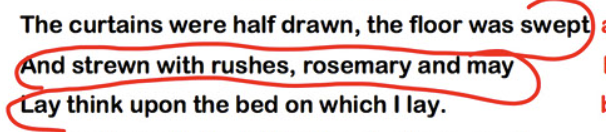
Enjambment
the continuation of a sentence or phrase from one line of poetry to the next
ex:
Meter
the rhythm (or pattern of beats) in a line of poetry
Imagery
Elements of a poem that invoke any of the five senses to create a set of mental images
ex: The air smelled salty, reminding me that the beach is nearby
Poetic Foot
(basic unit of measurement of a meter) repeated sequence of rhythm comprised of two or more stressed and/or unstressed syllables
iamb
a unit, usually of two syllables, containing an unstressed syllable followed by a stressed syllable
ex: deLAY or da DUM
Iambic
the pattern of a poetic line made up of iambs
ex: Shall I compare thee to a summer's day? shall I com-PARE thee TO a SUM-mer's DAY?
trochee
a two-syllable metrical pattern in poetry in which a stressed syllable is followed by an unstressed syllable
ex: Poet = PO-et
trochaic/trochaic meter
having a rhythm with one long or strong syllable and one short or weak syllable
or
a line of poetry composed of trochees
ex: "ONCE up-ON a MID-night DREA-ry, WHILE I PON-dered, WEAK and WEA-ry"
Anapest
a three-syllable metrical pattern in poetry in which two unstressed syllables are followed by a stressed syllable
ex: "understand" = un-der-STAND
anapestic
a metrical foot consisting of two unstressed syllables followed by one stressed syllable
dactyl
is an example of a poetic foot, which is a collection of syllables with a specific pattern of stress and unstress. is a three-syllable foot in which the pattern is one stressed syllable followed by two unstressed syllables.
ex: MEL-o-dy
dactylic
A metrical foot consisting of an accented syllable followed by two unaccented syllables
Pyrrhic
a metrical foot of two unaccented syllables
ex: TO A green thought
IN A green shade
Spondee
a two-syllable metrical pattern in poetry in which both syllables are stressed
ex: DOWN-TOWN
Spondaic
A metrical foot consisting of two accented syllables
ex: Break, break, break,
On thy cold grey stones, O Sea!
And I would that my tongue could utter
The thoughts that arise in me.
Refrain
a line, phrase, or single word that is repeated periodically within the poem to build up drama, emphasis, or rhythm
ex: Twinkle, Twinkle, little star
Repetition
repeating words, phrases, lines, or stanzas
Anaphora
a poetic technique in which successive phrases or lines begin with the same words
Rhythm
the recurrence of specific sounds based on long and short patterns of stressed and unstressed syllables
Scansion
visual cues to show which syllables are weak and which syllables are strong
Monometer
a line of verse consisting of a single metrical foot
ex: Thus I
Pass by,
And die:
As One,
Unknown
Dimeter
a line of verse consisting of two metrical feet
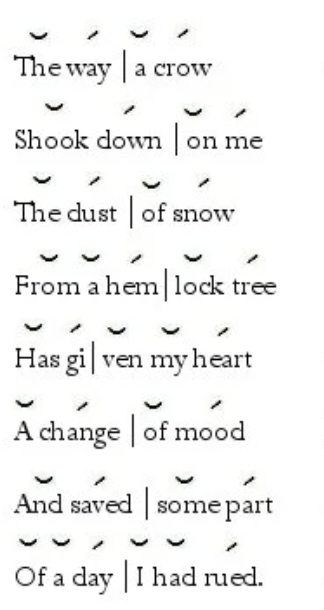
Trimeter
a meter of three metrical feet per line
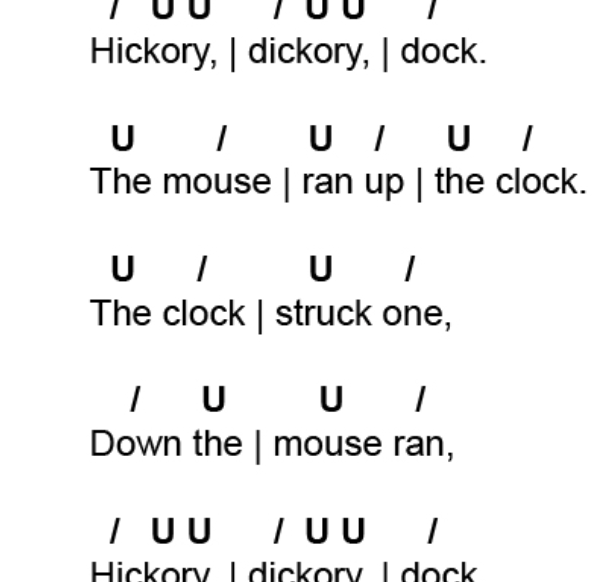
Tetrameter
line of poetic verse that consists of four metrical feet
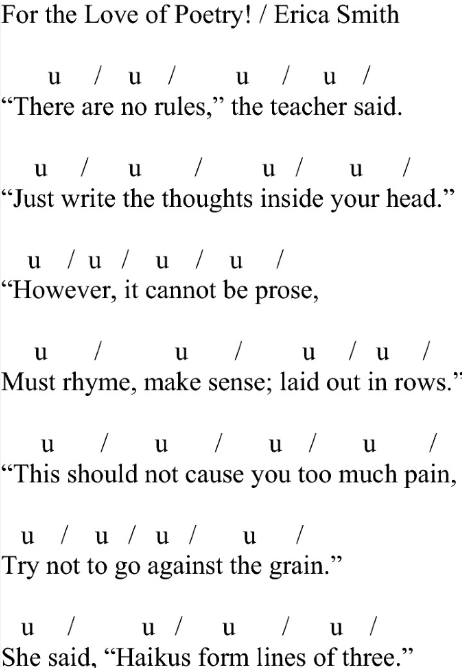
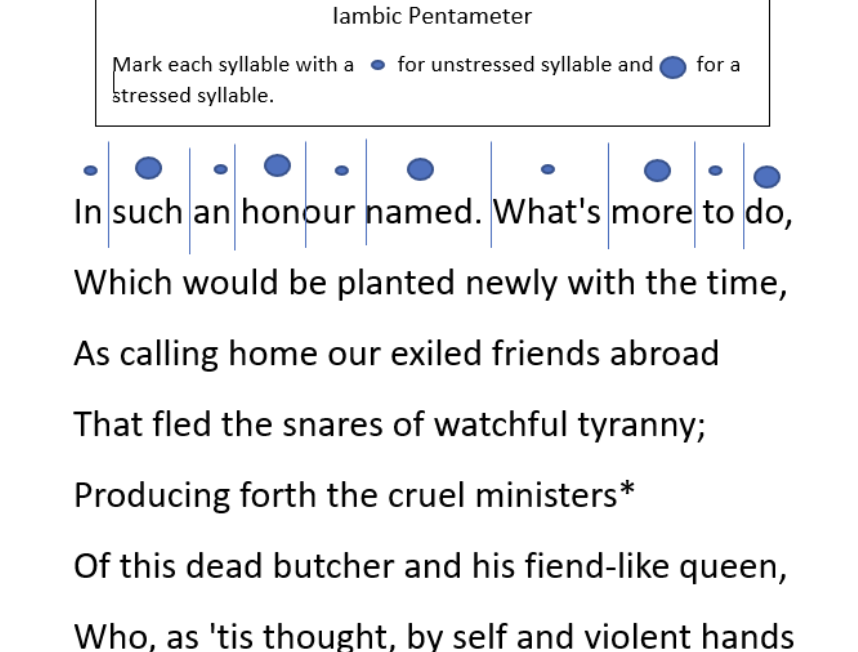
Pentameter
the repetition of a pattern of syllables five times in the same line
Hexameter
a metrical line of verses consisting of six feet
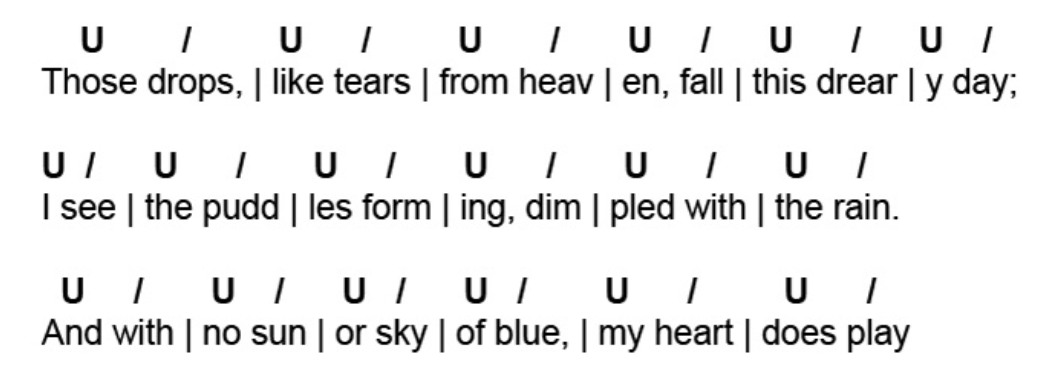
Heptameter
a type of meter where each line of verse contains seven metrical feet

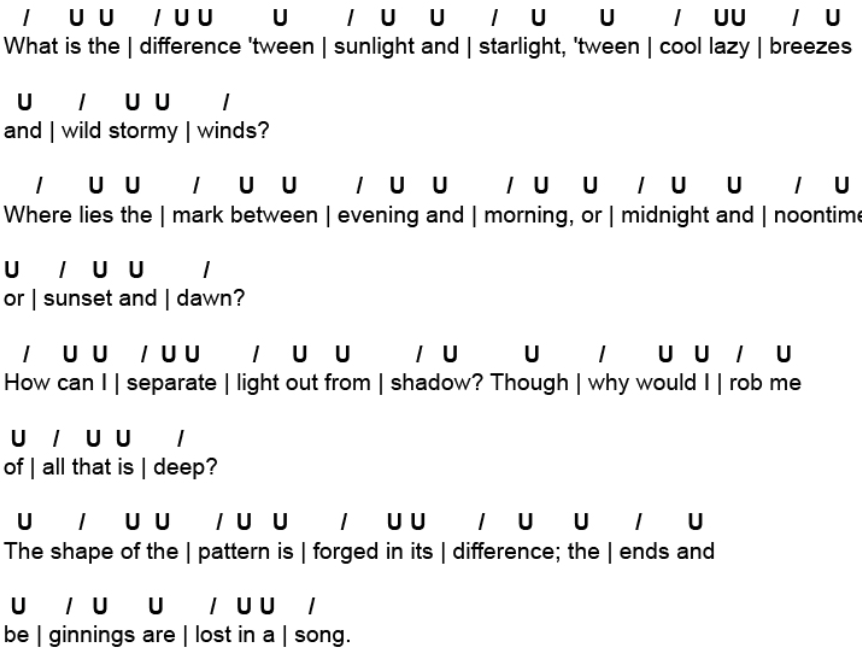
Octameter
a line of verse that contains sixteen syllables or eight metrical feet
Style
the way in which a writer writes. It takes into account literary devices like diction, tone, figurative language, and word choice and creates a 'voice' for the writer
Syntax
word order, tense, subject-verb agreement and even sentence length. The way words are put together in a sentence affect the tone and meaning of a piece of writing
Theme
the message an author wants to communicate through the piece
or
a universal idea, lesson, or message explored throughout a work of literature
Symbol
a person, object, place, event, or action that suggests more than its literal meaning
Tone
a literary device that conveys the author's attitude toward the subject, speaker, or audience of a poem
Irony
a situation in which there is a contrast between expectation and reality
ex: “I Wandered Lonely as a Cloud” by William Wordsworth – The speaker——— finds company in solitude through the vision of daffodils
Verbal Irony
when the literal meaning of what someone says is different from—and often opposite to—what they actually mean
ex: someone saying “Just what I needed”, after spilling coffee on their shirt
dramatic Irony
a literary and theatrical device in which the reader or audience knows more than the characters they are following
ex: In the classic myth of Oedipus, Oedipus leaves his family because it has been foretold that he will kill his father and marry his mother. Oedipus doesn't know, however, that he was adopted
sonnet
A 14-line poem with a variable rhyme scheme
or
it has fourteen lines of iambic pentameter linked by an intricate rhyme scheme
or
a poem of 14 lines that reflects upon a single issue or idea
(sonnets are associated with desire)
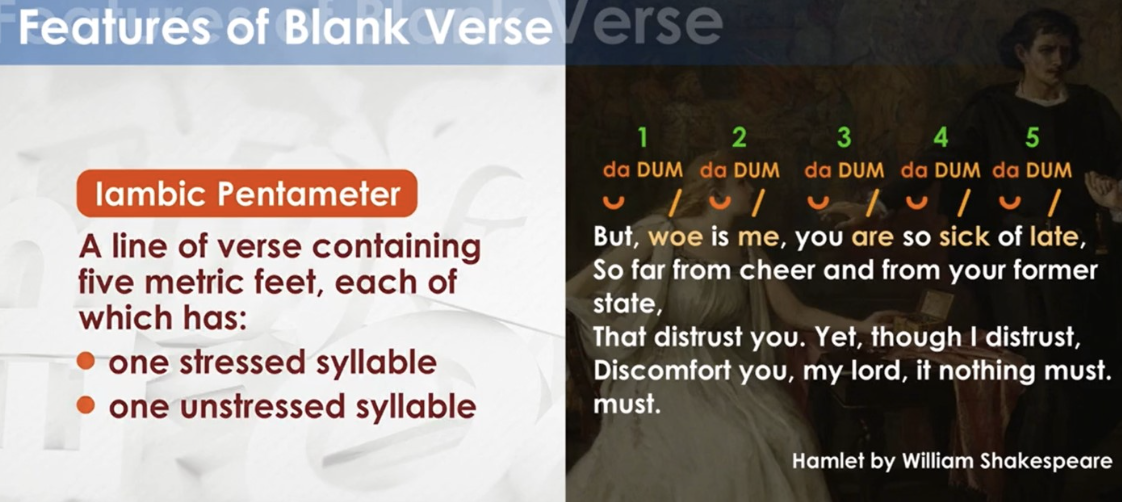
Blank Verse
poetry written in unrhymed but metered lines, almost always iambic pentameter
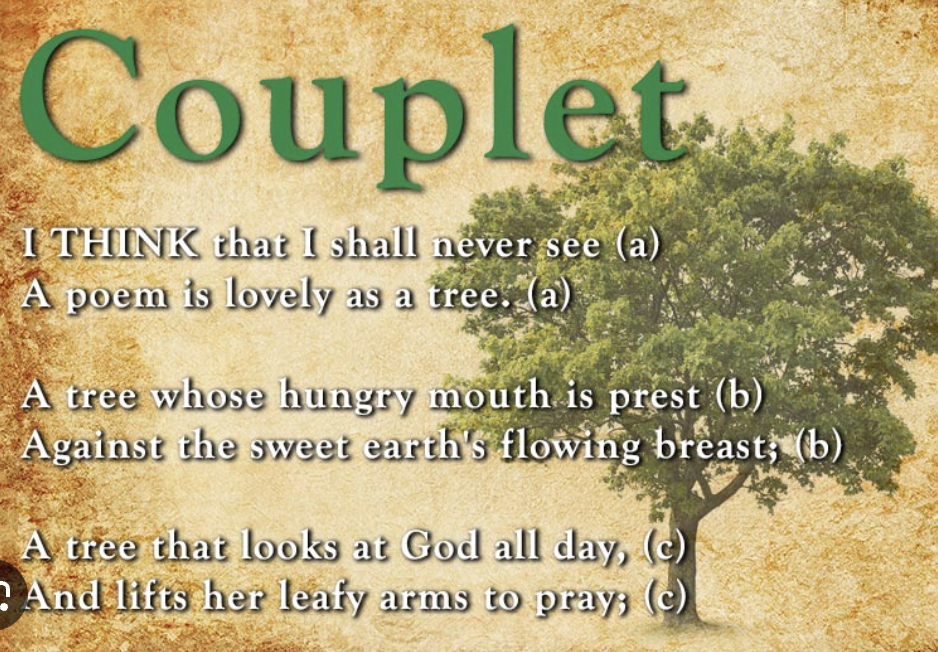
Couplet
a unit of poetry containing two lines of verse that form a singular thought or idea. can be rhymed or un-rhymed
heroic couplet
a rhyming couplet, or pair of lines with end rhymes in iambic pentameter, meaning there are five iambic 'feet' on each line.
is a specific type of couplet that discusses heroic themes and that usually uses iambic pentameter
octave
a verse form consisting of eight lines of iambic pentameter (in English) or of hendecasyllables (in Italian). The most common rhyme scheme for an _______ is ABBA ABBA
Sestet
six lines of poetry forming a stanza or complete poem
ex:
And was going to ask Wimpy if he had bought any spinach.
“M’love,” he intercepted, “the plains are decked out in thunder
Today, and it shall be as you wish.” He scratched
The part of his head under his hat. The apartment
Seemed to grow smaller. “But what if no pleasant
Inspiration plunge us now to the stars? For this is my country.”
Volta
is a rhetorical shift or dramatic change in thought and/or emotion
quatrain
is a four-line stanza of poetry. It can be a single four-line stanza, meaning that it is a stand-alone poem of four lines, or it can be a four-line stanza that makes up part of a longer poem
ryhme
the repetition of syllables, typically at the end of a verse line
end rhyme
rhymes that occur in the final words of lines of poetry
ex: "The ladies men admire, I've heard, / Would shudder at a wicked word."
Eye Rhyme
an imperfect rhyme in which two words are spelled similarly but pronounced differently
ex: move and love
Half rhyme
two words that have only their final consonant sounds and no preceding vowel or consonant sounds in common
ex: (such as stopped and wept, or parable and shell
feminine ryhme
a rhyme involving two syllables
ex: (as in motion and ocean or willow and billow)
masculine rhyme
When two words rhyme at the end of two lines of poetry, and when those words' final syllables are stressed. For instance, keep/deep
Internal Rhyme
a rhyme that occurs in the middle of lines of poetry, instead of at the ends of lines
ex: "I drove myself to the lake / and dove into the water."
Cadence
The patterning of rhythm in natural speech, or in poetry without a distinct meter
ex:
Understatement
the presentation of something as being smaller, worse, or less important than it actually is.
ex: "It seems to be raining a little," in the middle of a hurricane
Catalogue
verse that presents a list of people, objects, or abstract qualities
ex: Glory be to God for dappled things—
For skies of couple-colour as a brinded cow;
For rose-moles all in stipple upon trout that swim;
Fresh-firecoal chestnut-falls; finches’ wings;
Landscape plotted and pieced—fold, fallow, and plough;
And áll trádes, their gear and tackle and trim.
Aubade
A love poem or song welcoming or lamenting the arrival of the dawn
Blazon
catalogues the physical attributes of a subject, usually female
ex:
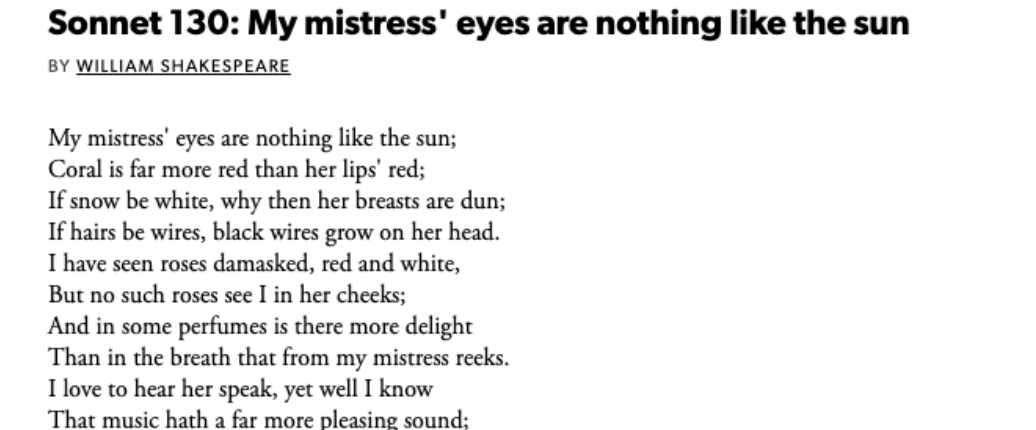
anti-blazon
relies on negations and negatives to describe the female, as William Shakespeare did, insisting his mistress' eyes were “nothing like the sun.”
Ode
A formal, often ceremonious lyric poem that addresses and often celebrates a person, place, thing, or idea
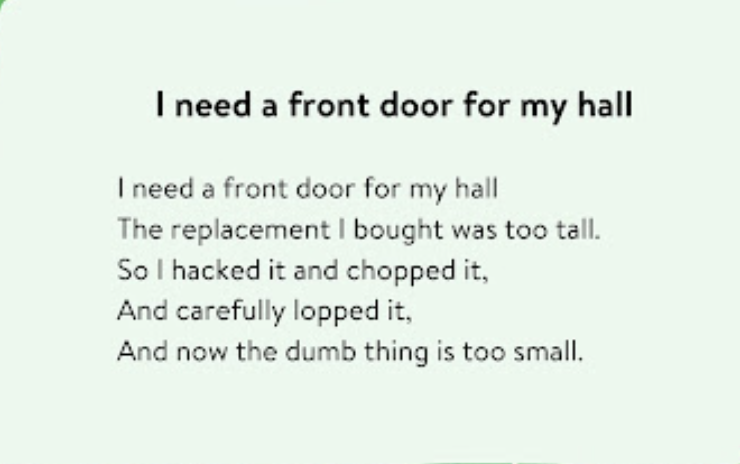
Limerick
closed-formed poem with a light and humorous subject matter
consists of five lines
the first four set up the joke
the final line delivers the punch line
Villanelle
a fixed-form poem consisting of five tercets and a quatrain and also follows a specific rhyme scheme using only two different sounds
or
A French verse form consisting of five three-line stanzas and a final quatrain, with the first and third lines of the first stanza repeating alternately in the following stanzas
ex: Do Not Go Gentle Into That Good Night
Dylan Thomas (1914-1953)
Do not go gentle into that good night,
Old age should burn and rave at close of day;
Rage, rage against the dying of the light.
Though wise men at their end know dark is right,
Because their words had forked no lightning they
Do not go gentle into that good night,
Ballad
a poem with a musical quality