Foundations of Psychology I Lecture 7 – Interpersonal relationships
 View linked note
 Call Kai
 Learn
Learn Practice Test
 Spaced Repetition
 Match
Match Flashcards
 Knowt Play
1/19

There's no tags or description
Looks like no tags are added yet.
Name | Mastery | Learn | Test | Matching | Spaced | Call with Kai |
|---|
No analytics yet
Send a link to your students to track their progress
20 Terms
Affiliation
The basic human need for companionship.
Conditioning: More pronounced under specific conditions (Schachter, 1959) - affiliation anxiety experiments highlighted this need.
Role of Companionship: Companionship is critical for emotional and psychological well-being.
Attachment Style
The patterns of attachment behavior that individuals exhibit in relationships, based on the relationship they ahd with their primary caregiver. Typically categorized into
secure
anxious
avoidant
disorganized
Internal Working Model (Bowlby, 1969)
The particular attachment style we learn as infants and young children becomes our working model or schema for what relationships are like.
Stages of Adult Attachment (Zeifman & Hazan, 2000)
Stages of Adult Attachment (Zeifman & Hazan, 2000)
Inspired by Bowlby’s Stages of Attachment Theory (Bowlby):
Preattachment Phase: Birth - 6 weeks
Indiscriminate Attachment Phase: 2 - 6 months
Discriminate Attachment Phase: starting from 7 or 8 months
Reciprocal Relationship Formation: 18 months onwards
(Zeifman and Hazan) Adult equivalents: attraction → flirting → falling in love → loving/long-term.
How relationships start: Proximity (Propinquity)
Propinquity effect – the finding that the more we see and interact with people, the mor eikely they are to become our friends
How relationships start - Exposure effect (reason behind propinquity effect)
The more exposure we have to something, the more we like it → the mere exposure effect is the reason behind the propinquity effect
How relationships start - Similarity
People tend to like those who are similar to themselves.
The More Similar opinions are to yours, the more you like the person (Newcomb, 1961)
Similar interpersonal style and communication skills (Burleson & Samter, 1996)
Similar interests/experiences
Similarity - Self-fulfilling prophecy and reciprocal liking
When we expect people to like us, we elicit more favorable behavior from them and show more to them.
How do relationships start - Physical Attractiveness (“What is beautiful is good” stereotype)
The stereotype that what is beautiful is good, leading to assumptions about a person's characteristics.
Attractive people are assumed to be:
Kinder
Warmer
More sociable
More sexually responsive
This stereotype appears as early as 6 years old (Dion & Dion, 1995).
Physical attractiveness - Self-fulfilling nature of ‘attractiveness’ (Snyder, Tanke & Berscheid, 1977)
People rated as attractive → treated warmly → behave warmly.
Same effect for men and women.
Types of Love - Passionate love
Love characterized by physical attraction and emotional highs, often marked by excitement and infatuation.
Intense longing
Thrilling
First experinced in adolescense
Often present in beginning of a romantic relationship
Roller-coaster of emotions
Type of love - Companionate love
A type of love characterized by deep affection, emotional intimacy, and strong attachment, often emphasizing companionship, trust, and a commitment to caring for one another.
Calm and stable
Applies to friendships and long term romantic partners
Charcaterised by Shared values & experiences
Deep sense of Trust
Most often present in couples that have been together for a long time
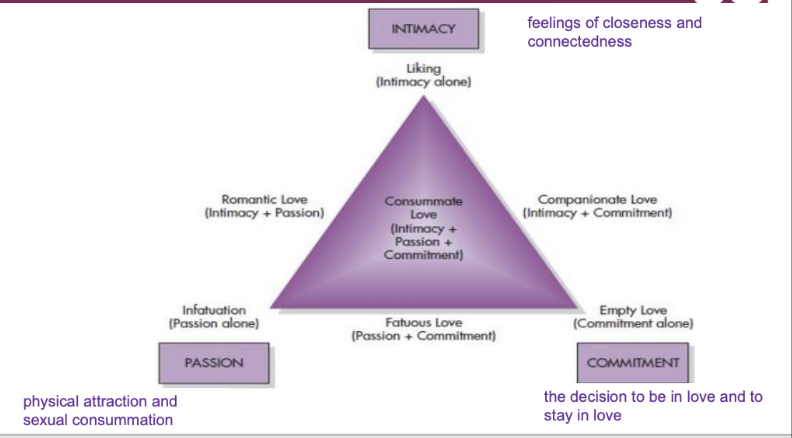
Types of love - Triangular Theory of Love (Sternberg, 1988)
Defines love using three components, creating seven subtypes.:
intimacy (closeness)
passion (sexual attraction)
commitment (decision to stay)
These create 7 subtypes:
Liking = intimacy only
Infatuation = passion only
Empty love = commitment only
Romantic love = intimacy + passion
Companionate love = intimacy + commitment
Fatuous love = passion + commitment
Consummate love = intimacy + passion + commitment
What makes people stay in relationships - Social Exchange Theory (Homans, 1974)
Theory which examines how individuals make choices by weighing the costs and benefits in relationships.
What makes people stay in relationships - Type of intimate relationship Clark & Mills (1979, 1993)
Communal — respond to need; don’t expect immediate return
Exchange — give/receive equally; expect reciprocation
Investment Model (Rusbult, 1983)
A model explaining that commitment depends on:
1) satisfaction
2) comparison level for alternatives (being with someone else etc)
3) investment size (what you’d lose by leaving)
Why relationships end - Three reasons relationships end (Duck, 2001)
Pre-existing doom — incompatible from start
Mechanical failure — two “good” people can’t make it work (most common)
Sudden death — betrayal, cheating -> immediate termination of relationship
How relationships end - Four Stages of Relationship Breakdown (Duck, 1982)
Intrapsychic phase — focuses internally on their partner's inadequacies and privately weighs the costs of the relationship“I can’t stand this anymore.”
Dyadic phase — confrontation; “We need to talk.”
Social phase — others get involved; “I mean it. Im planning to break up with him this time”
Grave-dressing phase — aftermath, rewriting story; “It’s inevitable.” or "We simply grew apart and wanted different things in life. It was a mutual and necessary decision for both of us to find happiness."
Experience of breaking up - Breakers vs Breakees (Akert, 1998)
Breakers (people who intitae the breakup) = less distress
Breakees (the person broken up with)= most distress
Mutual = intermediate distress
Gottman's Four Horsemen of the Apocalypse
Communication styles that are highly predictive of a failing relationships when present and persistent:
1. Criticism; e.g. You never think about how I feel, you always just do whatever you want to
2. Contempt; e.g. You’re the laziest person I’ve ever met
3. Defensiveness; e.g. You know how busy I’ve been. Why didn’t you just call the restaurant yourself instead of expecting me to do it
4. Stonewalling. e.g. I’m just too busy to talk about this right now