Co-evolution: The evolutionary arms race - Topic 10 (part 2)
 Call Kai
 Learn
Learn Practice Test
 Spaced Repetition
 Match
Match Flashcards
 Knowt Play
1/36

There's no tags or description
Looks like no tags are added yet.
Name | Mastery | Learn | Test | Matching | Spaced | Call with Kai |
|---|
No analytics yet
Send a link to your students to track their progress
37 Terms
Co-evolution
RECIPROCAL evolutionary change in two or more species driven by their INTERACTIONS; each species acts as a SELECTIVE PRESSURE on the other
Co-evolution
If one species evolves a new trait, the interacting species faces new WHAT, which leads to ongoing, coupled WHAT change
WHAT selection
Not WHAT: driven by WHAT
Co-evolution
If one species evolves a new trait, the interacting species faces new SELECTIVE PRESSURES, which leads to ongoing, coupled EVOLUTIONARY change
RECIPROCAL selection
Not RANDOM: driven by SPECIFIC INTERACTIONS
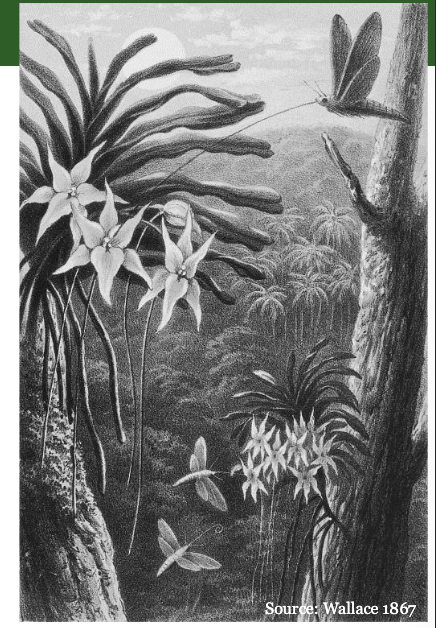
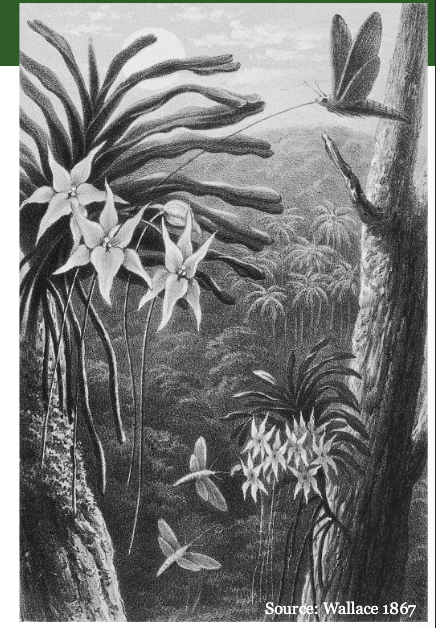
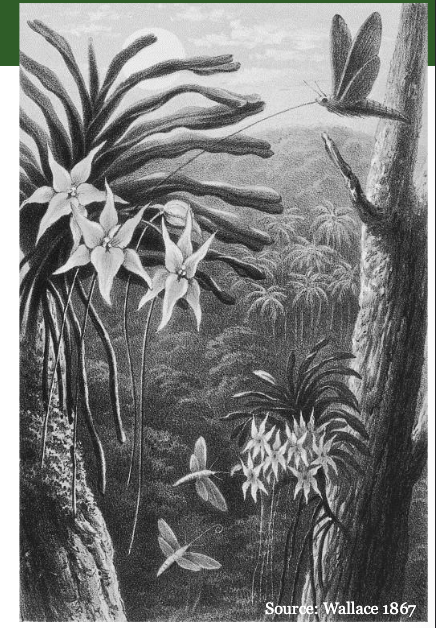
Example: Flower shape evolves to match pollinator mouthparts
Reciprocal selection
Each species selects for TRAITS in the other
Evolutionary arms Race
Cycle of CO-EVOLUTIONARY escalation; one species improves OFFENCE, other improves DEFENCE, repeat indefinitely
Red queen hypothesis
Organisms must keep evolving just to maintain FITNESS relative to co-evolving partners

Arms race and red queen
Arms races create escalating WHAT
WHAT based (WHAT)
Arms races cannot escalate HWAT; WHAT and WHAT often stabilize traits
Arms race and red queen
Arms races create escalating ADAPTATIONS
GENETICS-based (EVOLUTION)
Arms races cannot escalate INDEFINITELY; TRADE-OFFS and COSTS often stabilize traits
Predator-prey co-evolution
Predator strategies:
WHAT and agility (cheetahs, peregrine falcon)
Camouflage (polar bears)
WHAT hunting (wolves, orcas)
Stealth and ambush (lynx)
WHAT specialization (sight, smell)
Predator-prey co-evolution
Predator strategies:
SPEED and agility (cheetahs, peregrine falcon)
Camouflage (polar bears)
COOPERATIVE hunting (wolves, orcas)
Stealth and ambush (lynx)
SENSORY specialization (sight, smell)
Predator-prey co-evolution
Prey strategies:
Speed and escape behaviours
WHAT (stick insects, flounder)
Armour (turtle shells, pangolin scales)
Group vigilance, defense, coordinated escape, and visual confusion (stripes)
WHAT and warning defences
Predator-prey co-evolution
Prey strategies:
Speed and escape behaviours
CAMOUFLAGE (stick insects, flounder)
Armour (turtle shells, pangolin scales)
Group vigilance, defense, coordinated escape, and visual confusion (stripes)
CHEMICALS and warning defences
Arms races don’t always escalate indefinitely; WHAT and WHAT often stabilize traits
Arms races don’t always escalate indefinitely; TRADE-OFFS and COSTS often stabilize traits
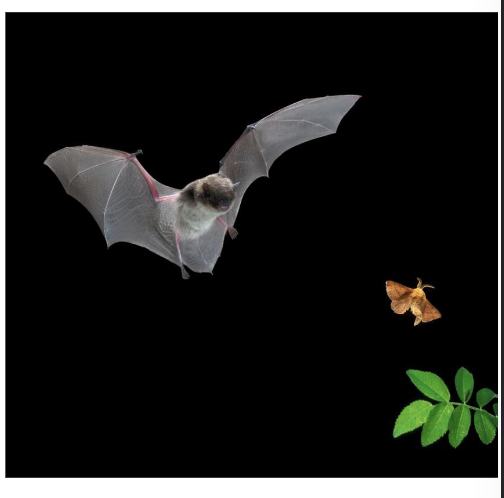
Predator-prey Co-evolution: Bats and moths
Bat Adaptations:
Echolocation to detect prey at night
Highly maneuverable flight
Moth Counter-adaptations
Ultrasonic ears tuned to bat calls
Escape dives and erratic flight when bat calls detected
Ultrasonic clicks that jam echolocation
Arms Race:
Bats evolve more precise WHAT
Moths evolve better WHAT and WHAT mechanisms
Predator-prey Co-evolution: Bats and moths
Bat Adaptations:
Echolocation to detect prey at night
Highly maneuverable flight
Moth Counter-adaptations
Ultrasonic ears tuned to bat calls
Escape dives and erratic flight when bat calls detected
Ultrasonic clicks that jam echolocation
Arms Race:
Bats evolve more precise ECHOLOCATION
Moths evolve better DETECTION and INTERFERENCE mechanisms
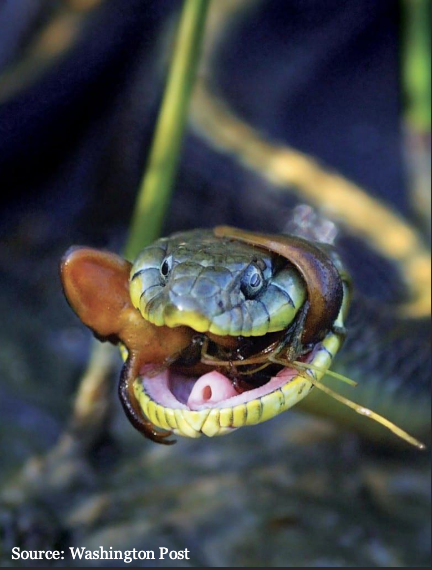
Predator-prey Co-evolution: Toxins and resistance
Rough skinned Newt defence:
Produce tetrodotoxin (TTX), one of the most potent natural toxins
Blocks sodium channels and causes paralysis or death
Garter Snake Counter-Adaptation
Genetic resistance to TTX
Modified Na+ channels allow consumption of toxic newts
Arms race:
Newts evolve higher WHAT levels
Snakes evolve greater toxin WHAT
Trade-offs constrain WHAT
Resistance reduces snake WHAT
Toxin production is energetically WHAT
Predator-prey Co-evolution: Toxins and resistance
Rough skinned Newt defence:
Produce tetrodotoxin (TTX), one of the most potent natural toxins
Blocks sodium channels and causes paralysis or death
Garter Snake Counter-Adaptation
Genetic resistance to TTX
Modified Na+ channels allow consumption of toxic newts
Arms race:
Newts evolve higher TOXIN levels
Snakes evolve greater toxin RESISTENCE
Trade-offs constrain ESCALATION
Resistance reduces snake SPEED
Toxin production is energetically COSTLY
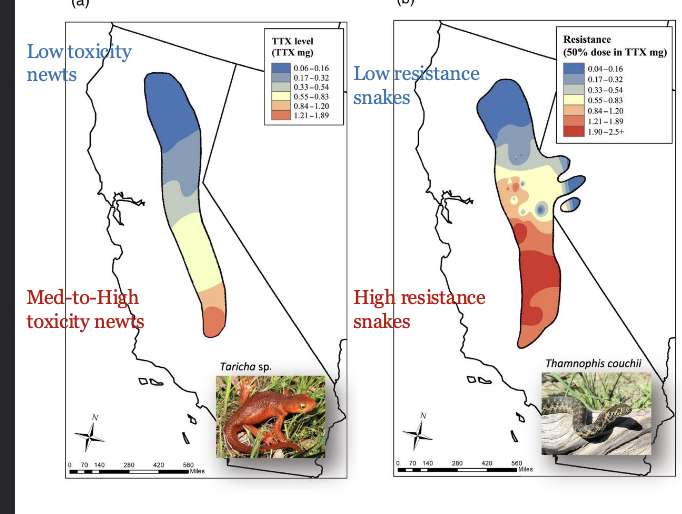
Predator-prey Co-evolution: Toxins and resistance
Newt toxicity and snake resistance both vary across the landscape
These traits WHAT each other geographically (high - high, low - low)
Suggests a WHAT evolutionary relationship across populations
Predator-prey Co-evolution: Toxins and resistance
Newt toxicity and snake resistance both vary across the landscape
These traits TRACK each other geographically (high - high, low - low)
Suggests a LINKED evolutionary relationship across populations
Visual Anti-Predatory Strategies
WHAT
WHAT
WHAT
WHAT
Visual Anti-Predatory Strategies
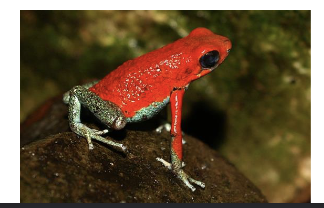
Crypsis
Aposematism
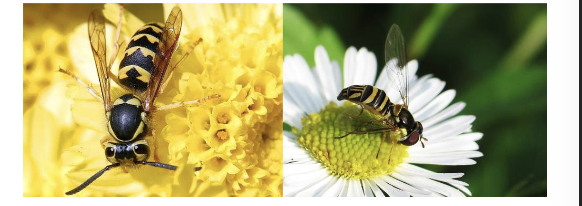
Batesian mimicry
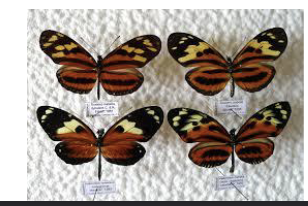
Müllerian mimicry
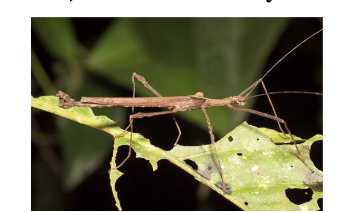
Crypsis
Avoiding detection by BLENDING into environments; reduce visibility
Aposematism
WARNING COLOURATION; bright colours signal “I am dangerous/toxic)
Batesian mimicry
A palatable species mimics the appearance of a TOXIC species
Müllerian
Two or more TOXIC species resemble each other; both BENEFIT
Herbivory Co-evolution
Herbivores evolve to WHAT, WHAT, and WHAT plant tissues
Plants are not passive or defenseless; they have evolved to WHAT, WHAT, or WHAT from herbivory
Interactions often involve WHAT, WHAT, and WHAT based strategies
Often drives specialization on narrow set of plants that a herbivore can tolerate
Herbivory Co-evolution
Herbivores evolve to LOCATE, CONSUME, and DIGEST plant tissues
Plants are not passive or defenseless; they have evolved to DETER, TOLERATE, or RECOVER from herbivory
Interactions often involve CHEMICAL, STRUCTURAL, and TIMING based strategies
Often drives specialization on narrow set of plants that a herbivore can tolerate
Common traits shaped by herbivory
Plant defence:
WHAT defenses (tannins)
Structural defenses (thorns)
WHAT defenses (after damage)
Timing/phenology
Mutualisms (attractive predators)
Common traits shaped by herbivory
Plant defence:
CHEMICAL defenses (tannins)
Structural defenses (thorns)
INDUCIBLE defenses (after damage)
Timing/phenology
Mutualisms (attractive predators)
Common traits shaped by herbivory
Herbivore counter-adaptations:
WHAT mechanisms
Behavioral strategies (selective feeding)
Morphological traits (dentition)
WHAT/sequestration (store toxins)
Timing shifts (when defenses are lower)
y herbivory
Herbivore counter-adaptations:
DETOXIFICATION mechanisms
Behavioral strategies (selective feeding)
Morphological traits (dentition)
TOLERANCE/sequestration (store toxins)
Timing shifts (when defenses are lower)
Herbivore-Plant Co-evolution: Milkweed and Monarchs
Milkweed Defenses
Produces toxic cardiac glycoside
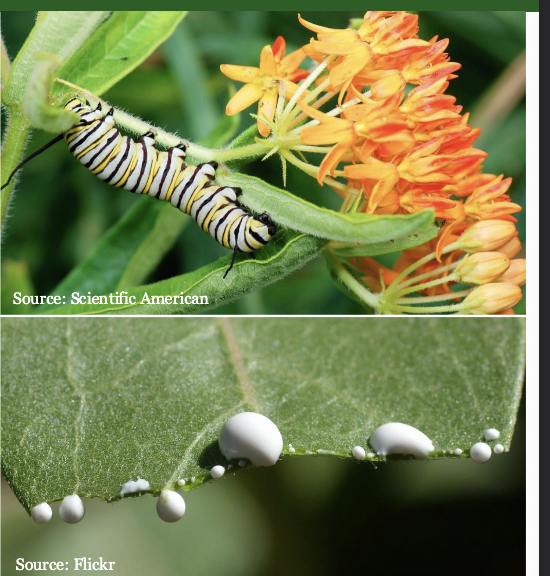
Sticky latex sap
Tough leaves and hairs
Monarch Counter-adaptations
Physiological resistance to cardenolides
Sequester toxins in their tissues, making their own bodies toxic to predators !!
Vein cutting drains latex before feeding
Co-evolution of extreme specialization:
Monarch caterpillars feed almost WHAT on milkweed and rely on WHAT to make them unpalatable to predators (trade-off?)
Herbivore-Plant Co-evolution: Milkweed and Monarchs
Milkweed Defenses
Produces toxic cardiac glycoside
Sticky latex sap
Tough leaves and hairs
Monarch Counter-adaptations
Physiological resistance to cardenolides
Sequester toxins in their tissues, making their own bodies toxic to predators !!
Vein cutting drains latex before feeding
Co-evolution of extreme specialization:
Monarch caterpillars feed almost EXCLUSIVELY on milkweed and rely on TOXINS to make them unpalatable to predators (trade-off?)
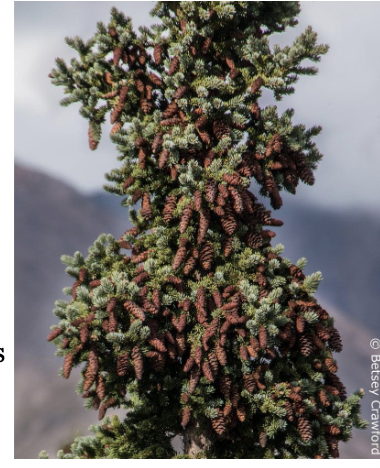
Herbivore-Plant Co-evolution: Masting Trees and Seed Eaters
Plants can evolve WHAT as an anti-predator defence; overwhelming or avoiding predators as opposed to repelling them
Herbivore-Plant Co-evolution: Masting Trees and Seed Eaters
Plants can evolve REPRODUCTIVE TIMING as an anti-predator defence; overwhelming or avoiding predators as opposed to repelling them
Herbivore-Plant Co-evolution: Masting Trees and Seed Eaters
Plant Strategy
Synchronize heavy seed production every 2–7 years
Overproduce = predator satiation
Excess seeds escape predation and germinate successfully
Low seed years keep predator populations small
Seed Predator Strategies
Increase reproduction in mast years
Cache seeds to survive lean years
Rapidly track mast events with population increases
Temporal arms race:
plants “WHAT” the system; consumers try to keep up; lean years WHAT the system
Herbivore-Plant Co-evolution: Masting Trees and Seed Eaters
Plant Strategy
Synchronize heavy seed production every 2–7 years
Overproduce = predator satiation
Excess seeds escape predation and germinate successfully
Low seed years keep predator populations small
Seed Predator Strategies
Increase reproduction in mast years
Cache seeds to survive lean years
Rapidly track mast events with population increases
Temporal arms race:
plants “FLOOD” the system; consumers try to keep up; lean years RESET the system
Parasite-Host Co-evolution
Parasites evolve to:
WHAT hosts
WHAT quickly
WHAT to new hosts
Hosts evolve to:
WHAT infection
Limit WHAT cause by parasites
Often involve immune response and physiological defences
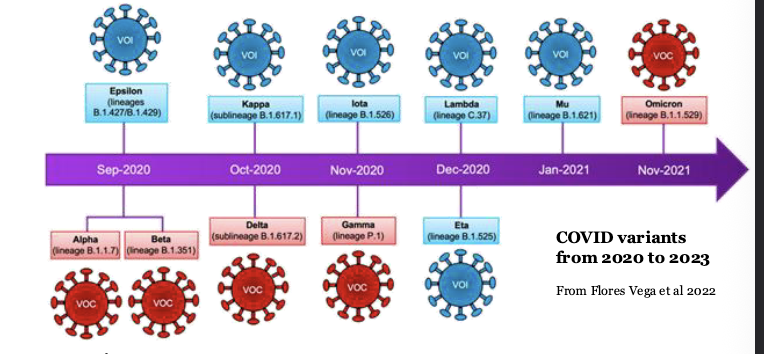
Show some of the WHAT evolutionary change in nature (SARS-CoV-2 variants)
Parasite-Host Co-evolution
Parasites evolve to:
INFECT hosts
REPLICATE quickly
TRANSMIT to new hosts
Hosts evolve to:
PREVENT infection
Limit DAMAGE cause by parasites
Often involve immune response and physiological defences
Show some of the FASTEST evolutionary change in nature (SARS-CoV-2 variants)
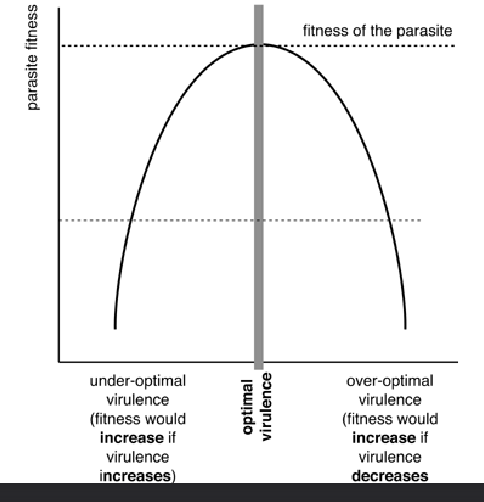
Virulence
The harm a parasite causes to its host
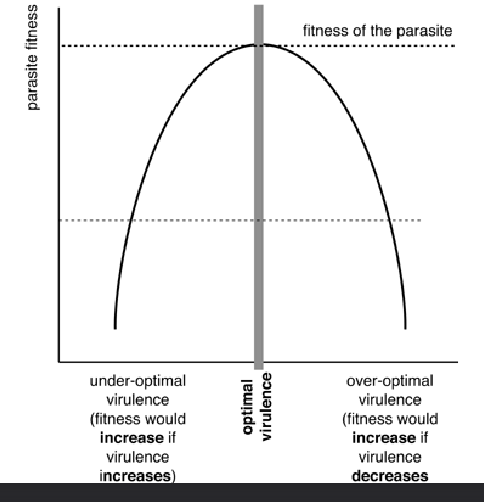
Three types of virulence
WHAT
WHAT
WHAT
Three types of virulence
Low virulence
High virulence
Optimal virulence
Low virulence
Host survives, but LOWER transmission rate
Low virulence example the common cold
WHAT virulence x WHAT shedding x WHAT duration = WHAT
Low virulence example the common cold
LOW virulence x LOW shedding x LONG duration = STEADY
High virulence
High transmission, but short infection window
High virulence example Ebola
WHAT virulence x WHAT shedding x WHAT duration = WHAT
High virulence example Ebola
HIGH virulence x HIGH shedding x SHORT duration (host dies quickly) = CONSTRAINED
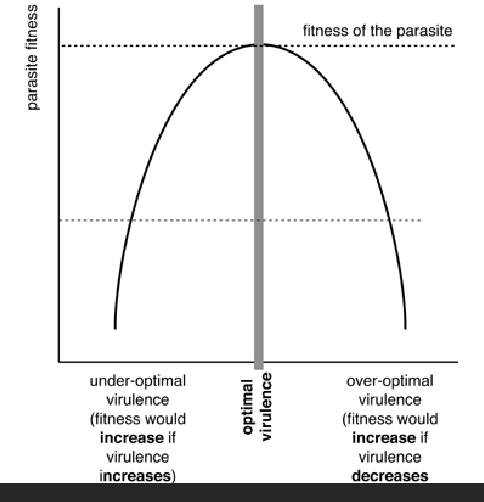
Optimal virulence
Intermediate; Maximizes transmission, not damage
Optimal virulence example Influenza
WHAT virulence x WHAT shedding x WHAT duration = WHAT
Optimal virulence example Influenza
MODERATE virulence x HIGH shedding x SHORTER duration = OPTIMAL
Myxoma Virus and Rabbits
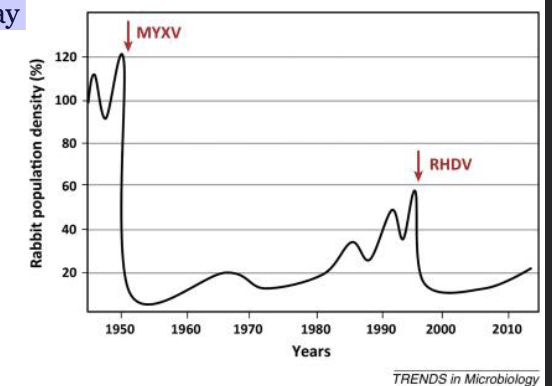
1950s: Myxoma virus (MYXV) introduced to kill invasive rabbits
• ~99% initial mortality
• Rabbits rapidly evolved partial WHAT (only ~60% mortality)
• Rabbits became abundant again
1995: Rabbit Hemorrhagic Disease Virus (RHDV) introduced
• New virus, different physiological pathway
• WHAT the host-parasite arms race
• High rabbit mortality returns
Ongoing arms race:
• Rabbits evolving resistance again
• Myxoma virus evolving higher virulence
• Continuous back-and-forth WHAT
Myxoma Virus and Rabbits
1950s: Myxoma virus (MYXV) introduced to kill invasive rabbits
• ~99% initial mortality
• Rabbits rapidly evolved partial RESISTANCE (only ~60% mortality)
• Rabbits became abundant again
1995: Rabbit Hemorrhagic Disease Virus (RHDV) introduced
• New virus, different physiological pathway
• RESET the host-parasite arms race
• High rabbit mortality returns
Ongoing arms race:
• Rabbits evolving resistance again
• Myxoma virus evolving higher virulence
• Continuous back-and-forth ADAPTATION
Myxoma Virus and Rabbits
Human interventions become part of the WHAT, often WHAT (rather than stopping) evolutionary dynamics.
Myxoma Virus and Rabbits
Human interventions become part of the SELECTIVE ENVIRONMENT, often RESHAPING (rather than stopping) evolutionary dynamics.
Energy spent on defence = energy not spent on WHAT or WHAT
Energy spent on defence = energy not spent on REPRODUCTION or GROWTH
eg, heavily armoured mussels grow slower than unarmoured
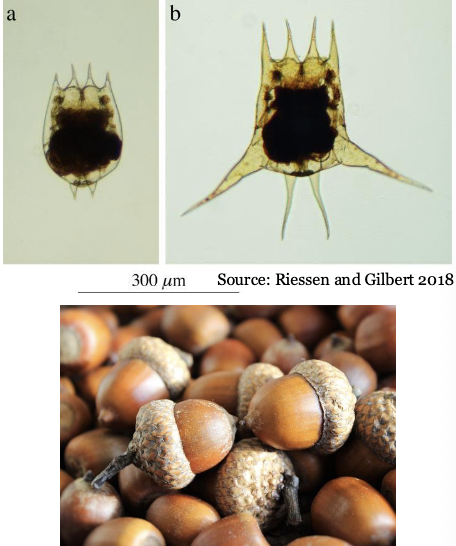
Context-dependent defence
Many species only produce defences when predator cues present to save energy
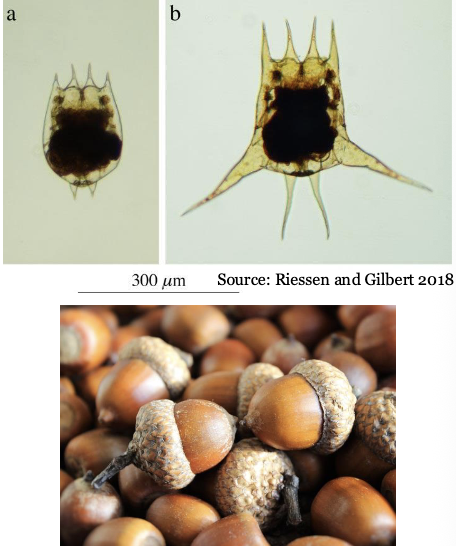
eg, plankton grow neck teeth and body spines when predators are detected
Optimal defence theory
Invest in protection of most VALUABLE/VULNERABLE tissues (young, reproductive structures, head, vital organs)