C1.2 Cell Respiration
 Call Kai
 Learn
Learn Practice Test
 Spaced Repetition
 Match
Match Flashcards
 Knowt Play
1/26

There's no tags or description
Looks like no tags are added yet.
Name | Mastery | Learn | Test | Matching | Spaced | Call with Kai |
|---|
No analytics yet
Send a link to your students to track their progress
27 Terms
ATP is
a nucleotide composed of adenine, ribose and three phosphate groups
ATP is required for:
active transport across membranes
synthesis of macromolecules by anabolism
movements of cells using flagellum or cillia
movemnt within the cells - chromosomes in mitosis or meiosis
endergonic reaction
requires energy
exergonic reaction
releases energy
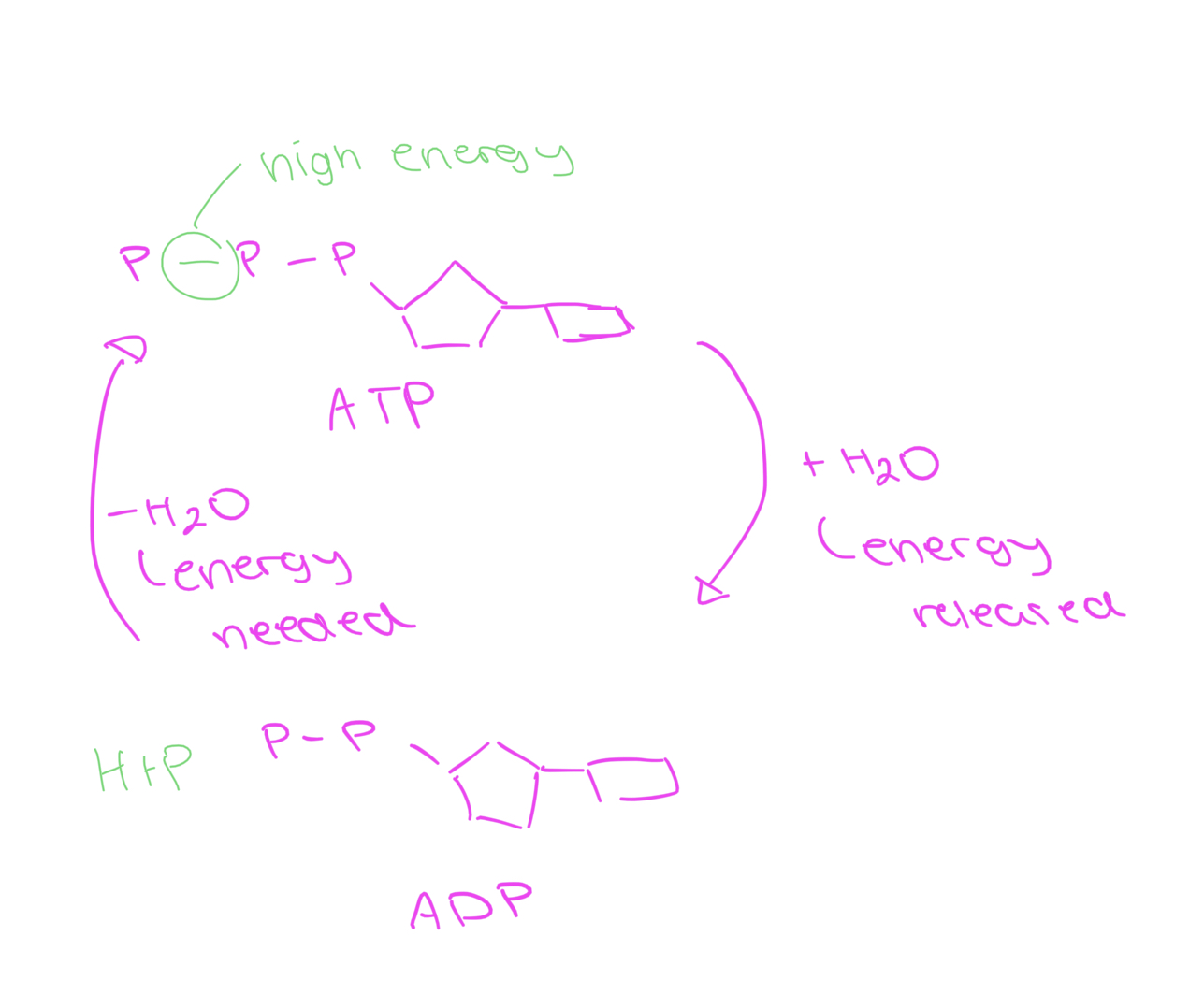
Why is ATP good as an energy source
phosphor is negatiely charged and repels itself hence the bonds are unstable with a low activation energy and high in energy
ATP and ADP cycle
What in the repisration equation is reduction and what is oxidation?
C6H12O6 + 6O2 → 6CO2 + 6H2O
oxygen → water = reduction
glucose → carbon dioxide = oxidation
How many ATP produced by anaerobic respiration
2 ATP
Equation for anaerobic repisration in humans
glucose → lactic acid
Equation for anaerobic respiration in yeast
glucose → CO2 and ethanol
where does anaerobic repisration take place
cytoplasm
Equation for aerobic respiration
C6H12O6 + O2 → 6CO2 + 6H20
Where does aerobic repisration take place
First cytoplasm (glycolisys) then mitochondria (Krebs, link reaction and electron transport chain)
What can be used for aerobic respiration
carbohydrates fatty acids or amino acids
What can be used for anaerobic respiration
Only carbohydrates
How much ATP produced by aerobic respiration
30-34
What measured aerobic respiration
respirometer
Rate of cell respiration is affected by
temprature
pH
tyep of cell
glucose concentration
oxygen concentration
carbon dioxide concentraion
Glycolysis steps
Phosporylation → ATP is split attaching two phsophate groups to the 6 carbom molecule which is unstable / loss of 2 ATP
Lysis - the unstable 6 carbon molecule lyses into two seperate 3 carbon molecules (triose phosphate)
TP becomes oxides while NAD is reduce to NADH - the energy released add two more phosphate groups to the 3 carbom molecules (not from ATP)
ATP formtaion - enzymes take the phosphate groups and attach them to ADP froming ATP leaving two pyruvates
Glycolysis net gain
2 ATP, 2 NADH, 2 pyruvates
Anaerobic repisration after glycolysis
If no oxygen is present → regeneration of NAD as pyruvate needs to be reduced to become lactic acid so NADH is oxides
Link reaction
After glycosylis pyruvate moves to matrix
Pyruvate becomes decarboxylated forming a 2 carbon acetyl group and release of carbon dioxide
Acetyl group is oxides and NAD reduced to NADH
Acetyl group combines with a coenzyme A forming acetyl CoA which can enter Krebs cycle
→ Since two pyruvates two Acetyl CoA produced
Krebs cycle
in the matrix
Acetyl CoA enters the cycle and attaches to oxaloacetate - releasing CoA and forming citrate (6C)
Citrate becomes decarboxylated giving of CO2 and becomes oxides while NAD reduced to NADH forming a 5 Carbon molecule
5C becomes decarboxylated giving of CO2 and its oxides and NAD reduced to NADH forming a 4 carbon molecule
ATP is produced
FAD reduced to FADH2
NAD reduced to NADH
oxaloacetate regenerated
This is repated as two acetyl coa
Krebs cycle net products
1 ATP, 1 FADH2, 3 NADH and 2 CO2
Electron transport chain
In the intermembrane space electron carriers are located
NADH and FADH become oxidised and pass their electrons onto the carriers
The electrons move along the chain releasing energy
The energy is used to transport hydorgen ions into the intermembrane space creating a proton gradient
The protons move back to the matrix via facilitated diffusion by ATP synthase and the harnessed energy is used to synthesize ATP
When the energy from electrons is used up oxygen accepts then and binds with the hydrogen ions which are found in high concentrations forming water
Chemiosmosis
movement of protons from high concetration to low through ATP synthase to convert ADP to ATP
Use of fatty acids instead of glucose for respiration
yield 20% more energy
more oxidasibale C-H bonds and less oxygen
glycolysis then does not take place just starts at link reaction

