BIO-110 Chapter 7
 Call Kai
 Learn
Learn Practice Test
 Spaced Repetition
 Match
Match Flashcards
 Knowt Play
1/80

There's no tags or description
Looks like no tags are added yet.
Name | Mastery | Learn | Test | Matching | Spaced | Call with Kai |
|---|
No analytics yet
Send a link to your students to track their progress
81 Terms
Charles Darwin published “On the origin of species by means of natural selection” on the date:
November 24, 1859
Ancient Greeks believed that species were _______ and ______
permanent, unchanging
The Middle Ages followed literal interpretations of the bible and believed that earth was relatively ___ (5000 years old) and that all _____ remains as it was orginally created.
new, life
Fossils were discovered in the _____ and scientist began to suspect that modern creatures came from ancient forms of extinct species.
1700s
Lamarck
was one of the first to suggest that life evolves through physical changes (giraffe stretching its neck overtime) that enable organisms to pass these adaptations to their offspring
Lyell
suggested that earth was very old and gradually changing through slow, accumulating processes such as erosion and earthquakes
Who was Wallace?
darwins colleague that was preparing to publish his own ideas of natural selection around the same time
evolution
all living species have descended from a succession of ancestral species, each of which accumulated modifications that helped them survive in their habitat
Natural selection
the process by which organisms with certain traits are more likely to survive and reproduce than other organisms
Penicillin which was once the most widely used antibiotic is now nearly useless due to the ______ of ________ bacteria
evolution, penicillin-resistant
Evolution does not result in steady progress through each generation. Natural selection cannot anticipate what an organism will need in the future. _____ is always driven by the local __________ _______ at that time.
evolution, environmental conditions
Only traits that are encoded within _____ can passed on to the next generation can possibly affect the _____ ____ of that generation
genes, reproductive success
artificial selection
the selective breeding of domesticated crops and animals (corn and dogs)
antibiotics
natural/synthetic drugs that inhibit or kill bacteria
Over time, antibiotics become useless because _____ have ______ resistance to them.
bacteria, evolved
Adaptation
an inherited character that enhances an organisms ability to survive and reproduce in a particular environment.
Fitness
relative survival and reproduction of one variant
Individuals with _______ for a particular _________ are more likey to survive and reproduce
adaptation, environment
Fossil record
ordered sequence of fossils found in layers of rock, with older fossils buried further down, and newer fossils near the surface
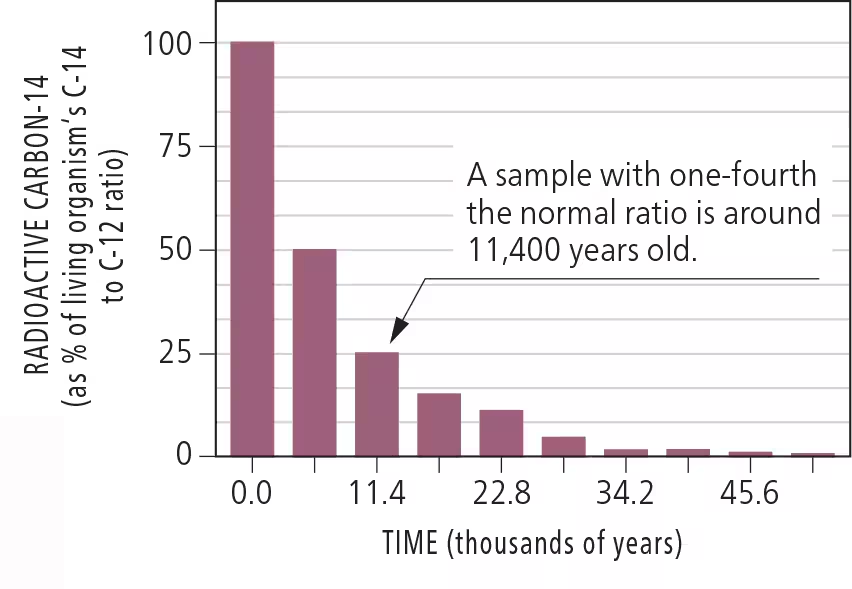
Radiometric dating
based on the breakdown of all radioactive isotopes (carbon-14) found in all living matter. (the lower the amount, the older it is)
Sedimentary fossils form when _____ from surrounding sediment replaces the organic matter of a dead organism. Amber is fossilized _____ ____, which preserves species in great detail. Organisms can be frozen in ___.
minerals, tree sap, ice
The fossil record provides evidence of evolution by…
ancient species such as a basilosaurus whale had hind back legs which shows proof of their land-walking evolutionary past
Biogeography
study of the distribution of species and ecosystems across different regions and how it changes over time
An example of biogeography is the dominance of _______ mammals in Australia vs the dominance of ______ mammals elsewhere. This is because 50 million years ago Australia split off from the other continents and became isolated.
marsupial, placental
Marsupials
complete embryonic development in a pouch
Comparative anatomy
the study of the similarities and differences in the anatomical structures of various species
Comparing the structure of human skeletons to bats and porpoises show that…. which is an example of comparative anatomy
the similarities among these limbs reflect their shared evolution from a common ancestor
Bioinformatics
by comparing the sequences of DNA and proteins from different organisms, scientists can gain insight into their shared evolutionary history. If the sequences of genes/proteins are closely matched, they have a recent common ancestor
A popular misconception about evolution is that…..
an individual can evolve
Evolution is defined only in terms of changes in a _______ over time.
population
What is a population?
a group of individuals of the same species living in the same place at the same time
Microevolution
a change in a population’s gene pool over a succession of generations; (short period of time)
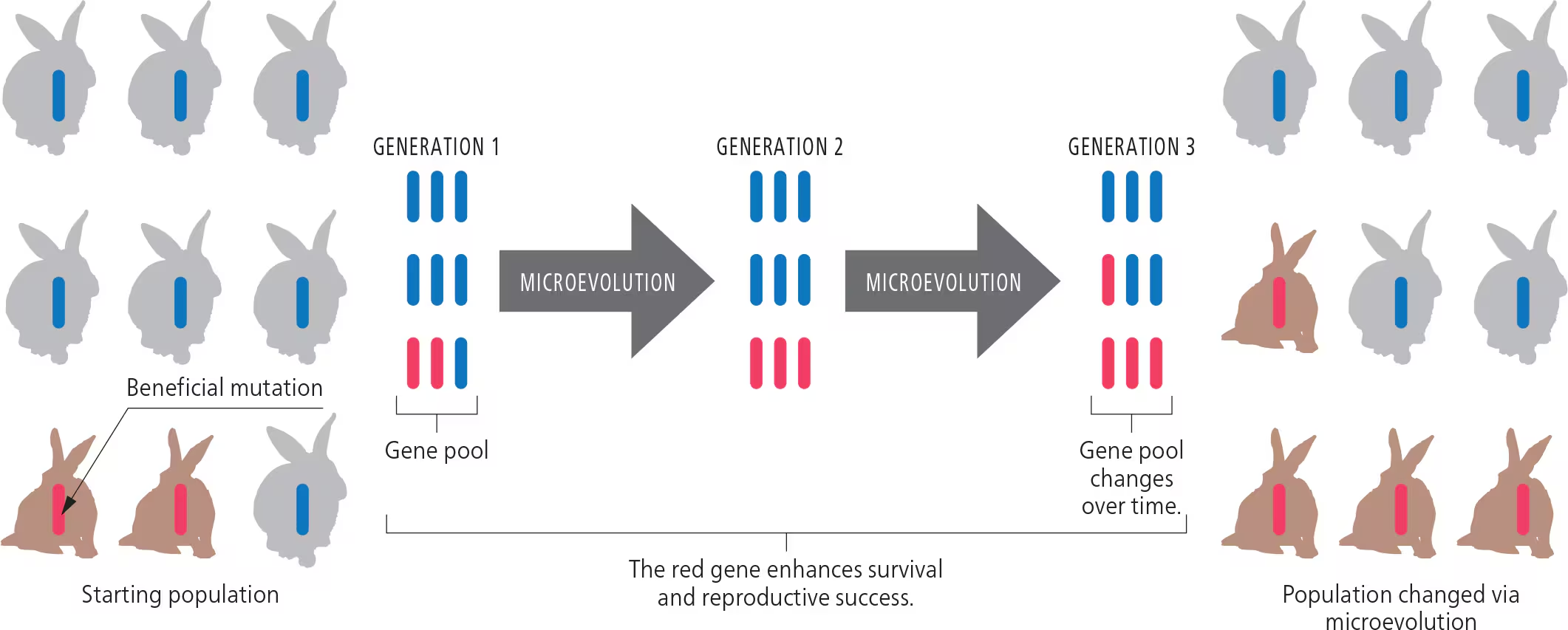
In the example of microevolution in rabbits, how did the red version of the gene first arise in the population?
mutation
Gene pool
all the genes present in a population at a certain time.
Evolution acts on populations _______— members of the same species
interbreeding
Mutations
random changes to DNA, can be good bad or neutral
Sexual recombination in evolution
produces new arrangements of existing genes through crossing over and independent assortment
Darwinian fitness
reproductive success: the number of healthy offspring produced
What is an example of Darwinian fitness?
camouflaged gecko
Genetic drift
a change in a gene pool due to chance.
In a ______ population, the death or migration of a few individuals will have a ____ impact. But if the population is ______ or isolated, random changes can have a significant impact on the gene pool.
large, minimal, small
Bottleneck effect
a change in the gene pool because of a reduction in population size due to a disaster etc
If a disaster/change creates a small population it is called the…
founder effect
Gene flow
tends to make separate populations more genetically similar as they exchange genes.
As humans have begun to meet, mate, and exchange genes, the human population has become more ______ _____
genetically uniform
Sexual selection
a form of natural selection whereby certain individuals are more likely to attract mates and, therefore, have more offspring (peacocks)
Tectonic plates
huge irregularly shaped masses of the earth’s crust
4.6-541 million years ago. Earth was formed, oldest known prokaryotic fossils were found, oldest known eukaryotic fossils were found.
precambrian era
541-252 million years ago. Explosion in animal diversity, plant life dominates, animals migrate to land, mass extinction event wiped out 90% of all life on earth
paleozoic era
252-66 million years ago. First dinosaurs, early mammal (megazostrodon) and flowering plants began to dominate the land.
mesozoic era
66 million years ago to today. Dinosaurs went extinct, 200,000 years ago human creatures appeared.
cenezoic era
What event marks the start of the era in which humans evolved?
extinction of the dinosaurs
Macroevolution
encompasses such major changes as the origin of new species, mass extinctions, and the diversification of new forms of life.
Speciation
the formation of new and distinct species in the course of evolution.
Throughout Earth’s history, ancestral species gave rise to one or more new species, which in turn evolved again and again, giving rise to the incredible diversity we see today. This is called?
speciation
______ _____ refers to new structures or properties of organisms that allow them to perform new functions, often leading to evolutionary advantages. (based on macroevolution)
novel features
_____ _____ promote macroevolution. The evolutionary history of life on earth has been punctuated by brief catastrophic periods which in turn creates diversification after these wipe outs.
mass extinctions
Species
a population that is capable of interbreeding to produce healthy offspring that can themselves reproduce.
Reproductive barriers
prevent members of different species from interbreeding.
Members of a species often identify each other through specific rituals, markings, or smells. A peahen, for example, will only mate with a peacock who displays his large and colorful feathers.
This is an example of…..
behavioral isolation
Many species are able to reproduce only at specific times. Any attempts by members of another species to mate outside of this time frame will not be successful. For example, different species of toad will only breed at different times of year (early summer versus late summer, for example).
This is an example of….
mating time differences
If species live in slightly different habitats, they may never meet. For example, there are three different species of bristlecone pine trees. Each one grows only in areas that are well separated from the other species by mountains.
This is an example of….
Habitat isolation
Members of different species often cannot mate because their anatomies are incompatible. For example, in orchids, the pollen-bearing organs of many species have a specific structure that allows only one specific pollinator species to land and collect pollen.
This is an example of….
mechanical incompatibility
The gametes (sperm and egg) of different species usually cannot fertilize each other. This is particularly important during spawning season in aquatic habitats, when individuals of many different species release gametes into the same body of water. Multiple species of sea urchins, for example, may live alongside each other, but the sperm of one species cannot fertilize the eggs of another.
This is an example of….
gametic incompatibility
If two members of different species do manage to mate, a hybrid organism may result. Such hybrids may be unfit, or they may be sterile and unable to reproduce themselves, or they may produce unfit offspring. For example, a mule, a hybrid produced from a female horse and a male donkey, is always sterile.
This is an example of….
hybrid weakness
Speciation occurs when one ancestral species evolves into one or more new species. A key event in this process is often the ______ of a single population into two or more populations that are _____ from each other.
separation, isolated
Describes a pattern of evolution where species change slowly and gradually over long periods. This involves small adaptations accumulating over millions of years, transforming an ancestral species into a modern one.
graduated model
Punctuated equilibrium
Ex: mammals were relatively unchanged for millions of years until dinosaurs went extinct, and then a rapid series of speciation followed.
describes such periods of stasis (no change) interrupted by occasional bursts of speciation.
A physical barrier—such as the formation of a valley, mountain range, or body of water—arises that physically isolates populations from each other.
allopatric speciation
The emergence of a new species right in the midst of its parent population without geographic isolation.
Ex: two ancestral species of wheat produced a sterile hybrid. An error in cell division caused this hybrid to double its chromosomes. Self-fertilization then produced today’s species of modern bread wheat.
sympatric speciation
Taxonomy
identification, naming, and classification of species
All life is classified into one of three large groups called _____
domains
Domain-kingdom-phylum-class-order-family-genus-species. What is this called?
taxonomic hierarchy
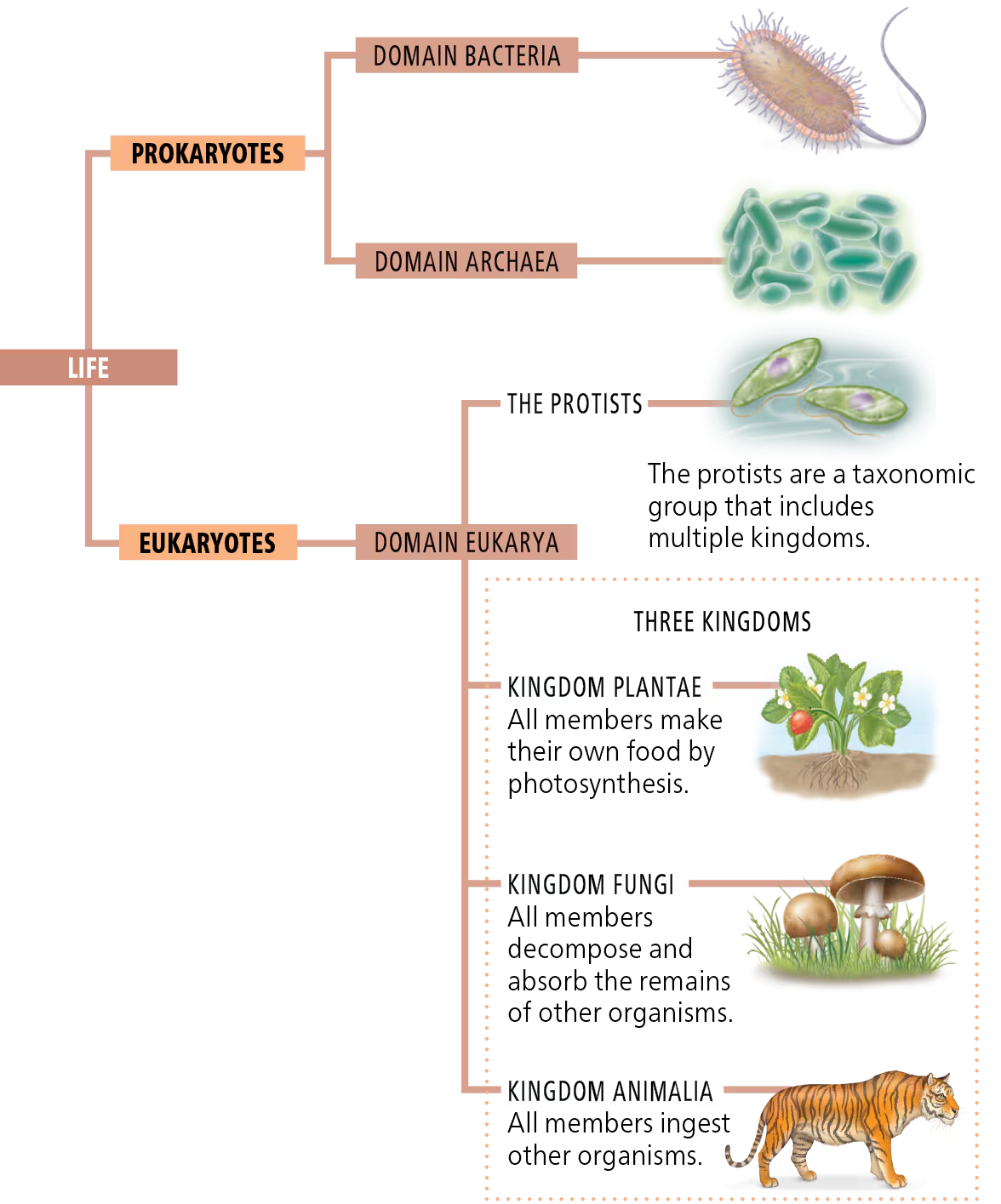
Three-domain system
two domains of prokaryotes - bacteria and archea
one domain of eukaryotes - eukarya
Eukarya - divided into 3 kingdoms: plantae, fungi, animalia
The remaining eukaryotes that do not fit into the three kingdoms (plantae, fungi, animalia) are called ____
protists
A binomial (two-part) latin name, is made of a ____ that always begins with a capital letter and a _____ which is always in lowercase
genus, species
Systematics
is the classification of organisms to shed light on their evolutionary relationships.
A hypothesis about the evolutionary history of related species. The relative placement of different species on _____ _____ is based on several lines of evidence, such as their appearance in the _____ ____, and (when available) an analysis of their DNA and proteins.
phylogenetic trees, fossil records
An ancestral species and all its descendants—a distinctive branch in the tree of life. what is this called
clade
The study of evolutionary history; specifically, an approach to systematics in which organisms are grouped by common ancestry
cladistics
A branching diagram that represents a hypothesis about evolutionary relationships between organisms.
phylogenetic tree

