Genes and diseases Lec 2
 Studied by 0 people
 Call Kai
 Learn
Learn Practice Test
 Spaced Repetition
 Match
Match Flashcards
 Knowt Play
1/101

There's no tags or description
Looks like no tags are added yet.
Name | Mastery | Learn | Test | Matching | Spaced | Call with Kai |
|---|
No analytics yet
Send a link to your students to track their progress
102 Terms
Phenotypes originate at the
cellular level
The first cells were described by
Robert Hooke in 1665.
The average adult human has
30 trillion cells.
somatic cells
any cells in the body that are not reproductive cells (sperm or egg);
Most body cells are
somatic
Germ cells
rise to haploid gametes
Germ cells give rise to
haploid gametes
Fertilization produces a
diploid zygote
Cells divide and differentiate into
their final cell fates.
How many different type of cells are there
290
Your cells are not
all the same
During gestation, your cells
divide
They all have the same
genome
when cells begin different characteristics depending on which genes are expressed
exome
Expressed
the instructions for a gene are used to create a protein.
cell fate.
As you continue to develop, cells begin to choose a job/identity,
differentiation
when every cell gets a different
Most differentiated cells will never
divide again.
stem cells
Population of cells that continue to divide and replenish damaged body cells.
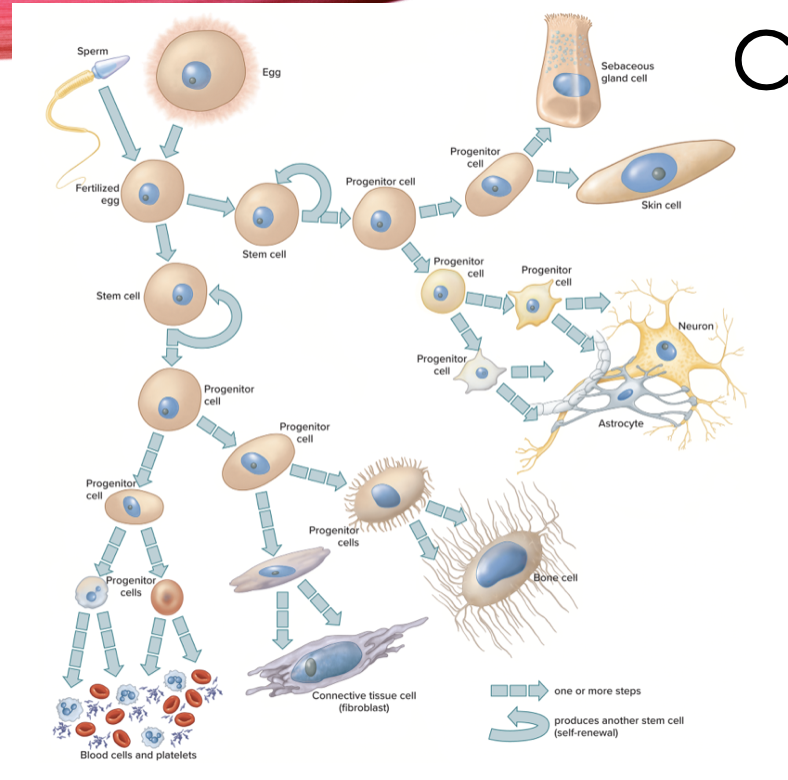
Cell lineage:
The path (progenitor cell types) a cell takes from egg to final differentiated form
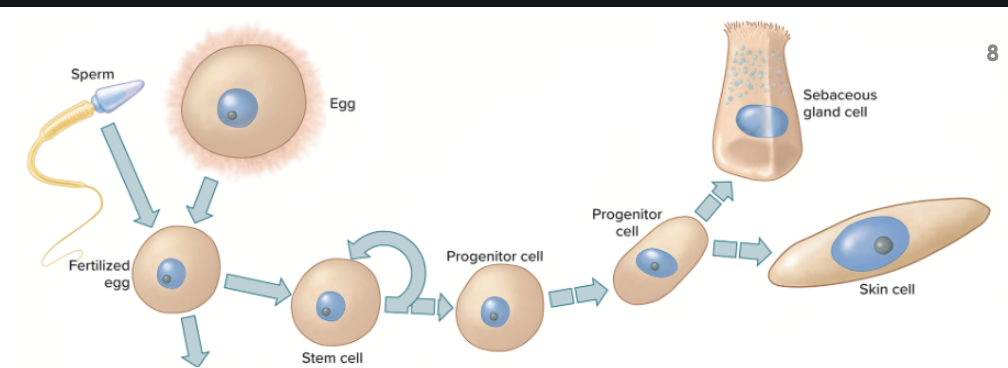
We group cells into four general categories (tissues)
Epithelial tissue: linings
Neuronal tissue: communication
Connective tissue: hold us together
Muscle tissue: movement
Epithelial tissue: linings
They line the inside of your blood vessels
They line the outsides of your organs
They line all your tubes
They cover the outside of your body
They line your gut and lungs
Neuronal tissue: communication
communication
They’re electrically active
They send out long projections to send signals across the body
Connective tissue: hold us together
They secrete strong elastic fibers
Or create very strong bones
Or travel in the circulating fluid carrying oxygen and protecting the body from pathogens
(yes, blood is considered a “connective tissue”)
Muscle tissue: movemen
Their structure allows them to contract
Voluntary: skeletal muscles
Involuntary: line our digestive system and other organs
Cells of the same type
form tissues,
and tissues form organs
Structure-function relationships:
The bumps and pillars and hairs increase the surface area so nutrients can be absorbed faster.
The cells that do the absorbing are only one layer thick, and they’re also waterproof and form a barrier to bacteria.
The muscles and nerves are arranged to squeeze in waves, moving food in one direction.
Changing the structure
might change the function.
Irritable bowel disease
changes epithelial cell shape and breaks seal between cells
mutations can
also change structure.
What distinguishes an epithelial cell from a muscle cell in the same person?
the exome
Epithelial tissue
These cells are linings. They line the insides and outsides of organs, and form mucous
membranes in the nose and mouth.
muscle tissue
These cells contain proteins that can contract. Some are voluntary and some are involuntary.
Epithelial tissue cells are arranged
single file and each is covered in microscopic little cilia for absorbing nutrients
Connective tissue cells hold
the epithelial cells in the correct shapes, and secure blood vessels to receive the nutrients
Muscle tissue cells help
squeeze digested food along the tube
Nervous tissue cells control the
muscles and carry information about the absorbed nutrients to the brain
Structure influences
function
SAME and DIFFERENT
All cells have the same genome.
Cell types have different exomes.
An inherited mutation will
be present in all cells.
It only affects tissues that require that gene.
A spontaneous mutation
may occur over the course of a lifetime.
It only affects cell types that arise from that stem cell population.
leukemia (blood cancer) only affects
blood cells
If a zygote inherits a mutation, which cells will have the mutation in their genome?
If a stem/progenitor cell acquires a mutation, which cells will have the mutation in their genome?
In both cases, which cells will exhibit symptoms (phenotype) because of the mutation?
cell diagram.
Explain how specialized cells will have different shapes and internal organelles depending on their job.
cell membrane.
The flexible skin around a cell and its organelles. It has two important properties:
1. It can pinch off to form vesicles, and vesicles can fuse with it
2. It is semipermeable: most chemicals cannot cross the cell membrane unless there
is a protein to transport them.
a. Water can cross the membrane (slowly)
b. Sugars and ion
Nucleus
• Cytoskeleton: Gives the cell shape and helps with movement of materials
Cytoskeleton
The protein “bones” of the cell that support its shape and allow it to move
cytoplasm
The watery substance inside cells
Smooth endoplasmic reticulum
Smooth endoplasmic reticulum (SER) – Makes lipids (fats), helps detoxify harmful substances, and stores calcium.
Rough endoplasmic reticulum
A system of cytoplasmic membranes arranged into maze-like sheets and channels.
Rough ER: Plasma membrane proteins and proteins destined to be secreted are made in here.
- They are shipped to the golgi complex for the next step of their production
golgi bodies
A series of flattened sacs.
- They sort, modify, and package proteins they receive from the rough ER and send them to the membrane or the lysosome.
Lysosome –
Organelles that contain digestive enzymes. They digest old proteins and lipids, and they
also digest food or bacteria the cell brings in from outside.
Mitochondria
Organelles that produce energy (ATP) within the cells. They are the reason we must
continually breathe oxygen.
Ribosomes
Cytoplasmic particles (made of rRNA and proteins) that read mRNA instructions and
assemble all of the cell’s proteins.
Cell membrane
The flexible skin around a cell and its organelles. It has two important properties:
1. It can pinch off to form vesicles, and vesicles can fuse with it
2. It is semipermeable: most chemicals cannot cross the cell membrane unless there
is a protein to transport them.
a. Water can cross the membrane (slowly)
b. Sugars a
Diagram showing different cell types
Cells devote internal space to their
function
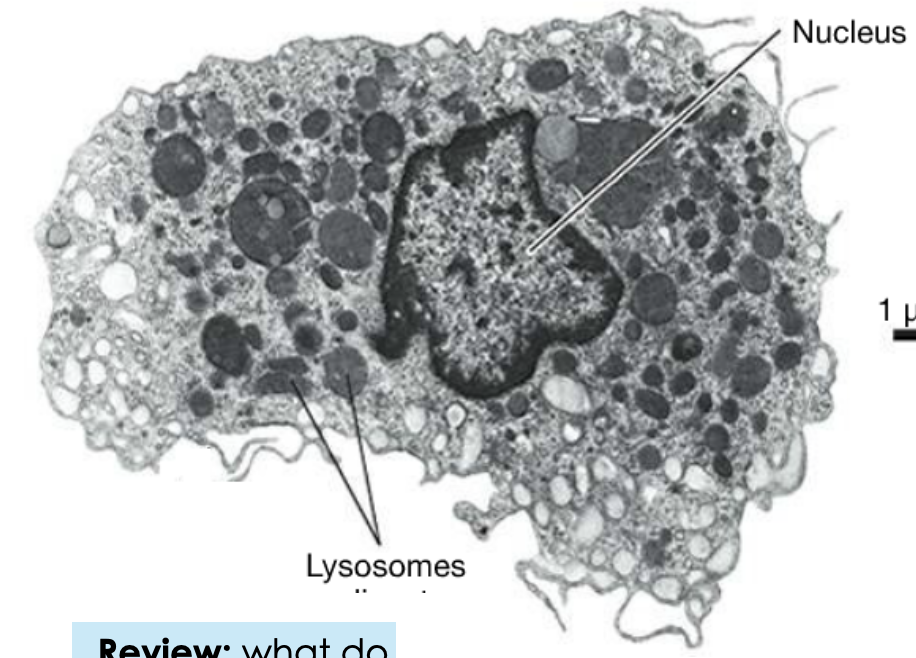
This white blood cell
chases and eats bacteria
Lysosomes
Organelles that contain digestive enzymes. They digest old proteins and lipids, and they
also digest food or bacteria the cell brings in from outside.
Pseudopodia
Detect and catch bacteria
Move the cell around
Muscles are basically
cells full of contractile proteins.
how are proteins the most versatile and perform most of the functions in the cell
how do DNA contains instructions for building proteins.
Macromolues
DNA, RNA
lipids
carbohydrates
proteins
others
DNA
-nucleic acids
- the genome/chromosomes/genetic code
Lipids
Fats and oils: Insoluble in water, store energy (long term)
Phospholipids and cholesterols: make up cell membranes
Carbohydrates:
Sugars, glycogen, starch: energy storage (short term)
Dietary fiber: cellulose from plants (we can’t digest it)
Oligosaccharides: signals on the surface of cells (like AB blood)
Proteins:
Enzymes: build and break down the other molecules (metabolism)
Structure: long fibers for connections and movement
Signaling, Immunity, Shipping and many other functions
other macro molecules
small organic molecules, minerals, and metals
Origin of macromolecules
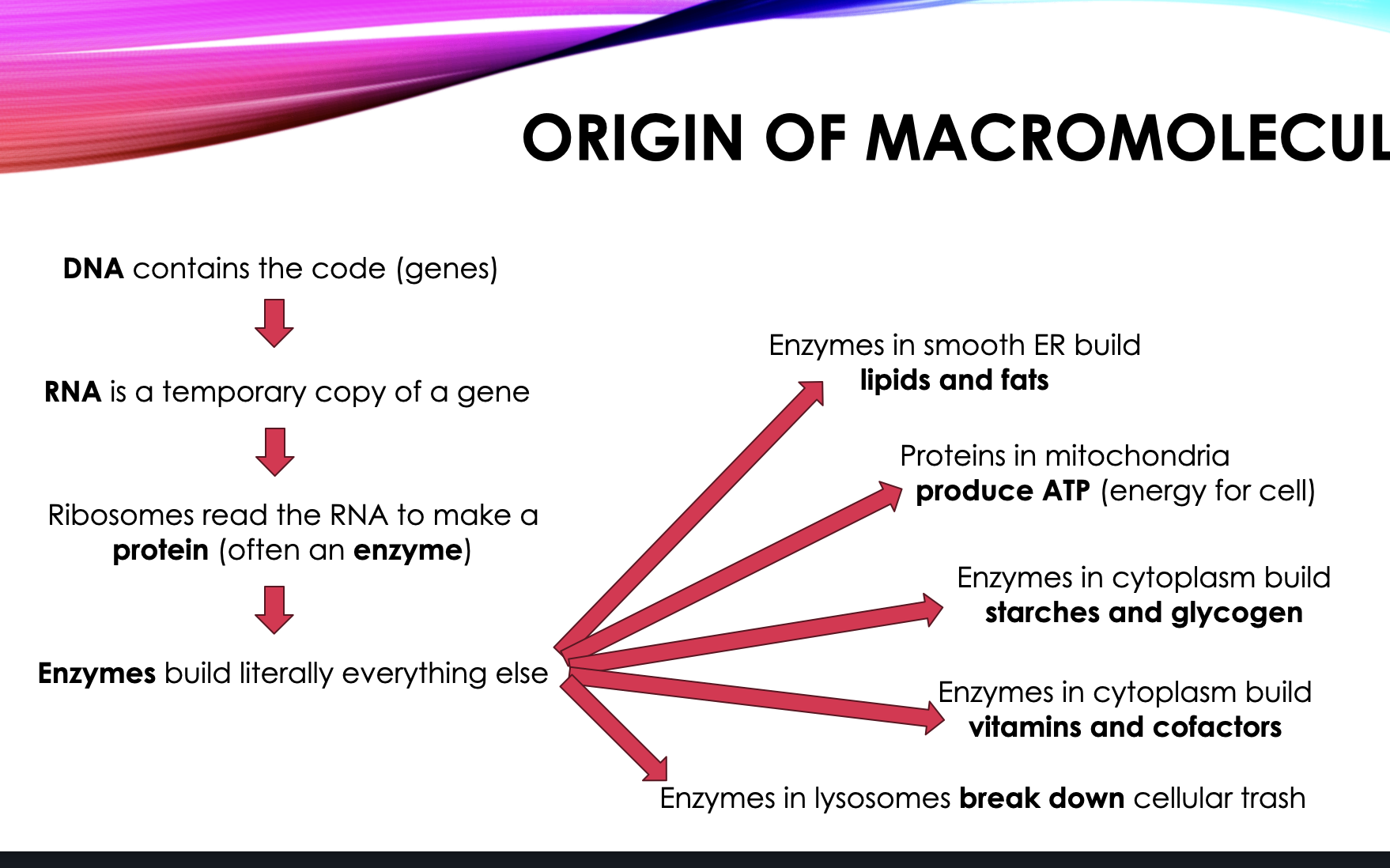
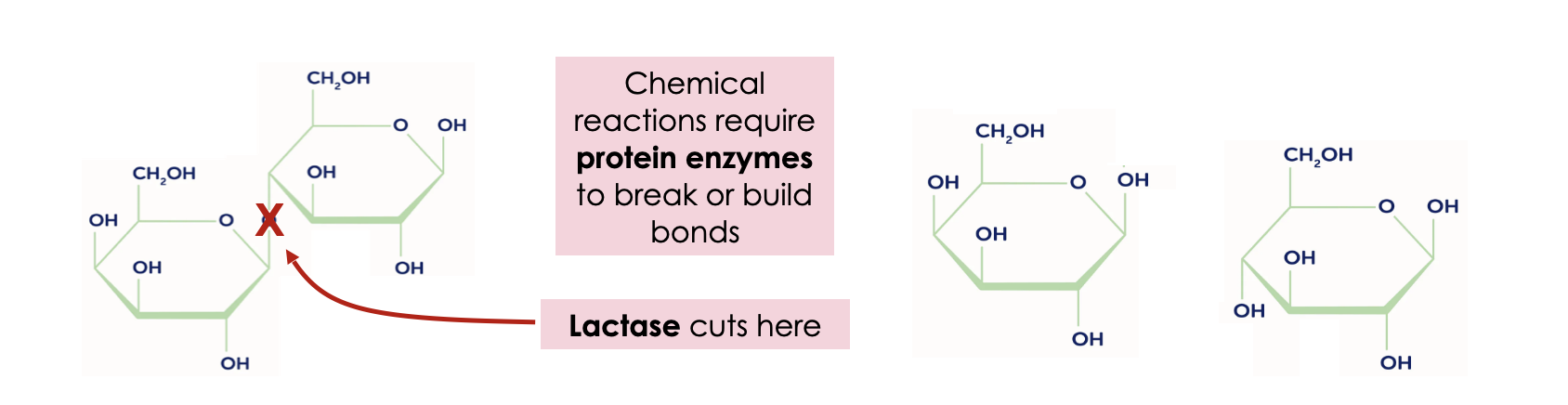
lactose intolerance (gene to phenotype)
1. The DNA change makes a cell unable to make an enzyme called lactase.
2. Without this enzymes the guts cannot break down lactose sugars into a form we can absorb, so
lactose lingers in the gut.
3. Bacteria in the gut eat the lactose instead, causing varying degrees of intestinal discomfort (gas,
bloating, nausea, diarrhea) when the person eats food containing lactose.
Some people have a mutation that prevents them from ever being able to make the enzyme. They have
congenital (inherited) lactose intolerance.
Others are only lactose intolerant as adults. Many adults stop making the enzyme after breastfeeding is
done. They have a normal lactase enzyme gene, it’s just not expressed any longer.
Phenotype (or effect of a mutation) ultimately depends on:
Which gene is mutated
How the mutation changes the protein
What the protein does in the cell
Which cells/tissues normally make that protein
How the cell/tissues’s function changes as a result of the changed protein
What that tissue normally does in the body, and how that changes when its cells aren’t working properly
Cells are the basic structural and functional unit
of living systems
Many genetic disorders alter something small at the cellular level
❖Often in only a few cell types
❖Leads to drastic effects on a tissue and organismal level
A genetic disorder is encoded in the DNA
❖…but it alters or breaks function of a protein
❖…which then affects the making of, organization and function of other macromolecules in cells
Cells are dynamic structures
❖ Constantly changing shape, reacting to the environment
Structure often reflects function
❖Change the structure or macromolecules, change the function
How damaged cells would be replaced
Why all cells have the same genome as the fertilized egg
Why an acquired mutation would only affect a small population of cells
Explain why cells don’t all look the same;
cells have outer and inner structures that reflect their function
Name some examples of structure-function relationships in cells from this lecture
If I give you a new cell type and tell you what its job is, could you predict what organelles it will have inside it?
Somatic cell
Most of the cells in your body have a genome identical to the genome you inherited as a
zygote. (Genome = your personal DNA code), although they vary in structure and function.
Germ cells/
Gametes
Specialized cells that are used in sexual reproduction. Germ or germline cells give rise to
gametes (sperm or egg) cells that carry only half of a genome.
Zygote
A newly fertilized egg
Stem cell
A cell that has the ability to differentiate into one of several related cell types. Mature
differentiated cells do not divide when damaged or dying; stem cell populations replenish
cells in tissues when replacements are needed.
Differentiation and cell fate
The process by which a cell matures into its adult cell type. There are 290 different types
of cells in your body
Cell lineage
The sequence of differentiation steps to produce a mature cell. Example:
Bone marrow stem cell → white blood cell progenitor cell → T-cell (differentiated)
Tissue
A group of cells of the same type that are attached to each other.
Epithelial tissue
These cells are linings. They line the insides and outsides of organs, and form mucous
membranes in the nose and mouth.
Neuronal tissue
These cells use electrical impulses to communicate over long distances
Muscle tissue
These cells contain proteins that can contract. Some are voluntary and some are
involuntary.
Connective tissue
These cells include bones, tendons, ligaments, and blood cells. They all secrete molecules
that maintain tissues around them, and act as a base that other tissues attach to.
Stem cells/progenitor cells are the source
of replacement cells lost to damage or time.
your blood cells are produced from stem
cells inside your bones, in the bone marrow. Why hide the stem cells there? Why not just have the
blood cells keep dividing in the blood to replenish lost cells?
Blood cells in particular are exposed to toxins that we eat and absorb, as well as nasty waste chemicals
produced by our cells. If a cell is old and ready to die, we don’t want that cell to be dividing to replace
itself! Instead, new blood cells come from protected populations hidden away inside bone marrow.
Vesicles
Big bubbles, like transport pods, that transport proteins and other substances throughout
the cell or to the outside. Vesicles can fuse with membranes.
 Note
Note  Flashcards (393)