economic world
 Call Kai
 Learn
Learn Practice Test
 Spaced Repetition
 Match
Match Flashcards
 Knowt Play
1/49

Earn XP
Description and Tags
Name | Mastery | Learn | Test | Matching | Spaced | Call with Kai |
|---|
No analytics yet
Send a link to your students to track their progress
50 Terms
Define development.
Progress of a country.
Define the following terms and give an example if needed: HIC, NEE, LIC, BRIC, MINT.
HIC - High Income Country (UK)
NEE - Newly Emerging Economy (Nigeria)
LIC - Low Income Country (Ethiopia)
BRIC - Brazil, Russia, India, China (fast-growing economies)
MINT - Mexico, Indonesia, Nigeria, Turkey (economies expected to follow BRICs footsteps)
What is GDP?
Gross Domestic Product - total value of goods and services produced within a country in a year.
What is GNI?
Gross National Income - the total income earned by a country's people and businesses,
What is HDI?
Human Development Index - A development measure, which uses life expectancy, literacy rates, and GNI. 1 is the highest and 0 is the lowest.
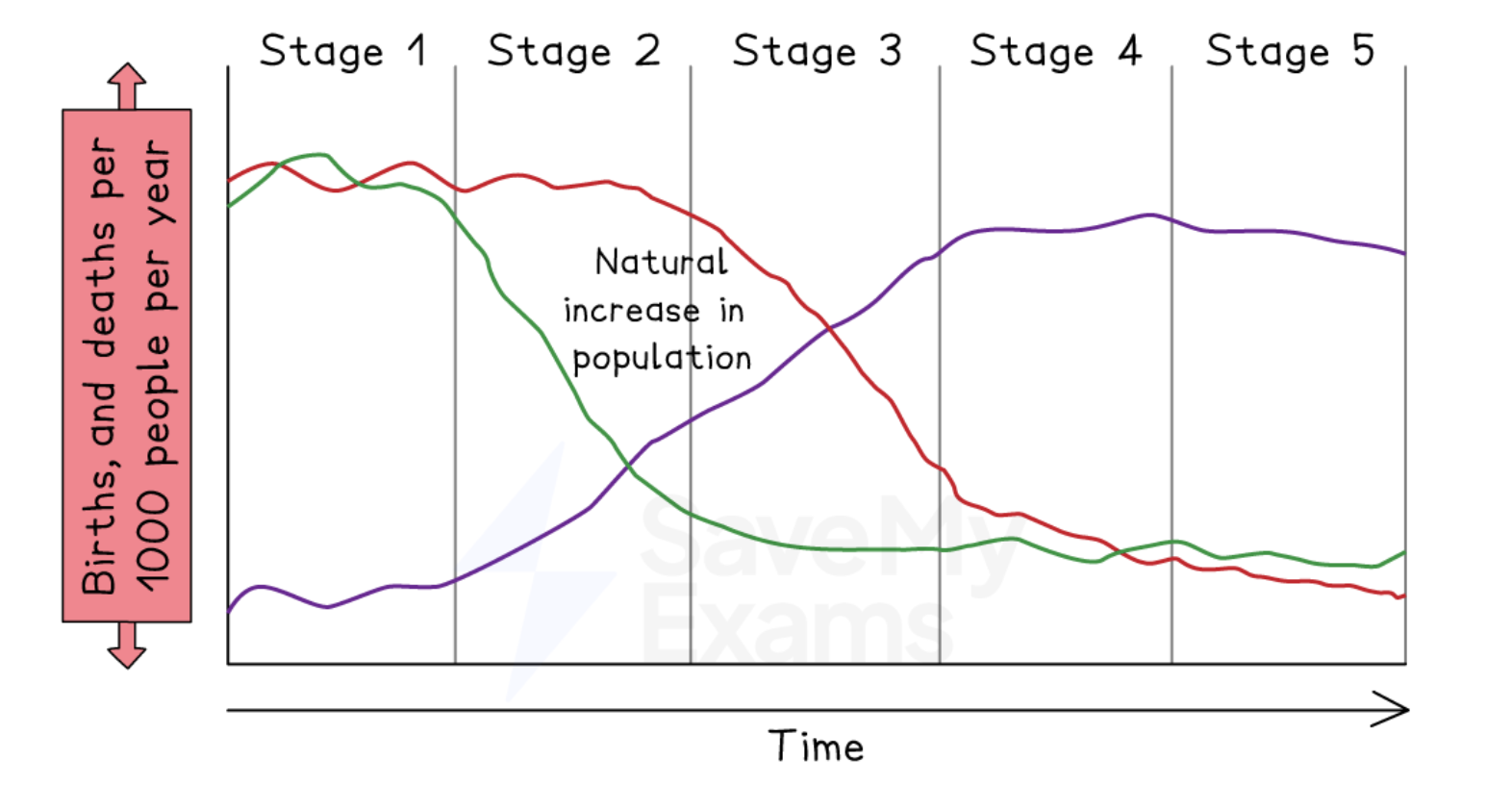
Describe the DTM (3 points)
Demographic Transition Model:
Shows how the population, BR, and DR fluctuate at each stage of development.
UK is around stage 4, while LICs would be stage 1.
Fluctuation at stage 1 shows poor health.
What are the four categories of causes of uneven development?
Historical (colonisation)
Physical (location or lack of resources)
Economic (global trade policies)
Political (corruption or conflict)
What are the four effects of uneven development?
Economic (income) - this usually kickstarts the others.
Physical (food and nutrition)
Social (family)
Happiness (wellbeing, social life)
Define development gap.
The disparity of wealth between the world’s richest (HICs) and poorest countries (LICs).
What are the strategies to reduce the development gap? (3 points)
Sustainable Development Goals (SDGs) - 17 separate goals made in ‘15 by the UN to end global poverty.
FairTrade - Ensures farmers receive a fair wage and good working conditions. FairTrade premium also supports the entire community.
Microfinance - People donate to farmers to invest in themselves and their business and pay it back over-time. Empowers individuals.
What are TNCs?
Transnational Corporation - e.g. Apple or Microsoft.
What are the positives and negatives of TNCs in lowly-developed countries?
P - Job opportunities, FDI, improvement of services and roads.
N - Exploitation of workforce, environmental pollution, leakage of income.
What is FDI?
Foreign Direct Investment
Case Study: Where in Nigeria is an example of a TNC causing advantages and disadvantages? (7 points)
Shell: Bodo Village, Nigeria
invested billions in oil extractions and infrastructure
Supports over 65,000 Nigerian people directly and even more indirectly
Large oil leak in 2008
Caused water and soil contamination - which affected the local area’s drinking water
Massive loss of fish population
Lack of accountability for many months
500,000 barrels approx spilt, but they claimed it was only 4000 initially.
What are some consequences of uneven development? (2 points).
Migration - Young people seek a better quality of life elsewhere.
Brain Drain - When highly skilled people are attracted to work somewhere else, causing the country’s economic development to decrease.
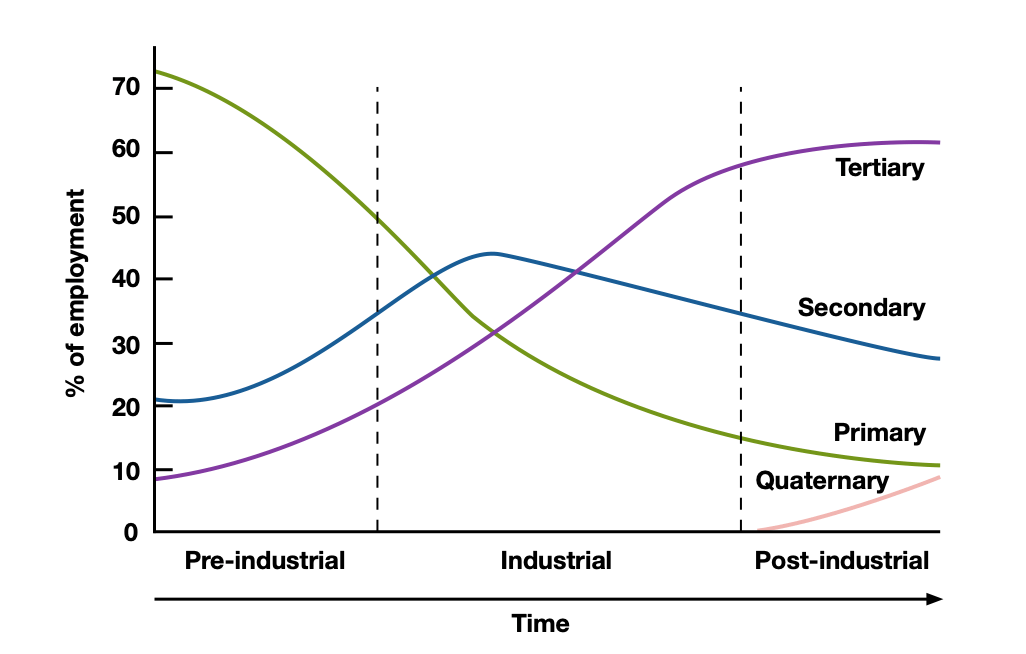
Describe the employment structure graph. (6 points)
Shows the percentage of jobs across the four work sectors.
Primary sector is agriculture.
Secondary sector is manufacturing.
Tertiary sector provides services for people (retail)
Quaternary sector is subject-specific jobs (IT)
LICs are heavily pre-industrial, while HICs like London are heavily post-industrial.
Where is Nigeria located?
West Africa, bordering countries such as Cameroon.
How is Nigeria regionally important? (5 points)
One of the fastest-growing economies in Africa
The variety of rainy and dry seasons allows it to have the highest farm output in Africa
Nigeria is the most populous African nation (over 230mill people)
Diverse economy
Imports telephones
How is Nigeria globally important? (4 points)
GDP of $440 billion in 2021
One of the world’s biggest oil exporters - around 2 million barrels exported each day
Nigerian film industry Nollywood has overtaken Hollywood to become the world's second-largest film industry
Main exports are rubber, cocoa, cotton and oil
Oil accounts for // % of Nigeria’s GDP.
14
What is ‘tied aid’?
When the country giving aid expects something in return, for example trade in the future.
What are the four types of aid?
Development Aid - Long-term aid to promote progress, e.g. from the World Bank and the EU.
Emergency Aid - Short-term aid during an emergency, usually after a disaster.
Bilateral Aid - Direct aid from one country to another, e.g. from the UK to Nigeria, but often tied aid.
Multilateral Aid - Richer countries giving money to international organisations (like the World Bank) to distribute to lower income countries.
Name some disadvantages of international aid.
May not reach the people who need it due to corruption.
Countries may become over-dependent on aid.
Food and water can become more expensive.
What is a key project that was started in Nigeria thanks to aid?
Anti-mosquito nets, provided by ‘Nets for Life’.
Why is aid needed in Nigeria?
60% of the population live on $1/day, and there are high wealth disparities within the country.
What effects has aid had on Nigeria?
Increased years of schooling for children.
Life expectancy increased from 45 to 55 in 2020.
Higher access to safe drinking water in rural areas.
Over 70% of Nigeria now own a mobile phone.
What Asian county has invested into and made a trade relationship with Nigeria?
China.
Case Study: Where can we see growth in tourism reducing development gap?
Tunisia, N Africa
Factors affecting tourism:
French language - attracts Europeans
Eight famous UNESCO Heritage sites incl. City of Carthage
Star wars set in tunisian sahara
Hot climates
Cons:
Leakage of profits (e.g. foreign advertisement keeps many profits)
Terrorist attacks - unattractive
Reducing dev gap:
Local demand for services e.g. accomodation
More job demand - employment of 525,000 people
Boosts econ growth
What factors in London have caused a shift in industry? (3 developed points)
Globalisation:
The process that creates a more interconnected world
UK firms have moved to NEEs
Deindustrialisation:
Mechanisation has replaced workers in agriculture - more reliable and cheaper to operate
Industries polluted the environment
Government Policies:
Laws can limit factory work
Privatisation: the turning of primary/secondary industries into companies - job loss
What four ways does industry damage our environment?
Air pollution (co2)
Wastewater (can pollute underground reservoirs)
Land pollution (hazardous byproducts leaking into soil)
Noise pollution
Case Study: Where can we see deindustrialisation?
NE England
Mines in Easington closed, 1000+ men unemployed
Shipyards closed as industry moved to China
7.5% unemployed
42% of people in coalfield neighbourhoods are part of the most deprived 30% in Britain
Investment of TNCs e.g. Nissan in Sunerland aims to improve the region
Define a growth corridor.
When an economy grows alongside a major transport route.
Case Study: Where is a growth corridor in the UK?
The M4 Corridor
Runs from W London (Heathrow) to Swansea in S Wales
Goes through areas such as Oxford and Cardiff
189 miles long
Key location for business - cheaper than central London, Heathrow’s presence
Railway follows this route
Close infamous universities (Oxford, Bristol, Bath)
What is a science park?
An area devoted to scientific research or the development of science-based industries.
What are some pros and cons of science parks?
Pros:
Employment of skilled graduates from local universities
Attractive locations (greenery, woodland)
Fast broadband
Nurseries and gyms
Good physical transport links
Cons:
Congestion
House and land prices may rise
Railways need to be improved to maximise speed and connectivity to other cities
Case Study: Where is a science park in the UK?
Cambridge Science Park
International connections
Situated 3km N of Cambridge City centre
Oldest science park in the UK - founded in 1970
Many facilities on site - gym, club, nursery
Car parks concealed by greenery
Cambridge economy pumps out £37B per year
What is counter urbanisation?
Movement of people out into the country.
What are some pros and cons of commuter settlements?
Pros:
Connected
Attractive greenery
Quieter way of life
Dynamic younger population
Cons:
House prices may increase
Quiet Mon-Fri (working hours) - isolated
Case Study: Where are two villages in rural decline and increase?
Alnwick - Northumberland. Attractive: schools, bus routes, A1, fast broadband
Millfield - N of Alnwick, Northumberland National Park. Unattractive: closing of primary school, migration of young people, pressure on services to serve elderly.
Case Study: Name an industry becoming more sustainable.
Nissan, Sunderland:
Energy consump, water consump, and Co2 emissions have decreased
Waste of landfill per car has decreased from 40 to 3 kg/car
Nissan electric car (LEAF
Case Study: Name a quarry becoming more sustainable.
Torr Quarry, Somerset:
Employs 100 people and contributes £15m a year to UK economy
Produces rock chippings for road construction
Limestone extraction site
200 acres landscaped with grassland and trees
Chippings transported via rail
Noise, water quality, and dust is monitored
Quarry is deepened and not expanded to allow site to work till 2040
Define North-South divide.
The socio-economic and cultural inequalities between the N and S of England.
What are some impacts of the NS divide?
Higher life expectancy in SE by 3 years
Highest disposable income in London
Higher unemployment in the N
Higher percentage of people are overweight in North - impacts life expectancy
Less globalisation in the N - less attraction
What are the three solutions to the divide?
Northern Powerhouse:
A branding concept to match the economy of the SE
Investment in science-tech e.g. Newcastle Science Central - 1200 jobs
More mayors in northern cities
Improvement of transport - very unsuccessful
HS2:
Cancelled - Only reaches Birmingham
Estimated cost of £43bill
Meets travel demands
Destruction of habitats
Devolution of power:
The spreading of government power
Manchester has its own mayor - £1b funds to improve their area
BBC built MediaCityUK in Salford, 142% increase in employment
Multiplier effect - other companies move nearby
How many destinations does LHR link to?
171
How do rail improvements support economic growth?
Example: HS2 to Birmingham
Connects the country
Network Rail - invests £25b into upgrading network in 2019
Partially effective - cancellation
How do road improvements support economic growth?
Example: Smart Motorways
Open up hard shoulder at constant speed
Cameras and road surfacing
Less congestion - less people late to work
£15b spent on improving roads in 2014
Has caused accidents - no new smart motorways have been built
How do airport improvements support economic growth?
Example; Heathrow
New runway - 40 more flight destinations
Concerns of noise pollution
Can cause reduction in house prices
Generates £4.65b to UK economy 2025
Cost £18.6b
Only helps people in south
How do port improvements support economic growth?
Example: London Gateway
Automatic loadings, quay cranes, and a logistics site
Supports national trade
Generates £1.9b to the economy
12000 local jobs
Very effective locally and nationally
What are some examples of the UK’s links with the world?
British Empire - Trade links
EU - Currency, laws, and political influence
Commonwealth - Trade links
Internet - Connectivity through deep sea cables
Language/culture - Remittances and sharing of culture in EU