Chapter 43: Behavioral Ecology
 Studied by 0 people
 Call Kai
 Learn
Learn Practice Test
 Spaced Repetition
 Match
Match Flashcards
 Knowt Play
1/45

There's no tags or description
Looks like no tags are added yet.
Name | Mastery | Learn | Test | Matching | Spaced | Call with Kai |
|---|
No analytics yet
Send a link to your students to track their progress
46 Terms
3 events of childbirth
cervix shortens and widens, baby is born head-first, face down, placenta is delivered
role of oxytocin
coordinate and generate uterine contractions
4 questions described by Tinbergen
Briefly describe them
– Causation: What physiological mechanisms cause the behavior?
– Development: How did the behavior develop? Here the focus is on the role of genes and the environment in shaping the development of the behavior.
– Adaptive function: How does the behavior promote the individual’s ability to survive and reproduce?
– Evolutionary history: How did the behavior evolve over time?
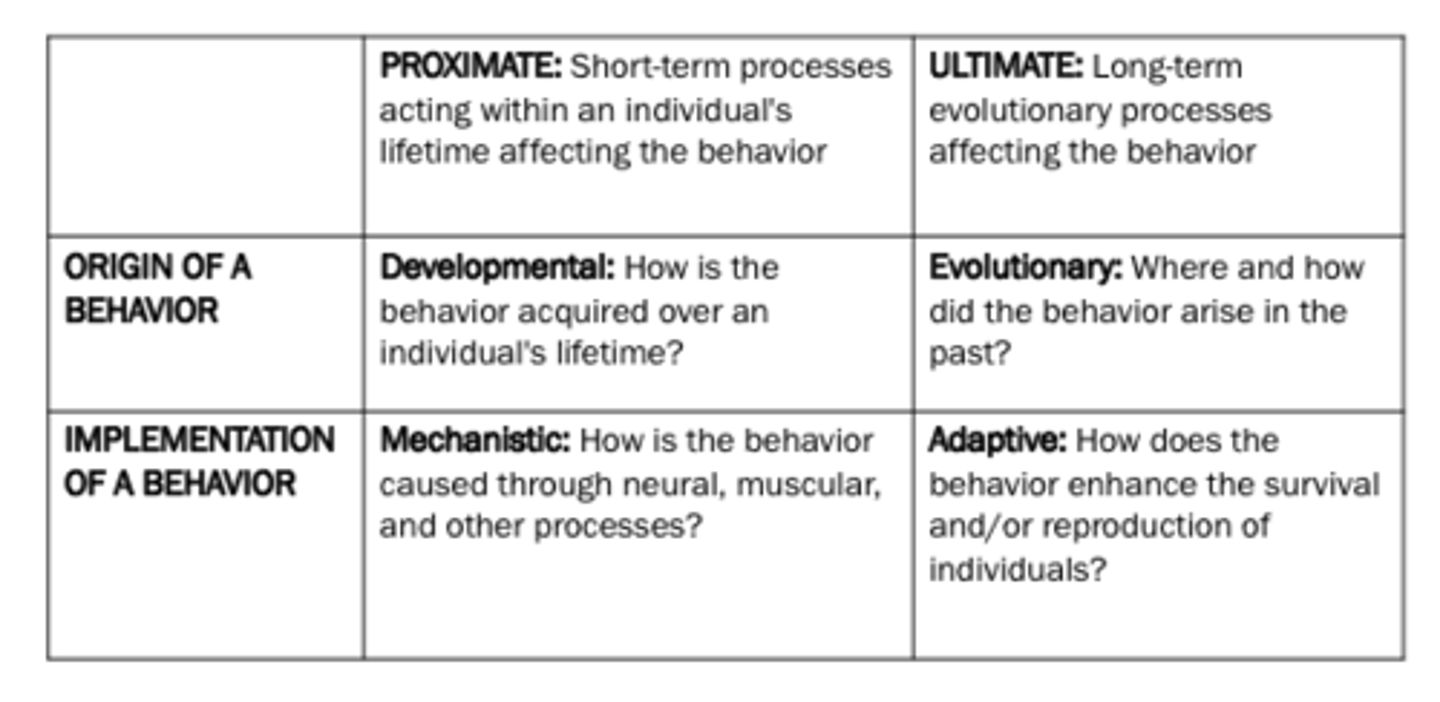
Example of Tinbergen's 4 questions
1.Causation:
- A bird sings because air passing through a specialized organ, the syrinx, causes membranes to vibrate.
2. Development:
- The male bird typically sings, and learned the song from his father or other males.
3. Adaptive Function:
- A male bird might sing to attract a mate to reproduce.
4. Evolutionary History:
- Complex bird songs may have evolved from vocalization made by ancestors that were reinforced and became increasingly standardized over time; we can often identify a bird species by hearing it sing now.
How are learned behaviors different from innate behaviors?
Give an example of each
Innate Behavior:
Instinctive and carried out regardless of earlier experience
example: a male silkworm moth flies upwind toward the source of a female-produced pheromone.
Learned Behavior:
–Depends on the individual’s experience
example: fruit flies learn to avoid certain locations or substance if they associate them with an unpleasant experience
What is a display?
Give an example
- patterns of behavior that are species specific
example: bird doing ritual dances to attract a mate
What is a fixed action pattern?
Give an example
- sequence of behaviors that, once triggered, is followed through to completion
example: the response of a goose to an egg that has fallen from its nest
key stimulus
stimulus that initiates the behavior
supernormal stimulus
- exaggerated stimulus that elicits a response more strongly than the normal stimulus; such as the goose and the soccer ball
feature detectors
- specialized sensory receptors or groups of sensory receptors that respond to important signals in the environment.
- allows animals to filter correct stimuli. Such as frogs recognizing songs of the same species
How can hormones influence behavior?
Briefly describe the Anolis lizard demonstration
- A stimulus can lead to a production of hormones, a widespread and prolonged effect
- In a group of all female Anolis lizards 80% of the females were prepared for reproduction with egg follicles in their ovaries, yet when a male was introduced displaying courtship behavior 100% of the females became reproductively active
- When multiple males were introduced only 40% of the females were reproductively active bc the males fought with each other rather than court females
- When a castrated male was introduced that didn't display courtship behavior (due to lack of hormones) there was no effect on the females' reproductive readiness
- When a castrated male injected with testosterone was introduced and displayed courtship behavior, the females were affected in the same way as a non-castrated male
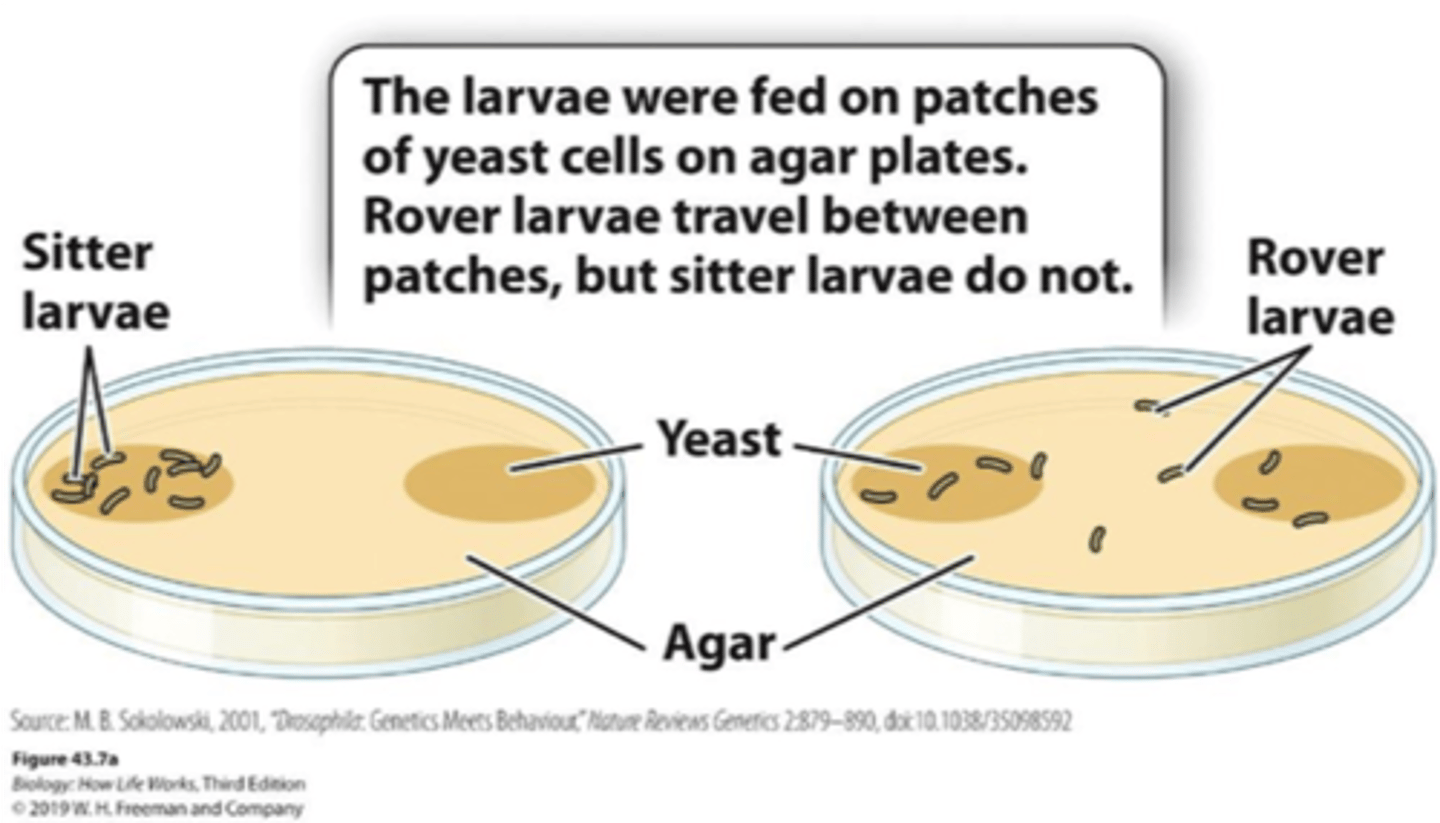
Summarize the foraging gene as an example of genes affecting behavior
- In Drosophila, two different alleles of the foraging (for) gene—fors and forR—are common in populations.
– In the absence of food, both “sitter” (fors) and “rover” (forR) larvae move about in search of food.
– In the presence of food, sitters barely move and rovers move extensively.
– The for gene encodes an enzyme expressed in the brain that affects neuronal activity and alters behavior.
Non-associative learning
learning that occurs in the absence of any particular outcome, such as a reward or punishment
habituation
- reduction or elimination of a behavioral response to a repeatedly presented stimulus
- Chicks presented with silhouettes flying overhead provoked a defensive crouching posture, over time they stopped crouching
sensitization
- enhancement of a response to a stimulus that is achieved by presenting a strong or novel stimulus first.
- This pre-stimulus makes the animal more alert and responsive to the next stimulus.
associative learning (also called conditioning)
occurs when an animal learns to link (or associate) two events
classical conditioning
- type of associative learning, in which two stimuli are paired, commonly known by Pavlov’s dogs
– Pavlov first presented the dogs with meat powder, and they salivated in response.
– He then presented the dogs with an additional cue, a ringing bell, whenever he presented the dogs with meat powder.
– Dogs eventually salivated at the sound of the bell alone, in expectation of the meat reward.
operant conditioning
Associative learning in which a behavior that was initially undirected has become paired with a particular stimulus through reward/punishment reinforcement
imitation
Observing and copying the behavior of another.
imprinting
the process by which certain animals form attachments during a critical period very early in life
Summarize the Lorenz experiments
- Konrad Lorenz observed newly hatched goslings and ducklings will follow any object they first see.
- After Lorenz's baby ducks had imprinted on him, they would not change their minds about who their parent was even when presented with their real mother duck.
What is kineses?
Who does this and why?
- random, undirected movement in response to a stimulus
– A Paramecium that finds itself in water that is too warm, or another unfavorable condition, will increase its speed and begin to make random turns (kineses).
What is magnetotaxis?
Who does this and why?
- movement toward or away from the Earth's magnetic field
- Genus Aquaspirillum anaerobic bacteria move toward magnetic north (deeper water and no oxygen)
Pigeons have compass and map senses, describe each
A compass may tell you which way is north, but you must also have map information—where you are with respect to your goal—if the compass is to be useful for finding a particular location.
*in pigeons, map sense is presumably based on landmarks*
circadian clock
give an example of an animal using this type of clock
- biological clock, on a near-daily cycle, that can be set by external cues and regulates many daily rhythms.
- In animals, the circadian clock may affect feeding, sleeping, hormone production, and core body temperature
- Example: mammals, reptiles, etc.
lunar clock
- moon-based biological clock
- seacoast species use this when tide is important
annual clock
- biological clock that corresponds closely to a solar year.
- Magicicada have a generation time of 13 or 17 years, cicada outbreak occurs every 13 or 17 years
photoperiod clock
- clock related to day length (seasons)
- mammals producing offspring in the spring (when resources are abundant)
What is the simplest definition of communication?
the transfer of information between two individuals
Sender
individual who, during communication, supplies a signal designed to elicit a response from the receiver
signals can be visual, auditory, electrical, chemical, or mechanical
Receiver
individual who, during communication, receives from the sender a signal designed to elicit a response
Ritualization
evolution of communication through co-opting and modifying behaviors
3 reasons for ritualizaiton
1. increasing the conspicuousness of the behavior
2. reducing the amount of variation in the behavior so that it can be immediately recognized
3. increasing its separation from the original function
- Many forms of communication have evolved that prevent animals from coming to harm in a so-called limited-war strategy.
-For example, males using elaborate displays rather than battling it out
- In some cases, communication in the natural world can be deceitful.
For example, a male may attempt to convince other males (or a female) that he is bigger (and stronger) than he really is
Why do birds perform songs?
Bird songs are advertisement displays, behaviors by which individuals draw attention to their status.
- Songs are typically produced in the breeding season; Usually males sing, but some perform "duets" with females
What is the round dance?
Who performs it?
For what distance is it used?
In honeybees, a simple dance performed if the food source is near, less than 50m
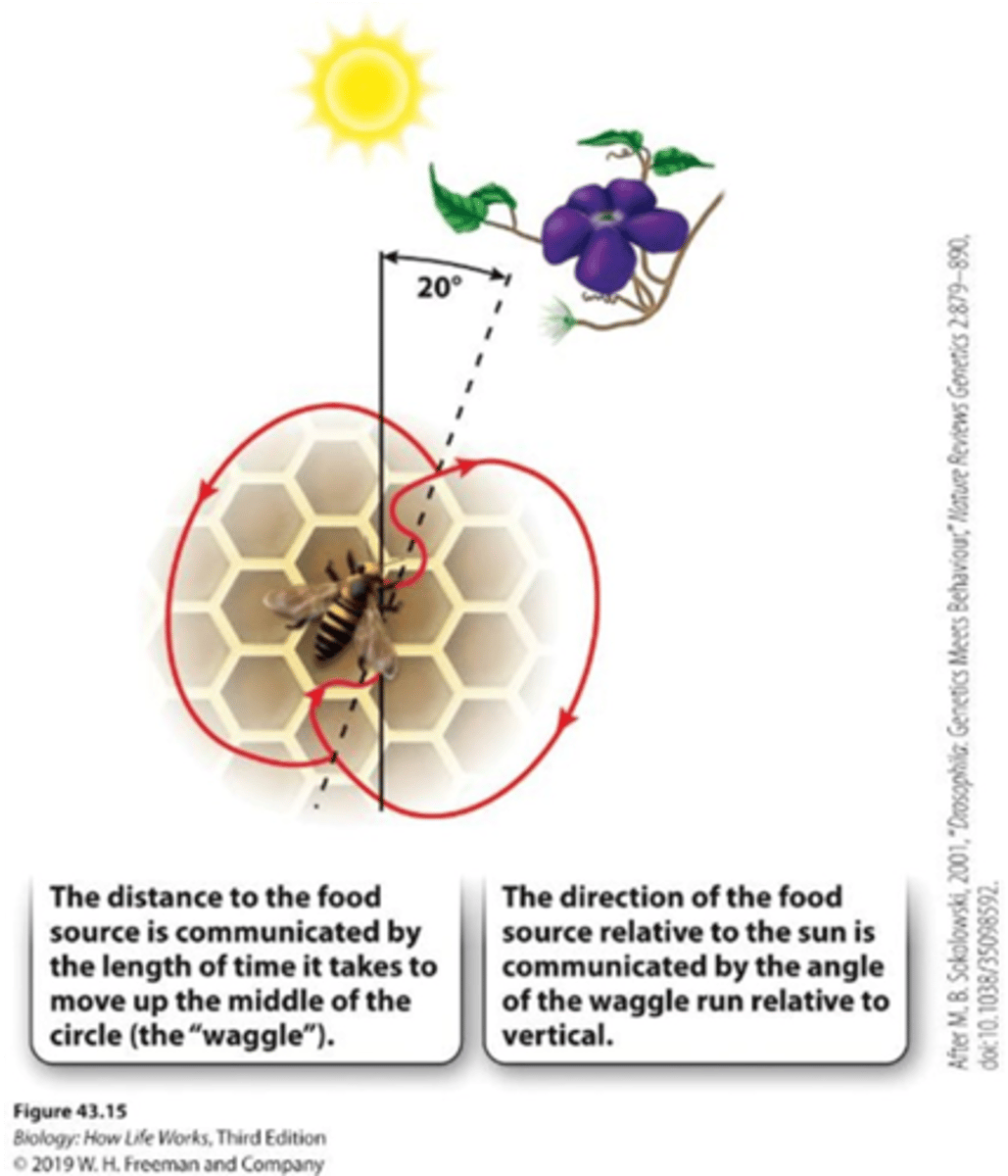
What is the waggle dance?
At what distance is it used?
In honey bees, a dance performed if the food source is more than 50m away
- The distance to the food source is communicated by the length of time it takes to move up the middle of the circle
- The direction of the food source relative to the sun is communicated by the angle of the waggle run relative to vertical
altruism
self-sacrificial behavior in which an individual's actions decrease its own fitness while increasing that of another individual; this should be selected against
group selection
natural selection operating on an individual is less powerful than selection on the group
reciprocal altruism
- exchange of favors between individuals
-Example: vampire bats, whereby bats returning from a successful feeding expedition often regurgitate blood meals to unsuccessful counterparts
Describe 2 ways an individual can contribute to the next generation
1.An individual can produce its own offspring.
2. Or, help close relatives who reproduced.
What is kin selection?
form of natural selection that favors the spread of alleles that promote behaviors that help close relatives, or kin
Give 2 examples of reproductive altruism in hymenoptera
- Cooperative care of the young, and consistent division of labor is observed
- Example: Honeybee queen is the reproducer, and workers manage the labor
What is eusocial?
Describes behavior most commonly observed in species of Hymenopteran insects, in which they have overlapping generations in a nest, cooperative care of the young, and clear and consistent division of labor between reproducers (the queen of a honeybee colony) and nonreproducers (the workers)
ecology
study of how organisms interact with one another and with their physical environment
abiotic factors
Aspects of the physical environment, such as temperature, water availability, or wind, that affect an organism or population
biotic factors
Any aspect of organisms that affects another organism
 Note
Note  Flashcards (393)